
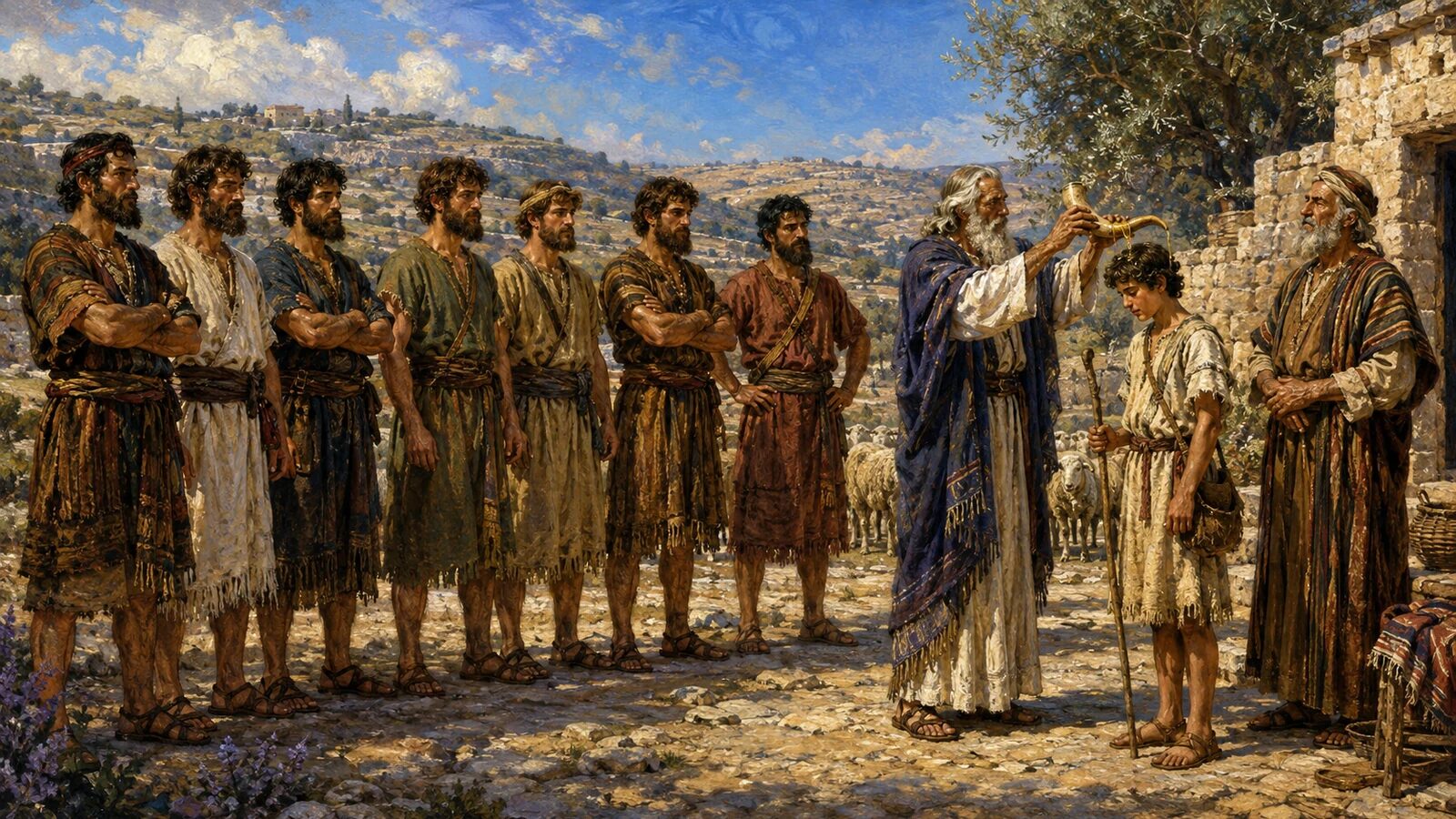
In several biblical families, the son people would have expected to take precedence was passed over. The covenant promise continued through Isaac, although Ishmael was born first. Jacob received the birthright Esau sold, and David was anointed king after his older brothers had appeared before Samuel. If I read these passages as though God simply preferred younger sons, I would miss what He was doing in each family.
They do not all describe the same kind of inheritance. Abel’s acceptable offering was not a transfer of family property, and David’s anointing appointed him to a responsibility. What they share is that birth order could not dictate God’s choice. These accounts also confront the assumption that a religious background gives someone a claim on Him. We become His children through Jesus Christ, not because we were born into a particular household.
God Looks Beyond Human Rank
The firstborn ordinarily held a privileged place in the family, with greater inheritance rights and responsibilities. Israel’s later law protected his double portion even when his father preferred another wife. The families in Genesis lived before that law was given, but the expectation of firstborn precedence helps explain why a younger son’s blessing could cause such consternation.
People also expected a king to look the part. Israel’s impressive-looking king Saul had proved unwilling to obey the LORD, so God sent Samuel to Jesse’s home to anoint his replacement. Yet when Samuel saw Jesse’s son Eliab, he too thought the man’s appearance recommended him for the throne. God corrected him:
But the LORD said to Samuel, “Do not look at his appearance or at his physical stature, because I have refused him. For the LORD does not see as man sees; for man looks at the outward appearance, but the LORD looks at the heart.”
Age, experience, and physical strength can be useful qualifications. Samuel’s mistake was allowing what he could see to settle a question God alone could answer. Eliab might look like a king, but that did not make him the man God had appointed. We can make a similar mistake when someone’s confidence or reputation impresses us enough that we stop considering his conduct.
The Hebrew words lev and levav, translated “heart,” refer to the inner person, including the mind and will. They include conscience, desires, and moral direction, not just emotion. God knows what a person trusts and what he is prepared to excuse. A polished religious presentation cannot conceal from Him the dishonesty someone practices when there is no audience to impress.
David’s later sins were appalling, so God’s choice certainly did not declare him incapable of wrongdoing. Scripture records those sins and his repentance when confronted. Saul, by contrast, repeatedly defended himself and shifted the blame, trying to present partial obedience as faithfulness. Their responses to correction revealed far more than either man’s appearance could.
Just as Eliab’s appearance could not determine who would be king, firstborn status could not compel God to assign a covenant role. In the Genesis accounts, He kept His promises even when their fulfillment upset a family’s expectations. He still called those people to trust Him, and their wrongdoing remained theirs to answer for.
I do not understand God’s choice of a covenant line as support for Calvinism or as proof that His invitation to everyone else is insincere. Christ died for the whole world. God genuinely offers salvation, people can resist Him, and we receive His gift through faith in Christ. A particular responsibility in the unfolding promise and a person’s reception of salvation must not be treated as the same question.
The Pattern Begins in Genesis
Cain and Abel are the first brothers whose different responses to God are set before us. Genesis 4 records no transfer of property between them. Cain was older, but God accepted Abel’s offering, and Hebrews identifies faith as the reason:
By faith Abel offered to God a more excellent sacrifice than Cain, through which he obtained witness that he was righteous, God testifying of his gifts; and through it he being dead still speaks.
Abel’s faith meant approaching God in trust, on His terms. Cain’s seniority could not make up for his refusal to do so. When his offering was rejected, he became angry, and God warned him about the sin threatening to master him. Cain disregarded that warning and murdered his brother. Being firstborn had given him no advantage in worship, while being younger had not prevented Abel from trusting God.
With Abraham’s sons, the question concerns the covenant promise directly. Ishmael was born first, through Hagar, after Sarah suggested that Abraham have a child through her maidservant. The arrangement brought jealousy and harsh treatment into the household. Later, in Genesis 17:15–21, God specifically promised Abraham a son through Sarah and named Isaac as the son with whom He would establish His covenant. Ishmael’s earlier birth could not alter that promise.
Isaac was born as God had said. When further conflict arose over the two sons, Sarah demanded that Hagar and Ishmael be sent away. Abraham was distressed, but God told him to listen to her:
But God said to Abraham, “Do not let it be displeasing in your sight because of the lad or because of your bondwoman. Whatever Sarah has said to you, listen to her voice; for in Isaac your seed shall be called.”
God’s care for Ishmael did not end because the covenant line continued through Isaac. He heard the boy in the wilderness, provided for him, and kept His promise to make him a great nation. Choosing Isaac for this role was not a declaration that Ishmael was beneath His concern. Abraham and Sarah’s attempt to obtain a son through their own arrangement had caused considerable distress, but it could neither produce nor replace the fulfillment God brought through Sarah.
Paul uses these two sons in Galatians 4 to explain the difference between bondage and promise. We cannot produce spiritual life by arranging our circumstances or constructing a religious system. It has to come from God. When I receive the inheritance through Christ, I have no reason to credit my pedigree or my religious accomplishments for something He has given me.
The next generation brings two separate incidents that are sometimes blended together. In Genesis 25, Esau sold his birthright to Jacob for a meal. In Genesis 27, Jacob disguised himself and deceived his blind father into giving him the blessing Isaac intended for Esau. Hebrews singles out Esau’s willingness to surrender the birthright:
lest there be any fornicator or profane person like Esau, who for one morsel of food sold his birthright.
Profane means treating something sacred as common. Esau’s hunger was not the offense; he was willing to surrender an enduring privilege to satisfy it. He valued the meal more than the birthright. Before I dismiss that as an absurd bargain, I need to consider whether I am prepared to compromise what God has entrusted to me just to preserve my comfort or gain someone’s approval.
Jacob wanted the birthright and blessing, but his interest in them did not make his methods righteous. Before the twins were born, God had told Rebekah that the older would serve the younger. Yet Jacob and Rebekah devised a scheme to obtain the blessing by deceiving Isaac. The deception aggravated the family conflict, Esau threatened Jacob’s life, and Jacob had to leave home. God’s promise continued through him, but he faced painful repercussions and discipline.
If I lie to obtain something I believe would benefit my ministry, I cannot defend the lie by pointing to the result. Jacob received the blessing, but God’s faithfulness did not excuse how he pursued it. Wanting something spiritual should lead me to trust God, rather than rationalize deceit because I think the outcome will be worthwhile.
God Raises the Overlooked
Joseph was Jacob’s eleventh son and Rachel’s first, so he was younger than most of his brothers, though Benjamin came after him. Jacob’s conspicuous favoritism and Joseph’s dreams provoked the brothers’ jealousy. They sold him into slavery, and a later false accusation put him in prison. Even after Joseph interpreted the cupbearer’s dream and asked to be remembered, the man forgot him for a time.
God eventually raised Joseph to authority in Egypt, where he supervised preparations for the famine. His brothers had to come to him for food, and the family they had endangered through their cruelty was preserved through Joseph’s work. Jacob came to Egypt as well. Before his death, another reversal of the customary order took place when he blessed Joseph’s sons.
Joseph positioned firstborn Manasseh for the right-hand blessing. Jacob crossed his hands, placing his right hand on younger Ephraim instead. Joseph tried to correct him, but Jacob explained that he had done it deliberately:
But his father refused and said, “I know, my son, I know. He also shall become a people, and he also shall be great; but truly his younger brother shall be greater than he, and his descendants shall become a multitude of nations.”
Manasseh also received a blessing and would become a great people. Ephraim’s greater prominence did not mean his older brother had been cursed or discarded. Joseph had expected the blessing to follow birth order, but Jacob would not change it simply to satisfy that expectation. Different responsibilities and blessings within God’s purposes are not, by themselves, evidence that He has treated someone unjustly.
After Jacob died, Joseph’s brothers feared that he would take revenge. Joseph reassured them and explained how he understood their actions and God’s purpose:
But as for you, you meant evil against me; but God meant it for good, in order to bring it about as it is this day, to save many people alive.
Providence means God’s governing care, and Joseph’s explanation includes both that care and his brothers’ culpability. They intended to harm him. God brought good from what they had done, preserving lives through the brother they rejected. He did not have to call their cruelty innocent in order to accomplish His purpose.
I see a gospel parallel in Joseph’s rejection and his later work to preserve life. Christ was rejected by His own people and suffered despite His complete innocence, yet salvation comes through the Son they rejected. Joseph could provide food during famine; he could not deliver anyone from sin. For that we must come to Jesus, whom God has appointed as Savior.
At Samuel’s visit to Jesse, centuries after Joseph’s lifetime, David was still tending sheep while his older brothers stood before the prophet. After the LORD passed over those sons, Samuel asked whether Jesse had any others. He insisted that David be brought in, and when David arrived, the LORD told Samuel to anoint him. The Spirit of the LORD came upon David from that day forward.
David’s absence from the gathering had not placed him beyond God’s notice. Nor did his anointing give him immediate possession of the throne. He would wait through years of danger and suffering, and he still needed correction. Being chosen for this responsibility required faithful conduct; it gave him no excuse for arrogance or carelessness. A Complete Bible Study on the Life of King David follows his preparation and reign.
The Messiah would come from David’s line. In choosing this younger son, God was continuing His work toward the promised Savior. Jesse’s household had not recognized the future king, but God’s promise did not depend on their ability to recognize him.
The Inheritance Comes Through Christ
These family blessings and appointments help expose the limits of inherited privilege. The New Testament also explains how we become God’s children and share an inheritance with Christ. John identifies the people who receive that right:
But as many as received Him, to them He gave the right to become children of God, to those who believe in His name: who were born, not of blood, nor of the will of the flesh, nor of the will of man, but of God.
Having Christian parents or growing up around Scripture can provide wonderful opportunities to hear the truth. Neither can accomplish the new birth for me. John says that those who receive Christ are those who believe in His name. Salvation is God’s gift, received by grace through faith, rather than a standing passed from one generation to the next. A Complete Bible Study on Being Born Again examines what it means to receive this new life.
Jesus is the eternal Son, fully God and fully man, born of a virgin and without sin. Wicked men physically tortured and punished Him, and He willingly bore that punishment for our sins in His innocent body. He shed His blood and died, completing His saving work through His blood and death before His bodily resurrection. The Father did not punish, curse, abandon, strike, bruise, or pour wrath on Jesus.
Christ died for every person, and His offer can be resisted. Those who believe are genuinely born again, indwelt by the Holy Spirit and sealed for redemption. Every genuine believer is eternally secure, but that assurance gives no permission for lawlessness. Calling myself a Christian does not establish that I have received the new life God gives. The study on Soteriology: The Study of Salvation develops these truths further.
It is to these children of God that the inheritance belongs:
The Spirit Himself bears witness with our spirit that we are children of God, and if children, then heirs: heirs of God and joint heirs with Christ, if indeed we suffer with Him, that we may also be glorified together.
We are joint heirs because we belong to Christ. Our inheritance rests on that relationship, which God Himself has provided. Paul includes suffering because we follow a rejected Lord before sharing His glory. He is not making hardship a payment for adoption, or declaring a believer disinherited because someone else has suffered more. The Spirit’s testimony concerns people who already belong to God as His children.
Our inheritance depends on Christ, so we also need to understand His own position. Colossians calls Him firstborn over creation and firstborn from the dead. Read by itself, the word could be misunderstood, but Paul immediately explains Christ’s relationship to everything that was created:
He is the image of the invisible God, the firstborn over all creation. For by Him all things were created that are in heaven and that are on earth, visible and invisible… And He is the head of the body, the church, who is the beginning, the firstborn from the dead, that in all things He may have the preeminence.
The Greek word prototokos, meaning “firstborn,” can describe the supreme heir. Here it expresses Christ’s rank and rightful inheritance. Paul cannot mean that Jesus is a created being when he says all created things exist through Him and for Him. The eternal Son became truly human and rose from the dead, and in everything He has preeminence, or first place. We inherit with Him because we belong to the rightful Heir.
Grace Confronts the Older-Brother Heart
Privilege can produce resentment when someone else receives mercy. Luke 15 begins with Pharisees and scribes complaining that Jesus welcomed sinners and ate with them. He answered with three parables about a lost sheep, a lost coin, and a lost son. In the third, the younger son squandered his inheritance and returned home repentant. His father welcomed him compassionately, but the older brother refused to enter the celebration:
“But he was angry and would not go in. Therefore his father came out and pleaded with him. So he answered and said to his father, ‘Lo, these many years I have been serving you; I never transgressed your commandment at any time; and yet you never gave me a young goat, that I might make merry with my friends.'”
The older brother thought his years of service entitled him to better treatment than his brother. His father came out and pleaded with him, yet he remained angry about the welcome given to someone who had behaved so badly. Jesus was confronting religious leaders who objected to His reception of sinners. They were familiar with covenant privilege but resented the mercy being shown to people who needed to repent.
I can make the same complaint if I decide someone else’s failure should disqualify him from mercy while my religious service should entitle me to it. The younger son’s conduct was destructive and required repentance. His father’s welcome did not make the waste and rebellion harmless; he received the son who returned. The older brother needed grace too, but his insistence on his own record kept him from sharing his father’s joy.
None of these passages makes younger people more spiritual. Esau treated a sacred privilege as disposable, Jacob resorted to deceit, and the older brother resented compassion. Birth order cannot tell us whether someone will trust God or resist Him. Nor can a respected position excuse the wrongdoing of the person who holds it.
Samuel’s judgment about Eliab also challenges how I assess people. Someone may speak confidently about the Bible and have a good reputation, but I still need to consider whether his teaching and conduct agree with Scripture. And if I am the one being overlooked, Joseph and David remind me that God knows where I am. Their years of suffering give me no basis to demand immediate recognition. I can do my work faithfully without knowing whether anyone else will ever commend it.
Being overlooked can become an excuse for pride too. I can decide that nobody appreciates me and begin nursing a grievance, convinced that God owes me the position or recognition someone else received. That presumption needs correction just as surely as boasting about a privileged background does.
But He gives more grace. Therefore He says: “God resists the proud, But gives grace to the humble.”
We must come humbly through Christ. Ancestry cannot give us eternal life, and useful ministry cannot earn it. Having received mercy ourselves, we should welcome others who repent instead of treating grace as a reward they must first deserve.
My Final Thoughts
God was not rewarding youth when He chose a younger son or an overlooked brother. He was keeping His word without being bound by a family’s expectations. The particular accounts teach us about acceptable faith, the covenant promise, and responsibilities He assigned. They also show that His faithfulness never made deceit acceptable or repentance unnecessary.
I need to consider what I am relying on before God. A religious upbringing cannot give me new birth, and someone else’s failure does not entitle me to a blessing. Jesus Christ is the rightful Heir, crucified and bodily risen, and through Him we become God’s children. The inheritance He gives is far too precious to exchange for passing comfort or approval. I want to value it accordingly, and to receive His mercy without begrudging it to someone else.