
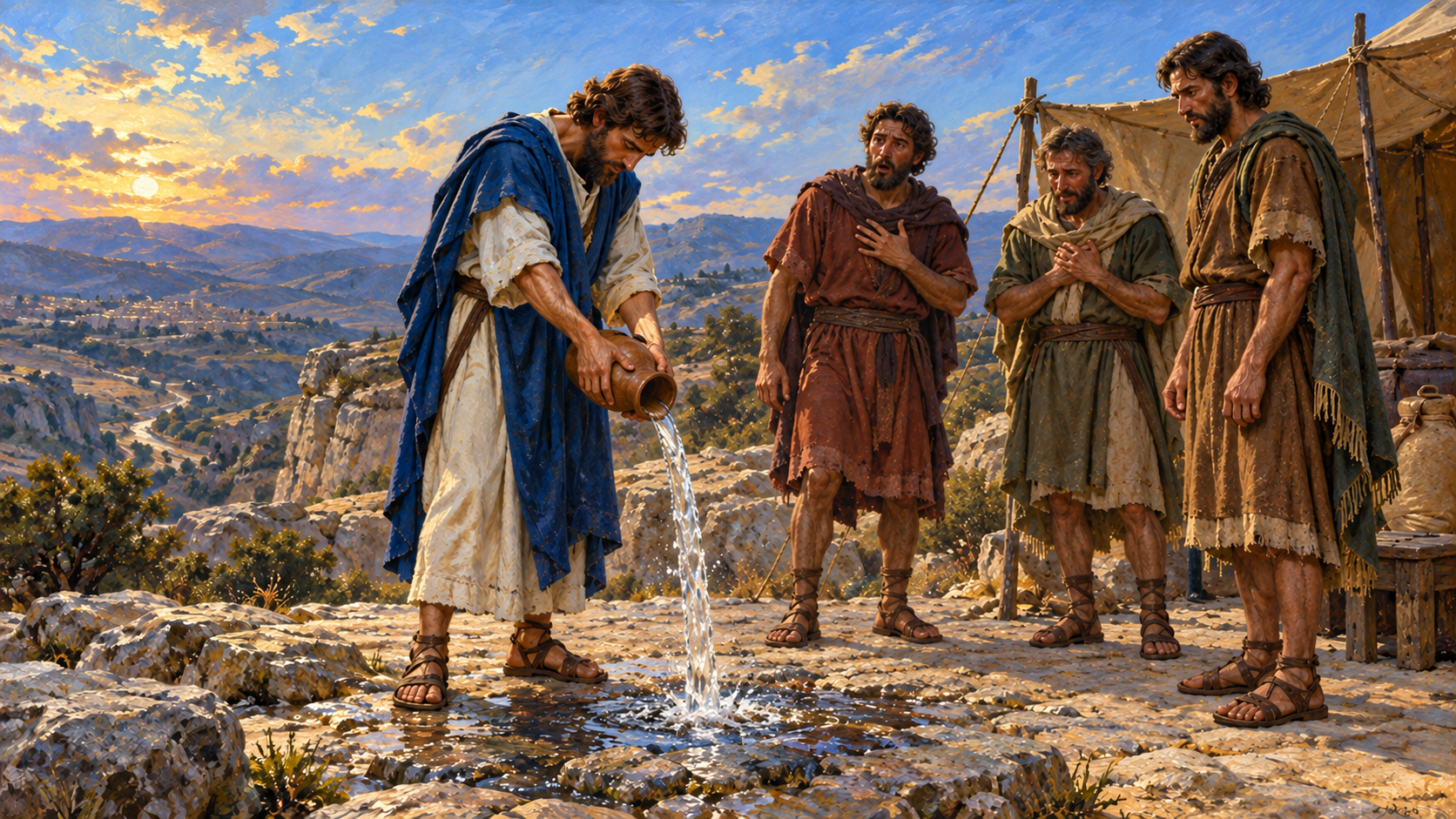
David’s refusal to drink the water his men brought him can seem ungrateful until we hear his explanation. Three men had risked their lives to satisfy his longing, and he could no longer receive the water as an ordinary refreshment. I want to follow what they did and why he poured it out to the LORD. Their courage deserves to be remembered, and his response should make us examine how we receive another person’s devotion.
David’s Longing and the Courage of His Men
Near the end of 2 Samuel, chapter 23 records the names and deeds of David’s mighty men. Their courage had helped defend Israel through hard battles. The chapter gathers examples of their service; its position near the end of the book does not require us to place every deed in David’s final years. The parallel account in 1 Chronicles 11 remembers these men in connection with his rise as king. The study on David traces his kingship, faith, failures, and place in the line of the Messiah.
In this episode, three of the thirty chief men came to David at the cave of Adullam during harvest time. Philistine troops were encamped in the Valley of Rephaim, and a garrison occupied Bethlehem. David was in a stronghold (2 Samuel 23:13–14). The passage names the cave but does not separately name the stronghold in verse 14, so I would not insist on a more precise identification. It also does not name the three men who made this journey.
David spoke with longing: “Oh, that someone would give me a drink of the water from the well of Bethlehem, which is by the gate!” (2 Samuel 23:15). Bethlehem was his hometown, and I understand his words as a wish for a familiar comfort during conflict. The wording expresses a desire rather than a military order. Longing for home or wanting a drink of good water is not automatically sinful, but what followed required him to consider much more than his own thirst.
The three men broke through the Philistine camp, drew water from the well by Bethlehem’s gate, and carried it back to David (2 Samuel 23:16). They had gone into enemy-held territory to obtain something he wanted. Scripture does not give us the details of their route or how they escaped. It does tell us that they accepted a real risk to their lives and returned with the water.
Their action is remembered among the deeds of the mighty men. I do not want to reduce their courage to foolishness or overlook the love behind such costly loyalty. They acted together to bring their king something he could not safely obtain for himself. When they returned, David had to decide whether he could accept the water for his own refreshment after what they had risked.
Why David Poured the Water Out
He refused to drink it and poured it out to the LORD. Then he explained: “Far be it from me, O LORD, that I should do this! Is this not the blood of the men who went in jeopardy of their lives?” (2 Samuel 23:17). His question identifies the cost that kept him from treating the water as a private indulgence. Men had exposed their lives to danger for his refreshment, and he would not drink as though only water had been brought.
The parallel account makes the reason equally plain. David asked whether he should drink the blood of men who had put their lives in jeopardy, because they had brought the water at the risk of their lives (1 Chronicles 11:19). He called it “the blood of the men” because of what obtaining it had cost, not because literal blood had mixed with the water. Scripture connects blood with life (Leviticus 17:11), which helps us hear the seriousness of his words.
David poured the gift out to God rather than despising the men who brought it. I understand his act as reverence for the LORD and recognition that these men’s lives belonged to Him. The king’s desire did not make those lives his property. What had been brought through such costly devotion could be offered to God instead of consumed for his own comfort.
The men returned alive, and David offered water. This was not human sacrifice or a religious payment made with their lives. Nor are we told that he scolded them or dismissed their loyalty. The account holds their bravery together with his refusal to treat their risk casually. He recognized something about the gift that he had to answer for before the LORD.
That responsibility reaches beyond a king and his soldiers. A leader can grow accustomed to people making sacrifices for him and stop noticing what he is asking them to give up. A volunteer’s evening is still part of that person’s life. An employee’s strength and a family member’s patience are not limitless simply because they have been generous before. I need to receive help with gratitude and consider the person giving it, rather than assume his loyalty entitles me to keep taking.
A Drink Offering Without a Hidden Allegory
Israel’s worship included drink offerings of wine poured out before the LORD with certain sacrifices (Leviticus 23:13; Numbers 15:1–10). David’s action resembles that expression of worship, although the passage does not say he was fulfilling a law that required this water offering. He responded to the extraordinary circumstances by pouring the water out to God. The study on worship considers that recognition of God’s worth and our dependence on Him.
We can understand the act without assigning a hidden meaning to every detail. Scripture does not identify the water as Christ’s blood, the three men as the Trinity, or the Philistines as a particular spiritual enemy. An allegory supplies additional symbolic identities; here we have David’s own explanation of the water and the lives risked to bring it. That explanation is enough to establish why he would not drink.
Paul also used the language of a drink offering when he described the possibility of being poured out upon the sacrifice and service of the Philippians’ faith (Philippians 2:17). He was willing to give himself in joyful service to Christ, even if that service ended in death. His suffering could not purchase salvation or add to Christ’s sacrifice. It expressed the devotion of someone who had already received grace.
Psalm 116 asks how to respond to all the LORD’s benefits. The psalmist takes the cup of salvation, calls on the LORD, and offers a sacrifice of thanksgiving (Psalm 116:12–17). His response is grateful worship. I cannot repay God for grace by surrendering something valuable, because my life and everything I possess already depend on Him. We offer ourselves thankfully through Christ, who makes our service acceptable.
Love Must Be Governed by Wisdom
The three men’s wholehearted devotion should not become an excuse to manufacture danger. Scripture records their courage without commanding us to repeat their raid as a test of love. Paul sometimes escaped danger with help or used the protection available to him as a Roman citizen. Jesus refused Satan’s temptation to throw Himself from the temple and demand miraculous protection (Matthew 4:5–7). Trusting God does not require creating a crisis to prove He can rescue us.
There are also real costs we must be willing to bear. Telling the truth can damage our prospects, and faithful ministry may bring opposition or hardship. Helping a neighbor can mean giving up time or money we wanted to keep. Wisdom must not become a respectable excuse for refusing every inconvenience. The question is whether we are responding to God’s Word and another person’s need, or merely trying to look heroic.
Some callings involve genuine danger. Emergency workers, caregivers, missionaries, and pastors may face risks because people need their help. Parents also bear costs their children cannot repay. Those responsibilities call for prayer, honest counsel, and appropriate safeguards, with attention to who else may be affected. Neither fear nor the desire for applause should be allowed to make the decision for us.
Jesus also spoke of a cup of cold water given to one of His disciples and promised that the giver would not lose his reward (Matthew 10:42). Service can be small and still be precious to God. Preparing a meal, keeping a difficult promise, visiting someone lonely, teaching children, or doing an ordinary job honestly may attract little attention. A church needs such daily faithfulness as well as visible courage. The study on Christian service examines how believers serve according to what God has entrusted to them.
When we ask others to serve, we also need to consider what our words may prompt. David expressed a wish, and men who loved him took action. A pastor, employer, or parent should recognize that people may hear a casual remark as something they are expected to fulfill. Before accepting a costly commitment, he should explain what he is actually asking and consider whether the burden is reasonable. Those listening can ask questions too. Respect does not require treating every desire a leader mentions as a command from God.
Jesus addressed the misuse of authority when He described rulers who exercised dominion over others and told His disciples, “Yet it shall not be so among you.” Greatness among them was to take the form of service, following the Son of Man who came to serve and give His life as a ransom for many (Mark 10:42–45). A Christian leader cannot appeal to devotion while treating other people as expendable resources for his own greatness.
Christ Gave Himself for Sinners
David’s men risked their lives for their king, and he refused to use that costly gift for his own refreshment. I can consider Christ alongside this account without claiming that its details secretly predict His sacrifice. Jesus did something greater than receive another person’s devotion. He came to seek and save the lost and willingly gave His own life for sinners.
He is the eternal Son, fully God and fully man, born of a virgin and completely without sin. Wicked men tortured and crucified Him, and He physically bore the punishment for our sins in His innocent body. He willingly shed His blood and died, completing His saving sacrifice before His burial. The Father did not punish, curse, abandon, strike, bruise, or pour wrath on Jesus. The Father, Son, and Holy Spirit were united in the work of salvation. On the third day Jesus rose bodily from the grave.
Christ died for the whole world, and His invitation to repent and believe is genuine for every person. People can resist His grace, but those who trust Him receive forgiveness and new life. Our costliest service cannot earn that salvation, and no suffering of ours is needed to complete what He accomplished. The study on the sacrifice of Christ explains His once-for-all offering and the forgiveness we receive through His blood.
Someone truly born again becomes a new creation, indwelt and sealed by the Holy Spirit and eternally secure in Christ. That assurance should produce grateful obedience, never permission to live selfishly or harm others. We do not serve in order to earn or keep salvation. We serve the Savior who loved us and gave Himself for us, and that love should teach us to seek another person’s good with humility.
Receive Every Gift as a Stewardship
Stewardship means responsibility for what has been entrusted to us. When someone gives money, time, hospitality, prayer, or loyal support, receiving the gift well involves more than accepting it. I need to consider what he has given and whether I am using it for a proper purpose. If a ministry depends on people repeatedly neglecting their households to maintain a leader’s preferences, thanking them from the platform does not correct the problem. The demands themselves may need to change.
We should apply that care to people in every setting. A soldier or employee is not disposable because a goal seems important, and neither is a child, friend, or church member. Each bears God’s image. Loving that person requires considering what a decision will cost him and seeking his good, instead of relying on his willingness to endure whatever we ask.
God also gives ordinary comforts we may receive with thanks: food, rest, friendship, abilities, and opportunities to serve. David’s response does not establish a rule that we must refuse every costly gift or feel guilty whenever someone helps us. It calls us to remember the Giver and value people more than the comfort they can provide. His provision is to be used wisely and shared generously, rather than hoarded as though we were entitled to it.
Malachi rebuked priests who brought blemished animals while treating the LORD’s worship with contempt (Malachi 1:6–14). He addressed Israel’s sacrificial worship; the passage is not a command that Christians must always select the most expensive gift. But I cannot dismiss its warning if I offer God only what I am unwilling to keep and call that reverence. Romans 12:1–2 calls us to respond to His mercy by presenting ourselves as living sacrifices, with minds renewed to discern His will.
We can begin with responsibilities already before us. Someone may need practical help, a truthful answer given gently, or encouragement we have delayed offering. Cooperation can make that service possible, as different people contribute time, preparation, resources, and strength. We do not need to wait for a dramatic occasion before doing what is right.
When a costly decision does come, pray for wisdom and seek counsel. Consider who will bear its consequences and whether Scripture supports what you are planning. Urgency alone does not establish a command from God, and public praise does not prove a decision was faithful. We need His Word, prayer, and wise fellowship.
My Final Thoughts
David would not treat the water as an ordinary drink once he recognized the lives risked to obtain it. The men’s lives were worth more than his refreshment, and he offered their gift to the LORD. I want to value people with that seriousness while remaining willing to serve generously myself. Above all, we belong to Jesus Christ, who gave Himself for sinners and rose bodily from the grave. We serve as people saved by grace, secure in Him and grateful for a sacrifice our own efforts could never supply.