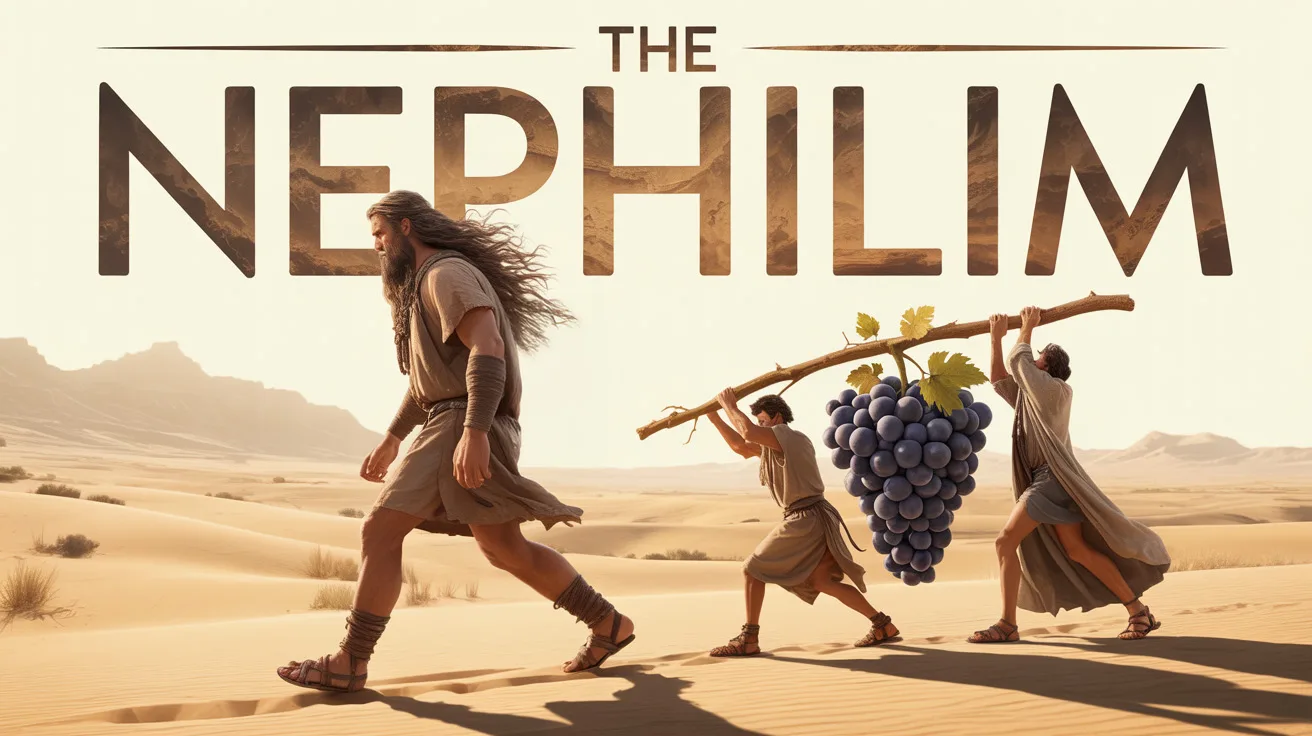
The Bible speaks plainly about the Nephilim, yet modern readers often hesitate to believe what the text actually says. From Genesis to the words of Jesus Christ, Scripture presents a world in which supernatural rebellion, corrupted flesh, and divine judgment are real and historically grounded. This study examines the Nephilim not as myth or symbolism, but as literal beings whose existence shaped the Flood, the conquest of Canaan, and the unfolding of God’s redemptive plan. By letting Scripture interpret Scripture, we will follow the biblical record wherever it leads, trusting that God’s Word is truthful, complete, and worthy of our full confidence.
Lets begin with Genesis 6:4, which is the foundational text for understanding the Nephilim. It does not exist in isolation, but sits directly within the account of pre-Flood corruption that provoked God’s judgment on the earth.
“There were giants on the earth in those days, and also afterward, when the sons of God came in to the daughters of men and they bore children to them. Those were the mighty men who were of old, men of renown.” (Genesis 6:4)
That single clause establishes several non-negotiable facts. First, the Nephilim existed on the earth, not in heaven, not in vision, not in metaphor. Second, they existed during a defined historical period, “in those days,” which refers back to the multiplication of mankind and the events described in Genesis 6:1–3. Third, they are introduced as a known reality, not explained as a symbol, parable, or moral abstraction.
The verse continues by explaining the circumstances surrounding their appearance. They are directly connected to an unnatural union that violated God’s created order. The grammar of the passage places the Nephilim as the outcome or result of this union, not merely a coincidental presence.
The final clause of the verse identifies them as “mighty men who were of old, men of renown.” The Hebrew word used here for “mighty men” is גִּבֹּרִים (gibborim), a term that never refers to ordinary men by default. It consistently describes warriors of unusual strength, size, or dominance.
Nephilim and Gibborim
It is important not to flatten the language of Genesis 6. The Nephilim are not called gibborim; rather, they are described as becoming gibborim. This distinction matters. The Nephilim are the beings produced, while the gibborim describe what they became: dominant, violent, powerful figures in the ancient world.
The word gibbor is used elsewhere to describe extraordinary warriors:
“A mighty man of valor…” (Judges 6:12)
Yet in Genesis 6, the term is elevated beyond normal human categories. These are not merely brave men. They are “men of renown,” a phrase that points to legendary status, remembered across generations.
This explains why similar figures appear in post-Flood history. The giants did not completely disappear with the waters; it persisted within tribes of the nations.
The Second Occurrence of Nephilim
The second and final use of the word Nephilim occurs centuries later, after the Flood, during Israel’s wilderness journey.
“And there we saw the giants…” (Numbers 13:33)
The spies sent into Canaan did not invent a new term. They deliberately used the same word from Genesis 6. This is critical. The text does not say, “giants like the Nephilim,” but explicitly identifies them directly as the Nephilim. And later, the Anakim are described as descendants of them.
Just as important is the reaction of the spies. They do not describe ordinary tall men. They describe a terror so overwhelming that it shattered the faith of an entire generation.
“And we were like grasshoppers in our own sight, and so we were in their sight.” (Numbers 13:33)
This language is not poetic exaggeration. It is eyewitness testimony shaped by fear, memory, and comparison. Israel had seen large men before. They had not seen this.
Terms Referring to Giants in the Old Testament
Scripture uses several distinct terms for giant clans, all of which reinforce the reality of abnormal physical stature.
The Anakim are repeatedly described as “great and tall” (Deuteronomy 9:2). The Rephaim are associated with immense size and terror (Deuteronomy 2:11). The Emim are called “a people as great and numerous and tall as the Anakim” (Deuteronomy 2:10).
None of these terms are metaphorical. Contextually, they are geographic, ethnic, and historical identifiers. Moses also speaks of them the same way he speaks of the Moabites or Edomites and one king stands out above them all.
“For only Og king of Bashan remained of the remnant of the giants. Indeed his bedstead was an iron bedstead… nine cubits in length and four cubits in width.” (Deuteronomy 3:11)
This is not symbolic, his bed was literally 14 feet or longer according to the dimensions given.
Why “Giants” Is the Correct Translation
Some modern translations attempt to avoid the word “giants,” preferring “fallen ones” or “heroes.” But the Septuagint, translated by Hebrew scholars centuries before Christ, uses the Greek word γίγαντες (gigantes). This is where the English word “giants” originates.
Those translators understood the Hebrew context. They did not soften it. They did not allegorize it. They translated it plainly.
The Nephilim as a Doctrine
The Nephilim are not a fringe doctrine, nor are they an embarrassment to biblical faith. They are part of the biblical worldview as God revealed it. Scripture presents them as literal, physical beings whose existence disrupted creation and provoked judgment. Ignoring them does not protect the authority of Scripture; it weakens it.
If we trust the Word of God, we must trust it where it is uncomfortable as well as where it is familiar. Genesis 6 and Numbers 13 are not myths. They are history, and they set the stage for everything that follows.
Sons of God and the Daughters of Men
Genesis 6 does not open with mythology, speculation, or allegory. It opens with population growth, history moving forward, and a world quietly descending into corruption. The language is sober, judicial, and explanatory. Moses is not telling a campfire story; he is explaining why God destroyed the world.
“Now it came to pass, when men began to multiply on the face of the earth, and daughters were born to them…” (Genesis 6:1)
This verse establishes the setting. Humanity is expanding exactly as God commanded in Genesis 1:28. The problem is not population growth. The problem is what happens next. The text does not say “some men sinned.” It describes a transgression so severe that it provoked a global judgment.
The Sons of God
Genesis 6 then introduces a phrase that is crucial to understanding the entire passage:
“…that the sons of God saw the daughters of men, that they were beautiful; and they took wives for themselves of all whom they chose.” (Genesis 6:2)
The phrase “sons of God” is not vague in Scripture. It is not a poetic reference to godly men, kings, or the line of Seth. Scripture itself defines how this phrase is used.
Outside of Genesis 6, the exact Hebrew phrase bene ha’elohim appears only in the book of Job.
“Now there was a day when the sons of God came to present themselves before the LORD, and Satan also came among them.” (Job 1:6)
“Again there was a day when the sons of God came to present themselves before the LORD, and Satan came also among them…” (Job 2:1)
“When the morning stars sang together, and all the sons of God shouted for joy?” (Job 38:7)
In every instance, the sons of God are heavenly beings. They are present before the throne of God. They existed before the foundation of the earth. They are not human. Scripture never uses bene ha’elohim to refer to godly men, kings, or descendants of Seth.
To redefine the phrase in Genesis 6 without textual justification is not interpretation; it is avoidance or twisting of scripture.
Why the Sethite View Fails Biblically
The Sethite view argues that the “sons of God” were godly men from Seth’s line and the “daughters of men” were ungodly women from Cain’s line. While popular in later church history, this interpretation collapses under biblical scrutiny.
First, the text never identifies Seth’s descendants as “sons of God.” Adam is called a son of God individually (Luke 3:38), but his descendants are never collectively labeled that way. Second, the problem described in Genesis 6 is not intermarriage between believers and unbelievers; it is a violation so severe that God wipes out all flesh.
“And the LORD saw that the wickedness of man was great in the earth, and that every intent of the thoughts of his heart was only evil continually.” (Genesis 6:5)
Unequal marriage alone does not produce Nephilim, global corruption of flesh, or a flood. The Sethite view cannot account for the offspring described, nor for the intensity of God’s judgment.
Third, the text distinguishes clearly between “sons of God” and “daughters of men.” If both groups were human, the distinction is meaningless.
Angelic Rebellion and Physical Manifestation
Scripture teaches that angels can manifest physically. This is not speculative; it is plainly stated.
In Genesis 18–19, angels eat, walk, speak, and are physically desired by the men of Sodom.
“Now before they lay down, the men of the city, the men of Sodom, both old and young, all the people from every quarter, surrounded the house.” (Genesis 19:4)
The men of Sodom were not attempting to assault visions or spirits. They believed these beings were physically present. The angels later seized Lot by the hand (Genesis 19:16). Physical interaction is clearly possible. Genesis 6 describes a rebellion in which certain angels crossed a boundary God had established. This is confirmed elsewhere in Scripture.
New Testament Confirmation
The New Testament also backs up the plain reading found in Genesis 6 and reinforces it.
“And the angels who did not keep their proper domain, but left their own abode, He has reserved in everlasting chains under darkness for the judgment of the great day.” (Jude 1:6)
Jude places angelic rebellion alongside the Flood and Sodom.
“For if God did not spare the angels who sinned, but cast them down to hell and delivered them into chains of darkness, to be reserved for judgment; and did not spare the ancient world, but saved Noah…” (2 Peter 2:4–5)
Peter explicitly links sinful angels with the pre-Flood world. These passages make no sense if Genesis 6 is merely about human marriages. In fact, Jude goes even further:
“…as Sodom and Gomorrah… having given themselves over to sexual immorality and gone after strange flesh…” (Jude 1:7)
“Strange flesh” implies a violation of created boundaries. Angels pursuing human women fits the pattern Jude describes.
The Hybrid Offspring and the Corruption of Flesh
If we read Genesis 6 carefully, the emphasis is not only on moral corruption but on a corruption that affected “all flesh.” Scripture repeatedly stresses that the problem extended beyond human behavior into the created order itself.
“And God saw that the wickedness of man was great in the earth…” (Genesis 6:5)
“And God looked upon the earth, and indeed it was corrupt; for all flesh had corrupted their way on the earth.” (Genesis 6:12)
The phrase “all flesh” is critical. It does not describe attitudes, thoughts, or intentions alone, but the condition of living beings. The same expression is later used to justify the destruction of animals as well as humanity (Genesis 6:13, 17). This language points to a corruption that had spread beyond moral failure into something more pervasive.
Within that context, Noah is also described in a strikingly unique way:
“Noah was a just man, perfect in his generations. Noah walked with God.” (Genesis 6:9)
The phrase “perfect in his generations” cannot be referring merely to the existence of a genealogy. Moses is not saying that Noah had a family record, nor that his lineage was documented. Every person mentioned in Genesis has a genealogy; that fact alone would make the phrase meaningless. Instead, the contrast is deliberate. All flesh had corrupted its way, but Noah was “perfect” within his generations.
The Hebrew word translated “perfect” (tamiym) consistently carries the idea of being whole, complete, or without defect. It is used elsewhere to describe unblemished sacrificial animals (Exodus 12:5) and moral integrity (Psalm 18:23). In Genesis 6, it is paired with the word “generations,” not “ways” or “works,” indicating that the focus is not simply Noah’s behavior but his lineage.
This distinction matters. Scripture does not say Noah was sinless; it says he found grace (Genesis 6:8). What set Noah apart was that his family line had not been corrupted. In a world where “all flesh” had been compromised, Noah remained intact within his generations.
This explains why God preserved Noah’s entire household and not merely Noah himself. It also explains why the Flood was necessary. The Nephilim were not merely tall or powerful men; they represented a violation of God’s created order. The corruption of flesh threatened the continuation of the promised seed, and judgment became the only means of preserving redemption.
The Flood, then, was not indiscriminate destruction. It was a decisive act to preserve humanity as God created it. Noah’s preservation was not accidental. His generations were uncorrupted, and through that line, God would continue His redemptive plan.
How Did Giants Appear After the Flood?
Scripture is explicit that the Nephilim existed both before and after the Flood. Genesis 6:4 states this plainly, and Numbers 13 confirms their presence in Canaan. What Scripture does not do is provide a detailed mechanism explaining how this occurred. That silence is intentional by God, because He reveals what we need to know, not everything we might want to know.
“There were giants on the earth in those days, and also afterward…” (Genesis 6:4)
Several observations must guide our understanding. First, the Bible never treats the post-Flood giants as a contradiction. Moses, Joshua, and the prophets speak of them matter-of-factly. The burden, therefore, is not on Scripture to explain their existence, but on the reader to accept that God allowed their reemergence for His purposes.
Second, the Flood destroyed all flesh outside the ark, but it did not eliminate the possibility of future rebellion. Fallen angels still existed after the Flood, and Scripture never says they lost the capacity to rebel again. Jude and Peter both describe angelic transgression in connection with the Flood, but they do not state that such rebellion was forever impossible afterward.
“And the angels who did not keep their proper domain, but left their own abode…” (Jude 1:6)
“Now before they lay down, the men of the city, the men of Sodom, both old and young, all the people from every quarter, surrounded the house. And they called to Lot and said to him, “Where are the men who came to you tonight? Bring them out to us that we may know them carnally.”” (Genesis 19:4-5)
Third, Scripture repeatedly shows that corruption can reenter the human world after judgment. Sin did not end with the Flood. Idolatry did not end with Babel. Rebellion did not end with the wilderness. It is therefore consistent with the biblical pattern that the giant problem reappeared after divine judgment.
What matters most is not the precise mechanism, but the theological reality. The giants who appear after the Flood are treated as real, physical beings, connected to earlier rebellion, and subject to God’s judgment. Their existence does not undermine the Flood; it confirms that spiritual warfare continued.
The Bible’s focus is not on how the giants returned, but on how God dealt with them. They were confronted, defeated, and ultimately removed from the land promised to Abraham. Once again, the Word of God emphasizes obedience, judgment, and the preservation of the redemptive line rather than satisfying curiosity.
Jesus Taught Noah Was a Literal Account
Jesus affirms the historicity and severity of the Flood and links it to future revelation.
“But as the days of Noah were, so also will the coming of the Son of Man be.” (Matthew 24:37)
Christ did not treat Noah’s days as symbolic. He treated them as a real historical warning. If the days of Noah involved supernatural rebellion, deception, and corruption of humanity, then Christ’s warning carries profound implications. We must accept the possibility of the Nephilim returning in the latter part of the last days.
The Nephilim in Canaan
Moving forward to the account of Canaan, the spies’ report is often dismissed as an exaggeration born out of fear. But the text does not correct them. God judges their unbelief, not their description of the land’s inhabitants.
“And the men whom Moses sent to spy out the land… died by the plague before the LORD.” (Numbers 14:36–37)
They were punished for discouraging the people, not for lying about giants. In fact, Joshua and Caleb never dispute the existence of the Anakim. They dispute Israel’s ability apart from God.
“The land we passed through to spy out is an exceedingly good land… If the LORD delights in us, then He will bring us into this land…” (Numbers 14:7–8)
The giants were real and their fear was the issue.
The Anakim: The Most Feared Giants
Mentions of the Anakim appear repeatedly throughout the conquest narratives. They are not metaphors. They are a defined people group.
“Then Joshua came at that time and cut off the Anakim from the mountains: from Hebron, from Debir, from Anab… None of the Anakim were left in the land of the children of Israel; they remained only in Gaza, in Gath, and in Ashdod.” (Joshua 11:21–22)
Notice the specificity. Named cities. Named regions. These are actual military campaigns, not just allegories.
Goliath of Gath later emerges from one of these very cities.
The Rephaim: A Broader Giant Classification
The Rephaim are mentioned across multiple regions east and west of the Jordan.
“The Emim had dwelt there in times past, a people as great and numerous and tall as the Anakim. They were also regarded as giants, like the Anakim, but the Moabites call them Emim.” (Deuteronomy 2:10–11)
This passage shows something important: different cultures used different names for the same type of beings. “Rephaim,” “Anakim,” “Emim,” and “Zamzummim”. These are regional terms and not contradictions. Different people groups called the giants by different names.
Og King of Bashan: A Remnant of the Giants
That brings us to Og, who is described in a way that leaves no room for symbolism.
“For only Og king of Bashan remained of the remnant of the giants.” (Deuteronomy 3:11)
Scripture even gives us a measurement of his bed:
“Indeed his bedstead was an iron bedstead… nine cubits in length and four cubits in width.” (Deuteronomy 3:11)
God anchors Og’s identity in physical dimensions. This is deliberate. Measurements are given to shut down mythologizing. A cubit is the length from the average man’s elbow to the tip of his fingers, which is on average today around 18 inches. This means Og’s bed was around 13 1/2 ft. long and 6 ft. wide, which is huge.
God’s Command to Destroy the Giant Tribes
The command to drive out or destroy these tribes is one of the most criticized aspects of the Old Testament. But Scripture gives the reason plainly.
“For they would turn your sons away from following Me, to serve other gods…” (Deuteronomy 7:4)
These giants were not neutral inhabitants. They were violent, idolatrous, and corrupting influences tied to ancient rebellion. Their removal was not ethnic cleansing; it was judicial judgment.
Battles With Giants: Joshua, David, and the Giant Wars
The battles Israel fought in Canaan were not ordinary wars of territorial expansion. Scripture presents them as acts of divine judgment carried out through human obedience. This is especially true where giants are involved. From Moses to Joshua to David, the conflict with giant clans forms a continuous thread in Israel’s history.
Joshua did not invent a new mission. He executed the command given to him through Moses. When Israel crossed the Jordan, they entered land dominated by fortified cities and giant clans.
“You are crossing over the Jordan today, to go in to dispossess nations greater and mightier than yourself, cities great and fortified up to heaven, a people great and tall, the descendants of the Anakim…” (Deuteronomy 9:1–2)
The text emphasizes size, strength, and intimidation. God does not deny the threat; He asserts His supremacy over it and Joshua’s campaign specifically targeted these strongholds:
“Then Joshua came at that time and cut off the Anakim from the mountains: from Hebron, from Debir, from Anab… None of the Anakim were left in the land of the children of Israel; they remained only in Gaza, in Gath, and in Ashdod.” (Joshua 11:21–22)
This passage is crucial. It shows that the giants were not imaginary, and it explains why giants later appear in Philistine territory. Joshua broke their power in Israel’s land, but remnants fled to coastal strongholds.
The Rise of David: A New Phase in the Giant Conflict
Centuries after Joshua, giants resurface as national enemies under the Philistines. David’s rise to prominence is inseparable from this renewed conflict and Goliath was introduced with unmistakable clarity:
“And a champion went out from the camp of the Philistines, named Goliath, from Gath, whose height was six cubits and a span.” (1 Samuel 17:4)
Gath was one of the cities where we read early that the Anakim remnants went to. And goliath’s height of almost 10 ft. is quite remarkable and terrifying. It is no wonder why the Hebrews were scared of Goliath, but David’s response to Goliath reveals his heart in the face of conflict:
“Who is this uncircumcised Philistine, that he should defy the armies of the living God?” (1 Samuel 17:26)
David does not frame the battle as personal courage versus brute force. He frames it as defiance against God Himself. Goliath and the Philistines were in direct opposition to God and His people.
The Valley of Elah
Moving forward to the battle in the Valley of Elah, David’s declaration is one of the clearest statements of his reliance on the Lord for battle:
“The battle is the LORD’s, and He will give you into our hands.” (1 Samuel 17:47)
This was not bravado, it was confidence. David understood what Saul had forgotten… That God had already sworn victory over the giants. When David struck Goliath, Scripture emphasizes the impossibility of human explanation:
“So David prevailed over the Philistine with a sling and a stone…” (1 Samuel 17:50)
God once again used weakness to shame strength.
Goliath Was Not Alone
The defeat of Goliath did not end the war against giants. Scripture records multiple encounters with giants during David’s reign.
“Now it happened afterward that there was again a battle with the Philistines at Gob; then Sibbechai the Hushathite killed Saph, who was one of the sons of the giant.” (2 Samuel 21:18)
“There was war again with the Philistines at Gob, where Elhanan… killed the brother of Goliath the Gittite…” (2 Samuel 21:19)
“Yet again there was war at Gath, where there was a man of great stature…” (2 Samuel 21:20)
The phrase “sons of the giant” confirms the lineage. These were not just random tall men. They were part of a remaining bloodline.
David’s Mighty Men and the Final Purge
These battles were fought not by David alone, but by those who were loyal to him.
“These four were born to the giant in Gath, and were killed by the hand of David and by the hand of his servants.” (2 Samuel 21:22)
This verse marks the closing of a chapter that began in Genesis 6. The giants within Israel’s borders had finally been extinguished.
These conflicts were not merely about land or power. They were about preserving God’s covenant line through which the Messiah would come. Giants consistently opposed God’s redemptive plan. David’s victories ensured that the promise made in Genesis 3:15 and 2 Samuel 7 would remain intact.
While Scripture records the defeat of the giants within Israel, it also records something else: memory. The giants had become legends and were likely looked up to as gods. These legends possibly began to shape pagan religion, mythology, and rebellion.
The Book of Enoch, Extra-Biblical Traditions, and Nimrod
When studying the Nephilim, it is impossible to ignore the existence of ancient writings outside the canon of Scripture. These writings did not appear in a vacuum. They arose from cultures that still remembered the events described in Genesis 6, even if that memory could have been distorted over time.
Before diving into these other writings, let’s be very clear, Scripture alone is inspired, preserved, and authoritative. The following extra-biblical texts may contain fragments of history, but they must always be tested against the Word of God.
“To the law and to the testimony! If they do not speak according to this word, it is because there is no light in them.” (Isaiah 8:20)
This principle governs everything that follows. We do not build doctrine from extra-biblical sources. We use Scripture to evaluate them.
The Book of Enoch
The Book of Enoch is not Scripture. It was never part of the Hebrew canon, never treated as inspired by Israel, and never placed among the Old Testament writings by Christ or the apostles. However, it is an ancient Jewish text that reveals how Second Temple Jews understood Genesis 6.
Its value lies not in authority, but in insight into ancient interpretation. Enoch expands on the idea that certain angels rebelled, descended to earth, and corrupted humanity. This aligns with what Scripture already states in Genesis 6, Jude, and 2 Peter. But Enoch goes beyond Scripture tells us, and offers names, elaborate narratives, and speculative cosmology. Some or all of it may be true, but we can’t confirm these events with scripture, so caution is required.
Why Jude Mentions Enoch
Jude does make a brief reference to Enoch:
“Now Enoch, the seventh from Adam, prophesied about these men also, saying, ‘Behold, the Lord comes with ten thousands of His saints…’” (Jude 1:14)
Jude does not quote from the Book of Enoch to canonize it as scripture. He quotes a true statement preserved in an existing tradition, much like Paul quoting pagan poets in Acts 17:28. Truth can be preserved outside Scripture without becoming Scripture itself.
Jude’s use of Enoch reinforces one thing clearly: the early Jewish and Christian understanding of Genesis 6 involved angelic rebellion and judgment.
How We Should Approach the Book of Enoch
Enoch does align with Scripture in several key areas:
- Angelic beings rebelled
- Boundaries were crossed by angels mating with humans
- The corruption of humanity preceded the Flood and caused all flesh to become corrupt
- Worldwide judgment followed
These points are already affirmed in Genesis 6, Jude 1:6, and 2 Peter 2:4–5. Where Enoch aligns with Scripture and confirms what the Bible already teaches.
However, the Book of Enoch makes specific claims about demons that Scripture never clearly affirms, particularly the idea that demons are the disembodied spirits of dead Nephilim. Because the Bible does not explicitly teach this, such assertions must be held cautiously and never elevated to doctrine, especially when Scripture consistently identifies demons in connection with fallen angels rather than deceased hybrid beings.
Additionally, the Book of Enoch itself shows strong evidence of being a composite work written long after the time of the biblical Enoch. Its language, themes, and historical references reflect Second Temple Judaism rather than antediluvian authorship, indicating that it preserves a later interpretation and tradition rather than direct prophetic revelation from Enoch himself.
Nimrod and His Rebellion
After the flood, Genesis introduces to us Nimrod:
“Now Cush begot Nimrod; he began to be a mighty one on the earth.” (Genesis 10:8)
The phrase “mighty one” uses the same Hebrew word gibbor used in Genesis 6:4.
“He was a mighty hunter before the LORD; therefore it is said, ‘Like Nimrod the mighty hunter before the LORD.’” (Genesis 10:9)
The phrase “before the LORD” is not praise. It actually indicates defiance in God’s presence. Nimrod is not portrayed as righteous man, but rather a dominant, forceful, and authoritative man.
Was Nimrod a Giant or a Nephilim?
Scripture does not explicitly call Nimrod a Nephilim. It does, however, associate him with the same terminology used for the pre-Flood giants. This raises an important distinction.
Nimrod may or may not have been a Nephilim himself. But at the very least, he does represent the same spirit of rebellion, centralized power, and domination that characterized the antediluvian world. He does become the first post-Flood empire builder.
Nimrod and the Tower of Babel
Genesis 10 and 11 reveal to us that Nimrod’s kingdom included the city of Babel.
“And the beginning of his kingdom was Babel…” (Genesis 10:10)
Babel represents unified rebellion against God’s command to spread across the earth.
“Come, let us build ourselves a city, and a tower whose top is in the heavens; let us make a name for ourselves…” (Genesis 11:4)
This phrase also mirror Genesis 6:4: “men of renown.” The same desire for self-exaltation resurfaces.
Pagan Gods, Giants, and the Distortion of Ancient Memory
Scripture presents the Nephilim as real, historical beings whose existence disrupted God’s created order and contributed directly to divine judgment. What Scripture does not do is trace how humanity remembered these beings after the Flood and the scattering at Babel. That task belongs to history, culture, and memory rather than revelation. As people groups spread across the earth, the memory of extraordinary beings did not vanish; instead, it was preserved, reshaped, and eventually distorted into mythology and religious systems.
“For all the gods of the peoples are idols, but the LORD made the heavens.” (Psalm 96:5)
The word translated “idols” does not mean imaginary or fictional. Rather, it refers to illegitimate objects of worship. Throughout Scripture, idolatry is not portrayed as humanity inventing gods out of nothing, but as the misdirection of worship away from the Creator and toward created or rebellious beings.
Men of Renown and the Birth of God-Kings
Genesis 6:4 describes the Nephilim as “men of renown.” This phrase conveys reputation, lasting fame, and remembrance across generations. These were not obscure figures. They dominated the ancient world so profoundly that their names and deeds endured long after their destruction.
“Those were the mighty men who were of old, men of renown.” (Genesis 6:4)
Across the ancient world, remarkably similar stories appear: superhuman rulers, demi-gods, and god-kings who lived in a distant age, possessed extraordinary strength, ruled violently, and were eventually destroyed or removed. Scripture does not confirm these stories directly, but it does provide a coherent explanation for why such traditions exist at all.
It cannot be proven that the gods worshipped by pagan nations were Nephilim, and Scripture never makes that claim explicitly. However, it is reasonable to suggest that ancient peoples may have misremembered powerful beings from the pre-Flood and early post-Flood world, eventually elevating them into objects of worship. This remains a theory, not doctrine, and must be held cautiously.
The Titans, Heroes, and Greek Mythology
Greek mythology preserves one of the most developed traditions of primordial beings. The Titans are described as immense, ancient, and violent, ruling the world before being overthrown and imprisoned following a great cosmic conflict. This pattern bears a striking resemblance to the biblical account of rebellion followed by judgment.
The Olympian gods who succeeded the Titans were portrayed as lesser beings who ruled humanity, demanded worship, and produced heroic offspring through unions with women. Figures such as Hercules, Achilles, and Perseus share common traits: extraordinary strength, semi-divine origin, violent exploits, and enduring fame.
These myths should not be treated as Scripture, nor as precise history. Yet they may preserve distorted memories of real events filtered through pagan imagination. What Scripture identifies as rebellion and judgment, mythology reframes as heroism and tragedy.
Mesopotamian Tradition and the Epic of Gilgamesh
Mesopotamian literature provides some of the clearest examples of preserved ancient memory. The Sumerian King List records antediluvian rulers who reigned for extraordinarily long periods, followed by a catastrophic flood and the sudden resetting of civilization.
One of the most well-known figures from this tradition is Gilgamesh, a king described as possessing extraordinary strength and semi-divine origin. The Epic of Gilgamesh portrays him as a larger-than-life ruler who seeks immortality and survives a flood through the account of Utnapishtim. While Scripture does not identify Gilgamesh or equate him with the Nephilim, his portrayal does follow the same familiar pattern: immense power, partial divinity, violent rule, and obsession with overcoming death.
Pagan tradition also remembers the flood, but forgets the reason for the judgment.
“And God said, ‘My Spirit shall not strive with man forever, for he is indeed flesh; yet his days shall be one hundred and twenty years.’” (Genesis 6:3)
Scripture explains what Mesopotamian myth omits. The Flood was not an accident of fate, but rather from moral judgment.
False Gods, Fallen Angels, and Spiritual Reality
Scripture is clear about idolatry involving real spiritual forces that are operating behind false worship.
“They sacrificed to demons, not to God, to gods they did not know.” (Deuteronomy 32:17)
“The things which the Gentiles sacrifice they sacrifice to demons and not to God.” (1 Corinthians 10:20)
It is entirely plausible that these mighty beings drew worship away from the true God and unto themselves. Here again, caution is required. Scripture does allow for this framework but does not actually say it.
Why Israel Was Drawn Back to Idolatry
Israel’s repeated return to idolatry was not driven by artistry or philosophy, but by the perceived power behind the gods of the nations.
“They forsook the LORD God of their fathers… and followed other gods from among the gods of the people who were all around them.” (Judges 2:12)
The surrounding nations worshipped gods associated with strength, fertility, war, and dominion. These traits were embodied by mighty beings of old. Israel’s struggle was not merely cultural; it was spiritual.
Giants, Global Memory, and Post-Biblical History
Scripture does not claim that all memory of giants vanished after the Old Testament period. Cultures separated by oceans and languages preserved traditions of unusually large, violent, or semi-divine beings.
Native American traditions, particularly among the Paiute, speak of red-haired giants marked by violence and cannibalism who were eventually destroyed. These accounts predate European contact, suggesting independent cultural memory.
Early American newspapers frequently reported the discovery of unusually large skeletons. While not every report can be verified, their consistency across regions raises legitimate historical questions.
Similar claims appear in the Middle East, North Africa, and the Mediterranean regions that are already associated with biblical giant clans. Sensationalism must be rejected, but global consistency can not be ignored.
As in the Days of Noah
Jesus did not warn that giants would return physically, but that the conditions of Noah’s day would return spiritually.
“But as the days of Noah were, so also will the coming of the Son of Man be.” (Matthew 24:37)
Deception, corruption, violence, and denial of judgment defined that era and will eventually define ours as well. Could giants be a part of that era? Possibly, but we don’t know for certain.
My Final Thoughts
When all is said and done, the Nephilim are not a novelty topic, they are a Bible topic. The modern impulse is to soften Genesis 6, to spiritualize it, or to treat it as myth because it does not fit a naturalistic mindset. But Scripture does not give us permission to handle the text that way. Genesis 6:4 and Numbers 13:33 present the Nephilim and giants as literal, historical realities, and the Old Testament continues that thread through the Anakim, Rephaim, and even measurable details like the bedstead of Og (Deuteronomy 3:11). The Bible is not embarrassed by these details, and neither should we be.
More importantly, Genesis 6 is not merely about “tall men.” It is about supernatural rebellion, the corruption of what God made, and the certainty of divine judgment. Jude and Peter confirm that a class of angels transgressed boundaries God established (Jude 1:6; 2 Peter 2:4–5). Genesis emphasizes “all flesh” becoming corrupt (Genesis 6:12), while Noah is described as “perfect in his generations” (Genesis 6:9), highlighting God’s preservation of an uncorrupted line by grace (Genesis 6:8). The Flood was not random destruction; it was judicial and redemptive, God preserving humanity and His promise.
As we traced giants into Canaan and into David’s reign, the pattern remained consistent: these conflicts were never merely political. They were tied to covenant preservation and the safeguarding of the messianic line. From Joshua’s campaigns (Joshua 11:21–22) to David and his mighty men finishing off the last giant remnants in Gath (2 Samuel 21:22), God repeatedly demonstrated that no “mighty man” can stand against His purposes.
When we consider pagan mythology and post-biblical traditions, we must remain honest and cautious. It is not known, nor can it be proven, that the “gods” of paganism were Nephilim. Yet it is reasonable to suspect that ancient myths of Titans, heroes, and god-kings likely do preserve distorted memories of the “men of renown” (Genesis 6:4), and later weaponized by demonic influence to pull worship away from the Creator (Deuteronomy 32:17; 1 Corinthians 10:20).
Finally, Jesus’ warning matters: “as the days of Noah were, so also will the coming of the Son of Man be” (Matthew 24:37). Christ’s point is not to satisfy curiosity, but to awaken sobriety, because deception, corruption, violence, and the refusal to heed His warnings are a recurring mark of a world that is ripe for judgment. Could there be elements in the last days that resemble Noah’s era in more ways than we expect? Possibly. But we do not build certainty where God has given silence. Our calling is simpler and stronger: believe the Word, test all things by Scripture, refuse fear, and stand faithful to Christ.
The giants fell. The myths faded. Kingdoms rose and collapsed. But the Word of God stands, and the Seed prevailed. Jesus Christ is the true Son of David, the conquering King, and the One who will judge the world in righteousness. Our confidence is not in hidden knowledge, but in revealed truth.



 Get the book that teaches you how to evangelize and disarm doctrines from every single major cult and religion.