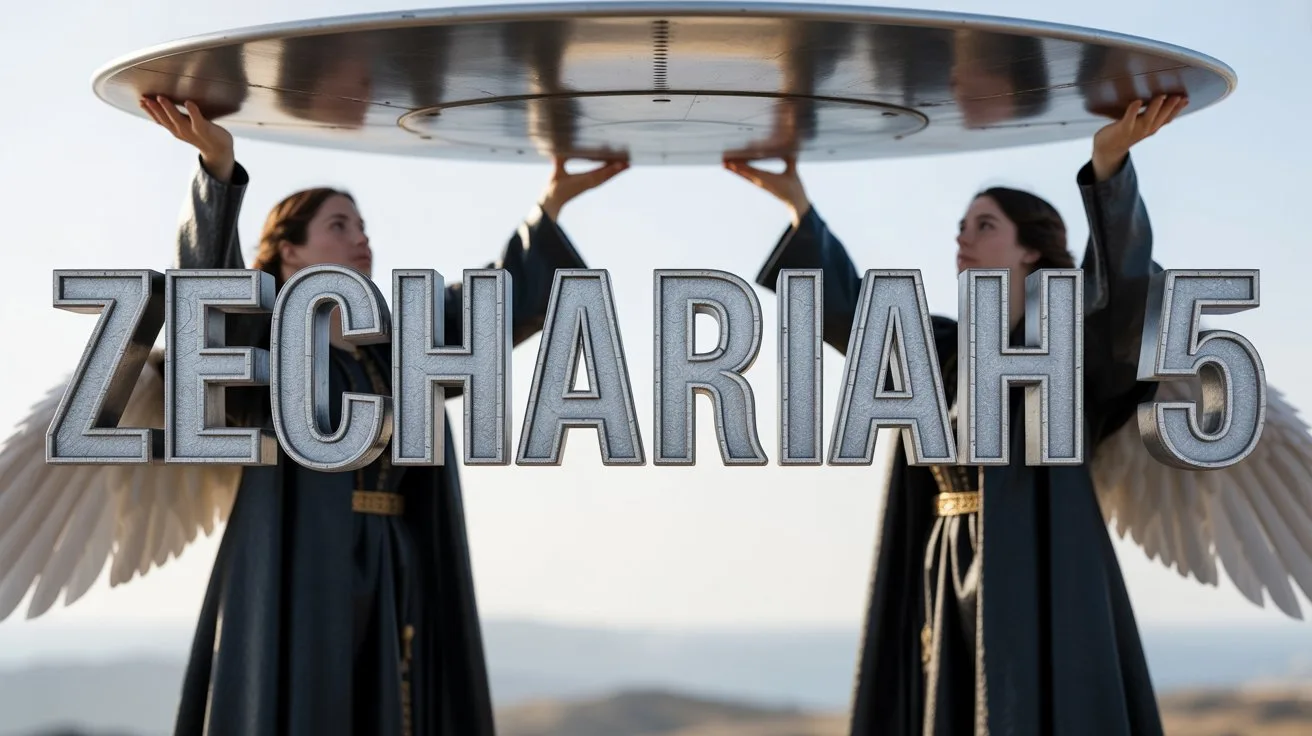

Zechariah 5 gives us one of the most unusual visions in the Old Testament: a flying scroll of judgment and an ephah basket containing a woman called “Wickedness,” sealed with lead and carried through the air to Shinar. These images are not random. They are God-given symbols meant to teach Israel and to warn later generations about how sin moves, how it is contained, how it is transported, and where it ultimately gathers.
In this study we will walk through Zechariah 5:5-11 in its post-exile setting, track the meaning of the symbols inside the vision, and connect the themes to the broader biblical testimony about Babylon, spiritual deception, and end-times rebellion. We will do this carefully, letting Scripture interpret Scripture, and making sure our conclusions remain anchored to what the text actually says.
Zechariah’s Night Visions
Zechariah ministered to the returned exiles after Babylon had fallen to the Medo-Persians. The temple work had stalled, the people were discouraged, and the nation was spiritually vulnerable. God gave Zechariah a series of visions to strengthen the remnant, correct their thinking, and assure them that the Lord had not abandoned His purposes.
Zechariah 5 sits within a cluster of visions that deal with cleansing, restoration, and the removal of evil from the covenant community. The vision of the flying scroll (Zechariah 5:1-4) announces curse and judgment against unrepentant sin. Immediately after that, the vision of the ephah (Zechariah 5:5-11) shows wickedness being contained and relocated. In other words, God is not only exposing sin, He is also dealing with it.
“Then the angel who talked with me came out and said to me, ‘Lift your eyes now, and see what this is that goes forth.’ So I asked, ‘What is it?’ And he said, ‘It is a basket that is going forth.’ He also said, ‘This is their resemblance throughout the earth: Here is a lead disc lifted up, and this is a woman sitting inside the basket’; then he said, ‘This is Wickedness!’ And he thrust her down into the basket and threw the lead cover over its mouth.” (Zechariah 5:5-8)
Notice the guided nature of the vision. Zechariah is not guessing his way through symbolism. He is asking questions, and an interpreting angel gives answers. That matters. It keeps us humble. It tells us that when the angel labels the woman “Wickedness,” we do not have the freedom to redefine her into something more flattering or vague. The vision is about moral and spiritual evil.
The Ephah and Human Systems
An “ephah” was a standard unit used in commerce, especially for dry goods like grain. It could refer to the measurement itself or to the container associated with measuring. That commercial flavor is important because the prophets often connected spiritual decay with corrupt economic life: dishonest scales, cheating, oppression, and greed. Wickedness does not only show up in overt idolatry; it also shows up in normal life when people exploit one another.
In Zechariah 5, the ephah becomes more than a measurement. It becomes a symbol of wickedness expressed in “throughout the earth.” The phrase “their resemblance throughout the earth” indicates that what is being shown is representative, not local. Wickedness is not merely a personal sin problem; it can become an organized, distributed pattern in human society.
“Dishonest scales are an abomination to the Lord, But a just weight is His delight.” (Proverbs 11:1)
This is why it is reasonable to see the ephah as a symbol of systematized evil, especially evil tied to commerce, culture, and public life. The post-exilic community needed to learn that rebuilding the temple while tolerating dishonesty and moral compromise would not bring true restoration. God was calling them to covenant faithfulness in the marketplace as well as in worship.
At the same time, the ephah is not only about Israel’s internal life. The angel’s language broadens the scope. Wickedness has a “resemblance throughout the earth.” Sin spreads, normalizes, and becomes embedded in structures. Zechariah is being shown that God sees and will address wickedness on a global scale.
The Lead Cover and Contained Evil
Zechariah sees a “lead disc” lifted up, and then the interpreting angel and the vision itself emphasize that the woman is forced down and sealed inside. Lead is heavy. The picture is not of wickedness escaping freely, but of wickedness being restrained and contained until an appointed time and place.
Scripture sometimes uses “weight” imagery for judgment and heaviness. In Zechariah 5, the lead appears functional more than decorative: it is a lid. The woman is not reigning in the ephah; she is being confined. That should correct an overly sensational reading that turns the vision into a celebration of evil power. The emphasis is that God can restrict what seems uncontrollable.
“Then he said, ‘This is Wickedness!’ And he thrust her down into the basket and threw the lead cover over its mouth.” (Zechariah 5:8)
In the earlier vision, the flying scroll represented God’s curse against covenant-breaking sins like theft and perjury (Zechariah 5:3-4). Here, rather than a curse going out, we see wickedness being gathered and transported. Put together, the two visions show both sides of divine dealing: God judges sin, and God removes sin. The remnant needed both truths. They needed sobriety about sin and hope that God would not let evil remain forever in their midst.
This is also where a careful modern application can be made. While we must not force technology into every prophetic image, the idea of contained wickedness is very relevant. Evil often hides behind impressive coverings: respectable institutions, persuasive narratives, polished appearances, and “sealed” secrets. The lead lid is an image of concealment and restraint. The vision teaches that what is hidden is still known to God, and what is restrained will not remain restrained forever if God appoints its unveiling for judgment.
The Woman Called Wickedness
The woman in the ephah is explicitly identified: “This is Wickedness!” That is crucial. The vision is not primarily about gender, and it is not an attack on women. Scripture often personifies abstract qualities as women, both positively and negatively. Proverbs personifies wisdom as a woman who calls out in the streets (Proverbs 1 and Proverbs 8). It also personifies folly as an immoral woman (Proverbs 7 and Proverbs 9). These are literary ways to make spiritual realities vivid.
“Wisdom calls aloud outside; She raises her voice in the open squares.” (Proverbs 1:20)
So in Zechariah 5, “Wickedness” is a personification. The Hebrew concept behind “wickedness” here points to lawlessness, guilt, and moral perversion. The vision is showing evil as something that can be “contained” and moved, not because evil is merely an idea, but because there are spiritual and societal mechanisms that carry it.
We should also observe that the woman is passive in the vision. She is sitting, then she is thrust down, then she is carried. The agents are elsewhere. This helps us keep the emphasis where the text puts it: wickedness is being handled by spiritual forces in a larger plan. It is not an image of an empowered queen ruling the skies; it is an image of evil being packaged for relocation.
Still, it is not a harmless relocation. The destination matters, and the building of a “house” for it matters. Wickedness is not being eliminated in Zechariah 5; it is being concentrated. That concentration sets the stage for later biblical revelation about Babylon as a final focal point of rebellion.
The Winged Women and Uncleanness
Zechariah then sees “two women” with wings like a stork lifting the ephah “between earth and heaven.” This is one of the reasons the passage feels mysterious. Angels in Scripture are consistently described with masculine terms, and although angels can appear in human form, Zechariah is not told these are angels. They are simply “two women,” and their wings are compared to an unclean bird.
“Then I raised my eyes and looked, and there were two women, coming with the wind in their wings; for they had wings like the wings of a stork, and they lifted up the basket between earth and heaven.” (Zechariah 5:9)
The stork is listed among the unclean birds in the Law. That does not mean the animal is evil in itself, but it does mean it was ceremonially unclean for Israel and therefore served as a fitting symbol for something not associated with holiness. In symbolic visions, details like this are rarely accidental. If God wanted to communicate purity, He could have used imagery tied to clean animals. The choice of an unclean bird pushes the reader away from thinking these are holy agents.
“The stork, the heron after its kind, the hoopoe, and the bat.” (Leviticus 11:19)
So what are they? The safest answer is to say: they are the carriers of wickedness, and the imagery signals uncleanness. That allows for the possibility that they represent demonic forces or corrupt spiritual agencies working in the unseen realm to move evil into position. The Bible teaches that there are real spiritual powers behind human rebellion.
“For we do not wrestle against flesh and blood, but against principalities, against powers, against the rulers of the darkness of this age, against spiritual hosts of wickedness in the heavenly places.” (Ephesians 6:12)
We should be careful here. Zechariah does not explicitly say “demons,” so we should not speak more confidently than Scripture. Yet the combination of “Wickedness,” unclean symbolism, and aerial movement “between earth and heaven” fits with the broader biblical theme that evil has spiritual administration behind it. The point is not to satisfy curiosity, but to cultivate discernment. Evil often travels with help.
Shinar and the Pattern of Babylon
When Zechariah asks where the ephah is going, the angel says it is being taken “to build a house for it in the land of Shinar.” Shinar is a loaded biblical term. It reaches back to Genesis 11 and the tower of Babel. That was humanity’s organized attempt to unite in pride, make a name, and resist the command to spread out. Babel becomes Babylon, and Babylon becomes a recurring symbol of idolatry, oppression, and religious confusion.
“And he said to me, ‘To build a house for it in the land of Shinar; when it is ready, the basket will be set there on its base.’” (Zechariah 5:11)
In Genesis, Shinar is the location of Babel’s rebellion. In Zechariah, Shinar is the location where wickedness is given a “house,” meaning a place of establishment, permanence, and public presence. That is a sobering development. Wickedness is not merely being moved out of the land for Israel’s benefit, though that is part of it. It is being relocated to a place that represents organized rebellion.
This also fits the flow of Zechariah’s visions. God is restoring Jerusalem and cleansing His people, but the world’s rebellion is not over. The vision implies separation: God purifies His people while wickedness consolidates elsewhere. That is a theme the Bible develops more fully later. God gathers His people to Himself, and rebellion gathers to its own center.
“Come out of her, my people, lest you share in her sins, and lest you receive of her plagues.” (Revelation 18:4)
Revelation uses Babylon as a symbol of end-times religious, economic, and political rebellion against God. Zechariah’s “house” for wickedness in Shinar harmonizes with that trajectory. The Bible is consistent: Babylon is not only a historical empire; it is also a spiritual pattern. It is the world organized in defiance of the living God.
End Times Deception and Lying Wonders
Zechariah’s vision is not given as a technical blueprint of future machines, but it is clearly concerned with the movement and placement of wickedness on a large scale. That makes it legitimate to connect the passage to other Scriptures that warn about end-times deception. The New Testament repeatedly teaches that the final phase of rebellion will include persuasive signs, false narratives, and spiritual counterfeit.
“The coming of the lawless one is according to the working of Satan, with all power, signs, and lying wonders, and with all unrighteous deception among those who perish, because they did not receive the love of the truth, that they might be saved.” (2 Thessalonians 2:9-10)
Notice what Paul emphasizes. The deception is not only intellectual; it is experiential. It involves “power,” “signs,” and “lying wonders.” That means it will feel compelling. It will look impressive. And it will be morally charged, aimed at steering people away from truth and toward unrighteousness.
This is where some believers have suggested that modern “alien” narratives could be used as a platform for deception, potentially masking demonic activity under a technological costume. Scripture does not use the word “alien” in the modern sense, so we should not speak as though the Bible directly predicts UFO phenomena. Yet Scripture does teach that fallen angels and deceiving spirits can disguise their intentions and present themselves in attractive or authoritative ways.
“And no wonder! For Satan himself transforms himself into an angel of light.” (2 Corinthians 11:14)
Therefore, if a future deception includes supernatural manifestations with a persuasive explanation that denies the biblical God, denies the gospel, or reframes Christ as unnecessary, believers should not be surprised. Zechariah 5 gives us a picture of wickedness being transported “between earth and heaven.” Whether one sees that as purely symbolic or potentially connected to aerial phenomena, the theological takeaway is the same: evil seeks to establish itself, and spiritual forces can facilitate its spread.
Jesus warned that end-times deception would be intense, and that it would aim even at those who are attentive to God. The protection is not speculation. The protection is rootedness in Christ and steadiness in His Word.
“For false christs and false prophets will rise and show great signs and wonders to deceive, if possible, even the elect.” (Matthew 24:24)
How Believers Should Respond
Zechariah’s vision is not given to make God’s people fearful, but to make them discerning and faithful. If wickedness can be packaged, concealed, and moved, then the people of God must learn to evaluate the fruit of ideas, movements, and experiences, not just their presentation. The lead lid warns us that evil likes to be hidden. The flight between heaven and earth warns us that evil can present itself as transcendent, enlightened, or “beyond” ordinary religion. The destination of Shinar warns us that evil seeks a center, a house, a base of operations.
“Beloved, do not believe every spirit, but test the spirits, whether they are of God; because many false prophets have gone out into the world.” (1 John 4:1)
Testing the spirits is not mystical guesswork. It is doctrinal and moral evaluation. Does a message confess the biblical Jesus Christ? Does it honor His incarnation, His cross, and His resurrection? Does it produce obedience, humility, and holiness, or does it excuse sin and inflate pride? Does it align with the apostles’ teaching in Scripture?
Practically, believers respond by keeping the gospel central, by walking in repentance, and by refusing to romanticize darkness. Zechariah 5 reminds us that wickedness is real and personal, but it is also structural. It can be housed. It can be institutionalized. That is why God calls His people to be distinct.
“Therefore ‘Come out from among them And be separate, says the Lord. Do not touch what is unclean, And I will receive you.’” (2 Corinthians 6:17)
Finally, we respond with confidence in God’s final victory. Zechariah does not end with wickedness reigning. It ends with wickedness being handled, moved, and set in a place where God will ultimately judge it. Revelation makes plain that Babylon falls. The systems of rebellion do not win. Christ does.
My Final Thoughts
Zechariah 5 is a strong reminder that evil is not only a personal temptation but also a coordinated reality that can be concealed, transported, and established. Whether we read the flying ephah strictly as symbolic imagery or see in it a pattern that could overlap with future deceptions, the passage calls us to clarity: wickedness is wickedness, even when it is packaged attractively.
The safest place for the believer is not in chasing theories but in staying grounded in Scripture, alert to deception, and anchored in Jesus Christ. As we watch the world build its “houses” for rebellion, we choose to build our lives on the truth, walk in the light, and trust that the Lord will finish His work of cleansing and restoration.

 Get the book that teaches you how to evangelize and disarm doctrines from every single major cult and religion.