
Scripture says that God is Spirit, yet it describes His right hand rescuing and upholding people. It also speaks of a place of honor at His right hand. I need to pay attention to what each passage describes instead of assigning one meaning to every use. Psalm 110 brings the royal language into particular focus: the risen Jesus sits at the Father’s right hand while awaiting the final subjection of His enemies.
How Scripture Uses the Right Hand
We read about God’s eyes, ears, face, arm, and even His wings. These descriptions tell us something true about His knowledge, presence, protection, or action. They do not require us to imagine the Father as a human being with a body made of physical parts.
But the hour is coming, and now is, when the true worshipers will worship the Father in spirit and truth; for the Father is seeking such to worship Him. God is Spirit, and those who worship Him must worship in spirit and truth."
When Jesus says that God is Spirit, He gives us a reason to read descriptions of God’s hand with care. I can believe that God truly rescued Israel without imagining that the Father reached down with physical fingers. The term anthropomorphism describes this use of human form in speaking about God. We understand how a hand works, so the image helps us recognize His power in action. It tells us who delivered His people without describing the Father’s anatomy.
The Hebrew word commonly translated right hand is yamin. Greek uses forms of dexios, including dexia, for the right hand or side. Depending on the setting, this language can describe strength, help, or a place of honor. The surrounding passage tells us which is intended.
Moses sang after God opened the sea for Israel and closed it over Pharaoh’s pursuing force.
"Your right hand, O LORD, has become glorious in power; Your right hand, O LORD, has dashed the enemy in pieces. And in the greatness of Your excellence You have overthrown those who rose against You; You sent forth Your wrath; It consumed them like stubble. And with the blast of Your nostrils The waters were gathered together; The floods stood upright like a heap; The depths congealed in the heart of the sea. The enemy said, ‘I will pursue, I will overtake, I will divide the spoil; My desire shall be satisfied on them. I will draw my sword, My hand shall destroy them.’ You blew with Your wind, The sea covered them; They sank like lead in the mighty waters. "Who is like You, O LORD, among the gods? Who is like You, glorious in holiness, Fearful in praises, doing wonders? You stretched out Your right hand; The earth swallowed them.
Moses was praising God for a rescue the people had just experienced. Their enemy had boasted that his own hand would destroy them, but his army could not withstand the Creator. The breath, wind, and hand in the song describe God’s direct action through what He had made. The rescue loses none of its reality when we recognize that these images do not give God literal nostrils and fingers. Isaiah later uses the same image to describe God’s support for Israel.
"But you, Israel, are My servant, Jacob whom I have chosen, The descendants of Abraham My friend. You whom I have taken from the ends of the earth, And called from its farthest regions, And said to you, ‘You are My servant, I have chosen you and have not cast you away: Fear not, for I am with you; Be not dismayed, for I am your God. I will strengthen you, Yes, I will help you, I will uphold you with My righteous right hand.’"
In Isaiah, God’s righteous right hand upholds His servant Israel. He addresses the descendants of Abraham and promises His presence, strength, and help. His people have reason to trust Him when they are afraid because the One exercising that power is morally perfect and faithful to His word. I do not want to remove Israel from a promise given to that nation. We can learn to trust God’s character without treating every national promise as though it had been addressed to us.
Besides describing strength and support, the right hand can identify a place of honor beside a ruler or precedence in a blessing. Jacob deliberately crossed his hands when blessing Joseph’s sons, putting his right hand on the younger, Ephraim. Joseph tried to correct him, but Jacob explained that his choice was intentional. The hand showed which son would receive the greater blessing; it did not make the older brother wicked or the left side evil.
Proverbs 3:16 makes the point particularly clear by picturing wisdom with length of days in her right hand and riches and honor in her left. Both hands carry gifts. Judges describes the left-handed Ehud delivering Israel from Moab, and 1 Chronicles records Benjamites who could fight with either hand. In Song of Solomon, the beloved’s left hand supports the head. These passages give us no reason to regard left-handedness as a moral defect.
The meaning changes again in Jonah 4:11, where people in Nineveh cannot discern their right hand from their left. The language conveys ignorance or helplessness. A physical direction carries no spiritual power of its own, and neither a seat, an entrance, nor a gesture can make someone holy. In Matthew 25, the positions at the King’s right and left express the judgment He has made.
"When the Son of Man comes in His glory, and all the holy angels with Him, then He will sit on the throne of His glory. All the nations will be gathered before Him, and He will separate them one from another, as a shepherd divides his sheep from the goats. And He will set the sheep on His right hand, but the goats on the left. Then the King will say to those on His right hand, ‘Come, you blessed of My Father, inherit the kingdom prepared for you from the foundation of the world:
The sheep receive the kingdom, while the goats face everlasting punishment. Their deeds of mercy reveal their allegiance to Christ; those deeds do not purchase salvation. He identifies closely with His least brethren, so the way people treat His followers exposes their response to Him. Right and left display His verdict in this scene, without establishing any moral difference between right-handed and left-handed people.
Psalm 16 gives us a different use of the image. David sets the LORD before him and describes God at his right hand, expressing the protective nearness on which he depends. He is not claiming a seat for himself on God’s throne. His confidence extends even to death as the psalm declares that God’s Holy One will not be left in Sheol, the realm of the dead, or undergo bodily decay. Peter and Paul explain why that promise reaches beyond David: his own body decayed, while Jesus rose bodily from the grave.
The psalm ends with fullness of joy in God’s presence and everlasting pleasures at His right hand. The One who protects His people also gives them life and lasting delight in His presence. Those ideas belong together here, although each passage must still tell us what its particular use of the right hand means.
Psalm 110 and the Identity of the Messiah
The LORD said to my Lord, "Sit at My right hand, Till I make Your enemies Your footstool." The LORD shall send the rod of Your strength out of Zion. Rule in the midst of Your enemies! Your people shall be volunteers In the day of Your power; In the beauties of holiness, from the womb of the morning, You have the dew of Your youth. The LORD has sworn And will not relent, "You are a priest forever According to the order of Melchizedek."
Psalm 110 turns our attention to royal authority. David records the LORD speaking to someone he calls his Lord, a King invited to sit at God’s right hand while awaiting the public subjection of His enemies. This is the central Old Testament passage behind the New Testament’s description of Christ in that exalted place.
This King is also a priest forever according to the order of Melchizedek. Genesis 14 introduces Melchizedek as king of Salem and priest of God Most High. I understand Abraham’s meeting with him as a Christophany, an appearance of the eternal Son before He became man. Psalm 110 therefore does not place Jesus beneath an unrelated human priest. The Messiah openly exercises the eternal royal priesthood already seen in Melchizedek, uniting roles that an ordinary king in David’s line could not fulfill in this way.
While the Pharisees were gathered together, Jesus asked them, saying, "What do you think about the Christ? Whose Son is He?" They said to Him, "The Son of David." He said to them, "How then does David in the Spirit call Him ‘Lord,’ saying: ‘The LORD said to my Lord, "Sit at My right hand, Till I make Your enemies Your footstool"’? If David then calls Him ‘Lord,’ how is He his Son?" And no one was able to answer Him a word, nor from that day on did anyone dare question Him anymore.
The Pharisees correctly identified the Messiah as David’s descendant, but Jesus showed why their answer was incomplete. David, speaking by the Holy Spirit, called that descendant his Lord. Both descriptions are true of Jesus: the eternal Son became fully human through the virgin birth without ceasing to be fully God. He belongs to David’s line in history and is also the Lord to whom David owed allegiance.
We also need to account for one Person addressing another in the psalm. The Father and Son cannot be one Person appearing in different roles when Jesus was sent by the Father, prayed to Him, returned to Him, and sat at His right hand. Scripture reveals one God eternally existing as three distinct Persons, Father, Son, and Holy Spirit, equal in divine nature and without beginning. Their personal distinction does not divide God into separate gods.
The royal language describes Christ’s relationship to the Father and His authority. The Father is Spirit, while the risen Son also possesses a real, glorified human body. The image does not require us to picture the Father as a human being sitting in a chair, and it gives us no reason to make the Son’s bodily presence in heaven figurative. Jesus really entered heaven as the risen Son of Man, honored and exalted beside the Father.
Christ’s Resurrection, Ascension, and Reign
At Pentecost, Peter explained both what had happened to Jesus and what the crowd could now see and hear.
This Jesus God has raised up, of which we are all witnesses. Therefore being exalted to the right hand of God, and having received from the Father the promise of the Holy Spirit, He poured out this which you now see and hear. "For David did not ascend into the heavens, but he says himself: ‘The LORD said to my Lord, "Sit at My right hand, Till I make Your enemies Your footstool."’ "Therefore let all the house of Israel know assuredly that God has made this Jesus, whom you crucified, both Lord and Christ."
Peter’s hearers needed to recognize the Jesus whom their leaders had rejected. Wicked men had crucified Him, but God raised Him from the dead and exalted Him. Christ then received the Father’s promised Holy Spirit and poured Him out. What the crowd could see and hear at Pentecost testified that the enthroned Messiah was acting.
The words “Made both Lord and Christ” announce the crucified Jesus as the promised Messianic ruler, publicly installed and declared through His resurrection and exaltation. They do not mean that He became divine at that moment. The Son is eternal and already shared God’s glory before He became man.
His ascension was bodily, just as His resurrection was bodily. Jesus ate and spoke with His disciples, showed them His wounds, and invited them to touch Him. Matthew 28:9 also records the women holding His feet as they worshiped Him. This same Jesus entered heaven in His glorified body and will return bodily.
The theological term session refers to Christ’s sitting at God’s right hand and comes from the Latin word for sitting. Scripture uses His seated posture to express enthronement, so we should understand Him as a King exercising authority. He reigns now, while His literal thousand-year reign on earth still lies ahead. Hostile nations and the continuation of death cannot overturn His authority; every enemy will be publicly subjected to Him at the appointed time.
The Enthroned Christ’s Finished Work and Present Ministry
And every priest stands ministering daily and offering repeatedly the same sacrifices, which can never take away sins. But this Man, after He had offered one sacrifice for sins forever, sat down at the right hand of God, from that time waiting till His enemies are made His footstool. For by one offering He has perfected forever those who are being sanctified.
Paul contrasts the Levitical priests of Israel, who served under the law given through Moses, with Christ. Those priests stood day after day offering sacrifices that could not remove sin, while Jesus offered Himself once and sat down. His sacrifice accomplished what theirs could not, so it needs neither repetition nor addition. When we observe communion, we remember His body and blood and proclaim His death. We do not offer Him again or perform a ceremony that completes His saving work.
Jesus is the eternal Son, fully God and fully man, and He lived without sin. Wicked men tortured and crucified Him, but He voluntarily gave Himself to be slain as the perfect sacrifice for our sins. His saving sacrifice through His shed blood and death was complete before He was buried and rose bodily from the grave. The Father did not punish, curse, abandon, strike, bruise, or pour wrath on Jesus. His exaltation follows the completed sacrifice He willingly offered.
Because Christ died for the sins of the whole world, God’s invitation is genuine for every person, even though people can resist and reject it. A sinner who repents and trusts Jesus is forgiven and born again, and the Holy Spirit indwells and seals that believer. Our eternal security rests in Christ’s work. It belongs to people who have truly received new life, rather than merely adopted a Christian label, and it never makes lawlessness acceptable. Obedience grows from that new life; it does not earn or keep salvation. Paul grounds our assurance in God’s saving work and Christ’s present intercession.
What then shall we say to these things? If God is for us, who can be against us? He who did not spare His own Son, but delivered Him up for us all, how shall He not with Him also freely give us all things? Who shall bring a charge against God’s elect? It is God who justifies. Who is he who condemns? It is Christ who died, and furthermore is also risen, who is even at the right hand of God, who also makes intercession for us. Who shall separate us from the love of Christ? Shall tribulation, or distress, or persecution, or famine, or nakedness, or peril, or sword?
At the Father’s right hand, Christ intercedes for His people, representing them before God on the basis of His completed sacrifice and bodily resurrection. He does not need to suffer again or persuade a reluctant Father to love us. The Father acted in love when He sent the Son and delivered Him into the hands of wicked men. The Son gave Himself willingly, and the Spirit seals those who believe. Father, Son, and Holy Spirit act in complete agreement for our salvation.
Since God justifies us, declaring us righteous through Christ, no accusation can overturn His verdict. No created power can separate a born-again believer from His love. That assurance gives me reason to confess sin honestly instead of hiding what the Savior already knows. The One who intercedes for me also calls me to holiness, and gratitude for His forgiveness should lead me back into obedience.
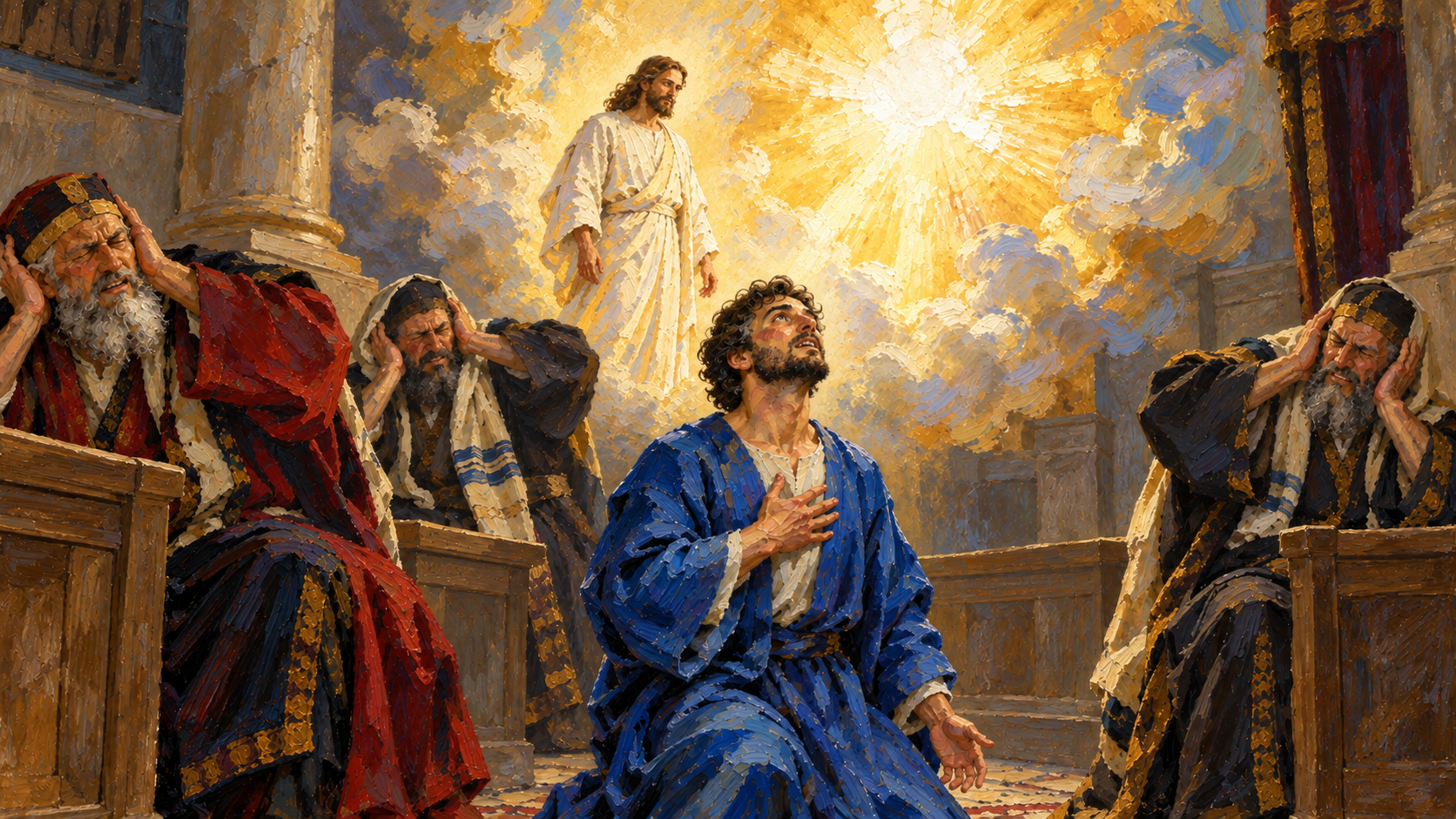
Stephen saw this exalted Jesus while his hearers were furious at his testimony and rebuke. Filled with the Holy Spirit, he looked into heaven before those men put him to death by stoning.
But he, being full of the Holy Spirit, gazed into heaven and saw the glory of God, and Jesus standing at the right hand of God, and said, "Look! I see the heavens opened and the Son of Man standing at the right hand of God!" Then they cried out with a loud voice, stopped their ears, and ran at him with one accord; and they cast him out of the city and stoned him. And the witnesses laid down their clothes at the feet of a young man named Saul.
Stephen saw Jesus standing, which does not contradict the passages describing Him as seated. To be enthroned does not mean that the King can never rise. Some readers understand His standing as receiving and honoring Stephen; others see Him acting as Stephen’s advocate or rising to judge his persecutors. The passage records the posture without telling us which explanation accounts for it.
What we can see plainly is Stephen’s confidence in the living Son of Man. As the men stoned him, he entrusted his spirit to Jesus, then knelt and asked mercy for his killers. Christ received His servant, whose death did not add another saving sacrifice to the cross. Stephen’s prayer echoed the Lord’s while he bore witness to the One who alone died for sins.
Stephen was killed while Jesus reigned, so we must not read Psalm 110 as a promise that every enemy will stop acting immediately. Its footstool pictures decisive royal conquest, the complete subjection of His enemies that still lies ahead. Until then, Satan deceives, nations resist Christ, and persecutors harm believers. Sin continues to wound people’s lives, and death takes them to the grave. The psalm describes Christ waiting for the appointed time when His enemies will be subjected to Him. Their present activity cannot overturn His authority.
Christ will return bodily and reign on earth, and His victory will ultimately include the destruction of death itself. The dead will be raised, and every creature will be held accountable. Revelation 20 places the final judgment of the unbelieving dead after the thousand-year reign. Verse 10 assigns endless torment to the devil, the beast, and the false prophet. Unbelieving human beings face the second death, the irreversible destruction of body and soul in Gehenna, the hell of final judgment. That punishment has an everlasting effect; human beings do not possess an inherent immortality that keeps them alive in conscious suffering forever.
Living Under the Authority of the Risen King
Ephesians 1 connects the power that raised Christ from the dead with His exaltation above every spiritual authority and every name in this age and the age to come. The same Christ has been given to the church as Head over everything. These spiritual powers are real creatures beneath Him, so occult practices, astrology, and claims about territorial spirits give us no reason to regard them as His equals. We answer evil by depending on God in prayer, holding to the truth, and living in obedience, without resorting to superstitious formulas.
Christ’s headship also sets limits on human authority. A pastor, church council, denomination, or civil ruler has no right to overrule His written Word, and someone claiming to speak as a prophet must submit that claim to Scripture. Whatever authority a person receives must be exercised under Christ. James and John needed correction when they sought an honored place beside Him.
Then James and John, the sons of Zebedee, came to Him, saying, "Teacher, we want You to do for us whatever we ask." And He said to them, "What do you want Me to do for you?" They said to Him, "Grant us that we may sit, one on Your right hand and the other on Your left, in Your glory." But Jesus said to them, "You do not know what you ask. Are you able to drink the cup that I drink, and be baptized with the baptism that I am baptized with?"
James and John understood that seats beside a king carried honor, but their request exposed ambition and a shallow grasp of the suffering ahead. Jesus directed them to what He would endure, then taught them to understand greatness through service. He contrasted the domination practiced by Gentile rulers with the way His followers should treat one another. The greatest must serve, and the first must become slave of all, following the Lord who gave His own life as a ransom for many.
Jesus did not call the left seat evil, because both places the brothers wanted carried honor. Those positions would be assigned according to God’s preparation, rather than secured by asking for rank over the other disciples. Their desire for that rank needed correction. A seating arrangement could expose their ambition, but it could not give them spiritual worth.
If I seek a church title or a public platform because I want recognition, I am approaching service with the same misplaced concern. Visibility and access to influential people are poor measures of faithfulness. The reigning Christ calls me to serve under His authority, not to compete for a place where others will notice me.
That call to faithful service includes trusting Christ when obedience brings suffering. Stephen died under the stones, apostles went to prison, and faithful churches have endured painful losses. We can grieve those losses and pray honestly without doubting the King’s authority. God’s right hand does not promise immediate comfort, wealth, political dominance, or exemption from persecution. It assures us that His strength cannot fail, Christ’s sacrifice is complete, and no enemy can finally keep His people from Him. Through bodily resurrection, He will overcome even death’s hold.
We therefore approach the Father in Christ’s name with reverence and assurance. We ask according to His will, leave the timing with Him, and obey what He has already made clear. Faith rests in the living Lord who intercedes and reigns; it does not try to make Him serve our wishes through a formula.
My Final Thoughts
God’s right hand describes His strength, help, or royal honor as each passage requires, and Psalm 110 directs me to the risen Son who holds that exalted place. His sacrifice is complete, He intercedes for His people, and His reign will bring every enemy beneath His feet. I can therefore bring my need to the Father without pretending to control His answer. I also need to serve without competing for recognition, trusting the King whose care reaches beyond the trouble I face and even beyond death itself.