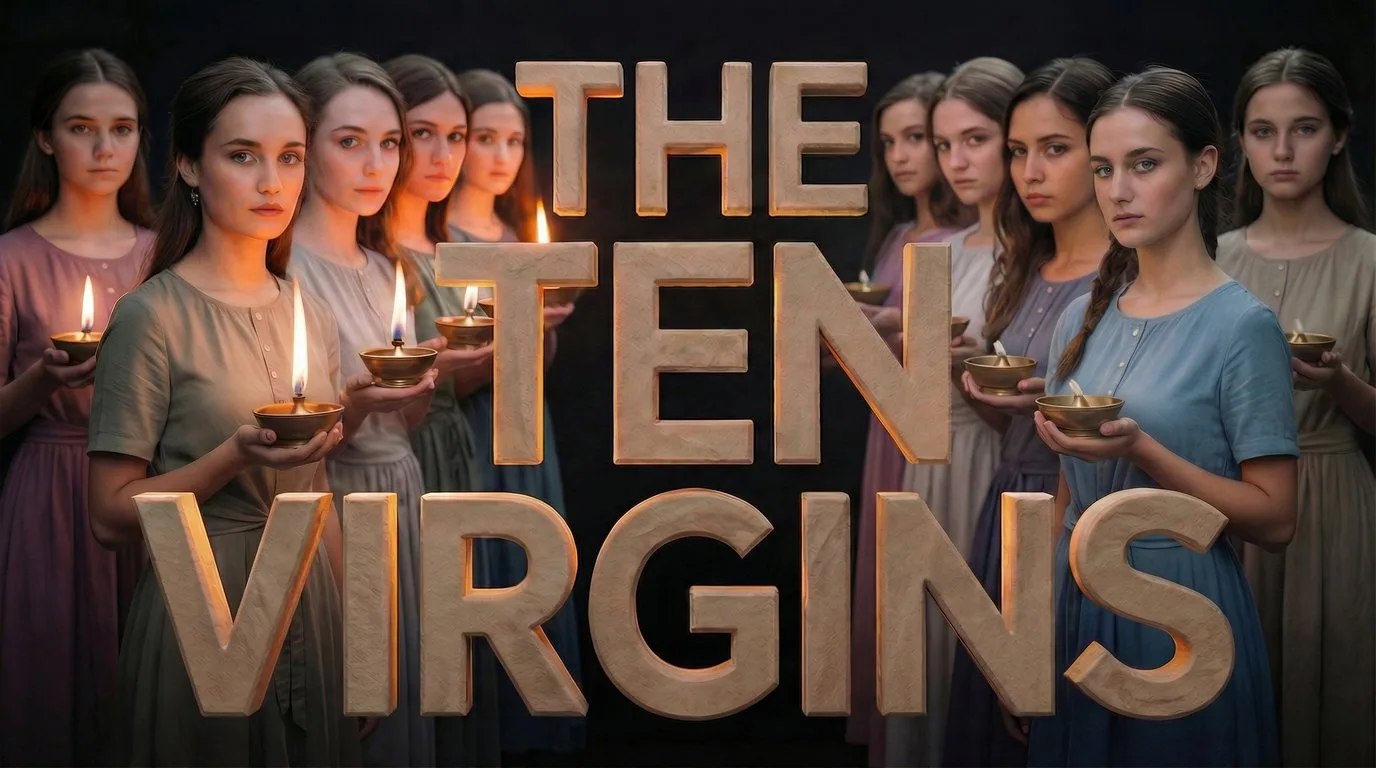

Jesus’ parable of the ten virgins in Matthew 25:1-13 is one of the clearest calls in Scripture for professing believers to examine whether their readiness for Christ’s return is real. It is not a parable meant to satisfy curiosity about end-times details as much as it is a loving warning that outward association with the people of God is not the same as inward spiritual life.
In this study we will walk through the parable carefully, paying attention to the immediate context in Matthew 24-25, the key symbols Jesus uses, and the way the rest of Scripture helps us interpret those symbols. The goal is not to speculate, but to understand what Jesus is teaching, and then to respond with faith, vigilance, and practical obedience as we await our Bridegroom.
The Parable In Its Setting
Jesus introduces the parable of the ten virgins in Matthew 25:1–13, saying, “Then the kingdom of heaven shall be likened to ten virgins who took their lamps and went out to meet the bridegroom.” These virgins symbolize believers awaiting Christ’s return, just as the Church awaits her Bridegroom. This imagery echoes Revelation 19:7–9, where we see the marriage supper of the Lamb and the bride (the Church) clothed in fine linen. The lamps in their hands signify their outward profession of faith, visible to the world as they prepare to meet the bridegroom.
It is important to notice the first word of the parable: “Then.” Jesus is not speaking in a vacuum. Matthew 25 flows directly out of the Olivet Discourse in Matthew 24, where Christ speaks of His coming, the deception that will surround that season, and the need for watchfulness. He has already said that the day and hour are unknown (Matthew 24:36), that His coming will be sudden and dividing (Matthew 24:40-41), and that His servants will be evaluated on faithfulness (Matthew 24:45-51). The parable of the ten virgins continues the same burden: be ready, not merely informed.
“Watch therefore, for you do not know what hour your Lord is coming. But know this, that if the master of the house had known what hour the thief would come, he would have watched and not allowed his house to be broken into. Therefore you also be ready, for the Son of Man is coming at an hour you do not expect.” (Matthew 24:42–44)
Those words form the atmosphere of Matthew 25. Jesus is pressing His disciples toward a posture of readiness that remains steady even when time stretches longer than expected. The parable does not begin with enemies outside the wedding, but with attendants who are invited and included in the procession. That detail is part of what makes the warning so searching. The danger is not only atheism, or hostility, or obvious rebellion. The danger Jesus highlights is a kind of religious nearness that still fails to endure to the end.
The Wedding Imagery And First-Century Background
To feel the force of the story, it helps to understand a bit of the wedding custom Jesus is drawing from. In a typical Jewish wedding celebration, there would be a betrothal period followed later by a time when the bridegroom would come, often at night, to bring the bride to the wedding feast. Friends and attendants would join the procession, carrying lamps to light the way and to honor the bridegroom. The timing could be uncertain, and delays were not unheard of. That uncertainty is essential to the parable. Jesus is teaching about a coming that is certain but not scheduled according to human expectation.
The virgins, then, are not pictured as strangers who show up without invitation. They are part of the bridal party. They are associated with the event and appear to share a common purpose: they “went out to meet the bridegroom.” In that sense, they resemble people who have heard the gospel, identified with the community of faith, and taken their place among those who claim to be awaiting Christ. Yet the story makes clear that proximity to the wedding is not the same as preparedness for it.
Ten Virgins, One Company, Two Conditions
Jesus divides the group into two kinds: five wise and five foolish. The difference is not described in terms of enthusiasm, nor in terms of orthodoxy, nor in terms of public association. They all have lamps. They all go out. They all anticipate the bridegroom. They all, as the story develops, become drowsy and sleep. The distinguishing mark is what they carry besides the lamp: the wise took oil in their vessels, the foolish did not.
This is an important observation for careful Bible reading. If sleep alone were the decisive issue, then all ten would be condemned, because all ten sleep. But Jesus does not condemn them equally. He shows that in a delayed season, outward sameness can mask inward difference. Two people can sit in the same church, sing the same songs, affirm the same truths, and yet have a different spiritual condition when the moment of testing arrives. The parable is not designed to make us suspicious of others in a cynical way, but to make us sober about our own spiritual reality before God.
The Lamps As Visible Profession
Jesus says they “took their lamps.” In the ancient world, these were small clay lamps or torches that required fuel to burn. A lamp without oil could be carried in the hand and still look like a lamp, but it could not fulfill its purpose when darkness came. In the same way, a person can carry the external markers of faith and still lack the inner reality that sustains endurance. Scripture consistently warns about this distinction between appearance and life.
Jesus rebuked religious leaders who honored God with their lips while their heart was far from Him (Matthew 15:8). He warned that many would say “Lord, Lord” and yet be unknown to Him (Matthew 7:21–23). Paul described a form of godliness that denies its power (2 Timothy 3:5). None of these passages exist to produce despair, but to call us to a faith that is more than a label. The lamp is what others can see: confession, participation, public identity. The oil speaks to what only God can truly measure: the genuine life of the Spirit in a person, evidenced over time by persevering faith and obedience.
What Does The Oil Represent?
Interpreters through church history have sometimes attempted to assign the oil to a specific Christian work, such as good deeds, or prayer, or Scripture knowledge. While those practices matter deeply, the parable itself points us toward something more foundational. The oil is not merely an action, but a supply of life that enables the lamp to burn when the delay becomes long and the hour becomes late.
In the broader sweep of Scripture, oil frequently functions as a symbol connected with the Holy Spirit and consecration. Kings and priests were anointed with oil as a sign of being set apart for God, and the Spirit’s empowering presence is often linked to such anointing. Zechariah’s vision of the lampstand fed by olive trees concludes with God’s declaration, “Not by might nor by power, but by My Spirit” (Zechariah 4:6). In the New Testament, the Spirit is given to believers as the One who indwells, seals, and sustains them (Ephesians 1:13–14). The Spirit produces fruit over time (Galatians 5:22–23), and He keeps believers clinging to Christ rather than simply carrying religious habits.
So while we should not flatten the parable into a one-word equation, the oil most naturally points to the inward reality of the Spirit-given life. It is the difference between a faith that is merely carried and a faith that is living and enduring. The wise have not only a lamp but a reserve, not only an outward identity but an inward supply. That reserve does not mean they are stronger in themselves. It means they have what the Bridegroom provides, received truly, kept truly, and proven over time.
The Delay Of The Bridegroom
Jesus says, “But while the bridegroom was delayed, they all slumbered and slept.” The delay is not an accident in the story. It is the point where superficial readiness is exposed. Many people can live faithfully for a short sprint. The deeper test is the slow passage of time, the ordinary years, the repeated disappointments, the prayers that seem unanswered, the rhythms of life that dull spiritual urgency. The delay is where many lamps begin to sputter.
In Matthew 24, Jesus already addressed this danger in the parable of the evil servant who says in his heart, “My master is delaying his coming” (Matthew 24:48). The problem was not the master’s actual timing, but the servant’s internal conclusion that delay equals permission. Jesus exposes that reasoning as deadly. Delay is not cancellation. Delay is not indifference. Delay is mercy, because God is patient, not willing that any should perish but that all should come to repentance (2 Peter 3:9). Yet that same patience becomes a test. What will we do with the time between promise and fulfillment?
“At Midnight” And The Sudden Cry
Jesus continues, “And at midnight a cry was heard: ‘Behold, the bridegroom is coming; go out to meet him!’” Midnight is the least convenient time. It underscores that the coming of Christ will not fit human schedules. It also suggests that the return will break into a world spiritually dark, a time when many are least alert. The cry is loud, public, undeniable. Whatever private assumptions people have been living with, the announcement shatters them. The moment of decision arrives.
When the cry comes, all ten virgins rise and trim their lamps. Again, the similarity is striking. The foolish do not refuse to get up. They are not portrayed as openly rebellious. They respond to the announcement. Yet their response cannot overcome what they neglected in advance. Preparedness for Christ’s coming is not something that can be improvised in the last minute. It is formed over a lifetime of receiving grace, walking in the light, returning quickly when we stumble, and cultivating a real relationship with the Lord.
“Our Lamps Are Going Out”
The foolish say, “Give us some of your oil, for our lamps are going out.” Their lamps had some initial flame, enough to join the group and perhaps to look like everyone else for a while. But now, under the strain of the long wait and the sudden demand of the moment, the lack becomes visible. This is one of the most sobering dynamics in spiritual life. A person can burn brightly for a season on borrowed momentum, on the energy of a new experience, on the strength of community expectations, on emotional uplift. But the long haul reveals what is real.
The wording also suggests that the foolish only realize the seriousness of their condition when the cry is heard. That is part of the tragedy. They are not atheists; they are late awakeners. They are those who assumed they could carry a lamp without carrying oil, that they could remain connected to the wedding without maintaining readiness for it. The parable is a mercy because it warns us now, before midnight, to examine ourselves while there is still time to seek the Lord.
Why The Wise Cannot Share Their Oil
The wise answer, “No, lest there should not be enough for us and you; but go rather to those who sell, and buy for yourselves.” At first glance, this can sound unkind. But Jesus is not teaching selfishness. He is teaching personal spiritual reality. Some things cannot be transferred. Another person’s faith cannot substitute for yours. Another person’s intimacy with God cannot be borrowed at the last moment. Parents cannot lend their salvation to their children. A spouse cannot share saving faith as if it were a physical commodity. A church cannot distribute genuine new birth through mere attendance.
The wise refusal also underscores that the time for obtaining oil is before the procession begins. The foolish are sent to “buy,” not because salvation is purchased by human merit, but because the story is using marketplace language to stress urgency and personal responsibility. Scripture is clear that eternal life is the gift of God, not of works (Ephesians 2:8–9). Yet Scripture is also clear that we are commanded to repent and believe the gospel, to come to Christ, to receive, to abide. Those commands do not contradict grace. They describe the way grace is received.
Isaiah uses similar language when he calls the thirsty to come and buy without money and without price (Isaiah 55:1). The point is not that we earn, but that we must come. There is a real transaction of trust and surrender, a real receiving of Christ, a real entering into covenant life with Him. The foolish, in the parable, try to secure what they neglected, but the timing is wrong. They waited until the crisis to seek what should have been sought in the calm.
The Closed Door
Jesus says that while the foolish went to buy, the bridegroom came, and those who were ready went in with him to the wedding, “and the door was shut.” That sentence carries enormous weight. The door is not shut because God delights in excluding. The door is shut because history moves toward a real consummation. Mercy has a window. Patience has a purpose. Judgment is not a myth. At the return of Christ, the opportunity to prepare ends and the reality of our condition is made manifest.
This theme appears throughout Scripture. In Noah’s day, the ark door was shut and the flood came (Genesis 7:16). In Jesus’ teaching, there is a narrow door, and many will seek to enter and will not be able because they delayed until it was too late (Luke 13:24–28). The closed door is meant to awaken us. Many modern people want a universe where every door remains open forever. Jesus teaches that the kingdom has a decisive moment. The Bridegroom truly comes. The wedding truly begins. The story of redemption reaches its public completion.
“Lord, Lord, Open To Us”
The foolish return and cry, “Lord, Lord, open to us!” They use respectful language. They appear earnest. But their plea is late and their relationship is unproven. The Bridegroom answers, “Assuredly, I say to you, I do not know you.” This echoes the earlier warning in Matthew 7, where Jesus speaks of those who prophesied and did wonders, yet He declares, “I never knew you.” The issue is not that the Lord lacked information about them. It is relational knowledge. Covenant knowledge. The knowledge of belonging.
This is the point where the parable confronts every hearer with a personal question: do you know Christ, and are you known by Him? Not in the sense of being aware of Christian facts, but in the sense of having come to Him for salvation, trusting Him, confessing Him, and abiding in Him. Jesus describes eternal life as knowing the only true God and Jesus Christ whom He has sent (John 17:3). That knowledge is not mere data. It is life-giving union and relationship.
The foolish assumed that being near the wedding party was enough. They assumed that carrying a lamp was enough. They assumed that calling Him “Lord” would be enough. Jesus says there is a kind of closeness that still misses the heart of the matter. It is possible to participate in religious activities and still not have the inward life of God. The warning is not meant to paralyze believers with endless doubt, but to prevent complacency and to call nominal Christians to real conversion.
“Watch Therefore”
Jesus ends, “Watch therefore, for you know neither the day nor the hour in which the Son of Man is coming.” Watchfulness is the conclusion, but we must define it rightly. Watchfulness is not frantic date-setting. It is not obsessing over headlines. It is not living in constant fear. Biblical watchfulness is sustained spiritual attentiveness, a life ordered around the reality that Christ will return, that we will give account, and that our present choices matter.
In Matthew 24 and 25, Jesus pairs watchfulness with faithfulness. The watchful servant is the one who keeps doing what the master assigned. The wise virgin is the one who carries oil through the delay. Watchfulness is therefore deeply practical. It includes repentance that stays current, faith that stays active, hope that stays anchored, love that stays warm, and obedience that stays sincere. It means refusing to let delay erode devotion.
How This Parable Relates To Assurance
Some readers fear that the parable teaches a believer can lose salvation at the last minute. Others fear that the parable creates insecurity that undermines joy. We need to read it in harmony with the whole counsel of God. Scripture teaches that those who are truly born of God are kept by God’s power through faith (1 Peter 1:5). Jesus declares that none can snatch His sheep from His hand (John 10:28). At the same time, Scripture teaches that genuine faith perseveres, and that perseverance is one of the evidences of reality. John writes that some departed from the fellowship because they were not truly of it (1 John 2:19). Jesus teaches that some receive the word with joy but have no root and fall away under pressure (Matthew 13:20–21).
The parable of the ten virgins fits within that pattern. It does not depict five people who were truly ready and then became unready. It depicts five who were never truly supplied. They carried lamps but lacked oil. The story is a warning against a false assurance that rests on externals, and it is also an encouragement that true readiness can endure the delay. The wise are not portrayed as superhuman. They get sleepy too. But they have what sustains them when the midnight cry comes.
The Danger Of Living On Borrowed Light
One of the more subtle lessons of the parable is that spiritual life cannot be maintained indefinitely on borrowed light. Borrowed light can come from the Christian environment. It can come from family heritage, from church culture, from friendships, from routines, from public expectations. All of these can be blessings, and God often uses them. Yet none of them can substitute for personal faith and the inward work of the Spirit.
Jesus’ parable pushes us to ask whether our lamp is burning from inward oil or merely from outward proximity. When life becomes painful, when prayers feel unanswered, when temptation grows stronger, when social pressure increases, borrowed light often fades. In those seasons, what remains is what is real. The wise are those whose relationship with Christ is not merely social, but spiritual. They have learned to go to Him, to confess sin, to receive mercy, to feed on His word, to pray, to obey, and to be renewed.
Readiness And Daily Repentance
Readiness is not the claim that we never fail. The wise virgins are not said to be morally flawless. The parable is not about achieving sinless perfection before Christ returns. It is about being truly His, and living in a way that aligns with that reality. That includes a lifestyle of repentance, because repentance is not only the doorway into the kingdom but the ongoing posture of citizens of the kingdom.
When we repent quickly, we are not trying to keep God from loving us. We are returning to the One who already loves us in Christ. We are keeping our fellowship clear. We are refusing the slow drift that turns small compromises into hardened habits. One of the ways oil is “kept” is by not grieving the Holy Spirit through persistent, cherished sin. Paul exhorts believers not to grieve the Spirit (Ephesians 4:30), and to walk by the Spirit rather than fulfilling the desires of the flesh (Galatians 5:16). That walk is not a single emotional moment. It is a daily orientation.
The Parable And The Next Parables
Matthew 25 does not stop with the ten virgins. Jesus immediately follows with the parable of the talents (Matthew 25:14–30) and then the picture of the final judgment (Matthew 25:31–46). This sequence helps us interpret the virgins correctly. Readiness is not passive. The talents emphasize faithful stewardship during the master’s absence. The judgment scene emphasizes that true allegiance to Christ is revealed in how we treat “the least of these,” showing that faith expresses itself in love and obedience.
So the ten virgins warn against being unprepared, the talents warn against being idle, and the judgment scene warns against a loveless religion. Together they present a full picture: waiting for Christ is not sitting still. It is living faithfully, doing the will of God, serving with what we have been given, and keeping our hearts awake to the reality of His appearing.
My Final Thoughts
The parable of the ten virgins is both a warning and a gift. It warns us that outward association with the people of God is not the same as being inwardly prepared to meet Christ, and it gifts us with clarity about what truly matters before the midnight cry is heard. Jesus does not tell this story to make tender consciences hopeless, but to expose complacency and to invite us into a living readiness grounded in the Spirit and sustained through the delay.
As you wait for the Bridegroom, do not settle for carrying a lamp without oil. Come to Christ, abide in Him, and let the Spirit keep your faith burning with steady hope and sincere obedience. The cry will come, the door will close, and the wedding will begin, and those who are ready will find that the One they have waited for is more glorious than they imagined.

 Get the book that teaches you how to evangelize and disarm doctrines from every single major cult and religion.