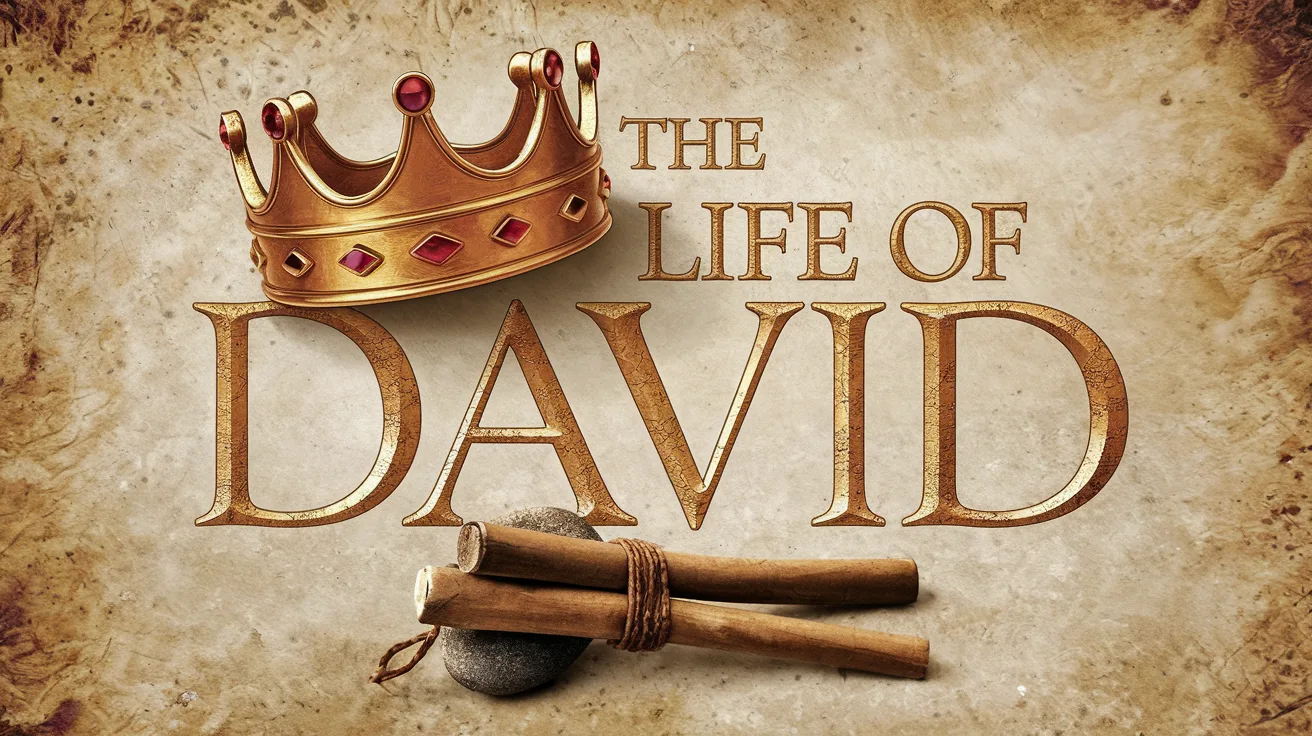

The life of David is one of the most extensive biographies in the Bible. From his youth as a shepherd to his death as Israel’s greatest king, David’s life spans more than forty chapters in 1 Samuel, 2 Samuel, 1 Chronicles, and the opening of 1 Kings. He is also the primary author of the Psalms, giving us inspired prayers and songs that flow out of real experiences. When we study David, we are not merely studying history; we are gazing into the heart of a man who, despite his failures, was called “a man after God’s own heart” (1 Samuel 13:14).
This study will guide you through every season of David’s life. It will not only recount the events but also draw lessons about faith, obedience, repentance, and the providence of God. Most importantly, it will point us to Jesus Christ, the ultimate Son of David, who fulfills every promise and hope seen in David’s life.
“And when He had removed him, He raised up for them David as king, to whom also He gave testimony and said, ‘I have found David the son of Jesse, a man after My own heart, who will do all My will.’”
(Acts 13:22)
The purpose of this study is not to glorify David, but to see the glory of God displayed in his life. His victories, his songs of worship, his moments of weakness, and his deep repentance all reveal that God delights in a heart that longs for Him above all else.
Where is David’s account found in scripture? Primarily in 1 Samuel 16:1 through 1 Kings 2:12, with summaries in 1 Chronicles and 2 Chronicles. His psalms are scattered throughout the book of Psalms, offering personal reflections during times of danger, triumph, and sorrow. As we move through this study, we will weave together the historical narrative and his poetic worship to understand David more fully.
| Event | Approx. Age | Scripture Reference |
|---|---|---|
| Birth in Bethlehem | ~1040 BC | 1 Samuel 16:1 |
| Anointed by Samuel | Teenager | 1 Samuel 16:13 |
| Defeats Goliath | ~17 years old | 1 Samuel 17 |
| Flees from Saul | 20s | 1 Samuel 19–31 |
| Becomes King of Judah | ~30 | 2 Samuel 2:4 |
| Becomes King of All Israel | ~37 | 2 Samuel 5:3 |
| Sin with Bathsheba | ~50 | 2 Samuel 11 |
| Census and Plague | Late in reign | 2 Samuel 24 |
| Death of David | ~70 | 1 Kings 2:10–11 |
David’s Beginnings: From Shepherd to Anointed
David’s account begins in the small town of Bethlehem. He was the youngest of Jesse’s eight sons, tending sheep in the fields while his older brothers carried more visible responsibilities. In human eyes, David was insignificant, but God saw what others did not: a heart devoted to Him.
The Lord Chooses David
Israel was in crisis. King Saul had disobeyed God and forfeited his kingdom. God sent the prophet Samuel to Bethlehem to anoint a new king from among Jesse’s sons. Samuel assumed the eldest, Eliab, would be God’s choice, but the Lord corrected him:
“But the Lord said to Samuel, ‘Do not look at his appearance or at his physical stature, because I have refused him. For the Lord does not see as man sees; for man looks at the outward appearance, but the Lord looks at the heart.’”
(1 Samuel 16:7)
This verse is a cornerstone truth: God values character over appearance, heart over status. Samuel examined seven sons, but none were chosen. Then Jesse mentioned the youngest, out in the fields:
“So he sent and brought him in. Now he was ruddy, with bright eyes, and good-looking. And the Lord said, ‘Arise, anoint him; for this is the one!’ Then Samuel took the horn of oil and anointed him in the midst of his brothers; and the Spirit of the Lord came upon David from that day forward.”
(1 Samuel 16:12–13)
Notice two key things: the anointing happened in private, and the Spirit of the Lord empowered David for what was ahead. God often prepares His servants in obscurity before bringing them into public view.
David the Shepherd
Before the throne came the pasture. David returned to tending sheep, a task that seemed small but was shaping his character. His experiences as a shepherd taught him courage, care, and dependence on God. Later, he would write:
“The Lord is my shepherd; I shall not want. He makes me to lie down in green pastures; He leads me beside the still waters. He restores my soul.”
(Psalm 23:1–3)
The same God who helped David lead sheep would later help him lead a nation. Shepherding was not wasted time; it was God’s training ground for kingship. In the quiet hills, David learned to worship. He composed songs that declared God’s glory:
“The heavens declare the glory of God; and the firmament shows His handiwork. Day unto day utters speech, and night unto night reveals knowledge.”
(Psalm 19:1–2)
Leadership begins in hidden places. Our faithfulness in small things determines our readiness for greater responsibilities. David’s private devotion preceded his public calling.
David in Saul’s Service
Not long after his anointing, David was summoned to play the harp for King Saul, who was tormented by a distressing spirit. Scripture says:
“And so it was, whenever the spirit from God was upon Saul, that David would take a harp and play it with his hand. Then Saul would become refreshed and well, and the distressing spirit would depart from him.”
(1 Samuel 16:23)
This seemingly small role placed David in the royal court, preparing him for the future. He served humbly, even though he had been anointed to replace Saul. David’s patience here is remarkable. He did not push for the throne; he trusted God’s timing.
This teaches us that before David ever faced Goliath or sat on a throne, he learned to trust and obey God in the simple, hidden tasks. That is where every true servant of God begins.
David and Goliath: A Heart of Faith
1 Samuel 17 is one of the most famous in all of Scripture: a young shepherd faces a seasoned warrior with nothing but a sling and faith in God. This moment defines David’s character and demons/”>demonstrates what it means to trust the Lord against overwhelming odds. But this is more than a children’s story about courage. It is a lesson in spiritual warfare, humility, and reliance on God’s power.
The Challenge of Goliath
Israel and the Philistines stood on opposite hills with a valley between them. Goliath, a giant nearly nine feet tall, stepped forward every day for forty days, mocking Israel and defying the armies of God. The Bible describes him in detail:
“And a champion went out from the camp of the Philistines, named Goliath, from Gath, whose height was six cubits and a span. He had a bronze helmet on his head, and he was armed with a coat of mail, and the weight of the coat was five thousand shekels of bronze.”
(1 Samuel 17:4–5)
This description emphasizes the impossibility of victory through human strength. Saul and all Israel were “dismayed and greatly afraid” (1 Samuel 17:11). Fear paralyzed the army of God. Then David entered the scene, sent by his father to bring food to his brothers. He heard Goliath’s defiance and asked a question that revealed his perspective:
“Who is this uncircumcised Philistine, that he should defy the armies of the living God?”
(1 Samuel 17:26)
David saw what others missed: this was not merely a military challenge; it was a spiritual one. Goliath was mocking the God of Israel, and David’s faith burned with holy indignation.
David’s Faith and Saul’s Doubt
When David volunteered to fight, Saul tried to dissuade him, pointing out his youth and inexperience. But David’s confidence was rooted not in himself but in God’s past faithfulness:
“Your servant has killed both lion and bear; and this uncircumcised Philistine will be like one of them, seeing he has defied the armies of the living God. The Lord, who delivered me from the paw of the lion and from the paw of the bear, He will deliver me from the hand of this Philistine.”
(1 Samuel 17:36–37)
Faith does not ignore reality; it remembers God’s power in past trials and trusts Him for the present. Saul agreed and offered his armor, but David refused:
“I cannot walk with these, for I have not tested them.” So David took them off.”
(1 Samuel 17:39)
David understood that victory would not come through human methods. He chose a sling and five smooth stones, ordinary weapons for a shepherd, but powerful in God’s hand.
The Battle in the Valley
The confrontation between David and Goliath is dramatic and full of spiritual insight. Goliath mocked David, but David declared the source of his confidence:
“Then David said to the Philistine, ‘You come to me with a sword, with a spear, and with a javelin. But I come to you in the name of the Lord of hosts, the God of the armies of Israel, whom you have defied. This day the Lord will deliver you into my hand, and I will strike you and take your head from you… that all the earth may know that there is a God in Israel. Then all this assembly shall know that the Lord does not save with sword and spear; for the battle is the Lord’s, and He will give you into our hands.’”
(1 Samuel 17:45–47)
Those words echo through history: “The battle is the Lord’s.” David ran toward Goliath, slung a stone, and struck the giant in the forehead. The enemy fell face down on the ground. Scripture records the victory plainly:
“So David prevailed over the Philistine with a sling and a stone, and struck the Philistine and killed him. But there was no sword in the hand of David.”
(1 Samuel 17:50)
The lesson is clear: God delights to use the weak to confound the mighty (1 Corinthians 1:27). The victory was not in the stone but in the God who guided it.
Theological Insights from This Event
This event foreshadows Christ, the greater Son of David, who faced an enemy we could never defeat: sin and death. Like David, Jesus stood alone, seemingly weak, yet triumphed through the power of God. When David declared, “that all the earth may know that there is a God in Israel,” he spoke a truth that reaches its ultimate fulfillment in Christ’s victory at the cross.
For believers today, the principle remains: the battle belongs to the Lord. Whatever obstacles confront us: fear, temptation, opposition; Our hope is not in human strength but in God’s power and promises.
This victory launched David into national prominence, but it also set the stage for years of testing. His triumph over Goliath would lead to Saul’s jealousy and relentless pursuit, ushering in one of the most challenging seasons of David’s life.
David and Saul: Trials and Waiting
After the victory over Goliath, David’s life changed dramatically. He went from obscurity to national fame in a single day. The people sang his praises, and Saul brought him into his court. But this newfound honor also brought envy, betrayal, and years of hardship. David’s time in Saul’s service would teach him patience, humility, and unwavering trust in God’s timing.
David’s Rise and Saul’s Jealousy
Following Goliath’s defeat, Saul placed David over his army, and his success was undeniable. Scripture records:
“So David went out wherever Saul sent him, and behaved wisely; and Saul set him over the men of war, and he was accepted in the sight of all the people and also in the sight of Saul’s servants.”
(1 Samuel 18:5)
But David’s popularity soon stirred Saul’s jealousy. As the women of Israel sang in celebration, Saul’s heart turned bitter:
“So the women sang as they danced, and said: ‘Saul has slain his thousands, and David his ten thousands.’ Then Saul was very angry, and the saying displeased him; and he said, ‘They have ascribed to David ten thousands, and to me they have ascribed only thousands. Now what more can he have but the kingdom?’ So Saul eyed David from that day forward.”
(1 Samuel 18:7–9)
This envy grew into murderous intent. Twice Saul hurled a spear at David (1 Samuel 18:11), and repeatedly sought to kill him. Yet through every plot, God protected David.
Jonathan’s Covenant of Loyalty
In the midst of Saul’s hostility, David found an extraordinary friend in Jonathan, Saul’s son. Their bond was marked by selfless love and covenant faithfulness:
“Then Jonathan and David made a covenant, because he loved him as his own soul. And Jonathan took off the robe that was on him and gave it to David, with his armor, even to his sword and his bow and his belt.”
(1 Samuel 18:3–4)
This act symbolized Jonathan’s recognition of God’s hand on David. Despite being the heir to Saul’s throne, Jonathan chose loyalty to God’s plan over personal ambition. Later he reassured David:
“Do not fear, for the hand of Saul my father shall not find you. You shall be king over Israel, and I shall be next to you. Even my father Saul knows that.”
(1 Samuel 23:17)
The friendship between David and Jonathan stands as one of the purest examples of covenant love in Scripture, reflecting Christlike humility and devotion.
David Flees and Finds Refuge in God
As Saul’s attempts intensified, David became a fugitive. From Gibeah to the wilderness of Ziph and the caves of Adullam, he lived on the run for years. During this time, David wrote many psalms, pouring out his soul to God. One such prayer likely came from these caves:
“Be merciful to me, O God, be merciful to me! For my soul trusts in You; and in the shadow of Your wings I will make my refuge, until these calamities have passed by.”
(Psalm 57:1)
Even while hunted, David’s faith never wavered. He refused to take matters into his own hands, waiting for God to fulfill His promise.
David Spares Saul Twice
The clearest evidence of David’s integrity is seen in two pivotal moments when he had the opportunity to kill Saul but chose mercy instead.
The First Opportunity – The Cave at En Gedi:
“And the men of David said to him, ‘This is the day of which the Lord said to you, “Behold, I will deliver your enemy into your hand, that you may do to him as it seems good to you.”’ And David arose and secretly cut off a corner of Saul’s robe.”
(1 Samuel 24:4)
David restrained his men and explained why he would not harm Saul:
“The Lord forbid that I should do this thing to my master, the Lord’s anointed, to stretch out my hand against him, seeing he is the anointed of the Lord.”
(1 Samuel 24:6)
The Second Opportunity – The Camp at Ziph:
Again David spared Saul’s life, taking his spear and water jug as evidence (1 Samuel 26:7–11).
“But David said to Abishai, ‘Do not destroy him; for who can stretch out his hand against the Lord’s anointed, and be guiltless?’ David said furthermore, ‘As the Lord lives, the Lord shall strike him, or his day shall come to die, or he shall go out to battle and perish. The Lord forbid that I should stretch out my hand against the Lord’s anointed. But please, take now the spear and the jug of water that are by his head, and let us go.’”
(1 Samuel 26:9–11)
In both cases, David honored God’s authority by refusing to kill the king, even though Saul sought his life.
This period of testing was long and painful, but it shaped David into the king God wanted him to be. Suffering deepened his dependence on the Lord and refined his heart. The next chapter of his life would bring triumph as Saul fell and David ascended to the throne.
The Friendship of David and Jonathan: A Covenant of Loyalty and Love
Among the many relationships in David’s life, none is more remarkable than his friendship with Jonathan, the son of Saul. In a world where royal succession often led to rivalry and bloodshed, Jonathan’s devotion to David shines as a testimony to covenant love and humility. Their bond teaches us about loyalty, sacrificial friendship, and ultimately points to Christ’s love for His people.
The Birth of a Covenant Friendship
The friendship between David and Jonathan began immediately after David’s victory over Goliath. Scripture tells us:
“Now when he had finished speaking to Saul, the soul of Jonathan was knit to the soul of David, and Jonathan loved him as his own soul. Saul took him that day, and would not let him go home to his father’s house anymore. Then Jonathan and David made a covenant, because he loved him as his own soul.”
(1 Samuel 18:1–3)
The phrase “knit to the soul” speaks of a deep spiritual bond. This was not a superficial acquaintance but a covenantal relationship based on mutual faith in the Lord and shared commitment to His purposes. Jonathan saw in David the anointing of God and responded with humility and honor.
Jonathan’s Act of Surrender
Jonathan, as the heir to Saul’s throne, could have viewed David as a threat. Instead, he demonstrated incredible humility by symbolically laying down his claim to kingship:
“And Jonathan took off the robe that was on him and gave it to David, with his armor, even to his sword and his bow and his belt.”
(1 Samuel 18:4)
In ancient culture, robes and weapons represented identity, authority, and inheritance. By giving these to David, Jonathan was acknowledging God’s plan and surrendering his personal ambition. His loyalty was not self-serving; it was rooted in obedience to God’s will.
Loyalty Tested by Saul’s Rage
As Saul’s jealousy grew into murderous hatred, Jonathan remained steadfast in his friendship with David. When Saul plotted to kill David, Jonathan risked his own life to protect him:
“So Jonathan spoke well of David to Saul his father, and said to him, ‘Let not the king sin against his servant, against David, because he has not sinned against you, and because his works have been very good toward you.’”
(1 Samuel 19:4)
When Saul’s anger intensified, Jonathan devised a plan to warn David of impending danger. Their final meeting before David fled is one of the most moving moments in Scripture:
“Then they kissed one another; and they wept together, but David more so. Then Jonathan said to David, ‘Go in peace, since we have both sworn in the name of the Lord, saying, “May the Lord be between you and me, and between your descendants and my descendants, forever.”’”
(1 Samuel 20:41–42)
This covenant extended beyond their lifetimes. Later, David would honor this promise by showing kindness to Jonathan’s son, Mephibosheth (2 Samuel 9:7), demonstrating the enduring power of covenant faithfulness.
The Death of Jonathan and David’s Lament
Jonathan died alongside Saul in battle against the Philistines (1 Samuel 31). When David heard the news, his grief was profound. His lament, recorded in 2 Samuel 1, reflects the depth of their bond:
“I am distressed for you, my brother Jonathan; you have been very pleasant to me; your love to me was wonderful, surpassing the love of women.”
(2 Samuel 1:26)
This verse has often been misunderstood, but it simply expresses the rare, sacrificial nature of their friendship. A love marked by loyalty, faithfulness, and covenant devotion. It is a love that mirrors the self-giving love of Christ.
Christ in the Covenant of Friendship
Jonathan’s love for David foreshadows Christ’s love for His people. Just as Jonathan laid down his royal robes, Jesus laid aside His glory to identify with us (Philippians 2:6–8). And just as Jonathan pledged his life for David, Christ gave His life for sinners (John 15:13). This friendship points us to the ultimate Friend who never fails.
In an age of shallow connections, the account of David and Jonathan challenges us to pursue relationships grounded in truth, loyalty, and sacrificial love. It calls us to be covenant-keepers in a world of convenience.
David as King: Triumph, the Ark, and the Davidic Covenant
After years of hardship and waiting, the word of the Lord was fulfilled: David ascended to the throne of Israel. His path had been long and marked by suffering, but now God’s promise came to pass. David’s kingship was characterized by victories, worship, and the establishment of a covenant that would shape the rest of redemptive history.
The Coronation of David
Following the death of Saul and Jonathan, David mourned deeply (2 Samuel 1:17–27). His lament for Saul and Jonathan reflects both honor and humility, showing that David did not rejoice in Saul’s downfall. After a time of mourning, David inquired of the Lord and was anointed king over Judah in Hebron (2 Samuel 2:1–4). Seven years later, all Israel recognized him as king:
“Then all the tribes of Israel came to David at Hebron and spoke, saying, ‘Indeed we are your bone and your flesh… Also the Lord said to you, “You shall shepherd My people Israel, and be ruler over Israel.”’ So all the elders of Israel came to the king at Hebron, and King David made a covenant with them at Hebron before the Lord. And they anointed David king over Israel.”
(2 Samuel 5:1–3)
David’s reign began in Hebron and then moved to Jerusalem, which he captured and established as his capital (2 Samuel 5:6–9). This city would become the center of worship and the future site of the temple.
Bringing the Ark to Jerusalem
One of David’s greatest desires was to honor the Lord by bringing the Ark of the Covenant to Jerusalem. This event underscores David’s heart for worship and the centrality of God’s presence among His people.
“So David went and brought up the ark of God from the house of Obed-Edom to the City of David with gladness. And so it was, when those bearing the ark of the Lord had gone six paces, that he sacrificed oxen and fatted sheep. Then David danced before the Lord with all his might.”
(2 Samuel 6:12–14)
David’s exuberant worship was an expression of gratitude and humility. He recognized that the true King of Israel was the Lord Himself. This joyful procession marked a spiritual high point in the nation, yet David longed for something more permanent: a house for the Lord.
The Desire to Build a Temple
David’s passion for God’s glory led him to propose building a permanent temple for the Lord. Having brought the Ark of the Covenant into Jerusalem and established the city as the center of worship, David longed to replace the tabernacle with a magnificent house for God. However, God had a greater plan, one that would reveal His authority and His grace. Through the prophet Nathan, God spoke these words to David:
“Go and tell My servant David, ‘Thus says the Lord: Would you build a house for Me to dwell in? For I have not dwelt in a house since the time that I brought the children of Israel up from Egypt, even to this day, but have moved about in a tent and in a tabernacle. Wherever I have moved about with all the children of Israel, have I ever spoken a word to anyone from the tribes of Israel, whom I commanded to shepherd My people Israel, saying, “Why have you not built Me a house of cedar?”’”
(2 Samuel 7:5–7)
This divine response shifts the perspective entirely. While David wanted to build a house for God, the Lord declared that He would build a house for David, a royal dynasty that would endure forever. This remarkable promise is known as the Davidic Covenant, one of the most significant covenants in all of Scripture.
The Davidic Covenant
God’s covenant with David is recorded in 2 Samuel 7. This covenant established the foundation for Israel’s hope and points directly to the Messiah. Here is the heart of that promise:
“Also the Lord tells you that He will make you a house. When your days are fulfilled and you rest with your fathers, I will set up your seed after you, who will come from your body, and I will establish his kingdom. He shall build a house for My name, and I will establish the throne of his kingdom forever… And your house and your kingdom shall be established forever before you. Your throne shall be established forever.”
(2 Samuel 7:11–13, 16)
In this moment, God transforms David’s desire into a covenant promise that points far beyond a physical temple. While Solomon would build the temple, the eternal throne would be fulfilled in Christ, the Son of David, whose kingdom has no end.
Unlike the Mosaic Covenant, which was conditional, the Davidic Covenant is unconditional in its ultimate fulfillment. Individual kings could be disciplined for disobedience, but the promise of an eternal throne stood firm because it rested on God’s faithfulness.
Christ, the Son of David
The Davidic Covenant finds its ultimate fulfillment in Jesus Christ. The angel Gabriel announced to Mary:
“And behold, you will conceive in your womb and bring forth a Son, and shall call His name JESUS. He will be great, and will be called the Son of the Highest; and the Lord God will give Him the throne of His father David. And He will reign over the house of Jacob forever, and of His kingdom there will be no end.”
(Luke 1:31–33)
Jesus is not only legally the Son of David through Joseph (Matthew 1:1–16) but also physically descended from David through Mary, who came from David’s line (Luke 3:31). Paul affirms this truth when he writes:
“Concerning His Son Jesus Christ our Lord, who was born of the seed of David according to the flesh.”
(Romans 1:3)
This means the Davidic promise is fulfilled perfectly in Christ. What began as a covenant with a shepherd-king in Jerusalem finds its climax in the reign of Christ, the Shepherd-King of all creation. He is the Root and the Offspring of David, the bright and morning star (Revelation 22:16). His kingdom shall never end.
David’s reign marked a golden age for Israel, but it was only a shadow of the greater kingdom to come. This covenant is a cornerstone of redemptive history, reminding us that God’s plan is bigger than any human dream.
David’s Failures: Sin, Repentance, and Consequences
Even a man after God’s own heart is not immune to sin. David’s life, marked by great faith and worship, also includes moments of deep failure. These failures remind us that sin has consequences, even for God’s anointed, and that restoration comes only through confession and grace. This section focuses on David’s two most significant sins: his affair with Bathsheba and the census that brought judgment on Israel.
The Sin with Bathsheba
David’s greatest moral failure is recorded in 2 Samuel 11. At the time when kings went out to battle, David remained in Jerusalem. Idleness opened the door to temptation:
“Then it happened one evening that David arose from his bed and walked on the roof of the king’s house. And from the roof he saw a woman bathing, and the woman was very beautiful to behold. So David sent and inquired about the woman. And someone said, ‘Is this not Bathsheba, the daughter of Eliam, the wife of Uriah the Hittite?’”
(2 Samuel 11:2–3)
Despite knowing she was another man’s wife, David sent for Bathsheba and lay with her. When she conceived, David tried to cover his sin by recalling her husband from battle. When Uriah refused to go home out of loyalty to his fellow soldiers, David arranged his death in battle:
“Set Uriah in the forefront of the hottest battle, and retreat from him, that he may be struck down and die.”
(2 Samuel 11:15)
This tragic chain of events shows how sin multiplies when unchecked. David broke multiple commandments: lust, adultery, deception, and murder. Yet God saw it all:
“But the thing that David had done displeased the Lord.”
(2 Samuel 11:27)
Nathan’s Rebuke and David’s Confession
God sent the prophet Nathan to confront David. Using a parable about a rich man stealing a poor man’s lamb, Nathan exposed David’s guilt. David’s response was immediate:
“So David said to Nathan, ‘I have sinned against the Lord.’ And Nathan said to David, ‘The Lord also has put away your sin; you shall not die.’”
(2 Samuel 12:13)
Though forgiven, David faced severe consequences: the death of his child, turmoil in his family, and rebellion within his kingdom. This sobering reality reminds us that while grace removes guilt, sin often leaves scars.
Psalm 51: The Prayer of a Broken Heart
David’s heartfelt repentance is beautifully expressed in Psalm 51, written after Nathan confronted him:
“Have mercy upon me, O God, according to Your lovingkindness; according to the multitude of Your tender mercies, blot out my transgressions. Wash me thoroughly from my iniquity, and cleanse me from my sin. For I acknowledge my transgressions, and my sin is always before me.”
(Psalm 51:1–3)
David understood that his sin was ultimately against God:
“Against You, You only, have I sinned, and done this evil in Your sight.”
(Psalm 51:4)
He pleaded not only for pardon but for purity:
“Create in me a clean heart, O God, and renew a steadfast spirit within me. Do not cast me away from Your presence, and do not take Your Holy Spirit from me.”
(Psalm 51:10–11)
The Sin of the Census
Later in life, David committed another serious error by ordering a census of Israel’s fighting men (2 Samuel 24:1–9). Though counting soldiers may seem harmless, it reflected pride and reliance on human strength rather than God. Joab warned against it, but David insisted. Afterward, David’s conscience smote him:
“And David’s heart condemned him after he had numbered the people. So David said to the Lord, ‘I have sinned greatly in what I have done; but now, I pray, O Lord, take away the iniquity of Your servant, for I have done very foolishly.’”
(2 Samuel 24:10)
God sent a plague as judgment, killing 70,000 men. When David saw the angel striking the people, he interceded:
“Surely I have sinned, and I have done wickedly; but these sheep, what have they done? Let Your hand, I pray, be against me and against my father’s house.”
(2 Samuel 24:17)
David then built an altar on the threshing floor of Araunah, offering sacrifices that turned away God’s wrath (2 Samuel 24:18–25). This site would later become the location of Solomon’s temple (2 Chronicles 3:1), linking David’s failure to God’s plan for redemption.
David’s failures offer hope for all who have fallen: no sin is beyond God’s mercy when there is genuine repentance. His life also warns us to guard our hearts and remain dependent on the Lord.
David’s Final Years and His Legacy: Preparing for the Temple and Passing the Throne
As David approached the end of his life, his passion for God’s glory remained as strong as ever. Although marked by triumph and failure, his heart never ceased to beat for the Lord. The closing chapters of his life reveal a man focused on worship, preparing for a future he would not see and ensuring that God’s purposes would continue through the next generation.
David’s Desire to Build the Temple
David longed to build a house for the Lord, but God chose Solomon for this task (1 Chronicles 28:2–6). Rather than resisting, David devoted his final years to gathering materials and organizing workers for the construction:
“So David gave to his son Solomon the plans for the vestibule, its houses, its treasuries, its upper chambers, its inner chambers, and the place of the mercy seat… ‘All this,’ said David, ‘the Lord made me understand in writing, by His hand upon me, all the works of these plans.’”
(1 Chronicles 28:11, 19)
Though denied the privilege of building the temple, David’s obedience shines in his willingness to prepare the way. His generosity was astounding:
“Indeed I have taken much trouble to prepare for the house of the Lord one hundred thousand talents of gold and one million talents of silver, and bronze and iron beyond measure, for it is so abundant.”
(1 Chronicles 22:14)
David understood that true greatness lies in serving God’s purposes, even when someone else finishes the work.
The Charge to Solomon
David’s final instructions to Solomon reveal his priorities. More than military strength or political skill, David emphasized obedience to God:
“Now, my son, may the Lord be with you; and may you prosper, and build the house of the Lord your God, as He has said to you. Only may the Lord give you wisdom and understanding, and give you charge concerning Israel, that you may keep the law of the Lord your God.”
(1 Chronicles 22:11–12)
Later, before the assembly of Israel, David exhorted Solomon again:
“As for you, my son Solomon, know the God of your father, and serve Him with a loyal heart and with a willing mind; for the Lord searches all hearts and understands all the intent of the thoughts. If you seek Him, He will be found by you; but if you forsake Him, He will cast you off forever.”
(1 Chronicles 28:9)
These words reflect David’s lifelong lesson: true success flows from a heart fully devoted to God.
David’s Final Prayer of Praise
As preparations concluded, David led Israel in a magnificent prayer of worship recorded in 1 Chronicles 29. His words exalt God as the source of all blessing:
“Yours, O Lord, is the greatness, the power and the glory, the victory and the majesty; for all that is in heaven and in earth is Yours; Yours is the kingdom, O Lord, and You are exalted as head over all.”
(1 Chronicles 29:11)
This prayer reveals the heart of a king who recognized that every victory, every resource, and every breath belonged to the Lord.
The Death of David
The Scriptures summarize David’s life in these words:
“So he died in a good old age, full of days and riches and honor; and Solomon his son reigned in his place.”
(1 Chronicles 29:28)
Acts 13:36 adds this powerful commentary:
“For David, after he had served his own generation by the will of God, fell asleep, was buried with his fathers, and saw corruption.”
Though his life was imperfect, David fulfilled God’s purpose in his generation. His story ends, but his legacy continues through the covenant God made with him, a covenant fulfilled in Jesus Christ, the Son of David, the King of kings.
David’s Legacy in Redemptive History
David’s life points beyond himself to the Messiah. The New Testament opens with these words:
“The book of the genealogy of Jesus Christ, the Son of David, the Son of Abraham.”
(Matthew 1:1)
The throne David once occupied is now forever filled by Jesus Christ, whose kingdom will never end (Luke 1:32–33). The shepherd who became king reminds us of the Shepherd-King who laid down His life for the sheep and reigns eternally.
Psalms Written Throughout David’s Life:
| Life Event | Psalm | Theme |
|---|---|---|
| Anointed & Called | Psalm 23 | The Lord as Shepherd |
| Fleeing from Saul | Psalm 57 | Refuge in God |
| Sin with Bathsheba | Psalm 51 | Repentance |
| Deliverance from Enemies | Psalm 18 | God’s Salvation |
| Old Age Reflections | Psalm 37 | The Way of the Righteous |
My Final Thoughts
From the pastures of Bethlehem to the palace of Jerusalem, David’s life displays the grace of God. He was a warrior and a worshiper, a sinner and a saint. He knew triumph and tragedy, but through it all, he remained a man after God’s own heart because he loved the Lord above all else.
May we, like David, serve our generation by the will of God, and leave behind a legacy of faith that points others to the greater Son of David… our Lord, Jesus Christ.


 Get the book that teaches you how to evangelize and disarm doctrines from every single major cult and religion.