
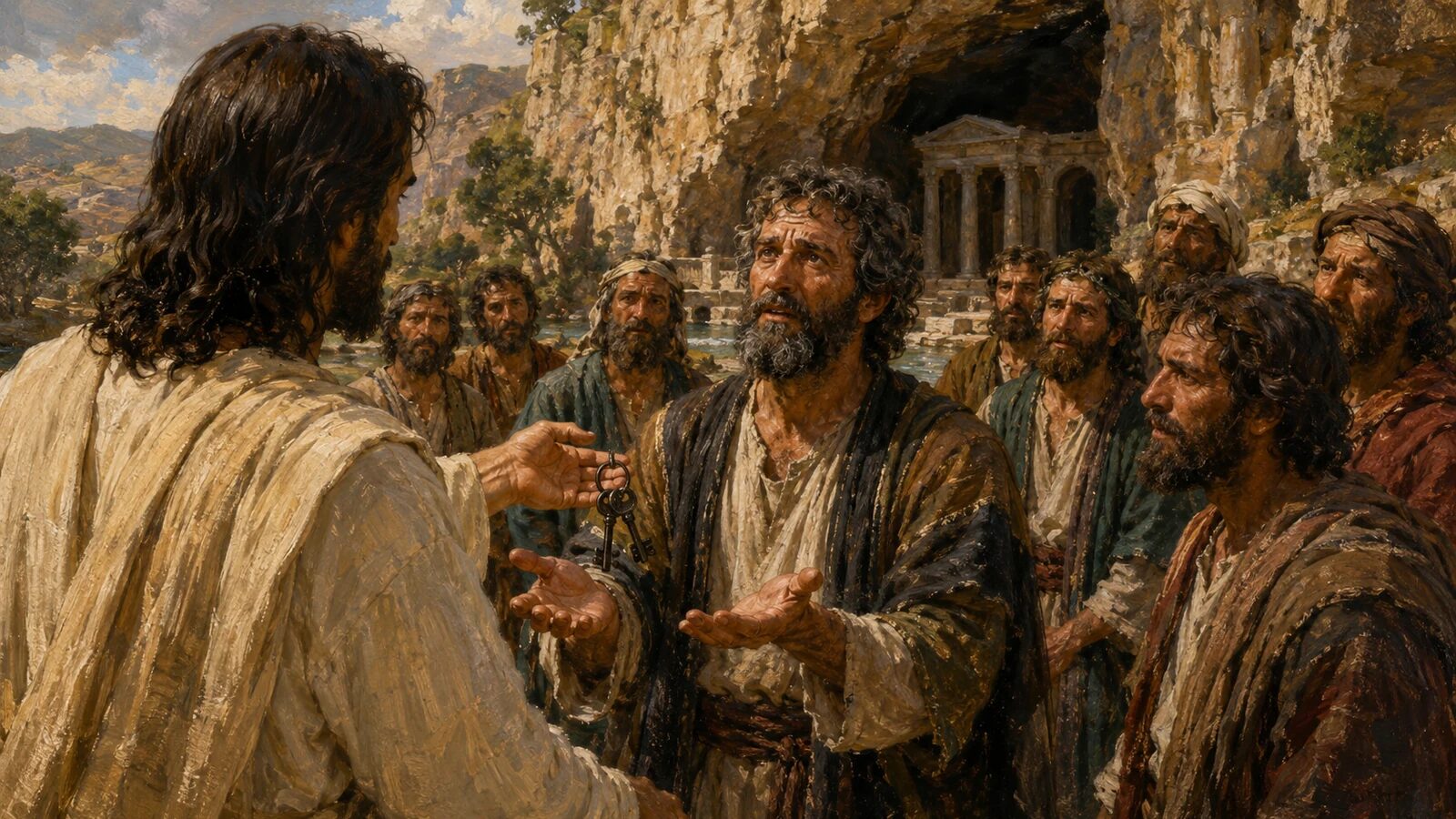
Peter had just confessed Jesus as the Christ, the Son of the living God, when Jesus spoke about giving him the keys of the kingdom. I need to take that responsibility seriously. Peter’s preaching would have a prominent place in the early church, but nothing in the promise made him a replacement for the King he served.
If someone entrusts me with his keys, I am accountable for how I use them. Having the keys does not make the property mine. In Matthew 16, Jesus entrusted Peter with authority connected to His kingdom and with the responsibility described as binding and loosing. We need to understand what He authorized before using those words to defend church power or a particular way of praying.
Peter’s Confession and Christ’s Church
The conversation took place in the region of Caesarea Philippi, north of Galilee, where pagan worship and political authority were prominent. Jesus asked His disciples who people said He was. They reported that some thought He was John the Baptist, Elijah, Jeremiah, or another prophet. Those answers could sound respectful while still failing to recognize Him.
He then asked His disciples, “But who do you say that I am?”
Simon Peter answered and said, “You are the Christ, the Son of the living God.”
Calling Jesus the Christ identifies Him as the Messiah, God’s anointed King. Peter was confessing more than admiration for a prophet or reformer. Jesus is the eternal Son, fully God and fully man, through whom the kingdom comes. Jesus called Peter blessed because the Father had revealed this truth to him. Peter had not figured this out on his own.
Jesus followed that confession with a promise about His church:
And I also say to you that you are Peter, and on this rock I will build My church, and the gates of Hades shall not prevail against it.
The wordplay between Peter and rock gives us reason to recognize Peter’s real place in the church’s foundation. He would witness the risen Christ and become a central preacher in Acts. Yet Jesus says, “I will build My church.” The church belongs to Him, and Peter’s role cannot turn it into Peter’s possession or make him a foundation independent of Christ.
Hades is the realm of the dead. Its gates picture the power of death to hold people, but Jesus promises that death will not finally defeat those He gathers. His bodily resurrection demonstrates His authority over it. The church’s future rests on the living Christ, rather than on a leader’s ability to preserve an institution.
Paul describes the apostles’ place within that foundation:
Having been built on the foundation of the apostles and prophets, Jesus Christ Himself being the chief cornerstone.
The apostles’ authoritative witness to Christ is foundational, and that witness is preserved in Scripture. Christ is the chief cornerstone with whom the whole building must align. Acknowledging His authority does not require us to diminish the apostles, but their authority cannot be separated from the Lord they proclaimed.
The Keys as Delegated Stewardship
After promising to build His church, Jesus spoke of giving Peter the keys. The Greek word kleis means a key. Scripture uses this ordinary object to picture authority to open and shut, including authority entrusted to someone serving a king. Isaiah 22 describes the key of David’s house being given to a royal steward:
The key of the house of David I will lay on his shoulder; So he shall open, and no one shall shut; And he shall shut, and no one shall open.
The steward could exercise substantial authority within the king’s household without becoming its owner. He answered to the king for what he did. I understand Peter’s responsibility in the same way: Christ entrusted him with kingdom truth to proclaim and apply, but Peter remained answerable to Him.
Jesus connected the keys with binding and loosing:
And I will give you the keys of the kingdom of heaven, and whatever you bind on earth will be bound in heaven, and whatever you loose on earth will be loosed in heaven.
In Jewish settings, binding and loosing could concern forbidding and permitting, or deciding what agreed with God’s revealed will. I understand Jesus to be giving authority that must agree with heaven, rather than allowing Peter to devise a ruling that heaven would be obliged to accept. The NASB renders the wording as “shall have been bound” and “shall have been loosed” in heaven. That wording supports the priority of heaven’s authority.
For example, when we assure someone who repents and believes that Christ forgives him, we are announcing what God has promised. We are not making Him forgive by saying the words. When we warn someone who refuses Christ, we are explaining the judgment God has revealed, not creating condemnation through our own disapproval.
Matthew records a sharp correction after Jesus gave Peter this promise. When Jesus began explaining His coming suffering, death, and resurrection, Peter opposed what He said:
But He turned and said to Peter, “Get behind Me, Satan! You are an offense to Me, for you are not mindful of the things of God, but the things of men.”
The Father had revealed the truth Peter confessed, yet Peter could still resist the Lord’s teaching when his mind was set on human concerns. His apostolic responsibility did not make him incapable of error. Christ would build His church through the cross and resurrection Peter did not yet understand.
The risen Christ identifies Himself as the One who holds authority over death:
I am He who lives, and was dead, and behold, I am alive forevermore. Amen. And I have the keys of Hades and of Death.
No apostle, pastor, or council holds that power in himself. Christ’s servants proclaim His kingdom and the way of salvation under His authority. A church cannot claim that its office or tradition gives it ownership of the life only He can give.
In Luke 11, Jesus used another key image when He rebuked experts in the religious law:
Woe to you lawyers! For you have taken away the key of knowledge. You did not enter in yourselves, and those who were entering in you hindered.
They refused to enter and hindered people who were entering. A teacher can do harm by obscuring Scripture beneath human tradition or making access to God seem dependent on loyalty to his religious system. If my teaching leaves people more afraid of disagreeing with me than concerned to understand Scripture, I need to examine how I am using that responsibility.
The Gospel Opens the Door in Acts
Peter’s preaching in Acts gives us concrete examples of his apostolic responsibility. At Pentecost, he proclaimed the crucified and risen Christ. When his hearers were cut to the heart and asked what they should do, he called them to repent and identify openly with Jesus:
Then Peter said to them, “Repent, and let every one of you be baptized in the name of Jesus Christ for the remission of sins.”
I read this command alongside the rest of the New Testament. Water baptism follows salvation and publicly identifies a believer with Christ; it does not produce new life, purchase forgiveness, or replace faith. Peter called people to turn from their rejection of Jesus. Forgiveness is found through Christ’s blood and received by faith.
Acts 8 then records Philip preaching Christ among the Samaritans, whose relationship with the Jews had long been marked by religious and ethnic hostility. People believed, and the apostles in Jerusalem sent Peter and John. They prayed and laid hands on the Samaritan believers, who received the Holy Spirit. Their participation gave apostolic recognition to these believers as part of the same church. The gospel had not established a rival Samaritan body with a different Savior.
In Acts 10, Peter entered the home of Cornelius, a Gentile, and again proclaimed forgiveness through Christ:
To Him all the prophets witness that, through His name, whoever believes in Him will receive remission of sins.
The Holy Spirit came upon the hearers while Peter was still speaking, before he commanded water baptism. Peter could not reasonably forbid baptism to people God had already received. In Acts 11, he defended the event by pointing to God’s gift of the same Spirit. In Acts 15, he explained that God had purified their hearts by faith.
Jews, Samaritans, and Gentiles entered through the same Christ and received the same Holy Spirit. Peter did not invent a new entrance for each group or make forgiveness depend on his personal approval. He preached the Christ to whom the prophets testified, and God confirmed the message.
Those who repent and believe are born again: the Holy Spirit gives them new life. He lives within them and seals them as God’s own, so they are eternally secure in Christ. That assurance gives no permission for lawlessness. Obedience shows the presence of new life; it does not earn salvation or keep us saved. Repentant people can trust the Savior’s promise rather than live at the mercy of a human gatekeeper.
Authority That Serves Truth and Restoration
The church’s responsibility to declare God’s truth also includes dealing with sin. In Matthew 18, Jesus tells us to speak privately with a brother who sins against us. If he will not listen, we are to take one or two others; if he still refuses, we bring the matter before the church. Someone who refuses to hear even the church is to be treated as outside its fellowship. Jesus used binding and loosing within that instruction:
Assuredly, I say to you, whatever you bind on earth will be bound in heaven, and whatever you loose on earth will be loosed in heaven.
Here the authority extends beyond Peter to the church acting in Christ’s name and according to His Word. A congregation cannot honestly present open, unrepentant rebellion as fellowship with Christ. It must confront what can be known, seeking correction and restoration rather than an opportunity to punish someone it dislikes.
After His resurrection, Jesus also spoke to the disciples about forgiveness as He commissioned them. He showed them His hands and side and sent them with His message:
If you forgive the sins of any, they are forgiven them; if you retain the sins of any, they are retained.
The words belong to the risen Lord’s commission to His disciples. God forgives through Christ, so I do not understand this as a private power to manufacture forgiveness. The church announces forgiveness to the repentant believer and refuses to pronounce peace over someone who rejects Christ and clings to sin. Its declaration must agree with the gospel.
When dealing with sin within a congregation, we need an honest hearing of evidence. Discipline must not become a way to manipulate accusations, protect influential people, or punish those who question them. Leaders remain accountable to the same Scripture they teach. When repentance is real, we should pursue restoration instead of using a person’s past as a means of control.
Christ Holds the Ultimate Keys
The church’s message must direct people to the One who saves. Jesus identifies Himself as the Door:
I am the door. If anyone enters by Me, he will be saved, and will go in and out and find pasture.
He does not merely point toward an entrance controlled by someone else. Those who enter by Him are saved. He alone is the sinless God-man who willingly gave Himself to be slain as the perfect sacrifice for our sins. He completed that sacrifice through His shed blood and death, then was buried and rose bodily. As our perfect Mediator, He now brings us to God.
Jesus said to him, “I am the way, the truth, and the life. No one comes to the Father except through Me.”
No human office can make itself another necessary mediator between the sinner and the Savior. Teachers are responsible to explain the way Christ has opened. If I tell people that forgiveness depends on their loyalty to me, I have substituted myself for the Lord I am supposed to proclaim.
Revelation returns to the key of David when Jesus addresses the church in Philadelphia:
These things says He who is holy, He who is true, “He who has the key of David, He who opens and no one shuts, and shuts and no one opens.”
He set an open door before a church with little strength, and their weakness did not diminish His authority. They did not have to become a powerful church before He could open a door for them. Christ reigns, and the Spirit works through the gospel, God’s power for salvation to everyone who believes.
I can pray with confidence in that authority without assuming my words put heaven under an obligation to follow my plans. Asking in Christ’s name means coming under His authority. The Father is good, the Son intercedes, and the Spirit helps us pray, so we have reason to ask boldly while remaining submitted to God.
We can ask God for an open door and courage to speak through it. We can seek wisdom when correction is needed and plead for people to be saved. God commands prayer and truly works through it.
My Final Thoughts
Peter received a significant apostolic responsibility, and the church still has real work entrusted to it. We need to proclaim the gospel clearly, teach Scripture, and deal honestly with visible sin. I want to assure repentant believers of Christ’s forgiveness and warn those who refuse Him. I am accountable to Christ for how I carry out that responsibility. The keys do not make the kingdom ours. Jesus remains its King and the only Savior to whom we can direct people.