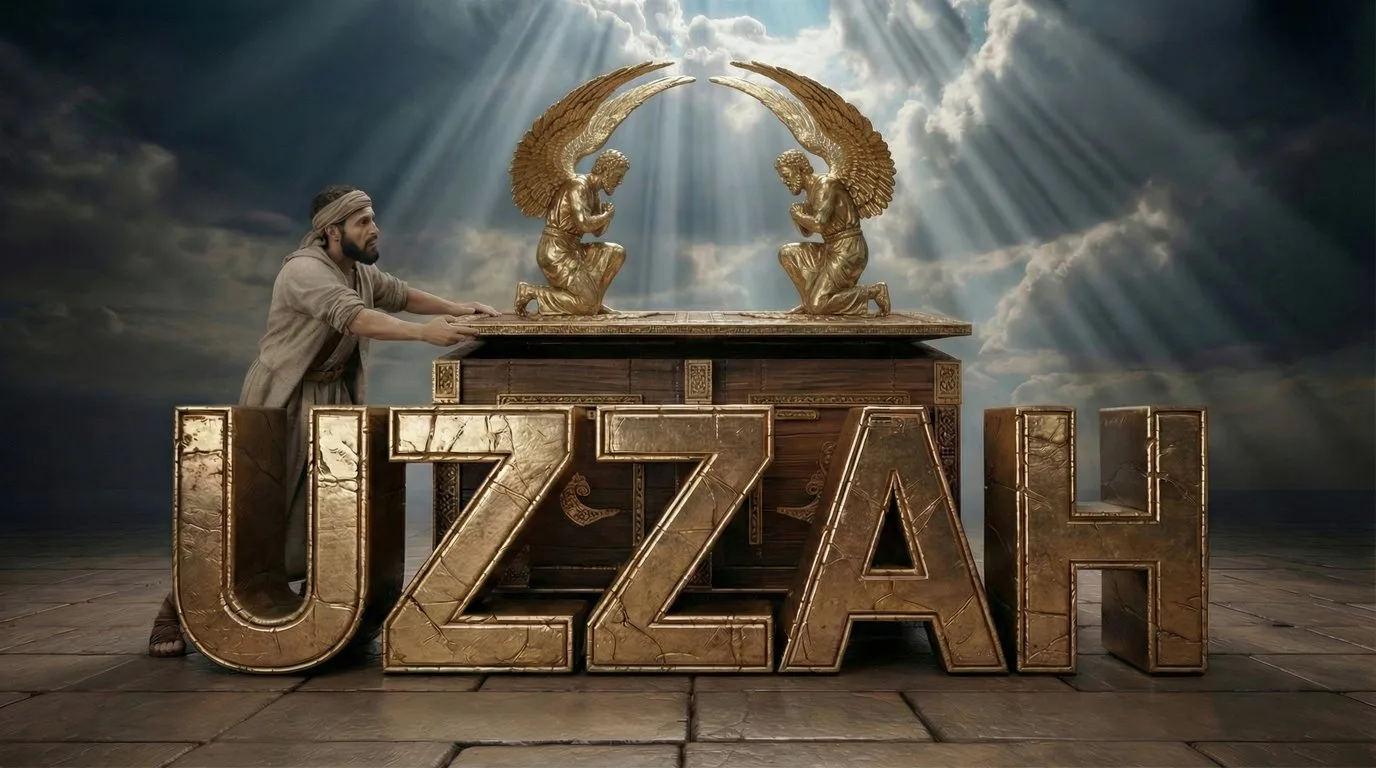

The death of Uzzah is one of those passages that almost forces us to slow down and ask hard questions. It is found in 2 Samuel 6:1–7 and 1 Chronicles 13:9–10, where Uzzah reaches out to steady the Ark of the Covenant as it is being transported. When he touches the Ark, God strikes him dead. This incident has long raised questions about God’s justice, the nature of holiness, and the power of the Ark itself.
If we read this account quickly, it can feel confusing or even troubling. But when we place it back into the larger biblical story and pay attention to what God had already said about the Ark, a clearer picture begins to emerge. This is not a story about an unpredictable God. It is a story about a holy God who keeps His word, and about people who must learn that God is not to be handled casually, even when intentions seem sincere.
Understanding the Ark of the Covenant
The Ark of the Covenant was the most sacred object in Israel, symbolizing the presence of God among His people. It was constructed according to God’s specific instructions in Exodus 25:10–22. The Ark contained the tablets of the Law, Aaron’s rod that budded, and a pot of manna (Hebrews 9:4). It was not just a relic but represented God’s holiness and covenant with Israel.
When Scripture describes the Ark, it does not invite us to think of it as a magical object. It was holy because it belonged to God and was set apart for His worship. The Ark sat in the Most Holy Place, and the mercy seat on top of it was where the blood was applied on the Day of Atonement. The whole arrangement preached a sermon: God is holy, sin is serious, atonement is necessary, and access to God is only on God’s terms.
God gave specific instructions about how the Ark was to be transported. In Numbers 4:15, God commanded that the Ark should be carried by Levites using poles and never touched directly. Even the Levites, who were sanctified to handle sacred things, were not allowed to touch the Ark itself. To disobey these instructions was to profane God’s holiness.
“But they shall not touch any holy thing, lest they die.” (Numbers 4:15)
This is an important starting point. The warning was not hidden in fine print. It was part of the public instruction God gave to His people. The Ark could be carried, but not handled. It could be moved, but only in the way God appointed. The poles were not a convenience. They were a boundary, a constant reminder that the Lord is near and yet not to be approached in a common way.
God’s Instructions Were Not Arbitrary
When God commanded Israel about the Ark, He was not making random rules to test their obedience. His commands taught them what He is like. The tabernacle system trained Israel to recognize that God is distinct from His creation, that sin separates, and that holy things are not to be treated as everyday objects.
For example, the Ark was made with rings so the poles could remain in place. Once the poles were set, they were not to be removed in ordinary circumstances. The design itself enforced the command: no one needed to touch the Ark directly, because God had already provided a way to carry it without touching it.
“You shall put the poles into the rings on the sides of the ark, that the ark may be carried by them. The poles shall be in the rings of the ark; they shall not be taken from it.” (Exodus 25:14–15)
So when we come to Uzzah’s death, we are not dealing with a moment where God suddenly decided to be strict. We are dealing with God doing exactly what He said He would do if His holiness was violated. That may still feel sobering, but it is not capricious. God’s holiness is consistent, and His word is reliable.
It is also important to see that the command about touching holy things was not meant to keep Israel away from God in a hopeless way. It was meant to teach them the right way to draw near. The entire sacrificial system, the priesthood, and the Day of Atonement declared that God desired fellowship with His people, but that fellowship would be enjoyed through His appointed means, with reverence and faith.
The Incident Uzzah’s Death
When David sought to bring the Ark to Jerusalem, it was transported on a new cart drawn by oxen. Along the way, the oxen stumbled, and Uzzah reached out to steady the Ark.
“Then the anger of the LORD was aroused against Uzzah, and God struck him there for his error; and he died there by the ark of God.” (2 Samuel 6:7)
Here we see the direct involvement of God in Uzzah’s death. The Bible explicitly states that God struck him down. Scripture does not leave room for the idea that Uzzah merely had a heart attack or that the Ark had some impersonal force. This was the Lord acting in judgment.
In the parallel account, the chronicler also emphasizes the suddenness and seriousness of the event. The moment was meant to stop the entire procession and force everyone, including David, to reckon with what had just happened. They were celebrating, singing, and moving forward with great energy, but they were not moving forward according to the Word of God.
“And when they came to Nachon’s threshing floor, Uzzah put out his hand to the ark of God and took hold of it, for the oxen stumbled. Then the anger of the LORD was aroused against Uzzah, and He struck him there because he put his hand to the ark; and he died there before God.” (1 Chronicles 13:9–10)
Notice that both accounts highlight the same point: the act that brought judgment was Uzzah putting his hand to the Ark. The oxen stumbling is part of the circumstance, but it is not the explanation. The explanation is that God had forbidden touching the holy thing, and Uzzah did it.
Why Did Uzzah Die
Disobedience to God’s Command
The Ark was transported incorrectly, in direct violation of God’s instructions. It was placed on a cart, mimicking the Philistines’ earlier method of transporting it in 1 Samuel 6:7–8. God had commanded that the Ark should be carried on poles by Levites (Exodus 25:14–15). The method of transport was already a breach of God’s law.
This detail matters because it shows the problem was bigger than a single moment of panic when the oxen stumbled. The entire approach was wrong from the beginning. A “new cart” may have sounded respectful, but God never asked for a cart. He asked for consecrated men to carry the Ark in a consecrated way.
It is possible to have good motives and still be disobedient. In fact, good motives can sometimes disguise disobedience. We may assume God will be pleased because our plan seems reasonable, efficient, and even “honoring.” Yet God is honored not only by our enthusiasm but by our submission to His Word.
Holiness and the Fear of the Lord
God’s holiness is central to understanding this event. In Leviticus 10:1–3, Nadab and Abihu were struck dead for offering unauthorized fire before the Lord, illustrating that approaching God’s holiness casually or irreverently leads to judgment. Uzzah’s act, while seemingly innocent, treated God’s holiness as common. Even well-intentioned disobedience does not exempt one from judgment.
“By those who come near Me I must be regarded as holy; and before all the people I must be glorified.” (Leviticus 10:3)
This is one of the clearest principles in the Old Testament about worship and holiness. God does not allow people to redefine what it means to approach Him. When He gives boundaries, they are not meant to ruin joy. They are meant to protect true worship and to guard the truth about who God is.
The Ark’s Power and God’s Presence
While the Ark was a physical object, its power came from God’s presence. It was not a “weapon” in the sense of independent functionality. The Ark’s holiness was a reflection of God Himself. When Uzzah touched it, it was not the Ark’s power that killed him, but God’s judgment.
It is worth being clear here: the Bible does not present the Ark as an idol. Israel was always tempted to treat sacred things as if they could be used to control outcomes, but God repeatedly corrected that thinking. The Ark could not be manipulated. God was not contained. The Ark represented His covenant presence, but the Lord remained sovereign and personally active.
God’s Justice and Mercy
Some may see this act as harsh, but it underscores God’s justice. As Isaiah declares, “For My thoughts are not your thoughts, nor are your ways My ways,” says the LORD (Isaiah 55:8). God’s holiness is not to be treated lightly, even when intentions appear good. This incident was a lesson for Israel about reverence and obedience.
“For My thoughts are not your thoughts, nor are your ways My ways,” says the LORD. (Isaiah 55:8)
At the same time, we should not miss that God’s goal was not to destroy Israel but to teach them. Judgment in moments like this is severe, but it is also instructive. It confronts the lie that God is “safe” in the sense of being manageable. He is good, but He is not casual. He invites His people near, but not on self-chosen terms.
David’s Reaction And God’s Lesson
When Uzzah died, David’s reaction becomes part of the story’s teaching. He was not indifferent. He was deeply affected, but his emotions were mixed. Scripture shows that David became angry and afraid. This tells us that even a man after God’s own heart can experience confusion when confronted with God’s holiness.
“David became angry because of the LORD’s outbreak against Uzzah; and he called the name of the place Perez Uzzah to this day. David was afraid of the LORD that day; and he said, ‘How can the ark of the LORD come to me?’” (2 Samuel 6:8–9)
David’s question is revealing: “How can the ark of the LORD come to me?” In one sense, that is exactly the right question. It is the question every sinner should ask in the presence of a holy God. The problem is that David asked it as if the Lord were the obstacle, rather than their disobedience being the obstacle.
God was not refusing to bless David or refusing to dwell among His people. God was insisting that His presence must be honored. The Ark could come to Jerusalem, but it could not come on a cart, and it could not come through careless handling.
There is a pastoral warning here for us. We can have strong spiritual desires and still need correction. We can want God’s presence, God’s blessing, and God’s work, and yet attempt to pursue those desires with methods and attitudes that are shaped more by what “works” than by what God has said.
David’s fear also shows that the Lord got his attention. Healthy fear of God does not drive us away from Him forever, but it does drive us away from presumption. It produces humility, careful listening, and a renewed commitment to obey.
What Changed In The Second Attempt
The account does not end with Uzzah’s death. It pauses the celebration, but it does not cancel God’s purpose. The Ark is temporarily placed in the house of Obed-Edom, and the Lord blesses that household. This detail is important because it shows that God’s presence is not a curse to those who honor Him. The problem was never that God was with His people. The problem was irreverence and disobedience in how they approached Him.
“The ark of the LORD remained in the house of Obed-Edom the Gittite three months. And the LORD blessed Obed-Edom and all his household.” (2 Samuel 6:11)
When David hears of that blessing, he tries again, but this time the approach is different. The chronicler gives us a key insight: David eventually recognizes that the first attempt failed because they did not consult God’s order. He specifically mentions that the Levites must carry the Ark, as God commanded.
“For because you did not do it the first time, the LORD our God broke out against us, because we did not consult Him about the proper order.” (1 Chronicles 15:13)
This is the turning point. David learns that sincerity is not enough. Zeal is not enough. Worship must be shaped by God’s revealed will. The phrase “proper order” is not about lifeless ritual. It is about aligning with God’s instruction.
And in the second attempt, we see more than corrected method. We see a corrected heart posture. There is still celebration, but now it is celebration under the fear of the Lord. Sacrifices are offered, and the Ark is carried rather than carted. God’s presence comes with joy when God’s holiness is honored.
This speaks to a common struggle. Many believers want joyful worship without careful obedience, as if reverence will quench joy. Scripture shows the opposite: reverence protects joy from becoming shallow and protects worship from becoming self-exalting. The joy God gives is deep enough to stand in the presence of His holiness.
Other Considerations
In 1 Samuel 6:19-20: God struck down the men of Beth Shemesh for looking into the Ark, demonstrating that its sacredness was not to be profaned.
(1 Samuel 6:19-20)
This earlier event helps confirm that Uzzah’s death was not an isolated, random outburst. When the Ark returned from the Philistines, the people of Beth Shemesh treated it with curiosity rather than reverence, and judgment followed. The repeated lesson is that God’s holiness is real, and God’s instructions about holy things are protective boundaries, not optional suggestions.
Exodus 19:12–13: God set limits on Mount Sinai to protect the people from His holiness, further emphasizing that boundaries around sacred things must be respected.
(Exodus 19:12–13)
At Sinai, God drew a line and warned the people not to cross it. Even though He had redeemed them from Egypt, they were still sinners. His holiness had not changed, and their need for mediation had not disappeared. The boundaries were mercy as much as warning, because unguarded contact with divine holiness would bring destruction upon an unprepared people.
Hebrews 12:28–29: “Let us have grace, by which we may serve God acceptably with reverence and godly fear. For our God is a consuming fire.”
“Therefore, since we are receiving a kingdom which cannot be shaken, let us have grace, by which we may serve God acceptably with reverence and godly fear. For our God is a consuming fire.” (Hebrews 12:28–29)
The New Testament does not soften God into someone less holy. It calls us to grace, yes, but it also calls us to reverence and godly fear. Grace does not mean God has become casual about sin. Grace means God has provided a righteous way for sinners to be welcomed and transformed, and that welcome should produce gratitude, humility, and careful devotion.
Christ And The Greater Access
One of the most helpful ways to process Uzzah’s death is to see it in the light of what God was teaching Israel through the entire Old Covenant system. The Ark, the tabernacle, the priesthood, and the boundaries around holy things all pointed forward. They trained God’s people to long for a better priest, a better sacrifice, and a better covenant.
Under the Old Covenant, access to the Most Holy Place was restricted. Only the high priest could enter, and only at appointed times, and only with blood. That restriction did not mean God did not love His people. It meant that sin was a barrier they could not remove by good intentions or human effort. They needed cleansing and mediation that God Himself would ultimately provide.
“Let us therefore come boldly to the throne of grace, that we may obtain mercy and find grace to help in time of need.” (Hebrews 4:16)
Through Jesus Christ, believers are invited to come boldly to the throne of grace. That boldness is not arrogance. It is confidence in Christ’s finished work. We do not come because we have steadied the Ark with our own hands. We come because Christ has opened the way by His blood.
At the same time, the boldness of Hebrews 4:16 must be held together with the reverence of Hebrews 12:28–29. The same New Testament that invites us to draw near also warns us not to refuse the One who speaks from heaven. In other words, access has increased because the Mediator is perfect, not because holiness has decreased.
This is where many misunderstand the story of Uzzah. They imagine that if they had been there, they would have done the same thing, and that God should have excused it. But the deeper issue is not whether Uzzah was trying to help. The issue is that Uzzah’s hand was not the solution to the Ark’s safety. God did not need protecting. God required honoring.
In Christ, God does not ask us to approach Him by our own improvisation. He asks us to approach Him through His Son. The heart of faith is not, “Lord, I will do what seems best to me,” but “Lord, I will trust Your way.” That is why this story still matters for believers today. It confronts self-directed spirituality and replaces it with God-directed worship.
My Final Thoughts
Uzzah’s death is a sobering reminder that God’s holiness is absolute and not to be trifled with. While it may seem severe, it serves as a lesson to approach God with reverence and obedience. God’s commands regarding the Ark were not arbitrary but reflected His nature. This story challenges us to examine our own approach to God. Do we take His holiness seriously? Do we follow His Word precisely, or do we rely on human wisdom?
This account also points us to the grace found in Jesus Christ. Through Christ, we are made holy and can boldly approach God’s throne (Hebrews 4:16). However, this does not negate the need for reverence and obedience. Let us strive to honor God as the holy and righteous King He is, remembering that His ways are perfect.

 Get the book that teaches you how to evangelize and disarm doctrines from every single major cult and religion.