
Eliezer of Damascus is often identified as the servant Abraham sent to find a wife for Isaac. He may have been, but Genesis 24 does not name that servant. I want to examine the connection without making it more certain than Scripture does. We can appreciate the man’s faithful work even when we cannot be sure of his name.
The Named Eliezer and the Unnamed Servant
Genesis 15 introduces Eliezer after Abraham has refused the king of Sodom’s reward. The LORD reassured Abraham that He was his shield and exceedingly great reward. Abraham nevertheless had a question about the future God had promised him: how would he have descendants when he still had no child?
After these things the word of the LORD came to Abram in a vision, saying, “Do not be afraid, Abram. I am your shield, your exceedingly great reward.” But Abram said, “Lord GOD, what will You give me, seeing I go childless, and the heir of my house is Eliezer of Damascus?” Then Abram said, “Look, You have given me no offspring; indeed one born in my house is my heir!” And behold, the word of the LORD came to him, saying, “This one shall not be your heir, but one who will come from your own body shall be your heir.”
Abraham expected Eliezer to inherit his household if he remained childless. The Hebrew expression translated “the heir of my house” is difficult, and translations differ over its wording. The next verse, however, states the concern plainly: someone born in Abraham’s household stood to inherit because Abraham had no offspring. The NET notes on Genesis 15:2 discuss both the wording and the custom of designating a household member as heir.
God corrected Abraham’s expectation by promising a son from his own body. That answer did not accuse Eliezer of wrongdoing or suggest that he had become untrustworthy. He could hold an honored position in Abraham’s household without being the son through whom God would fulfill His covenant promise. God later named Isaac as the son with whom He would establish His covenant in Genesis 17:19. Isaac’s place in that line came from God’s promise, not an inheritance arrangement Abraham made in the absence of a child.
The name Eliezer means “God is help,” as the Brown–Driver–Briggs Hebrew lexicon explains. Other men in Scripture bear that name, including a son of Moses, so we need to distinguish them. The name fits the account’s emphasis on God’s help, but its meaning cannot establish that Eliezer was the servant sent to find Rebekah.
By chapter 24, Sarah had died and Isaac was a grown man. Abraham called “the oldest servant of his house, who ruled over all that he had” and entrusted him with finding Isaac a wife. Such extensive responsibility makes Eliezer a reasonable possibility. A trusted household member who once stood to inherit could have continued to serve after Isaac’s birth.
Decades had passed, though, and another man could have assumed that responsibility. Genesis calls the envoy the servant or the man throughout the chapter. I am willing to consider the identification with Eliezer, but the evidence does not allow me to present it as an established fact.
A Commission With Godly Limits
Finding Isaac a wife concerned the future of the promised family, so Abraham gave specific instructions. Isaac was not to marry a Canaanite woman, and the servant must not take him back to Abraham’s former homeland. The servant was to go to Abraham’s country and family to find a wife instead.
I understand Abraham’s restriction in light of God’s covenant and the wickedness Genesis had already described in Canaan. Isaac’s marriage concerned the faithfulness of the family through whom God would fulfill His promise. Yet seeking a wife among his relatives did not mean they were all free of idolatry. Joshua 24:2 says his ancestors served other gods, and Genesis 31:19 later mentions Laban’s household idols. Abraham’s directions concerned this marriage within God’s promises; family ancestry alone could not guarantee anyone’s faithfulness.
He required the servant to swear by the LORD, the God of heaven and earth. Placing a hand under the thigh was part of this solemn oath; Jacob later required the same gesture from Joseph concerning his burial in Genesis 47. A connection with offspring and the covenant line is possible, but Scripture does not explain all the gesture’s symbolism.
Now Abraham was old, well advanced in age; and the LORD had blessed Abraham in all things. So Abraham said to the oldest servant of his house, who ruled over all that he had, “Please, put your hand under my thigh, and I will make you swear by the LORD, the God of heaven and the God of the earth, that you will not take a wife for my son from the daughters of the Canaanites, among whom I dwell; but you shall go to my country and to my family, and take a wife for my son Isaac.” And the servant said to him, “Perhaps the woman will not be willing to follow me to this land. Must I take your son back to the land from which you came?” But Abraham said to him, “Beware that you do not take my son back there. The LORD God of heaven, who took me from my father’s house and from the land of my family, and who spoke to me and swore to me, saying, ‘To your descendants I give this land,’ He will send His angel before you, and you shall take a wife for my son from there. And if the woman is not willing to follow you, then you will be released from this oath; only do not take my son back there.” So the servant put his hand under the thigh of Abraham his master, and swore to him concerning this matter.
The servant raised a foreseeable difficulty before leaving. What should he do if the woman would not come? Could he take Isaac back to Abraham’s former homeland in Mesopotamia, the region beyond the Euphrates? Abraham firmly ruled that out. God had brought him away from that land and promised Canaan to his descendants. Finding a wife must not become a reason to reverse the direction God had given the family.
Abraham trusted the LORD to send His angel before the servant, but he also made provision for a refusal. If the woman would not follow, the servant would be released from the oath. He had responsibility for carrying out the mission, not permission to force a woman to come or authority to relocate Isaac when the assignment became difficult.
By raising the difficulty before he left, the servant could learn exactly what Abraham required of him. He would not have to choose between breaking his oath and forcing an unwilling woman to come. Abraham had given him a serious responsibility while allowing for a result he could not control.
Prayer, Providence, and Rebekah’s Character
The servant took ten camels and goods from Abraham’s household and traveled to the city of Nahor in Mesopotamia. He arrived at the well in the evening, when women came out to draw water. He had reached the region Abraham specified, but he still needed to find the right family and a woman willing to leave with him. He brought that need to the LORD.
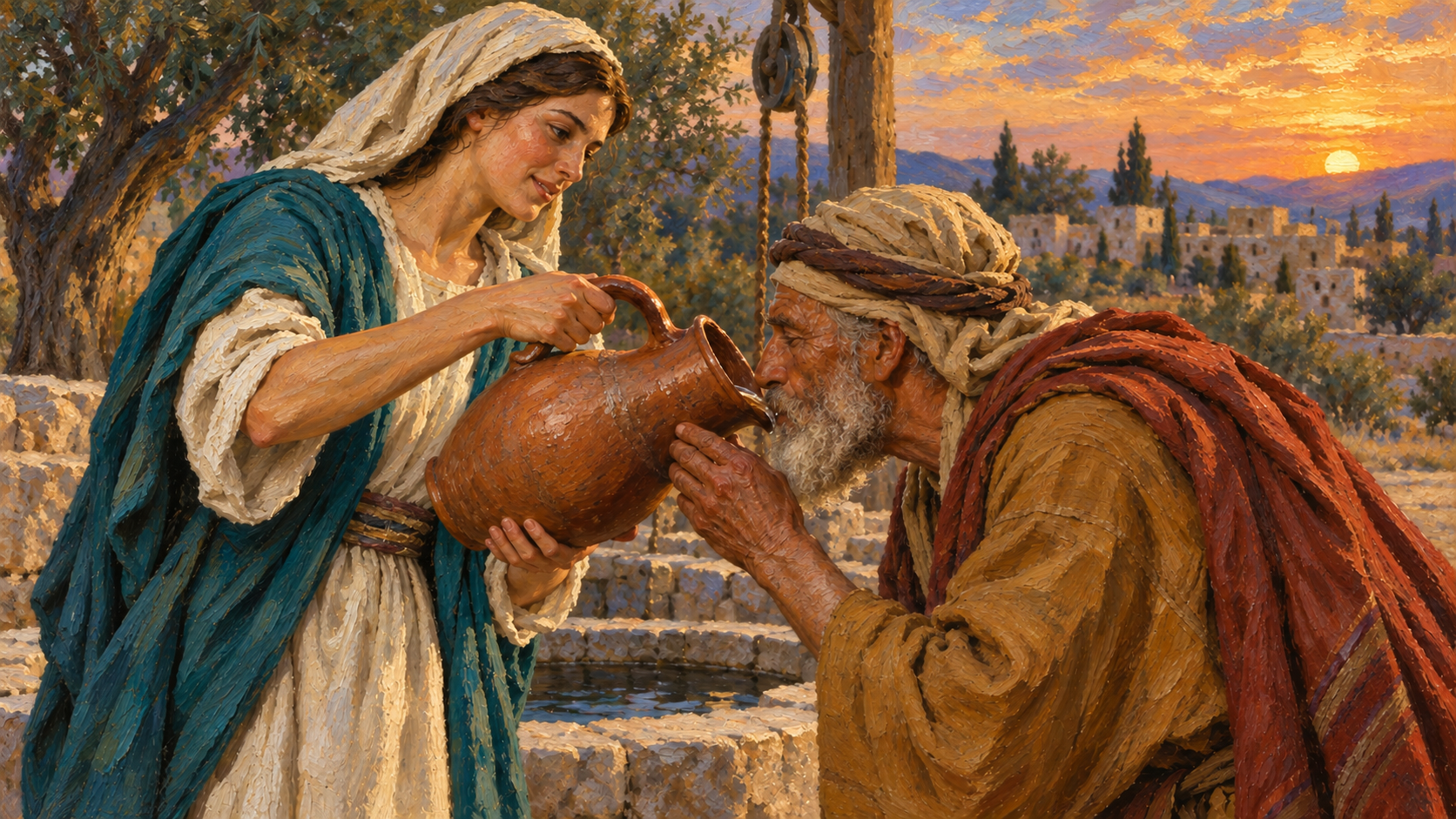
Then the servant took ten of his master’s camels and departed, for all his master’s goods were in his hand. And he arose and went to Mesopotamia, to the city of Nahor. And he made his camels kneel down outside the city by a well of water at evening time, the time when women go out to draw water. Then he said, “O LORD God of my master Abraham, please give me success this day, and show kindness to my master Abraham. Behold, here I stand by the well of water, and the daughters of the men of the city are coming out to draw water. Now let it be that the young woman to whom I say, ‘Please let down your pitcher that I may drink,’ and she says, ‘Drink, and I will also give your camels a drink’–let her be the one You have appointed for Your servant Isaac. And by this I will know that You have shown kindness to my master.” And it happened, before he had finished speaking, that behold, Rebekah, who was born to Bethuel, son of Milcah, the wife of Nahor, Abraham’s brother, came out with her pitcher on her shoulder. Now the young woman was very beautiful to behold, a virgin; no man had known her. And she went down to the well, filled her pitcher, and came up. And the servant ran to meet her and said, “Please let me drink a little water from your pitcher.” So she said, “Drink, my lord.” Then she quickly let her pitcher down to her hand, and gave him a drink. And when she had finished giving him a drink, she said, “I will draw water for your camels also, until they have finished drinking.” Then she quickly emptied her pitcher into the trough, ran back to the well to draw water, and drew for all his camels. And the man, wondering at her, remained silent so as to know whether the LORD had made his journey prosperous or not.
The servant asked to see generosity and diligence in the woman who would join Isaac’s household. Giving a stranger a drink would show hospitality. Volunteering to water ten camels as well would require considerable effort beyond what the traveler had asked. His request concerned qualities suited to that household, rather than a spectacle unrelated to the assignment.
Rebekah arrived before he had finished praying, and the narrator tells us her family connection before the servant discovers it. She was the granddaughter of Abraham’s brother Nahor and his wife Milcah. The reader can already see the answer taking shape while the servant still has questions to ask.
Rebekah quickly lowered her pitcher to give him a drink, then offered water for the camels and continued until they had finished. Although Genesis gives no gallon total, it describes enough for us to appreciate the effort. She had to draw the water, carry it, and empty her pitcher repeatedly for ten animals. Her offer committed her to sustained physical work.
She did that work before hearing about the proposed marriage or seeing the gifts the servant had brought. Her helpfulness was already evident before she knew what his visit might offer her. We cannot claim to know every thought behind her actions, but the servant could see her readiness to work for a stranger and care for his animals.
He watched quietly while she watered the camels. What he had asked for was happening before him, but he still needed to know whether she belonged to Abraham’s family. Depending on God did not excuse him from listening, observing, and asking that necessary question.
So it was, when the camels had finished drinking, that the man took a golden nose ring weighing half a shekel, and two bracelets for her wrists weighing ten shekels of gold, and said, “Whose daughter are you? Tell me, please, is there room in your father’s house for us to lodge?” So she said to him, “I am the daughter of Bethuel, Milcah’s son, whom she bore to Nahor.” Moreover she said to him, “We have both straw and feed enough, and room to lodge.” Then the man bowed down his head and worshiped the LORD. And he said, “Blessed be the LORD God of my master Abraham, who has not forsaken His mercy and His truth toward my master. As for me, being on the way, the LORD led me to the house of my master’s brethren.” So the young woman ran and told her mother’s household these things.
When the camels had finished drinking, he took out the jewelry and asked about her family and lodging. Rebekah named Bethuel, the son of Nahor and Milcah, as her father. The servant’s later report explains that he then placed the jewelry on her. She also confirmed that the household had room for his party and feed for the animals. Her answer supplied the family connection he needed.
The servant bowed and worshiped the LORD when he heard it. God had led him to Abraham’s relatives and shown kindness to his master. I understand providence as God’s wise direction of events toward His purpose. Here we see it through a journey, an arrival at a well, an act of hospitality, and a conversation. The servant had worked diligently, but he credited God rather than treating the outcome as a tribute to his own skill.
The jewelry honored Rebekah, but it did not buy the right to take her to Isaac. Abraham’s instructions still allowed for a refusal, and the family had yet to hear the servant’s proposal.
A Truthful Report and Rebekah’s Choice
Rebekah ran home and told her mother’s household. Her brother Laban saw the jewelry, heard her report, and went out to welcome the servant. His later conduct may make us suspect a financial interest in the visit, but we cannot assume that it explains every motive behind his welcome here. The servant entered the house and accepted their hospitality, then insisted on explaining his errand before eating.
Now Rebekah had a brother whose name was Laban, and Laban ran out to the man by the well. So it came to pass, when he saw the nose ring, and the bracelets on his sister’s wrists, and when he heard the words of his sister Rebekah, saying, “Thus the man spoke to me,” that he went to the man. And there he stood by the camels at the well. And he said, “Come in, O blessed of the LORD! Why do you stand outside? For I have prepared the house, and a place for the camels.” Then the man came to the house. And he unloaded the camels, and provided straw and feed for the camels, and water to wash his feet and the feet of the men who were with him. Food was set before him to eat, but he said, “I will not eat until I have told about my errand.” And he said, “Speak on.” So he said, “I am Abraham’s servant. The LORD has blessed my master greatly, and he has become great; and He has given him flocks and herds, silver and gold, male and female servants, and camels and donkeys. And Sarah my master’s wife bore a son to my master when she was old; and to him he has given all that he has. Now my master made me swear, saying, ‘You shall not take a wife for my son from the daughters of the Canaanites, in whose land I dwell; but you shall go to my father’s house and to my family, and take a wife for my son.’ And I said to my master, ‘Perhaps the woman will not follow me.’ But he said to me, ‘The LORD, before whom I walk, will send His angel with you and prosper your way; and you shall take a wife for my son from my family and from my father’s house. You will be clear from this oath when you arrive among my family; for if they will not give her to you, then you will be released from my oath.’ “And this day I came to the well and said, ‘O LORD God of my master Abraham, if You will now prosper the way in which I go, behold, I stand by the well of water; and it shall come to pass that when the virgin comes out to draw water, and I say to her, “Please give me a little water from your pitcher to drink,” and she says to me, “Drink, and I will draw for your camels also,”–let her be the woman whom the LORD has appointed for my master’s son.’ “But before I had finished speaking in my heart, there was Rebekah, coming out with her pitcher on her shoulder; and she went down to the well and drew water. And I said to her, ‘Please let me drink.’ And she made haste and let her pitcher down from her shoulder, and said, ‘Drink, and I will give your camels a drink also.’ So I drank, and she gave the camels a drink also. Then I asked her, and said, ‘Whose daughter are you?’ And she said, ‘The daughter of Bethuel, Nahor’s son, whom Milcah bore to him.’ So I put the nose ring on her nose and the bracelets on her wrists. And I bowed my head and worshiped the LORD, and blessed the LORD God of my master Abraham, who had led me in the way of truth to take the daughter of my master’s brother for his son. Now if you will deal kindly and truly with my master, tell me. And if not, tell me, that I may turn to the right hand or to the left.”
He introduced himself as Abraham’s servant and began with what the LORD had done for his master. He described Abraham’s wealth and made clear that Isaac was Sarah’s son, born in her old age, and the heir to that wealth. The servant then set out Abraham’s instructions and recounted the prayer, Rebekah’s response, and his discovery of her family connection.
He also explained that his oath allowed for a refusal. If Abraham’s family would not give the woman, he would be released; his master’s authority did not eliminate their ability to say no. The report adds details to the earlier account, including that he had prayed in his heart and placed the jewelry on Rebekah after learning who she was. We can read the passages together without treating those differences of emphasis as contradictions.
After explaining his errand, the servant asked whether they would deal kindly and truly with Abraham. He needed their answer before he could decide what to do next. His companions joined him in eating and drinking with the family later, so his earlier refusal to eat was no rejection of their hospitality. He wanted to attend to his duty before enjoying the meal.
Then Laban and Bethuel answered and said, “The thing comes from the LORD; we cannot speak to you either bad or good. Here is Rebekah before you; take her and go, and let her be your master’s son’s wife, as the LORD has spoken.” And it came to pass, when Abraham’s servant heard their words, that he worshiped the LORD, bowing himself to the earth. Then the servant brought out jewelry of silver, jewelry of gold, and clothing, and gave them to Rebekah. He also gave precious things to her brother and to her mother. And he and the men who were with him ate and drank and stayed all night. Then they arose in the morning, and he said, “Send me away to my master.” But her brother and her mother said, “Let the young woman stay with us a few days, at least ten; after that she may go.” And he said to them, “Do not hinder me, since the LORD has prospered my way; send me away so that I may go to my master.” So they said, “We will call the young woman and ask her personally.” Then they called Rebekah and said to her, “Will you go with this man?” And she said, “I will go.” So they sent away Rebekah their sister and her nurse, and Abraham’s servant and his men. And they blessed Rebekah and said to her: “Our sister, may you become The mother of thousands of ten thousands; And may your descendants possess The gates of those who hate them.” Then Rebekah and her maids arose, and they rode on the camels and followed the man. So the servant took Rebekah and departed.
Laban and Bethuel acknowledged that the matter came from the LORD and agreed to the marriage. The servant worshiped again, then gave Rebekah jewelry and clothing and presented gifts to her brother and mother. The party ate, drank, and stayed the night. In the morning, he asked to return to Abraham, but Rebekah’s brother and mother wanted her to remain for at least ten days.
The servant urged them to let him leave because the LORD had prospered his journey. The family then called Rebekah and asked, “Will you go with this man?” She answered, “I will go.” They were asking whether she would go with him at once instead of remaining for the requested delay. Her answer made her willingness to undertake the journey explicit, in keeping with Abraham’s instruction that an unwilling woman was not to be compelled to come.
Rebekah left her household to marry a man she had not met. We can recognize the courage involved in that decision without endorsing everything she did later in life. Her family blessed her, and she departed with her nurse and maids, accompanied by the servant and his men. God directed the journey through people who listened, answered, and acted. His guidance did not make their decisions meaningless.
Completing the Mission and Reading the Typology Carefully
Isaac was in the field near evening when the caravan approached. Rebekah asked the servant who the man walking toward them was, and he answered, “It is my master.” She dismounted and covered herself with a veil. The servant then reported to Isaac what he had done.
Now Isaac came from the way of Beer Lahai Roi, for he dwelt in the South. And Isaac went out to meditate in the field in the evening; and he lifted his eyes and looked, and there, the camels were coming. Then Rebekah lifted her eyes, and when she saw Isaac she dismounted from her camel; for she had said to the servant, “Who is this man walking in the field to meet us?” The servant said, “It is my master.” So she took a veil and covered herself. And the servant told Isaac all the things that he had done. Then Isaac brought her into his mother Sarah’s tent; and he took Rebekah and she became his wife, and he loved her. So Isaac was comforted after his mother’s death.
With that report, the servant’s part in the account comes to an end, and Genesis turns to the marriage. Isaac took Rebekah as his wife, loved her, and found comfort after his mother’s death. We are not told what position the servant held afterward. He had brought Rebekah safely to Isaac and completed the work Abraham entrusted to him.
I do not want our interest in the envoy to obscure the people he served. Sarah had died, Isaac had lost his mother, and Rebekah had left her own family. Their marriage continued the family through whom God’s promise would be fulfilled, and the chapter also speaks plainly of Isaac’s love and comfort. Those are part of the account, not incidental details to discard while looking for a symbolic meaning.
A familiar Christian interpretation sees Abraham as a picture of the Father, Isaac as a picture of Christ, the servant as a picture of the Holy Spirit, and Rebekah as the church brought to her Bridegroom. This is often called typology: an earlier person or event is understood to anticipate a later work of God. Where Scripture establishes such a connection, we should receive it. Here, however, the full proposed correspondence is an interpretation rather than an identification the passage itself makes.
I can see the appeal in a father sending a servant to find a bride for his son. The servant uses the father’s resources, speaks of the son, and brings the woman to him. Those similarities can illustrate truths about Christ and the Spirit, but the New Testament does not identify Eliezer or the unnamed servant as a type of the Holy Spirit. Jesus explained the work of the Spirit to His apostles before His death.
However, when He, the Spirit of truth, has come, He will guide you into all truth; for He will not speak on His own authority, but whatever He hears He will speak; and He will tell you things to come. He will glorify Me, for He will take of what is Mine and declare it to you. All things that the Father has are Mine. Therefore I said that He will take of Mine and declare it to you.
The Spirit would guide the apostles into truth and glorify Christ, declaring what belonged to Him. The Spirit is a divine Person who speaks and guides, not an impersonal influence. Those truths rest on Christ’s teaching; they do not require a symbolic explanation of the camels, bracelets, meal, or distance traveled in Genesis 24.
I would use the comparison to illustrate doctrine already established in Scripture. It cannot supply new doctrine, make the divine Spirit equivalent to a household employee, or erase Rebekah’s real choice. We do not have to assign a spiritual meaning to every difference between this marriage mission and the gospel, either. The analogy is useful only when we first understand what happened and keep the comparison within those limits.
Faithful Stewardship Before the Lord
Whether he was Eliezer or another man, Abraham’s servant gives us a clear example of stewardship. A steward has responsibility for work and resources that belong to someone else. This man listened to his instructions, clarified the limits of his authority, traveled with the goods entrusted to him, and reported back when the assignment was complete. Writing to the Corinthians about how they should regard him and other ministers, Paul puts faithfulness ahead of human approval.
Let a man so consider us, as servants of Christ and stewards of the mysteries of God. Moreover it is required in stewards that one be found faithful. But with me it is a very small thing that I should be judged by you or by a human court. In fact, I do not even judge myself. For I know of nothing against myself, yet I am not justified by this; but He who judges me is the Lord. Therefore judge nothing before the time, until the Lord comes, who will both bring to light the hidden things of darkness and reveal the counsels of the hearts. Then each one’s praise will come from God.
Paul is speaking here about apostles and ministers as servants of Christ entrusted with God’s mysteries, truths He has revealed. He requires faithfulness and directs attention to the Lord’s judgment, which will expose motives hidden from human observers. Having a clear conscience did not make Paul the final judge of his own service. The Lord was entitled to examine him more thoroughly than either Paul or his critics could.
The need for faithfulness extends to every Christian responsibility, but the outcome alone cannot tell us whether someone has been faithful. Abraham had already allowed for the possibility that the woman would refuse. The servant could have followed his instructions and returned without a bride, having kept his oath. Forcing an agreement would have exceeded his authority, even if it produced the outward result Abraham desired.
I need to be just as honest when I describe circumstances to someone whose agreement I want. Leaving out a difficulty or exaggerating the certainty of God’s direction may make my proposal sound stronger, but it withholds information the other person needs. The servant gave the family his account and asked for their answer. He did not claim that his prayer entitled him to dictate it.
The servant’s prayer at the well was tied to his particular commission. I do not read it as divination, an attempt to uncover hidden knowledge through forbidden practices, or as a technique for controlling God’s answer. Nor would I make it a pattern of tests that Christians must set for every decision. We can ask for wisdom and God’s direction while continuing to weigh circumstances in light of Scripture. A remarkable coincidence cannot authorize disobedience or give us control over someone else’s decision.
If the Lord entrusts service to me, the responsibility does not make the people involved my possession. A teacher cannot change God’s Word to retain an audience, and someone helping another believer cannot demand control over every subsequent decision. We can pray, speak truthfully, and carry out our duties diligently while recognizing the limits of the responsibility we have received.
Faithful service does not purchase our forgiveness. Jesus Christ is the eternal Son, fully God and fully man, born of a virgin and without sin. Wicked men tortured and crucified Him, while He voluntarily gave Himself to be slain as the perfect sacrifice for our sins. His saving sacrifice through His shed blood and death was complete before His burial and bodily resurrection. The Father did not punish, curse, abandon, strike, bruise, or pour wrath on Jesus. Father, Son, and Holy Spirit remained united, with no broken fellowship in the Godhead.
Christ died for the whole world, and God’s offer of salvation is genuine for every person, though people can resist and reject it. Everyone is called to repent and believe. Whoever truly believes is forgiven and justified, meaning declared righteous before God, and is born again. The Holy Spirit indwells and seals that believer, who is eternally secure in Christ. That assurance never licenses lawlessness, and a superficial profession does not prove that someone has been born again. New life should become evident in our conduct, although obedience neither earns nor keeps salvation and does not make us sinlessly perfect.
My Final Thoughts
Eliezer may have been the man Abraham sent to find Rebekah, but Genesis does not settle his identity. It does tell us how the servant carried out the assignment. He asked a necessary question before leaving, prayed for God’s help, attended to what Rebekah actually did, and gave her family an honest report. He respected the limits Abraham had placed on him and brought Rebekah to Isaac with the mission complete. I want to serve the Lord with that care and give Him thanks for what He provides. A successful outcome gives me no right to take the credit or claim control over the people I serve.