
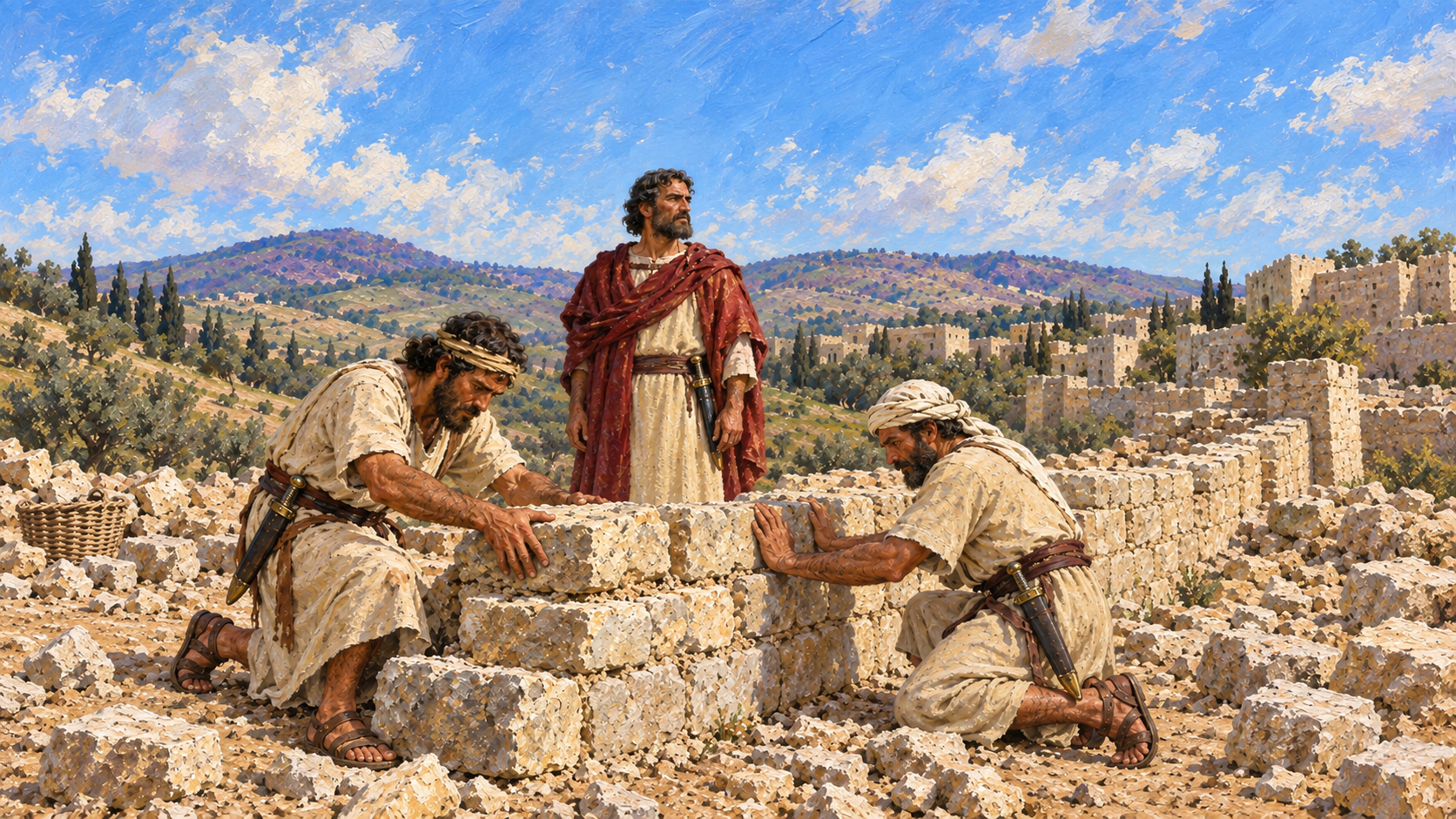
Nehemiah led the rebuilding of Jerusalem’s wall in fifty-two days, but the book doesn’t end with that achievement. God used this man’s burden to restore ordered life in the city, yet the people later returned to familiar sins. Why did the people fall back into sin after such a work of restoration? Following Nehemiah in his post-exile setting helps us see why outward reform could never replace the deeper restoration God would bring through the Messiah.
Israel’s Return and Nehemiah’s Calling
Babylon destroyed Jerusalem and Solomon’s temple after generations of covenant rebellion. Kings and Chronicles explain how Judah came to that deserved judgment, while Jeremiah and Lamentations describe the devastation from within the crisis. Yet God had not canceled His promises. The LORD preserved a remnant and moved foreign rulers to allow His people to return.
Cyrus first authorized the temple rebuilding. Zerubbabel and Jeshua led that work, and Haggai and Zechariah later urged the people to finish it. Ezra arrived to teach the Law. Nehemiah entered this continuing restoration when Jerusalem’s temple stood but its walls remained broken and its gates burned.
Keeping that sequence in view helps me distinguish the work described in Ezra and Nehemiah. The first returning group reestablished the altar and eventually finished the second temple. Ezra came later to teach God’s Law, and Nehemiah heard about a city whose temple stood but whose walls and gates still offered no security. Jerusalem remained exposed to attack. Its damaged defenses also hindered orderly civic life and made visible the humiliation that had followed Judah’s rebellion.
Nehemiah served Artaxerxes, usually identified as Artaxerxes I. The king’s twentieth year is commonly dated to 445 or 444 BC, depending on the chronological convention used. Those dates help us place Nehemiah’s work within the return already underway. He did not begin that return or rebuild the temple, and the fifty-two days did not complete everything God had promised. They belonged to one wall project in His larger work after the exile.
Much of the book lets us hear Nehemiah describe events himself. He records the news he received and his prayer, then takes us through his request to the king and inspection of Jerusalem. As the work progresses, he explains the problems he faced. Alongside those memoirs are genealogies and public prayers, as well as the names of those who committed themselves to the covenant. Other passages turn our attention to Ezra and the wider community.
Ezra and Nehemiah formed one work in the traditional Hebrew arrangement, so their close historical and theological connection is understandable. That does not tell us who gave Nehemiah its final form. His memoirs make up the core of the book, but the inspired text does not say that Ezra compiled it. I would leave the final human editor unidentified rather than claim a certainty Scripture does not give us.
The first six chapters follow the rebuilding of the wall. In chapters 7-10, the people are registered and hear Scripture read publicly, leading to confession and a renewed covenant commitment. Chapters 11-12 describe Jerusalem’s repopulation and dedication. Then chapter 13 takes us to Nehemiah’s return after a later absence, when he discovers serious relapse. The finished wall had not made the people fully faithful.
I notice that the book could have stopped at the completed project, but it takes us further. Once the wall was standing, how would the people live inside it? Chapter 13 makes us face that question honestly.
The words of Nehemiah the son of Hachaliah. It came to pass in the month of Chislev, in the twentieth year, as I was in Shushan the citadel, that Hanani one of my brethren came with men from Judah; and I asked them concerning the Jews who had escaped, who had survived the captivity, and concerning Jerusalem. And they said to me, “The survivors who are left from the captivity in the province are there in great distress and reproach. The wall of Jerusalem is also broken down, and its gates are burned with fire.” So it was, when I heard these words, that I sat down and wept, and mourned for many days; I was fasting and praying before the God of heaven. And I said: “I pray, LORD God of heaven, O great and awesome God, You who keep Your covenant and mercy with those who love You and observe Your commandments, please let Your ear be attentive and Your eyes open, that You may hear the prayer of Your servant which I pray before You now, day and night, for the children of Israel Your servants, and confess the sins of the children of Israel which we have sinned against You. Both my father’s house and I have sinned. We have acted very corruptly against You, and have not kept the commandments, the statutes, nor the ordinances which You commanded Your servant Moses. Remember, I pray, the word that You commanded Your servant Moses, saying, ‘If you are unfaithful, I will scatter you among the nations; but if you return to Me, and keep My commandments and do them, though some of you were cast out to the farthest part of the heavens, yet I will gather them from there, and bring them to the place which I have chosen as a dwelling for My name.’ Now these are Your servants and Your people, whom You have redeemed by Your great power, and by Your strong hand. O Lord, I pray, please let Your ear be attentive to the prayer of Your servant, and to the prayer of Your servants who desire to fear Your name; and let Your servant prosper this day, I pray, and grant him mercy in the sight of this man.” For I was the king’s cupbearer.
Hanani and the men with him told Nehemiah that the remnant in Judah was living in distress and reproach. Jerusalem’s wall was broken and its gates burned. Nehemiah sat down and wept when he heard them. For many days he mourned with fasting and prayer. His first response was to bring the disaster before the God of heaven, rather than express public outrage or rush into a plan.
He began his prayer by acknowledging God’s greatness and the mercy with which He keeps His covenant. Then Nehemiah confessed Israel’s sins, including his own and those of his father’s house. He recalled what the LORD had said about scattering the disobedient and gathering those who returned. His appeal for help rested on that revealed promise, not on any claim that he deserved it.
At the end of the prayer, Nehemiah asked for mercy before the king and told us that he was the royal cupbearer. That office gave him trusted access, but he still served at the monarch’s pleasure. The conversation ahead could be dangerous. Prayer was preparing him to act wisely on the burden he carried.
I also notice that he says, “we have sinned.” He had not personally committed every offense that brought the exile, yet he did not distance himself from the covenant people and blame only earlier generations. He acknowledged that God’s discipline was just and asked for mercy on the strength of God’s promise. That confession led him to make a request and then act obediently; it was not empty self-condemnation.
And it came to pass in the month of Nisan, in the twentieth year of King Artaxerxes, when wine was before him, that I took the wine and gave it to the king. Now I had never been sad in his presence before. Therefore the king said to me, “Why is your face sad, since you are not sick? This is nothing but sorrow of heart.” So I became dreadfully afraid, and said to the king, “May the king live forever! Why should my face not be sad, when the city, the place of my fathers’ tombs, lies waste, and its gates are burned with fire?” Then the king said to me, “What do you request?” So I prayed to the God of heaven. And I said to the king, “If it pleases the king, and if your servant has found favor in your sight, I ask that you send me to Judah, to the city of my fathers’ tombs, that I may rebuild it.” Then the king said to me (the queen also sitting beside him), “How long will your journey be? And when will you return?” So it pleased the king to send me; and I set him a time. Furthermore I said to the king, “If it pleases the king, let letters be given to me for the governors of the region beyond the River, that they must permit me to pass through till I come to Judah, and a letter to Asaph the keeper of the king’s forest, that he must give me timber to make beams for the gates of the citadel which pertains to the temple, for the city wall, and for the house that I will occupy.” And the king granted them to me according to the good hand of my God upon me. Then I went to the governors in the region beyond the River, and gave them the king’s letters. Now the king had sent captains of the army and horsemen with me. When Sanballat the Horonite and Tobiah the Ammonite official heard of it, they were deeply disturbed that a man had come to seek the well-being of the children of Israel. So I came to Jerusalem and was there three days. Then I arose in the night, I and a few men with me; I told no one what my God had put in my heart to do at Jerusalem; nor was there any animal with me, except the one on which I rode. And I went out by night through the Valley Gate to the Serpent Well and the Refuse Gate, and viewed the walls of Jerusalem which were broken down and its gates which were burned with fire. Then I went on to the Fountain Gate and to the King’s Pool, but there was no room for the animal under me to pass. So I went up in the night by the valley, and viewed the wall; then I turned back and entered by the Valley Gate, and so returned. And the officials did not know where I had gone or what I had done; I had not yet told the Jews, the priests, the nobles, the officials, or the others who did the work. Then I said to them, “You see the distress that we are in, how Jerusalem lies waste, and its gates are burned with fire. Come and let us build the wall of Jerusalem, that we may no longer be a reproach.” And I told them of the hand of my God which had been good upon me, and also of the king’s words that he had spoken to me. So they said, “Let us rise up and build.” Then they set their hands to this good work. But when Sanballat the Horonite, Tobiah the Ammonite official, and Geshem the Arab heard of it, they laughed at us and despised us, and said, “What is this thing that you are doing? Will you rebel against the king?” So I answered them, and said to them, “The God of heaven Himself will prosper us; therefore we His servants will arise and build, but you have no heritage or right or memorial in Jerusalem.”
When Artaxerxes noticed Nehemiah’s sadness, Nehemiah became dreadfully afraid. He answered respectfully and explained Jerusalem’s condition. After a brief prayer to God, he asked to be sent to Judah. He was ready to name a return time and request the letters he would need for safe passage. He also asked for timber for the gates and his residence.
Nehemiah’s request helps me see how preparation can belong within faith. He understood what the task required and respected legitimate authority as he asked for the necessary resources. He did not treat those practical arrangements as unbelief. When the king agreed, Nehemiah credited the good hand of God, recognizing His providence without treating the Persian ruler as Israel’s savior.
After reaching Jerusalem, Nehemiah waited three days and inspected the walls at night with only a few men. He gathered firsthand knowledge before announcing the plan. Then he told the leaders about God’s hand and the king’s words. They answered, “Let us rise up and build.” Sanballat, Tobiah, and Geshem mocked, but Nehemiah grounded the work in the God of heaven.
The opposition was political as well as personal. Sanballat was connected with Samaria, Tobiah was an Ammonite official with influential relationships inside Judah, and Geshem represented Arab interests in the region. A strengthened Jerusalem could alter the balance of local power. Their charge of rebellion was therefore calculated to make an authorized project look like a threat to Persia. Nehemiah could answer firmly because he had the king’s letters, but his deepest confidence remained in God.
Nehemiah gives me no reason to choose between trusting God and doing careful work. Prayer accompanied his response to danger and his specific request to the king. Once in Jerusalem, he inspected the damage before announcing a plan. Through all of that preparation, he continued to credit God for opening the way.
Rebuilding Amid Opposition and Injustice
Then Eliashib the high priest rose up with his brethren the priests and built the Sheep Gate; they consecrated it and hung its doors. They built as far as the Tower of the Hundred, and consecrated it, then as far as the Tower of Hananel. Next to Eliashib the men of Jericho built. And next to them Zaccur the son of Imri built. Also the sons of Hassenaah built the Fish Gate; they laid its beams and hung its doors with its bolts and bars. And next to them Meremoth the son of Urijah, the son of Koz, made repairs. Next to them Meshullam the son of Berechiah, the son of Meshezabel, made repairs. Next to them Zadok the son of Baana made repairs. Next to them the Tekoites made repairs; but their nobles did not put their shoulders to the work of their Lord.
It would be easy to pass quickly over the unfamiliar names in chapter 3, but I don’t want to miss the people behind them. Priests worked beside rulers, and craftsmen and merchants repaired other sections. Whole families took part, while residents from surrounding districts accepted their portions of the wall. Some worked opposite their own houses, serving the city through a responsibility close to home.
The repairs continued around Jerusalem from gate to gate. Nehemiah organized the common task so that many people could take responsibility for a defined section. No one rebuilt the city alone, and Scripture preserves names we might miss if we focused only on the finished achievement.
The repeated names help us see how that shared work happened. Some people repaired near their homes, others came from outside Jerusalem, and some finished one assignment before taking another. We are reading about a covenant community working under God, not merely admiring a monument to one impressive leader.
Among those names, Scripture also records the Tekoite nobles who refused to put their shoulders to the work of their Lord. Their refusal appears beside the faithfulness of ordinary laborers. That should make me consider whether I am humbly obeying God in the assignment He gives me. Rank does not excuse me from obedience, and the amount of attention a task receives does not determine its value to God.
But it so happened, when Sanballat heard that we were rebuilding the wall, that he was furious and very indignant, and mocked the Jews. And he spoke before his brethren and the army of Samaria, and said, “What are these feeble Jews doing? Will they fortify themselves? Will they offer sacrifices? Will they complete it in a day? Will they revive the stones from the heaps of rubbish–stones that are burned?” Now Tobiah the Ammonite was beside him, and he said, “Whatever they build, if even a fox goes up on it, he will break down their stone wall.” Hear, O our God, for we are despised; turn their reproach on their own heads, and give them as plunder to a land of captivity! Do not cover their iniquity, and do not let their sin be blotted out from before You; for they have provoked You to anger before the builders. So we built the wall, and the entire wall was joined together up to half its height, for the people had a mind to work. Now it happened, when Sanballat, Tobiah, the Arabs, the Ammonites, and the Ashdodites heard that the walls of Jerusalem were being restored and the gaps were beginning to be closed, that they became very angry, and all of them conspired together to come and attack Jerusalem and create confusion. Nevertheless we made our prayer to our God, and because of them we set a watch against them day and night. Then Judah said, “The strength of the laborers is failing, and there is so much rubbish that we are not able to build the wall.” And our adversaries said, “They will neither know nor see anything, till we come into their midst and kill them and cause the work to cease.” So it was, when the Jews who dwelt near them came, that they told us ten times, “From whatever place you turn, they will be upon us.” Therefore I positioned men behind the lower parts of the wall, at the openings; and I set the people according to their families, with their swords, their spears, and their bows. And I looked, and arose and said to the nobles, to the leaders, and to the rest of the people, “Do not be afraid of them. Remember the Lord, great and awesome, and fight for your brethren, your sons, your daughters, your wives, and your houses.” And it happened, when our enemies heard that it was known to us, and that God had brought their plot to nothing, that all of us returned to the wall, everyone to his work. So it was, from that time on, that half of my servants worked at construction, while the other half held the spears, the shields, the bows, and wore armor; and the leaders were behind all the house of Judah. Those who built on the wall, and those who carried burdens, loaded themselves so that with one hand they worked at construction, and with the other held a weapon. Every one of the builders had his sword girded at his side as he built. And the one who sounded the trumpet was beside me. Then I said to the nobles, the rulers, and the rest of the people, “The work is great and extensive, and we are separated far from one another on the wall. Wherever you hear the sound of the trumpet, rally to us there. Our God will fight for us.” So we labored in the work, and half of the men held the spears from daybreak until the stars appeared. At the same time I also said to the people, “Let each man and his servant stay at night in Jerusalem, that they may be our guard by night and a working party by day.” So neither I, my brethren, my servants, nor the men of the guard who followed me took off our clothes, except that everyone took them off for washing.
Sanballat mocked the Jews by questioning whether their burned stones could be used again, while Tobiah ridiculed the wall’s strength. Nehemiah brought the mockery to God in prayer. The people had a mind to work and continued building, so ridicule did not stop their progress.
When ridicule failed, the enemies conspired to attack Jerusalem and throw the work into confusion. Nehemiah prayed and posted a guard. As the workers grew weary and reports of danger multiplied, he armed families and stationed them at exposed areas. He also reminded them that the Lord is great and awesome. Their watchfulness belonged alongside their trust in Him.
The builders were already exhausted, with rubble around them and unfinished gaps in the wall. Now nearby Jews kept warning that an attack could come from any direction. Nehemiah had to address both their fear and their practical weakness. He pointed them back to who God is, placed defenders where the wall was weakest, and established a signal by which the scattered workers could call for help.
We need to distinguish that threat from ordinary criticism. These opponents had formed a coalition to stop an authorized rebuilding by force. Their actions made them enemies of the work; an honest question would not have done so. I would not use Sanballat’s example to call every critic an enemy of God or shield a leader from fair questions.
Half of Nehemiah’s servants worked while half held weapons. Builders carried loads with one hand and held a weapon with the other, while those constructing the wall wore swords. A trumpeter remained near Nehemiah so scattered workers could rally if an attack began.
Nehemiah arranged for the people to defend one another, rather than leaving each worker to prove his courage alone. He explained the danger and organized protection while assuring them that God would fight for them. They worked from dawn until the stars appeared, and servants stayed within Jerusalem at night.
We can learn to be ready and responsible under God without copying ancient Judah’s military arrangements into every church project. Christians should plan wisely and protect vulnerable people while obeying lawful authority. Such care need not be driven by fear. Nehemiah was organizing civil defense within Israel’s covenant, which gives us no warrant for reckless violence.
And there was a great outcry of the people and their wives against their Jewish brethren. For there were those who said, “We, our sons, and our daughters are many; therefore let us get grain, that we may eat and live.” There were also some who said, “We have mortgaged our lands and vineyards and houses, that we might buy grain because of the famine.” There were also those who said, “We have borrowed money for the king’s tax on our lands and vineyards. Yet now our flesh is as the flesh of our brethren, our children as their children; and indeed we are forcing our sons and our daughters to be slaves, and some of our daughters have been brought into slavery. It is not in our power to redeem them, for other men have our lands and vineyards.” And I became very angry when I heard their outcry and these words. After serious thought, I rebuked the nobles and rulers, and said to them, “Each of you is exacting usury from his brother.” So I called a great assembly against them. And I said to them, “According to our ability we have redeemed our Jewish brethren who were sold to the nations. Now indeed, will you even sell your brethren? Or should they be sold to us?” Then they were silenced and found nothing to say. Then I said, “What you are doing is not good. Should you not walk in the fear of our God because of the reproach of the nations, our enemies? I also, with my brethren and my servants, am lending them money and grain. Please, let us stop this usury! Restore now to them, even this day, their lands, their vineyards, their olive groves, and their houses, also a hundredth of the money and the grain, the new wine and the oil, that you have charged them.” So they said, “We will restore it, and will require nothing from them; we will do as you say.” Then I called the priests, and required an oath from them that they would do according to this promise. Then I shook out the fold of my garment and said, “So may God shake out each man from his house, and from his property, who does not perform this promise. Even thus may he be shaken out and emptied.” And all the assembly said, “Amen!” and praised the LORD. Then the people did according to this promise.
Then the outcry came from inside the Jewish community. Families without enough grain had mortgaged their fields and houses, while others borrowed to pay the king’s tax. As debt deepened, their children were brought into servitude. Wealthy countrymen were charging interest and profiting from their neighbors’ distress.
Nehemiah was angry when he heard this, but he thought carefully before rebuking the nobles and rulers for exacting usury from their own people. He required them to restore the families’ fields and houses, along with their vineyards and olive groves. They also had to return what they had charged in money and grain, as well as wine and oil. The leaders promised to restore it all.
If I read Nehemiah only as a lesson in overcoming outside opposition, I miss what was happening within the walls. Defending Jerusalem could not excuse powerful Jews devouring their own brothers. Nehemiah accepted a cost himself: during his twelve years as governor, he refused the food allowance because the people were already heavily burdened. He treated authority as a responsibility to them, rather than an entitlement.
The families’ plight explains the references to slavery among fellow Israelites. They had mortgaged the land that fed them and borrowed to meet Persian taxes. Debt service had then cost them control of their sons and daughters. The Law set boundaries on lending and required mercy toward needy brothers. Nehemiah was confronting people who used famine and desperation to acquire their neighbors’ property and labor, not condemning every loan in every economy.
I see this internal crisis as central to the restoration. Jerusalem’s people could not point to a repaired wall as evidence that all was well while the powerful were taking their brothers’ property and labor through famine and debt.
Now it happened when Sanballat, Tobiah, Geshem the Arab, and the rest of our enemies heard that I had rebuilt the wall, and that there were no breaks left in it (though at that time I had not hung the doors in the gates), that Sanballat and Geshem sent to me, saying, “Come, let us meet together among the villages in the plain of Ono.” But they thought to do me harm. So I sent messengers to them, saying, “I am doing a great work, so that I cannot come down. Why should the work cease while I leave it and go down to you?” But they sent me this message four times, and I answered them in the same manner. Then Sanballat sent his servant to me as before, the fifth time, with an open letter in his hand. In it was written: It is reported among the nations, and Geshem says, that you and the Jews plan to rebel; therefore, according to these rumors, you are rebuilding the wall, that you may be their king. And you have also appointed prophets to proclaim concerning you at Jerusalem, saying, “There is a king in Judah!” Now these matters will be reported to the king. So come, therefore, and let us consult together. Then I sent to him, saying, “No such things as you say are being done, but you invent them in your own heart.” For they all were trying to make us afraid, saying, “Their hands will be weakened in the work, and it will not be done.” Now therefore, O God, strengthen my hands. Afterward I came to the house of Shemaiah the son of Delaiah, the son of Mehetabel, who was a secret informer; and he said, “Let us meet together in the house of God, within the temple, and let us close the doors of the temple, for they are coming to kill you; indeed, at night they will come to kill you.” And I said, “Should such a man as I flee? And who is there such as I who would go into the temple to save his life? I will not go in!” Then I perceived that God had not sent him at all, but that he pronounced this prophecy against me because Tobiah and Sanballat had hired him. For this reason he was hired, that I should be afraid and act that way and sin, so that they might have cause for an evil report, that they might reproach me. My God, remember Tobiah and Sanballat, according to these their works, and the prophetess Noadiah and the rest of the prophets who would have made me afraid. So the wall was finished on the twenty-fifth day of Elul, in fifty-two days. And it happened, when all our enemies heard of it, and all the nations around us saw these things, that they were very disheartened in their own eyes; for they perceived that this work was done by our God.
Sanballat and Geshem repeatedly invited Nehemiah to the plain of Ono because they intended to harm him. He replied that he was doing a great work and could not come down. He was refusing an enemy’s trap that would take him away from his assigned task.
That particular refusal did not place Nehemiah above counsel or correction, and it should not become a slogan that excuses a leader from accountability or family duty. Nehemiah listened to reports and consulted others. He answered legitimate authority and confronted sin. He rejected this invitation because it was meant to harm him, with repeated requests drawing attention away from necessary work.
The enemies next sent an open letter accusing Nehemiah of planning rebellion and seeking to become king. Shemaiah then tried to frighten him into hiding unlawfully in the temple, so that his sin would give them grounds for an evil report. Nehemiah tested the supposed prophecy against God’s command and recognized that God had not sent it. Religious language could not make that manipulation a word from Him.
Shemaiah appeared to offer protection, but Nehemiah had no lawful right to hide in the inner sanctuary. Going there out of fear would mean disobeying God and giving his opponents an accusation to use. That helps me understand what discernment requires. I cannot judge a message only by its urgency or its references to God; a true word from Him will not require me to violate what He has already written.
The wall was completed on the twenty-fifth day of Elul after fifty-two days of construction. The speed amazed and discouraged the surrounding enemies because they perceived that the work had been done by God.
Those fifty-two days covered the concentrated wall project, not Jerusalem’s whole restoration. The temple had been rebuilt earlier, and the people’s spiritual renewal and Nehemiah’s later reforms fell outside that period. After the wall was finished, the book continued through registration and the public reading of Scripture that led to worship. It then described the repopulation and dedication of Jerusalem, followed much later by Nehemiah’s return to confront renewed compromise.
Finishing the wall vindicated the faithful labor, but it did not prove that every worker or resident was inwardly faithful. Tobiah still had influential friends among the Jews, and their letters continued to pass. We can acknowledge God’s providence in a successful project without assuming that every spiritual danger has been resolved.
The Written Word and a Renewed Covenant Commitment
Then it was, when the wall was built and I had hung the doors, when the gatekeepers, the singers, and the Levites had been appointed, that I gave the charge of Jerusalem to my brother Hanani, and Hananiah the leader of the citadel, for he was a faithful man and feared God more than many. And I said to them, “Do not let the gates of Jerusalem be opened until the sun is hot; and while they stand guard, let them shut and bar the doors; and appoint guards from among the inhabitants of Jerusalem, one at his watch station and another in front of his own house.” Now the city was large and spacious, but the people in it were few, and the houses were not rebuilt. Then my God put it into my heart to gather the nobles, the rulers, and the people, that they might be registered by genealogy. And I found a register of the genealogy of those who had come up in the first return, and found written in it:
After the wall and doors were set, Nehemiah appointed gatekeepers, singers, and Levites. He entrusted Jerusalem to Hanani and Hananiah, describing Hananiah as faithful and God-fearing. The gates would open under defined conditions and guards would stand at assigned posts.
The completed defenses still needed people to care for them. Nehemiah chose responsible leaders and established routines instead of assuming that yesterday’s achievement guaranteed tomorrow’s safety. I need that reminder about service after a visible success: faithfulness continues when the public celebration is over.
Jerusalem was large but sparsely populated. God put it into Nehemiah’s heart to gather the nobles and rulers with the people and register them by genealogy. The preserved list connects this returning community to Israel’s history. Restoration concerned actual families and their inheritances. It also required attention to priestly qualifications and the order God had established for His covenant people.
Now all the people gathered together as one man in the open square that was in front of the Water Gate; and they told Ezra the scribe to bring the Book of the Law of Moses, which the LORD had commanded Israel. So Ezra the priest brought the Law before the assembly of men and women and all who could hear with understanding on the first day of the seventh month. Then he read from it in the open square that was in front of the Water Gate from morning until midday, before the men and women and those who could understand; and the ears of all the people were attentive to the Book of the Law. So Ezra the scribe stood on a platform of wood which they had made for the purpose; and beside him, at his right hand, stood Mattithiah, Shema, Anaiah, Urijah, Hilkiah, and Maaseiah; and at his left hand Pedaiah, Mishael, Malchijah, Hashum, Hashbadana, Zechariah, and Meshullam. And Ezra opened the book in the sight of all the people, for he was standing above all the people; and when he opened it, all the people stood up. And Ezra blessed the LORD, the great God. Then all the people answered, “Amen, Amen!” while lifting up their hands. And they bowed their heads and worshiped the LORD with their faces to the ground. Also Jeshua, Bani, Sherebiah, Jamin, Akkub, Shabbethai, Hodijah, Maaseiah, Kelita, Azariah, Jozabad, Hanan, Pelaiah, and the Levites, helped the people to understand the Law; and the people stood in their place. So they read distinctly from the book, in the Law of God; and they gave the sense, and helped them to understand the reading. And Nehemiah, who was the governor, Ezra the priest and scribe, and the Levites who taught the people said to all the people, “This day is holy to the LORD your God; do not mourn nor weep.” For all the people wept, when they heard the words of the Law. Then he said to them, “Go your way, eat the fat, drink the sweet, and send portions to those for whom nothing is prepared; for this day is holy to our Lord. Do not sorrow, for the joy of the LORD is your strength.” So the Levites quieted all the people, saying, “Be still, for the day is holy; do not be grieved.” And all the people went their way to eat and drink, to send portions and rejoice greatly, because they understood the words that were declared to them.
The people gathered as one in the open square and asked Ezra to bring the Book of the Law of Moses. He read from morning until midday before men, women, and all who could understand. The assembly listened attentively.
Ezra stood on a wooden platform with named men beside him. When he opened the book, the people rose to their feet. Ezra blessed the LORD, and the assembly answered, “Amen, Amen.” They lifted their hands before bowing their faces to the ground in worship. Their physical responses followed the public opening of God’s Word.
The Levites helped the people understand what was being read. God’s Word was neither a ceremonial object to display nor a sound they could not follow. They read it distinctly and explained its meaning. If we speak about revival while neglecting accurate reading and understanding, we have missed what was central to Nehemiah 8.
Giving the sense certainly included explanation. Some interpreters also understand it to include translation or language assistance for a community that had lived under foreign rule. We do not have to choose only one method to recognize the result: the people understood what God had said. Ezra and the Levites helped them follow the meaning rather than assuming that hearing a public reading would answer every question.
That attention to understanding makes me think about how we honor Scripture when we teach it. These people needed to know what the written Word said so they could respond to it. The teachers served them by explaining its meaning, not by leaving them with words they could hear but could not follow.
Hearing the Law brought the people to tears, but Nehemiah, Ezra, and the Levites did not treat weeping as the goal. This was a holy day, and the people were to eat and drink together. Anyone who had prepared food was to share with those who had none. The leaders called the whole assembly to rejoice in the strength of the LORD.
They were not denying the sin the Law had exposed. The extended confession in the following chapters makes that clear. They were teaching the people how to respond on this particular sacred day. Conviction should lead us toward obedient worship, not leave us in despair.
When the people later found the written command about the Feast of Tabernacles, they kept it with great gladness. Their response came from understanding what God had said, rather than from emotion alone. The fellowship and generosity they shared as they celebrated belonged to that obedience.
Now on the twenty-fourth day of this month the children of Israel were assembled with fasting, in sackcloth, and with dust on their heads. Then those of Israelite lineage separated themselves from all foreigners; and they stood and confessed their sins and the iniquities of their fathers. And they stood up in their place and read from the Book of the Law of the LORD their God for one-fourth of the day; and for another fourth they confessed and worshiped the LORD their God. Then Jeshua, Bani, Kadmiel, Shebaniah, Bunni, Sherebiah, Bani, and Chenani stood on the stairs of the Levites and cried out with a loud voice to the LORD their God. And the Levites, Jeshua, Kadmiel, Bani, Hashabniah, Sherebiah, Hodijah, Shebaniah, and Pethahiah, said: “Stand up and bless the LORD your God Forever and ever! “Blessed be Your glorious name, Which is exalted above all blessing and praise! You alone are the LORD; You have made heaven, The heaven of heavens, with all their host, The earth and everything on it, The seas and all that is in them, And You preserve them all. The host of heaven worships You. “You are the LORD God, Who chose Abram, And brought him out of Ur of the Chaldeans, And gave him the name Abraham; You found his heart faithful before You, And made a covenant with him To give the land of the Canaanites, The Hittites, the Amorites, The Perizzites, the Jebusites, And the Girgashites– To give it to his descendants. You have performed Your words, For You are righteous.
The assembly gathered in sackcloth and fasting, reading the Law before confessing sin and worshiping God. Their prayer began with the LORD as the only Creator, who sustains all He has made and is worshiped by heaven’s host. It then recalled His call of Abraham and deliverance of Israel in the Exodus. From Sinai and His wilderness provision, the prayer followed Israel into the land. It remembered the rebellion that followed the conquest and the troubled years of the judges. Even in exile, God’s continuing mercy remained part of their history.
As they confessed, the people looked at Israel’s failures alongside God’s character. Again and again, their pride and disobedience were met by His readiness to pardon. He had been gracious and compassionate toward them. We can follow that history and see His patience without losing sight of either their guilt or His covenant faithfulness.
They also acknowledged their present distress. Although they lived in the land God had given their fathers, foreign kings ruled over them and enjoyed its produce because of Israel’s sins. Their worship did not hide their responsibility or pretend that the consequences had disappeared.
This helps us understand what the repaired wall had and had not accomplished. Israel had not recovered the independence it enjoyed under David or Solomon. Artaxerxes still ruled, and Persian taxes continued to burden the land. Even Nehemiah’s authority depended on the king’s appointment. The people could thank God for genuine mercy while recognizing that His covenant promises still awaited their final fulfillment.
Now the rest of the people–the priests, the Levites, the gatekeepers, the singers, the Nethinim, and all those who had separated themselves from the peoples of the lands to the Law of God, their wives, their sons, and their daughters, everyone who had knowledge and understanding– these joined with their brethren, their nobles, and entered into a curse and an oath to walk in God’s Law, which was given by Moses the servant of God, and to observe and do all the commandments of the LORD our Lord, and His ordinances and His statutes: We would not give our daughters as wives to the peoples of the land, nor take their daughters for our sons; if the peoples of the land brought wares or any grain to sell on the Sabbath day, we would not buy it from them on the Sabbath, or on a holy day; and we would forego the seventh year’s produce and the exacting of every debt. Also we made ordinances for ourselves, to exact from ourselves yearly one-third of a shekel for the service of the house of our God: for the showbread, for the regular grain offering, for the regular burnt offering of the Sabbaths, the New Moons, and the set feasts; for the holy things, for the sin offerings to make atonement for Israel, and all the work of the house of our God. We cast lots among the priests, the Levites, and the people, for bringing the wood offering into the house of our God, according to our fathers’ houses, at the appointed times year by year, to burn on the altar of the LORD our God as it is written in the Law. And we made ordinances to bring the firstfruits of our ground and the firstfruits of all fruit of all trees, year by year, to the house of the LORD; to bring the firstborn of our sons and our cattle, as it is written in the Law, and the firstborn of our herds and our flocks, to the house of our God, to the priests who minister in the house of our God; to bring the firstfruits of our dough, our offerings, the fruit from all kinds of trees, the new wine and oil, to the priests, to the storerooms of the house of our God; and to bring the tithes of our land to the Levites, for the Levites should receive the tithes in all our farming communities. And the priest, the descendant of Aaron, shall be with the Levites when the Levites receive tithes; and the Levites shall bring up a tenth of the tithes to the house of our God, to the rooms of the storehouse. For the children of Israel and the children of Levi shall bring the offering of the grain, of the new wine and the oil, to the storerooms where the articles of the sanctuary are, where the priests who minister and the gatekeepers and the singers are; and we will not neglect the house of our God.
The leaders and people put their commitment to God’s Law in writing. They addressed faithfulness in marriage and promised to stop buying goods in violation of the Sabbath. They renewed their obligations for the sabbatical year as well. Regular support for the temple included wood for the offerings, along with the firstfruits and firstborn that belonged to the LORD. They also promised the required tithes so that God’s house would no longer be neglected.
These were serious promises to keep obligations already given through Moses. Signing them did not establish the promised new covenant or permanently change every heart. Chapter 13 would show how quickly people could neglect what they had sworn to do.
I want to keep that covenant renewal distinct from what Jeremiah and Ezekiel promised. Jeremiah spoke of God’s Law written on the heart under a new covenant. Ezekiel described cleansing and a new heart, with God’s Spirit dwelling within His people. In Nehemiah 10, the community was setting its seal to duties under the Mosaic covenant. That was right for Israel at this time, but signing the document could not produce the inward work the prophets described.
Vows can make our responsibilities clear, but only God gives new birth. Churches should teach obedience and establish accountable practices without claiming that a signed pledge or public ceremony makes someone spiritually alive. An emotional moment cannot do that either. The Law exposed sin and directed Israel’s covenant life; Christ and the Holy Spirit bring saving renewal.
A Refilled City, Joyful Dedication, and Painful Relapse
The leaders already lived in Jerusalem. Lots were therefore used to select one out of every ten people from the wider population to reside in the city. Others volunteered, and the people blessed them for accepting the disruption. The chapter again records individual names and families. It identifies priests and Levites, as well as the gatekeepers and other workers who sustained the city.
Repopulating Jerusalem meant asking families to change their lives for the community’s good. A building can be celebrated at its dedication, but people must go on making homes and carrying out the work that sustains a city. Worship needed steady service. Administration and justice also required continued attention, along with daily security. The restored city depended on that ordinary faithfulness.
The names help us follow the continuity of God’s dealings with Israel. These people belonged to particular tribes and households, with identified priestly lines and hometowns. They were not anonymous symbols of restoration, but people in real history whose names God chose to preserve.
Now at the dedication of the wall of Jerusalem they sought out the Levites in all their places, to bring them to Jerusalem to celebrate the dedication with gladness, both with thanksgivings and singing, with cymbals and stringed instruments and harps. And the sons of the singers gathered together from the countryside around Jerusalem, from the villages of the Netophathites, from the house of Gilgal, and from the fields of Geba and Azmaveth; for the singers had built themselves villages all around Jerusalem. Then the priests and Levites purified themselves, and purified the people, the gates, and the wall. So I brought the leaders of Judah up on the wall, and appointed two large thanksgiving choirs. One went to the right hand on the wall toward the Refuse Gate. After them went Hoshaiah and half of the leaders of Judah, and Azariah, Ezra, Meshullam, Judah, Benjamin, Shemaiah, Jeremiah, and some of the priests’ sons with trumpets–Zechariah the son of Jonathan, the son of Shemaiah, the son of Mattaniah, the son of Michaiah, the son of Zaccur, the son of Asaph, and his brethren, Shemaiah, Azarel, Milalai, Gilalai, Maai, Nethanel, Judah, and Hanani, with the musical instruments of David the man of God. And Ezra the scribe went before them. By the Fountain Gate, in front of them, they went up the stairs of the City of David, on the stairway of the wall, beyond the house of David, as far as the Water Gate eastward. The other thanksgiving choir went the opposite way, and I was behind them with half of the people on the wall, going past the Tower of the Ovens as far as the Broad Wall, and above the Gate of Ephraim, above the Old Gate, above the Fish Gate, the Tower of Hananel, the Tower of the Hundred, as far as the Sheep Gate; and they stopped by the Gate of the Prison. So the two thanksgiving choirs stood in the house of God, likewise I and the half of the rulers with me; and the priests, Eliakim, Maaseiah, Minjamin, Michaiah, Elioenai, Zechariah, and Hananiah, with trumpets; also Maaseiah, Shemaiah, Eleazar, Uzzi, Jehohanan, Malchijah, Elam, and Ezer. The singers sang loudly with Jezrahiah the director. Also that day they offered great sacrifices, and rejoiced, for God had made them rejoice with great joy; the women and the children also rejoiced, so that the joy of Jerusalem was heard afar off.
Levites came to Jerusalem for a dedication filled with gladness and thanksgiving. Their singing was accompanied by cymbals and stringed instruments, including harps. The priests and Levites first purified themselves, then the people, the gates, and the wall. Two large thanksgiving choirs went in opposite directions along the wall before meeting at the house of God.
I notice how the dedication answered Tobiah’s ridicule. He had said that a fox could break the wall, yet worshipers were now standing on it and walking along it in procession. They celebrated by offering sacrifices and giving thanks, directing their joy toward God instead of boasting about their engineering.
The women and children rejoiced with the men, and their joy could be heard far from Jerusalem. We began with Nehemiah weeping over the ruined city; now we hear its people celebrating. Both grief and joy had their proper place as God restored them.
Now before this, Eliashib the priest, having authority over the storerooms of the house of our God, was allied with Tobiah. And he had prepared for him a large room, where previously they had stored the grain offerings, the frankincense, the articles, the tithes of grain, the new wine and oil, which were commanded to be given to the Levites and singers and gatekeepers, and the offerings for the priests. But during all this I was not in Jerusalem, for in the thirty-second year of Artaxerxes king of Babylon I had returned to the king. Then after certain days I obtained leave from the king, and I came to Jerusalem and discovered the evil that Eliashib had done for Tobiah, in preparing a room for him in the courts of the house of God. And it grieved me bitterly; therefore I threw all the household goods of Tobiah out of the room. Then I commanded them to cleanse the rooms; and I brought back into them the articles of the house of God, with the grain offering and the frankincense. I also realized that the portions for the Levites had not been given them; for each of the Levites and the singers who did the work had gone back to his field. So I contended with the rulers, and said, “Why is the house of God forsaken?” And I gathered them together and set them in their place. Then all Judah brought the tithe of the grain and the new wine and the oil to the storehouse. And I appointed as treasurers over the storehouse Shelemiah the priest and Zadok the scribe, and of the Levites, Pedaiah; and next to them was Hanan the son of Zaccur, the son of Mattaniah; for they were considered faithful, and their task was to distribute to their brethren. Remember me, O my God, concerning this, and do not wipe out my good deeds that I have done for the house of my God, and for its services! In those days I saw people in Judah treading wine presses on the Sabbath, and bringing in sheaves, and loading donkeys with wine, grapes, figs, and all kinds of burdens, which they brought into Jerusalem on the Sabbath day. And I warned them about the day on which they were selling provisions. Men of Tyre dwelt there also, who brought in fish and all kinds of goods, and sold them on the Sabbath to the children of Judah, and in Jerusalem. Then I contended with the nobles of Judah, and said to them, “What evil thing is this that you do, by which you profane the Sabbath day? Did not your fathers do thus, and did not our God bring all this disaster on us and on this city? Yet you bring added wrath on Israel by profaning the Sabbath.” So it was, at the gates of Jerusalem, as it began to be dark before the Sabbath, that I commanded the gates to be shut, and charged that they must not be opened till after the Sabbath. Then I posted some of my servants at the gates, so that no burdens would be brought in on the Sabbath day. Now the merchants and sellers of all kinds of wares lodged outside Jerusalem once or twice. Then I warned them, and said to them, “Why do you spend the night around the wall? If you do so again, I will lay hands on you!” From that time on they came no more on the Sabbath. And I commanded the Levites that they should cleanse themselves, and that they should go and guard the gates, to sanctify the Sabbath day. Remember me, O my God, concerning this also, and spare me according to the greatness of Your mercy! In those days I also saw Jews who had married women of Ashdod, Ammon, and Moab. And half of their children spoke the language of Ashdod, and could not speak the language of Judah, but spoke according to the language of one or the other people. So I contended with them and cursed them, struck some of them and pulled out their hair, and made them swear by God, saying, “You shall not give your daughters as wives to their sons, nor take their daughters for your sons or yourselves. Did not Solomon king of Israel sin by these things? Yet among many nations there was no king like him, who was beloved of his God; and God made him king over all Israel. Nevertheless pagan women caused even him to sin. Should we then hear of your doing all this great evil, transgressing against our God by marrying pagan women?” And one of the sons of Joiada, the son of Eliashib the high priest, was a son-in-law of Sanballat the Horonite; therefore I drove him from me. Remember them, O my God, because they have defiled the priesthood and the covenant of the priesthood and the Levites. Thus I cleansed them of everything pagan. I also assigned duties to the priests and the Levites, each to his service, and to bringing the wood offering and the firstfruits at appointed times. Remember me, O my God, for good!
Nehemiah returned to Artaxerxes in the king’s thirty-second year and later received permission to come back to Jerusalem. During his absence, Eliashib had prepared a large temple chamber for Tobiah, while the portions intended for the Levites were neglected. Commerce had also returned on the Sabbath. At the same time, covenant-breaking marriages had spread among the people.
Nehemiah threw Tobiah’s possessions out and ordered the temple rooms cleansed, then restored the articles and offerings that belonged there. He appointed trustworthy treasurers to handle the provisions. To address Sabbath commerce, he shut the gates before the day began and confronted merchants who lingered outside. He also rebuked the responsible leaders and dealt with the compromised alliances in the priesthood.
The ending is unsettling because these were the people who had heard the Law and confessed their sin. They had signed public commitments and celebrated the wall’s dedication, yet those reforms did not maintain themselves. Nehemiah repeatedly asked God to remember him as he addressed the failures. God had truly restored Jerusalem, but the work remained incomplete and Israel still needed inward covenant renewal.
We should allow for the time that passed before chapter 13. Nehemiah had returned to the Persian king as promised and later obtained leave to visit Jerusalem again. During that absence, duties were neglected and compromising alliances became evident. A sincere response to Scripture did not remove the community’s continuing need for faithful teaching and correction. They still had to remain watchful over time.
I don’t want to hurry past that uncomfortable ending. The people had responded with tears and confession, then committed themselves publicly and celebrated together. In time, familiar compromises returned. Necessary as Nehemiah’s reforms were, they could not give people new hearts.
Some Jewish men had married women of Ashdod, Ammon, and Moab, and their children did not know the language of Judah. Nehemiah cited Solomon, whose foreign wives turned his heart toward other gods. The issue was idolatrous covenant compromise and the transmission of Israel’s faith.
Deuteronomy restricted Ammonite and Moabite admission to Israel’s assembly because of those nations’ past hostility. That judgment on the nations did not put a foreigner who truly turned to the LORD beyond grace. Consider Ruth: she left Moab’s gods and confessed Israel’s God as her own, and His people received her. Nehemiah was confronting marriages that preserved pagan allegiance and drew households away from covenant obedience. Ancestry alone was not the problem.
Rahab also joined Israel’s God and people, while Ruth, a Moabitess, was received through her loyal confession and covenant faith, which placed her within Israel and the Messiah’s ancestry. Their examples show why we cannot use Scripture to justify racial separation. A foreign origin did not keep a genuine worshiper of the LORD from being received.
Nehemiah carried out forceful civil reforms as a governor in post-exile Judah under the Mosaic covenant. The church has not inherited that office or authority to police ethnicity. We are to preserve the enduring spiritual command: believers must marry in the Lord and refuse idolatrous union.
Keeping worship and covenant faithfulness in view helps me apply this passage without making race the issue. Ruth and Rahab were received as worshipers of the LORD. The command to marry in the Lord continues that concern for faithfulness to Him.
Leadership, Promised Restoration, and the Greater Restorer
He brought his burden to God, then gathered facts and made specific requests instead of relying on enthusiasm alone. As he organized the shared work, he continued to credit God for opening the way. He prepared a responsible defense against danger and refused to overlook exploitation within the community. The written Word helped him test a claim to prophecy. He chose people who had proved faithful and accepted personal cost rather than treating leadership as a means of comfort.
Some of his actions were severe, particularly in chapter 13. We should face those actions without turning each one into a method for all leaders to copy, and without dismissing the seriousness of the covenant crisis. His office as Judah’s governor differed from a pastor’s responsibility in the church.
Christian leaders can learn from his courage and clarity, including the care he took in planning and restraining his own privileges. We must also remain accountable and generous toward those we serve, with Scripture governing our work. Nehemiah gives no leader a place beyond questions or permission to call every ambition a divine burden. We need to test a proposed task by God’s Word and honest facts while respecting rightful authority. A worthy goal still requires righteous means.
Isaiah had announced that Jerusalem and the temple would be rebuilt, even naming Cyrus as the ruler God would use. Daniel 9 speaks of Jerusalem’s street and wall being built again in troublesome times. Nehemiah’s work fits the promised return and the conflict surrounding restoration.
Isaiah 58:12 speaks about righteous repair and is often applied to Nehemiah. But the passage does not name him, and it is not an exclusive prediction of his book. I can appreciate a connection without claiming that Scripture says more than it does. Each passage still needs to be understood in its context.
Nehemiah’s work did not establish the final messianic kingdom. Judah remained under Persia, sin returned, and the book closed with reform rather than royal glory. Through this restoration, God preserved Israel and Jerusalem for His continuing purpose. The Messiah will return bodily to restore Israel and judge rebellion, reigning literally as the prophets promised.
The ending keeps me from treating the wall as the final fulfillment of Israel’s promises. Judah still served Persia, its people returned to sin, and no Davidic king sat in Jerusalem. What God had done through Nehemiah was real, but the Messiah’s future work was still needed.
Nehemiah interceded for guilty people and left royal comfort to serve their restoration, accepting reproach along the way. Those parallels can help us understand faithful leadership, though Scripture does not formally identify him as a type of Christ. Jesus is far greater because He is the eternal Son, fully God and fully man. He was born of a virgin and remained completely without sin.
Wicked men physically tortured and punished Jesus before killing Him. He willingly bore that real punishment for our sins in His innocent body. Christ shed His blood for the whole world and died before being buried and rising bodily from the dead. The Father did not punish or curse Jesus, nor did He abandon His Son. He did not strike, bruise, or pour wrath on Him.
God genuinely offers salvation to everyone, though people can resist and reject Him. Whoever repents and believes in Christ is forgiven and justified, or declared righteous before God. That person is born again as a new creation, indwelt and sealed by the Holy Spirit. Everyone truly saved remains eternally secure. That security neither permits lawlessness nor proves that every superficial profession is genuine.
Jerusalem’s walls could hold back an enemy, but they could not cleanse guilt or create obedience in a person’s heart. A written commitment could name a duty without giving someone a new heart to fulfill it. Jesus saves by His blood and gives the Holy Spirit to those who believe. He is building His church now and will return bodily to restore Israel and reign for a literal thousand years. He will judge evil before bringing His redeemed people into the final city God prepares.
The limits we have considered help us learn from Nehemiah accurately. The wall’s completion was one part of a longer restoration, and his authority belonged to a particular covenant setting. We can learn from his faithful service without putting leaders beyond correction or asking outward reforms to accomplish the inward renewal only God can give.
Related studies give fuller treatments of the building of the second temple, prayer, and the book of Lamentations.
My Final Thoughts
Following Nehemiah from his tears in Shushan to the difficult reforms of chapter 13 gives me encouragement without allowing me to overlook the people’s need. God truly restored Jerusalem as Nehemiah prayed and prepared the work, then led the people to labor together. They returned to God’s written Word as well. Yet neither a sound wall nor sincere vows could cleanse guilt or create lasting obedience in the heart. Jesus Christ is the greater Restorer who shed His blood for the whole world and died. He was buried and rose bodily so that everyone who receives Him by faith can be forgiven and born again. I want to serve faithfully in the work God gives me while remembering where my hope belongs. It rests in Christ, beyond what any project, human leader, or season of outward reform can accomplish.