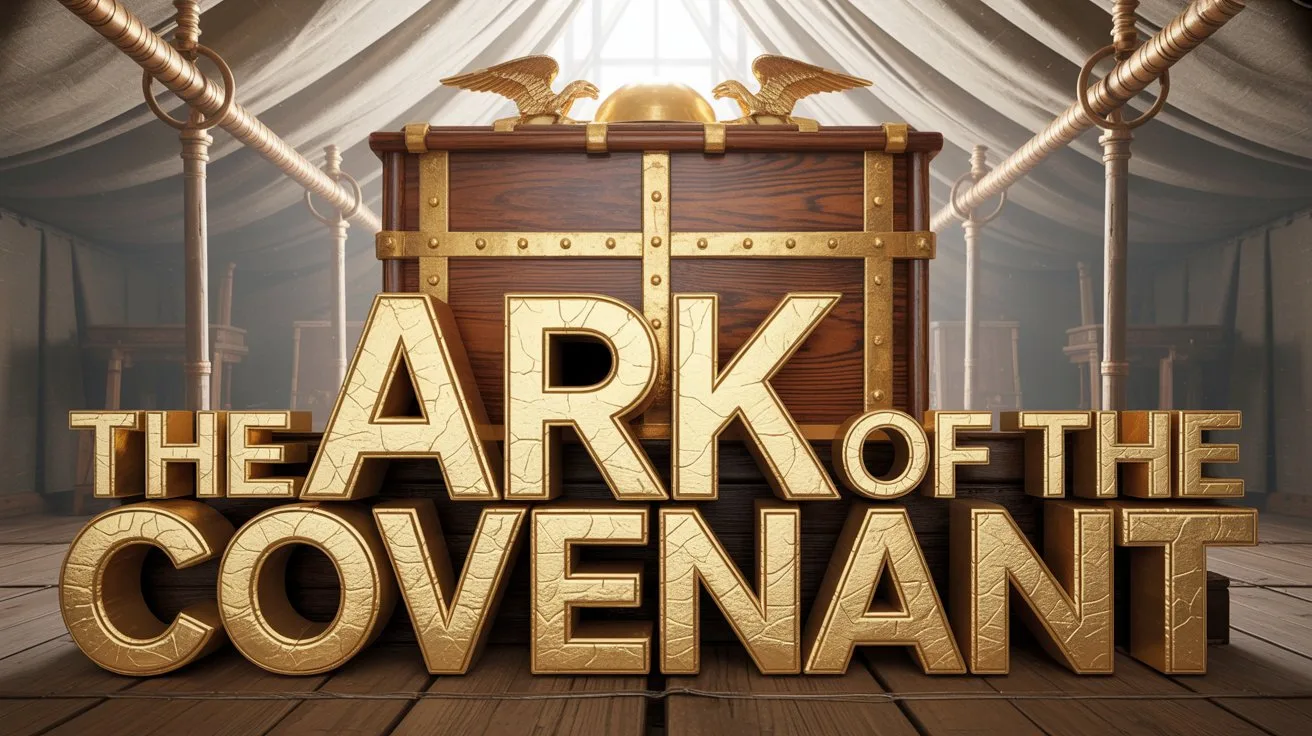

The Ark of the Covenant captures our attention because it was the most sacred object in Israel’s worship and the focal point of God’s special, covenant relationship with His people. Scripture presents it as a real, historical item built at God’s command, carried with careful reverence, and associated with moments of guidance, blessing, judgment, and holy fear.
In this study we will walk through the Bible’s own testimony about the Ark: its construction and purpose, the mercy seat where God met with His people, what was placed inside it, how it was to be handled, and the major events surrounding it from Moses to the kings. We will also think carefully about later references and the question of where it is now, while keeping our conclusions anchored to what Scripture actually says.
God’s Pattern and the Ark
“And let them make Me a sanctuary, that I may dwell among them. According to all that I show you, that is, the pattern of the tabernacle and the pattern of all its furnishings, just so you shall make it.” (Exodus 25:8-9)
The Ark did not originate in Israel’s imagination. God Himself commanded it as part of the tabernacle furnishings. The key idea in Exodus is that God provided a “pattern” and the people were to obey it. This is important because it sets the tone for everything that follows: the Ark is not a magical object that can be used however people want, and it is not a lucky charm. It belongs to God, it is defined by God’s instructions, and it must be approached on God’s terms.
The Ark is called “the ark of the Testimony” in several passages. “Testimony” refers to the covenant witness God gave Israel, especially His law. The Ark therefore functioned like a covenant chest, containing the covenant document and standing at the center of covenant worship. It reminded Israel that their relationship with God was not based on sentiment or superstition, but on God’s holy self-revelation and their responsibility to obey Him.
At the same time, the Ark also pointed to something greater. The tabernacle system taught Israel that sin separates people from a holy God and that atonement, cleansing, and mediation are necessary. The Ark sat in the Most Holy Place, behind the veil. That physical separation preached a spiritual message: God is near, yet God is holy. Access requires God’s appointed way.
The Dimensions and Materials
“And they shall make an ark of acacia wood; two and a half cubits shall be its length, a cubit and a half its width, and a cubit and a half its height. And you shall overlay it with pure gold, inside and out you shall overlay it, and shall make on it a molding of gold all around.” (Exodus 25:10-11)
God specified the Ark’s size and construction. A cubit is commonly estimated around 18 inches, though exact length may have varied. Using that general measure, the Ark was about 45 inches long and about 27 inches wide and high. It was not enormous. It was portable, designed to be carried, yet significant enough to be the central symbol of Israel’s worship.
It was made of acacia wood, a strong wood found in the region. In Scripture, acacia appears often in tabernacle construction, likely because it was both durable and readily available in the wilderness. The Ark was then overlaid with pure gold inside and out, and adorned with a gold molding. The combination of wood and gold communicates something of the tabernacle’s overall message: God’s holiness and glory are not approached casually, yet God is willing to dwell among His people in a way they can carry with them.
The beauty of the Ark was not for showmanship. It was not a tool for Israel’s national pride. Its craftsmanship was an offering of reverence. When God defines something as holy, His people respond with care, excellence, and obedience, not because God needs human artistry, but because the heart is being trained to honor Him.
The Mercy Seat and Meeting Place
“You shall make a mercy seat of pure gold; two and a half cubits shall be its length and a cubit and a half its width. And you shall make two cherubim of gold; of hammered work you shall make them at the two ends of the mercy seat.” (Exodus 25:17-18)
“And there I will meet with you, and I will speak with you from above the mercy seat, from between the two cherubim which are on the ark of the Testimony, about everything which I will give you in commandment to the children of Israel.” (Exodus 25:22)
The lid of the Ark was the “mercy seat,” made of pure gold, with two cherubim facing toward the center. The Hebrew term translated “mercy seat” is connected to the idea of atonement and covering. This becomes especially clear in Leviticus 16, where the high priest brought blood on the Day of Atonement and applied it in the Most Holy Place. The mercy seat was not merely decorative. It was the place where atonement was ceremonially presented before God according to His command.
God said, “There I will meet with you.” That statement gives the Ark its significance. It was not significant because gold has value, or because ancient objects are fascinating. The Ark mattered because God chose to associate His covenant presence with it in Israel’s worship. Many teachers use the term “Shekinah glory” to describe God’s manifested presence. While that specific word is not found in the Bible, the concept of God’s glory dwelling among His people is deeply biblical. God’s glory filled the tabernacle and later the temple, demonstrating His acceptance and His presence.
“The Lord reigns; Let the peoples tremble! He dwells between the cherubim; Let the earth be moved!” (Psalm 99:1)
Psalm 99:1 poetically describes the Lord as dwelling “between the cherubim.” This does not mean God is confined to a box. God is omnipresent. But the Lord, in His mercy, appointed a localized, covenantal meeting place in Israel’s worship so that His people would know He truly was among them and so that they would learn that communion with Him is holy.
What Was Placed Inside
“which had the golden censer and the ark of the covenant overlaid on all sides with gold, in which were the golden pot that had the manna, Aaron’s rod that budded, and the tablets of the covenant;” (Hebrews 9:4)
Hebrews looks back on the tabernacle and summarizes key items associated with the Ark. Three items are highlighted because each one testified to an aspect of Israel’s relationship with God.
The tablets of the covenant were the Ten Commandments, the foundational covenant stipulations given by God. They represented God’s moral will and Israel’s responsibility to obey. The law was not given as a ladder by which Israel could climb to heaven through self-effort, but as God’s holy standard that reveals sin and calls His people into a distinct, obedient life under His rule.
“And I will write on the tablets the words that were on the first tablets which you broke, and you shall put them in the ark.” (Deuteronomy 10:2)
The golden pot of manna reminded Israel of God’s faithful provision in the wilderness. Manna was not merely food; it was daily evidence that God can sustain His people where there is no natural supply. It also tested obedience, because Israel was to gather it according to God’s instruction. God’s provision and God’s commands belong together.
“And Moses said, ‘This is the thing which the Lord has commanded: “Fill an omer with it, to be kept for your generations, that they may see the bread with which I fed you in the wilderness, when I brought you out of the land of Egypt.”’” (Exodus 16:32)
Aaron’s rod that budded testified to God’s chosen leadership and the seriousness of approaching Him according to His appointments. Numbers 16-17 records rebellion against God’s order, and the budding rod was a gracious but firm sign that God Himself confirms whom He sets apart for priestly service.
“Now it came to pass on the next day that Moses went into the tabernacle of witness; and behold, the rod of Aaron, of the house of Levi, had sprouted and put forth buds, had produced blossoms and yielded ripe almonds.” (Numbers 17:8)
Taken together, these items spoke of covenant truth: God rules by His word, God provides by His mercy, and God appoints mediation by His authority. This is why the Ark is so often associated with reverence and caution. It held reminders not only of privilege, but of accountability.
Holy Handling and Transport
“You shall cast four rings of gold for it, and put them in its four corners… And you shall make poles of acacia wood, and overlay them with gold. You shall put the poles into the rings on the sides of the ark, that the ark may be carried by them. The poles shall be in the rings of the ark; they shall not be taken from it.” (Exodus 25:12-15)
God built “reverence” into the Ark’s design. Rings and poles allowed it to be carried without being touched. The poles were not to be removed, communicating ongoing readiness for movement and consistent separation between holy object and human hands. This was not because wood and gold were untouchable in themselves, but because God had set this object apart for holy use.
“And when Aaron and his sons have finished covering the sanctuary and all the furnishings of the sanctuary, when the camp is set to go, then the sons of Kohath shall come to carry them; but they shall not touch any holy thing, lest they die…” (Numbers 4:15)
The Kohathites, a clan within Levi, were assigned to carry the holy furnishings. Yet even they were warned: they were to carry, not touch. The holy things were to be covered before transport. This teaches a crucial spiritual principle: nearness to holy things does not eliminate the need for obedience. Familiarity does not cancel holiness.
In Joshua 3, when Israel crossed the Jordan, the Ark went before the people. The people were told to keep distance, not because God wanted them far away, but because they needed to learn the difference between the Creator and the creature. The distance underscored that God leads and the people follow.
“Yet there shall be a space between you and it, about two thousand cubits by measure. Do not come near it, that you may know the way by which you must go, for you have not passed this way before.” (Joshua 3:4)
The Ark’s role in leading Israel also shows that God’s presence is not only about private spirituality. God led His people as a people. The Ark at the front of the nation pictured a life ordered by God’s leadership, not by impulse, fear, or the pressure of enemies.
Power, Victory, and Misuse
“So the people sent to Shiloh, that they might bring from there the ark of the covenant of the Lord of hosts, who dwells between the cherubim…” (1 Samuel 4:4)
One of the most sobering Ark narratives is found in 1 Samuel 4-6. Israel, in spiritual decline, attempted to use the Ark as though it guaranteed victory. They brought it into battle, not as an act of humble dependence and repentance, but as a superstitious strategy. This exposes a temptation that still exists: treating holy things as tools to control outcomes rather than responding to God with obedience and humility.
God allowed the Ark to be captured by the Philistines. That was a shocking humiliation for Israel, but it was also a lesson. The Lord was not defeated. Israel’s presumption was exposed. And the Philistines soon learned that the Ark was not a trophy that could be placed alongside their idols.
“When the people of Ashdod arose early in the morning, there was Dagon, fallen on its face to the earth before the ark of the Lord. And they took Dagon and set it in its place again.” (1 Samuel 5:3)
Dagon falling before the Ark pictured the greater truth that false gods cannot stand before the true God. The Lord then afflicted the Philistines, and fear spread from city to city as they moved the Ark, attempting to escape the consequences. The narrative makes a clear point: the Ark cannot be domesticated. God will not share His glory with idols, and He will not be handled as though He is merely one power among many.
When the Philistines returned the Ark, the text shows careful attention to God’s sovereign hand. He directed events in ways no human could orchestrate. But Israel also needed to learn reverence afresh. At Beth Shemesh, men treated the Ark with irreverence, and judgment followed.
(1 Samuel 6:19)
Even when interpreting difficult details in that passage, the lesson is plain: God’s holiness is not canceled by our curiosity. Irreverence toward what God has sanctified is not a small matter. The Ark narratives refuse the modern idea that God’s holiness is only a poetic metaphor. Scripture presents holiness as a real attribute of God that affects how we approach Him.
Uzzah and the Costly Lesson
“And when they came to Nachon’s threshing floor, Uzzah put out his hand to the ark of God and took hold of it, for the oxen stumbled. Then the anger of the Lord was aroused against Uzzah, and God struck him there for his error; and he died there by the ark of God.” (2 Samuel 6:6-7)
The death of Uzzah is one of the most discussed moments related to the Ark. It feels startling because Uzzah’s act appears well-intentioned. But Scripture points to “his error.” The Ark was being transported on a cart rather than being carried as God commanded. The problem was not that Uzzah cared, but that Israel had set aside God’s instructions and substituted a convenient method.
This story teaches that good intentions do not erase disobedience. God had already spoken. The correct approach was not unclear; it had been written into the law. The holiness of God is not something we improvise around. When God sanctifies something for worship, He also defines how it is to be handled.
Later passages show that David learned from this. He recognized that the earlier attempt had not sought God “in the due order.”
“For because you did not do it the first time, the Lord our God broke out against us, because we did not consult Him about the proper order.” (1 Chronicles 15:13)
The “proper order” was not mere ritualism. It was obedience flowing from reverence. And this becomes a helpful bridge to New Testament application. We do not carry the Ark today, and we are not under the Mosaic system. Yet the principle remains: worship must be shaped by God’s word, not by convenience, pressure, or human creativity alone.
The Ark Through Israel’s History
“And they brought in the ark of the Lord, and set it in its place, in the midst of the tabernacle that David had erected for it. Then David offered burnt offerings and peace offerings before the Lord.” (2 Samuel 6:17)
The Ark’s journeys tell the story of Israel’s spiritual state across generations. After its return from the Philistines, it remained for a long time in Kiriath Jearim. The text indicates it was there about twenty years, and during that period Samuel called Israel to return to the Lord with all their hearts. The nation needed more than the physical presence of a sacred object; they needed repentance and renewed devotion.
“So the children of Israel put away the Baals and the Ashtoreths, and served the Lord only.” (1 Samuel 7:4)
Under David, the Ark came to Jerusalem, which became the political and worship center of the nation. David’s desire was not merely to consolidate power, but to honor the Lord and place worship at the heart of Israel’s life. Still, even David had to learn that enthusiasm must be joined to obedience, as the Uzzah incident showed.
Under Solomon, the Ark was placed in the temple, in the Most Holy Place. This was a climactic moment in Israel’s history, and the dedication of the temple emphasized that no building can contain God, yet God graciously places His name among His people and hears prayer directed toward Him.
“Then the priests brought in the ark of the covenant of the Lord to its place, into the inner sanctuary of the temple, to the Most Holy Place, under the wings of the cherubim.” (1 Kings 8:6)
“Nothing was in the ark except the two tablets of stone which Moses put there at Horeb, when the Lord made a covenant with the children of Israel, when they came out of the land of Egypt.” (1 Kings 8:9)
Notice that 1 Kings 8:9 emphasizes the tablets of the covenant at that time. That statement does not require us to deny the earlier testimony about other items associated with the Ark; it simply tells us what was in it at the temple dedication, highlighting the covenant document as central. Whatever the timing and details of where each item was kept, the theological point is consistent: at the center of Israel’s worship was God’s covenant word.
Glory, Judgment, and God’s Presence
“Then it came to pass, when the trumpeters and singers were as one… that the house, the house of the Lord, was filled with a cloud, so that the priests could not continue ministering because of the cloud; for the glory of the Lord filled the house of God.” (2 Chronicles 5:13-14)
When the Ark was installed in the temple, God’s glory filled the house. This “glory” is not merely emotional atmosphere. It is the manifest weight of God’s presence, a sign of His approval and nearness. The Old Testament repeatedly connects God’s glory with the tabernacle and temple, and those connections help us understand why the Ark was treated with such careful reverence.
Sometimes Scripture also describes dramatic phenomena in connection with God’s presence, including thunder and lightning. At Sinai, God’s descent was accompanied by powerful sights and sounds that communicated His majesty and caused the people to fear.
“Then it came to pass on the third day, in the morning, that there were thunderings and lightnings, and a thick cloud on the mountain; and the sound of the trumpet was very loud, so that all the people who were in the camp trembled.” (Exodus 19:16)
In the throne room scene of Revelation, lightning and thunder again appear as part of the vision’s imagery of divine majesty and judgment.
“And from the throne proceeded lightnings, thunderings, and voices…” (Revelation 4:5)
Some have speculated that the Ark carried an “electrical” charge to explain certain deaths associated with it. While the Bible does not present a technical mechanism, it does present a clear cause: God’s holiness and God’s judgment. The Ark incidents are theological before they are scientific. They teach that the Lord is not to be approached carelessly, and that disobedience to revealed instruction is serious, especially in matters tied directly to worship and covenant representation.
This also guards us from two extremes. We do not treat the Ark stories as primitive superstition, as though Israel simply feared objects. But we also do not turn the Ark into an object of mystical fascination, as though the lesson is to chase power. The Bible’s focus is God Himself: His presence, His holiness, His mercy, and His authority.
Where Is the Ark Now
“Then he said to the Levites who taught all Israel, who were holy to the Lord: ‘Put the holy ark in the house which Solomon the son of David, king of Israel, built. It shall no longer be a burden on your shoulders. Now serve the Lord your God and His people Israel.’” (2 Chronicles 35:3)
The last clear historical reference to the Ark in the Old Testament appears in Josiah’s day. After that, Scripture is notably quiet about its earthly location. When Babylon destroyed Jerusalem and the temple, the biblical record does not directly describe what happened to the Ark. This silence has led to many theories, but as Bible students we must distinguish between what is written and what is guessed.
Some propose the Ark was hidden to protect it from Babylon. Others point to traditions outside Scripture that place it elsewhere. Those ideas may be interesting historically, but they cannot carry doctrinal weight because God has not spoken clearly on the matter.
What Scripture does give us is a forward-looking perspective. Jeremiah spoke of a day when Israel would not speak of the Ark in the same way, suggesting a shift in redemptive focus.
“Then it shall come to pass, when you are multiplied and increased in the land in those days,” says the Lord, “that they will say no more, ‘The ark of the covenant of the Lord.’ It shall not come to mind, nor shall they remember it, nor shall they visit it, nor shall it be made anymore.” (Jeremiah 3:16)
In the New Testament, the book of Hebrews teaches that the tabernacle system pointed beyond itself. The earthly sanctuary and its furnishings were “copies” and “shadows” of heavenly realities. This does not deny the Ark’s historical reality. It explains its purpose in God’s unfolding plan.
“For Christ has not entered the holy places made with hands, which are copies of the true, but into heaven itself, now to appear in the presence of God for us;” (Hebrews 9:24)
Revelation includes a vision of God’s temple in heaven and mentions the Ark in that context.
“Then the temple of God was opened in heaven, and the ark of His covenant was seen in His temple. And there were lightnings, noises, thunderings, an earthquake, and great hail.” (Revelation 11:19)
Whether this is understood as the heavenly reality to which the earthly Ark pointed, or as visionary symbolism emphasizing covenant faithfulness and divine judgment, the effect is the same: God remains faithful to His covenant purposes, and His reign is not dependent on an artifact preserved on earth. The storyline of Scripture moves us from the symbols to their fulfillment, from the shadows to the substance, from the restricted access of the Most Holy Place to the open access purchased by the blood of Christ.
My Final Thoughts
The Ark of the Covenant teaches us that God is both near and holy. He graciously initiated a covenant with His people, provided a way for atonement, and led them by His presence, yet He also demanded reverence and obedience. The warnings connected to the Ark are not there to make us afraid of God in a superstitious way, but to teach us to honor Him as God.
As you reflect on the Ark, let it push you toward worship that is shaped by Scripture, not by habit or hype. And let it remind you that the greatest blessing is not possessing sacred things, but knowing the Lord Himself, approaching Him His way, with humble faith and a responsive heart.


 Get the book that teaches you how to evangelize and disarm doctrines from every single major cult and religion.