
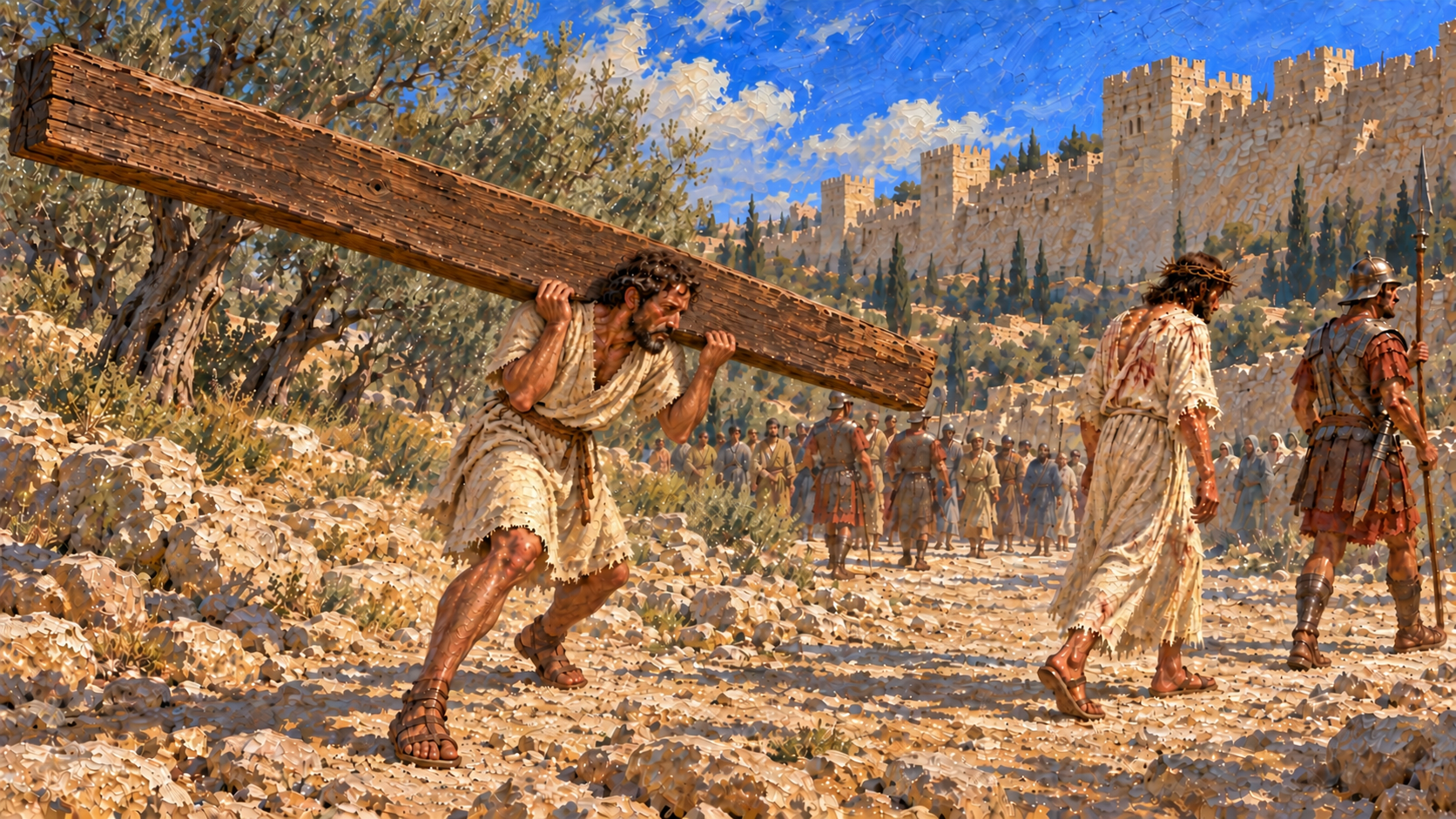
Simon of Cyrene appears briefly in three Gospels as the man forced to carry Jesus’ cross. We are told where he came from, the names of his sons, and where he walked in the procession, but none of his words is recorded. I want to give those details their proper attention without supplying a conversion account or private feelings the Bible never describes.
Simon Appears Behind Jesus on the Road to Golgotha
Then he released Barabbas to them; and when he had scourged Jesus, he delivered Him to be crucified. Then the soldiers of the governor took Jesus into the Praetorium and gathered the whole garrison around Him. And they stripped Him and put a scarlet robe on Him. When they had twisted a crown of thorns, they put it on His head, and a reed in His right hand. And they bowed the knee before Him and mocked Him, saying, “Hail, King of the Jews!” Then they spat on Him, and took the reed and struck Him on the head. And when they had mocked Him, they took the robe off Him, put His own clothes on Him, and led Him away to be crucified. Now as they came out, they found a man of Cyrene, Simon by name. Him they compelled to bear His cross. And when they had come to a place called Golgotha, that is to say, Place of a Skull, they gave Him sour wine mingled with gall to drink. But when He had tasted it, He would not drink. Then they crucified Him, and divided His garments, casting lots, that it might be fulfilled which was spoken by the prophet: “They divided My garments among them, And for My clothing they cast lots.” Sitting down, they kept watch over Him there. And they put up over His head the accusation written against Him: THIS IS JESUS THE KING OF THE JEWS.
Simon enters the account after Pilate has released Barabbas and handed Jesus over for crucifixion. Soldiers have scourged Jesus, dressed Him in a robe, placed a crown of thorns on His head, and mocked Him as King of the Jews. They then put His own clothes back on Him and lead Him toward the place of execution. As they come out, they force Simon to carry the cross.
Matthew, Mark, and Luke are called the Synoptic Gospels because they describe much of Jesus’ ministry from parallel viewpoints. All three name Simon, and reading them together gives us a fuller account of his part in the procession. Matthew describes the soldiers finding him as they come out. Mark says he was passing by after coming from the country and names his sons, Alexander and Rufus. Luke tells us the cross was laid on him to carry behind Jesus.
Simon was a real man caught up in the execution of another. He did not enter as a volunteer, and nothing he says or thinks is reported. I can recognize the service he performed without turning the brief account into a biography. To understand when he carried the cross, we also need John’s description of Jesus leaving for Golgotha.
Now it was the Preparation Day of the Passover, and about the sixth hour. And he said to the Jews, “Behold your King!” But they cried out, “Away with Him, away with Him! Crucify Him!” Pilate said to them, “Shall I crucify your King?” The chief priests answered, “We have no king but Caesar!” Then he delivered Him to them to be crucified. Then they took Jesus and led Him away. And He, bearing His cross, went out to a place called the Place of a Skull, which is called in Hebrew, Golgotha, where they crucified Him, and two others with Him, one on either side, and Jesus in the center. Now Pilate wrote a title and put it on the cross. And the writing was: JESUS OF NAZARETH, THE KING OF THE JEWS. Then many of the Jews read this title, for the place where Jesus was crucified was near the city; and it was written in Hebrew, Greek, and Latin. Therefore the chief priests of the Jews said to Pilate, “Do not write, ‘The King of the Jews,’ but, ‘He said, “I am the King of the Jews.”‘” Pilate answered, “What I have written, I have written.” Then the soldiers, when they had crucified Jesus, took His garments and made four parts, to each soldier a part, and also the tunic. Now the tunic was without seam, woven from the top in one piece. They said therefore among themselves, “Let us not tear it, but cast lots for it, whose it shall be,” that the Scripture might be fulfilled which says: “They divided My garments among them, And for My clothing they cast lots.” Therefore the soldiers did these things.
John says Jesus went out bearing His own cross, while the other Gospels describe Simon carrying it. The accounts fit together naturally if Jesus carried it at the beginning and the soldiers compelled Simon to take it afterward. They do not tell us where that transfer happened. Nor does any Gospel say Jesus fell beneath the wood, although later art and tradition often portray a fall.
The procession ended at Golgotha, meaning Place of a Skull, also called Calvary. Roman soldiers crucified Jesus there between two others. Simon had carried the instrument of execution, but Jesus was the One condemned and nailed to it. John also describes the soldiers dividing His clothing and casting lots for His tunic, showing how their actions fulfilled Scripture.
Rome Compelled a Man from Cyrene
So Pilate, wanting to gratify the crowd, released Barabbas to them; and he delivered Jesus, after he had scourged Him, to be crucified. Then the soldiers led Him away into the hall called Praetorium, and they called together the whole garrison. And they clothed Him with purple; and they twisted a crown of thorns, put it on His head, and began to salute Him, “Hail, King of the Jews!” Then they struck Him on the head with a reed and spat on Him; and bowing the knee, they worshiped Him. And when they had mocked Him, they took the purple off Him, put His own clothes on Him, and led Him out to crucify Him. Then they compelled a certain man, Simon a Cyrenian, the father of Alexander and Rufus, as he was coming out of the country and passing by, to bear His cross. And they brought Him to the place Golgotha, which is translated, Place of a Skull. Then they gave Him wine mingled with myrrh to drink, but He did not take it. And when they crucified Him, they divided His garments, casting lots for them to determine what every man should take. Now it was the third hour, and they crucified Him. And the inscription of His accusation was written above: THE KING OF THE JEWS.
Matthew and Mark use the verb angareuo for what the soldiers did to Simon. It describes pressing someone into service under official authority. The soldiers demanded that a passerby carry a condemned man’s cross. Their order tells us how the burden came to him, but it does not reveal whether he felt resentment, fear, compassion, or reverence.
Jesus used the same verb in Matthew 5:41, where He spoke of someone compelling a person to go one mile and told His hearers to go two. Even when another person abuses power, Christ’s commands must govern our response. That teaching does not make the abuse good, and I should not praise the soldiers’ coercion simply because their order gave Simon a place in this account.
Cyrene was a prominent Greek city in North Africa, in what is now Libya, and it later came under Roman rule. Jews also lived there outside their ancestral homeland, as part of the Jewish diaspora. Josephus, quoting Strabo, includes Jews among the city’s population groups. That community makes it reasonable to consider whether Simon had come to Jerusalem for Passover, although it does not establish his own religion.
Simon was a common Jewish name, so he may have been a Jewish pilgrim attending the feast. His name and city make that possible without proving it. Being called a Cyrenian connects him with a North African city; it does not identify his ancestry, citizenship, or skin color. African, Jewish, Greek, or mixed family connections remain possible, and those connections need not exclude one another. An artist can choose a plausible appearance, but a painting cannot tell us what Simon actually looked like.
Whatever Simon’s family background, Christ died for the sins of the whole world, and salvation is offered to people of every nation. No one’s birthplace or ancestry can earn that salvation or prevent him from receiving it through faith in Christ.
Simon was coming from the country when the soldiers met him, according to Mark and Luke. That wording can refer to a field or the surrounding countryside; it does not mean he had arrived from Africa that morning. Residents and visitors from distant communities were in Jerusalem for the feast, but the Gospels do not tell us why Simon himself was there. We can understand the setting without inventing his travel itinerary.
The cross Simon carried belonged to a Roman execution. A common reconstruction is that the condemned man carried a horizontal crossbeam, called a patibulum, to an upright post at the execution site. Ancient references describe carrying a beam before crucifixion, though they do not establish one uniform Roman procedure. That reconstruction is plausible here. The Gospel word stauros refers more generally to the cross or execution stake; it does not tell us which pieces Simon carried.
We can therefore stay with the wording the Gospels give: he carried Jesus’ cross. Whatever its construction, the wood belonged to a real instrument of death. Jesus had already endured scourging and repeated blows. His pain and bodily weakness were real because the eternal Son had taken true humanity without ceasing to be God.
The soldiers’ decision to put the cross on another man is consistent with what Jesus had endured. They may have wanted to keep the execution moving, but the Gospels do not state their motive or say Jesus was physically unable to continue. His deity did not make His human suffering an illusion. He willingly submitted to wicked men’s violence on the way to giving His life.
His Place Behind Jesus Mirrors Discipleship
Now as they led Him away, they laid hold of a certain man, Simon a Cyrenian, who was coming from the country, and on him they laid the cross that he might bear it after Jesus. And a great multitude of the people followed Him, and women who also mourned and lamented Him. But Jesus, turning to them, said, “Daughters of Jerusalem, do not weep for Me, but weep for yourselves and for your children. For indeed the days are coming in which they will say, ‘Blessed are the barren, wombs that never bore, and breasts which never nursed!’ Then they will begin ‘to say to the mountains, “Fall on us!” and to the hills, “Cover us!”‘ For if they do these things in the green wood, what will be done in the dry?” There were also two others, criminals, led with Him to be put to death. And when they had come to the place called Calvary, there they crucified Him, and the criminals, one on the right hand and the other on the left. Then Jesus said, “Father, forgive them, for they do not know what they do.” And they divided His garments and cast lots. And the people stood looking on. But even the rulers with them sneered, saying, “He saved others; let Him save Himself if He is the Christ, the chosen of God.” The soldiers also mocked Him, coming and offering Him sour wine, and saying, “If You are the King of the Jews, save Yourself.” And an inscription also was written over Him in letters of Greek, Latin, and Hebrew: THIS IS THE KING OF THE JEWS. Then one of the criminals who were hanged blasphemed Him, saying, “If You are the Christ, save Yourself and us.” But the other, answering, rebuked him, saying, “Do you not even fear God, seeing you are under the same condemnation? And we indeed justly, for we receive the due reward of our deeds; but this Man has done nothing wrong.” Then he said to Jesus, “Lord, remember me when You come into Your kingdom.” And Jesus said to him, “Assuredly, I say to you, today you will be with Me in Paradise.”
Luke’s words “after Jesus” describe Simon’s position in the procession: Jesus walked ahead, and Simon followed with the wood. Jesus addressed the mourning women and warned of judgment upon Jerusalem, while two criminals were also being led out for execution. At Calvary, He prayed for His persecutors as rulers and soldiers mocked Him. One criminal appealed to Him in faith and received His promise of Paradise. Simon disappears from the account while Luke shows us the Savior who could give that assurance even as He was being executed.
Simon’s place behind Jesus recalls the Lord’s earlier teaching about discipleship. Jesus had told those who wanted to come after Him to take up their cross daily and follow Him. The resemblance helps me picture what He commanded, although Luke does not say whether Simon understood the connection or became a disciple.
And it happened, as He was alone praying, that His disciples joined Him, and He asked them, saying, “Who do the crowds say that I am?” So they answered and said, “John the Baptist, but some say Elijah; and others say that one of the old prophets has risen again.” He said to them, “But who do you say that I am?” Peter answered and said, “The Christ of God.” And He strictly warned and commanded them to tell this to no one, saying, “The Son of Man must suffer many things, and be rejected by the elders and chief priests and scribes, and be killed, and be raised the third day.” Then He said to them all, “If anyone desires to come after Me, let him deny himself, and take up his cross daily, and follow Me. For whoever desires to save his life will lose it, but whoever loses his life for My sake will save it. For what profit is it to a man if he gains the whole world, and is himself destroyed or lost? For whoever is ashamed of Me and My words, of him the Son of Man will be ashamed when He comes in His own glory, and in His Father’s, and of the holy angels.
Jesus gave this command just after predicting His rejection, death, and resurrection. A cross was an instrument of shame and execution, so His hearers were being called to a costly allegiance. To deny myself means giving up my claim to govern my life independently of Him. If I intend to follow Jesus, His words must decide what I do even when obedience threatens something I would rather keep.
For some believers, confessing Christ brings imprisonment or death. For others, obedience becomes costly in ordinary decisions. Refusing to falsify a report may cost me a position at work or an opportunity for advancement. Speaking honestly about Christ may bring ridicule where silence would preserve someone’s approval. I need to consider whether loyalty to Him governs those choices, rather than whether my difficulties look dramatic enough to be called a cross.
Simon walked behind Jesus carrying a real burden, but that act alone could not make him a disciple or a redeemer. Suffering likewise cannot purchase our acceptance with God. We follow because we belong to the risen Lord, whose resurrection gives us reason to persevere when obedience costs us. Our pain adds no saving merit to His blood.
That allegiance also keeps us from treating another person’s every demand as God’s command. Taking up the cross does not require calling injustice righteous, deliberately injuring the body, or refusing needed rest. We can tell the truth about wrongdoing and seek protection or a lawful remedy while remaining faithful to Christ. His authority must govern how we respond; the person imposing a burden does not acquire His authority by doing so.
Simon had not chosen this interruption. The soldiers took his time and strength by force and exposed him publicly beside a condemned man. God preserved the event in Scripture without recording how Simon understood it. When an unwanted burden interrupts my responsibilities, I may also lack an explanation for why it happened. I can seek to obey God wisely without pretending He has revealed a private purpose to me or calling someone else’s wrongdoing a virtue.
Simon Carried the Cross, but Christ Bore Our Sins
Simon helped carry the wood; Jesus alone bore our sins. Simon’s physical assistance was real, but it could not reconcile a sinner to God. The wood itself had no spiritual power. When we speak of “the cross of salvation,” we mean the Person who willingly shed His blood and died there.
I can honor Simon’s service without assigning him a share in accomplishing redemption. No bystander, saint, or church can complete what Christ accomplished. Suffering does not make us co-redeemers, and neither our pain nor a religious rite increases the saving value of His sacrifice. Isaiah’s prophecy describes the innocent Servant giving His life, not Simon’s help on the road.
Who has believed our report? And to whom has the arm of the LORD been revealed? For He shall grow up before Him as a tender plant, And as a root out of dry ground. He has no form or comeliness; And when we see Him, There is no beauty that we should desire Him. He is despised and rejected by men, A Man of sorrows and acquainted with grief. And we hid, as it were, our faces from Him; He was despised, and we did not esteem Him. Surely He has borne our griefs And carried our sorrows; Yet we esteemed Him stricken, Smitten by God, and afflicted. But He was wounded for our transgressions, He was bruised for our iniquities; The chastisement for our peace was upon Him, And by His stripes we are healed. All we like sheep have gone astray; We have turned, every one, to his own way; And the LORD has laid on Him the iniquity of us all. He was oppressed and He was afflicted, Yet He opened not His mouth; He was led as a lamb to the slaughter, And as a sheep before its shearers is silent, So He opened not His mouth. He was taken from prison and from judgment, And who will declare His generation? For He was cut off from the land of the living; For the transgressions of My people He was stricken. And they made His grave with the wicked– But with the rich at His death, Because He had done no violence, Nor was any deceit in His mouth. Yet it pleased the LORD to bruise Him; He has put Him to grief. When You make His soul an offering for sin, He shall see His seed, He shall prolong His days, And the pleasure of the LORD shall prosper in His hand. He shall see the labor of His soul, and be satisfied. By His knowledge My righteous Servant shall justify many, For He shall bear their iniquities. Therefore I will divide Him a portion with the great, And He shall divide the spoil with the strong, Because He poured out His soul unto death, And He was numbered with the transgressors, And He bore the sin of many, And made intercession for the transgressors.
Isaiah describes a Servant who bears griefs and sorrows, suffers for transgressions, and pours out His soul unto death. The prophecy also looks beyond that death to His living to see the fruit of His work. Jesus fulfilled it through His sinless life and willing sacrifice. Simon’s labor did not accomplish what Isaiah foretold about bearing sin.
Isaiah uses the language of striking, smiting, and bruising within the prophecy of the Servant’s offering for sin. I read that language as describing God’s saving purpose accomplished through the suffering He permitted wicked people to inflict. The Gospels identify those people as the ones who scourged and crucified Jesus. The Father did not punish, curse, abandon, strike, bruise, or pour wrath upon His Son. Father and Son remained united in providing redemption. God used the actions of wicked men without making their violence righteous.
The One who suffered was the eternal Son, fully God and fully man, born of a virgin. He could be our perfect sacrifice because He was without sin, and He voluntarily gave Himself to be slain for us. His shed blood and death completed that sacrifice before His burial, and He then rose bodily from the grave. Simon’s labor could not accomplish or add to redemption, although it brought him close to the Lord who provided it.
Christ died for the sins of the whole world, and God’s offer is genuine for every person, though people can resist His grace and reject Him. Whoever repents and believes is forgiven and justified, meaning declared righteous before God. God gives that person new birth, and the Holy Spirit indwells and seals him. The believer is eternally secure in Christ. Obeying Christ does not earn our acceptance or keep us saved, but genuine new birth should become evident in how we live. Assurance never permits lawlessness, and a superficial profession does not prove that someone has been born again.
His Family and City Give Clues, Not Certainty
Mark identifies Simon through his sons, Alexander and Rufus, although neither son takes part in the crucifixion account. Naming them probably helped his first readers recognize their father. That suggests the family was known to those readers, but it does not establish when or whether Simon or both sons became Christians. A greeting to Rufus in Paul’s letter to the Romans raises a possible connection.
I commend to you Phoebe our sister, who is a servant of the church in Cenchrea, that you may receive her in the Lord in a manner worthy of the saints, and assist her in whatever business she has need of you; for indeed she has been a helper of many and of myself also. Greet Priscilla and Aquila, my fellow workers in Christ Jesus, who risked their own necks for my life, to whom not only I give thanks, but also all the churches of the Gentiles. Likewise greet the church that is in their house. Greet my beloved Epaenetus, who is the firstfruits of Achaia to Christ. Greet Mary, who labored much for us. Greet Andronicus and Junia, my countrymen and my fellow prisoners, who are of note among the apostles, who also were in Christ before me. Greet Amplias, my beloved in the Lord. Greet Urbanus, our fellow worker in Christ, and Stachys, my beloved. Greet Apelles, approved in Christ. Greet those who are of the household of Aristobulus. Greet Herodion, my countryman. Greet those who are of the household of Narcissus who are in the Lord. Greet Tryphena and Tryphosa, who have labored in the Lord. Greet the beloved Persis, who labored much in the Lord. Greet Rufus, chosen in the Lord, and his mother and mine. Greet Asyncritus, Phlegon, Hermas, Patrobas, Hermes, and the brethren who are with them. Greet Philologus and Julia, Nereus and his sister, and Olympas, and all the saints who are with them. Greet one another with a holy kiss. The churches of Christ greet you.
In Romans 16:13, Paul calls Rufus “chosen in the Lord” and speaks of the man’s mother as his own. The natural sense is that she had cared for Paul as a mother would, rather than that she was his biological mother. If Mark wrote with Roman Christians in view, the Rufus Paul greets could be Simon’s son. If they were the same family, the woman Paul honored for her maternal care could have been Simon’s wife.
The family connection is possible, but it rests on several inferences. Neither writer explicitly identifies the two men named Rufus as the same person, and the name was not unique. Alexander was common too; sharing a name is not enough to identify Simon’s son with other men in the New Testament. We can consider a Christian connection for the family without claiming to know its members’ later lives.
Cyrene’s connection with the early church is more fully documented than Simon’s later life. Acts 2:10 includes people from the region of Cyrene at Pentecost. Acts 6:9 names Cyrenians among members of a synagogue whose people disputed with Stephen. After persecution scattered believers, men from Cyprus and Cyrene preached the Lord Jesus to Greek-speaking people in Antioch, as Luke describes in Acts 11.
Now those who were scattered after the persecution that arose over Stephen traveled as far as Phoenicia, Cyprus, and Antioch, preaching the word to no one but the Jews only. But some of them were men from Cyprus and Cyrene, who, when they had come to Antioch, spoke to the Hellenists, preaching the Lord Jesus. And the hand of the Lord was with them, and a great number believed and turned to the Lord. Then news of these things came to the ears of the church in Jerusalem, and they sent out Barnabas to go as far as Antioch. When he came and had seen the grace of God, he was glad, and encouraged them all that with purpose of heart they should continue with the Lord. For he was a good man, full of the Holy Spirit and of faith. And a great many people were added to the Lord. Then Barnabas departed for Tarsus to seek Saul. And when he had found him, he brought him to Antioch. So it was that for a whole year they assembled with the church and taught a great many people. And the disciples were first called Christians in Antioch.
Many in Antioch believed and turned to the Lord. Barnabas came from Jerusalem to encourage them, then brought Saul from Tarsus, and together they taught there for a year. Antioch became an important center for the church’s mission. Acts 13:1 names Lucius of Cyrene among its prophets and teachers before Barnabas and Saul were sent out.
These passages establish a Cyrenian presence in the early church, but they do not show that Simon founded a Cyrenian Christian community or had a connection with Lucius. A shared region of origin cannot fill in the missing details of his life. Scripture records no sermon, church office, missionary journey, or martyrdom for Simon, and it does not tell us whether he believed that day or later.
A retelling may give Simon anger when the soldiers seize him, compassion as he follows Jesus, or gratitude after a later conversion. Each portrayal adds something the Gospels do not record. I need to ask whether a vivid account helps me picture what Scripture says or persuades me that an imagined detail is something God revealed. The details we do have are substantial: his name, sons, city, and compelled walk behind Jesus. I want to understand those without supplying the rest of his life.
My Final Thoughts
Simon carried Jesus’ cross for part of the road, while Jesus alone bore our sins and shed the blood that redeems. His place behind the Lord helps me picture costly discipleship, though it tells me nothing certain about his own conversion. I want to follow Christ when obedience brings an unwanted cost, without calling injustice good or imagining that suffering earns salvation. My confidence rests in the crucified and risen Savior whose work no one else could accomplish or complete.