
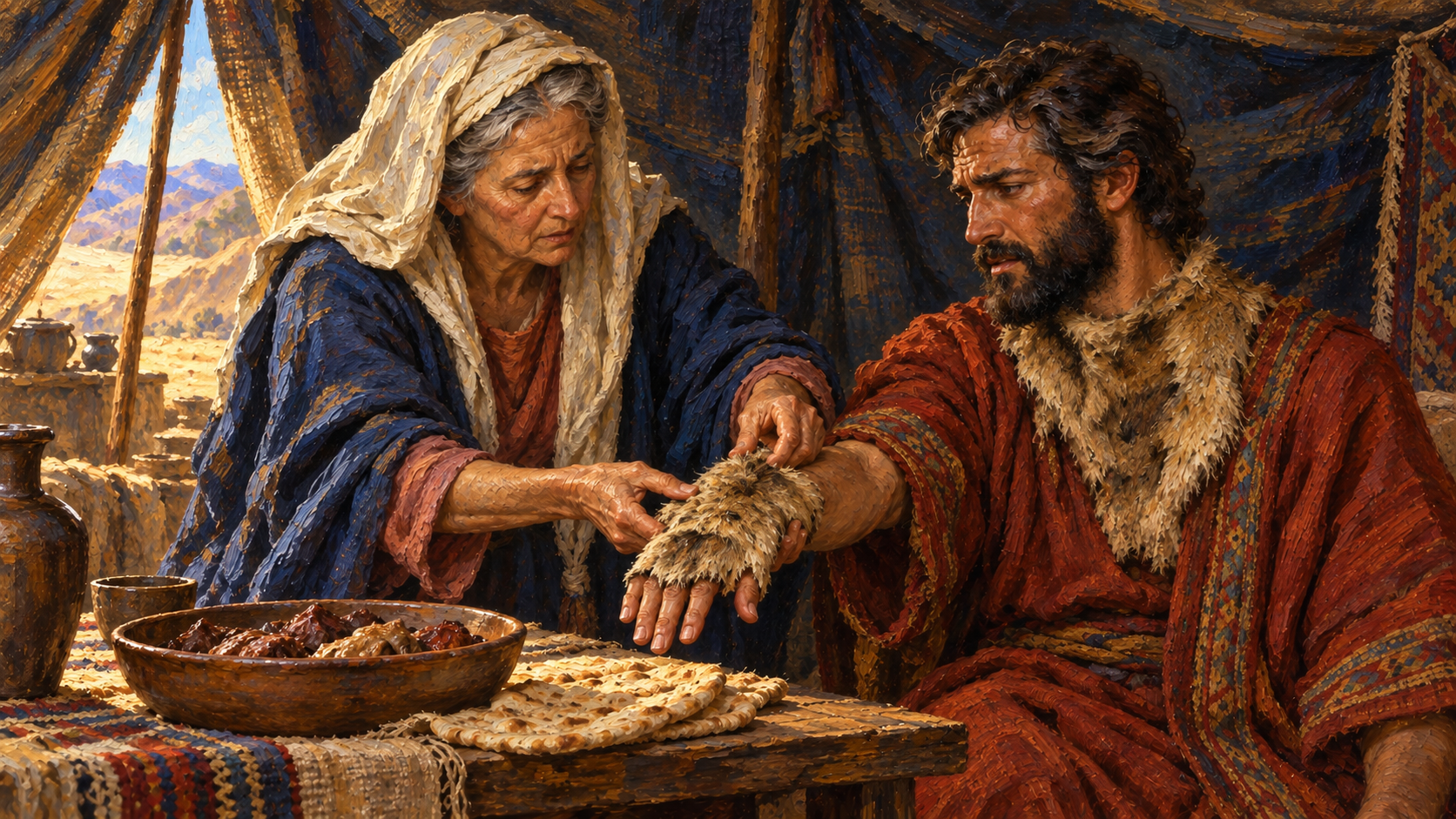
Rebekah willingly left her home to marry Isaac and later sought the LORD when her pregnancy brought distress. She also favored one son and devised the deception that divided her household. I cannot do justice to her life by remembering only her generous beginning or only that later failure. Genesis records both, along with God’s faithfulness to a promise this family could neither earn nor overturn.
Rebekah at the Well and Her Willing Choice
Genesis 24 introduces Rebekah as Bethuel’s daughter and Laban’s sister. Her grandparents were Abraham’s brother Nahor and his wife Milcah, so she belonged to Abraham’s extended family. Genesis later calls Bethuel and Laban Syrians from Padan Aram, referring to their Aramean connection with the region of Haran. They were not among the Canaanite peoples living around Isaac.
Her Hebrew name is commonly written Rivqah. Proposed meanings include ideas of binding or captivating, but its origin is uncertain. I would not explain her later ability to influence people by appealing to a disputed name meaning. Genesis gives us her conduct to examine without asking us to derive her character from the name.
Abraham had sent his senior servant to find Isaac a wife from these relatives. He ruled out marriage to a Canaanite woman and expressly forbade taking Isaac back to Mesopotamia. The son through whom God would continue His promise was to remain in the promised land. The concern was covenant faithfulness, not a claim that ancestry made one people naturally superior. Abraham’s own relatives were not uniformly free of idolatry; Joshua 24:2 describes his ancestors serving other gods, and Genesis 31:19 later mentions Laban’s household idols. This was a particular commission within God’s promises to Abraham.
Genesis does not name the servant, though readers often identify him with Eliezer of Damascus in Genesis 15. That connection is possible, but the text does not establish it.
At the well, he asked the LORD to guide him through a response that would reveal generosity and diligence. He would ask a young woman for a drink; if she also offered water for his ten camels, he would recognize her as the woman God had appointed. That would require far more effort than handing a traveler a cup. Before he had finished praying, Rebekah arrived.
And it happened, before he had finished speaking, that behold, Rebekah, who was born to Bethuel, son of Milcah, the wife of Nahor, Abraham’s brother, came out with her pitcher on her shoulder. Now the young woman was very beautiful to behold, a virgin; no man had known her. And she went down to the well, filled her pitcher, and came up. And the servant ran to meet her and said, “Please let me drink a little water from your pitcher.” So she said, “Drink, my lord.” Then she quickly let her pitcher down to her hand, and gave him a drink. And when she had finished giving him a drink, she said, “I will draw water for your camels also, until they have finished drinking.” Then she quickly emptied her pitcher into the trough, ran back to the well to draw water, and drew for all his camels. And the man, wondering at her, remained silent so as to know whether the LORD had made his journey prosperous or not. So it was, when the camels had finished drinking, that the man took a golden nose ring weighing half a shekel, and two bracelets for her wrists weighing ten shekels of gold, and said, “Whose daughter are you? Tell me, please, is there room in your father’s house for us to lodge?” So she said to him, “I am the daughter of Bethuel, Milcah’s son, whom she bore to Nahor.” Moreover she said to him, “We have both straw and feed enough, and room to lodge.” Then the man bowed down his head and worshiped the LORD. And he said, “Blessed be the LORD God of my master Abraham, who has not forsaken His mercy and His truth toward my master. As for me, being on the way, the LORD led me to the house of my master’s brethren.”
Rebekah volunteered the work and continued until the camels had finished drinking. She lowered her pitcher for the stranger, emptied water into the trough, and repeatedly returned to the well for more. Genesis gives no gallon total, so I would not invent one to make the effort sound impressive. Drawing and carrying enough water for ten animals already involved sustained, demanding work.
She had not yet heard the marriage proposal or received the jewelry. Her helpfulness was visible before those things occurred. We can appreciate the generosity of what she did without claiming to know every private thought behind it. The servant watched quietly, then asked about her family and whether his party could lodge with them.
Learning that she was Bethuel’s daughter supplied the family connection he needed. Rebekah also told him that they had feed for the animals and room to lodge. He bowed and worshiped the LORD, crediting Him for leading the journey to Abraham’s relatives. God’s providence, His direction of events toward His purpose, included Rebekah’s willing actions. The passage gives us no reason to treat her as a person whose decisions were unreal or irrelevant.
At the house, the servant explained Abraham’s instructions and recounted what had happened at the well. Laban and Bethuel acknowledged that the matter came from the LORD. Their agreement was followed by further gifts to Rebekah and precious things for her family, but the conversation did not end with the gifts.
Then Laban and Bethuel answered and said, “The thing comes from the LORD; we cannot speak to you either bad or good. Here is Rebekah before you; take her and go, and let her be your master’s son’s wife, as the LORD has spoken.” And it came to pass, when Abraham’s servant heard their words, that he worshiped the LORD, bowing himself to the earth. Then the servant brought out jewelry of silver, jewelry of gold, and clothing, and gave them to Rebekah. He also gave precious things to her brother and to her mother. And he and the men who were with him ate and drank and stayed all night. Then they arose in the morning, and he said, “Send me away to my master.” But her brother and her mother said, “Let the young woman stay with us a few days, at least ten; after that she may go.” And he said to them, “Do not hinder me, since the LORD has prospered my way; send me away so that I may go to my master.” So they said, “We will call the young woman and ask her personally.” Then they called Rebekah and said to her, “Will you go with this man?” And she said, “I will go.” So they sent away Rebekah their sister and her nurse, and Abraham’s servant and his men. And they blessed Rebekah and said to her: “Our sister, may you become The mother of thousands of ten thousands; And may your descendants possess The gates of those who hate them.” Then Rebekah and her maids arose, and they rode on the camels and followed the man. So the servant took Rebekah and departed.
The next morning, her brother and mother wanted her to stay longer, while the servant asked to return promptly to Abraham. They called Rebekah and asked, “Will you go with this man?” She answered, “I will go.” The immediate question concerned leaving with him instead of accepting the delay. Her answer nevertheless plainly expressed her willingness to make the journey and marry Isaac.
Abraham had already said the servant would be released from his oath if the woman would not follow him. God’s guidance was therefore no excuse to force her to come, and the gifts did not buy the right to disregard her answer. Rebekah left with her nurse and maids, accompanied by the servant and his men.
I see courage in her decision to leave familiar country and family for a man she had not met. Her departure resembles Abraham’s in that broad respect, but we should keep the circumstances distinct. She had heard the servant’s detailed report, her household had recognized God’s hand, and she traveled with companions. Her willingness was a response to what she had heard, not a reason to commend reckless decisions made without understanding.
Marriage, Prayer, and the Two Nations
When the caravan approached, Isaac was in the field near evening. Rebekah asked the servant who he was, and he identified Isaac as his master. She dismounted and covered herself with a veil. After the servant reported what he had done, Isaac received her as his wife.
Now Isaac came from the way of Beer Lahai Roi, for he dwelt in the South. And Isaac went out to meditate in the field in the evening; and he lifted his eyes and looked, and there, the camels were coming. Then Rebekah lifted her eyes, and when she saw Isaac she dismounted from her camel; for she had said to the servant, “Who is this man walking in the field to meet us?” The servant said, “It is my master.” So she took a veil and covered herself. And the servant told Isaac all the things that he had done. Then Isaac brought her into his mother Sarah’s tent; and he took Rebekah and she became his wife, and he loved her. So Isaac was comforted after his mother’s death.
Genesis speaks of Isaac’s love for Rebekah and the comfort he found after Sarah’s death. Rebekah became the next matriarch, the mother in the family through which Israel and ultimately the Messiah would come. Yet the chapter does not reduce the marriage to its place in a genealogy. Isaac loved the woman he married, and that love brought comfort in his bereavement.
Bringing her into Sarah’s tent also shows continuity in the household. It does not make Rebekah a replacement mother for Isaac. She entered her own marriage, and Genesis describes her as his wife. The reference to comfort should be read within that relationship.
The marriage was followed by a long wait for children. Isaac was forty when he married Rebekah and sixty when the twins were born, an interval of about twenty years. God’s promise concerning the family did not make every stage of its fulfillment quick or easy.
This is the genealogy of Isaac, Abraham’s son. Abraham begot Isaac. Isaac was forty years old when he took Rebekah as wife, the daughter of Bethuel the Syrian of Padan Aram, the sister of Laban the Syrian. Now Isaac pleaded with the LORD for his wife, because she was barren; and the LORD granted his plea, and Rebekah his wife conceived. But the children struggled together within her; and she said, “If all is well, why am I like this?” So she went to inquire of the LORD. And the LORD said to her: “Two nations are in your womb, Two peoples shall be separated from your body; One people shall be stronger than the other, And the older shall serve the younger.” So when her days were fulfilled for her to give birth, indeed there were twins in her womb. And the first came out red. He was like a hairy garment all over; so they called his name Esau. Afterward his brother came out, and his hand took hold of Esau’s heel; so his name was called Jacob. Isaac was sixty years old when she bore them. So the boys grew. And Esau was a skillful hunter, a man of the field; but Jacob was a mild man, dwelling in tents. And Isaac loved Esau because he ate of his game, but Rebekah loved Jacob.
Isaac pleaded with the LORD because his wife was barren, and the LORD answered. When the children struggled within her, Rebekah also went to inquire of Him. She brought her distress to the One who could explain what was happening. His answer went beyond the immediate difficulty of the pregnancy: she carried two nations, and the older would serve the younger.
That word concerned Jacob and Esau as well as their descendants, Israel and Edom. The younger son’s line would carry the Abrahamic promise, so firstborn status would not determine God’s choice. The announcement came before either child had done good or evil. Neither could claim to have earned the position God assigned.
Paul quotes these events in Romans 9 while defending the faithfulness of God’s word concerning Israel. He also quotes Malachi’s words about Jacob and Esau, spoken centuries after the brothers lived and addressing the nations descended from them. I understand the passages to establish God’s freedom to choose the covenant line. I do not read them as saying that one unborn individual was irresistibly saved while the other was condemned without regard to his response to God. Genesis continues to hold both brothers responsible for their conduct.
Rebekah had received a genuine word from the LORD. That knowledge belongs in our understanding of her later concern for Jacob, but it did not authorize whatever means she chose to advance him. God had announced what would happen; He had not instructed her to deceive her husband.
Favoritism and the Blessing Deception
The boys grew into different ways of life. Esau became a skilled hunter, while Jacob lived in tents. The description of Jacob as a mild man distinguishes his manner of life from Esau’s; it cannot mean that Jacob was incapable of dishonesty. Genesis soon records how willing he was to take advantage of his brother.
The parents also chose favorites. Isaac loved Esau because he ate of his game, while Rebekah loved Jacob. We are not told her reason in that verse. The division was more serious than appreciating different qualities in two children, because each parent would act to secure the blessing for the favored son.
Before that crisis, Esau sold his birthright to Jacob for food. The birthright concerned the firstborn son’s privileged standing and inheritance. Genesis 25:34 says Esau despised it, so we should not accept his later accusation as though Jacob had simply stolen something Esau had refused to part with. Jacob’s willingness to exploit his hunger was also no commendable way to treat a brother.
The blessing in Genesis 27 is connected with the birthright, but it is a separate event. Isaac would pronounce a solemn blessing concerning his son’s future, including prosperity and authority over his brothers. In the interval, Esau married Hittite women, causing grief to both his parents.
When Esau was forty years old, he took as wives Judith the daughter of Beeri the Hittite, and Basemath the daughter of Elon the Hittite. And they were a grief of mind to Isaac and Rebekah.
Isaac and Rebekah shared that grief even though each favored a different son. The marriages belonged to the same concern for the covenant household that had shaped Abraham’s instructions for Isaac’s wife. We should take the religious setting seriously without turning it into a claim of natural ethnic superiority.
When Isaac was old and had lost his sight, he called Esau and asked him to hunt and prepare the food he loved. He intended to bless him after the meal. Rebekah overheard and devised a way for Jacob to receive the blessing while Isaac believed he was speaking to Esau.
Now it came to pass, when Isaac was old and his eyes were so dim that he could not see, that he called Esau his older son and said to him, “My son.” And he answered him, “Here I am.” Then he said, “Behold now, I am old. I do not know the day of my death. Now therefore, please take your weapons, your quiver and your bow, and go out to the field and hunt game for me. And make me savory food, such as I love, and bring it to me that I may eat, that my soul may bless you before I die.” Now Rebekah was listening when Isaac spoke to Esau his son. And Esau went to the field to hunt game and to bring it. So Rebekah spoke to Jacob her son, saying, “Indeed I heard your father speak to Esau your brother, saying, ‘Bring me game and make savory food for me, that I may eat it and bless you in the presence of the LORD before my death.’ Now therefore, my son, obey my voice according to what I command you. Go now to the flock and bring me from there two choice kids of the goats, and I will make savory food from them for your father, such as he loves. Then you shall take it to your father, that he may eat it, and that he may bless you before his death.” And Jacob said to Rebekah his mother, “Look, Esau my brother is a hairy man, and I am a smooth-skinned man. Perhaps my father will feel me, and I shall seem to be a deceiver to him; and I shall bring a curse on myself and not a blessing.” But his mother said to him, “Let your curse be on me, my son; only obey my voice, and go, get them for me.” And he went and got them and brought them to his mother, and his mother made savory food, such as his father loved. Then Rebekah took the choice clothes of her elder son Esau, which were with her in the house, and put them on Jacob her younger son. And she put the skins of the kids of the goats on his hands and on the smooth part of his neck. Then she gave the savory food and the bread, which she had prepared, into the hand of her son Jacob.
Jacob objected because his father might feel his smooth skin, discover the impersonation, and curse him instead. His expressed concern was being detected and suffering the consequence. Rebekah answered, “Let your curse be on me,” and instructed him to obey her. She prepared the food, put Esau’s clothes on Jacob, and covered his hands and neck with goatskins.
This was a deliberate arrangement to deceive a blind man. Rebekah used her knowledge of the food Isaac enjoyed and the clothing available in the house to make the impersonation convincing. Jacob then took the meal and carried the plan into his father’s presence.
So he went to his father and said, “My father.” And he said, “Here I am. Who are you, my son?” Jacob said to his father, “I am Esau your firstborn; I have done just as you told me; please arise, sit and eat of my game, that your soul may bless me.” But Isaac said to his son, “How is it that you have found it so quickly, my son?” And he said, “Because the LORD your God brought it to me.” Isaac said to Jacob, “Please come near, that I may feel you, my son, whether you are really my son Esau or not.” So Jacob went near to Isaac his father, and he felt him and said, “The voice is Jacob’s voice, but the hands are the hands of Esau.” And he did not recognize him, because his hands were hairy like his brother Esau’s hands; so he blessed him. Then he said, “Are you really my son Esau?” He said, “I am.” He said, “Bring it near to me, and I will eat of my son’s game, so that my soul may bless you.” So he brought it near to him, and he ate; and he brought him wine, and he drank. Then his father Isaac said to him, “Come near now and kiss me, my son.” And he came near and kissed him; and he smelled the smell of his clothing, and blessed him and said: “Surely, the smell of my son Is like the smell of a field Which the LORD has blessed. Therefore may God give you Of the dew of heaven, Of the fatness of the earth, And plenty of grain and wine. Let peoples serve you, And nations bow down to you. Be master over your brethren, And let your mother’s sons bow down to you. Cursed be everyone who curses you, And blessed be those who bless you!”
Jacob repeatedly claimed to be Esau. When Isaac asked how the hunt had succeeded so quickly, Jacob even attributed the supposed success to the LORD. He was using God’s name to lend credibility to a lie. Isaac recognized Jacob’s voice but was misled by the hairy hands. He ate the meal, then asked his son to come near and kiss him. The smell of Esau’s clothes reinforced the disguise, and Isaac pronounced the blessing.
Rebekah knew what God had said before the twins’ birth, and the blessing she sought for Jacob agreed with the announced reversal of the brothers’ positions. Genesis 27 does not say that she explained her plan by quoting that earlier word, however. We know both that she favored Jacob and that she had received the promise. Neither fact made the deception obedient. She could have appealed truthfully to Isaac and entrusted the result to God.
The blessing included abundance from the land and authority over his brothers. Its language of blessing and cursing recalls God’s promise to Abraham, while the announced rule over his brothers accords with the word Rebekah received before their birth. Jacob had obtained it through deception, but that does not make the deception the means God required in order to keep His promise. The next events expose what the family had done and the consequences they would face.
Separation and Rebekah’s Covenant Legacy
Esau returned just after Jacob had left Isaac. He brought the meal his father had requested and expected the promised blessing. His arrival revealed that Isaac had blessed the wrong man while believing him to be Esau.
Now it happened, as soon as Isaac had finished blessing Jacob, and Jacob had scarcely gone out from the presence of Isaac his father, that Esau his brother came in from his hunting. He also had made savory food, and brought it to his father, and said to his father, “Let my father arise and eat of his son’s game, that your soul may bless me.” And his father Isaac said to him, “Who are you?” So he said, “I am your son, your firstborn, Esau.” Then Isaac trembled exceedingly, and said, “Who? Where is the one who hunted game and brought it to me? I ate all of it before you came, and I have blessed him–and indeed he shall be blessed.” When Esau heard the words of his father, he cried with an exceedingly great and bitter cry, and said to his father, “Bless me–me also, O my father!” But he said, “Your brother came with deceit and has taken away your blessing.” And Esau said, “Is he not rightly named Jacob? For he has supplanted me these two times. He took away my birthright, and now look, he has taken away my blessing!” And he said, “Have you not reserved a blessing for me?” Then Isaac answered and said to Esau, “Indeed I have made him your master, and all his brethren I have given to him as servants; with grain and wine I have sustained him. What shall I do now for you, my son?” And Esau said to his father, “Have you only one blessing, my father? Bless me–me also, O my father!” And Esau lifted up his voice and wept. Then Isaac his father answered and said to him: “Behold, your dwelling shall be of the fatness of the earth, And of the dew of heaven from above. By your sword you shall live, And you shall serve your brother; And it shall come to pass, when you become restless, That you shall break his yoke from your neck.” So Esau hated Jacob because of the blessing with which his father blessed him, and Esau said in his heart, “The days of mourning for my father are at hand; then I will kill my brother Jacob.” And the words of Esau her older son were told to Rebekah. So she sent and called Jacob her younger son, and said to him, “Surely your brother Esau comforts himself concerning you by intending to kill you. Now therefore, my son, obey my voice: arise, flee to my brother Laban in Haran. And stay with him a few days, until your brother’s fury turns away, until your brother’s anger turns away from you, and he forgets what you have done to him; then I will send and bring you from there. Why should I be bereaved also of you both in one day?” And Rebekah said to Isaac, “I am weary of my life because of the daughters of Heth; if Jacob takes a wife of the daughters of Heth, like these who are the daughters of the land, what good will my life be to me?”
Isaac trembled violently when he realized what had happened. He identified Jacob’s conduct as deceit, yet affirmed that Jacob would remain blessed. Esau cried bitterly and pleaded for a blessing too. His distress was real, but the explanation he gave shifted blame for the birthright he had willingly sold. Hebrews 12 later warns us through his exchange of that privilege for food and his inability to recover the blessing merely by weeping over the loss.
Esau planned to kill Jacob after Isaac’s death. When his words were reported to Rebekah, she told Jacob to flee to her brother Laban in Haran until the anger passed. She expected to send for him after “a few days.” Her plea about being bereaved of both sons makes clear how grave she understood the danger to be.
To Isaac, she spoke about her grief over the Hittite women and her dread of Jacob marrying one too. That concern was genuine; Genesis had already said the marriages grieved both parents. Yet this conversation did not disclose the threat of murder that had prompted her instructions to Jacob. Isaac agreed to send him to her family to find a wife.
Then Isaac called Jacob and blessed him, and charged him, and said to him: “You shall not take a wife from the daughters of Canaan. Arise, go to Padan Aram, to the house of Bethuel your mother’s father; and take yourself a wife from there of the daughters of Laban your mother’s brother. May God Almighty bless you, And make you fruitful and multiply you, That you may be an assembly of peoples; And give you the blessing of Abraham, To you and your descendants with you, That you may inherit the land In which you are a stranger, Which God gave to Abraham.” So Isaac sent Jacob away, and he went to Padan Aram, to Laban the son of Bethuel the Syrian, the brother of Rebekah, the mother of Jacob and Esau.
Isaac now knowingly blessed Jacob and explicitly gave him the blessing of Abraham: descendants and inheritance in the land God had promised. There was no disguise in this meeting. I distinguish this open covenant blessing from the blessing concerning prosperity and dominion obtained in chapter 27, while recognizing that the two are connected. God did not need Rebekah’s scheme to make Isaac identify Jacob openly as the heir of Abraham’s promise.
I cannot put every wrong in this household at Rebekah’s feet. Isaac intended to give Esau precedence even though God’s word had announced the older serving the younger. Genesis does not record Rebekah relaying that word to Isaac, so we should distinguish his evident favoritism from what we infer about his knowledge. Rebekah devised the deception, Jacob carried it out, and Esau answered his loss with a plan to murder his brother. Each remained responsible for the choices he or she made.
God fulfilled His word without becoming the author of their wrongdoing. His ability to carry out His purpose did not turn their lies, favoritism, or hatred into acts of faith. Rebekah had secured the blessing for Jacob, but protecting his life required sending away the son she wanted to favor.
The departure lasted far longer than Rebekah’s few days. Jacob later described twenty years in Laban’s household, fourteen for his daughters and six for his flock. Genesis records no message from Rebekah calling him back and no reunion when he returned. Her death is not narrated, so I would not claim certainty that she never saw Jacob again. We can say that Scripture gives us no account of such a meeting.
Later, after Jacob returned to Canaan, Genesis records the death of Rebekah’s nurse Deborah near Bethel. A member of the household that had accompanied Rebekah now appears in the account of Jacob’s family, though we are not told when or how she came to be with them.
Now Deborah, Rebekah’s nurse, died, and she was buried below Bethel under the terebinth tree. So the name of it was called Allon Bachuth.
The name Allon Bachuth is commonly rendered the oak of weeping, as the translation notes on Genesis 35:8 explain. The burial place commemorated mourning for Deborah, suggesting the affection in which she was held. It does not supply a missing account of Rebekah’s own death.
We learn where Rebekah was buried from Jacob’s final instructions to his sons. He named the members of the family already buried in the cave of Machpelah, the burial property Abraham had purchased in Canaan.
Then he charged them and said to them: “I am to be gathered to my people; bury me with my fathers in the cave that is in the field of Ephron the Hittite, in the cave that is in the field of Machpelah, which is before Mamre in the land of Canaan, which Abraham bought with the field of Ephron the Hittite as a possession for a burial place. There they buried Abraham and Sarah his wife, there they buried Isaac and Rebekah his wife, and there I buried Leah. The field and the cave that is there were purchased from the sons of Heth.” And when Jacob had finished commanding his sons, he drew his feet up into the bed and breathed his last, and was gathered to his people.
Rebekah was buried with Isaac, alongside Abraham and Sarah in the family’s burial place. Her place there identifies her with the covenant family, but it does not erase her personal responsibility. She was the hospitable young woman who willingly became Isaac’s wife and later sought God during her pregnancy. She was also the mother who drew her son into a calculated deception.
Through Jacob came Israel, and through Israel came Jesus Christ according to the flesh. God did not require morally perfect ancestors in order to bring the Messiah into the world. Rebekah’s failures could not defeat His promise, and their place in the account does not make those failures righteous.
What Rebekah’s Life Teaches Us
Her hospitality deserves more than a passing compliment. She saw a traveler with a need, offered help he had not requested, and continued until the work was done. I can learn from that willingness without treating service as something a person must perform to earn human worth. People who serve generously deserve thanks, not the assumption that everyone is entitled to make further demands on them.
Her decision to go with Abraham’s servant also keeps God’s guidance from becoming an excuse to disregard a person. The family acknowledged that the LORD had directed the journey, yet Rebekah was asked about leaving and gave her own answer. Claiming to recognize God’s hand does not authorize me to use spiritual language to override someone else’s responsibility to decide.
The long wait for children and the difficult pregnancy require care in how we speak to suffering believers. Isaac prayed and Rebekah conceived, but Genesis does not present that answer as a method guaranteeing conception for every couple. It does not blame her barrenness on sin or weak faith. We can pray earnestly with people facing infertility without shaming them or promising a result God has not promised them. Rebekah’s own inquiry also encourages us to bring distress to the LORD rather than assume that receiving a promise means every circumstance will be easy to understand.
Her favoritism was no less real than those strengths. A parent can understand something true about a child’s future and still do harm by making that child an ally against a spouse. If affection depends on sharing a parent’s interests, satisfying that parent’s ambitions, or taking sides in a family dispute, the children are being drawn into a rivalry they should not have to sustain. Knowing God’s word does not excuse that treatment.
Nor can I defend deceit by appealing to a biblical goal. If I distort what happened so another person will do what I want, the supposed benefit does not make my account truthful. Rebekah’s knowledge of the promise did not authorize a disguise, and Jacob’s receipt of the blessing did not prove God approved their conduct. We need to obey Him in the means we use as well as the end we seek.
The separation also warns against assuming that we can manage every consequence once a lie has succeeded. Rebekah planned for a short absence; Jacob spent twenty years with Laban. Forgiveness does not guarantee the immediate removal of every earthly consequence. Still, recognizing deception or unhealthy alliances in our own family is a reason to repent and begin repair, not to conclude that change is impossible. We should confess what we actually did, correct the false account, and stop using one relative against another. Reconciliation may take time, and it cannot be achieved by demanding that the injured person pretend nothing happened.
My confidence therefore has to rest in God’s faithfulness rather than my ability to control a household or secure a future. The promised line led to Jesus Christ, the eternal Son, fully God and fully man, born of a virgin and without sin. Wicked men physically tortured, punished, and killed Him, and He willingly bore that punishment for our sins in His innocent body. The Father did not punish, curse, abandon, strike, bruise, or pour wrath on Jesus. Through His shed blood and death, Christ completed the work that provides salvation. He was buried and rose bodily from the dead.
Christ died for the whole world, and God’s offer of salvation is genuine even though people can resist and reject it. Everyone is called to repent and believe. Whoever truly believes is forgiven and justified, or declared righteous before God, and is born again. The Holy Spirit indwells and seals that believer, who is eternally secure in Christ. That security never permits lawlessness. A superficial profession is not proof of the new birth; new conduct should give evidence of the new creation, while neither earning salvation nor establishing sinless perfection. We receive salvation through faith in Christ, not through ancestry, manipulation, or moral achievement.
My Final Thoughts
Rebekah’s courage and generous service deserve to be remembered alongside the harm she caused through favoritism and deception. God kept His promise without approving the wrong this family did to one another. I want to learn from her readiness to serve and seek the LORD, while refusing to excuse dishonest methods because I believe the desired result is right. His faithfulness gives us reason to tell the truth and obey, even when we cannot see how He will bring His word to fulfillment.