
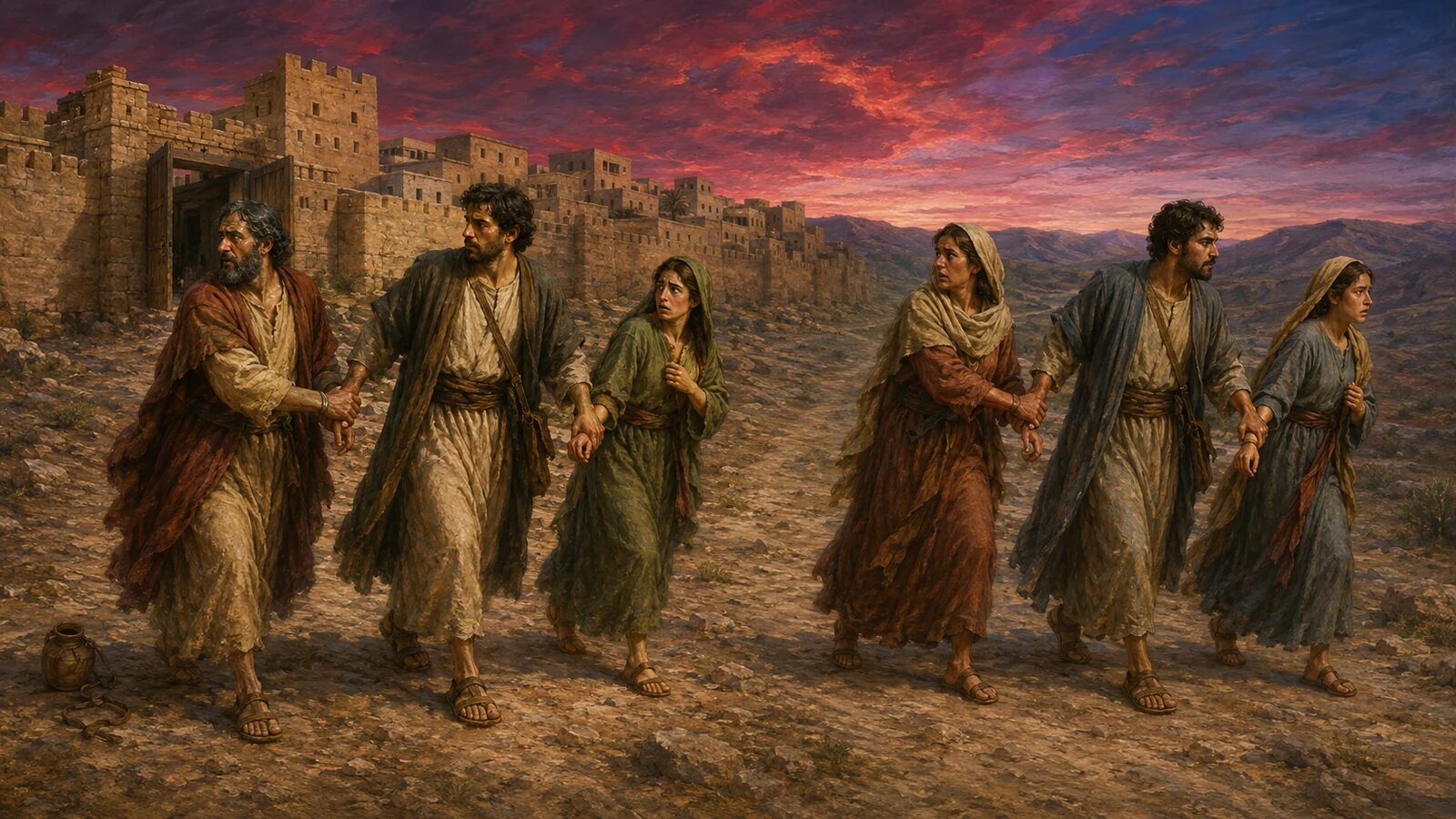
Peter calls Lot righteous, yet Genesis records choices that brought terrible harm to him and his family. I cannot ignore either part of that testimony. God rescued a man who belonged to Him, but His mercy did not make Lot’s decisions wise or spare the household every consequence. We need to understand how a man grieved by Sodom’s wickedness became so reluctant to leave it.
Lot’s Warning and God’s Mercy
Lot’s example is uncomfortable because we can recognize something as wrong while continuing to arrange our lives around it. Leaving may threaten our income, relationships, or the comforts we have become accustomed to. Peter says Sodom’s lawlessness tormented Lot day after day, yet Genesis shows him hesitating when the angels told him to get out. His distress was real, but it had not brought him to a decisive break with the city.
Lot’s Privilege and His Choice by Sight
Lot was the son of Haran, Abram’s brother. Haran died in Ur while his father Terah was still alive. We are not told all the household arrangements after that loss, but Genesis records it before introducing Abram’s journey:
And Haran died before his father Terah in his native land, in Ur of the Chaldeans. Then Abram and Nahor took wives: the name of Abram’s wife was Sarai, and the name of Nahor’s wife, Milcah, the daughter of Haran the father of Milcah and the father of Iscah. But Sarai was barren; she had no child.
Before recording God’s promise to make Abram a great nation, Genesis tells us that Sarai had no child. That future would depend on God keeping His word, despite circumstances in the household that gave little assurance of it. Lot accompanied Abram when he left the city of Haran for Canaan:
So Abram departed as the LORD had spoken to him, and Lot went with him. And Abram was seventy-five years old when he departed from Haran. Then Abram took Sarai his wife and Lot his brother’s son, and all their possessions that they had gathered, and the people whom they had acquired in Haran, and they departed to go to the land of Canaan. So they came to the land of Canaan.
Lot saw Abram build altars to the Lord and also accompanied him into Egypt, where his uncle acted out of fear. After returning to Canaan, Abram went back to the place near Bethel where he had worshiped before. Lot had a close view of genuine faith in an imperfect man, including both his obedience and his failures.
Prosperity eventually made it difficult for the two households to remain together. Their animals needed more pasture than the land could support, and the herdsmen began to quarrel:
Lot also, who went with Abram, had flocks and herds and tents. Now the land was not able to support them, that they might dwell together, for their possessions were so great that they could not dwell together. And there was strife between the herdsmen of Abram’s livestock and the herdsmen of Lot’s livestock. The Canaanites and the Perizzites then dwelt in the land.
Abram proposed a separation to preserve peace. Although he was the older man and the recipient of God’s promise, he offered Lot the first choice of where to settle:
So Abram said to Lot, “Please let there be no strife between you and me, and between my herdsmen and your herdsmen; for we are brethren. Is not the whole land before you? Please separate from me. If you take the left, then I will go to the right; or, if you go to the right, then I will go to the left.”
Abram was willing to accept the land Lot left for him. He did not have to secure the most attractive pasture in order for God to fulfill His promise. Lot looked toward the Jordan plain, where abundant water offered a considerable advantage for the livestock on which his wealth depended:
And Lot lifted his eyes and saw all the plain of Jordan, that it was well watered everywhere (before the LORD destroyed Sodom and Gomorrah) like the garden of the LORD, like the land of Egypt as you go toward Zoar. Then Lot chose for himself all the plain of Jordan, and Lot journeyed east. And they separated from each other.
The comparison to the garden of the Lord describes the land’s fertility, not the character of its inhabitants. Moses also tells us this was “before the LORD destroyed Sodom and Gomorrah.” The region looked inviting, but the reader is already being warned that its cities would come under judgment.
Abram dwelt in the land of Canaan, and Lot dwelt in the cities of the plain and pitched his tent even as far as Sodom. But the men of Sodom were exceedingly wicked and sinful against the LORD.
Lot settled among the cities of the plain and pitched his tent as far as Sodom. Genesis places the city’s wickedness beside that decision. The pasture could be excellent while the people living there were exceedingly sinful against the Lord. Choosing land for his herds was also choosing surroundings in which his family would have to live.
How Compromise Draws a Person In
By Genesis 14, Lot was living in Sodom itself. Four eastern kings defeated the kings of the plain and carried away people and possessions, including Lot and his goods:
They also took Lot, Abram’s brother’s son who dwelt in Sodom, and his goods, and departed.
When Abram heard that his nephew had been taken, he armed the trained men of his household and pursued the captors. He recovered Lot, the other captives, and what had been taken from them:
So he brought back all the goods, and also brought back his brother Lot and his goods, as well as the women and the people.
Lot now had firsthand experience of the danger that could reach his household through Sodom. Genesis does not record his private response to that rescue, but by chapter 19 he was living in the city again. Whatever he thought about being captured, he had made no lasting break with the place.
Before the city’s destruction, the Lord spoke to Abraham, as Abram was now called, about the great “outcry” against Sodom. This was a cry arising from wrong suffered, not a complaint about an isolated mistake. The violence Genesis describes and the oppression Ezekiel later condemns help us understand the harm behind that outcry. Abraham pleaded for the righteous who might be living there:
And Abraham came near and said, “Would You also destroy the righteous with the wicked? Suppose there were fifty righteous within the city; would You also destroy the place and not spare it for the fifty righteous that were in it? Far be it from You to do such a thing as this, to slay the righteous with the wicked, so that the righteous should be as the wicked; far be it from You! Shall not the Judge of all the earth do right?”
He was appealing to God’s justice, not trying to make an unjust judge behave reasonably. Abraham trusted that the Judge of all the earth would do right. He began with fifty righteous people and gradually reduced the number to ten, with the Lord agreeing to spare the city if that number could be found. Abraham stopped at ten, and the conversation ended. The judgment that followed showed that even those ten were not there.
Genesis then follows the two angels into Sodom:
Now the two angels came to Sodom in the evening, and Lot was sitting in the gate of Sodom. When Lot saw them, he rose to meet them, and he bowed himself with his face toward the ground.
The gate was a place for public business and the hearing of disputes. Boaz conducted a witnessed transaction at Bethlehem’s gate, and Absalom met people seeking judgment at Jerusalem’s gate. Lot was participating in the city’s everyday life, but his presence there does not establish that he was a magistrate or held another particular office.
These two visitors are called angels; neither is identified as Christ or as the distinctive Angel of the LORD. Lot insisted that they stay in his house instead of spending the night in the square. His urgency suggests he understood the danger, and what happened that evening confirmed it:
Now before they lay down, the men of the city, the men of Sodom, both old and young, all the people from every quarter, surrounded the house. And they called to Lot and said to him, “Where are the men who came to you tonight? Bring them out to us that we may know them carnally.”
Men from every part of the city, both young and old, surrounded the house and demanded the visitors for sexual abuse. This was widespread, public wickedness. Lot went outside and condemned their intentions, but then proposed something appalling:
So Lot went out to them through the doorway, shut the door behind him, and said, “Please, my brethren, do not do so wickedly! See now, I have two daughters who have not known a man; please, let me bring them out to you, and you may do to them as you wish; only do nothing to these men, since this is the reason they have come under the shadow of my roof.”
His responsibility as a host explains his determination to protect the visitors; it cannot justify offering his daughters to a mob. They were entitled to his protection too. Lot could recognize the men’s wickedness and still propose a wicked solution when he was under pressure. Genesis records that offer without approving it.
The men accused him of acting as a judge and threatened to treat him worse than the visitors. As they pressed against him and approached the door, the angels pulled him inside and shut it. They struck the attackers with blindness, yet the men wore themselves out trying to find the entrance.
Lot, Abraham, and the Lord’s Rescue
The angels warned Lot that the city would be destroyed and told him to bring his family out. He carried the warning to his sons-in-law:
So Lot went out and spoke to his sons-in-law, who had married his daughters, and said, “Get up, get out of this place; for the LORD will destroy this city!” But to his sons-in-law he seemed to be joking.
Some readers understand these as husbands of other daughters who remained in Sodom; others understand them as men pledged to marry the two daughters in Lot’s house. Either way, they treated his warning as a joke. His compromised example may have damaged his credibility, but Genesis does not give their reason for dismissing him. He was telling them the truth, and they would not take it seriously.
At daybreak, the angels urged Lot to hurry with his wife and the two daughters who were there. Even then, he lingered:
And while he lingered, the men took hold of his hand, his wife’s hand, and the hands of his two daughters, the LORD being merciful to him, and they brought him out and set him outside the city.
Once the family was outside, the messengers gave them an urgent command:
Escape for your life! Do not look behind you nor stay anywhere in the plain. Escape to the mountains, lest you be destroyed.
Lot feared that disaster would overtake him before he could reach the mountains, so he asked to escape to the nearby town of Zoar. Permission was granted, and he reached it before the destruction began. The Lord then rained fire and brimstone on Sodom and Gomorrah, overthrowing the cities and what grew on the plain. Lot’s wife disobeyed the command against looking back:
But his wife looked back behind him, and she became a pillar of salt.
Abraham returned to the place where he had stood before the Lord and saw smoke rising from the region. Genesis explains Lot’s rescue by referring back to him:
And it came to pass, when God destroyed the cities of the plain, that God remembered Abraham, and sent Lot out of the midst of the overthrow, when He overthrew the cities in which Lot had dwelt.
God remembering Abraham means He acted with regard to him, not that He had forgotten who Abraham was. Abraham’s intercession for the righteous had been heard, although Sodom itself was not spared. He had not named Lot in the recorded prayer, but Genesis explicitly connects him with his nephew’s deliverance.
The escape was followed by another grievous episode. Lot became afraid to remain in Zoar and moved into a cave in the mountains with his two daughters. The older daughter said there was no man available to preserve their family line and devised a plan to make their father drunk. On successive nights, each daughter lay with him.
Genesis twice says Lot was unaware when they lay down or arose. The daughters devised the plan and deceived him; his intoxication was not consent to what they did. Their fear about the family’s future could not justify incest or violating their father. Surviving Sodom had not spared this household further wrongdoing and harm.
The sons born from those acts became the ancestors of Moab and Ammon. Their origins did not make every later member of those nations personally guilty of the daughters’ sin. Ruth was a Moabitess, and God brought her into the family line leading to David and ultimately to Christ. His mercy toward her did not approve the acts in Genesis 19, but her ancestry did not put her beyond His grace.
After reading all that, I might be tempted to dismiss Lot as someone who never belonged to God. Peter will not allow that conclusion:
and delivered righteous Lot, who was oppressed by the filthy conduct of the wicked (for that righteous man, dwelling among them, tormented his righteous soul from day to day by seeing and hearing their lawless deeds)
Peter repeatedly calls him righteous and says the conduct around him tormented his soul. I have to receive that testimony without using it to excuse what Lot did. A man who belonged to God had remained in a place where he was distressed day after day, and his decisions had exposed his family to terrible harm.
Feeling grieved by sin did not make those decisions faithful. If I keep arranging my life around conduct that troubles my conscience, my unhappiness does not prove that I am obeying God. Lot’s example warns a believer who has learned to disapprove inwardly while continuing to accommodate what is wrong.
Peter also places Lot’s rescue within God’s ability to distinguish the godly from the wicked:
then the Lord knows how to deliver the godly out of temptations and to reserve the unjust under punishment for the day of judgment
That gives me reason to keep praying for someone caught in compromise, even when I cannot see what is happening in his life. Abraham’s prayer did not make God overlook Sodom’s wickedness, but God was merciful to Lot. We can ask for that mercy without pretending that sin is safe or that our prayers can manipulate the Judge of all the earth.
Remember Lot’s Wife
Jesus also compared the days of Lot with the day when He, the Son of Man, would be revealed. People would be occupied with ordinary life until judgment suddenly came. He warned the person on a housetop not to return for possessions and the person in a field not to turn back:
Remember Lot’s wife.
Genesis does not describe Lot’s wife’s thoughts, but Jesus places her action within that warning about turning back. It cannot be reduced to a harmless glance of curiosity. When God tells us to leave, attachment to what we are leaving can become a reason to disobey Him. I need to take that seriously before comfort or possessions become more precious to me than His instruction.
The mob at Lot’s door was one expression of Sodom’s wickedness. Ezekiel also describes the arrogance and neglect that accompanied its prosperity:
Look, this was the iniquity of your sister Sodom: She and her daughter had pride, fullness of food, and abundance of idleness; neither did she strengthen the hand of the poor and needy. And they were haughty and committed abomination before Me; therefore I took them away as I saw fit.
The city had abundant food and leisure while refusing to strengthen the poor and needy. Its people became haughty and committed abomination before God. That rebuke requires us to hear more than one charge against Sodom; neglect of the poor cannot explain away the sexual rebellion Genesis records. Jude also names that rebellion:
as Sodom and Gomorrah, and the cities around them in a similar manner to these, having given themselves over to sexual immorality and gone after strange flesh, are set forth as an example, suffering the vengeance of eternal fire.
It would be dishonest to condemn Sodom’s sexual wickedness while ignoring its callous treatment of the poor, or to discuss its injustice as though its sexual conduct were irrelevant. God heard the outcry against a city whose corruption was harming people. The prosperity that looked so attractive to Lot had not made those surroundings good for his household.
I need to consider more than the immediate advantage when an opportunity looks promising. A better salary can come with pressure to be dishonest, and a relationship can gradually require me to excuse conduct I know is wrong. The benefit may be real, but I still need to ask what accepting it will require of me. Lot’s choice of pasture was also a choice about where he would bring his family.
Living close to faithful people cannot make that decision for me. Abram rescued Lot, and God remembered Abraham when He brought Lot out of Sodom, but his nephew remained responsible for his own conduct. Believing parents and a sound church can give us truthful counsel; they cannot obey in our place.
Those close to us also learn from what we tolerate. If children hear us condemn something while we keep making room for it, they may learn to disregard our warnings. Lot could not control his family’s decisions, but he did not give them a consistent example. I need to consider where my choices are leading while there is still time to change them.
The mercy that brought Lot out directs us toward the greater deliverance God offers through Jesus Christ. He is the eternal Son, fully God and fully man, who lived without sin. Wicked men physically tortured and punished His innocent body, then killed Him. He willingly bore that real punishment for our sins, shedding His blood and dying. His saving work through His blood and death was complete before He was buried and rose bodily from the grave. The Father did not punish, curse, abandon, strike, bruise, or pour wrath on Jesus.
Christ died for the whole world, and God’s genuine offer can be resisted. Every person must repent and believe in Him. The believer is forgiven and justified, meaning declared righteous before God, and genuinely born again. The Holy Spirit indwells and seals that person, whose salvation is eternally secure. That security gives no permission for lawlessness, and merely calling ourselves Christians does not establish that we have received new life.
My Final Thoughts
Lot’s deliverance gives me hope for believers who have drifted, but I do not want to imitate the decisions that made his life so miserable. God was merciful while he lingered, yet Lot still suffered loss and his household suffered grievously. When Scripture warns me about the direction I am taking, I need to respond before I become so settled that leaving feels harder than staying with what I know is wrong.