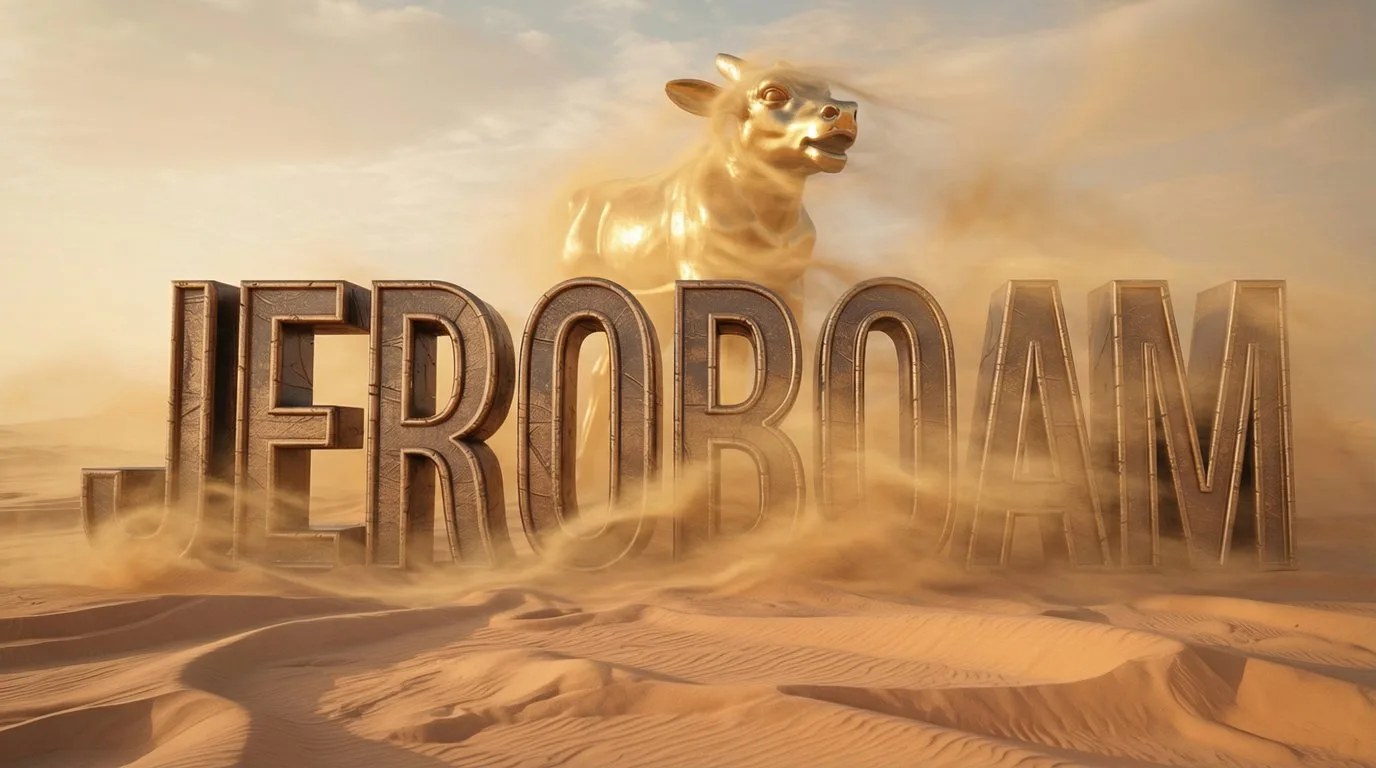

Jeroboam, son of Nebat, is a significant figure in the history of Israel. He was the first king of the northern kingdom after the united monarchy of Israel split into two (1 Kings 11:26). Jeroboam was an Ephraimite and initially served as a superintendent over the labor force during Solomon’s reign (1 Kings 11:28). God chose him to rule over the ten tribes of Israel because of Solomon’s disobedience and idolatry. Despite being chosen by God, Jeroboam became infamous for leading Israel into sin, setting a precedent for future kings of the northern kingdom.
When Scripture repeatedly references “the sin of Jeroboam,” it is not simply recalling ancient political decisions. It is showing us how quickly a person can move from calling to compromise, from opportunity to idolatry, and how a leader’s spiritual choices can shape generations. Jeroboam’s life also helps us think carefully about God’s faithfulness, human responsibility, the role of prophecy, and the danger of replacing God’s Word with what seems practical.
Key Passages About Jeroboam
Jeroboam’s life is not told in a single chapter but woven through Kings and Chronicles, and then referenced again and again as a moral and spiritual benchmark for the northern kingdom. Reading these passages together gives us a complete picture: his calling, his rise, his fear-driven compromise, God’s warnings, and the long shadow his choices cast over Israel.
“And he shall be your servant; and if you heed all that I command you, walk in My ways, and do what is right in My sight to keep My statutes and My commandments, as My servant David did, then I will be with you and build for you an enduring house, as I built for David, and will give Israel to you.” (1 Kings 11:38)
1 Kings 11:26-40
Jeroboam first appears as a servant of Solomon. A prophet named Ahijah approaches him and tears a new garment into twelve pieces, giving Jeroboam ten, symbolizing the division of Israel. Ahijah conveys God’s message, declaring Jeroboam would rule over ten tribes because of Solomon’s unfaithfulness. However, Jeroboam is warned to walk in God’s ways and keep His commandments to establish a lasting dynasty.
This opening account is important because Jeroboam’s kingship did not begin with his ambition, but with God’s announced judgment on Solomon’s house. At the same time, God’s message to Jeroboam includes a genuine conditional promise. Jeroboam is not presented as a robot acting out an unavoidable fate. He is addressed as a morally responsible man who can “heed,” “walk,” and “do what is right.” Scripture holds together God’s foreknowledge and announced plans with real human accountability.
1 Kings 12:1-24
After Solomon’s death, Jeroboam returns from exile in Egypt (where he fled from Solomon). The northern tribes rebel against Solomon’s son, Rehoboam, and make Jeroboam king. This marks the formal division of Israel into the northern kingdom (Israel) and southern kingdom (Judah).
In this passage we also see how political sin and spiritual compromise often intertwine. Rehoboam’s harsh response to the people’s request becomes the immediate spark that ignites division, yet the text makes clear God had already spoken about judgment because of Solomon’s idolatry. The division is therefore both a consequence of human folly and an outworking of God’s righteous discipline.
1 Kings 12:25-33
Jeroboam establishes Shechem as his capital and introduces idolatrous worship to prevent the people from going to Jerusalem to worship at the Temple. He makes two golden calves, placing one in Bethel and the other in Dan, and declares, “Here are your gods, O Israel, which brought you up from the land of Egypt!” (1 Kings 12:28). This act leads Israel into sin and becomes known as “the sin of Jeroboam.”
This is the turning point. Jeroboam does not merely commit a private sin. He institutionalizes false worship. He reshapes national religion, changes worship centers, and effectively trains the people to disobey what God had already revealed through Moses about where and how Israel was to worship. Jeroboam’s reasoning begins with fear, but fear that is allowed to rule soon becomes organized rebellion.
1 Kings 13
A prophet from Judah warns Jeroboam at the altar in Bethel, prophesying the eventual destruction of his idolatrous system by a future king named Josiah. Jeroboam’s hand withers when he tries to seize the prophet, but it is later restored after the prophet prays.
This account highlights God’s mercy even in judgment. Jeroboam experiences a direct sign, not only to authenticate the prophetic word, but to give him an opportunity to humble himself. Yet the larger context shows that even a dramatic sign does not automatically produce repentance if the heart is set on self-preservation rather than submission to God.
1 Kings 14:1-20
When Jeroboam’s son Abijah falls sick, Jeroboam sends his wife to the prophet Ahijah. The prophet delivers a harsh message: because of Jeroboam’s sin, his dynasty will be cut off, and Israel will suffer judgment. His son dies, fulfilling the prophecy.
Notice that Jeroboam does not go himself, and he attempts to conceal the inquiry by disguising his wife. This shows a conflicted conscience: Jeroboam still knows where a true prophet is, and yet he approaches God’s word with calculation. The result is not only personal loss, but an announcement of national consequences. Scripture is teaching us that leadership sin is never isolated.
1 Kings 15:1-30
Jeroboam’s reign is used as a benchmark of sin for later kings. Nadab, his son, continues in his father’s sinful ways, and Baasha eventually kills Jeroboam’s entire family, fulfilling Ahijah’s prophecy.
This passage underlines an often-overlooked truth: Jeroboam’s sin was not only an incident of idolatry, it was a path that his household and nation learned to walk. When Nadab continues the same pattern, it shows how the sin of a father can become the default setting of the next generation, not because judgment is arbitrary, but because the same false worship continues to shape the heart and mind.
2 Kings 10:29-31; 13:2, 11; 14:24; 15:9, 18, 24, 28
Jeroboam’s sin becomes a recurring phrase in the historical books, describing the idolatry and disobedience of future kings of Israel. His golden calf worship leaves a lasting impact on the northern kingdom.
When Scripture repeats a phrase, it is often inviting us to learn something structural, not merely biographical. “The sin of Jeroboam” becomes a lens through which the northern kingdom is evaluated. Even when some kings show partial reforms, the text repeatedly notes that they did not depart from Jeroboam’s sins. This tells us that the calf system became embedded in the identity of Israel’s northern state.
2 Chronicles 10-13
Chronicles retells Jeroboam’s rise and rebellion against Rehoboam. It highlights Jeroboam’s idolatry and the consequences of his disobedience (including his defeat by King Abijah of Judah, 2 Chronicles 13:1-20).
Chronicles often emphasizes temple worship and the proper priesthood, so Jeroboam’s religious innovations appear even more sharply. The chronicler shows how Jeroboam’s counterfeit system led to spiritual decline and conflict, while Judah, though far from perfect, retained the Davidic line and the temple in Jerusalem.
Jeroboam’s Calling and Opportunity
Jeroboam’s life begins with unusual promise. God did not overlook his background. Jeroboam was from Ephraim, a tribe with historical prominence in Israel, and he was recognized as capable in Solomon’s administration. Scripture says Solomon saw he was industrious and promoted him over the labor force of Joseph (1 Kings 11:28). His rise was not a fluke, and it was not merely political. It was a providential opening.
“Then it happened at that time, when Jeroboam went out of Jerusalem, that the prophet Ahijah the Shilonite met him on the way; and he had clothed himself with a new garment, and the two were alone in the field.” (1 Kings 11:29)
Ahijah’s act of tearing the garment is a vivid, public sign with a clear interpretation. The kingdom would be torn from Solomon’s house. Yet God also explains that the division is not total, because of His promise to David and His choice of Jerusalem. In other words, God’s discipline is real, and His covenant faithfulness is also real. The northern kingdom does not replace Judah. It exists alongside it, and both kingdoms remain accountable to the Lord.
Most importantly, God sets before Jeroboam a real possibility of enduring blessing. The promise of an “enduring house” is stated conditionally. Jeroboam was offered the chance to be a king who would lead people in faithfulness. That offer makes his later choices even more sobering. His downfall is not caused by lack of opportunity, but by turning away from what God clearly said.
This is one of the clearest places to emphasize a biblical balance: God’s word announced what would happen, and Jeroboam still had moral responsibility to walk in God’s ways. Scripture does not present Jeroboam as unable to obey, but as unwilling, choosing fear and self-rule over faith and obedience.
The Kingdom Divides in Judgment
The division of Israel is both a national tragedy and a righteous act of discipline. Solomon’s later reign was marked by spiritual compromise. First Kings records that Solomon’s wives turned his heart after other gods, and the Lord was angry with him because his heart had turned (1 Kings 11:4, 9). The kingdom’s split did not come from nowhere. It came after clear warnings, clear commands, and clear disobedience.
“So the king did not listen to the people; for the turn of events was from the LORD, that He might fulfill His word, which the LORD had spoken by Ahijah the Shilonite to Jeroboam the son of Nebat.” (1 Kings 12:15)
When Rehoboam rejected the counsel of the older men and spoke harshly to the people, it was the immediate cause of rebellion. The people responded with the memorable line, “To your tents, O Israel!” (1 Kings 12:16). Jeroboam is then made king over Israel, while Judah remains under the house of David.
This passage teaches a critical lesson about how God’s purposes and human choices interact. Rehoboam made a prideful decision. The northern tribes chose rebellion. Jeroboam accepted kingship. And over it all, God’s prior word was fulfilled. The text does not excuse the sin of any party. Instead, it shows that God can accomplish His righteous judgments even through human decisions, without being the author of their evil.
The division also created a spiritual pressure point. The temple was in Jerusalem, and the law of Moses tied Israel’s worship to God’s chosen place. Jeroboam now faced the temptation to treat worship as a political tool. That is exactly what he did. The split placed Jeroboam at a crossroads: trust God to secure his reign, or secure it through religious manipulation.
The Sin of Jeroboam
Jeroboam’s name is remembered primarily for one thing: he “made Israel sin.” His political anxiety became religious innovation, and his religious innovation became national corruption. The key text is 1 Kings 12:25-33, where Jeroboam establishes an alternate worship system that directly competes with the worship commanded by God.
“Now it happened, if this people go up to offer sacrifices in the house of the LORD at Jerusalem, then the heart of this people will turn back to their lord, Rehoboam king of Judah, and they will kill me and go back to Rehoboam king of Judah.” (1 Kings 12:27)
This verse exposes Jeroboam’s motivation. His first concern is not “How do I lead these people to God?” but “How do I keep these people from leaving me?” The result is counterfeit religion built to protect his throne.
Jeroboam made two golden calves and placed them at Bethel and Dan, locations at the southern and northern ends of his kingdom. This was strategic. He made worship convenient and accessible. But convenience cannot justify disobedience. He also used language that echoed Israel’s earlier idolatry at Sinai, saying, “Here are your gods, O Israel, which brought you up from the land of Egypt!” (1 Kings 12:28). That deliberate echo should alarm the reader. It is as if Jeroboam is resurrecting the very sin that had brought severe judgment in the days of Moses (Exodus 32).
Jeroboam also changed the priesthood and the feast days. First Kings says he “made priests from every class of people, who were not of the sons of Levi” (1 Kings 12:31). He also instituted a feast in the eighth month “like the feast that was in Judah” (1 Kings 12:32). That language is telling. Jeroboam imitates true worship, but he changes it enough to control it. This is a warning about man-made religion: it often borrows biblical language and forms, but it subtracts obedience and adds human authority.
Jeroboam’s sin was not simply that he made images. It was that he rejected God’s appointed means of worship, replaced it with his own system, and led the nation into a pattern of disobedience. The repeated evaluation of Israel’s later kings proves that his system became foundational to the northern kingdom’s identity.
Prophetic Warnings and Merciful Signs
God did not leave Jeroboam without witness. Jeroboam received clear warnings from prophets, and even experienced direct signs from God. These were not given merely to predict the future, but to confront sin and call for repentance. This shows the heart of God: He warns before He judges, and He corrects in order to restore.
“And he said, ‘O altar, altar! Thus says the LORD: “Behold, a child, Josiah by name, shall be born to the house of David; and on you he shall sacrifice the priests of the high places who burn incense on you, and men’s bones shall be burned on you.”’” (1 Kings 13:2)
The prophecy of Josiah is remarkable because it names a future king of Judah who would bring reform and judgment upon Jeroboam’s altar at Bethel. Scripture later records the fulfillment in the reign of Josiah (2 Kings 23). This long-range prophetic precision underscores that God is not reacting impulsively. He is patient, purposeful, and consistent with His word.
When Jeroboam stretched out his hand to seize the man of God, his hand withered (1 Kings 13:4). This immediate judgment was a warning sign to Jeroboam personally. Yet the restoration of the hand after the prophet prayed (1 Kings 13:6) also shows mercy. Jeroboam did not deserve healing, but God granted it. The question becomes: what should mercy produce? Biblically, mercy should produce repentance, gratitude, and renewed obedience. But the text will later say, “After this event Jeroboam did not turn from his evil way” (1 Kings 13:33). Mercy rejected becomes greater accountability.
We should also notice how Jeroboam interacts with prophecy. He is not ignorant of the Lord’s word. He knows Ahijah. He recognizes the authority of the prophet from Judah. He even asks for prayer. Yet he does not yield his system. There is a kind of religious interest that still refuses submission. Jeroboam stands as an example that exposure to truth is not the same as obedience to truth.
Judgment on Jeroboam’s House
First Kings 14 brings Jeroboam’s sin into the painful realm of family consequence. When his son Abijah becomes sick, Jeroboam sends his wife in disguise to inquire of Ahijah. The disguise itself is instructive. Jeroboam is attempting to approach the prophet while hiding his identity, as if the prophet’s God can be managed through secrecy. But Ahijah, though old and blind, receives revelation from the Lord and speaks directly to her as Jeroboam’s wife (1 Kings 14:5-6).
“Because I exalted you from among the people, and made you ruler over My people Israel, and tore the kingdom away from the house of David, and gave it to you, and yet you have not been as My servant David, who kept My commandments and who followed Me with all his heart, to do only what was right in My eyes; but you have done more evil than all who were before you, for you have gone and made for yourself other gods and molded images to provoke Me to anger, and have cast Me behind your back.” (1 Kings 14:7-9)
This is one of the most direct indictments in the books of Kings. God reminds Jeroboam of grace: “I exalted you.” Jeroboam’s authority was not self-made. It was granted. Then God states the core issue: Jeroboam “cast Me behind your back.” That phrase expresses deliberate rejection. Jeroboam did not merely drift. He chose to push the Lord away in order to secure his reign through idolatry.
The prophecy announces the cutting off of Jeroboam’s male descendants, the disgrace of his house, and future judgment on Israel. It also includes a striking detail: the child Abijah, though he dies, is said to have “some good thing” found in him toward the Lord (1 Kings 14:13). This shows that God’s judgments are discerning and just. Even in a corrupt household, God sees the heart. Abijah’s death is not presented as meaningless cruelty, but as part of a larger judgment on the house, while also indicating God’s awareness of what is good.
When Abijah dies as the prophecy said, it confirms the truthfulness of God’s word. Jeroboam is confronted again with the reliability of prophecy, yet his legacy is already set. The rest of his reign is summarized with the statement that he reigned twenty-two years, and then died (1 Kings 14:20). The brevity of the summary is itself sobering. A man offered an enduring house ends with a short epitaph, while his sin echoes through generations.
Jeroboam as a Lasting Benchmark
One of the most significant features of Jeroboam’s legacy is how often later kings are measured against him. The phrase “he did not depart from the sins of Jeroboam the son of Nebat, who had made Israel sin” appears repeatedly throughout Kings. This does more than criticize a single man. It shows how a leader’s spiritual decisions can set a trajectory that becomes normalized.
“However he did not turn away from the sins of Jeroboam the son of Nebat, who had made Israel sin, but walked in them.” (2 Kings 13:6)
Even when Jehu removed Baal worship, he did not remove the golden calves (2 Kings 10:29-31). That is particularly instructive. A person may address one visible form of idolatry and still retain another because it is tied to political identity, personal comfort, or institutional tradition. Jeroboam’s calf system had become the “respectable” idolatry of the northern kingdom, the kind that leaders could tolerate because it served the state.
This is one reason Scripture treats Jeroboam with such gravity. He did not simply stumble. He established an alternative religion that claimed to represent Israel’s God while disobeying God’s commands. That kind of corruption is especially dangerous because it can feel familiar, patriotic, and even spiritual, while quietly training people to distrust God’s word and to accept substitutes.
Second Chronicles contributes additional insight by emphasizing the priesthood and temple worship. In 2 Chronicles 11:13-17, the priests and Levites who wanted to remain faithful to the Lord came to Judah because Jeroboam rejected them from serving as priests. That means Jeroboam’s reforms were not merely additions, but exclusions. Faithful servants were displaced. When true worship is replaced with counterfeit worship, it often forces a choice: either conform to the counterfeit or separate from it.
Why Is Jeroboam Significant?
Jeroboam is significant because he represents both the potential for God’s blessing and the consequences of disobedience. His life serves as a cautionary tale of squandered opportunity and spiritual compromise.
“But Jeroboam said in his heart, ‘Now the kingdom may return to the house of David.’” (1 Kings 12:26)
Chosen by God
Jeroboam’s rise to power was not accidental. God specifically chose him to lead the northern kingdom (1 Kings 11:37-38). He was given the opportunity to walk in obedience and establish a lasting dynasty, just as David had. However, his fear and lack of trust in God led him to idolatry.
This is not a minor point. Jeroboam’s downfall did not begin with atheism, but with unbelief toward God’s promise. God told him what would happen and what kind of obedience was required. Jeroboam responded by saying “in his heart” that he might lose the kingdom. That inner reasoning became the seed of outward sin. Many spiritual collapses begin quietly, not with a dramatic rebellion, but with internal conclusions that God cannot be trusted to keep His word.
We should also observe that God’s calling does not eliminate the need for ongoing faith. Jeroboam could not live on yesterday’s prophetic word while disobeying today’s command. In Scripture, a genuine call to leadership is never permission to redefine God’s standards. The higher the responsibility, the greater the accountability.
The Sin of Jeroboam
Jeroboam’s greatest legacy is his idolatry, known as “the sin of Jeroboam.” By creating alternative worship sites with golden calves, he directly violated God’s commandments. This act set a pattern of sin that plagued Israel until its destruction in 722 B.C.
The long-term effect is sobering. Later generations inherited Jeroboam’s system as if it were normal. What begins as “political necessity” can become spiritual tradition. Over time, people forget it was invented in fear, and they defend it as heritage. That is one reason God repeatedly sent prophets to the northern kingdom. He was calling the nation back to covenant faithfulness and warning them that their religious system was corrupted at its root.
This also provides a needed reminder for believers today: idolatry is not only bowing before statues. It is anything that replaces obedience to God with a substitute we can control. Jeroboam’s calves were controllable. The temple was not. Jerusalem required submission to God’s chosen place and God’s appointed priesthood. Jeroboam wanted worship he could regulate.
Division of the Kingdom
Jeroboam’s reign marked the permanent division of Israel into two kingdoms: Israel (northern kingdom) and Judah (southern kingdom). This division fulfilled God’s judgment on Solomon’s unfaithfulness (1 Kings 11:9-13), but also weakened the nation politically and spiritually.
Politically, a divided nation becomes vulnerable. Spiritually, division can lead to competition and compromise. Jeroboam’s greatest fear was that people would return to the house of David if they returned to Jerusalem. His solution was to create an alternative spiritual identity. The tragic irony is that by trying to protect the nation from reunification, he pushed it deeper into judgment.
Yet the division also shows God’s faithfulness to His promises. Judah retained the Davidic line, and the Lord preserved a lamp for David in Jerusalem (1 Kings 11:36). God’s discipline of Solomon did not cancel God’s covenant. It restrained Solomon’s house, but it did not erase God’s plan that would ultimately bring the Messiah through David’s line.
Warnings of Prophets
Jeroboam’s reign is intertwined with prophetic warnings. Both Ahijah (1 Kings 11:29-39) and the unnamed prophet from Judah (1 Kings 13:1-6) rebuke him, highlighting God’s desire for repentance. Despite these warnings, Jeroboam hardened his heart.
There is a pattern in Jeroboam’s life: he encounters the word of the Lord, he experiences a moment of fear or discomfort, he seeks relief, and then he continues unchanged. This highlights a truth we must take seriously: conviction is not the same as repentance. Repentance involves a real turning, a change of direction, a submission of the will to God’s revealed truth.
Jeroboam also shows that a person can acknowledge the power of God and still refuse the authority of God. When his hand withered, he immediately recognized something supernatural had occurred, and he asked for intercession. But he did not dismantle the altar. He wanted relief without surrender. Scripture presses us to ask whether we want God’s help while still clinging to our own control.
Symbol of Apostasy
Jeroboam becomes a symbol of apostasy throughout Scripture. His name is repeatedly invoked as a benchmark of rebellion and idolatry (e.g., 2 Kings 13:6). His legacy underscores the destructive power of disobedience and idolatry, not just for an individual but for an entire nation.
Apostasy is not always a sudden abandonment of all religion. In Jeroboam’s case, it was the creation of an alternative version of the faith, one that claimed continuity with Israel’s history (“who brought you up from the land of Egypt”) while contradicting God’s instructions. That is why his sin is so frequently remembered. It represents a particularly deceptive kind of rebellion: the kind that keeps religious language while rejecting God’s authority.
This also highlights why Scripture insists that worship and doctrine must be governed by God’s word. When people feel free to adjust worship to meet political needs, cultural preferences, or personal fears, they are walking Jeroboam’s path. The remedy is not nostalgia, activism, or convenience. The remedy is humble submission to what God has spoken.
My Final Thoughts
Jeroboam’s life is a powerful warning about the consequences of disobedience and misplaced fear. Though he was chosen by God and given great potential, his lack of faith and reliance on his own wisdom led to his downfall. His life challenges us to trust God’s promises, reject idolatry in all its forms, and live in obedience to His Word.
As believers, we must guard against the temptation to compromise our faith for the sake of convenience, remembering that the path of obedience is the only one that leads to lasting blessing. When God’s Word is clear, the most “practical” option is still disobedience if it contradicts Scripture. The Lord is worthy of simple, steady faith, and He is able to keep what we entrust to Him when we choose to walk in His ways.


 Get the book that teaches you how to evangelize and disarm doctrines from every single major cult and religion.