
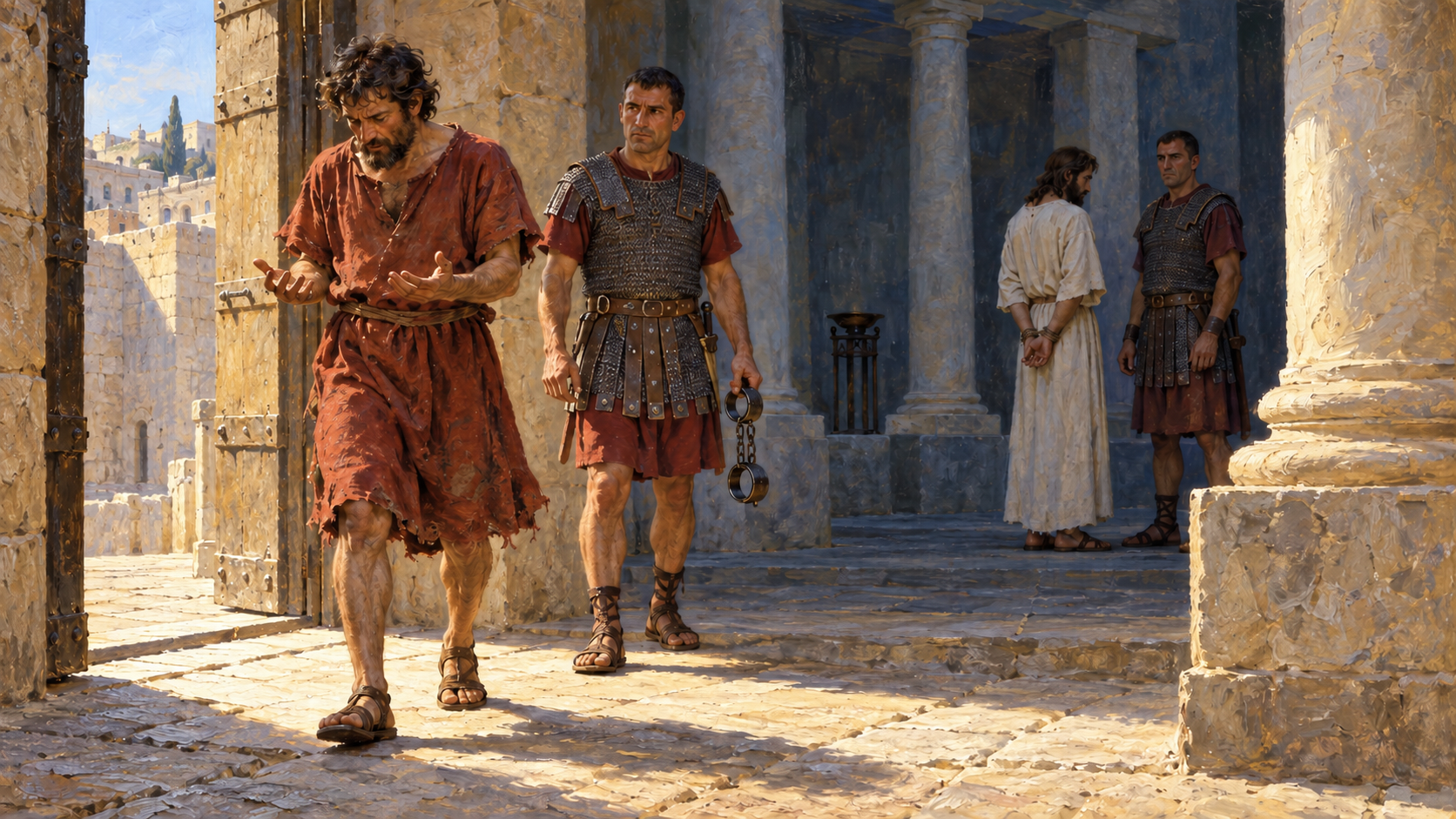
Barabbas walked out of Roman custody while Jesus was handed over to be scourged and crucified. The prisoner who went free had been involved in rebellion and murder. The Man condemned in his place had done nothing wrong, and the governor knew it. When I read these accounts, I need to consider both the injustice of that decision and the mercy Christ willingly provided for guilty people like us.
Barabbas, His Name, and His Crimes
We meet Barabbas during the Roman hearing of Jesus. Matthew describes him as a notorious prisoner, and Mark and Luke connect his imprisonment with insurrection and murder. Insurrection is an uprising against the governing authorities. He was being held for violent crimes, not for an innocent disagreement with Rome.
John calls him a lestes, a robber or bandit. The word describes someone who plunders, rather than a thief who steals by stealth. Mark and Luke add the details about rebellion and murder, so we are not relying on the word alone to establish his crimes. These accounts tell us why he was in custody while leaving most of his earlier life unknown. Thayer’s Greek lexicon explains the term.
His name comes from the Aramaic expression bar-abba, commonly understood as “son of the father” or “son of Abba.” The crowd chose the man with that name while rejecting the eternal Son of the Father. I can recognize the irony without claiming that the Gospel writers present his name as a prophecy. They establish who Jesus is through His words and deeds; we do not need to discover a hidden meaning in another prisoner’s name. See the lexical entry for Barabbas.
Some manuscripts of Matthew 27:16–17 give the longer name Jesus Barabbas, a reading discussed in the NET Bible’s textual note. The received Greek text and the NKJV used here read simply Barabbas. This study follows that wording; the contrast between the guilty prisoner and the innocent Christ does not depend on the variant.
Barabbas’s crimes exposed him to severe Roman punishment. Scripture does not say he had already received a final sentence of crucifixion or that a particular wooden cross had been prepared for him. Those details sometimes make their way into preaching, but the actual exchange is striking enough without adding them. Pilate released a man imprisoned for rebellion and murder while authorizing the execution of Jesus.
The Choice in All Four Gospels
Matthew describes Pilate questioning Jesus about His kingship. The Lord acknowledged that He was King but did not answer the accusations brought against Him, and Pilate marveled at His silence. The governor also knew that the leaders had handed Jesus over out of envy. During the hearing, his wife warned him against condemning that just Man. The governor had ample reason to reject the leaders’ demand for His death.
Now Jesus stood before the governor. And the governor asked Him, saying, "Are You the King of the Jews?" Jesus said to him, "It is as you say." And while He was being accused by the chief priests and elders, He answered nothing. Then Pilate said to Him, "Do You not hear how many things they testify against You?" But He answered him not one word, so that the governor marveled greatly. Now at the feast the governor was accustomed to releasing to the multitude one prisoner whom they wished. And at that time they had a notorious prisoner called Barabbas. Therefore, when they had gathered together, Pilate said to them, "Whom do you want me to release to you? Barabbas, or Jesus who is called Christ?" For he knew that they had handed Him over because of envy. While he was sitting on the judgment seat, his wife sent to him, saying, "Have nothing to do with that just Man, for I have suffered many things today in a dream because of Him." But the chief priests and elders persuaded the multitudes that they should ask for Barabbas and destroy Jesus. The governor answered and said to them, "Which of the two do you want me to release to you?" They said, "Barabbas!" Pilate said to them, "What then shall I do with Jesus who is called Christ?" They all said to him, "Let Him be crucified!" Then the governor said, "Why, what evil has He done?" But they cried out all the more, saying, "Let Him be crucified!" When Pilate saw that he could not prevail at all, but rather that a tumult was rising, he took water and washed his hands before the multitude, saying, "I am innocent of the blood of this just Person. You see to it." And all the people answered and said, "His blood be on us and on our children." Then he released Barabbas to them; and when he had scourged Jesus, he delivered Him to be crucified.
The chief priests and elders persuaded the crowd to ask for Barabbas and demand Jesus’ destruction. When Pilate asked what evil Jesus had done, they answered with louder demands for crucifixion, without naming an offense. As the uproar grew, he yielded to their demand rather than use his authority to protect the innocent Man before him.
Pilate washed his hands before the crowd while authorizing the very sentence for which he disclaimed responsibility. Ordering Jesus scourged and delivered to crucifixion made him responsible, whatever he said about the blood being someone else’s concern. His own words made the decision more brazen: he called Jesus just while handing Him over to be killed.
The crowd’s statement about blood must also be read accurately. Matthew records what the people at that hearing said under the influence of those leaders. Their words give later generations no permission to hate Jewish people. Jesus, His mother, His apostles, and the first believers were Jewish, and Acts also names Roman rulers and Gentiles among His opponents. We need to identify the guilt of those who acted without transferring it to an entire people or to descendants who took no part in the hearing.
Mark adds that Barabbas was chained with fellow rebels who had committed murder during the uprising. He also tells us plainly why Pilate finally gave the crowd what it wanted.
Immediately, in the morning, the chief priests held a consultation with the elders and scribes and the whole council; and they bound Jesus, led Him away, and delivered Him to Pilate. Then Pilate asked Him, "Are You the King of the Jews?" He answered and said to him, "It is as you say." And the chief priests accused Him of many things, but He answered nothing. Then Pilate asked Him again, saying, "Do You answer nothing? See how many things they testify against You!" But Jesus still answered nothing, so that Pilate marveled. Now at the feast he was accustomed to releasing one prisoner to them, whomever they requested. And there was one named Barabbas, who was chained with his fellow rebels; they had committed murder in the rebellion. Then the multitude, crying aloud, began to ask him to do just as he had always done for them. But Pilate answered them, saying, "Do you want me to release to you the King of the Jews?" For he knew that the chief priests had handed Him over because of envy. But the chief priests stirred up the crowd, so that he should rather release Barabbas to them. Pilate answered and said to them again, "What then do you want me to do with Him whom you call the King of the Jews?" So they cried out again, "Crucify Him!" Then Pilate said to them, "Why, what evil has He done?" But they cried out all the more, "Crucify Him!" So Pilate, wanting to gratify the crowd, released Barabbas to them; and he delivered Jesus, after he had scourged Him, to be crucified.
Mark identifies Pilate’s motive: he wanted to gratify the crowd. He had found no wrongdoing in Jesus, yet he granted their demand for crucifixion. The governor was charged with administering justice, but he allowed an agitated crowd to determine whom he would release and whom he would punish.
Luke describes how Jesus came before both Pilate and Herod. The accusers claimed that He was misleading the nation, forbidding payment of taxes, and presenting Himself as a king. Those accusations raised political questions a Roman governor would have to consider. Yet Pilate found no fault in Jesus after examining Him, and sending Him to Herod produced no grounds for a death sentence either.
Then the whole multitude of them arose and led Him to Pilate. And they began to accuse Him, saying, "We found this fellow perverting the nation, and forbidding to pay taxes to Caesar, saying that He Himself is Christ, a King." Then Pilate asked Him, saying, "Are You the King of the Jews?" He answered him and said, "It is as you say." So Pilate said to the chief priests and the crowd, "I find no fault in this Man." But they were the more fierce, saying, "He stirs up the people, teaching throughout all Judea, beginning from Galilee to this place." When Pilate heard of Galilee, he asked if the Man were a Galilean. And as soon as he knew that He belonged to Herod's jurisdiction, he sent Him to Herod, who was also in Jerusalem at that time. Now when Herod saw Jesus, he was exceedingly glad; for he had desired for a long time to see Him, because he had heard many things about Him, and he hoped to see some miracle done by Him. Then he questioned Him with many words, but He answered him nothing. And the chief priests and scribes stood and vehemently accused Him. Then Herod, with his men of war, treated Him with contempt and mocked Him, arrayed Him in a gorgeous robe, and sent Him back to Pilate. That very day Pilate and Herod became friends with each other, for previously they had been at enmity with each other. Then Pilate, when he had called together the chief priests, the rulers, and the people, said to them, "You have brought this Man to me, as one who misleads the people. And indeed, having examined Him in your presence, I have found no fault in this Man concerning those things of which you accuse Him; no, neither did Herod, for I sent you back to him; and indeed nothing deserving of death has been done by Him. I will therefore chastise Him and release Him" (for it was necessary for him to release one to them at the feast). And they all cried out at once, saying, "Away with this Man, and release to us Barabbas"– who had been thrown into prison for a certain rebellion made in the city, and for murder. Pilate, therefore, wishing to release Jesus, again called out to them. But they shouted, saying, "Crucify Him, crucify Him!" Then he said to them the third time, "Why, what evil has He done? I have found no reason for death in Him. I will therefore chastise Him and let Him go." But they were insistent, demanding with loud voices that He be crucified. And the voices of these men and of the chief priests prevailed. So Pilate gave sentence that it should be as they requested. And he released to them the one they requested, who for rebellion and murder had been thrown into prison; but he delivered Jesus to their will.
Herod had hoped to see Jesus perform a miracle. When the Lord gave no answer to his many questions, Herod joined his soldiers in treating Him with contempt and mocking Him. They sent Jesus back to Pilate, where the governor again declared that nothing deserving death had been established. Even Pilate’s proposal to chastise Him and then release Him was unjust, because it meant punishing someone he had just pronounced innocent.
The people refused that proposal and demanded Barabbas. At the end of the hearing, Luke again names the released prisoner’s rebellion and murder while describing Jesus as delivered to their will. Pilate had tried to secure His release, but finally gave the sentence they requested. The leaders and crowd were guilty of demanding His death, and the governor remained accountable for turning their demand into a Roman judgment.
John records Pilate’s conversation with Jesus about His kingdom. Jesus did not deny being King. He explained that if His kingdom came from this world, His servants would fight to prevent His arrest.
Then they led Jesus from Caiaphas to the Praetorium, and it was early morning. But they themselves did not go into the Praetorium, lest they should be defiled, but that they might eat the Passover. Pilate then went out to them and said, "What accusation do you bring against this Man?" They answered and said to him, "If He were not an evildoer, we would not have delivered Him up to you." Then Pilate said to them, "You take Him and judge Him according to your law." Therefore the Jews said to him, "It is not lawful for us to put anyone to death," that the saying of Jesus might be fulfilled which He spoke, signifying by what death He would die. Then Pilate entered the Praetorium again, called Jesus, and said to Him, "Are You the King of the Jews?" Jesus answered him, "Are you speaking for yourself about this, or did others tell you this concerning Me?" Pilate answered, "Am I a Jew? Your own nation and the chief priests have delivered You to me. What have You done?" Jesus answered, "My kingdom is not of this world. If My kingdom were of this world, My servants would fight, so that I should not be delivered to the Jews; but now My kingdom is not from here." Pilate therefore said to Him, "Are You a king then?" Jesus answered, "You say rightly that I am a king. For this cause I was born, and for this cause I have come into the world, that I should bear witness to the truth. Everyone who is of the truth hears My voice." Pilate said to Him, "What is truth?" And when he had said this, he went out again to the Jews, and said to them, "I find no fault in Him at all. "But you have a custom that I should release someone to you at the Passover. Do you therefore want me to release to you the King of the Jews?" Then they all cried again, saying, "Not this Man, but Barabbas!" Now Barabbas was a robber.
The Lord was explaining the source and character of His kingdom. He had come to bear witness to the truth, rather than organize the kind of armed revolt associated with Barabbas. Earlier in John 18, Peter had drawn his sword and struck the high priest’s servant. Jesus ordered him to put it away and spoke of accepting the cup His Father had given Him (John 18:10–11). Peter’s use of the sword was not how Jesus would establish His rule.
After questioning Jesus about His kingdom, Pilate went out to the accusers and announced that he found no fault in Him. He offered to release the King of the Jews according to the Passover custom, but the people demanded Barabbas. John then describes the suffering Pilate authorized.
So then Pilate took Jesus and scourged Him. And the soldiers twisted a crown of thorns and put it on His head, and they put on Him a purple robe. Then they said, "Hail, King of the Jews!" And they struck Him with their hands. Pilate then went out again, and said to them, "Behold, I am bringing Him out to you, that you may know that I find no fault in Him." Then Jesus came out, wearing the crown of thorns and the purple robe. And Pilate said to them, "Behold the Man!" Therefore, when the chief priests and officers saw Him, they cried out, saying, "Crucify Him, crucify Him!" Pilate said to them, "You take Him and crucify Him, for I find no fault in Him." The Jews answered him, "We have a law, and according to our law He ought to die, because He made Himself the Son of God." Therefore, when Pilate heard that saying, he was the more afraid, and went again into the Praetorium, and said to Jesus, "Where are You from?" But Jesus gave him no answer. Then Pilate said to Him, "Are You not speaking to me? Do You not know that I have power to crucify You, and power to release You?" Jesus answered, "You could have no power at all against Me unless it had been given you from above. Therefore the one who delivered Me to you has the greater sin." From then on Pilate sought to release Him, but the Jews cried out, saying, "If you let this Man go, you are not Caesar's friend. Whoever makes himself a king speaks against Caesar." When Pilate therefore heard that saying, he brought Jesus out and sat down in the judgment seat in a place that is called The Pavement, but in Hebrew, Gabbatha. Now it was the Preparation Day of the Passover, and about the sixth hour. And he said to the Jews, "Behold your King!" But they cried out, "Away with Him, away with Him! Crucify Him!" Pilate said to them, "Shall I crucify your King?" The chief priests answered, "We have no king but Caesar!" Then he delivered Him to them to be crucified. Then they took Jesus and led Him away.
The soldiers scourged Jesus, placed a crown of thorns on His head, and dressed Him in a purple robe. They struck Him while mocking His kingship. When Pilate brought Him before the people and repeated his finding of innocence, the chief priests and officers continued to demand crucifixion. Their accusation that Jesus made Himself the Son of God increased Pilate’s fear and prompted him to question the Lord again.
Pilate claimed the power to crucify or release Him. Jesus answered that he could have no authority against Him unless it had been given from above, then spoke of the greater sin of the one who delivered Him up. Permission to exercise authority did not make Pilate’s use of it righteous. Nor did another person’s greater sin make the governor innocent.
The accusers increased the political pressure by declaring that releasing Jesus would show disloyalty to Caesar. Pilate took his seat in judgment, and the chief priests declared that they had no king but Caesar. The governor then handed Jesus over to be crucified, granting the execution the leaders wanted without any valid grounds for condemning Him.
Pilate’s failure makes me examine my response when I know someone is being treated unjustly. Privately agreeing that an accusation is false does little for the accused person if I then help carry out the mistreatment to please others. Most of us will never exercise a governor’s authority, but we can use the same excuse for a wrong decision. Pressure from other people does not remove our responsibility for what we choose to do.
Pilate, the Crowd, and Human Responsibility
After Jesus rose, Peter addressed a crowd in Jerusalem following the healing of a man who had been lame. He explained that the apostles’ own power or godliness had not made the man walk. The healing directed them to Jesus, and Peter brought them back to the choice made before Pilate.
So when Peter saw it, he responded to the people: "Men of Israel, why do you marvel at this? Or why look so intently at us, as though by our own power or godliness we had made this man walk? The God of Abraham, Isaac, and Jacob, the God of our fathers, glorified His Servant Jesus, whom you delivered up and denied in the presence of Pilate, when he was determined to let Him go. But you denied the Holy One and the Just, and asked for a murderer to be granted to you, and killed the Prince of life, whom God raised from the dead, of which we are witnesses. And His name, through faith in His name, has made this man strong, whom you see and know. Yes, the faith which comes through Him has given him this perfect soundness in the presence of you all. "Yet now, brethren, I know that you did it in ignorance, as did also your rulers. But those things which God foretold by the mouth of all His prophets, that the Christ would suffer, He has thus fulfilled. Repent therefore and be converted, that your sins may be blotted out, so that times of refreshing may come from the presence of the Lord, and that He may send Jesus Christ, who was preached to you before, whom heaven must receive until the times of restoration of all things, which God has spoken by the mouth of all His holy prophets since the world began.
Peter named their guilt directly: they had denied the Holy and Just One and asked for a murderer to be released. He acknowledged that they and their rulers had acted in ignorance, but that ignorance did not excuse their part in killing the Prince of life. Even so, Peter did not treat them as beyond forgiveness. He called them to repent and be converted so that their sins could be blotted out.
The mercy Peter offered reaches the very people he had charged with rejecting Christ. He proclaimed forgiveness through the One they had denied. I need to keep that honesty and that invitation together when speaking to someone about sin. Denying that any wrong was done leaves a guilty person deceived, while telling him he is too wicked to come to Christ withholds the invitation the apostles gave.
When the authorities later threatened Peter and John for speaking in Jesus’ name, the apostles reported the threats to the other believers. The church prayed from Psalm 2, recalling how God had fulfilled His purpose despite the opposition of rulers and peoples.
And being let go, they went to their own companions and reported all that the chief priests and elders had said to them. So when they heard that, they raised their voice to God with one accord and said: "Lord, You are God, who made heaven and earth and the sea, and all that is in them, who by the mouth of Your servant David have said: 'Why did the nations rage, And the people plot vain things? The kings of the earth took their stand, And the rulers were gathered together Against the LORD and against His Christ.' "For truly against Your holy Servant Jesus, whom You anointed, both Herod and Pontius Pilate, with the Gentiles and the people of Israel, were gathered together to do whatever Your hand and Your purpose determined before to be done. Now, Lord, look on their threats, and grant to Your servants that with all boldness they may speak Your word, by stretching out Your hand to heal, and that signs and wonders may be done through the name of Your holy Servant Jesus." And when they had prayed, the place where they were assembled together was shaken; and they were all filled with the Holy Spirit, and they spoke the word of God with boldness.
The believers named Herod, Pontius Pilate, Gentiles, and people of Israel as those gathered against God’s holy Servant. They also acknowledged that God’s hand and purpose had determined beforehand what would be accomplished. The hearing and crucifixion had not caught Him unprepared. He fulfilled His saving purpose through events in which wicked people were acting against His Son.
God’s fulfilled purpose did not make Him the author of their hatred or turn them into blameless puppets. The apostles who proclaimed that purpose also called the participants to repent. Herod’s contempt, the leaders’ envy, the crowd’s demand, and Pilate’s authorization were their own culpable actions. God’s purpose to redeem sinners excused none of them.
The church answered renewed threats by asking for boldness to continue speaking God’s word. They knew the rulers had not defeated His purpose in crucifying Jesus, and they depended on Him as they faced opposition themselves. Their prayer was answered with power to speak, rather than a promise that obedience would keep them from suffering.
A Real Exchange and a Limited Picture
A just decision at Pilate’s judgment seat should have freed Jesus. Instead, the governor offered His release and Barabbas’s release as alternatives, then gave the crowd the prisoner it requested. In that historical sense, Jesus went to death in Barabbas’s place. The innocent Man was condemned while the guilty man was freed.
The crowd rejected the true King in favor of a violent prisoner, but choosing Barabbas could not give him Christ’s authority or remove it from the Son of God. Jesus would truly die at human hands and willingly provide salvation through that death. He would also rise bodily despite the opposition of those who condemned Him.
Barabbas left custody without having erased his crimes or established his innocence. His release helps me consider the mercy we need before God, since none of us can erase our sins or make ourselves righteous. Jesus had no sins of His own, yet willingly gave Himself for sinners. We can learn from the comparison while keeping release from a human prison distinct from eternal salvation.
The Gospels record no words from Barabbas and tell us nothing about his response afterward. They do not place him at the crucifixion, describe him carrying a cross, or report his repentance and faith. He might have heard more about Jesus later, or returned to violence; we have no recorded answer. A dramatic encounter supplied by a preacher or an imaginative retelling cannot establish what Scripture leaves unknown.
I cannot call Barabbas a Christian simply because he walked free, and I cannot pronounce his final condemnation because he had been a murderer. Christ offers salvation even to murderers and rebels who repent and believe. Barabbas received temporary deliverance from Rome; whether he received new life in Christ is something God has not told us.
What Christ Accomplished Through His Death and Resurrection
To understand how Jesus saves guilty people, we need more than the courtroom exchange. Isaiah 53 describes the suffering Servant’s innocence and the offering He would make for sin. It takes us from the injustice done to Jesus to what He willingly provided through His death.
Who has believed our report? And to whom has the arm of the LORD been revealed? For He shall grow up before Him as a tender plant, And as a root out of dry ground. He has no form or comeliness; And when we see Him, There is no beauty that we should desire Him. He is despised and rejected by men, A Man of sorrows and acquainted with grief. And we hid, as it were, our faces from Him; He was despised, and we did not esteem Him. Surely He has borne our griefs And carried our sorrows; Yet we esteemed Him stricken, Smitten by God, and afflicted. But He was wounded for our transgressions, He was bruised for our iniquities; The chastisement for our peace was upon Him, And by His stripes we are healed. All we like sheep have gone astray; We have turned, every one, to his own way; And the LORD has laid on Him the iniquity of us all. He was oppressed and He was afflicted, Yet He opened not His mouth; He was led as a lamb to the slaughter, And as a sheep before its shearers is silent, So He opened not His mouth. He was taken from prison and from judgment, And who will declare His generation? For He was cut off from the land of the living; For the transgressions of My people He was stricken. And they made His grave with the wicked– But with the rich at His death, Because He had done no violence, Nor was any deceit in His mouth. Yet it pleased the LORD to bruise Him; He has put Him to grief. When You make His soul an offering for sin, He shall see His seed, He shall prolong His days, And the pleasure of the LORD shall prosper in His hand. He shall see the labor of His soul, and be satisfied. By His knowledge My righteous Servant shall justify many, For He shall bear their iniquities. Therefore I will divide Him a portion with the great, And He shall divide the spoil with the strong, Because He poured out His soul unto death, And He was numbered with the transgressors, And He bore the sin of many, And made intercession for the transgressors.
The people described in Isaiah’s prophecy saw the Servant’s affliction and esteemed Him stricken and smitten by God. Isaiah explains that His wounds were for our transgressions and His bruising for our iniquities: the innocent Servant suffered for the guilty. The passage also speaks of the Lord’s pleasure and purpose in making His life an offering for sin. I understand that language in light of the Father’s purpose to save through the Son’s willing sacrifice, without making the Father responsible for the actions of His torturers.
Jesus is the eternal Son, fully God and fully man, born of a virgin and without sin. The Gospel accounts identify wicked men as those who struck, scourged, mocked, and crucified Him. He voluntarily gave Himself to be slain as the perfect sacrifice for our sins, offering His innocent blood and life. His silence before His accusers expressed willing submission to God’s saving purpose; it did not mean the Father was attacking Him.
The Father did not punish, curse, abandon, strike, bruise, or pour wrath on Jesus. The Son remained the spotless offering, and the Father remained with Him throughout His suffering. Father, Son, and Holy Spirit acted in unity, with no broken fellowship in the Godhead. Jesus’ saving work through His shed blood and death was complete before His burial and bodily resurrection. His resurrection did not supply an unfinished payment for sin. The One who had truly died now lived again, and death could not hold Him.
In Romans 3, Paul explains how guilty people receive what Jesus provided. Justification is God’s declaration that the believer is righteous in Christ. God gives this righteous standing freely through the redemption Jesus accomplished, rather than as a reward for offsetting wrongdoing with good deeds.
But now the righteousness of God apart from the law is revealed, being witnessed by the Law and the Prophets, even the righteousness of God, through faith in Jesus Christ, to all and on all who believe. For there is no difference; for all have sinned and fall short of the glory of God, being justified freely by His grace through the redemption that is in Christ Jesus, whom God set forth as a propitiation by His blood, through faith, to demonstrate His righteousness, because in His forbearance God had passed over the sins that were previously committed, to demonstrate at the present time His righteousness, that He might be just and the justifier of the one who has faith in Jesus.
Paul also calls Christ a propitiation by His blood, through faith. The term identifies Him as the sufficient sacrifice through whom sin is dealt with and God’s righteous judgment is satisfied. The blood Jesus willingly shed provides forgiveness while God remains just. He does not pardon us by pretending our sins were acceptable, and the passage does not require us to imagine the Father venting anger upon His Son.
Christ died for the whole world, so His provision is genuinely available to every person. His saving offer can be resisted, and not everyone is justified. Paul identifies the one who has faith in Jesus as the person God justifies. Barabbas’s release tells us what Pilate did for a prisoner; Romans explains how a sinner is made right with God through faith in Christ.
That faith rests on the real Jesus who died and rose, not merely on an inspiring comparison between two men before a governor. Paul reminded the Corinthians of the gospel he had preached and of the witnesses who had seen the risen Lord.
Moreover, brethren, I declare to you the gospel which I preached to you, which also you received and in which you stand, by which also you are saved, if you hold fast that word which I preached to you–unless you believed in vain. For I delivered to you first of all that which I also received: that Christ died for our sins according to the Scriptures, and that He was buried, and that He rose again the third day according to the Scriptures, and that He was seen by Cephas, then by the twelve. After that He was seen by over five hundred brethren at once, of whom the greater part remain to the present, but some have fallen asleep. After that He was seen by James, then by all the apostles. Then last of all He was seen by me also, as by one born out of due time.
Later in this chapter, Paul answers some Corinthians who were denying the resurrection of the dead. If Christ had not risen, their faith would be futile and they would still be in their sins (1 Corinthians 15:12–19). We must read his phrase “unless you believed in vain” within that argument. A profession emptied of the truth about Christ cannot save. Paul directs them to the crucified, buried, and bodily risen Lord, rather than teaching that a person truly born again later becomes unborn.
The risen Christ is Lord and Judge, no longer a prisoner before Pilate. He offers forgiveness to the world that rejected Him, and every sinner needs to repent and believe in Him. Religious position and political influence cannot secure the righteousness that comes through faith. Neither can family heritage, water baptism, or acts of self-denial save us.
Everyone who truly believes is forgiven and justified. God gives that person new birth, and the Holy Spirit, a divine Person, comes to live within him and seals him for the promised inheritance. This is regeneration: God makes the believer a new creation. Merely calling ourselves Christians does not establish that we have received this life, but everyone truly born again is eternally secure in Christ.
New life changes how we respond to sin. Romans 6 describes believers as united with Christ in His death and resurrection and freed from slavery to sin. Water baptism symbolizes that identification after salvation; it does not cause the new birth. Believers can still sin and need correction, so new birth does not mean sinless perfection. Yet we have been freed from sin’s rule, not given permission to settle into a life of rebellion. The Spirit leads us into obedience, and our conduct should give evidence of the life we have received.
Obedience includes Jesus’ call to deny ourselves and take up the cross (Luke 9:23). Following Him can cost us approval, comfort, opportunity, and even our lives. Accepting that cost neither earns nor keeps salvation, and it adds nothing to Christ’s atonement or the payment for forgiveness. We follow because we trust the Savior who has already given Himself for us. His command calls for faithful allegiance, not an attempt to finish His work.
If you are truly born again, your hope rests with the Savior who gives eternal life and keeps His people. No one can snatch you from His hand. His care gives us reason to obey with courage and gratitude, welcome correction when we stray, and extend mercy to others who need the forgiveness we have received.
My Final Thoughts
I do not know what Barabbas did with the freedom he received. I do know that the innocent Jesus willingly shed His blood and died for guilty people, then rose bodily from the grave. We should not admire His mercy while refusing His invitation. Come to Him in repentance and faith. He forgives, gives new life, and keeps everyone who truly believes; that grace calls for grateful obedience to our living King.