
Absalom’s rebellion began in a household where a terrible wrong had gone unpunished. Amnon raped Tamar, and David became angry without administering any discipline that Scripture records. Absalom then arranged Amnon’s murder and eventually tried to overthrow his father. I want to follow those events without losing sight of Tamar or allowing the guilt of one man to excuse what another chose to do.
Trouble in David’s House
Absalom was David’s third son. His mother, Maacah, was the daughter of Talmai, king of Geshur. Tamar was his full sister, while Amnon, David’s firstborn through Ahinoam, was their older half-brother. These relationships placed the conflict inside the royal household, where family loyalties and the succession to the throne affected the nation as well.
Absalom’s Hebrew name, Avshalom, combines the ideas of father and peace. It is commonly understood as "father of peace" or "my father is peace," the latter being the explanation in the Brown-Driver-Briggs lexicon. His royal birth and handsome appearance gave him standing, yet neither kept him from cultivating hatred and eventually seeking his father’s throne.
The trouble did not begin with Absalom. David had committed adultery with Bathsheba and arranged Uriah’s death. Nathan confronted him, and David confessed and received forgiveness. Yet God announced that violence and adversity would arise within his own house. Forgiveness did not mean that every consequence of his actions would disappear.
Then Nathan said to David, "You are the man! Thus says the LORD God of Israel: 'I anointed you king over Israel, and I delivered you from the hand of Saul. I gave you your master's house and your master's wives into your keeping, and gave you the house of Israel and Judah. And if that had been too little, I also would have given you much more! Why have you despised the commandment of the LORD, to do evil in His sight? You have killed Uriah the Hittite with the sword; you have taken his wife to be your wife, and have killed him with the sword of the people of Ammon. Now therefore, the sword shall never depart from your house, because you have despised Me, and have taken the wife of Uriah the Hittite to be your wife.' Thus says the LORD: 'Behold, I will raise up adversity against you from your own house; and I will take your wives before your eyes and give them to your neighbor, and he shall lie with your wives in the sight of this sun. For you did it secretly, but I will do this thing before all Israel, before the sun.'"
God carried out the judgment He announced without becoming guilty of the wicked acts through which it unfolded. Amnon chose to assault Tamar. Absalom deliberately arranged a murder and later rebelled, and Ahithophel advised the public sexual humiliation of David’s household. Those choices fulfilled the announced judgment without making the men innocent agents. We must recognize both God’s authority to judge David and each man’s responsibility for his own sin.
Amnon followed Jonadab’s crafty advice to gain access to Tamar. Pretending to be ill, he asked for her to prepare food for him. When she brought it into his room, he seized her and demanded that she lie with him. She refused plainly, called the act disgraceful, and warned him of the shame and folly it would bring.
Then Amnon said to Tamar, "Bring the food into the bedroom, that I may eat from your hand." And Tamar took the cakes which she had made, and brought them to Amnon her brother in the bedroom. Now when she had brought them to him to eat, he took hold of her and said to her, "Come, lie with me, my sister." But she answered him, "No, my brother, do not force me, for no such thing should be done in Israel. Do not do this disgraceful thing! And I, where could I take my shame? And as for you, you would be like one of the fools in Israel. Now therefore, please speak to the king; for he will not withhold me from you." However, he would not heed her voice; and being stronger than she, he forced her and lay with her. Then Amnon hated her exceedingly, so that the hatred with which he hated her was greater than the love with which he had loved her. And Amnon said to her, "Arise, be gone!" So she said to him, "No, indeed! This evil of sending me away is worse than the other that you did to me." But he would not listen to her. Then he called his servant who attended him, and said, "Here! Put this woman out, away from me, and bolt the door behind her." Now she had on a robe of many colors, for the king's virgin daughters wore such apparel. And his servant put her out and bolted the door behind her. Then Tamar put ashes on her head, and tore her robe of many colors that was on her, and laid her hand on her head and went away crying bitterly. And Absalom her brother said to her, "Has Amnon your brother been with you? But now hold your peace, my sister. He is your brother; do not take this thing to heart." So Tamar remained desolate in her brother Absalom's house. But when King David heard of all these things, he was very angry. And Absalom spoke to his brother Amnon neither good nor bad. For Absalom hated Amnon, because he had forced his sister Tamar.
Tamar’s appeal to speak to the king was part of her effort to stop Amnon, not consent to his assault. Nor do her words establish that God’s law permitted a marriage between them; Leviticus 18:9 forbids sexual relations between half-brother and half-sister. She told him not to force her, but he refused to listen and used his greater strength. Her clothing, her preparation of food, and her presence in the room did not make her responsible for his crime. Amnon was guilty of rape, and Jonadab had helped devise the scheme that placed her within his reach.
After assaulting Tamar, Amnon treated her with hatred and had her expelled, with the door bolted behind her. The man who had claimed to love her would not even listen when she protested this further wrong. She left crying bitterly and remained desolate in Absalom’s house. That description shows the devastation she suffered without suggesting that she had lost her worth. The guilt belonged to her assailant.
David became very angry when he heard what had happened, but Scripture records no discipline of Amnon. Some teachers suggest that guilt over his own conduct weakened David’s response. That is possible, yet the passage does not tell us why he failed to administer justice. His anger did not discharge his responsibility as king and father. Knowing he was upset did nothing to remedy Tamar’s suffering.
I do not want Tamar to disappear from our attention as the account follows the men into further conflict. Families and churches should listen to those who have been harmed, protect them from further harm, and tell the truth. Seeking justice through lawful authorities belongs with that care. If a family silences the injured person to protect its reputation, the offender remains sheltered while the person harmed continues to suffer.
Absalom gave Tamar a place in his house, and his words may have been intended to quiet or calm her. The passage records no public pursuit of justice or call for Amnon to repent. He said nothing to Amnon, either good or bad, while continuing to hate him. The revenge he later arranged shows the danger concealed beneath that silence.
Vengeance, Exile, and a Return Without Repentance
Two full years passed before Absalom acted. He invited the king’s sons to a sheep-shearing celebration at Baal Hazor and pressed David to let Amnon attend. Sheep shearing could provide an occasion for a substantial feast, making the invitation a believable reason to bring the brothers together away from Jerusalem. Absalom had instructed his servants to wait until the wine affected Amnon, then kill him at his signal.
And it came to pass, after two full years, that Absalom had sheepshearers in Baal Hazor, which is near Ephraim; so Absalom invited all the king's sons. Then Absalom came to the king and said, "Kindly note, your servant has sheepshearers; please, let the king and his servants go with your servant." But the king said to Absalom, "No, my son, let us not all go now, lest we be a burden to you." Then he urged him, but he would not go; and he blessed him. Then Absalom said, "If not, please let my brother Amnon go with us." And the king said to him, "Why should he go with you?" But Absalom urged him; so he let Amnon and all the king's sons go with him. Now Absalom had commanded his servants, saying, "Watch now, when Amnon's heart is merry with wine, and when I say to you, 'Strike Amnon!' then kill him. Do not be afraid. Have I not commanded you? Be courageous and valiant." So the servants of Absalom did to Amnon as Absalom had commanded. Then all the king's sons arose, and each one got on his mule and fled.
Absalom had planned a killing, with time to arrange the setting, name his victim, and instruct his servants. This was no uncontrolled response at the moment of Tamar’s assault. He even urged the servants to be courageous and valiant as they carried out the murder. The language of valor did not make an evil command righteous. Amnon deserved judgment, but Absalom had no right to arrange a private execution at his feast.
The other royal sons fled, and Absalom escaped to Geshur, where his maternal grandfather Talmai ruled. He stayed for three years, sheltered by a royal relative beyond David’s immediate reach. David mourned Amnon and eventually longed for Absalom, but Scripture records no confession from the fugitive son. His revenge had brought a death and an exile into a household already devastated by Tamar’s assault.
Recognizing David’s longing for his son, Joab arranged for a wise woman from Tekoa to present a carefully constructed appeal. David allowed Absalom back to Jerusalem while refusing to receive him into his presence. Father and son then spent two years in the same city without restored fellowship. When Joab ignored two requests to visit, Absalom ordered his servants to burn Joab’s barley field.
Now in all Israel there was no one who was praised as much as Absalom for his good looks. From the sole of his foot to the crown of his head there was no blemish in him. And when he cut the hair of his head–at the end of every year he cut it because it was heavy on him–when he cut it, he weighed the hair of his head at two hundred shekels according to the king's standard. To Absalom were born three sons, and one daughter whose name was Tamar. She was a woman of beautiful appearance. And Absalom dwelt two full years in Jerusalem, but did not see the king's face. Therefore Absalom sent for Joab, to send him to the king, but he would not come to him. And when he sent again the second time, he would not come. So he said to his servants, "See, Joab's field is near mine, and he has barley there; go and set it on fire." And Absalom's servants set the field on fire. Then Joab arose and came to Absalom's house, and said to him, "Why have your servants set my field on fire?" And Absalom answered Joab, "Look, I sent to you, saying, 'Come here, so that I may send you to the king, to say, "Why have I come from Geshur? It would be better for me to be there still."' Now therefore, let me see the king's face; but if there is iniquity in me, let him execute me." So Joab went to the king and told him. And when he had called for Absalom, he came to the king and bowed himself on his face to the ground before the king. Then the king kissed Absalom.
Absalom demanded either an audience with David or execution if guilt could be found in him. He had arranged Amnon’s murder and had just destroyed Joab’s crop to force his cooperation, yet he confessed neither wrong in this appeal. Joab carried the demand to David, who finally received his son with a kiss.
The kiss did not establish that trust had been repaired. Absalom bowed before David, but the next chapter finds him gathering support for a revolt. An outward reunion and genuine reconciliation are different. Refusing personal vengeance does not require us to treat an offender as trustworthy before there is reason to do so. Restored fellowship calls for truth about what happened and credible evidence of changed conduct.
Appearance and the Hearts of Israel
Chapter 14’s description of Absalom helps us understand his public appeal. No man in Israel received greater praise for his appearance. His hair grew so heavy that he cut it at the end of each year, weighing it at two hundred shekels according to the king’s standard. Since ancient weight standards varied, I would not insist on an exact modern conversion.
He also had three sons and a beautiful daughter named Tamar. Yet when he later raised a pillar to preserve his name, he said he had no son to keep his memory alive. His sons may have died before that statement, but Scripture does not tell us what happened to them. We can acknowledge both passages without supplying a family history the text leaves unrecorded.
Absalom added a chariot, horses, and fifty runners to his impressive appearance, displaying royal grandeur before he possessed the throne. God’s reminder to Samuel that people look at outward appearance while the Lord looks at the heart helps us judge that display properly. Admiration for Absalom’s looks did not establish his fitness to rule. His conduct reveals how he used the attention he received.
He rose early to stand beside the way to the city gate, where people came seeking the king’s judgment. After asking where they lived, he affirmed their claims and told them there was no royal deputy to hear them. Then he described how he would give them justice if he were judge. When someone approached to bow, he drew the person close and kissed him.
After this it happened that Absalom provided himself with chariots and horses, and fifty men to run before him. Now Absalom would rise early and stand beside the way to the gate. So it was, whenever anyone who had a lawsuit came to the king for a decision, that Absalom would call to him and say, "What city are you from?" And he would say, "Your servant is from such and such a tribe of Israel." Then Absalom would say to him, "Look, your case is good and right; but there is no deputy of the king to hear you." Moreover Absalom would say, "Oh, that I were made judge in the land, and everyone who has any suit or cause would come to me; then I would give him justice." And so it was, whenever anyone came near to bow down to him, that he would put out his hand and take him and kiss him. In this manner Absalom acted toward all Israel who came to the king for judgment. So Absalom stole the hearts of the men of Israel. Now it came to pass after forty years that Absalom said to the king, "Please, let me go to Hebron and pay the vow which I made to the LORD. For your servant took a vow while I dwelt at Geshur in Syria, saying, 'If the LORD indeed brings me back to Jerusalem, then I will serve the LORD.'" And the king said to him, "Go in peace." So he arose and went to Hebron. Then Absalom sent spies throughout all the tribes of Israel, saying, "As soon as you hear the sound of the trumpet, then you shall say, 'Absalom reigns in Hebron!'" And with Absalom went two hundred men invited from Jerusalem, and they went along innocently and did not know anything. Then Absalom sent for Ahithophel the Gilonite, David's counselor, from his city–from Giloh–while he offered sacrifices. And the conspiracy grew strong, for the people with Absalom continually increased in number.
By placing himself between those seeking justice and the king responsible for administering it, Absalom gained an audience for his own ambitions. He pronounced their cases right and offered sympathy while portraying David’s government as unwilling to listen. A fair judgment requires examination of the claim and a hearing for the other side. Absalom instead used the promise of justice to recruit supporters, helped by a manner that made him seem approachable.
Verse 7 dates Absalom’s request to visit Hebron with the words "after forty years" in the NKJV. This follows the Masoretic Text, the traditional Hebrew text underlying that translation. Some ancient witnesses read four years, a reading many modern translations adopt; the NET translation note explains the alternative. I retain forty in the quotation. Scripture does not identify the event from which those years are counted, and proposed starting points within David’s life or reign remain uncertain. I would acknowledge the difficulty rather than silently replace the Hebrew reading.
Absalom used a vow to the Lord as his pretext for requesting permission to go to Hebron. David sent him in peace, but Absalom sent agents throughout Israel to announce his kingship when the trumpet sounded. Two hundred invited men accompanied him innocently, unaware of the plot. Their presence could give an impression of support they had never knowingly offered. When David’s counselor Ahithophel joined Absalom, the conspiracy grew stronger.
David fled Jerusalem when he learned that Israel’s hearts had turned toward Absalom. He warned that delay could leave them exposed to a sudden attack and bring the sword against the city. By leaving promptly, he sought to protect those with him and avoid an immediate battle inside Jerusalem. Psalm 3 identifies itself with this flight. Surrounded by opposition, David looked to the Lord to shield and sustain him.
Open Rebellion and the Counsel Absalom Chose
Once in Jerusalem, Absalom asked Ahithophel what to do. The counselor urged him to go in to the concubines David had left to keep the house. Publicly taking the king’s concubines asserted a claim to his place and authority. Ahithophel’s advice therefore used sexual wrongdoing to strengthen the revolt: it would demonstrate a complete break with David and embolden Absalom’s supporters.
Then Absalom said to Ahithophel, "Give advice as to what we should do." And Ahithophel said to Absalom, "Go in to your father's concubines, whom he has left to keep the house; and all Israel will hear that you are abhorred by your father. Then the hands of all who are with you will be strong." So they pitched a tent for Absalom on the top of the house, and Absalom went in to his father's concubines in the sight of all Israel. Now the advice of Ahithophel, which he gave in those days, was as if one had inquired at the oracle of God. So was all the advice of Ahithophel both with David and with Absalom.
These women were being used to advertise Absalom’s power and humiliate his father. The tent on the palace roof made the act deliberately public, fulfilling Nathan’s warning that David’s secret sin would be answered by public adversity within his house. That fulfillment did not make the sexual sin righteous or excuse the man who advised it. Absalom and Ahithophel remained responsible for their choices.
Ahithophel next urged an immediate attack on David while he was weary and vulnerable. Hushai, David’s loyal agent in Jerusalem, proposed assembling a great national army with Absalom at its head. His plan gave Absalom a prominent role but required a delay. After Absalom chose this plan, Hushai sent a warning to David, who crossed the Jordan with his people before the attack could come. As 2 Samuel 17:14 explains, the Lord intended to defeat Ahithophel’s sound military counsel so that disaster would fall on Absalom.
The Lord frustrated Ahithophel’s plan and preserved His anointed king, without making rebellion or deception virtuous. Absalom and his advisers made real choices in the civil war he had begun. His preference for a plan centered on himself also gives me reason to examine what I find attractive in advice. A proposal may offer me greater prominence while leading me away from sound judgment.
Absalom’s Death and David’s Grief
David divided his forces under three commanders and ordered them to deal gently with Absalom for his sake. The soldiers heard the instruction before going into battle. His army defeated the rebels in the woods of Ephraim, where fighting spread across the countryside and the woods claimed more lives than the sword.
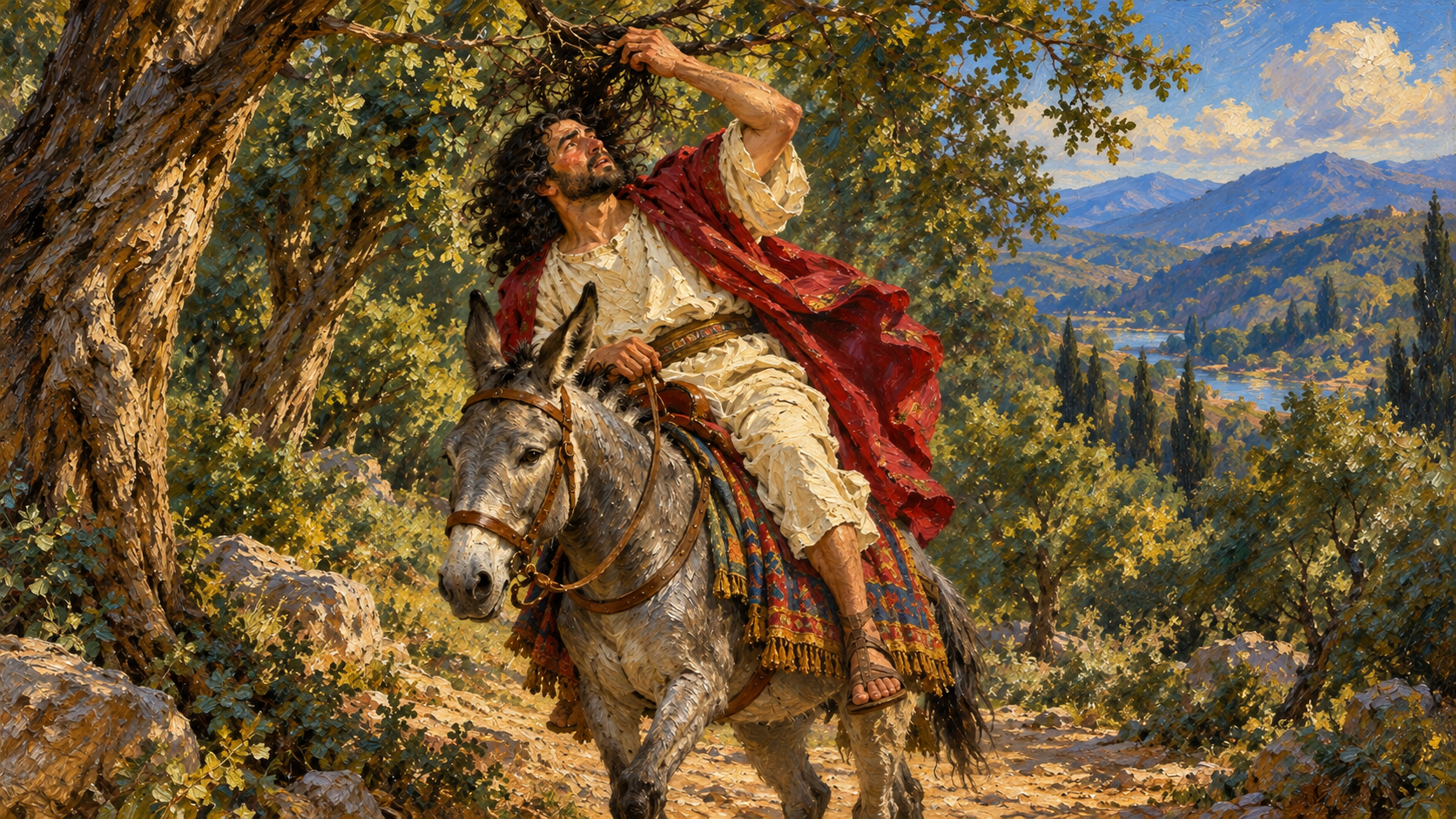
So the people went out into the field of battle against Israel. And the battle was in the woods of Ephraim. The people of Israel were overthrown there before the servants of David, and a great slaughter of twenty thousand took place there that day. For the battle there was scattered over the face of the whole countryside, and the woods devoured more people that day than the sword devoured. Then Absalom met the servants of David. Absalom rode on a mule. The mule went under the thick boughs of a great terebinth tree, and his head caught in the terebinth; so he was left hanging between heaven and earth. And the mule which was under him went on. Now a certain man saw it and told Joab, and said, "I just saw Absalom hanging in a terebinth tree!" So Joab said to the man who told him, "You just saw him! And why did you not strike him there to the ground? I would have given you ten shekels of silver and a belt." But the man said to Joab, "Though I were to receive a thousand shekels of silver in my hand, I would not raise my hand against the king's son. For in our hearing the king commanded you and Abishai and Ittai, saying, 'Beware lest anyone touch the young man Absalom!' Otherwise I would have dealt falsely against my own life. For there is nothing hidden from the king, and you yourself would have set yourself against me." Then Joab said, "I cannot linger with you." And he took three spears in his hand and thrust them through Absalom's heart, while he was still alive in the midst of the terebinth tree. And ten young men who bore Joab's armor surrounded Absalom, and struck and killed him. So Joab blew the trumpet, and the people returned from pursuing Israel. For Joab held back the people. And they took Absalom and cast him into a large pit in the woods, and laid a very large heap of stones over him. Then all Israel fled, everyone to his tent. Now Absalom in his lifetime had taken and set up a pillar for himself, which is in the King's Valley. For he said, "I have no son to keep my name in remembrance." He called the pillar after his own name. And to this day it is called Absalom's Monument.
The passage says Absalom’s head caught in the terebinth. His famous hair may account for the familiar description of it becoming entangled, but that detail is not explicitly stated here. We should teach what the text records: his mule went under the branches, his head caught, and the animal went on, leaving him suspended.
The soldier who found Absalom refused to kill him because he had heard David’s command. Joab disregarded the order and thrust three spears through Absalom while he was still alive. Ten armor-bearers then surrounded and killed him. Perhaps Joab considered the rebel leader too dangerous to spare, but that possible reasoning cannot give him authority to cancel the king’s express instruction.
Joab called off the pursuit, and Absalom’s body was thrown into a pit and covered with a great heap of stones. His surviving supporters fled. The man who had erected a monument to preserve his name was buried in the woods after a rebellion that cost thousands of lives.
When the messengers reached David, he asked about Absalom’s safety. Ahimaaz reported victory without giving him a clear answer about his son. The Cushite’s reply finally made the death known, and David went up to the chamber over the gate and wept.
So Ahimaaz called out and said to the king, "All is well!" Then he bowed down with his face to the earth before the king, and said, "Blessed be the LORD your God, who has delivered up the men who raised their hand against my lord the king!" The king said, "Is the young man Absalom safe?" Ahimaaz answered, "When Joab sent the king's servant and me your servant, I saw a great tumult, but I did not know what it was about." And the king said, "Turn aside and stand here." So he turned aside and stood still. Just then the Cushite came, and the Cushite said, "There is good news, my lord the king! For the LORD has avenged you this day of all those who rose against you." And the king said to the Cushite, "Is the young man Absalom safe?" So the Cushite answered, "May the enemies of my lord the king, and all who rise against you to do harm, be like that young man!" Then the king was deeply moved, and went up to the chamber over the gate, and wept. And as he went, he said thus: "O my son Absalom–my son, my son Absalom–if only I had died in your place! O Absalom my son, my son!"
David’s words, “If only I had died in your place,” expressed an anguished wish. He had not taken Absalom’s place, and his love could neither remove his son’s guilt nor bring him back to life. Even as king, he could not undo that death or all the failures that preceded it. I can recognize a father’s genuine love in this cry without excusing either man’s conduct.
David’s withdrawal also affected the men who had risked their lives to save him and his household. They returned to the city ashamed, without the public recognition and encouragement their service deserved. Joab confronted David, warning that continued withdrawal would leave him without loyal supporters.
And Joab was told, "Behold, the king is weeping and mourning for Absalom." So the victory that day was turned into mourning for all the people. For the people heard it said that day, "The king is grieved for his son." And the people stole back into the city that day, as people who are ashamed steal away when they flee in battle. But the king covered his face, and the king cried out with a loud voice, "O my son Absalom! O Absalom, my son, my son!" Then Joab came into the house to the king, and said, "Today you have disgraced all your servants who today have saved your life, the lives of your sons and daughters, the lives of your wives and the lives of your concubines, in that you love your enemies and hate your friends. For you have declared today that you regard neither princes nor servants; for today I perceive that if Absalom had lived and all of us had died today, then it would have pleased you well. Now therefore, arise, go out and speak comfort to your servants. For I swear by the LORD, if you do not go out, not one will stay with you this night. And that will be worse for you than all the evil that has befallen you from your youth until now." Then the king arose and sat in the gate. And they told all the people, saying, "There is the king, sitting in the gate." So all the people came before the king. For everyone of Israel had fled to his tent.
Joab went too far in describing David’s grief as hatred for his friends. Mourning his son was not itself wrong. Yet the king still owed recognition and encouragement to the men who had risked their lives for him and his household. David rose and sat in the gate, taking up his public duty while still carrying a father’s sorrow.
The failures in this account call us to pursue justice without turning it into revenge. Tamar should have been heard and protected, and Amnon should have faced impartial judgment. David’s failure did not authorize Absalom to arrange a killing. We can tell the truth, report wrongdoing to lawful authorities, and maintain boundaries that protect people without claiming the right to punish someone ourselves.
The reunion in Jerusalem warns us against treating a gesture as proof of reconciliation. A kiss and a bow could not repair the damage done by murder, silence, and coercion. Trust needs truthful dealing and changed conduct. Where that evidence is absent, we should not pressure an injured person to act as though fellowship has been restored or give up necessary protection.
Absalom’s conduct at the gate shows how a leader can exploit a real need. David had failed to administer justice within his family, and people still needed fair judgments. Absalom used that need to build his following. Making me feel understood does not establish that a leader is truthful or fit to lead. I need to examine whether he investigates fairly, submits to Scripture, and teaches sound doctrine, rather than let his agreement with my complaint settle the question of his integrity.
The monument Absalom raised also makes me consider the reputation I seek. Recognition cannot change what I have done or make an unrepentant life honorable. His pillar preserved his name, but he would be remembered for murder and rebellion. Although Scripture records no repentance before his death, it does not disclose his eternal state. I will not pronounce a verdict beyond what we are told. His sudden end is warning enough to confess sin and turn to the Lord while we can.
David wished he could die for his son. Jesus Christ, the sinless Son of David and eternal Son of God, actually gave Himself for sinners. He is fully God and fully man, born of a virgin. Wicked men tortured and crucified Him, but He voluntarily gave Himself to be slain as the perfect sacrifice for our sins. His saving work through His shed blood and death was complete before He was buried and rose bodily. The Father did not punish, curse, abandon, strike, bruise, or pour wrath on Jesus. Father, Son, and Holy Spirit remained united, with no broken fellowship within the Godhead.
Christ died for the whole world, and His offer of salvation is genuine even though people can resist His grace. God forgives and justifies everyone who repents and believes, declaring the believer righteous before Him. That person is born again and made new. The Holy Spirit, a divine Person, indwells and seals every true believer, whose salvation is eternally secure in Christ. This security gives no permission for lawlessness, and merely calling ourselves Christians does not prove new birth. Our conduct should show evidence of new life, but those actions never earn or keep salvation. A believer may sin and need correction; genuine new birth does not mean sinless perfection.
I can bring the wrong done against me honestly before the Lord while also confessing my own sin. Another person’s guilt does not make every response I choose righteous. Christ calls us to live truthfully under His authority, seeking justice through the means He gives and refusing to let hatred direct us. Where reconciliation cannot yet be honest, wise boundaries can remain.
My Final Thoughts
Amnon’s crime and David’s failure must be named plainly, but neither excused Absalom’s murder or revolt. His public warmth attracted people while he was preparing to usurp his father’s authority. I want to learn from the whole account: to listen when someone has been harmed, seek justice without vengeance, and judge a leader by truthful conduct rather than personal appeal. We can acknowledge what others have done without concealing our own need to repent before the righteous King who gave Himself to save us.