
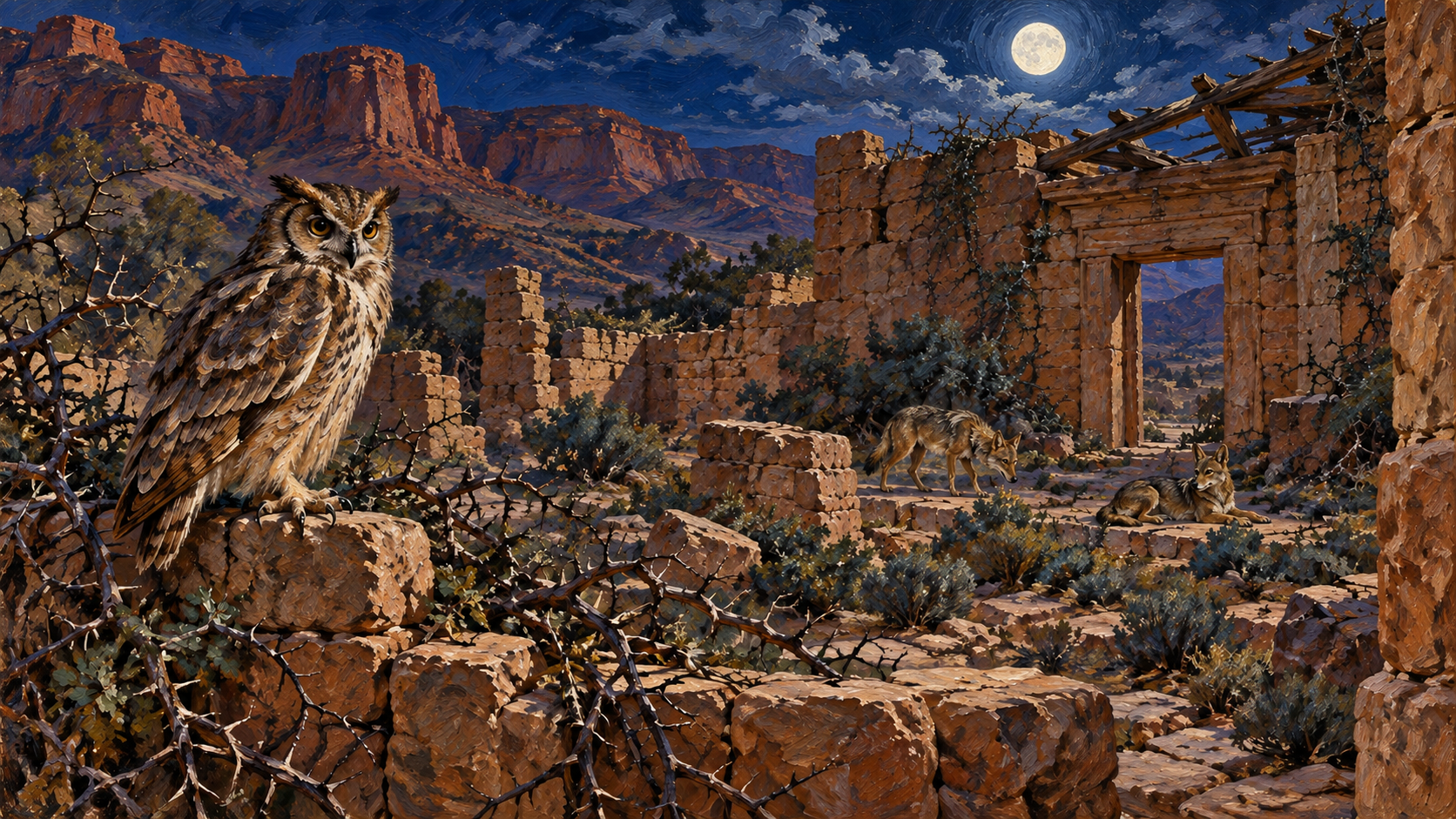
Isaiah 34:14 contains a rare Hebrew word often written as lilit. Some English Bibles print it as Lilith, a name now associated with a detailed legend about Adam’s supposed first wife. I do not believe Isaiah gives us that woman or her biography. To understand why, we need to read the word within his judgment against Edom and distinguish that prophecy from the traditions that developed later.
What Isaiah 34 Actually Says
The familiar legend describes a woman created before Eve who refused Adam’s authority, left him, and became associated with danger to children. None of those details appears in Isaiah 34. The NKJV renders lilit as “night creature” and places it among the beings that occupy Edom after judgment has left the land desolate.
I use the Masoretic Text, the traditional Hebrew text of the Old Testament, as the base for this language study. The question is what the word means where Isaiah uses it. A later writer’s use of a similar name may tell us about that writer’s beliefs, but it cannot add another person to Isaiah’s account or Genesis.
The chapter begins with a summons to all nations. Edom and its city Bozrah then receive particular attention. Edom descended from Esau, Jacob’s brother, and occupied the region south and southeast of Judah associated with Seir. Its hostility toward Israel was especially culpable because of that family relationship. Isaiah sets this particular enemy within a much wider announcement of the LORD’s judgment.
Come near, you nations, to hear; And heed, you people! Let the earth hear, and all that is in it, The world and all things that come forth from it. For the indignation of the LORD is against all nations, And His fury against all their armies; He has utterly destroyed them, He has given them over to the slaughter. Also their slain shall be thrown out; Their stench shall rise from their corpses, And the mountains shall be melted with their blood. All the host of heaven shall be dissolved, And the heavens shall be rolled up like a scroll; All their host shall fall down As the leaf falls from the vine, And as fruit falling from a fig tree. “For My sword shall be bathed in heaven; Indeed it shall come down on Edom, And on the people of My curse, for judgment. The sword of the LORD is filled with blood, It is made overflowing with fatness, With the blood of lambs and goats, With the fat of the kidneys of rams. For the LORD has a sacrifice in Bozrah, And a great slaughter in the land of Edom. The wild oxen shall come down with them, And the young bulls with the mighty bulls; Their land shall be soaked with blood, And their dust saturated with fatness.” For it is the day of the LORD’s vengeance, The year of recompense for the cause of Zion.
The prophecy concerns the LORD’s vengeance for the cause of Zion, not the ancestry of a night being. Its language includes battle, slaughter, and upheaval in the heavens. I would not reduce that judgment to a symbol of someone’s inner struggles, nor do I expect every prophetic image to function as a modern eyewitness report. God is announcing that He will act against the nations’ wickedness.
Edom gives the announcement a definite people and place. At the same time, the summons to all nations and the description of the heavens point beyond Edom alone toward the final Day of the LORD. I understand the judgment of this historical enemy within that larger prophetic fulfillment.
The remaining verses describe the land after its overthrow. No nobles remain to rule it, thorns fill the palaces, and creatures find places to rest and nest in the ruins. God describes measuring out the territory and assigning it to these new occupants. The places where people once exercised power have become wilderness dwellings.
Its streams shall be turned into pitch, And its dust into brimstone; Its land shall become burning pitch. It shall not be quenched night or day; Its smoke shall ascend forever. From generation to generation it shall lie waste; No one shall pass through it forever and ever. But the pelican and the porcupine shall possess it, Also the owl and the raven shall dwell in it. And He shall stretch out over it The line of confusion and the stones of emptiness. They shall call its nobles to the kingdom, But none shall be there, and all its princes shall be nothing. And thorns shall come up in its palaces, Nettles and brambles in its fortresses; It shall be a habitation of jackals, A courtyard for ostriches. The wild beasts of the desert shall also meet with the jackals, And the wild goat shall bleat to its companion; Also the night creature shall rest there, And find for herself a place of rest. There the arrow snake shall make her nest and lay eggs And hatch, and gather them under her shadow; There also shall the hawks be gathered, Every one with her mate. “Search from the book of the LORD, and read: Not one of these shall fail; Not one shall lack her mate. For My mouth has commanded it, and His Spirit has gathered them. He has cast the lot for them, And His hand has divided it among them with a measuring line. They shall possess it forever; From generation to generation they shall dwell in it.”
The night creature rests in this abandoned landscape alongside the other wilderness inhabitants. Isaiah gives it no speech, worshipers, or authority over human beings. He does not connect it with Adam, marriage, Eden, or infants. Whatever associations the word carried for an ancient hearer, its role in this passage is to help describe the desolation where human rulers once lived.
The words “find for herself” agree with the noun’s feminine grammatical form. Hebrew gives grammatical gender to animal names and other nouns as well. A feminine pronoun cannot by itself turn this noun into a woman’s proper name or tell us about her family and deeds.
Isaiah ends by directing his hearers to the book of the LORD. The creatures will occupy the land because His mouth has commanded it and His Spirit has gathered them. We can be certain of that judgment and its aftermath because God has spoken, even while admitting that we cannot precisely identify one of the creatures.
The Rare Hebrew Word and Translation Choices
A word occurring only once in the Hebrew Bible is called a hapax legomenon. Isaiah 34:14 is the only biblical occurrence of lilit, so we have no second passage in which to compare its use. The immediate context therefore deserves close attention. Related ancient words and translation history offer further help without removing every uncertainty.
The word has commonly been associated with night, which helps explain renderings such as “night creature.” That association does not settle its origin. The Brown–Driver–Briggs Hebrew lexicon describes a female night-demon and considers the word probably borrowed from Babylonian. It suggests that the similar sound may have led people to connect it with the Hebrew word for night, without establishing the word’s origin. Since the entry gives a supernatural reading, I would not claim a scholarly consensus that Isaiah meant an animal.
I still would not make the identification more definite than the passage allows. A nocturnal animal fits the ruined wilderness setting; an ominous being familiar from ancient imagery is another interpretation. Even if Isaiah’s audience associated the term with a feared night spirit, that would not establish the later figure’s biography. The question of the word’s ancient associations and the claim that Adam had a wife before Eve are separate questions.
The KJV renders the term “screech owl,” while the NKJV gives the broader “night creature.” Other versions use expressions such as “night monster” or “night bird,” and some print Lilith. Translation expresses what a word is understood to mean; transliteration carries its sound into another alphabet. Printing Lilith can therefore preserve the Hebrew sound without proving that the later legend is part of Isaiah.
A specific animal name gives the reader a concrete picture, but it may suggest more certainty about the species than we possess. The NKJV’s wording is helpful because it keeps the creature within the night and wilderness setting without making a modern species identification. I can use that rendering while admitting that an ancient audience may have heard more ominous associations than the English expression conveys.
The Septuagint, the ancient Greek translation of the Old Testament, also records an early interpretive choice. It can show us how translators understood a difficult Hebrew passage, but I do not give its rendering authority to replace or correct the Masoretic base. Neither an ancient translation nor a modern transliteration can supply the missing details of a person’s life.
Other prophets use wilderness inhabitants to portray the overthrow of human power. Jeremiah describes Babylon’s princes, military strength, treasure, and idolatry coming under judgment, followed by desert creatures occupying the land.
“A sword is against the Chaldeans,” says the LORD, “Against the inhabitants of Babylon, And against her princes and her wise men. A sword is against the soothsayers, and they will be fools. A sword is against her mighty men, and they will be dismayed. A sword is against their horses, Against their chariots, And against all the mixed peoples who are in her midst; And they will become like women. A sword is against her treasures, and they will be robbed. A drought is against her waters, and they will be dried up. For it is the land of carved images, And they are insane with their idols. “Therefore the wild desert beasts shall dwell there with the jackals, And the ostriches shall dwell in it. It shall be inhabited no more forever, Nor shall it be dwelt in from generation to generation. As God overthrew Sodom and Gomorrah And their neighbors,” says the LORD, “So no one shall reside there, Nor son of man dwell in it.
Zephaniah gives a comparable description of Nineveh. The city that boasted of its security becomes a place for animals to lodge and lie down. Its inhabitants can no longer preserve the grandeur they thought belonged to them permanently.
And He will stretch out His hand against the north, Destroy Assyria, And make Nineveh a desolation, As dry as the wilderness. The herds shall lie down in her midst, Every beast of the nation. Both the pelican and the bittern Shall lodge on the capitals of her pillars; Their voice shall sing in the windows; Desolation shall be at the threshold; For He will lay bare the cedar work. This is the rejoicing city That dwelt securely, That said in her heart, “I am it, and there is none besides me.” How has she become a desolation, A place for beasts to lie down! Everyone who passes by her Shall hiss and shake his fist.
These comparisons cannot identify every difficult creature name in Isaiah, but they show why the wilderness setting belongs in his prophecy. A proud, fortified society can come under God’s judgment and become a place where animals live undisturbed. We can understand that reversal without assigning every creature a modern classification.
Ancient Associations and Later Lilith Traditions
Ancient Mesopotamian literature contains terms compared with lilit and beliefs about dangerous female spirits. Those traditions predate the medieval first-wife legend. We should acknowledge them when discussing the word’s history, rather than claim that no one understood it supernaturally until a medieval writer invented that reading.
A prophet can also use imagery familiar to his hearers without endorsing every belief attached to it. If Isaiah’s audience imagined a dreaded wilderness being, the announced reversal would still be plain: a land formerly ruled by proud people would become a resting place for what they feared outside their settlements. That would not introduce a competing deity or require worship of the creature.
A nonbiblical Dead Sea Scroll composition known as the Songs of the Sage includes lilit in a list of hostile spirits. The term appears in 4Q510, fragment 1, line 5, alongside destructive spirits and demons. That passage documents a supernatural use of the term; it contains no account of a wife of Adam and cannot verify the later biography.
The Dead Sea Scrolls include copies of biblical books and other kinds of writing. The composition just mentioned belongs to the nonbiblical material. A belief recorded in a community’s literature does not gain the authority of Scripture or overrule Isaiah’s wording in the Masoretic Text. Rabbinic discussions, magical bowls, and protective amulets likewise show what people believed and practiced. They do not prove that the events described in those beliefs happened.
The recognizable account of Lilith as Adam’s first wife appears in the anonymous medieval Alphabet of Ben Sira, generally placed around the eighth through tenth centuries after Christ. This puts the work well over a millennium after Isaiah. It must not be confused with the much earlier wisdom book Sirach, also called the Wisdom of Ben Sira.
The medieval tale itself describes Lilith disputing with Adam and leaving him, then associates her with harm to infants and protective amulets. Later writers within Kabbalah, a tradition of Jewish mysticism, reshaped the figure. These writings help us trace the development of the tradition, but they do not belong to Genesis’ account of creation.
Modern literature, entertainment, political movements, and occult systems have adapted her again. She may be presented as a rebel, a victim, a goddess, or a demon. Describing that cultural use does not require accepting the account as history. It also does not justify assuming that every artistic reference is an act of worship. We need to determine what a person actually believes and does.
Genesis Does Not Give Adam Another Wife
The first-wife claim is sometimes attached to the different presentations of humanity’s creation in Genesis 1 and 2. Genesis 1 describes God creating humanity as male and female in His image. Genesis 2 gives the fuller account of the man’s formation, his life in the garden, and the woman God formed and brought to him.
Then God said, “Let Us make man in Our image, according to Our likeness; let them have dominion over the fish of the sea, over the birds of the air, and over the cattle, over all the earth and over every creeping thing that creeps on the earth.” So God created man in His own image; in the image of God He created him; male and female He created them. Then God blessed them, and God said to them, “Be fruitful and multiply; fill the earth and subdue it; have dominion over the fish of the sea, over the birds of the air, and over every living thing that moves on the earth.” And God said, “See, I have given you every herb that yields seed which is on the face of all the earth, and every tree whose fruit yields seed; to you it shall be for food. Also, to every beast of the earth, to every bird of the air, and to everything that creeps on the earth, in which there is life, I have given every green herb for food”; and it was so. Then God saw everything that He had made, and indeed it was very good. So the evening and the morning were the sixth day.
The fuller account in Genesis 2 describes Adam still lacking a helper comparable to him before God forms the woman.
And the LORD God said, “It is not good that man should be alone; I will make him a helper comparable to him.” Out of the ground the LORD God formed every beast of the field and every bird of the air, and brought them to Adam to see what he would call them. And whatever Adam called each living creature, that was its name. So Adam gave names to all cattle, to the birds of the air, and to every beast of the field. But for Adam there was not found a helper comparable to him. And the LORD God caused a deep sleep to fall on Adam, and he slept; and He took one of his ribs, and closed up the flesh in its place. Then the rib which the LORD God had taken from man He made into a woman, and He brought her to the man. And Adam said: “This is now bone of my bones And flesh of my flesh; She shall be called Woman, Because she was taken out of Man.” Therefore a man shall leave his father and mother and be joined to his wife, and they shall become one flesh. And they were both naked, the man and his wife, and were not ashamed.
I read these chapters as complementary descriptions of the same creation. Genesis 1 names no first woman who disappears and has to be replaced in chapter 2. The fuller account explains how God provided Adam with a helper comparable to him. Adam recognized her as bone of his bones and flesh of his flesh, and Genesis explains marriage from their one-flesh union.
After the fall, Adam named his wife Eve because she was the mother of all living. Genesis follows the couple out of the garden and goes on to record their children’s births. It gives no account of an earlier wife, her departure, or children Adam had with another woman before Eve.
And Adam called his wife’s name Eve, because she was the mother of all living. Also for Adam and his wife the LORD God made tunics of skin, and clothed them. Then the LORD God said, “Behold, the man has become like one of Us, to know good and evil. And now, lest he put out his hand and take also of the tree of life, and eat, and live forever”– therefore the LORD God sent him out of the garden of Eden to till the ground from which he was taken. So He drove out the man; and He placed cherubim at the east of the garden of Eden, and a flaming sword which turned every way, to guard the way to the tree of life.
The New Testament also names Adam and Eve in the order of their formation in 1 Timothy 2:13. Genesis already identifies the woman God brought to Adam and the marriage He established, so a later legend cannot supply a missing spouse. An alternative account may interest a reader as literature without becoming a suppressed part of Scripture.
Spiritual Warfare and Careful Discernment
Rejecting a false biography does not require denying the existence of spiritual evil. Scripture teaches that Satan and demons are real. It also distinguishes the false gods people imagine from the evil spirits involved in idolatrous worship. Paul warns the Corinthians about participation in pagan sacrifices.
What am I saying then? That an idol is anything, or what is offered to idols is anything? Rather, that the things which the Gentiles sacrifice they sacrifice to demons and not to God, and I do not want you to have fellowship with demons. You cannot drink the cup of the Lord and the cup of demons; you cannot partake of the Lord’s table and of the table of demons. Or do we provoke the Lord to jealousy? Are we stronger than He?
Paul denies that an idol is a real god while warning that participation in pagan sacrifices can involve fellowship with demons. Recognizing the Lilith legend as folklore therefore gives a Christian no reason to experiment with invocation, spells, amulets, or attempts to contact a supposed spirit. A false explanation of a ritual does not make taking part in it harmless.
We are given a different way to resist evil. Paul directs believers to the Lord’s strength, the truth of His Word, faith, righteousness, salvation, and persevering prayer.
Finally, my brethren, be strong in the Lord and in the power of His might. Put on the whole armor of God, that you may be able to stand against the wiles of the devil. For we do not wrestle against flesh and blood, but against principalities, against powers, against the rulers of the darkness of this age, against spiritual hosts of wickedness in the heavenly places. Therefore take up the whole armor of God, that you may be able to withstand in the evil day, and having done all, to stand. Stand therefore, having girded your waist with truth, having put on the breastplate of righteousness, and having shod your feet with the preparation of the gospel of peace; above all, taking the shield of faith with which you will be able to quench all the fiery darts of the wicked one. And take the helmet of salvation, and the sword of the Spirit, which is the word of God; praying always with all prayer and supplication in the Spirit, being watchful to this end with all perseverance and supplication for all the saints–
Paul’s description of the armor directs us to what God supplies. His truth counters deception, and the righteousness He provides shapes the life He calls us to live. The gospel of peace prepares us to stand, while faith resists the wicked one’s attacks. Salvation guards our thinking, and Scripture is the Spirit’s sword. As we use what God has given, we also remain watchful in prayer for all the saints. We do not need secret demon names or an invented account of a spirit’s ancestry to follow that instruction.
Discernment should govern our judgments about people as well as our reading. Someone may encounter the name Lilith while studying literature, translating Isaiah, examining ancient religion, or discussing art. That mention does not establish invocation or worship. If someone actually seeks spiritual contact or gives religious devotion to the figure, we should address that conduct directly. Suspicion is not evidence, and vague accusations make it harder to explain the actual error.
The same care applies to sources. Isaiah is inspired Scripture; the nonbiblical Qumran composition, the Talmud, Kabbalistic writings, and the Alphabet of Ben Sira do not share that authority. They can be studied for historical and cultural information. A novel, song, or social media claim may also tell us how people are using the figure now. None can make Genesis say that Adam had a wife it never gives him.
Paul warned Timothy about false teaching and speculation in Ephesus long before the medieval Lilith legend was written. His instruction applies when fascination with such claims begins to displace the teaching Scripture actually gives. We need to consider what our attention to those materials is producing.
As I urged you when I went into Macedonia–remain in Ephesus that you may charge some that they teach no other doctrine, nor give heed to fables and endless genealogies, which cause disputes rather than godly edification which is in faith. Now the purpose of the commandment is love from a pure heart, from a good conscience, and from sincere faith, from which some, having strayed, have turned aside to idle talk, desiring to be teachers of the law, understanding neither what they say nor the things which they affirm.
I need to ask whether my study is leading toward love from a pure heart, a good conscience, and sincere faith, or merely feeding disputes about claims the text does not establish. Learning about an ancient belief can be useful. Repeating it as biblical fact, or making it the center of spiritual life, is a different use of the material.
Isaiah 34 directs us to God’s certain judgment of wickedness. Genesis directs us to the Creator, the dignity He gave humanity, and the marriage He established. It then records the fall and God’s judgment, along with the first promise that leads toward Christ. Those teachings deserve more attention than an attempt to reconstruct the life of Isaiah’s night creature.
Jesus Christ gives us the salvation Paul names among God’s armor. He is the eternal Son, fully God and fully man. Born of a virgin, He lived without sin and is our only Savior. In giving Himself to be slain as the perfect sacrifice for our sins, He willingly endured the torture and crucifixion inflicted by wicked men. His shed blood and death completed that sacrifice before His burial and bodily resurrection. The Father did not punish, curse, abandon, strike, bruise, or pour wrath on Jesus. Father, Son, and Holy Spirit remained united in His saving work.
Because Christ died for the sins of the whole world, God’s offer of salvation is genuine for every person, although people can resist His grace and reject Him. Whoever repents and trusts the risen Christ is forgiven and born again as a new creation. The Holy Spirit lives in that believer and seals him in eternal security. This gives no permission for lawlessness. Changed conduct should show the new life He has given, although obedience neither earns nor keeps salvation and does not make us sinlessly perfect. A shallow profession cannot substitute for the new birth. We can live in truth and rely on Christ without seeking protection through charms or supposed secret knowledge.
My Final Thoughts
I do not believe Scripture gives Adam a wife before Eve or supplies the later Lilith biography in Isaiah 34:14. The rare Hebrew word belongs to a prophecy of Edom’s desolation, and its exact identification remains uncertain. We can acknowledge ancient supernatural associations without treating a medieval legend as revelation. I want our confidence to rest in the written Word and Jesus Christ, with enough care to reject false teaching accurately and enough firmness to refuse actual occult practice.