
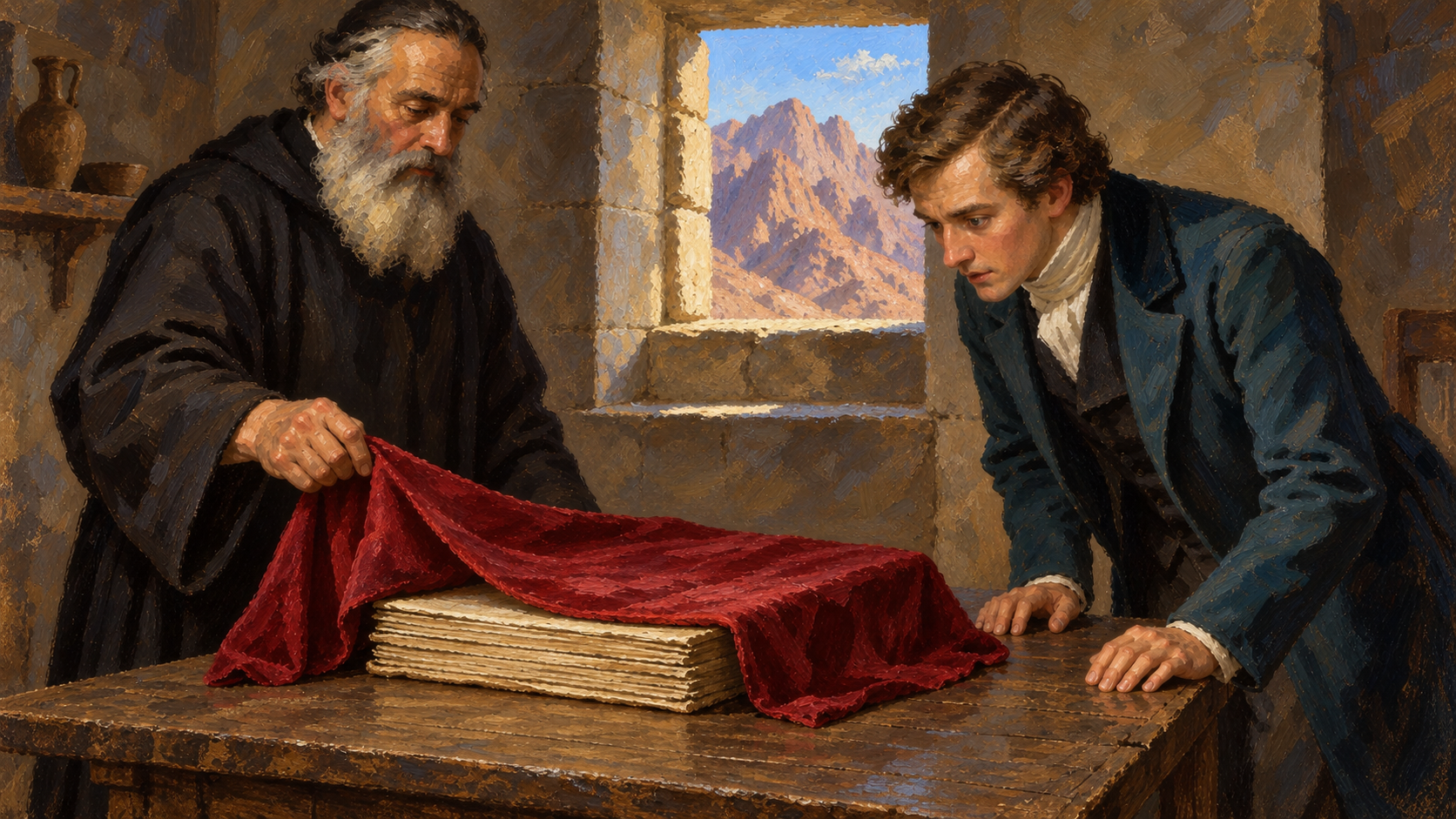
Codex Sinaiticus is often discussed as though its age alone settles every New Testament textual question. An ancient manuscript deserves our attention, but I want to know more than how old it is before accepting its readings. We need to understand what it contains and how it compares with the other manuscripts, then consider what authority God has given it.
What Codex Sinaiticus Is and What It Contains
Codex Sinaiticus is a large Greek manuscript written on parchment. It contains the earliest surviving complete copy of the New Testament along with much of the Greek Old Testament. Several other early Christian writings also appear within the codex. Scholars usually designate the manuscript with the Hebrew letter aleph or the catalog number 01.
Sinaiticus preserves a great deal of ancient material, which makes it especially valuable for study. Its many corrections let us see how scribes and later readers worked with the text. The unusual circumstances of its modern discovery and dispersal also help explain the interest in it. Still, we need to distinguish a copy from an autograph, the original manuscript written by a biblical author or under his direction. Sinaiticus is an imperfect handwritten copy. I cannot treat it as the standard by which every other manuscript must be judged when it belongs to a much larger history of copying and transmission.
The debate can go wrong in either direction. Calling Sinaiticus an obvious nineteenth-century forgery avoids examining the evidence for its antiquity. Treating that antiquity as sufficient reason to displace readings received through the Byzantine tradition avoids a different part of the evidence. Neither approach gives the manuscript the careful examination it needs.
I accept the manuscript’s genuine antiquity, but I do not accept Alexandrian critical-text assumptions as the controlling method. For New Testament language work, I use the Textus Receptus and the received Byzantine tradition. Sinaiticus deserves study, but it cannot overrule that base.
God inspired Scripture, but the surviving manuscripts are handwritten copies of that text rather than the original pages. A scribe might accidentally miss a line or repeat a word while copying. Spelling could change too, and a familiar phrase might be made to agree with the wording of another passage. Some copyists added explanations, while others corrected work already on the page. Comparing the manuscripts helps researchers recognize what happened during copying.
The disagreement is not over whether to examine the manuscripts, but over how much weight to give their evidence. Modern critical editors often favor a smaller group of early manuscripts associated with the Alexandrian form of the text and choose among competing readings passage by passage. The received-text position gives greater weight to the form copied and used throughout the Greek-speaking Byzantine church. That tradition later stood behind the related printed Greek editions known as the Textus Receptus.
I want to give every word of Scripture careful attention without making Christian doctrine depend on the reputation of Sinaiticus. The Bible repeatedly reveals the Trinity and teaches that Christ is fully God and fully man. His bodily resurrection and the saving importance of His shed blood appear throughout the New Testament, as does salvation by grace through faith. Scripture’s divine authority does not rest on the reading of one manuscript.
Sinaiticus was an enormous codex, a book made from folded and bound leaves rather than a scroll. Its leaves were parchment prepared from animal skin. The makers gathered folded sheets into sections called quires and bound those sections together. Most pages have four narrow columns of Greek majuscule writing, an ancient style of capital letters. At least three primary scribes shared the considerable task of copying the text.
The surviving New Testament is complete, but the surviving Old Testament is not. Many early quires and portions within the Old Testament were lost, so calling Sinaiticus the oldest complete Bible is inaccurate.
The surviving leaves are now held in four principal locations. The British Library has the largest portion, and Leipzig University Library holds other leaves. Additional material remains at the National Library of Russia and Saint Catherine’s Monastery. Through a digital reunification project, readers can examine high-resolution images and transcriptions of these surviving leaves together, even though the manuscript is physically divided.
Its order and contents differ from a modern Protestant Bible. The Greek Old Testament includes books outside the Hebrew canon, and Barnabas and part of the Shepherd of Hermas follow the New Testament books.
Its Discovery, Date, and Physical History
Researchers generally date Sinaiticus to the fourth century, often near its middle. They rely primarily on paleography, the comparison of handwriting with other material whose date is known or can be established. Individual letter forms and the scribes’ abbreviations help with that comparison. Page layout and recurring scribal habits supply further evidence. By comparing these features with related manuscripts, researchers judge which period best fits the codex.
That gives us a reasoned range, not a date written down by the original scribes. I would not confuse uncertainty about the exact decade or place of production with uncertainty about whether a manuscript is ancient at all.
No comprehensive radiocarbon test has established the codex’s age. We should acknowledge that without assuming the fourth-century date is guesswork or that the absence of a test proves forgery. Researchers also have the book’s physical construction and handwriting to examine. The work of distinct scribes and the layers of correction spanning centuries provide further evidence that needs to be considered together.
How can researchers tell that at least three primary scribes worked on the manuscript? Each hand has characteristic spelling habits and letter forms. The books assigned to each scribe show how the work was divided, and their corrections give us more evidence. Some revision took place while the codex was still being produced, when scribes or supervisors checked what had been copied.
Corrections continued after the codex was finished. Later readers sometimes changed the spelling or supplied words an earlier scribe had missed. In other places they deleted text and substituted a different reading. Some faded letters were retraced, and notes were added to the page. Researchers place certain correcting hands in the centuries soon after production and others in the medieval period.
Before treating a large correction count as alarming, I want to know what was corrected. Many changes concern spelling or minor copying errors. Some affect individual words or extend to a sentence or a longer passage. These layers show that people actively used and checked Sinaiticus. They also give us a reason not to treat the original scribes’ wording as an untouched, perfect standard.
Tischendorf was not the first modern visitor to report seeing the manuscript. The official collaborative history records that the Italian visitor Vitaliano Donati saw a biblical manuscript at Saint Catherine’s in 1761 that is identified with Sinaiticus.
That earlier report creates a problem for the claim that Sinaiticus was manufactured in 1839. If the manuscript was seen at the monastery decades before that date, it could not have originated in the later project.
We know less about the manuscript’s custody before the eighteenth century. Ancient monastic books commonly lack a complete record of where they were kept, so a gap in that record is not enough to establish forgery.
When Tischendorf visited in 1844, the monks brought 129 Old Testament leaves to his attention. He obtained 43 of them and later published them in Leipzig under the title Codex Friderico-Augustanus, named in honor of his royal patron.
Tischendorf later said the leaves had been in a basket destined for burning. That is a dramatic account, but the surviving official reconstruction points out that it comes from Tischendorf himself. No independent contemporary record of the episode has been identified.
I would keep that distinction in mind when discussing what happened. We know the leaves were at Saint Catherine’s when Tischendorf visited and that he received and later published 43 of them. Whether they were about to be burned cannot settle an argument about the manuscript’s authenticity or ownership.
Tischendorf returned with the patronage of Tsar Alexander II. He examined the 347 leaves made available to him in Cairo and asked permission to take them to Saint Petersburg to compare the manuscript with his transcription. Having access to the leaves would also help him prepare the codex for publication.
In the receipt he signed, he described the transfer as a loan and promised to return the manuscript when requested. Diplomatic correspondence discussed the hope of a donation, but it also acknowledged that the monastery retained ownership until such a donation took place.
The 1859 receipt explicitly described a loan, so I cannot call the transfer an uncomplicated gift. Yet an account of secret theft would also fail to explain the written receipt and the negotiations that followed. Tischendorf’s public edition and the later formal acts also belong in any account of what happened.
The signed donation to the Tsar came ten years after the loan. During the intervening years, Saint Catherine’s faced a dispute over who would be recognized as its archbishop. Russian diplomats connected their help in that dispute with a resolution of the manuscript’s status.
The donation documents are genuine, but I do not think that settles every question about the transfer. The ten-year delay and political pressure complicate the circumstances. Disputes over authority within the monastery also raise questions about how freely it could act. The ownership controversy continued when the Soviet government sold the codex to the British Museum in 1933.
We should investigate how the codex changed hands without asking those ownership disputes to answer a different question. They do not tell us when the parchment was copied or whether a particular reading preserves the apostles’ wording. Those questions require us to examine the manuscript’s text and history of copying.
In 1862, Constantine Simonides claimed that he had produced the codex at Mount Athos in 1839 as a youthful project. His skill as a manuscript forger is one reason people continue to take an interest in that allegation.
Simonides could imitate manuscripts skillfully, but that does not establish the truth of this particular claim. The reported 1761 sighting came before the work he said he had done, and independent witnesses also saw the manuscript at Sinai during the 1840s. Several scribes worked on the codex, whose ancient layers of correction fit a long history of use. Its quire construction and physical wear point in the same direction, along with fragments discovered later.
I do not believe the evidence supports Simonides’ account. The earlier sighting and the manuscript’s physical history point against it. Rejecting Alexandrian textual priority does not require me to call Sinaiticus a forgery.
When Porfirij Uspenskij examined the codex in 1845, he described fine white parchment. Modern observers have noted differences in color between the leaves in Leipzig and those kept elsewhere. Some take the later yellowing as proof that the manuscript was artificially aged.
Parchment does not always age to the same color. The animal skin and its preparation affect its appearance, as can later surface treatments. Storage exposes leaves to different amounts of light and humidity, while handling adds wear and dirt. Conservation decisions and modern photography can also change how the color appears to us. The leaves separated in 1844 spent more than a century in different environments.
Comparing the color of the leaves can raise questions for conservation scientists to investigate. That visual comparison cannot by itself tell us when a leaf was made or prove chemical tampering. I would need direct material evidence before accepting a claim of deliberate aging.
Sinaiticus has not undergone comprehensive radiocarbon dating. Such testing would require removing material from a major artifact, which raises ethical and conservation concerns. Even a successful result would date the animal skin; it would not directly tell us when every line of ink was applied.
The absence of that test does not mean researchers have left the codex unexamined. Conservators across the four institutions documented every surviving leaf. They studied the parchment and inks under magnification while examining the book’s construction and accumulated damage. Specialized lighting and high-resolution images revealed details not apparent in ordinary viewing, and the project explored the usefulness of multispectral methods as well.
The ink observations and studies of light reflected from the page are consistent with ancient materials. Project reports also identify conclusions that remain preliminary, and we should preserve those qualifications when discussing the findings. “Not carbon dated” does not mean “not scientifically examined.”
Sinaiticus, Vaticanus, and the Received Text
In the New Testament, Sinaiticus often agrees with readings associated with the Alexandrian tradition and differs from the Byzantine manuscript stream that later became dominant. These names describe recognizable patterns of readings. They do not mean that God inspired separate regional editions. The codex’s shorter readings at several well-known passages have strongly influenced modern textual discussion.
Sinaiticus does not agree consistently with any modern critical edition, and even its own scribes and correctors sometimes differ. When we examine it, we are dealing with one complex witness to the text rather than a ready-made modern Bible.
Its early date gives us a reason to take its readings seriously, but age cannot establish originality by itself. An early copy can contain a mistake. A later copy may faithfully preserve wording handed down from an older manuscript.
Codex Vaticanus is another fourth-century Greek Bible often discussed alongside Sinaiticus. They agree against the Byzantine tradition in many places. Those agreements have led scholars to regard them as strong evidence for an early Alexandrian form of the text.
Yet the two codices also disagree with each other thousands of times when every difference is counted. Totals vary depending on how differences are counted. Spelling and word order may be counted separately, as may corrections and repeated differences. Many variations are minor, though some affect meaningful wording. Sharing an early date and a general textual character does not make the two manuscripts a single flawless witness.
I do not accept that agreement between these two manuscripts should routinely displace the received Byzantine text. I want to compare them accurately and learn from their history, but neither agreement nor antiquity gives them automatic supremacy.
The Textus Receptus is not just one printed edition. It is a family of closely related Greek New Testament editions produced from the sixteenth century onward. They stand substantially within the Byzantine tradition that had been copied and used throughout the Greek-speaking church.
The KJV and NKJV use this received Greek base, though their English style and translation decisions differ. I quote the NKJV publicly and check New Testament language work against the Textus Receptus or received Byzantine tradition.
I am not claiming that a printed page fell from heaven or that every TR edition is identical down to the letter. My conviction is that God preserved His Word through the textual tradition received by the church. That is why I do not make a reconstructed Alexandrian text the standard by which the received text must be judged.
The Majority Text identifies readings supported by most available Greek manuscripts, usually within the Byzantine tradition. Since the Textus Receptus belongs to that same broad tradition, it agrees with the majority in most places. That does not make the two identical.
At some points, the printed TR editors followed a minority reading. Latin influence also appears in the history of the Textus Receptus, and editorial reconstruction was sometimes necessary. As a result, a received reading may be preserved in only a few known Greek witnesses. We cannot use “received” and “majority” as though they always mean the same thing.
We can see this in 1 John 5:7-8. The heavenly witnesses are in the Textus Receptus, but they do not have overwhelming support among the surviving Greek manuscripts. If I use received and majority interchangeably here, I misrepresent the evidence. The received-text position needs an honest defense of the passage, not an inaccurate manuscript count.
Important Variant Passages
The original hand of Sinaiticus ends Mark at 16:8, as does Vaticanus. Vaticanus also has unusual blank space after Mark that is often discussed. Most Greek manuscripts preserve verses 9-20, and the passage was known and used early in church history.
Now when He rose early on the first day of the week, He appeared first to Mary Magdalene, out of whom He had cast seven demons. She went and told those who had been with Him, as they mourned and wept. And when they heard that He was alive and had been seen by her, they did not believe.
I receive the full ending of Mark as canonical. It records the risen Christ’s appearances and His commission to His followers, then describes His ascension and the apostles’ subsequent witness. When we read about the accompanying signs, we need to consider Acts and the rest of Scripture too. Isolating those statements to justify reckless practices would ignore that context.
The resurrection and commission are also taught throughout the other Gospels and the New Testament, so removing this passage would not erase those truths from the Bible. I still regard the textual question as serious. Inspiration concerns every received word, and teaching found elsewhere does not make this passage disposable.
Sinaiticus and several other early witnesses do not include the account of the woman caught in adultery. In some manuscripts it appears in different locations. The received Byzantine tradition preserves it in John.
When Jesus had raised Himself up and saw no one but the woman, He said to her, "Woman, where are those accusers of yours? Has no one condemned you?" She said, "No one, Lord." And Jesus said to her, "Neither do I condemn you; go and sin no more."
Jesus did not excuse the woman’s adultery. He exposed a malicious and legally corrupt accusation, and after her accusers left, He commanded her to leave her sin.
I receive this account as canonical while acknowledging the difficulties in its transmission history. Its absence from Alexandrian witnesses does not, in my judgment, authorize removing it from the received Gospel of John.
Sinaiticus omits Matthew 18:11 and Acts 8:37, and it lacks the longer doxology in Matthew 6:13. Its forms of Luke 4:4 and Colossians 1:14 are shorter than those in the Textus Receptus. Each passage has its own manuscript evidence, so I would examine them individually rather than bundle these differences into a slogan.
Now as they went down the road, they came to some water. And the eunuch said, "See, here is water. What hinders me from being baptized?" Then Philip said, "If you believe with all your heart, you may." And he answered and said, "I believe that Jesus Christ is the Son of God." So he commanded the chariot to stand still. And both Philip and the eunuch went down into the water, and he baptized him.
Acts 8:37 makes the relationship between faith and baptism explicit. Its absence from a critical-text Bible does not mean that Bible teaches baptismal regeneration, or salvation through baptism. The surrounding account and the wider New Testament still place faith before Christian baptism.
in whom we have redemption through His blood, the forgiveness of sins.
The received wording in Colossians 1:14 explicitly names Christ’s blood. Critical editions retain the teaching about His blood elsewhere throughout the New Testament, so the shorter reading here does not eliminate blood atonement from Scripture. Even so, I preserve the received phrase because our salvation is in the real blood Jesus shed. Wicked men physically tortured and punished Him before putting Him to death.
For there are three that bear witness in heaven: the Father, the Word, and the Holy Spirit; and these three are one. And there are three that bear witness on earth: the Spirit, the water, and the blood; and these three agree as one.
The Textus Receptus and NKJV include the words about the Father and the Word together with the Holy Spirit. Sinaiticus and most surviving Greek manuscripts lack those words, as do modern critical editions. The known Greek support is limited and relatively late. Latin transmission played a major role in the passage’s history.
I receive this reading within the Textus Receptus because of my settled conviction about the base text. That does not give me a reason to hide the manuscript evidence or claim overwhelming Greek-majority support that the passage does not have.
The Trinity does not depend on this one verse, because Scripture repeatedly reveals one God in three co-equal, co-eternal Persons. The received wording is an especially direct witness to that truth. Removing it cannot remove the doctrine from the Bible.
The Codex Does Not Define the Canon
Sinaiticus includes the Epistle of Barnabas and part of the Shepherd of Hermas after Revelation. Its Greek Old Testament also contains writings outside the Hebrew Masoretic canon and the Protestant Old Testament.
Finding a work bound into this codex tells us that it was copied and valued. It does not tell us that those who produced the book gave every work the same canonical status. An ancient volume could hold Scripture alongside other material intended to be read in church or considered useful for instruction.
The contents are another reason I cannot let one ancient codex define the canon. I receive the Hebrew Masoretic Text as the Old Testament base and hold to the 66-book canon. Neither the Septuagint collection nor Sinaiticus has authority to enlarge or overrule it.
After its publication, Sinaiticus had enormous influence because it supplied such an early and extensive witness. Modern critical work uses more than this codex, however. Vaticanus and early papyrus manuscripts also receive substantial attention. Editors compare manuscripts written in ancient capital-letter styles with those written in later lowercase styles, and they examine early translations. They can also consult quotations preserved by early Christian writers.
The Nestle-Aland and United Bible Societies editions use an eclectic method. Their editors do not follow one manuscript or family at every verse. At each difference, they decide which reading they judge to be earliest. They consider the witnesses’ character and relationships alongside known copying habits and the immediate context. They also ask which reading best explains how the others arose. This is why those editions sometimes follow Sinaiticus and sometimes reject it.
My disagreement is with the method’s tendency to favor Alexandrian readings and editorial reconstruction over the received Byzantine tradition. I want to address that method accurately. Saying that a modern translation was simply copied from one manuscript would misrepresent how its text was chosen.
We also need to distinguish the Greek edition from the English translation made from it. A translator may start with a critical Greek edition and then choose among the options its editors note. A disputed passage may be bracketed or moved into a footnote. We need to read the stated textual basis and examine how the translation handles each passage.
Textual Variants and God’s Preserved Word
Some defenses of the received text go too far by saying that critical readings remove the resurrection or the Trinity from Scripture. The same accusation is made about blood atonement and Christ’s saving mission. Others claim that believer’s baptism or biblical authority disappears. These claims overstate what an individual textual variant can do.
The resurrection is taught in all four Gospels and remains central to Acts and the Epistles. We learn the Trinity from the witness of the whole canon. The Gospels and Acts show the saving importance of Christ’s blood, and the New Testament letters teach it again. Romans, Ephesians, Hebrews, Peter, John, and Revelation all bear that witness. Many passages besides Acts 8:37 teach salvation through faith, and Scripture’s authority does not depend on the longer form of Luke 4:4.
Rather than use the gospel as a debating slogan, I want to state it plainly. Jesus is the eternal Son, fully God and fully man. He was born of a virgin and was completely sinless. Wicked men physically tortured and punished Him before killing Him. He willingly bore that real punishment for our sins in His innocent body and shed His blood. He died and was buried, then rose bodily. The Father did not punish or curse Jesus. He did not abandon Him, strike or bruise Him, or pour wrath on Him.
Christ died for the whole world, and God’s genuine offer can be resisted or rejected. Everyone is called to repent and believe in Jesus. A person who truly believes is forgiven and justified, born again and made new. The Holy Spirit indwells and seals that believer, who is eternally secure. This security never gives permission for lawlessness, and a superficial profession does not prove that someone has been born again. These truths remain clear across the manuscript traditions we are discussing. Recognizing that does not make an inspired disputed passage expendable.
I am not suggesting that variants are unimportant. If God inspired a sentence, the church should preserve and teach it even when its doctrine appears elsewhere. We should defend received readings out of faithfulness to the text, without suggesting that Christianity disappears from every other Bible.
Readers of critical-text translations can hear the gospel and be saved. I still prefer and publicly use the NKJV because its New Testament stands on the Textus Receptus and preserves the received passages in the text.
Inspiration belongs to the God-breathed words themselves. When we speak of preservation, we mean God’s faithfulness in keeping those words available as manuscripts were copied and used. Translation carried that Word into other languages, while correction and comparison brought errors in individual copies to light. The church received and transmitted the text through human labor, but that work never took place outside God’s providence.
The grass withers, the flower fades, But the word of our God stands forever.
Heaven and earth will pass away, but My words will by no means pass away.
Psalm 12 celebrates the purity of the LORD’s words and His keeping power among flattering and violent speakers. Isaiah says God’s word stands forever, and Jesus says His words will never pass away. I can trust those promises without claiming that every surviving copyist worked without error.
The abundance of manuscripts lets us see variations instead of concealing them. In Sinaiticus, we can still examine the original scribes’ work alongside corrections made during production and later revisions. Seeing these imperfections helps explain why the church compares witnesses. No one codex can be identified with the inspired autograph.
The received-text position recognizes God’s preservation in the wording widely copied and used through the Byzantine tradition and received by the church. That conviction does not require every surviving manuscript to be identical. Sinaiticus remains useful evidence within this history, even where we reject its readings.
When I compare translations, I begin by identifying the underlying text. The NKJV presents the Textus Receptus in its New Testament and supplies useful notes about Majority and critical-text differences. The KJV shares that base in older English, while translations such as the ESV and NIV generally follow modern critical editions.
From there, we can compare a disputed passage in its own context. Read the translation’s preface to understand its stated textual basis, then examine the relevant footnotes. Look at what happened to the wording: was it omitted from the main text or placed in brackets? Was it moved entirely to a note, or is the difference one of translation? Once that is clear, examine the Greek witnesses and the method behind the editor’s decision.
I want readers to understand why I use the NKJV and receive the traditional passages. That calls for a calm explanation of the evidence. It does not call for treating every modern translation as a deliberate corruption or saying no one can be saved through one. Nor should we dismiss the variants as irrelevant.
Our faith rests in the God who spoke and in Jesus Christ as Scripture reveals Him. We do not need to imagine that a museum holds one flawless copy of the Bible in order to trust God’s Word. Careful textual study should deepen our confidence in His preservation and make us humbler and more attentive to what He has said.
My Final Thoughts
Codex Sinaiticus is an ancient manuscript that deserves careful study, and I do not think we gain anything by dismissing its genuine value. Even so, it remains one handwritten witness rather than the authority of Scripture itself or the final judge of every disputed reading. We can face the variants honestly while trusting that God preserved His Word through the manuscript tradition. I keep the received text at the center because my confidence rests in God’s Word, not in the prestige of one codex.