
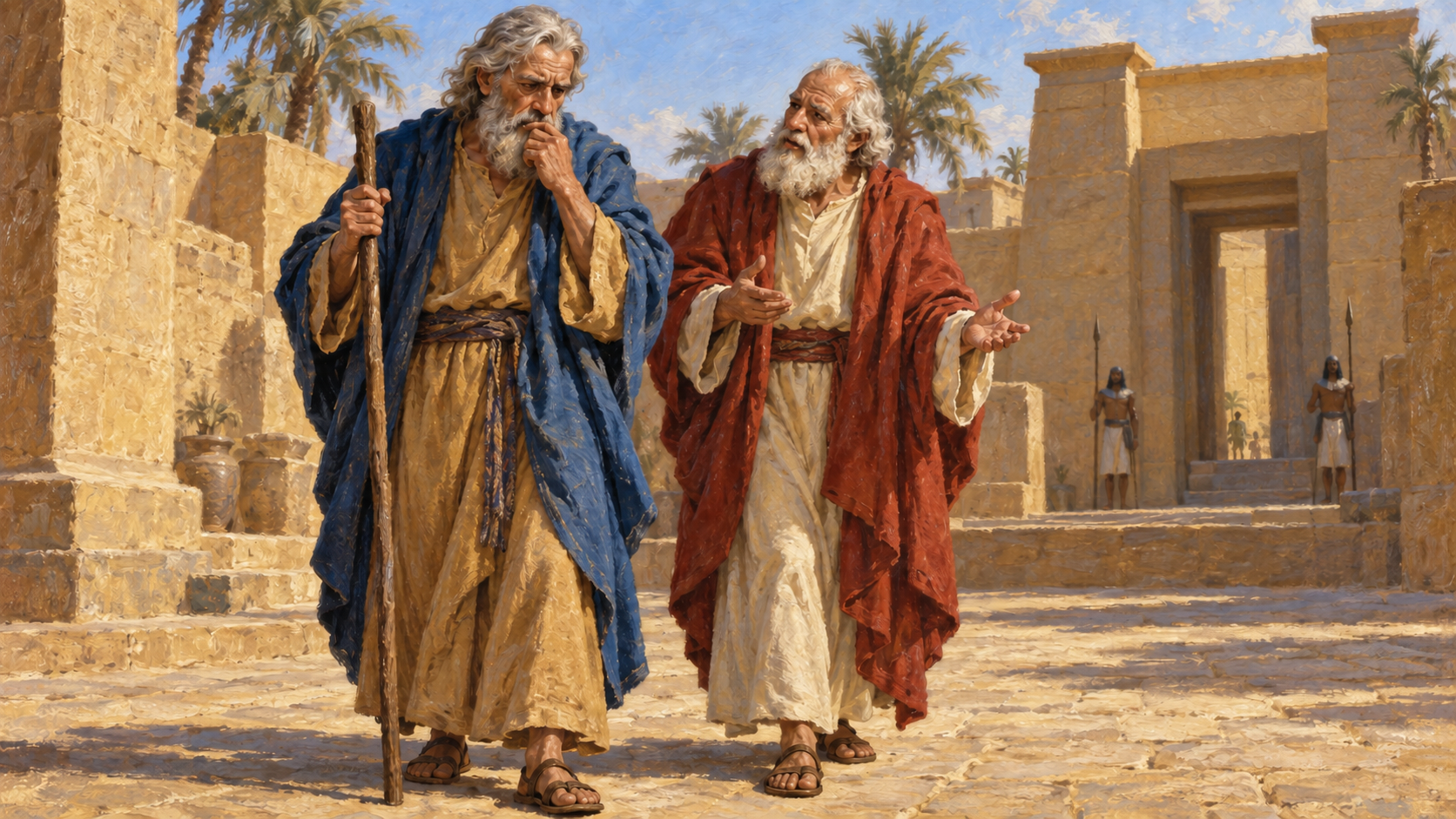
When Moses called himself a man of “uncircumcised lips,” he was objecting to God’s command to speak to Pharaoh. The expression sounds strange to us, especially because Exodus has already described a dangerous incident involving circumcision in Moses’ household. Was he referring to that failure, confessing some other uncleanness, or saying that he could not speak well? I understand him to be returning to his earlier concern about speaking. To see why, we need to follow the conversation between Moses and the LORD.
Moses’ Objection and God’s Answer
At the burning bush, Moses raised several objections to the work God had assigned him. He questioned whether he was the man to approach Pharaoh, asked what name he should give the Israelites, and wondered whether they would believe that the LORD had appeared to him. God promised His presence, revealed His name, and gave Moses signs to perform. Even after those answers, Moses objected to being the spokesman.
Then Moses said to the LORD, “O my Lord, I am not eloquent, neither before nor since You have spoken to Your servant; but I am slow of speech and slow of tongue.” So the LORD said to him, “Who has made man’s mouth? Or who makes the mute, the deaf, the seeing, or the blind? Have not I, the LORD? Now therefore, go, and I will be with your mouth and teach you what you shall say.”
The Hebrew behind “slow of speech and slow of tongue” describes a heavy mouth and tongue. Moses may have had a physical difficulty with speech, or he may have been describing his lack of fluency and eloquence. His reluctance to take the assignment is clear, but a particular speech disorder is not. Saying that he definitely stuttered goes further than Scripture does.
Acts 7:22 also tells us that Moses was educated in Egypt’s wisdom and mighty in words and deeds. We should allow that description to stand alongside his objection in Exodus. Education and a reputation for effective speech do not settle every question about a person’s ability or willingness to address a hostile ruler. Stephen describes Moses’ upbringing and earlier life; Exodus records the objection he made when God sent him back to Egypt. Neither passage requires us to accuse him of lying or diagnose an illness.
The LORD answered by directing Moses to the One who had made his mouth. He did not require Moses to become impressive before he could go; He promised, “I will be with your mouth.” God would teach him what to say. Moses nevertheless asked Him to send someone else, and the LORD became angry. Whatever difficulty Moses faced, he was now refusing a command God had made plain.
God provided Aaron to help Moses speak while still requiring Moses to go. The brothers would work together: Moses would receive God’s words and give them to Aaron, who would speak for him. Aaron’s help gave Moses a way to obey the command without releasing him from the work.
When they first appeared before Pharaoh, the king refused to release Israel and made the people’s labor more oppressive. They still had to produce the required number of bricks, but they now had to gather their own straw. Israel’s officers blamed Moses and Aaron for making their suffering worse, and Moses returned to the LORD asking why He had sent him. In Exodus 6, God answered with His covenant promises. He would redeem Israel, take them as His people, and bring them into the land He had promised to Abraham, Isaac, and Jacob.
So Moses spoke thus to the children of Israel; but they did not heed Moses, because of anguish of spirit and cruel bondage. And the LORD spoke to Moses, saying, “Go in, tell Pharaoh king of Egypt to let the children of Israel go out of his land.” And Moses spoke before the LORD, saying, “The children of Israel have not heeded me. How then shall Pharaoh heed me, for I am of uncircumcised lips?” Then the LORD spoke to Moses and Aaron, and gave them a command for the children of Israel and for Pharaoh king of Egypt, to bring the children of Israel out of the land of Egypt.
Moses delivered those promises, but the Israelites did not listen. Exodus gives the reason: their anguish of spirit and cruel bondage. Their response was not an assessment of Moses’ pronunciation or education. These were exhausted, oppressed people whose conditions had deteriorated since the brothers’ first visit to Pharaoh.
Moses used Israel’s response as a reason to question how Pharaoh would hear him. If his own people would not listen to a promise of rescue, why would Pharaoh heed a demand to release his slaves? He added his concern about his lips, as though his own limitations settled whether the mission could succeed. The LORD responded by commanding both brothers to carry out the work.
A genealogy, or family record, identifies Moses and Aaron before the account returns to God’s commission at the end of Exodus 6. Moses repeats his objection there, and chapter 7 explains how he and Aaron are to speak.
So the LORD said to Moses: “See, I have made you as God to Pharaoh, and Aaron your brother shall be your prophet. You shall speak all that I command you. And Aaron your brother shall tell Pharaoh to send the children of Israel out of his land.
Being “as God to Pharaoh” did not make Moses divine. He represented God before the king, delivering commands that carried God’s authority. Aaron would serve as Moses’ prophet, receiving the words entrusted to Moses and announcing them to Pharaoh. That arrangement explains how Moses could obey despite his objection about speaking.
Pharaoh’s resistance would require far more than a persuasive presentation. The king hardened his heart, and the LORD also brought judgment by hardening him, as Exodus records. Pharaoh remained responsible for refusing God’s command. The LORD would multiply signs and judgments until Egypt knew who He was; Israel’s release would not depend on Moses finding an eloquent enough argument to win the king over.
Aaron was not free to soften the message until Pharaoh found it agreeable. He had to convey what God had said. The command to release Israel stood even when Pharaoh refused it, and the brothers had to return with that same authority behind them.
During the plagues, Moses announced God’s demands, interceded with Him, and performed the acts He commanded. Aaron also spoke and acted at God’s direction. Although Moses took an increasingly prominent role, Exodus does not describe a medical cure or a change of personality. We can follow what he did without inventing an explanation for his growing participation.
What “Uncircumcised Lips” Means
The Hebrew phrase is aral sefatayim, “uncircumcised of lips.” Moses’ lips stand for his speech. Aral means uncircumcised, used here as a figure for speech he considered unfit for the task. The Brown–Driver–Briggs Hebrew lexicon identifies this use as a figure for inability to speak. The wording does not establish a diagnosis, and its meaning here should not be imposed on every other use of circumcision language.
Moses had already described his mouth and tongue as heavy. Now, after Israel’s failure to listen, he used a stronger expression for the same objection. He considered himself an inadequate spokesman and expected Pharaoh to reject him. The NET translation notes on Exodus 6:12 also connect this wording with his earlier claim that he could not speak well enough to do the work.
God answered Moses’ concern by assigning Aaron to speak as Moses’ prophet while requiring Moses to communicate His commands. He performed no ritual on Moses’ mouth, declared no cleansing of his lips, and made no reference to the circumcision in Moses’ household. I therefore understand “uncircumcised lips” as Moses’ description of speech he believed was unsuitable for the task, rather than a confession of hidden moral impurity.
The Circumcision Crisis in Exodus 4
To assess the proposed connection with Exodus 4, we first need to understand the command involved. Circumcision was the physical covenant sign God had commanded Abraham and the males of his household to receive. Abraham had already believed the LORD in Genesis 15, before the command was given in Genesis 17. The procedure did not produce his faith or earn his righteousness. Yet a sign does not become optional simply because it cannot save anyone.
This is My covenant which you shall keep, between Me and you and your descendants after you: Every male child among you shall be circumcised; and you shall be circumcised in the flesh of your foreskins, and it shall be a sign of the covenant between Me and you.
Genesis 17:14 warned that an uncircumcised male had broken the covenant and was to be cut off from his people. Moses was returning to Egypt to announce that God would keep His covenant, but the required sign had been neglected in his own household. That neglect led to a crisis on the journey.
And it came to pass on the way, at the encampment, that the LORD met him and sought to kill him. Then Zipporah took a sharp stone and cut off the foreskin of her son and cast it at Moses’ feet, and said, “Surely you are a husband of blood to me!” So He let him go. Then she said, “You are a husband of blood!”–because of the circumcision.
The traditional reading identifies Moses as the man whose life was threatened. The Hebrew uses a pronoun rather than naming the person, however, and some readers understand the threat to concern his son. The son who was circumcised is not named either. We know from the action that he had not received the required sign, but Exodus does not explain why it had been delayed or who had made that decision.
Zipporah’s words leave further questions. “Feet” may refer to literal feet, though some take it as a modest expression for the private parts. The precise force of “husband of blood” is debated as well. Her words refer to the circumcision, as verse 26 explains, but they do not tell us whether she was angry, relieved, or expressing something else. Exodus does not describe her feelings or record an earlier disagreement about the procedure. I cannot confidently use her words to reconstruct an argument between husband and wife.
The outcome is clearer than the disputed details. Zipporah circumcised her son, and the LORD let the threatened person go. A neglected covenant requirement had brought danger, and carrying out that requirement ended the crisis. The passage does not describe the blood as a sacrifice appeasing divine wrath, so I would not give it that meaning.
The order of events gives us another reason to distinguish this crisis from Moses’ later expression about his lips. After the encampment incident, he met Aaron at the mountain of God. The brothers then met Israel’s elders, and the people initially believed the signs and worshiped. Pharaoh subsequently increased their workload. Only after that deterioration, when the people no longer heeded the promise, did Moses call his lips uncircumcised. His stated concern was whether anyone would listen to him.
I do not see evidence in that conversation that Moses was confessing the earlier circumcision failure. God’s answer concerns the commands and how the brothers are to speak them. The household crisis and Moses’ objection belong to the same account, but the text gives us different explanations for them.
There is a legitimate connection with Moses’ calling. He was not exempt from God’s commands because God had chosen him to lead Israel. Public responsibility could not excuse neglect in his household. That warning follows from the incident itself; it does not depend on making his later words about his lips a disguised reference to it.
Heart, Ear, and Lips in Scripture
Other passages show how circumcision became a figure for something deeper than the physical sign. Leviticus 26:41 speaks of an uncircumcised heart being humbled. Deuteronomy 10:16 commands Israel to circumcise the heart and stop being stiff-necked, describing the inward resistance that continued despite their covenant privileges. Deuteronomy later promises God’s own work in their hearts.
And the LORD your God will circumcise your heart and the heart of your descendants, to love the LORD your God with all your heart and with all your soul, that you may live.
The promise concerns a heart made willing to love the LORD. Jeremiah applies the image to ears when he confronts people who resent God’s warning and will not receive it.
To whom shall I speak and give warning, That they may hear? Indeed their ear is uncircumcised, And they cannot give heed. Behold, the word of the LORD is a reproach to them; They have no delight in it.
Jeremiah’s hearers resented God’s word and took no pleasure in it. Their uncircumcised ear was unreceptive to His warning, just as an uncircumcised heart resists God inwardly. Moses used the image for lips he thought could not deliver the message adequately. These figures share the picture of something unfit for its intended use, but we need each passage’s context to understand the failure being described.
This does not make Moses’ resistance innocent. God had already answered his objections, and Moses remained responsible to obey. Still, we should distinguish his reluctance to speak from Jeremiah’s description of an audience that despised God’s Word. Otherwise, a useful comparison becomes an excuse to assign the same meaning to every passage.
Isaiah’s commission provides another comparison involving lips. His actual word is “unclean,” rather than “uncircumcised,” and his confession takes place after he sees the Holy King.
So I said: “Woe is me, for I am undone! Because I am a man of unclean lips, And I dwell in the midst of a people of unclean lips; For my eyes have seen the King, The LORD of hosts.” Then one of the seraphim flew to me, having in his hand a live coal which he had taken with the tongs from the altar. And he touched my mouth with it, and said: “Behold, this has touched your lips; Your iniquity is taken away, And your sin purged.”
Isaiah confessed uncleanness, and the seraph’s action came with an explicit declaration that his iniquity was taken away and his sin purged. In Exodus 6–7, God answered Moses by explaining how he and Aaron would speak. Those different responses help us distinguish the problems each man had expressed. I cannot use Isaiah’s cleansing as proof that Moses was confessing the same kind of uncleanness.
Both men nevertheless depended on what God provided. Isaiah received cleansing he could not accomplish for himself. Moses received God’s presence, words, and practical assistance. Their commissions did not rest on an inflated opinion of themselves, and neither man had authority to set aside God’s command because he felt unequal to it.
Weakness, Obedience, and Life in Christ
The New Testament also uses circumcision language figuratively, but Colossians 2 takes us beyond a servant’s concern about speaking. Paul describes what Christ has done for people who were dead in their trespasses. Their forgiveness and new life come through Him.
In Him you were also circumcised with the circumcision made without hands, by putting off the body of the sins of the flesh, by the circumcision of Christ, buried with Him in baptism, in which you also were raised with Him through faith in the working of God, who raised Him from the dead. And you, being dead in your trespasses and the uncircumcision of your flesh, He has made alive together with Him, having forgiven you all trespasses, having wiped out the handwriting of requirements that was against us, which was contrary to us. And He has taken it out of the way, having nailed it to the cross.
The circumcision made without hands describes Christ’s work in people He makes alive and forgives. No physical operation confers that righteousness. Paul also says they were raised with Christ through faith in God’s working. I do not read this as teaching that water baptism causes regeneration, meaning the new birth. Baptism follows faith and pictures our identification with Christ in His burial and resurrection to new life.
Paul’s use of the covenant image does not erase Israel or make physical circumcision irrelevant in its original setting. In Romans 2, he likewise exposes the folly of relying on an outward mark while breaking God’s law. The Spirit’s inward work cannot be replaced by inherited privilege or religious ceremony. That rebuke of hypocrisy does not cancel God’s promises to Israel.
Paul directs us to Christ because neither an outward mark nor our efforts can remove our guilt. Whatever abilities we bring to our service, we need forgiveness and new life. Jesus is the eternal Son, fully God and fully man, born of a virgin and without sin. Wicked men tortured and crucified Him, while He voluntarily gave Himself to be slain as the perfect sacrifice for our sins. His saving work through His shed blood and death was complete before His burial and bodily resurrection. The Father did not punish, curse, abandon, strike, bruise, or pour wrath on Jesus. Father, Son, and Holy Spirit remained united, with no broken fellowship in the Godhead.
Christ died for the whole world, and His call to repent and believe is genuine even though people can resist and reject it. Whoever truly believes is forgiven and justified, meaning declared righteous before God. That person is born again, indwelt and sealed by the Holy Spirit, and eternally secure in Christ. The Spirit’s work should become evident in how we live, although obedience neither earns nor keeps salvation. New birth does not make us sinlessly perfect, and a Christian label without new life provides no assurance. Being secure in Christ gives us no permission to live lawlessly.
Our standing before God rests in Christ, so we should be careful about the conclusions we draw from someone’s difficulty with speech. A speech disability, an accent, limited schooling, or a need for communication support is no evidence of spiritual impurity. We have no right to turn Moses’ metaphor into a disparaging label for shy Christians or inexperienced preachers. God provided Aaron’s assistance rather than demanding that Moses conceal his need.
The LORD’s answer about the mouth also named people who were mute or deaf and those who could see or were blind. He spoke as their Creator, without treating disabled people as mistakes or spiritual failures. Our treatment of them should reflect that dignity. We can give people time to respond, listen patiently, and provide suitable ways for them to communicate, so they can participate without being left embarrassed or excluded.
Moses’ assignment was particular to him. We cannot assume that every Christian must address a ruler or become a public teacher. The Spirit distributes gifts and responsibilities as He wills. But when God has made a duty clear in His Word, a sense of inadequacy does not release us from it. We can seek help, prepare carefully, and obey with the ability He has given us.
For a teacher, that preparation includes studying Scripture rather than expecting God to endorse whatever comes to mind. Moses had to receive God’s words and convey them accurately to Aaron; Aaron had to deliver them faithfully to Pharaoh. We depend on the Spirit as we study the written Word, check our claims, and accept correction. Careless preparation and embellished teaching cannot be justified by saying we trust God with our mouths.
The household incident adds a warning for anyone serving publicly. A title, a ministry, or a useful gift cannot excuse neglect of an actual command. We should confess disobedience and put right what we can. That does not mean God refuses to use a person until every family member is sinless. It means we must not defend a known wrong by pointing to the work we are doing for Him.
We also need to distinguish asking for help from refusing what God provides. Moses brought his questions and distress to the LORD, who answered him repeatedly. His request that God send someone else came after those answers. I can acknowledge a difficulty honestly and receive help without shame. When God has made a duty clear and supplied help, I cannot keep presenting my weakness as a reason to refuse Him.
A hearer’s response also needs to be considered fairly. Israel initially believed, then failed to heed Moses when cruel bondage crushed the people. Pharaoh resisted God’s demand because he would not submit to Him. Neither response by itself proved that Moses had spoken badly. We should examine our own faithfulness and clarity without assuming that every rejection exposes a fault in the messenger or that every favorable response proves his message true.
My Final Thoughts
I understand “uncircumcised lips” as Moses’ description of speech he considered inadequate for the work before him. His earlier objection, the immediate concern about being heard, and God’s provision of Aaron all support that reading. The household circumcision crisis carries its own warning about obedience, but Exodus does not identify it as the reason for this expression. God gave Moses His words and the assistance he needed, then required him to go. We can acknowledge our limitations just as honestly while receiving help and carrying out the duties God has actually given us.