
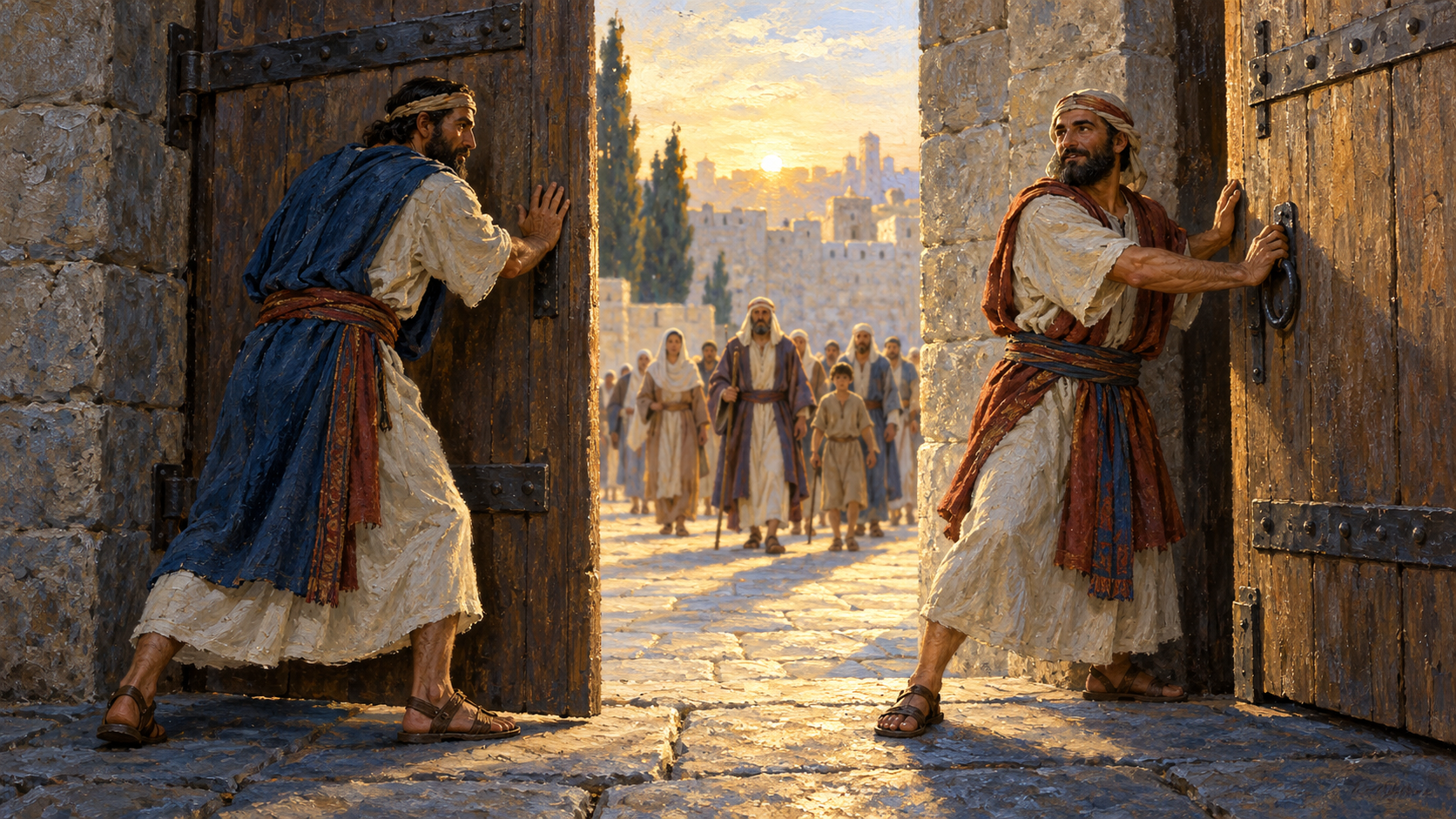
Korah rebelled against God, yet later generations of his family guarded Israel’s worship and sang some of its most beloved psalms. I want to understand how that family could take such a different direction. Numbers records that Korah’s sons survived, which raises the question of whether their father’s guilt became their own. As we follow their descendants through Chronicles and the Psalms, we can see the place God’s mercy gave them in faithful service without supplying details Scripture leaves untold.
Korah Despised an Honorable Calling and Rebelled Against God
These are the names of the sons of Levi according to their generations: Gershon, Kohath, and Merari. And the years of the life of Levi were one hundred and thirty-seven. The sons of Gershon were Libni and Shimi according to their families. And the sons of Kohath were Amram, Izhar, Hebron, and Uzziel. And the years of the life of Kohath were one hundred and thirty-three. The sons of Merari were Mahli and Mushi. These are the families of Levi according to their generations. Now Amram took for himself Jochebed, his father’s sister, as wife; and she bore him Aaron and Moses. And the years of the life of Amram were one hundred and thirty-seven. The sons of Izhar were Korah, Nepheg, and Zichri. And the sons of Uzziel were Mishael, Elzaphan, and Zithri. Aaron took to himself Elisheba, daughter of Amminadab, sister of Nahshon, as wife; and she bore him Nadab, Abihu, Eleazar, and Ithamar. And the sons of Korah were Assir, Elkanah, and Abiasaph. These are the families of the Korahites.
Korah belonged to Levi, the tribe God had set apart for service connected with the tabernacle. He was not an obscure troublemaker. His father was Izhar, his grandfather was Kohath, and Levi was his great-grandfather. Exodus also names his three sons: Assir, Elkanah, and Abiasaph.
Kohath’s sons included both Amram and Izhar. Moses and Aaron descended through Amram, while Korah came through Izhar, so the conflict in Numbers 16 involved relatives as well as leaders. That closeness helps me consider how envy grows. We may look at someone serving nearby and begin to resent an assignment we think should have been ours.
The genealogy does not stop with the man who rebelled. It preserves the names of his sons, whose descendants would later serve faithfully. I do not want to overlook them simply because Korah’s disgrace is easier to remember. Scripture tells the truth about his sin without erasing everyone connected to him.
The Kohathites already held an honorable responsibility. After Aaron and his sons covered the most sacred furnishings, the Kohathites carried them. Numbers 4 includes the ark and table in their care, along with the lampstand, altars, and other holy articles. They were forbidden to touch those objects or stare at them uncovered, but their work still brought them close to the visible center of Israel’s worship.
Moses asked whether Korah considered that Levitical work a small thing. God had set the Levites apart and brought them near to serve, so Korah was not being denied meaningful work. He despised the assignment he had because he wanted the priesthood God had given to Aaron’s house.
Korah was right to say that the whole congregation was holy, because God had called Israel a holy nation. But God had also given people distinct responsibilities. Shared covenant privilege did not authorize every Israelite, or even every Levite, to offer priestly incense. I see a warning here about using a true statement to defend an ambition God has not authorized. A desire for spiritual position can sound like a concern for equality.
Now Korah the son of Izhar, the son of Kohath, the son of Levi, with Dathan and Abiram the sons of Eliab, and On the son of Peleth, sons of Reuben, took men; and they rose up before Moses with some of the children of Israel, two hundred and fifty leaders of the congregation, representatives of the congregation, men of renown. They gathered together against Moses and Aaron, and said to them, “You take too much upon yourselves, for all the congregation is holy, every one of them, and the LORD is among them. Why then do you exalt yourselves above the assembly of the LORD?” So when Moses heard it, he fell on his face; and he spoke to Korah and all his company, saying, “Tomorrow morning the LORD will show who is His and who is holy, and will cause him to come near to Him. That one whom He chooses He will cause to come near to Him. Do this: Take censers, Korah and all your company; put fire in them and put incense in them before the LORD tomorrow, and it shall be that the man whom the LORD chooses is the holy one. You take too much upon yourselves, you sons of Levi!” Then Moses said to Korah, “Hear now, you sons of Levi: Is it a small thing to you that the God of Israel has separated you from the congregation of Israel, to bring you near to Himself, to do the work of the tabernacle of the LORD, and to stand before the congregation to serve them; and that He has brought you near to Himself, you and all your brethren, the sons of Levi, with you? And are you seeking the priesthood also? Therefore you and all your company are gathered together against the LORD. And what is Aaron that you complain against him?”
Korah joined with Dathan and Abiram from Reuben, and together they gathered 250 recognized leaders who represented the congregation. With that powerful coalition behind them, they openly challenged Moses and Aaron. They were doing much more than quietly asking for clarification.
Numbers 16 names On the son of Peleth in its opening verse and says nothing more about him. Later traditions offer explanations, but Scripture does not tell us whether he withdrew, escaped, or remained among people described more broadly. I would not fill that silence with an unrecorded conversation, however memorable a later account may be. We cannot teach it as biblical history.
Moses fell on his face and brought the dispute before the LORD. Rather than simply insist that no one could question him, he called for the censers to be brought before God. The LORD would show whom He had chosen to come near. Moses also exposed what Korah’s company wanted by asking whether they were seeking the priesthood.
Dathan and Abiram refused Moses’ summons and accused him of failed leadership. They even called Egypt a land flowing with milk and honey, borrowing the description of God’s promised land for the country that had enslaved them. Their rebellion changed the way they described the past. Deliverance became deception, and slavery was remembered as abundance.
Moses had not invented the priesthood or chosen Aaron because he preferred him, so opposing that appointment meant opposing the LORD. I would not extend that conclusion to every disagreement with a religious leader. Numbers 16 concerns an appointment God had publicly established and confirmed. It does not put human leaders beyond examination.
And the LORD spoke to Moses and Aaron, saying, “Separate yourselves from among this congregation, that I may consume them in a moment.” Then they fell on their faces, and said, “O God, the God of the spirits of all flesh, shall one man sin, and You be angry with all the congregation?” So the LORD spoke to Moses, saying, “Speak to the congregation, saying, ‘Get away from the tents of Korah, Dathan, and Abiram.'” Then Moses rose and went to Dathan and Abiram, and the elders of Israel followed him. And he spoke to the congregation, saying, “Depart now from the tents of these wicked men! Touch nothing of theirs, lest you be consumed in all their sins.” So they got away from around the tents of Korah, Dathan, and Abiram; and Dathan and Abiram came out and stood at the door of their tents, with their wives, their sons, and their little children. And Moses said: “By this you shall know that the LORD has sent me to do all these works, for I have not done them of my own will. If these men die naturally like all men, or if they are visited by the common fate of all men, then the LORD has not sent me. But if the LORD creates a new thing, and the earth opens its mouth and swallows them up with all that belongs to them, and they go down alive into the pit, then you will understand that these men have rejected the LORD.” Now it came to pass, as he finished speaking all these words, that the ground split apart under them, and the earth opened its mouth and swallowed them up, with their households and all the men with Korah, with all their goods. So they and all those with them went down alive into the pit; the earth closed over them, and they perished from among the assembly. Then all Israel who were around them fled at their cry, for they said, “Lest the earth swallow us up also!” And a fire came out from the LORD and consumed the two hundred and fifty men who were offering incense.
When the LORD spoke of consuming the congregation, Moses and Aaron immediately fell before Him and interceded. Instead of taking pleasure in their opponents’ destruction, they asked whether everyone should suffer for one man’s sin. God then told the people to move away from the rebels’ tents.
Moses told the people how they would know whether the LORD had sent him. An ordinary death for the rebels would mean He had not. If the earth opened and swallowed them, however, Israel would know that these men had rejected the LORD. The ground then split and the company went down into it, while fire consumed the 250 men offering incense.
Numbers 26 later says the earth swallowed Dathan and Abiram together with Korah when the company died. Numbers 16 describes the men with Korah and the 250 who were consumed by fire. Both passages tell us that God fully judged the rebellion, and Scripture is clear that Korah died. I do not need to reconstruct his exact physical location at every moment to accept what God has recorded.
God had warned Israel against approaching His sanctuary outside the order He had appointed. The severity of this judgment shows why holy things cannot be used to advance human ambition. Neither a well-known reputation nor a large following could make that disobedience acceptable worship.
Then the LORD spoke to Moses, saying: “Tell Eleazar, the son of Aaron the priest, to pick up the censers out of the blaze, for they are holy, and scatter the fire some distance away. The censers of these men who sinned against their own souls, let them be made into hammered plates as a covering for the altar. Because they presented them before the LORD, therefore they are holy; and they shall be a sign to the children of Israel.” So Eleazar the priest took the bronze censers, which those who were burned up had presented, and they were hammered out as a covering on the altar, to be a memorial to the children of Israel that no outsider, who is not a descendant of Aaron, should come near to offer incense before the LORD, that he might not become like Korah and his companions, just as the LORD had said to him through Moses. On the next day all the congregation of the children of Israel complained against Moses and Aaron, saying, “You have killed the people of the LORD.” Now it happened, when the congregation had gathered against Moses and Aaron, that they turned toward the tabernacle of meeting; and suddenly the cloud covered it, and the glory of the LORD appeared. Then Moses and Aaron came before the tabernacle of meeting. And the LORD spoke to Moses, saying, “Get away from among this congregation, that I may consume them in a moment.” And they fell on their faces. So Moses said to Aaron, “Take a censer and put fire in it from the altar, put incense on it, and take it quickly to the congregation and make atonement for them; for wrath has gone out from the LORD. The plague has begun.” Then Aaron took it as Moses commanded, and ran into the midst of the assembly; and already the plague had begun among the people. So he put in the incense and made atonement for the people. And he stood between the dead and the living; so the plague was stopped. Now those who died in the plague were fourteen thousand seven hundred, besides those who died in the Korah incident. So Aaron returned to Moses at the door of the tabernacle of meeting, for the plague had stopped.
Eleazar gathered the censers from the blaze, and their bronze was hammered into a covering for the altar. Since the men had presented the censers before the LORD, the metal was treated as holy. Later worshipers who saw that covering had a visible reminder that no one outside Aaron’s line was to take up the ministry of offering incense.
The altar covering was not a monument to Moses winning an argument. It warned Israel against repeating the same fatal presumption. I can see mercy in a warning like that: God was telling later worshipers where disobedience would lead so they would not follow those men into destruction.
Korah’s company had brought sacred vessels to establish its own authority, yet God made those very vessels a witness against their self-exaltation. Handling the right object and speaking the language of worship did not make their rebellion holy. That should make me examine whether my religious activity agrees with what God has spoken.
The next day, the congregation still blamed Moses and Aaron for killing the people of the LORD. They had seen God’s sign, yet they accused the men who had interceded for them. Their response shows how a heart determined to resist can refuse even visible evidence.
Moses again acted to save the people when the plague began. Aaron ran with incense from the altar and stood between the dead and the living until the plague stopped. Another fourteen thousand seven hundred had died, beyond those lost in Korah’s rebellion. Instead of retaliating, Moses and Aaron served the people who had accused them. The priestly work Korah had coveted became the means by which the congregation was spared further loss.
Aaron’s intercession showed Israel’s need for a mediator, someone to act on the people’s behalf before God. His incense provided temporary atonement within Israel’s covenant life, but it could not cleanse the conscience from sin. It pointed beyond itself to the perfect Savior. The same account that records death through unauthorized incense shows the priest God had appointed carrying incense in obedient intercession.
And the LORD spoke to Moses, saying: “Speak to the children of Israel, and get from them a rod from each father’s house, all their leaders according to their fathers’ houses–twelve rods. Write each man’s name on his rod. And you shall write Aaron’s name on the rod of Levi. For there shall be one rod for the head of each father’s house. Then you shall place them in the tabernacle of meeting before the Testimony, where I meet with you. And it shall be that the rod of the man whom I choose will blossom; thus I will rid Myself of the complaints of the children of Israel, which they make against you.” So Moses spoke to the children of Israel, and each of their leaders gave him a rod apiece, for each leader according to their fathers’ houses, twelve rods; and the rod of Aaron was among their rods. And Moses placed the rods before the LORD in the tabernacle of witness. Now it came to pass on the next day that Moses went into the tabernacle of witness, and behold, the rod of Aaron, of the house of Levi, had sprouted and put forth buds, had produced blossoms and yielded ripe almonds. Then Moses brought out all the rods from before the LORD to all the children of Israel; and they looked, and each man took his rod. And the LORD said to Moses, “Bring Aaron’s rod back before the Testimony, to be kept as a sign against the rebels, that you may put their complaints away from Me, lest they die.” Thus did Moses; just as the LORD had commanded him, so he did. So the children of Israel spoke to Moses, saying, “Surely we die, we perish, we all perish! Whoever even comes near the tabernacle of the LORD must die. Shall we all utterly die?”
God gave Israel another public sign to settle the complaints about the priesthood. Each tribal leader supplied a rod, and Moses placed them before the Testimony with Aaron’s name written on Levi’s rod. By morning, Aaron’s dead staff had sprouted. Along with buds and blossoms, it bore ripe almonds.
Aaron could not have produced that life through a campaign for office. God used the sign to identify the man He had chosen and answer the accusation that Aaron had exalted himself. The rod was then kept as a witness against rebellion.
The people were afraid and asked whether everyone who approached the tabernacle would die. Numbers 18 answered that concern by explaining the duties and safeguards God assigned to priests and Levites. His order made it possible for sinful people to approach Him without treating His holiness casually. It was meant to enable worship, not prevent it.
Korah’s Sons Survived and Answered to God for Themselves
The sons of Eliab were Nemuel, Dathan, and Abiram. These are the Dathan and Abiram, representatives of the congregation, who contended against Moses and Aaron in the company of Korah, when they contended against the LORD; and the earth opened its mouth and swallowed them up together with Korah when that company died, when the fire devoured two hundred and fifty men; and they became a sign. Nevertheless the children of Korah did not die.
Numbers gives us a brief but decisive statement about the family: “Nevertheless the children of Korah did not die.” I want to give those words their full weight without pretending to know the private details. Scripture records neither a conversation with their father nor the moment they moved away from him. It does not describe their feelings as judgment fell, and I should not turn that silence into an imagined scene.
Korah’s sons were spared their father’s final judgment. His biological line continued, and later genealogies trace faithful servants through it. His choices had terrible public consequences, but they did not force his descendants to make the same choices.
We cannot therefore say that every member of Korah’s household died. Numbers 16 describes the households and associates gathered at the rebels’ tents, while Numbers 26 specifically tells us his sons survived. We need to keep that exception in view as we read the judgment account.
“Yet you say, ‘Why should the son not bear the guilt of the father?’ Because the son has done what is lawful and right, and has kept all My statutes and observed them, he shall surely live. The soul who sins shall die. The son shall not bear the guilt of the father, nor the father bear the guilt of the son. The righteousness of the righteous shall be upon himself, and the wickedness of the wicked shall be upon himself. “But if a wicked man turns from all his sins which he has committed, keeps all My statutes, and does what is lawful and right, he shall surely live; he shall not die. None of the transgressions which he has committed shall be remembered against him; because of the righteousness which he has done, he shall live. Do I have any pleasure at all that the wicked should die?” says the Lord GOD, “and not that he should turn from his ways and live?
Ezekiel addressed Israelites who blamed their fathers while avoiding responsibility for their own rebellion during the exile. He rejected the claim that a son must bear his father’s guilt. A righteous son who refused his father’s wicked practice would live, while the guilty person bore his own iniquity. Deuteronomy 24:16 likewise forbids putting children to death for their fathers. In both passages, each person answers for his own sin.
A parent’s sin can still bring painful consequences to a family. Grief or financial loss may follow, and trust can be damaged along with important relationships. Korah’s sons also inherited a name associated with rebellion throughout Israel. But bearing those consequences is different from bearing personal guilt. God did not call the sons rebels simply because their father was one.
If you grew up in a destructive home, that difference is worth understanding. You may have learned sinful patterns or suffered serious wounds, and public shame may cling to your family name. None of that makes an ancestor’s identity your spiritual prison. You are responsible for how you answer God, and His mercy can give your life a different direction.
Later Korahites Guarded Worship and Led Israel’s Song
We now move beyond the wilderness rebellion to the service of later generations. Some served around the tabernacle and throughout the camp. Much later, David organized the Levites after the ark rested in the tent he had prepared, and Solomon’s temple brought another setting for their work. After the exile, 1 Chronicles 9 describes these families serving in restored Jerusalem while recalling duties from earlier generations. Keeping those settings distinct helps us follow the family’s long history without confusing the people or buildings involved.
Scripture does call Korahites gatekeepers of the tabernacle, but that ministry passed from one generation to another. We should not picture the same men standing beside the same structure for centuries. References to the house and tent, or to gates, chambers, treasuries, and the earlier camp, describe related stages in Israel’s worship history.
Chronicles uses the family records and remembered assignments to connect those stages. Worship in restored Jerusalem had roots in what God had ordered earlier. The descendants returned to trusted work shaped by God’s earlier order.
And the gatekeepers were Shallum, Akkub, Talmon, Ahiman, and their brethren. Shallum was the chief. Until then they had been gatekeepers for the camps of the children of Levi at the King’s Gate on the east. Shallum the son of Kore, the son of Ebiasaph, the son of Korah, and his brethren, from his father’s house, the Korahites, were in charge of the work of the service, gatekeepers of the tabernacle. Their fathers had been keepers of the entrance to the camp of the LORD. And Phinehas the son of Eleazar had been the officer over them in time past; the LORD was with him. Zechariah the son of Meshelemiah was keeper of the door of the tabernacle of meeting. All those chosen as gatekeepers were two hundred and twelve. They were recorded by their genealogy, in their villages. David and Samuel the seer had appointed them to their trusted office. So they and their children were in charge of the gates of the house of the LORD, the house of the tabernacle, by assignment. The gatekeepers were assigned to the four directions: the east, west, north, and south. And their brethren in their villages had to come with them from time to time for seven days. For in this trusted office were four chief gatekeepers; they were Levites. And they had charge over the chambers and treasuries of the house of God. And they lodged all around the house of God because they had the responsibility, and they were in charge of opening it every morning.
Shallum’s family record traces his line through Kore and Ebiasaph to Korah. He and his Korahite relatives kept gates, just as their fathers had guarded the entrance to the camp of the LORD. The writer recalls that David and Samuel had appointed gatekeepers to this trusted office.
Their responsibility extended beyond standing at a doorway. They served entrances facing every direction and watched over the chambers and treasuries. Because they remained responsible for the house of God, they lodged around it and opened it each morning. Their work protected holy space and made orderly access possible.
Korah had tried to approach God on his own terms. Generations later, his descendants guarded the places where worshipers entered in the way God had appointed. I would not read that as proof that every Korahite was converted or flawless. It does show that Korah’s rebellion did not disqualify every later descendant from honored responsibility.
A gatekeeper might receive less attention than a king or prophet, and even a singer could be more visible. Yet a failure at the gate could endanger worshipers and sacred property. I do not want to measure the value of that work by how many people noticed it. Scripture calls it a trusted office, and God measures faithfulness by obedience to the assignment He gives.
Concerning the divisions of the gatekeepers: of the Korahites, Meshelemiah the son of Kore, of the sons of Asaph. And the sons of Meshelemiah were Zechariah the firstborn, Jediael the second, Zebadiah the third, Jathniel the fourth, Elam the fifth, Jehohanan the sixth, Eliehoenai the seventh. Moreover the sons of Obed-Edom were Shemaiah the firstborn, Jehozabad the second, Joah the third, Sacar the fourth, Nethanel the fifth, Ammiel the sixth, Issachar the seventh, Peulthai the eighth; for God blessed him. Also to Shemaiah his son were sons born who governed their fathers’ houses, because they were men of great ability. The sons of Shemaiah were Othni, Rephael, Obed, and Elzabad, whose brothers Elihu and Semachiah were able men. All these were of the sons of Obed-Edom, they and their sons and their brethren, able men with strength for the work: sixty-two of Obed-Edom. And Meshelemiah had sons and brethren, eighteen able men. Also Hosah, of the children of Merari, had sons: Shimri the first (for though he was not the firstborn, his father made him the first), Hilkiah the second, Tebaliah the third, Zechariah the fourth; all the sons and brethren of Hosah were thirteen. Among these were the divisions of the gatekeepers, among the chief men, having duties just like their brethren, to serve in the house of the LORD. And they cast lots for each gate, the small as well as the great, according to their father’s house. The lot for the East Gate fell to Shelemiah. Then they cast lots for his son Zechariah, a wise counselor, and his lot came out for the North Gate; to Obed-Edom the South Gate, and to his sons the storehouse. To Shuppim and Hosah the lot came out for the West Gate, with the Shallecheth Gate on the ascending highway–watchman opposite watchman. On the east were six Levites, on the north four each day, on the south four each day, and for the storehouse two by two. As for the Parbar on the west, there were four on the highway and two at the Parbar. These were the divisions of the gatekeepers among the sons of Korah and among the sons of Merari.
1 Chronicles 26 names divisions of both Korahites and Merarites, recording their households and the men able to carry out the work. It specifies duties at gates and storehouses down to the daily numbers needed. Positions were assigned by lot, with the small and great submitting to the same process. Social importance did not decide who received a particular assignment.
It is easy to skim a roster like this and miss the care that supported Israel’s worship. Doors had to be watched and schedules followed, while supplies and property needed attention. Those tasks may seem ordinary beside sacrifices and songs, but unreliable handoffs or poor security could create disorder for the congregation. The practical work helped keep that disorder from burdening the people and distracting from ministry.
Some of these men had the physical strength their work required, while Zechariah is described as a wise counselor. Their abilities belonged in the service God assigned them. I see no reason here to set spiritual devotion against practical competence. Skill becomes service when we use it under God’s truth instead of to gain status.
Now these are the men whom David appointed over the service of song in the house of the LORD, after the ark came to rest. They were ministering with music before the dwelling place of the tabernacle of meeting, until Solomon had built the house of the LORD in Jerusalem, and they served in their office according to their order. And these are the ones who ministered with their sons: Of the sons of the Kohathites were Heman the singer, the son of Joel, the son of Samuel, the son of Elkanah, the son of Jeroham, the son of Eliel, the son of Toah, the son of Zuph, the son of Elkanah, the son of Mahath, the son of Amasai, the son of Elkanah, the son of Joel, the son of Azariah, the son of Zephaniah, the son of Tahath, the son of Assir, the son of Ebiasaph, the son of Korah, the son of Izhar, the son of Kohath, the son of Levi, the son of Israel. And his brother Asaph, who stood at his right hand, was Asaph the son of Berachiah, the son of Shimea, the son of Michael, the son of Baaseiah, the son of Malchijah, the son of Ethni, the son of Zerah, the son of Adaiah, the son of Ethan, the son of Zimmah, the son of Shimei, the son of Jahath, the son of Gershon, the son of Levi. Their brethren, the sons of Merari, on the left hand, were Ethan the son of Kishi, the son of Abdi, the son of Malluch, the son of Hashabiah, the son of Amaziah, the son of Hilkiah, the son of Amzi, the son of Bani, the son of Shamer, the son of Mahli, the son of Mushi, the son of Merari, the son of Levi. And their brethren, the Levites, were appointed to every kind of service of the tabernacle of the house of God.
Other Korahites served through music. David appointed Heman over the service of song, and Chronicles traces his ancestry through Joel and Samuel. The line continues through Elkanah to Assir and Ebiasaph before reaching Korah. Heman stood alongside Asaph from Gershon’s line and Ethan from Merari’s family.
That family record places Samuel in the Korahite line. When 1 Samuel calls Elkanah an Ephraimite, it is describing where the family lived, in Ephraim’s hill country. Chronicles gives his tribal ancestry as a Levite descended from Korah. I do not see a contradiction between those descriptions, since residence and descent answer different questions. The family remembered for resisting Moses later produced a prophet who faithfully spoke God’s Word and helped order Israel’s worship. Heman and his sons continued that service through music.
These branches did not need to compete over which task looked greatest. Some guarded gates while others sang, and other Levites carried the remaining responsibilities. Each household could serve faithfully by doing the work God had assigned it.
The Psalms of the Sons of Korah Teach Longing, Refuge, and Honest Lament
The canonical headings connect eleven psalms with the sons of Korah. They begin with Psalm 42 and continue through Psalms 44-49, followed by Psalms 84-85 and 87-88. Psalm 43 has no superscription, although it is often read with Psalm 42 because of their shared refrain and related themes. That connection is worth considering, but I would not present its authorship as certain.
The title “sons of Korah” refers to the continuing family line and its organized body of temple singers. It does not mean Korah’s immediate sons composed every psalm in the collection. Some headings are more specific. Psalm 88 is associated with the sons of Korah, and its heading also identifies it as a contemplation of Heman the Ezrahite.
These songs do not all sound alike. Alongside longing for God’s presence, we find national lament and celebration of His King. Confidence during upheaval appears beside sober wisdom about wealth and death. The singers love God’s dwelling, ask for restoration, and delight in Zion, yet they also give voice to nearly unrelieved darkness. I appreciate the room these psalms give for faithful worship to express more than one emotion.
As the deer pants for the water brooks, So pants my soul for You, O God. My soul thirsts for God, for the living God. When shall I come and appear before God? My tears have been my food day and night, While they continually say to me, “Where is your God?” When I remember these things, I pour out my soul within me. For I used to go with the multitude; I went with them to the house of God, With the voice of joy and praise, With a multitude that kept a pilgrim feast. Why are you cast down, O my soul? And why are you disquieted within me? Hope in God, for I shall yet praise Him For the help of His countenance. O my God, my soul is cast down within me; Therefore I will remember You from the land of the Jordan, And from the heights of Hermon, From the Hill Mizar. Deep calls unto deep at the noise of Your waterfalls; All Your waves and billows have gone over me. The LORD will command His lovingkindness in the daytime, And in the night His song shall be with me– A prayer to the God of my life. I will say to God my Rock, “Why have You forgotten me? Why do I go mourning because of the oppression of the enemy?” As with a breaking of my bones, My enemies reproach me, While they say to me all day long, “Where is your God?” Why are you cast down, O my soul? And why are you disquieted within me? Hope in God; For I shall yet praise Him, The help of my countenance and my God.
In Psalm 42, the writer is separated from gathered worship and longs for God as a deer thirsts for water. He remembers going with the multitude to God’s house in joy and praise. Now tears have taken the place of food, and his enemies keep asking where his God is.
He answers that distress by speaking to his own soul. He asks why he is cast down and tells himself to hope in God, without pretending his discouragement has gone away. His response shows me that I can acknowledge pain while holding to what remains true about God’s help and the praise still to come.
A family of gatekeepers knew the value of entrance and gathered worship, but the psalm expresses more than attachment to familiar work. The writer longs for the living God Himself, not simply a position near a building. That makes me ask a question about service: do I still thirst for the Lord, or am I content to work around sacred things? Ministry becomes empty when that desire for Him is gone.
God is our refuge and strength, A very present help in trouble. Therefore we will not fear, Even though the earth be removed, And though the mountains be carried into the midst of the sea; Though its waters roar and be troubled, Though the mountains shake with its swelling. Selah There is a river whose streams shall make glad the city of God, The holy place of the tabernacle of the Most High. God is in the midst of her, she shall not be moved; God shall help her, just at the break of dawn. The nations raged, the kingdoms were moved; He uttered His voice, the earth melted. The LORD of hosts is with us; The God of Jacob is our refuge. Selah Come, behold the works of the LORD, Who has made desolations in the earth. He makes wars cease to the end of the earth; He breaks the bow and cuts the spear in two; He burns the chariot in the fire. Be still, and know that I am God; I will be exalted among the nations, I will be exalted in the earth! The LORD of hosts is with us; The God of Jacob is our refuge. Selah
Psalm 46 pictures the earth being removed and mountains thrown into the sea while nations rage and kingdoms move. None of those circumstances offers stability. The singers can be confident because God Himself is their refuge and strength, present to help in trouble.
Again and again, the psalm confesses that the LORD of hosts is with His people. Their safety rests in His presence. I also notice where the command to be still appears: God is ending warfare and exalting His name among the nations. We should hear more than advice about private relaxation in those words. They call people to stop striving against the sovereign God and recognize who He is.
Korah had tried to overturn the order God established, but his descendants sang about the God whose voice melts the earth and whose presence secures His city. Their song places safety in yielding to Him instead of seizing control for themselves.
Hear this, all peoples; Give ear, all inhabitants of the world, Both low and high, Rich and poor together. My mouth shall speak wisdom, And the meditation of my heart shall give understanding. I will incline my ear to a proverb; I will disclose my dark saying on the harp. Why should I fear in the days of evil, When the iniquity at my heels surrounds me? Those who trust in their wealth And boast in the multitude of their riches, None of them can by any means redeem his brother, Nor give to God a ransom for him– For the redemption of their souls is costly, And it shall cease forever– That he should continue to live eternally, And not see the Pit. For he sees wise men die; Likewise the fool and the senseless person perish, And leave their wealth to others. Their inner thought is that their houses will last forever, Their dwelling places to all generations; They call their lands after their own names. Nevertheless man, though in honor, does not remain; He is like the beasts that perish. This is the way of those who are foolish, And of their posterity who approve their sayings. Selah Like sheep they are laid in the grave; Death shall feed on them; The upright shall have dominion over them in the morning; And their beauty shall be consumed in the grave, far from their dwelling. But God will redeem my soul from the power of the grave, For He shall receive me. Selah
Psalm 49 addresses people at every social level, and none can give God a ransom sufficient to redeem a brother’s soul. Both the wise and the foolish die. However much property they possess, they cannot make their temporary homes last forever.
The psalmist therefore looks to God to redeem his soul from the grave. A respected family name cannot supply that ransom any more than social status or wealth can. I have to recognize the same limit: what redemption requires is beyond anything we can purchase.
The New Testament tells us what that redemption costs: believers are redeemed by Christ’s precious blood. This Korahite psalm prepares its hearers to depend on God’s provision by showing why they cannot ransom themselves.
How lovely is Your tabernacle, O LORD of hosts! My soul longs, yes, even faints For the courts of the LORD; My heart and my flesh cry out for the living God. Even the sparrow has found a home, And the swallow a nest for herself, Where she may lay her young– Even Your altars, O LORD of hosts, My King and my God. Blessed are those who dwell in Your house; They will still be praising You. Selah Blessed is the man whose strength is in You, Whose heart is set on pilgrimage. As they pass through the Valley of Baca, They make it a spring; The rain also covers it with pools. They go from strength to strength; Each one appears before God in Zion. O LORD God of hosts, hear my prayer; Give ear, O God of Jacob! Selah O God, behold our shield, And look upon the face of Your anointed. For a day in Your courts is better than a thousand. I would rather be a doorkeeper in the house of my God Than dwell in the tents of wickedness. For the LORD God is a sun and shield; The LORD will give grace and glory; No good thing will He withhold From those who walk uprightly. O LORD of hosts, Blessed is the man who trusts in You!
In Psalm 84, the worshiper’s whole being cries out for the living God and longs for His dwelling place. Even the birds find places near His altars. Pilgrims go from strength to strength as they travel to appear before Him.
Verse 10 says a day in God’s courts is better than a thousand elsewhere. The NKJV continues, “I would rather be a doorkeeper in the house of my God than dwell in the tents of wickedness.” The rare Hebrew form carries the idea of standing or remaining at the threshold. Knowing that meaning helps us see how naturally the image fits the Korahite tradition of keeping gates.
We do not need to assume the writer was describing an actual shift at a gate. The line may be a poetic comparison, and I would not claim more than the psalm gives us. His preference is clear either way: the humblest place near God is better than a comfortable home among the wicked.
He is expressing allegiance to God by choosing modest service with Him over luxury gained through evil. That does not show contempt for ordinary life, nor does it make our church buildings the equivalent of Israel’s temple.
Other psalms in the collection help us hear more of the family’s worship. Psalm 85 asks God to revive His people and brings mercy together with truth as righteousness meets peace. Psalm 87 celebrates Zion and looks ahead to people from the nations being registered as born there.
Psalm 88 takes us into a suffering that does not lift by the end of the prayer. The writer cries day and night as he describes how close he is to the grave. Loved one and friend seem far away, and Scripture preserves his anguish without adding a quick emotional resolution.
I find help in the fact that this sufferer keeps addressing the LORD even when no relief is visible. He calls Him the God of his salvation and brings his anguish before Him. Honest lament does not become unbelief because the prayer ends before circumstances change. This psalm gives suffering believers words for that kind of honest lament.
A mature congregation needs to sing both Psalm 46 and Psalm 88. We can confess that God is our refuge and still make room for someone who can presently describe only darkness as his acquaintance. The sons of Korah help us understand why faithful worship does not always sound cheerful.
Korah’s Story Warns Leaders and Servants Without Making Them the Same
Some abusive leaders appeal to Korah’s rebellion when people ask them for biblical accountability. I would compare that appeal with what Moses actually did in Numbers 16. He did not conceal evidence or enrich himself through the dispute, and he did not insist that his unsupported word should settle it. He fell before God, denied exploiting the people, and submitted his claim to a public divine test.
Scripture tells church members to test what they hear. It also gives qualifications for overseers and records leaders receiving correction. A pastor cannot turn a personal preference into God’s appointment when that preference contradicts Scripture. Our final allegiance belongs to Christ and His Word.
We still need to take Korah’s rebellion seriously as a warning. Religious language can conceal envy or an effort to gather a faction, just as false accusations can accompany a romantic memory of former bondage. A craving for authority may even sound like spiritual concern. If I call for accountability, truth and humility need to govern that appeal. I must not give ambition a respectable name.
Coming to Him as to a living stone, rejected indeed by men, but chosen by God and precious, you also, as living stones, are being built up a spiritual house, a holy priesthood, to offer up spiritual sacrifices acceptable to God through Jesus Christ. Therefore it is also contained in the Scripture, “Behold, I lay in Zion A chief cornerstone, elect, precious, And he who believes on Him will by no means be put to shame.” Therefore, to you who believe, He is precious; but to those who are disobedient, “The stone which the builders rejected Has become the chief cornerstone,” and “A stone of stumbling And a rock of offense.” They stumble, being disobedient to the word, to which they also were appointed. But you are a chosen generation, a royal priesthood, a holy nation, His own special people, that you may proclaim the praises of Him who called you out of darkness into His marvelous light; who once were not a people but are now the people of God, who had not obtained mercy but now have obtained mercy.
Under the new covenant, every believer is united with Jesus Christ, the living cornerstone. Together we form a holy and royal priesthood whose spiritual sacrifices are acceptable through Him. That is why we cannot simply transfer Israel’s Aaronic priesthood to modern clergy.
Sharing in that priesthood does not remove the order God gives the church. The New Testament sets qualifications for elders and deacons and assigns authoritative teaching leadership in the local church to biblically qualified men. These offices exist to serve Christ’s people, not to establish a hereditary mediator between believers and God.
Jesus alone is our perfect High Priest and Mediator, and through Him a believer can come boldly to God. No human gatekeeper stands between the believer and the Savior. Church servants have work to do in guarding sound doctrine and caring for people. They can organize practical tasks and help keep gathered worship orderly, but they do not control access to Jesus.
A Family Can Receive a Different Legacy Through Mercy and Faithful Obedience
Korah’s name continued to warn Israel about rebellion, yet later generations also knew his family for faithful service. His descendants were trusted with entrances and treasuries, opening doors and working in ordered divisions. Samuel came from that line and spoke God’s Word, while Heman led the music. The Korahite psalms still help the church worship and trust God, giving believers words of hope as well as lament.
Ancestry did not earn them God’s favor, and Scripture never says that every descendant was faithful. What we can see is that an ancestor’s public failure did not make later obedience impossible. God’s mercy allowed his descendants to answer Him differently.
You may never be able to repair the reputation of someone who came before you. But you can believe what God has spoken and refuse to repeat that person’s sin. Faithful service in the place God gives you can establish a different legacy over time. That usually grows through repeated obedience, not one dramatic effort to erase the past.
Korah treated Levitical service as beneath him, while his descendants learned to honor the work of guarding a threshold and singing God’s truth. Accepting the assignment God gives is part of obedience. I need to value faithfulness there instead of measuring my worth by how close I am to power.
Surviving their father’s judgment did not save Korah’s sons from their own sin. They needed God’s mercy as every person does. Neither a respected genealogy nor faithful temple service could purchase eternal life. A worship song or even a courageous refusal to follow family evil could not provide salvation.
Jesus is the eternal Son who became fully man without ceasing to be fully God. Born of a virgin, He lived a completely sinless life. Wicked men physically tortured and punished Him before putting Him to death. Jesus willingly bore that real punishment for our sins in His innocent body and shed His blood. He died before rising bodily from the grave. The Father did not punish or curse Jesus. He did not abandon, strike, or bruise His Son, nor did He pour wrath on Him.
Christ died for the whole world, and God’s offer of salvation is genuine even though people can resist and reject it. Everyone who repents and believes in Jesus receives forgiveness and everlasting life by grace apart from works. God also justifies the believer, declaring that person righteous. Christ’s blood supplies the ransom Psalm 49 says no wealthy person can pay. The believer is born again as a new creation, and the Holy Spirit comes to dwell within and seals that person.
Everyone truly born again is eternally secure because Christ keeps those He saves. This is not permission for lawlessness, and a superficial profession does not prove new birth. Grace changes the believer’s standing before God and begins a new direction of grateful obedience.
We serve because God has accepted us, not to purchase His acceptance. Alongside the visible work of teaching and singing, Christians protect people and help newcomers feel welcome. Others organize the practical work. Even when such obedience receives little attention, Jesus sees it and gives every member of His body a place to serve.
My Final Thoughts
Korah’s sons did not have to become Korah, and I find hope in seeing how God preserved their line. Their father’s rebellion had real consequences, yet descendants of that family guarded worship and sang truth for generations. Their lives warn me against dressing ambition in religious language or treating honorable work as beneath me. They also show that a painful family name need not determine how we answer God. His mercy can lead us into a different pattern of obedience. No legacy can ransom the soul, so our deepest hope is in Jesus Christ, whose blood paid the price and whose grace gives new life.