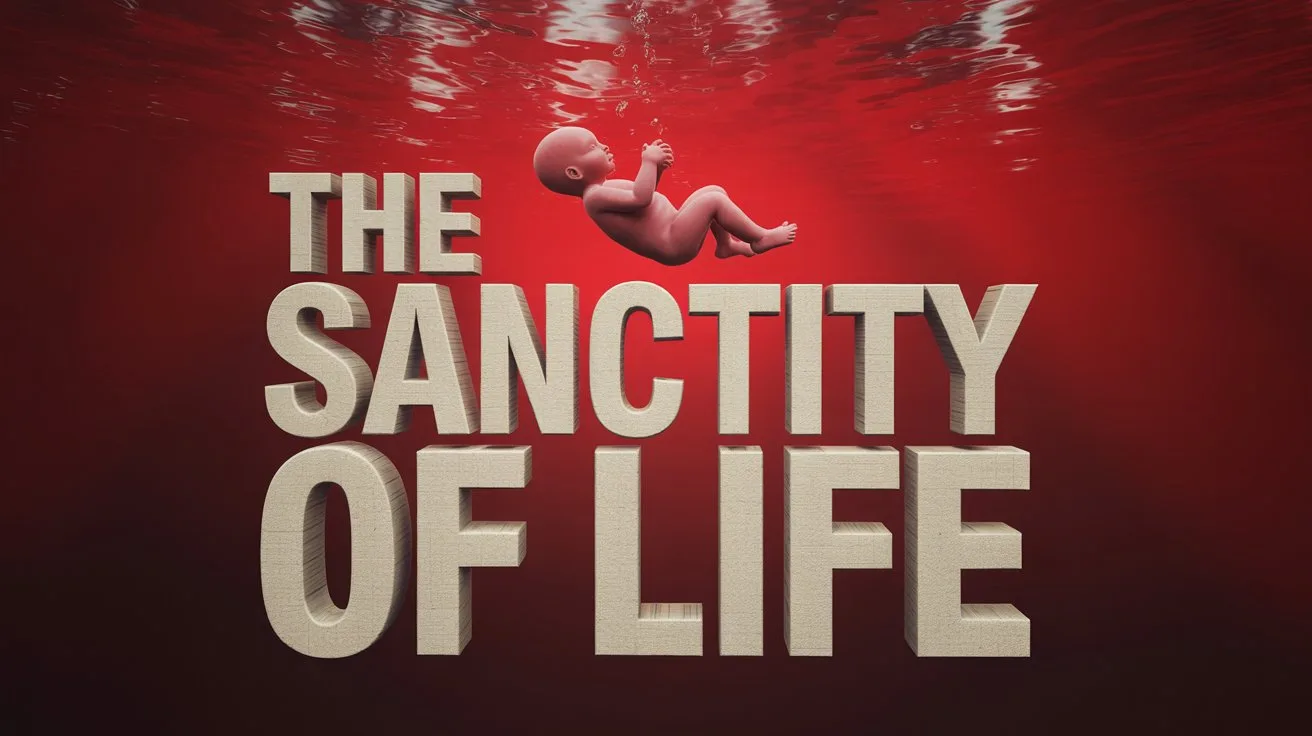
The Bible does not treat human life as a value we vote on or measure by usefulness. It treats life as sacred because God made people in a special way. Genesis 1:26-27 puts that right at the start, and it gives us the footing we need for thinking clearly about the unborn, the weak, the disabled, the elderly, and every person in between.
Made in His image
Genesis 1 is written as straightforward history, not as a vague religious reflection. The chapter moves in a steady pattern: God speaks, God makes, and what He makes is exactly what He intends. When the text gets to mankind, it slows down. It uses more words. It even includes God’s own counsel within Himself. That is already a signal that something different is happening with humans than with everything else in creation.
Then God said, "Let Us make man in Our image, according to Our likeness; let them have dominion over the fish of the sea, over the birds of the air, and over the cattle, over all the earth and over every creeping thing that creeps on the earth." So God created man in His own image; in the image of God He created him; male and female He created them. (Genesis 1:26-27)
Notice the wording
Genesis 1:26 starts with God saying, let Us make man. That plural language has been handled different ways, but at minimum it shows personal fellowship in God’s own being as He creates mankind. It does not teach multiple gods. The rest of Scripture is clear there is one God. The wording also puts a spotlight on mankind as the focus of careful, intentional creation.
Then the passage ties God’s image and likeness to dominion. Dominion is not a license to harm or exploit what God made. It is an assignment to rule under God’s authority, like a steward managing what belongs to someone else. Humans are meant to represent God’s rule on the earth in a creaturely way: to cultivate, guard, order, and use creation rightly.
What makes humans different
For the sanctity of life, it is simple. The value of a human being is not grounded in size, strength, independence, intelligence, or productivity. It is grounded in what God says mankind is. When God marks humans out as His image-bearers, He gives every human life a fixed worth that does not rise and fall with health, age, location, wantedness, or ability.
Here is an easy detail to miss. Genesis 1:27 repeats the same point three times in one verse: created, in His image, male and female. That repetition is not filler. It is emphasis. God plants a stake in the ground. If you want to know what a human is, you do not start with courts, trends, or convenience. You start with the Creator.
A word note
The Hebrew word for image is tselem. In the Old Testament it is used for an image or representation. The idea is not that God has a human body and we resemble Him physically. Scripture is clear that God is spirit. The word points to representation: humans are made to reflect something true about God in the world and to answer to Him as moral creatures. We can know Him, reason, choose, love, worship, and live responsibly before Him. We are not God, but we are His image-bearers.
This is why Christians should be careful with language that treats certain people as less than fully human when they are small, weak, unwanted, or dependent. Dependence is not a defect. Newborns are dependent. The sick are dependent. Many elderly people become dependent. None of that erases the image of God.
Male and female
The text also says God created them male and female. That means both sexes carry the image of God equally. The image is not owned by one sex more than the other, and it is not tied to cultural status. Genesis 1 sets a baseline the world keeps trying to dodge: every human life has God-given dignity.
That includes the unborn. Genesis 1 does not spell out embryology. It gives the category. Human beings are a distinct kind of creature because God made them in His image. If the unborn is truly human, then the unborn bears that same image. The next question is whether the Bible treats life in the womb as real human life. It does.
Life in the womb
The Bible speaks about the womb with an honesty that is both tender and firm. It does not treat what is inside the womb as a maybe-person. It treats that life as known by God and involved in real human identity. Different passages speak to different angles, but they lean the same direction.
John and Jesus before birth
Luke records an event where Elizabeth’s unborn child responds to Mary’s greeting. Luke’s main point is the greatness of Christ and the Spirit-led role of John as the forerunner. But along the way, the Holy Spirit uses normal, personal language for the unborn and treats what happens in the womb as the actions of a real child.
And it happened, when Elizabeth heard the greeting of Mary, that the babe leaped in her womb; and Elizabeth was filled with the Holy Spirit. Then she spoke out with a loud voice and said, "Blessed are you among women, and blessed is the fruit of your womb! (Luke 1:41-42)
There is also a quiet but important Christological detail. Elizabeth calls Mary the mother of her Lord while Jesus is still in Mary’s womb.
But why is this granted to me, that the mother of my Lord should come to me? (Luke 1:43)
That is not just polite religious talk. It fits the truth that the Son of God took on real humanity. He did not become human at birth. He became human when He was conceived by the Holy Spirit in Mary’s womb. Jesus is unique, of course. But Luke is not embarrassed to speak of real identity and real personhood in the womb.
God forms life
Psalm 139 comes from a different setting. David is worshiping God for God’s complete knowledge of him. In that worship, he talks about God’s work in the womb. The language is poetic, but the claim is plain: God is personally involved with that life before birth.
For You formed my inward parts; You covered me in my mother's womb. I will praise You, for I am fearfully and wonderfully made; Marvelous are Your works, And that my soul knows very well. (Psalm 139:13-14)
David does not speak as if the womb is a place where impersonal biology runs on its own and then a person shows up later. He speaks as someone who was being formed by God. That pushes back on a common cultural move: treating the unborn as valuable only if someone else assigns value. Psalm 139 roots value in God’s hands, not in human opinion.
Known before birth
Jeremiah 1:5 is about Jeremiah’s calling, not a blanket statement that every person is called to be a prophet. We need to keep the context straight. Still, the verse shows something true about God: His knowledge and purpose reach into the womb. God is not meeting a person for the first time at delivery.
"Before I formed you in the womb I knew you; Before you were born I sanctified you; I ordained you a prophet to the nations." (Jeremiah 1:5)
Put those passages together and the direction stays consistent. The Bible treats the unborn as human life under God’s care. It does not flatten the womb into a morally neutral space where life becomes meaningful only when someone grants it status later.
That brings us to the moral question Christians cannot avoid. If the unborn is human life made in God’s image, what does God say about the deliberate taking of innocent human life?
Truth, sin, and mercy
The Bible’s command against murder is not a social contract. It is a moral line rooted in God’s authority and in the value of the image-bearer. That command sits underneath every discussion about abortion, even when the culture tries to change the vocabulary.
"You shall not murder. (Exodus 20:13)
Words and reality
People often try to make abortion feel less serious by using distance words. Calling a child a fetus is one example. Fetus is just a stage-of-development term. It does not mean non-human. It is like saying infant, toddler, or teenager. The label tells you something about development, not something about whether the child is a person.
Another move is to split human from person, as if a living human can be present but not yet worthy of moral protection. Scripture does not treat personhood as a sliding scale we adjust when life gets inconvenient. The Bible ties moral protection to what humans are: image-bearers.
Genesis makes that connection explicit after the flood when God explains why shedding human blood is uniquely serious.
"Whoever sheds man's blood, By man his blood shall be shed; For in the image of God He made man. (Genesis 9:6)
Genesis 9:6 is not mainly a lesson about legal systems. It gives the reason human bloodshed carries a special weight. The stated reason is the image of God. That means the moral weight is not something society gets to revise when it wants a different outcome.
The hard cases
Rape and incest are horrific sins. They are violent crimes. A woman who has suffered that deserves protection, care, and real justice. Scripture does not minimize evil done to her, and neither should the church. People should not be pushed into silence, disbelief, or shame when they have been harmed.
At the same time, the child conceived is not the offender. The Bible’s pattern is not to punish the innocent for the guilty. The crime should be answered with justice against the criminal, not death for the child. Saying that is not meant to be cold. It is meant to be honest. Adding another act of violence does not heal the first one.
Medical crisis cases also require careful speech. Sometimes a pregnancy involves life-threatening complications. Christians should be grateful for doctors who act quickly to save lives. There is a moral difference between directly killing a child and providing medical care aimed at saving the mother in an emergency, even when the child cannot survive because of the brokenness of the situation. Intent and action matter. We should speak with humility where situations are complex, and we should speak plainly where the deliberate taking of innocent life is in view.
Plan B and early life
Confusion also shows up around drugs marketed as emergency contraception. The key question is timing. If conception has already occurred, then a new human life exists. From that point, any action intended to end that life is not morally neutral, even if the child is unseen and microscopic.
Some people argue about when pregnancy begins by medical definition. Christians should not base moral truth on a definition chosen to quiet the conscience. The Bible’s concern is the life God forms and knows. Psalm 139 and Jeremiah 1 push our thinking earlier than birth, and they fit naturally with the understanding that human life begins when God brings that new life into existence at conception. Where specific products work by preventing implantation after fertilization, that is not just contraception in effect. It is ending a new human life at its earliest stage.
Speaking with mercy
Now we need to say this plainly. If abortion is part of your past, the Bible does not leave you with nowhere to go. Abortion is sin because it is the taking of innocent life, but it is not a special category of sin that out-sins the cross. Jesus Christ died for sinners. He died for all. His blood is enough for real guilt and real regret.
If we confess our sins, He is faithful and just to forgive us our sins and to cleanse us from all unrighteousness. (1 John 1:9)
Forgiveness is not earned by self-punishment or years of shame. God forgives on the basis of Christ when a person comes to Him honestly. Confession means you stop defending it and call it what God calls it. Faith means you stop trusting yourself and rest your case on Jesus Christ alone. Salvation is by grace through faith, not by cleaning yourself up first. Good works and real change follow, but they do not buy forgiveness.
The church also has to learn to speak in a way that is both true and safe. Not safe as in hiding sin, but safe as in a place where repentance is met with help, not gossip or public humiliation. Jesus did not excuse sin, and He did not crush the sinner who came to Him.
She said, "No one, Lord." And Jesus said to her, "Neither do I condemn you; go and sin no more." (John 8:11)
We need both sides of that. If we speak for the unborn but have no patience for wounded women, we are not thinking like Christ. And if we claim compassion while denying what abortion is, we are not speaking truthfully.
Valuing life also means doing more than voting and arguing. It means helping mothers who feel trapped, abandoned, and scared. It means urging fathers to take responsibility instead of disappearing. It means families in the church stepping up in practical ways: rides, meals, baby supplies, childcare, steady friendship, and, when needed, adoption support handled with integrity and care. Saying life is sacred should show up in how we treat the people caught in the pressure of real-life crisis.
My Final Thoughts
Genesis 1:26-27 gives the basic reason human life is sacred: God made mankind in His image. When you follow the Bible’s own language about life in the womb, it consistently treats the unborn as real human life known by God. That is why abortion is not just a personal choice. It is the deliberate ending of an innocent life, and Scripture does not give us room to bless what God calls sin.
The same Bible that speaks clearly about sin also speaks clearly about mercy. Salvation is God’s gift through faith in Jesus Christ alone. If someone has participated in abortion, there is real forgiveness and real cleansing in Christ. For the church, faithfulness here means truth plus love, not truth without love, and not love that refuses to tell the truth.



 Get the book that teaches you how to evangelize and disarm doctrines from every single major cult and religion.