
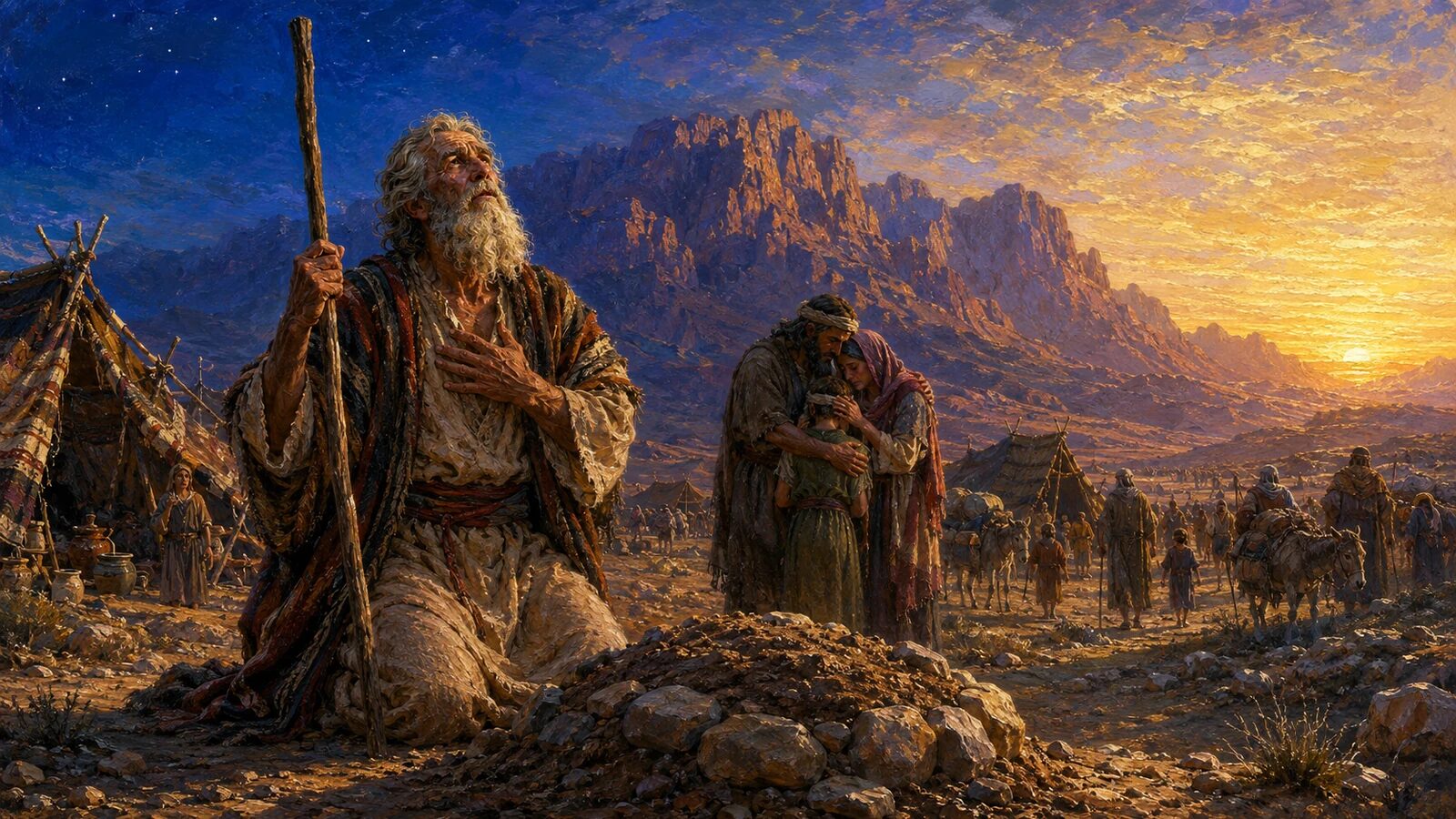
In Psalm 90, Moses prayed, “From everlasting to everlasting, You are God.” He was speaking to the God who existed before the mountains, yet asking Him for help with the brief lives we have here. I find that encouraging because I cannot stop time or guarantee what tomorrow will bring. We can bring those limitations before God and ask Him for mercy, wisdom, and work worth doing.
Psalm 90 and the Eternal God
The heading identifies this psalm as “A Prayer of Moses the man of God.” Moses knew the frailty of the people he led. They had been delivered from Egypt, heard God’s words at Sinai, and received manna, yet many hardened themselves against Him. After Israel refused to enter the land at Kadesh Barnea, God sentenced that rebellious generation to die in the wilderness while their children entered the land.
The psalm does not identify the occasion on which Moses wrote it. His years of leading a people who moved their tents and buried their dead help us understand why he began this way:
Lord, You have been our dwelling place in all generations.
The Lord had been the refuge of His people through generations of change. They had no settled home in the wilderness, but they could turn to the same God their fathers had known. Moses then spoke of His existence before the world began:
Before the mountains were brought forth, Or ever You had formed the earth and the world, Even from everlasting to everlasting, You are God.
Mountains can seem permanent when we measure them against our own lives. A family may live beneath the same ridge for generations, even as the people in that home grow old and die. Moses says even those mountains were brought forth. The world was formed, but he never says that God was formed or became God. Before any of it existed, “You are God.”
The Hebrew word olam, translated “everlasting,” can describe ancient time or an enduring future, with the extent understood from its context. We should not force every occurrence to carry exactly the same meaning. Here Moses places God before the beginning of the world and speaks of Him from everlasting to everlasting. I understand that to mean He has neither beginning nor end. He is the uncreated Creator, not simply the oldest being in existence.
That puts our own lives in perspective. In the rest of the psalm, Moses describes people returning to dust and a thousand years passing before God like yesterday. He also acknowledges sin and God’s anger. Our short lives are not merely an unfortunate limit to work around; we are accountable to the God who gave them.
Yet Moses ends by asking for wisdom, compassion, gladness, and work God will establish. He does not conclude that a short life is a useless one. If God is our dwelling place, we can ask Him to teach us how to spend our days instead of assuming there will always be another opportunity to obey Him.
Before Creation and Above Time
Genesis begins with God already present to create:
In the beginning God created the heavens and the earth.
No account of His origin comes before that statement. He does not receive life from someone greater, and He needs none of the things He makes in order to exist. Everything created depends on Him. That is why we must distinguish the Creator from the universe rather than describe Him as its soul or one powerful force within it.
If I make God part of the world, I have reduced Him to something dependent on the very creation He sustains. It also becomes easier to give divine honor to created things. Psalm 33 directs our worship to the One whose word brought the heavens into being:
By the word of the LORD the heavens were made, And all the host of them by the breath of His mouth.
His command brought the heavens into being without help from some greater power. The sun, moon, and stars continue to depend on Him, as we depend on Him for life and breath. He needs nothing outside Himself to sustain Him, and passing years cannot exhaust Him or improve His wisdom and holiness.
We live one moment at a time and often misunderstand even what has already happened. Tomorrow can make us anxious because we cannot see it. God knows the end from the beginning, and no threat takes Him by surprise. I can trust what Scripture says about His knowledge and authority without pretending to have settled every philosophical question about His relation to time.
Nor does His greatness make Him indifferent to people with such limited lives. Isaiah puts His eternal majesty and His care for the humble together:
For thus says the High and Lofty One Who inhabits eternity, whose name is Holy: “I dwell in the high and holy place, With him who has a contrite and humble spirit.”
Contrite describes someone who is grieved by sin and willing to acknowledge it instead of defending it. Isaiah was confronting idolatry and unfaithfulness, so this is not a promise that God approves of whatever we choose. The passage speaks of His judgment and His willingness to heal and revive. The Holy One receives people who come humbly to Him.
I do not have to impress the God who inhabits eternity before He will hear me. If I claim to honor His greatness while refusing to admit my sin, I am resisting the very God I say I revere. He already knows my weakness, and Isaiah gives me reason to seek His mercy rather than hide behind excuses.
Scripture records His involvement with people across generations. He called Abraham and delivered Israel, then spoke through the prophets. In the fullness of time He sent His Son, and after wicked men killed Jesus, God raised Him bodily. The Holy Spirit now dwells within believers as they await Christ’s return. God’s eternity does not leave Him watching events with detached indifference. He acts within the world He made and brings His purposes to completion.
The God Who Does Not Change
As God deals with changing circumstances, His own character remains dependable. We may change because we learn something, recognize that we were wrong, or grow tired of a responsibility. We may also become dishonest or cruel, betraying the trust people have placed in us. God has no ignorance to overcome or moral failure to correct. His holiness does not deteriorate, and His faithfulness does not wear out.
“For I am the LORD, I do not change; Therefore you are not consumed, O sons of Jacob.”
Malachi was addressing a people whose conduct deserved judgment. They had ignored God’s commands and withheld the tithes and offerings He required, yet He had not consumed them. Their disobedience had not erased His covenant promises. The following call to return was an offer of mercy from the same God who exposed their sin.
I need to receive that mercy without turning it into presumption. God’s patience gives me an opportunity to repent; it does not make disobedience harmless. His unchanging character means I can trust both His promise and His warning.
James describes His generosity with a comparison to the lights He created:
Every good gift and every perfect gift is from above, and comes down from the Father of lights, with whom there is no variation or shadow of turning.
Created lights shift and cast moving shadows, but the Father of lights does not become less good from one day to the next. His willingness to give what is good does not depend on a favorable mood. I can bring a need before Him without wondering whether He has become a different God since the last time I prayed.
The same confidence applies to His word. Cultural approval cannot make something true that God has called false, and changing public opinion cannot cancel His promises. He will not discover later that He made a mistake in what He told us.
The Eternal Son
When we speak of the eternal God, we must include the Son. Jesus is fully God and co-eternal with the Father and the Holy Spirit. The three are distinct Persons, not three gods. The Son is not the Father, and He was never a creature who eventually rose to divine status. John introduces Him as the Word:
In the beginning was the Word, and the Word was with God, and the Word was God.
The Word already existed in the beginning. He was with God, which distinguishes the Persons, and He was God, which declares His deity. John 1:3 goes on to say that everything created was made through Him. I cannot place the Word among created beings when John identifies Him as their Creator.
John later says the Word became flesh. That is the incarnation: the eternal Son taking on true humanity without ceasing to be God. The One born at Bethlehem had already existed before the world was made. Paul likewise identifies Him as Creator:
For by Him all things were created that are in heaven and that are on earth, visible and invisible… All things were created through Him and for Him.
Paul goes on to say that Christ is before all things and that in Him all things consist. He continues to sustain what He made, including the world He entered when He became man. He had not left creation running on its own and returned to discover what had happened.
Revelation expresses this divine authority with the title Alpha and Omega, the first and last letters of the Greek alphabet:
“I am the Alpha and the Omega, the Beginning and the End,” says the Lord, “who is and who was and who is to come, the Almighty.”
At the end of Revelation, Jesus also calls Himself the Alpha and the Omega, the Beginning and the End, and the First and the Last. These titles belong to Him because He shares the divine nature. The One who promised to return has authority over the whole course of history and will bring it to its appointed completion.
Paul brings the Son’s greatness and saving work together in the opening of Hebrews. God made the worlds through the Son, who upholds all things by His powerful word and purged our sins. The Creator came to save people who cannot sustain their own lives, much less cleanse themselves of sin.
Jesus was without sin and willingly gave Himself to be slain as the perfect sacrifice for our sins. Wicked men tortured His body and crucified Him. Through His shed blood and death He completed that saving sacrifice, then was buried and rose bodily. The Father did not punish, curse, abandon, strike, bruise, or pour wrath on Him. Father and Son were united in providing our salvation.
The risen Son sat down at the right hand of the Majesty on high. His saving work was accomplished, and He does not need to repeat the sacrifice. Later in Hebrews, Paul gives this assurance:
Jesus Christ is the same yesterday, today, and forever.
The Savior who received sinners in the Gospels has not become reluctant to receive them now. His mercy and authority have not changed. He remains the Mediator who brings us to God, the Shepherd who keeps His people, and the King who will return. We are trusting the same Lord who shed His blood and rose from the grave.
Everlasting Life in Christ
The everlasting life we receive from Christ is a gift, and that distinguishes it from God’s own eternal nature. He never began to exist and depends on nothing outside Himself. We began as creatures and will always depend on Him. Union with Christ gives believers truly endless life without making us divine or self-existent.
My hope would be precarious if it depended on a savior who could eventually cease to exist. It would be no more secure if keeping His promise depended on the strength of my feelings or my ability to hold on. Christ is eternal, His sacrifice is sufficient, and He faithfully keeps His sheep. When someone is born again, the Holy Spirit gives that person new life in Christ. That new life produces obedience, but obedience does not earn or keep salvation. Our security rests in the Savior’s faithfulness, even when circumstances and feelings change.
The lost do not receive that everlasting life. After their bodily resurrection, they face the Great White Throne judgment and the Lake of Fire. This is the second death, the final and irreversible destruction of human body and soul. Human souls are not inherently immortal, and I do not understand Scripture to teach everlasting conscious torment as the final fate of unbelieving people. Eternal life is God’s gift in Christ, received by grace as we turn in repentance and faith to His crucified and risen Son.
Moses prayed for wisdom in using the time God had given him. I cannot assume there will always be time later to deal with a sin I am excusing now. Nor should I dismiss the responsibilities God has already given me because my work seems ordinary or my life seems short. Moses asked God to establish the work he and his people did. We can ask Him for wisdom in what we do today while trusting Him with the years beyond our reach.
My Final Thoughts
Psalm 90 directs me to the God who was there before the mountains and remains the dwelling place of His people. He knows how brief our lives are, and He receives those who come humbly for mercy. The eternal Son entered His creation to save sinners and gives everlasting life to those who believe. I can rely on His promise while asking Him to correct how I am using the days He has given me.