
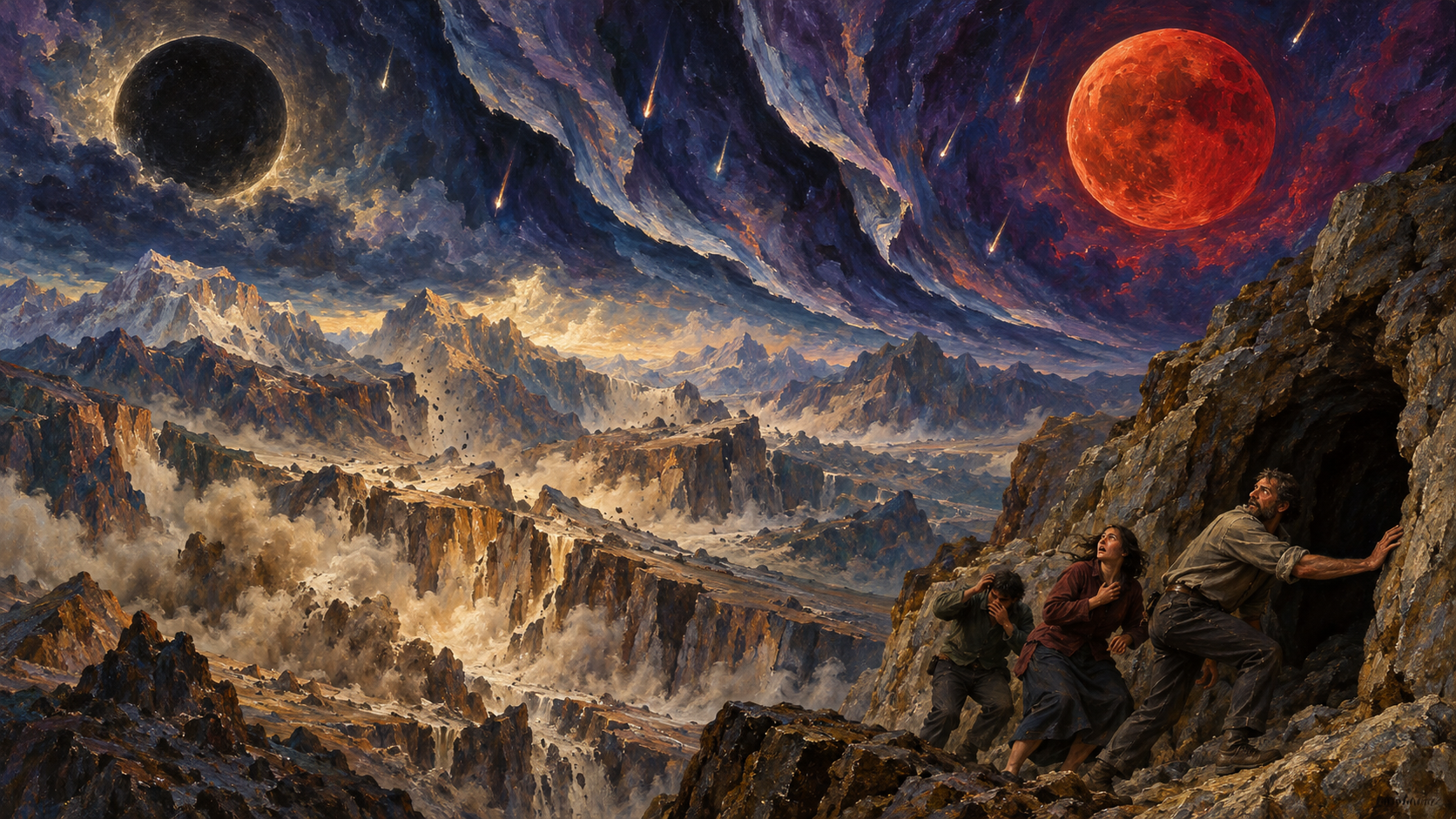
A red moon can prompt immediate claims about Joel or Revelation, but a familiar phrase is not enough to identify a fulfilled prophecy. I need to read what accompanies the changed moon, when the passage places it, and what God says He will accomplish. The biblical signs belong to connected judgments and Christ’s appearing. They cannot be reduced to an eclipse photographed against tonight’s sky.
Ordinary Eclipses and Prophetic Signs
God made the sun, moon, earth, and atmosphere. Their orderly relationships allow astronomers to predict eclipses. During a total lunar eclipse, Earth comes between the sun and moon, and sunlight filtered through Earth’s atmosphere can make the moon appear copper, orange, or red. A solar eclipse occurs when the moon passes between Earth and the sun, obscuring the sun for observers in particular locations. NASA’s explanation of eclipses describes these ordinary physical processes.
The popular name “blood moon” does not turn every red lunar eclipse into Joel’s sign. Joel places the changed moon alongside blood, fire, smoke, and a darkened sun. Revelation 6 includes a great earthquake, falling stars, a receding sky, and displaced mountains and islands. In Matthew 24, disturbed heavenly lights accompany the Son of Man’s public return. A lunar eclipse alone does not fulfill those connected descriptions.
A lunar tetrad is a series of four consecutive total lunar eclipses, as NASA explains. Some prophecy teachers give special significance to tetrads near biblical feast dates, but Scripture supplies no such calendar for calculating Christ’s return. A pattern may be interesting without having prophetic authority. Calling believers to watch does not authorize us to invent a sign God never gave.
Nor should we explain away the promised signs as mere political metaphors. The prophets do use darkened lights when describing judgments on nations, and that background deserves attention. I understand the future signs as real acts of God affecting creation. We can recognize prophetic language while taking seriously the upheaval He says will occur.
Joel, Pentecost, and the Day of the LORD
Joel begins with a locust invasion that devastated the land and disrupted ordinary worship. He calls priests, elders, and people to lament and return to the LORD. No king is named, and interpreters debate the book’s date, but its immediate setting is plain: God’s covenant people face severe chastening and need to repent. From that crisis, Joel looks toward restored blessing, the outpouring of the Spirit, and a greater Day of the LORD.
"And it shall come to pass afterward That I will pour out My Spirit on all flesh; Your sons and your daughters shall prophesy, Your old men shall dream dreams, Your young men shall see visions. And also on My menservants and on My maidservants I will pour out My Spirit in those days. "And I will show wonders in the heavens and in the earth: Blood and fire and pillars of smoke. The sun shall be turned into darkness, And the moon into blood, Before the coming of the great and awesome day of the LORD. And it shall come to pass That whoever calls on the name of the LORD Shall be saved. For in Mount Zion and in Jerusalem there shall be deliverance, As the LORD has said, Among the remnant whom the LORD calls.
The promise begins with the Spirit being poured out across generations and social positions. Sons and daughters, old and young, and servants would receive what God gave. “All flesh” does not mean every human being automatically receives the Spirit or is saved. The people Joel names show the breadth of the promise, while the invitation calls them to turn to the LORD.
The moon’s being turned “to blood” belongs to a larger scene of wonders in heaven and earth. Joel does not name a physical mechanism. Blood, fire, rising smoke, the darkened sun, and the changed moon appear before the great and awesome Day. Even in that warning, God promises salvation to whoever calls on His name.
Joel 3 continues with judgment among the nations, the valley of decision, and the LORD roaring from Zion and dwelling there. An open invitation to mercy is not a guarantee that everyone will accept it. Those who call on the LORD find deliverance; rebellion still faces His judgment.
Peter quoted this promise to explain what happened at Pentecost. The disciples were filled with the Spirit and spoke in languages visitors from many lands understood. Some listeners accused them of drunkenness, and Peter stood with the eleven to answer them.
But Peter, standing up with the eleven, raised his voice and said to them, "Men of Judea and all who dwell in Jerusalem, let this be known to you, and heed my words. For these are not drunk, as you suppose, since it is only the third hour of the day. But this is what was spoken by the prophet Joel: 'And it shall come to pass in the last days, says God, That I will pour out of My Spirit on all flesh; Your sons and your daughters shall prophesy, Your young men shall see visions, Your old men shall dream dreams. And on My menservants and on My maidservants I will pour out My Spirit in those days; And they shall prophesy. I will show wonders in heaven above And signs in the earth beneath: Blood and fire and vapor of smoke. The sun shall be turned into darkness, And the moon into blood, Before the coming of the great and awesome day of the LORD. And it shall come to pass That whoever calls on the name of the LORD Shall be saved.'
Peter said, “This is what was spoken by the prophet Joel.” I cannot reduce that declaration to an illustration unrelated to fulfillment. The promised outpouring had begun through the risen and exalted Christ. Yet Acts does not describe the sun becoming dark or the moon becoming bloodlike that morning, and the final Day of judgment had not arrived.
I understand Peter to be presenting the whole movement of Joel’s promise, with the beginning now visible and the cosmic culmination still future. Prophecy can bring separated stages into one view, as Old Testament passages place the Messiah’s suffering beside the glory that would follow. Pentecost truly belongs to Joel’s fulfillment, but it did not exhaust everything Joel announced.
The Day of the LORD likewise must be understood from each passage’s scope. It is not a twenty-four-hour label for a particular eclipse. The prophets use the expression for decisive divine intervention in judgment, bringing proud powers low and vindicating God’s purposes. Historical judgments can anticipate the final reckoning, while other passages describe the future Tribulation, Christ’s public return, His kingdom, and the renewal of creation.
I understand those future events in an ordered sequence. Christ gathers His church before the seven-year Tribulation. The seven years come from Daniel 9’s final prophetic “week” concerning Daniel’s people and Jerusalem; its covenant and the violation halfway through explain the divided halves developed elsewhere in prophecy. During that period, judgments expose the rebellion led by Antichrist, and God’s public dealings with Israel come to the foreground. Christ then returns bodily, defeats His enemies, delivers Israel, and reigns for a literal thousand years. Evil is finally defeated and creation renewed.
These events belong to one Lord’s purpose without occurring at one instant. First Thessalonians 5 describes sudden destruction overtaking an unprepared world, Matthew 24 places Christ’s visible coming after the Tribulation, and 2 Peter 3 reaches to the dissolution of the present heavens and earth. We need to preserve those settings rather than use the shared expression to flatten their sequence.
The Sixth Seal and Christ’s Visible Return
Revelation 5 identifies Jesus Christ as the Lamb worthy to take the sealed scroll and open it. The judgments that follow are under His authority. By the sixth seal, the disruption reaches throughout earth and sky.
I looked when He opened the sixth seal, and behold, there was a great earthquake; and the sun became black as sackcloth of hair, and the moon became like blood. And the stars of heaven fell to the earth, as a fig tree drops its late figs when it is shaken by a mighty wind. Then the sky receded as a scroll when it is rolled up, and every mountain and island was moved out of its place. And the kings of the earth, the great men, the rich men, the commanders, the mighty men, every slave and every free man, hid themselves in the caves and in the rocks of the mountains, and said to the mountains and rocks, "Fall on us and hide us from the face of Him who sits on the throne and from the wrath of the Lamb! For the great day of His wrath has come, and who is able to stand?"
The moon becomes “like blood.” That comparison describes its appearance without identifying a cause, and it gives us no reason to reduce the event to an inward feeling or a political change. John places it within an extraordinary disturbance of creation. An ordinary eclipse does not account for the earthquake, falling stars, receding sky, and movement of every mountain and island.
Blood imagery must also be read within its setting. Scripture elsewhere associates blood with life, violent death, sacrifice, and covenant, but we should not transfer every association into the moon’s changed appearance. Revelation 6 places the bloodlike moon within the scene of wrath. We should not make its appearance into a separate symbol of redemption when John places it among signs of judgment.
John also describes the human response. Rulers, commanders, wealthy people, slaves, and free people all seek shelter from the One on the throne and the wrath of the Lamb. Rank and resources cannot protect them. Their question, “Who is able to stand?” is followed in Revelation 7 by God’s servants and a redeemed multitude standing before His throne. Their safety comes from the salvation of God and the Lamb.
The Lamb’s wrath is His righteous judgment against rebellion. It must not be confused with the claim that the Father poured wrath on Jesus at the cross. The eternal Son, fully God and fully man, was sinless. Wicked men physically tortured and punished Him, while He willingly bore that real punishment for our sins in His innocent body. He shed His blood and died, completing His saving work before rising bodily. The Father did not punish, curse, abandon, strike, bruise, or pour wrath on Jesus. Christ died for the whole world and genuinely offers salvation, but He will judge those who finally refuse Him.
Jesus also described cosmic upheaval when answering His disciples’ questions after He foretold the temple’s destruction. Matthew 24 moves through false christs, wars, persecution, the abomination of desolation—a sacrilegious act in the holy place—and great Tribulation before describing His public appearing.
For as the lightning comes from the east and flashes to the west, so also will the coming of the Son of Man be. For wherever the carcass is, there the eagles will be gathered together. "Immediately after the tribulation of those days the sun will be darkened, and the moon will not give its light; the stars will fall from heaven, and the powers of the heavens will be shaken. Then the sign of the Son of Man will appear in heaven, and then all the tribes of the earth will mourn, and they will see the Son of Man coming on the clouds of heaven with power and great glory. And He will send His angels with a great sound of a trumpet, and they will gather together His elect from the four winds, from one end of heaven to the other.
The timing is explicit: “Immediately after the tribulation of those days” the heavenly lights are darkened and the powers of heaven shaken. Then the Son of Man appears, and the tribes of the earth mourn as they see Him coming in power and glory. Jesus compares His coming to lightning spanning the sky. His return will be public and unmistakable, not dependent on someone’s secret interpretation of a photograph.
I distinguish that appearing from the church’s gathering in 1 Thessalonians 4. Paul comforts the church with the resurrection of dead believers and the catching up of living believers to meet Christ in the air. Matthew 24 addresses Israel’s Tribulation setting and the Son of Man’s open arrival afterward. The same Lord acts in both, but their different settings must remain part of our interpretation.
The verbal parallels lead some interpreters to identify Matthew’s cosmic signs with Revelation’s sixth seal. Others place the seal earlier, following the sequence of judgments in Revelation. I understand the sixth seal to occur earlier and the disturbances to recur, culminating in the signs immediately before Christ’s visible return. A future fulfillment does not require every darkening to happen at the same moment.
The fourth trumpet gives us a specific reason to distinguish these disturbances.
Then the fourth angel sounded: And a third of the sun was struck, a third of the moon, and a third of the stars, so that a third of them were darkened. A third of the day did not shine, and likewise the night. And I looked, and I heard an angel flying through the midst of heaven, saying with a loud voice, "Woe, woe, woe to the inhabitants of the earth, because of the remaining blasts of the trumpet of the three angels who are about to sound!"
Here one-third of the sun, moon, and stars is struck, diminishing both day and night before the announcement of three further woes. The repeated fraction indicates restraint within severe judgment. Revelation places the trumpets after the seventh seal opens, so the fourth trumpet cannot simply be merged with the sixth seal as though John gave no further sequence.
The bowls later intensify judgment on the rebellious world. After the Tribulation, the climactic signs accompany Christ’s public return. That progression gives us further reason to distinguish recurring disturbances rather than force them into a single astronomical event.
We should be more cautious about physical mechanisms. John describes something like a mountain and an object like a star burning as a torch elsewhere in these judgments. Such comparisons tell us what he saw; they do not identify a particular asteroid, weapon, or satellite. Scripture gives no authority to supply those identities from current technology or a changing atmospheric theory.
Old Testament Foundations and the Meaning of the Signs
Isaiah, Ezekiel, Amos, Joel, and Zephaniah used darkness and shaken heavens in judgment prophecies before John wrote Revelation. Their historical settings help us recognize what the future signs mean: God confronts rebellion and overturns powers that seem secure.
Isaiah 13 names Babylon as its immediate subject, then describes judgment in language reaching beyond one city’s fall toward the worldwide Day of the LORD.
Wail, for the day of the LORD is at hand! It will come as destruction from the Almighty. Therefore all hands will be limp, Every man's heart will melt, And they will be afraid. Pangs and sorrows will take hold of them; They will be in pain as a woman in childbirth; They will be amazed at one another; Their faces will be like flames. Behold, the day of the LORD comes, Cruel, with both wrath and fierce anger, To lay the land desolate; And He will destroy its sinners from it. For the stars of heaven and their constellations Will not give their light; The sun will be darkened in its going forth, And the moon will not cause its light to shine. "I will punish the world for its evil, And the wicked for their iniquity; I will halt the arrogance of the proud, And will lay low the haughtiness of the terrible. I will make a mortal more rare than fine gold, A man more than the golden wedge of Ophir. Therefore I will shake the heavens, And the earth will move out of her place, In the wrath of the LORD of hosts And in the day of His fierce anger.
The darkened lights accompany God’s punishment of evil and His humiliation of the proud. Babylon’s fall belongs to the passage’s setting; it is not an excuse to turn the prophecy into an eclipse timetable. I understand its language to reach toward the final, worldwide fulfillment of that judgment. An empire’s apparent permanence cannot preserve it when God acts.
Ezekiel 32 uses the heavens’ darkening in a lament over Pharaoh and Egypt. The chapter portrays the ruler through the imagery of a lion and a sea monster before announcing his fall.
When I put out your light, I will cover the heavens, and make its stars dark; I will cover the sun with a cloud, And the moon shall not give her light. All the bright lights of the heavens I will make dark over you, And bring darkness upon your land," Says the Lord GOD.
The extinguished lights belong to Egypt’s public overthrow. They show that Pharaoh could not preserve the kingdom’s order or protect it from the Creator. I would not make this separate judgment on Egypt into a scientific explanation for Matthew 24. The common language connects God’s authority over nations and heavens while each passage keeps its own subject.
Amos 8 addresses people trampling the needy, falsifying scales, and treating days of worship as interruptions to profit. A darkened sun at noon and feasts turned to mourning announce judgment on that society. The signs concern the God who judges oppression and idolatry, not simply an impressive sight. We should not become fascinated by the sky while ignoring the wrongdoing the prophets confronted.
These passages also expose the limits of human refuge. Babylon boasted in its power, Pharaoh in his kingdom, and corrupt Israelites in wealth. Revelation’s rulers repeat the error, seeking caves when creation itself is shaken. The God who established the ordinary order of the heavens can interrupt it. Neither money nor political strength can make rebellion safe from Him.
The shaken heavens also precede the rightful King’s appearing. Matthew 24 moves to the Son of Man’s return, and Joel 3 to the LORD roaring from Zion and dwelling there. Creation is not slipping beyond its Maker’s reach. He acts against rebellious rule and brings His promises to completion. The warnings given through prophets, Christ, and apostles leave us with reason to repent before judgment arrives.
Fear, Hope, and Faithful Watchfulness
Luke 21 speaks of Jerusalem’s desolation and also looks toward the Son of Man’s public arrival. We need to follow the changing setting rather than place every part of the prophecy at one moment. The cosmic signs bring terror to the nations, but Jesus gives His faithful people a different expectation.
"And there will be signs in the sun, in the moon, and in the stars; and on the earth distress of nations, with perplexity, the sea and the waves roaring; men's hearts failing them from fear and the expectation of those things which are coming on the earth, for the powers of the heavens will be shaken. Then they will see the Son of Man coming in a cloud with power and great glory. Now when these things begin to happen, look up and lift up your heads, because your redemption draws near."
Their hope comes from knowing the King whose return brings deliverance. The same appearing that terrifies the rebellious encourages His people to lift their heads. The physical upheaval is real, yet it will not prevent Christ from keeping His word.
I do not understand Luke’s promise to place the church inside Daniel’s seventieth week. First Thessalonians 4 describes believers caught up to meet the Lord. Earlier, in 1 Thessalonians 1:10, Paul speaks of deliverance from the wrath to come, and chapter 5 says believers are not appointed to wrath. Revelation 3:10 promises that the faithful church will be kept from the worldwide hour of trial. Taken together, I understand these passages to teach a gathering before the Tribulation. Luke’s promise also gives hope to faithful people who will live through the events he describes.
That hope does not promise Christians freedom from every trouble now. Jesus said His followers would have tribulation in this world. Christians can suffer persecution, grief, war, and disaster. We also remain subject to physical death unless Christ gathers the church within our lifetime. Such suffering does not cancel His promise to keep the church from the coming worldwide hour of divine wrath. We need to distinguish affliction in this present world from that particular prophetic judgment.
Paul explains the church’s present responsibility in terms of watchfulness and sober conduct.
But concerning the times and the seasons, brethren, you have no need that I should write to you. For you yourselves know perfectly that the day of the Lord so comes as a thief in the night. For when they say, "Peace and safety!" then sudden destruction comes upon them, as labor pains upon a pregnant woman. And they shall not escape. But you, brethren, are not in darkness, so that this Day should overtake you as a thief. You are all sons of light and sons of the day. We are not of the night nor of darkness. Therefore let us not sleep, as others do, but let us watch and be sober. For those who sleep, sleep at night, and those who get drunk are drunk at night. But let us who are of the day be sober, putting on the breastplate of faith and love, and as a helmet the hope of salvation. For God did not appoint us to wrath, but to obtain salvation through our Lord Jesus Christ, who died for us, that whether we wake or sleep, we should live together with Him. Therefore comfort each other and edify one another, just as you also are doing.
The world speaks of peace and safety before sudden destruction, while believers belong to the day. Sleep and drunkenness picture moral carelessness here. Watchfulness appears in faith, love, and the hope of salvation, with believers comforting and building up one another. Paul supplies no eclipse table. He grounds assurance in God’s appointment of His people to salvation through Jesus Christ rather than wrath.
A chart cannot save anyone, and recognizing a red moon cannot produce new birth. Everyone who repents and believes in Christ receives forgiveness and eternal life by grace. The Holy Spirit indwells and seals the believer, who is eternally secure. A Christian label alone does not establish that someone has been born again, and security never permits lawlessness. The gospel directs us to Christ Himself, whose grace can be resisted but whose offer is genuine.
Peter extends the application to the final dissolution of the present creation and the new heavens and earth God promises.
But the day of the Lord will come as a thief in the night, in which the heavens will pass away with a great noise, and the elements will melt with fervent heat; both the earth and the works that are in it will be burned up. Therefore, since all these things will be dissolved, what manner of persons ought you to be in holy conduct and godliness, looking for and hastening the coming of the day of God, because of which the heavens will be dissolved, being on fire, and the elements will melt with fervent heat? Nevertheless we, according to His promise, look for new heavens and a new earth in which righteousness dwells. Therefore, beloved, looking forward to these things, be diligent to be found by Him in peace, without spot and blameless;
Knowing that the present order will pass away should lead me to holy conduct, devotion to God, and peace with others. We can resist sin, forgive, care for people, remain faithful to the gathered church, and continue proclaiming Christ while waiting for what He has promised. That is a more searching response to prophecy than following each alarming headline.
We should not wait for a changed moon or shaking ground before calling upon the Lord. Revelation shows that even severe signs do not automatically bring hardened people to repentance. The invitation is open now. We should hear God’s word, turn from sin, and trust the Savior who died and rose again.
My Final Thoughts
I do not believe an ordinary eclipse can be announced as the fulfillment of Joel or Revelation simply because the moon looks red. The passages describe connected judgments within God’s revealed purposes, and their settings and sequence deserve careful attention. Joel’s outpouring truly began at Pentecost, while the cosmic culmination remains ahead. Our hope rests in Christ gathering His people and fulfilling His word. I want that hope to produce faithful service and an honest invitation to others to call upon Him.