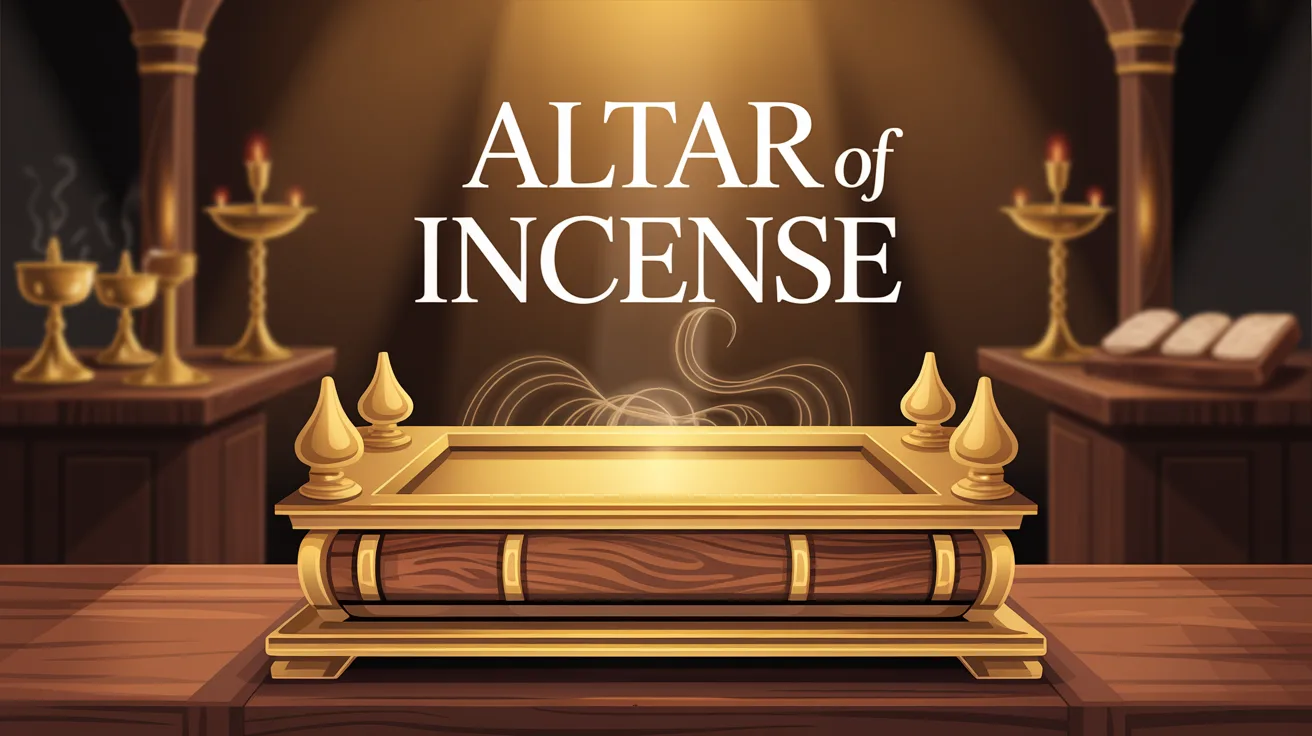

The Altar of Incense in the Law and the Tabernacle
God Himself designed this altar. It was small compared to the brazen altar, yet it stood nearest to the Most Holy Place, just before the veil. The nearness teaches us that true prayer lives close to God’s presence.
“You shall make an altar to burn incense on; you shall make it of acacia wood. A cubit shall be its length and a cubit its width, it shall be square, and two cubits shall be its height. Its horns shall be of one piece with it.”
(Exodus 30:1–2)
“You shall put it before the veil that is before the ark of the Testimony, before the mercy seat that is over the Testimony, where I will meet with you.”
(Exodus 30:6)
Moses later placed it exactly as commanded, and the priestly ministry began in rhythm with God’s pattern.
“He put the gold altar in the tabernacle of meeting in front of the veil; and he burned sweet incense on it, as the Lord had commanded Moses.”
(Exodus 40:26–27)
The Daily Rhythm of Prayer
Incense burned morning and evening. The fragrance rose when the lamps were tended. Prayer is not occasional in God’s house, it is continual.
“And Aaron shall burn on it sweet incense every morning when he tends the lamps. And when Aaron lights the lamps at twilight, he shall burn incense on it, a perpetual incense before the Lord throughout your generations.”
(Exodus 30:7–8)
David connects this altar to a life of devotion, and he even describes his prayer as a priest before God.
“Let my prayer be set before You as incense, the lifting up of my hands as the evening sacrifice.”
(Psalm 141:2)
Holy Fire, Holy Fragrance
The coals for this altar came from the brazen altar of sacrifice. This teaches us that intercession rests on atonement. We also see that God guarded the incense recipe; What was burned before Him was not common or copied for entertainment.
“You shall not make any for yourselves, according to its composition. It shall be to you holy for the Lord.”
(Exodus 30:37)
When priests ignored God’s order, judgment fell. This lesson is a sobering reminder that God receives worship on His terms, not ours.
“Then Nadab and Abihu, the sons of Aaron, each took his censer and put fire in it, put incense on it, and offered profane fire before the Lord, which He had not commanded them. So fire went out from the Lord and devoured them, and they died before the Lord.”
(Leviticus 10:1–2)
The Day of Atonement and the Cloud of Mercy
Once each year the high priest entered beyond the veil, but never without the covering cloud of incense. The smoke shielded him from death as he approached the mercy seat with blood.
“Then he shall take a censer full of burning coals of fire from the altar before the Lord, with his hands full of sweet incense beaten fine, and bring it inside the veil. And he shall put the incense on the fire before the Lord, that the cloud of incense may cover the mercy seat that is on the Testimony, lest he die.”
(Leviticus 16:12–13)
This anticipates Christ, who entered the true sanctuary for us. His sacrifice and His intercession are our access.
“For Christ has not entered the holy places made with hands, which are copies of the true, but into heaven itself, now to appear in the presence of God for us.”
(Hebrews 9:24)
“Therefore He is also able to save to the uttermost those who come to God through Him, since He always lives to make intercession for them.”
(Hebrews 7:25)
Incense and Prayer, Earth and Heaven
Scripture unites prayer with incense again in the New Testament vision of heaven. What the altar pictured on earth becomes a present reality before God’s throne.
“Now when He had taken the scroll, the four living creatures and the twenty‑four elders fell down before the Lamb, each having a harp, and golden bowls full of incense, which are the prayers of the saints.”
(Revelation 5:8)
The Golden Altar Before the Throne
John is shown the heavenly temple. The golden altar is there, not as a memory, but as a present ministry, joined to the prayers of the saints.
“Then another angel, having a golden censer, came and stood at the altar. He was given much incense, that he should offer it with the prayers of all the saints upon the golden altar which was before the throne.”
(Revelation 8:3)
“And the smoke of the incense, with the prayers of the saints, ascended before God from the angel’s hand.”
(Revelation 8:4)
This confirms what Psalm 141 taught. God receives the prayers of His people as incense. Heaven treats prayer as precious, and as effectual in the unfolding of God’s plan.
From Intercession to Judgment
Then the vision turns. The censer is filled with fire from the altar and cast to the earth. The same altar associated with mercy becomes the source from which judgments proceed.
“Then the angel took the censer, filled it with fire from the altar, and threw it to the earth. And there were noises, thunderings, lightnings, and an earthquake.”
(Revelation 8:5)
Revelation had already recorded the cry beneath the altar, because God does not ignore the blood of His witnesses or the petitions of His saints.
“And they cried with a loud voice, saying, ‘How long, O Lord, holy and true, until You judge and avenge our blood on those who dwell on the earth?’”
(Revelation 6:10)
Judgments unfold in response to the will of God, and in harmony with the prayers gathered at His altar. Later another heavenly voice sounds from this altar as trumpet judgments proceed.
“Then the sixth angel sounded, and I heard a voice from the four horns of the golden altar which is before God.”
(Revelation 9:13)
Priest and King, Mercy and Truth
The Lord Jesus is not only our High Priest who intercedes, He is also the appointed Judge. The gospel reveals both mercy and justice in the same Person.
“For the Father judges no one, but has committed all judgment to the Son.”
(John 5:22)
The age we live in is the day of salvation. The altar receives prayer. The bowls hold incense. Yet Scripture warns that the day comes when the fire is cast to the earth. The silence in heaven underscores the solemnity of what follows.
“When He opened the seventh seal, there was silence in heaven for about half an hour.”
(Revelation 8:1)
My Final Thoughts
The altar appears in Exodus to teach us how to draw near, and it appears in Revelation to show us how God answers. Prayer is not wasted. It rises before God, it fills golden bowls, and it moves history. Let us learn the holiness of the altar, the constancy of morning and evening offering, and the urgency of this hour. Christ intercedes for us now, therefore we must pray and Christ will also judge, therefore we must live holy, and call others to the mercy seat while the door stands open.
“Behold, now is the accepted time; behold, now is the day of salvation.” (2 Corinthians 6:2)


 Get the book that teaches you how to evangelize and disarm doctrines from every single major cult and religion.