
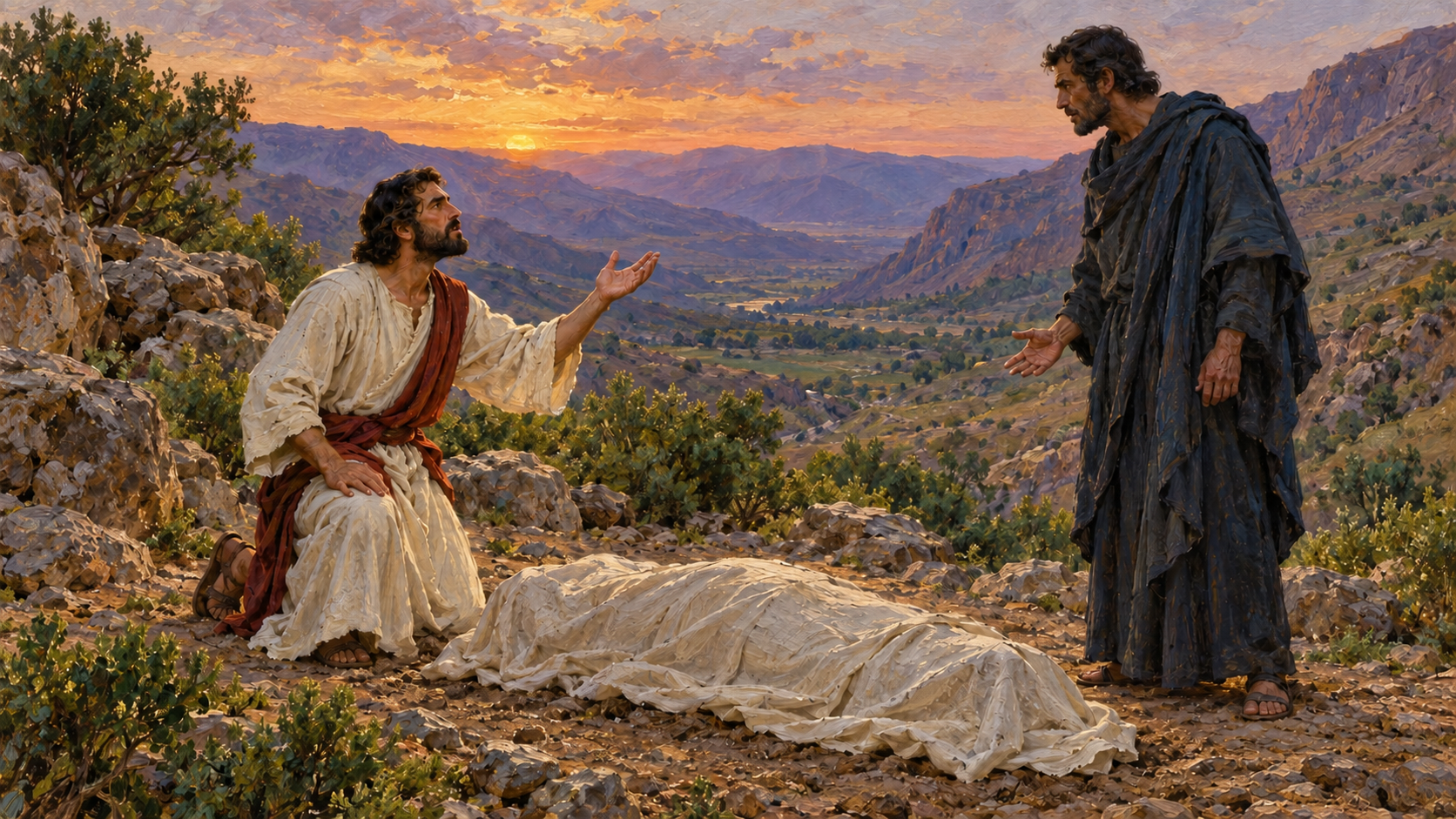
Jude tells us that Michael disputed with the devil over Moses’ body, but he does not explain Satan’s purpose. We can examine the burial of Moses and the suggestions readers have made without claiming to know what Jude does not disclose. I want to begin with why Jude included the event, because his stated lesson should govern what we teach from it.
Jude’s Point in Bringing Up the Dispute
Ungodly men had slipped into the church, used grace as permission for sin, and rejected the authority of the Lord Jesus Christ. They also spoke evil of dignities, or glorious beings. Jude had reminded his readers that Israel’s privileges did not protect unbelievers from judgment in the wilderness. Rebellious angels faced judgment too, as did Sodom and Gomorrah. He brings up those examples to expose the seriousness of rebellion and contempt for God’s authority.
Michael’s conduct gives Jude a pointed comparison. The false teachers reviled things they did not understand, while an archangel disputing with the devil refused to bring a reviling accusation against him. Michael said, “The Lord rebuke you!” Jude then returns in verse 10 to the ignorant, destructive speech of the intruders. He is exposing people whose reckless confidence exceeded both their knowledge and their authority.
Jude identifies the participants and tells us what their dispute concerned. He also records Michael’s appeal to the Lord. The Greek archangelos means a chief or ruling angel, so Michael had considerable rank while remaining under God’s authority. Jude presents the dispute as a real event, not a parable. Beyond Michael’s appeal, he does not supply their conversation or explain how the disagreement began.
Michael’s restraint does not suggest uncertainty about Satan’s evil. Scripture identifies the devil as a liar and murderer who deceives, tempts, and accuses. Michael could oppose him without taking the place of the final Judge. I understand his appeal as confidence in the Lord’s authority, rather than fear that Satan might be too powerful.
We still have Jude’s command to contend earnestly for the faith once for all delivered to the saints. Jude himself names corruption and warns sharply about its consequences. He is distinguishing truthful opposition from reviling. I can identify what a person publicly teaches and explain why it contradicts Scripture, but I have no right to add slander or invent secret motives. Nor should I enjoy humiliating him. Firmness is faithful when the charge is true and remains subject to God’s Word.
Moses, His Burial, and Michael’s Place
Deuteronomy supplies the background. Moses viewed the promised land from Mount Nebo and died in Moab according to the Lord’s word. His burial place was unknown to Israel.
So Moses the servant of the LORD died there in the land of Moab, according to the word of the LORD. And He buried him in a valley in the land of Moab, opposite Beth Peor; but no one knows his grave to this day.
The Hebrew verb translated “he buried” is singular and does not name its subject again. I understand the Lord as the natural subject, reflected in the NKJV’s capitalized “He.” God cared for Moses’ burial, while the grave remained hidden.
Moses died outside Canaan because he failed to honor the Lord as holy before Israel at Meribah. He had been entrusted with public responsibility, so that failure brought serious discipline. Yet his exclusion from the land did not mean he was lost. Hebrews includes him among the faithful, and the Gospels later show him with Christ at the Transfiguration. God corrected His servant without abandoning him. Jude gives us no reason to turn Moses’ failure into a final claim Satan held over him.
Michael’s other appearances help us understand his role. In Daniel 10, he came to assist an angelic messenger resisted by the prince of Persia.
But the prince of the kingdom of Persia withstood me twenty-one days; and behold, Michael, one of the chief princes, came to help me, for I had been left alone there with the kings of Persia.
Daniel identifies Michael as one of the chief princes, placing him among other heavenly princes. He later calls him Israel’s prince, and Daniel 12:1 describes him standing watch over Daniel’s people during a future time of trouble. Revelation 12 shows Michael leading angels against the dragon and his forces. His strength serves God’s purposes. He is not an independent savior.
I therefore do not identify Michael with Jesus. The eternal Son created every invisible power, including the angelic order to which Michael belongs.
For by Him all things were created that are in heaven and that are on earth, visible and invisible, whether thrones or dominions or principalities or powers. All things were created through Him and for Him.
Hebrews 1 asks which angel God ever addressed as His Son and commands the angels to worship Him. Jesus is fully God and became fully man, living without sin. He willingly gave Himself to be slain as the perfect sacrifice for the world. His saving work through His shed blood and death was complete before His burial and bodily resurrection. Michael serves under the Lord’s authority, while Christ possesses authority as Creator. We should identify Michael from that whole biblical description, rather than from his appeal, “The Lord rebuke you,” alone.
Michael’s name, the Hebrew Mikha’el, is commonly understood as the question, “Who is like God?” Its expected answer honors God’s incomparable greatness. Scripture never directs us to pray to Michael or seek his guidance, and it does not make him a mediator through whom we approach God. Daniel prayed to God, Jude directs us to the Lord’s rebuke, and Revelation centers worship on God and the Lamb.
Moses’ body was not divine and could not save anyone, but it was not worthless either. God formed the first man from dust, and His promise concerns bodily resurrection. We should neither credit human remains with spiritual power of their own nor dismiss the body as irrelevant to God’s care. An unknown grave or a body no longer intact cannot obstruct the Creator’s power to raise the dead. Our hope rests in Him, rather than in a preserved relic or knowledge of a burial place.
What We Can and Cannot Say About Satan’s Purpose
Readers have proposed several explanations for the dispute. Satan may have demanded possession of the body or opposed an assignment given to Michael. His conduct as an accuser makes a charge against Moses another possibility. Some readers suggest that he intended to promote idolatry through a relic. Others connect the dispute with Moses’ later appearance at the Transfiguration. Each suggestion draws on something we know elsewhere, but Jude identifies none of them as the reason.
The relic proposal appeals to the hidden grave and Israel’s misuse of the bronze serpent. People later offered incense to that object God had used, and Hezekiah had to destroy it. Concealing Moses’ grave may have prevented similar misuse, but Deuteronomy does not state that purpose. An accusation against Moses would fit Satan’s established conduct, but that does not tell us what any accusation concerned. We cannot claim he intended an idol or accused Moses specifically of killing the Egyptian. Nor does Jude say Satan owns every dead body or was trying to prevent a resurrection. A related passage can help us consider a possibility without establishing it as the answer.
The Transfiguration does establish that Moses was personally present with Jesus after death. Matthew records him speaking with the Lord alongside Elijah.
And behold, Moses and Elijah appeared to them, talking with Him.
Luke 9:30-31 describes Moses and Elijah appearing in glory. Neither Gospel says Moses had already received the final glorified body promised in resurrection. Christ is the firstfruits, the first to rise into that immortal resurrection life. Moses’ appearance therefore does not establish a connection with Jude’s dispute. It confirms his conscious presence after death without proving that every human soul is inherently immortal. Life belongs to God, and bodily resurrection rests on His power.
At the Transfiguration, Moses and Elijah direct attention to Christ as the fulfillment of the Law and the Prophets. The Father commands the disciples to hear His Son, preventing them from placing the servants on equal terms with Him. Their appearance gives us no warrant to pray to Moses or attach religious power to his remains.
A separate historical question concerns where Jude received the account. In the early third century, Origen referred to the Ascension of Moses while discussing this dispute and linked the work with Jude. His statement appears in On First Principles, Book III, chapter 2, section 1. That establishes what Origen reported. It does not prove that we possess the wording Jude knew.
The incomplete surviving Latin text commonly called the Testament of Moses or Assumption of Moses does not contain the dispute. In R. H. Charles’s translation of that text, the account breaks off during Moses’ address to Joshua. We cannot recover Michael’s unrecorded conversation from pages we do not possess.
None of that weakens Jude’s authority. The Holy Spirit could reveal a fact directly or guide Jude to use a true tradition. What Jude records carries canonical authority, the authority of inspired Scripture, because God gave it through him. Referring to an outside work need not make every claim in that work inspired. Jude also quotes a prophecy attributed to Enoch, just as Paul could quote Greek poets without making their writings Scripture. We receive what the biblical writer records without treating the rest of the outside material as a second Bible.
I can therefore affirm that a real dispute concerned Moses’ body and that Michael appealed to the Lord, while leaving Satan’s exact motive unresolved. Jude has told us enough to expose contemptuous speech and direct our confidence toward the Lord. Taking his words seriously includes accepting the limits of what he says. My curiosity does not entitle me to give an explanation the authority of revelation.
The Lord’s Rebuke and the Way We Face Spiritual Conflict
Michael’s appeal closely resembles the language in Zechariah 3. In that vision, Joshua the high priest stood in filthy garments before the Angel of the LORD, with Satan at his right hand to oppose or accuse him. I understand this divine Angel as the preincarnate Son, appearing before He became man. The Lord answered the accuser.
And the LORD said to Satan, “The LORD rebuke you, Satan! The LORD who has chosen Jerusalem rebuke you! Is this not a brand plucked from the fire?”
The Lord did not defend Joshua by pretending his garments were clean. The Angel commanded those standing before Him to remove the filthy garments and declared that Joshua’s iniquity had been taken away. Cleansing came from God, whose authority answered the accuser. That helps explain why an appeal to the Lord is stronger than an exchange of insults. He knows every fact and has authority to judge.
2 Peter 2:10-11 makes a similar comparison. Reckless people speak evil of dignities, while angels greater in strength do not bring a reviling accusation before the Lord. Greater power does not give them permission for reckless speech. We would miss that dependence on God if we treated Michael’s sentence as a formula to repeat. The words are not a magical defense. James gives believers a direct command:
Therefore submit to God. Resist the devil and he will flee from you.
James places submission to God before resistance to the devil. I need to keep that order when rejecting a lie or confessing sin. We resist through obedience to Scripture and prayer. In Ephesians 6, Paul tells believers to put on the armor God provides. Truth and righteousness shape our lives, and the gospel makes us ready to stand. We face the conflict in faith, secure in the salvation Christ gives, and answer deception with God’s Word while continuing in prayer. Paul does not instruct us to invent names for spirits, map territorial powers, or claim our own rank in the unseen world.
That restraint applies to sermons and church disagreements, to political discussions and online arguments. A teacher’s public doctrine may need a plain answer and a serious warning. Restraint cannot mean concealing the error behind vague politeness, but a true charge does not need exaggeration. I can say, “This doctrine contradicts Scripture,” and explain the contradiction without pretending to know everything in the teacher’s heart.
Pastors and parents have real responsibilities, as do rulers and teachers, but none occupies the final Judge’s place. A cutting remark may win an audience’s applause without making the speaker faithful. Before joining an accusation, I need to ask what evidence supports it. Am I adding contempt where an accurate explanation would have been enough? Michael’s example allows firm opposition while correcting the desire to make that opposition a display of ourselves.
Satan is a created enemy under God’s restraint and judgment, not an equal rival. Christ has triumphed over him. When temptation or accusation comes, I need to stand in the truth Christ supplies, rather than perform dramatically enough to intimidate the devil. Prayer expresses that dependence. Refusing a temptation because Scripture has exposed its lie may look ordinary, but it is real resistance.
Jude still calls the church to vigilance. We build ourselves up in the faith and pray in the Holy Spirit as we remain in God’s love. Those commands call us to live from the salvation He has given us, not to earn or keep it by our effort. Mercy also requires wisdom, because some people need a warning and others need patient help. We can protect people from error without becoming fascinated with darkness or inventing a supernatural explanation for every hardship. The Lord has given us truth to believe and commands to obey, even where He has not disclosed every detail.
My Final Thoughts
I cannot identify Satan’s precise purpose from a verse that does not reveal it. Jude does show Michael opposing evil without assuming God’s authority, while the background of Moses’ burial directs us to the Lord’s care for His servant. Moses is not an object of devotion, and Michael is not Christ. I want to contend firmly for the faith with that same respect for the limits of what God has said, trusting our risen Savior instead of exaggerating a charge or supplying a hidden motive to make an explanation sound complete.