
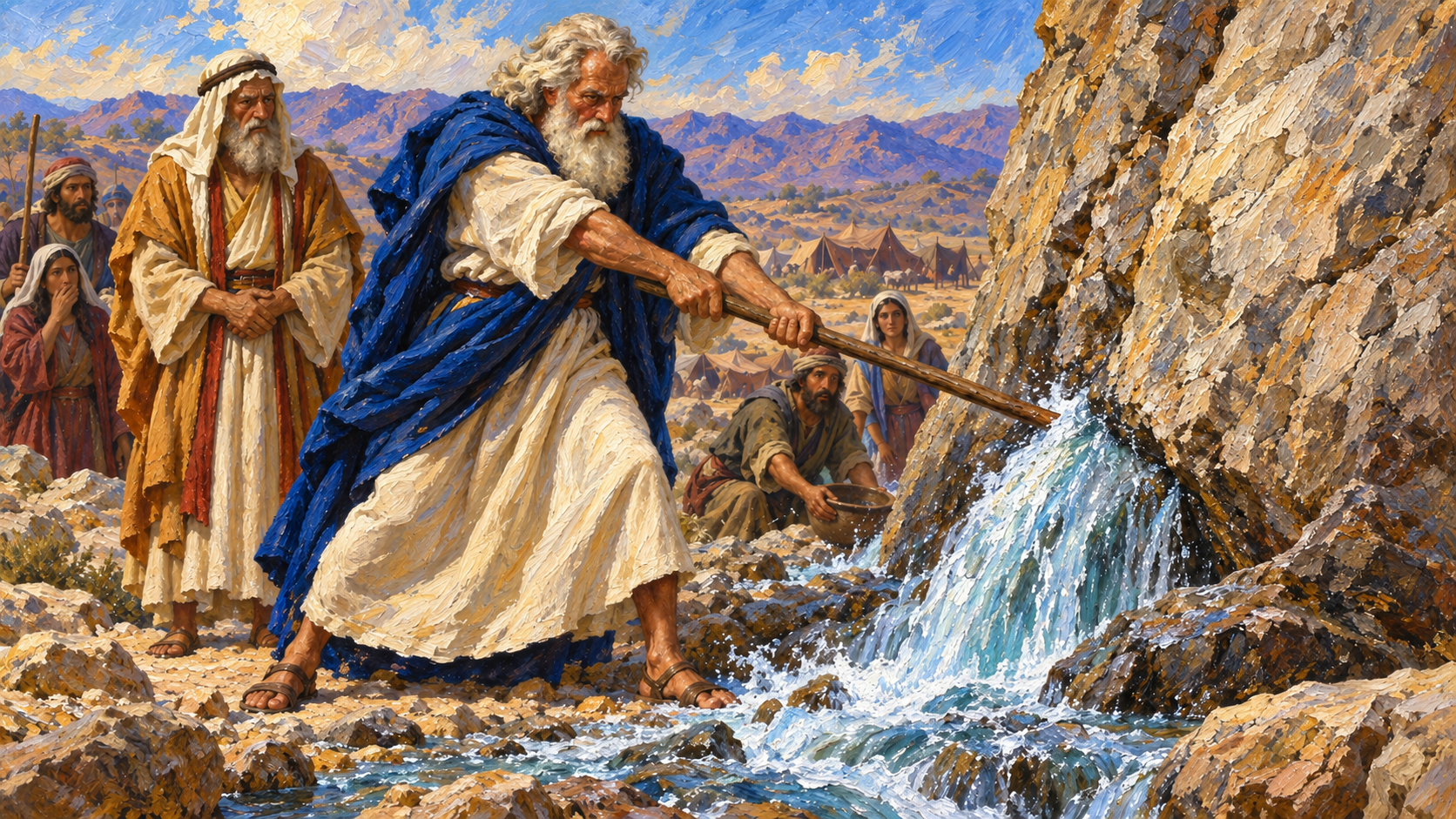
In Exodus 17, Moses struck a rock because God told him to. In Numbers 20, he struck a rock after God told him to speak to it, and God barred him from leading Israel into Canaan. I want to begin with those different commands, because we can miss God’s own explanation if we rush straight to an interpretation of what the rock represents. Paul identifies Christ as Israel’s spiritual Rock, but we need to distinguish what he teaches from the further connections people draw.
Two Crises and Two Commands
The first water crisis happened at Rephidim, near Horeb, early in Israel’s wilderness journey. The second came at Kadesh in the Wilderness of Zin, near the end of those years. Both accounts use the name Meribah, which refers to contention or quarreling, because the people repeated their quarrel with the Lord. The shared name should not lead us to confuse the two events.
By the time Israel reached Rephidim, the people had crossed the Red Sea, received drinkable water at Marah, and eaten the manna God supplied. Now they genuinely needed water, but they accused Moses of bringing them out of Egypt to kill them with thirst. Their complaint grew so threatening that Moses cried out to the Lord, saying they were almost ready to stone him. God answered with a precise instruction.
Then all the congregation of the children of Israel set out on their journey from the Wilderness of Sin, according to the commandment of the LORD, and camped in Rephidim; but there was no water for the people to drink. Therefore the people contended with Moses, and said, "Give us water, that we may drink." So Moses said to them, "Why do you contend with me? Why do you tempt the LORD?"
And the people thirsted there for water, and the people complained against Moses, and said, "Why is it you have brought us up out of Egypt, to kill us and our children and our livestock with thirst?" So Moses cried out to the LORD, saying, "What shall I do with this people? They are almost ready to stone me!"
And the LORD said to Moses, "Go on before the people, and take with you some of the elders of Israel. Also take in your hand your rod with which you struck the river, and go. Behold, I will stand before you there on the rock in Horeb; and you shall strike the rock, and water will come out of it, that the people may drink." And Moses did so in the sight of the elders of Israel.
So he called the name of the place Massah and Meribah, because of the contention of the children of Israel, and because they tempted the LORD, saying, "Is the LORD among us or not?"
Before Israel’s elders, Moses struck the rock with the rod God had associated with judgment on Egypt. He was carrying out the Lord’s command, and water came for the people to drink. The account gives us no reason to credit the rod with power of its own or to imagine Moses forcing God to provide. God Himself had promised to stand before him on the rock and supply what the people needed.
The names Massah and Meribah identify the people’s offense: Massah refers to testing, and Meribah to contention. Their question was, "Is the LORD among us or not?" Despite the deliverance they had witnessed, they treated their thirst as grounds to doubt His presence. Psalm 78 describes Him splitting rocks and giving abundant drink, while Psalm 105 describes water running through dry places like a river. The Lord provided generously for people who were questioning Him, without making their accusation right.
Decades later, Numbers 20 brings us to Kadesh, where Miriam died and was buried. Once again the congregation lacked water, and the people gathered against Moses and Aaron. They accused the leaders of bringing the assembly into the wilderness to die, complaining that the place had none of the crops they wanted and no water to drink. Their words repeated the distrust that had marked Israel’s earlier years.
Moses and Aaron initially responded by going to the tabernacle and falling on their faces before the Lord. His glory appeared, and He told Moses to take the rod and gather the congregation with Aaron. This time He commanded them to speak to the rock before the people.
Then the children of Israel, the whole congregation, came into the Wilderness of Zin in the first month, and the people stayed in Kadesh; and Miriam died there and was buried there. Now there was no water for the congregation; so they gathered together against Moses and Aaron.
And the people contended with Moses and spoke, saying: "If only we had died when our brethren died before the LORD! Why have you brought up the assembly of the LORD into this wilderness, that we and our animals should die here? And why have you made us come up out of Egypt, to bring us to this evil place? It is not a place of grain or figs or vines or pomegranates; nor is there any water to drink."
So Moses and Aaron went from the presence of the assembly to the door of the tabernacle of meeting, and they fell on their faces. And the glory of the LORD appeared to them. Then the LORD spoke to Moses, saying, "Take the rod; you and your brother Aaron gather the congregation together. Speak to the rock before their eyes, and it will yield its water; thus you shall bring water for them out of the rock, and give drink to the congregation and their animals."
So Moses took the rod from before the LORD as He commanded him. And Moses and Aaron gathered the assembly together before the rock; and he said to them, "Hear now, you rebels! Must we bring water for you out of this rock?" Then Moses lifted his hand and struck the rock twice with his rod; and water came out abundantly, and the congregation and their animals drank.
Then the LORD spoke to Moses and Aaron, "Because you did not believe Me, to hallow Me in the eyes of the children of Israel, therefore you shall not bring this assembly into the land which I have given them." This was the water of Meribah, because the children of Israel contended with the LORD, and He was hallowed among them.
Moses carried the rod as instructed, but he departed from the rest of God’s command. The Lord had said, "Speak to the rock before their eyes." Instead, Moses addressed the congregation angrily and struck the rock twice. God’s earlier instruction to strike at Horeb did not authorize another blow here. At Kadesh, obedience required both taking the rod and speaking to the rock.
Water still came out abundantly, allowing the congregation and its animals to drink even though Moses had disobeyed. We could draw the wrong conclusion from this miracle if we assumed that a good result proved God’s approval of the way it was obtained. The Lord supplied the people’s need and then expressly condemned the leaders’ conduct. His verdict belongs in our understanding of the miracle.
Why God Disciplined Moses and Aaron
God said Moses and Aaron had not believed Him or hallowed Him before Israel. To hallow God means to treat Him as holy, honoring Him in what we say and do before others. These leaders had received His instruction and publicly departed from it. Numbers 20:24 calls their action rebellion against His word, and Deuteronomy 32 calls it a trespass, a serious offense against Him.
Now the LORD said to Moses: "Go up into this Mount Abarim, and see the land which I have given to the children of Israel. And when you have seen it, you also shall be gathered to your people, as Aaron your brother was gathered. For in the Wilderness of Zin, during the strife of the congregation, you rebelled against My command to hallow Me at the waters before their eyes." (These are the waters of Meribah, at Kadesh in the Wilderness of Zin.)
People often summarize Moses’ offense by saying he lost his temper. Anger was involved, but that description becomes too mild when it leaves out unbelief and rebellion. God had entrusted Moses with representing Him before the congregation. By speaking and acting contrary to His command, Moses dishonored the Lord whose authority he was supposed to represent.
His question, "Must we bring water for you out of this rock?" deserves careful attention too. The word we can sound as though Moses and Aaron possessed the power to provide. Some readers understand Moses to be taking credit for God’s work. Others emphasize how his angry speech could make God appear harsher toward the people than His instruction warranted. These explanations identify real dangers in such conduct, but we must weigh them against God’s stated charge. Moses and Aaron failed to believe Him, rebelled against His command, and failed to hallow Him before Israel.
Psalm 106 also holds the congregation responsible for provoking Moses. The people had repeatedly opposed a man who interceded for them, and their conduct contributed to his rash speech.
They angered Him also at the waters of strife, So that it went ill with Moses on account of them; Because they rebelled against His Spirit, So that he spoke rashly with his lips.
Scripture acknowledges the provocation without excusing Moses’ response. I can have a legitimate grievance and still sin in the way I express it. When I use another person’s wrongdoing to justify my own harsh speech, I stop attending to what God requires of me. The difficulty of dealing with that person does not remove my responsibility before the Lord.
Moses and Aaron had done right to fall before the Lord, but they still needed to obey Him when they got up. Prayer does not give us permission to treat our irritation as God’s voice when we speak to others afterward. The public words and actions at Kadesh contradicted the very instruction Moses had just received.
Christ the Spiritual Rock
The title Rock also appears in Moses’ praise of the Lord in Deuteronomy 32. There it describes God’s dependable character: His work is perfect, His ways are just, and there is no injustice in Him. He can be trusted even when His people are unfaithful.
"Give ear, O heavens, and I will speak; And hear, O earth, the words of my mouth. Let my teaching drop as the rain, My speech distill as the dew, As raindrops on the tender herb, And as showers on the grass. For I proclaim the name of the LORD: Ascribe greatness to our God. He is the Rock, His work is perfect; For all His ways are justice, A God of truth and without injustice; Righteous and upright is He.
Paul draws on Israel’s wilderness experience to warn the Corinthians. All the people shared remarkable privileges: they passed through the sea under God’s protection and received the food and drink He supplied. Yet these shared benefits did not establish that everyone responded to Him in faith. As Paul identifies their Provider, he also tells us what became of most of those who received His gifts.
Moreover, brethren, I do not want you to be unaware that all our fathers were under the cloud, all passed through the sea, all were baptized into Moses in the cloud and in the sea, all ate the same spiritual food, and all drank the same spiritual drink. For they drank of that spiritual Rock that followed them, and that Rock was Christ. But with most of them God was not well pleased, for their bodies were scattered in the wilderness.
Christ was active among His people long before His birth in Bethlehem. He is the eternal Son, and the incarnation was His taking human nature, not the beginning of His existence. I understand Paul’s identification of the spiritual Rock to mean that Christ accompanied Israel as the divine Provider who sustained them. Paul is not identifying Jesus as a material stone or describing a boulder rolling behind the congregation. The water Israel drank was real, and the eternal Son supplied it.
Paul then warns against sinful desire, idolatry, sexual immorality, testing Christ, and complaining. God’s provision and membership in the congregation had not made Israel’s rebellion harmless. I should not assume that someone has trusted Christ merely because he attends church or receives God’s gifts. A religious profession can remain superficial, whereas genuine new birth changes the person.
Paul uses the Greek word petra for rock. The Hebrew accounts use tsur in Exodus 17 and sela in Numbers 20. Their meanings overlap: the Brown-Driver-Briggs entry for tsur gives rock or cliff, and its entry for sela gives crag or cliff and identifies tsur as a synonym. The different words do not establish two different spiritual meanings for the rocks. Paul’s explanation directs our attention to Christ as the One providing for Israel.
A familiar interpretation sees the two water crises as a picture of Christ’s sacrifice. According to that reading, striking the rock at Horeb represents Christ’s offering once for all. The later command to speak represents approaching Him after the sacrifice is complete, making Moses’ blows at Kadesh a picture of trying to sacrifice Him again. I understand the appeal of connecting Paul’s identification of the Rock with the finality of Christ’s offering. Before teaching the whole proposed picture, however, we need to ask how much of it Scripture actually explains.
Paul identifies the Rock as Christ without saying that each blow represents the crucifixion or that Moses was excluded from Canaan for portraying a repeated sacrifice. Exodus records his obedience to the command to strike but does not explicitly number his blows. Numbers specifically says he struck twice, then explains his offense as unbelief and failure to hallow God. Later passages in Numbers and Deuteronomy also call it rebellion and trespass. Those are the reasons God gives us to teach.
The finality of Christ’s offering has its own clear explanation in Scripture. Paul, whom I understand to be the author of Hebrews, contrasts Christ’s completed work with the priests’ repeated sacrifices.
By that will we have been sanctified through the offering of the body of Jesus Christ once for all. And every priest stands ministering daily and offering repeatedly the same sacrifices, which can never take away sins. But this Man, after He had offered one sacrifice for sins forever, sat down at the right hand of God, from that time waiting till His enemies are made His footstool. For by one offering He has perfected forever those who are being sanctified.
Christ’s offering was made once and needs no repetition. We can recognize a limited correspondence between His provision and the water accounts, provided we explain where we are drawing an inference. An inference is a conclusion we draw from the passages rather than an explanation they expressly give. I can appreciate possible foreshadowing while resting the doctrine on what Hebrews teaches directly.
We must also be precise about what Christ’s sacrifice involved and who inflicted His suffering. Jesus is the eternal Son, fully God and fully man, born of a virgin and completely sinless. Wicked men tortured and crucified Him, but He voluntarily gave Himself to be slain as the perfect sacrifice for the sins of the whole world. His saving work through His shed blood and death was complete before He was buried and rose bodily from the grave.
The Father did not punish, curse, abandon, strike, bruise, or pour wrath on Jesus. Father, Son, and Holy Spirit acted in unity, without any break in divine fellowship. I therefore reject an explanation of Exodus 17 that makes Moses represent the Father striking His Son. A proposed picture must agree with what we teach about Christ’s actual sacrifice. Jesus willingly endured the suffering wicked people inflicted on Him as He gave His life for our salvation.
Nor does the command to speak to the rock provide a formula for commanding Christ. God directed Moses; Moses did not devise words that compelled God to give water. We pray to the Father through the Son, asking according to His will and trusting His wisdom. Speaking forcefully or repeating a phrase cannot give us control over Him.
Moses, Canaan, and Living Water
Although God supplied water at Kadesh, the discipline He announced remained. Aaron died at Mount Hor. Moses continued leading Israel to the edge of Canaan and delivered his final instructions, but he would only see the land from Mount Nebo. Deuteronomy repeats God’s reason for denying him entry.
Then the LORD spoke to Moses that very same day, saying: "Go up this mountain of the Abarim, Mount Nebo, which is in the land of Moab, across from Jericho; view the land of Canaan, which I give to the children of Israel as a possession; and die on the mountain which you ascend, and be gathered to your people, just as Aaron your brother died on Mount Hor and was gathered to his people;
because you trespassed against Me among the children of Israel at the waters of Meribah Kadesh, in the Wilderness of Zin, because you did not hallow Me in the midst of the children of Israel. Yet you shall see the land before you, though you shall not go there, into the land which I am giving to the children of Israel."
Being excluded from Canaan was severe earthly discipline, but Moses did not lose his salvation. Hebrews 11 remembers his faith and his choice to identify with God’s people rather than hold on to Egypt’s treasures. We also see him with Elijah when Jesus was transfigured before three of His disciples. Moses’ failure at Kadesh had not erased the reality of his faith.
Now after six days Jesus took Peter, James, and John his brother, led them up on a high mountain by themselves; and He was transfigured before them. His face shone like the sun, and His clothes became as white as the light. And behold, Moses and Elijah appeared to them, talking with Him. Then Peter answered and said to Jesus, "Lord, it is good for us to be here; if You wish, let us make here three tabernacles: one for You, one for Moses, and one for Elijah."
While he was still speaking, behold, a bright cloud overshadowed them; and suddenly a voice came out of the cloud, saying, "This is My beloved Son, in whom I am well pleased. Hear Him!" And when the disciples heard it, they fell on their faces and were greatly afraid. But Jesus came and touched them and said, "Arise, and do not be afraid." When they had lifted up their eyes, they saw no one but Jesus only.
Moses’ presence at the transfiguration shows that God had not rejected him from salvation, yet his honored place did not make him Christ’s equal. The Father directed the disciples to hear His beloved Son. When they looked up, only Jesus remained. Moses gave the Law and served in God’s house; Jesus is the eternal Son over His own house.
The physical water that Moses brought to Israel sustained the people in the wilderness. Jesus later spoke of thirst and water to explain the life He gives. At the Feast of Tabernacles, which recalled Israel’s wilderness years, He invited thirsty people to come to Him and drink. John explains the gift Jesus was promising.
On the last day, that great day of the feast, Jesus stood and cried out, saying, "If anyone thirsts, let him come to Me and drink. He who believes in Me, as the Scripture has said, out of his heart will flow rivers of living water." But this He spoke concerning the Spirit, whom those believing in Him would receive; for the Holy Spirit was not yet given, because Jesus was not yet glorified.
John looks ahead to the gift of the Spirit after Jesus’ glorification. The Spirit had already been active among God’s people; His promised coming was not the beginning of His existence. Jesus’ invitation to come and drink is a call to believe in Him. It extends sincerely to anyone who thirsts, even though people can resist His grace. No one who repents and believes in Christ will be turned away. God forgives and justifies that person, declaring the believer righteous before Him.
The believer is also born again. Regeneration refers to this new birth, in which God makes the person new. Calling oneself a Christian does not establish that this has happened, so we should look for evidence of new life in the person’s conduct. That obedience neither earns nor keeps salvation, and it does not mean a believer never sins.
Every true believer receives the Holy Spirit, a divine Person who indwells and seals him, making him eternally secure in Christ. He is not a force or an emotional atmosphere. Water baptism follows salvation as our public identification with Christ; it neither causes the new birth nor purchases the Spirit. Security gives a genuine believer no permission for lawlessness, while an empty profession supplies no evidence of new birth.
Israel could not produce water from stone, and we cannot create spiritual life within ourselves. We receive salvation by grace through faith in Jesus Christ. The obedience that follows is evidence of the life He has given, never a payment to receive or retain it.
Listening, Speaking, and Leading Faithfully
Moses’ experience warns me against using visible success to excuse disobedience. The people’s needs were met when water came out, but God had already told Moses what faithful service required. Similarly, a church activity may attract people or a teacher may win praise while the methods or teaching contradict Scripture. A favorable response cannot settle whether we have obeyed God’s Word. We need to examine the work by what He has said.
Our experience and traditions need that same scrutiny. Striking the rock was once obedience for Moses; it became disobedience when God gave a different command. Familiarity with a method can make us less attentive to what Scripture requires, especially when we have seen it produce a result before. Its authority still depends on God’s Word, not the number of years we have used it.
The congregation’s thirst warns us of another danger: turning a genuine need into an accusation that God has abandoned us. We can tell Him plainly when we are frightened, exhausted, or unsure what to do. Biblical lament brings our pain before Him while honoring Him as God. Israel instead demanded that He prove His presence on their terms. We should bring our need to Him without repeating that test.
For those who teach, the public nature of Moses’ failure deserves particular attention. His position did not make careless words less serious. James gives the church a direct warning about the responsibility of teachers and the reach of our speech.
My brethren, let not many of you become teachers, knowing that we shall receive a stricter judgment. For we all stumble in many things. If anyone does not stumble in word, he is a perfect man, able also to bridle the whole body. Indeed, we put bits in horses’ mouths that they may obey us, and we turn their whole body.
Look also at ships: although they are so large and are driven by fierce winds, they are turned by a very small rudder wherever the pilot desires. Even so the tongue is a little member and boasts great things. See how great a forest a little fire kindles!
A small bit directs a horse, and a rudder turns a large ship. A teacher’s words can likewise influence the direction of an entire congregation. James also uses fire to describe the reach of harmful speech. A careless accusation or a distorted explanation of God can continue affecting people long after the first conversation, even when the speaker has moved on.
Moses called the people rebels, and they really had rebelled. Firm speech was not itself the offense. Faithful correction may require plain, uncomfortable words, but those words should name the wrong accurately and seek the person’s restoration. I need to examine whether I am serving God’s Word or borrowing His authority to magnify a personal grievance. Another person’s sin gives me no right to misrepresent the Lord.
James includes himself when he says, "we all stumble in many things." His warning should lead teachers to take their responsibility seriously, rather than drive qualified people from the work. Churches need teachers who remain teachable, submit to Scripture, and accept accountability. When we fail, we need to repent. Neither temperament nor years of experience can make our speech immune to sin.
After decades of service, Moses still had to obey the instruction God gave him. Earlier faithfulness did not make his public rebellion insignificant, and that failure did not erase his faith. Both truths should govern our response when we sin. We need to confess what we have done and accept its consequences, without minimizing the wrong or concluding that God’s grace has come to an end.
My Final Thoughts
I want to let God’s explanation of Moses’ failure govern how I teach this passage. Moses obeyed at Horeb and rebelled at Kadesh because the commands were different. Water still came, but it did not make his conduct right. Christ sustained Israel, gave Himself once for all as our sacrifice, and gives life to everyone who believes in Him. Trust in His provision should make me attentive to His words, especially when pressure tempts me to excuse my own. Neither earlier faithfulness nor a favorable result can replace obedience to what He has said.