
What do we actually know about Mary Magdalene? Her name is familiar, but many claims about her life do not come from the Bible. I want to follow what the Gospels tell us about her, because her deliverance and faithful witness give us plenty to consider and keep directing us to Jesus Christ.
What Scripture Tells Us About Mary
The Gospels consistently call her Mary Magdalene, distinguishing her from the other women named Mary. The name most naturally connects her with Magdala in Galilee. Beyond that, we know little of her background. Scripture does not name her parents or tribe, tell us her age or occupation, or say whether she married or had children. I would rather leave those questions open than fill the gaps with a biography we cannot find in the text.
Luke introduces Mary as Jesus traveled through cities and villages preaching. The Twelve were with Him, along with women who had been healed of evil spirits and infirmities. Mary was one of those women, and Luke says seven demons had gone out from her. Mark 16:9 repeats that fact. We are not told what all the outward effects looked like, but her oppression was severe, and Jesus delivered her from it.
We are not told that a particular sin caused Mary’s condition. Scripture never calls her sexually immoral or a prostitute, nor does it identify her as the unnamed woman who anointed Jesus. I cannot take the fact that demons oppressed her and use it to accuse her of something the text never says. Her deliverance shows Christ’s authority, and inventing a darker past for Mary would draw us away from what we have actually been given.
The Gospels describe evil spirits as real created beings under God’s authority. They are not poetic names for every human struggle. Jesus rebuked them and cast them out by His command, and He showed that same authority in delivering Mary. No spiritual darkness was beyond His power. Yet the account does not linger over the seven demons. It turns our attention to the Savior who freed her and to how she lived afterward.
After her deliverance, Mary followed Jesus. Luke 8:1-3 names her with Joanna and Susanna among the many women who traveled with Jesus and the Twelve. As Christ proclaimed the kingdom of God, these women used their own resources to provide for the ministry. They helped sustain His work and that of His disciples by putting what God had entrusted to them at His service.
I don’t want to pass over that practical service while discussing titles and offices. God saw Mary’s provision and continued obedience, and Luke honors it without calling her an apostle. Jesus gave the Twelve a distinct foundational role, and the New Testament later sets qualifications for authoritative teaching leadership in the local church. Mary’s faithfulness does not need an office Scripture never gave her to make it valuable. Luke also shows her serving alongside other faithful women, rather than treating her as an isolated celebrity.
Among these women, Mary has a place the Gospels clearly preserve. They name her and describe her witness, yet her life directs us back to Jesus rather than competing with Him for attention. He defeated the evil that oppressed her and showed her mercy. Her continued devotion was to the Lord who had done that for her.
At the Cross, the Burial, and the Empty Tomb
All four Gospels place Mary Magdalene in the closing events of Jesus’ crucifixion and burial. Matthew and Mark name her among the women who had followed Him from Galilee and ministered to Him. John places her at the cross with Jesus’ mother and Mary the wife of Clopas. The writers give us different vantage points, but they agree that Mary was a known witness of Jesus’ death.
We need to remember what Mary was witnessing. Jesus had been condemned under Pontius Pilate and tortured before He was nailed to the cross. He truly died, and Joseph of Arimathea and Nicodemus handled His body and placed it in a tomb. The Gospels describe neither an apparent death nor a vague spiritual departure. The incarnate Son bore the punishment for our sins in His innocent body, shedding His blood and willingly giving His life.
Matthew 27:61 and Mark 15:47 place Mary Magdalene among the women who watched where Jesus was laid. That helps me understand their return to the tomb. They had seen His burial and knew where His body was, so they were not wandering to an unknown place several days later.
That continued presence does not mean every male disciple was absent from every part of these events. John records the beloved disciple at the cross. What we can say is that the Gospel writers identified these women as genuine witnesses. They were present through the public events of Christ’s death and burial, then the discovery of His empty tomb and the proclamation that He had risen.
Mary returned to the tomb on the first day of the week. Matthew names her with the other Mary, while Mark includes Mary the mother of James and Salome. Luke names Joanna and Mary the mother of James with her, along with other women. John begins with Mary’s early arrival while it was still dark. Each Gospel selects details for its own account, but all give Mary a central place in the discovery.
The women came with spices while they were still grieving. Their concern was how to deal with the stone, not how to celebrate a victory they already expected. John tells us that Mary first feared someone had taken the Lord’s body, and Luke says the women’s later report sounded like idle tales to the apostles. I find those reactions hard to reconcile with a plan to invent the resurrection. These people had to face news they had not expected.
The angels told the women that Jesus was not there because He had risen. His empty tomb was essential to the evidence, though it was not the whole case: the risen Lord also appeared to witnesses. He had not merely lived on through His influence or in His followers’ private feelings. His body was no longer in the grave because He had risen bodily, just as He had promised.
Mary and the other women brought the news to the disciples. Their place as the first witnesses at the tomb did not make them apostles or change God’s order for church leadership. It did establish them as genuine witnesses to the decisive events of redemption, and God preserved that testimony in the Gospels.
Mary Met the Risen Christ
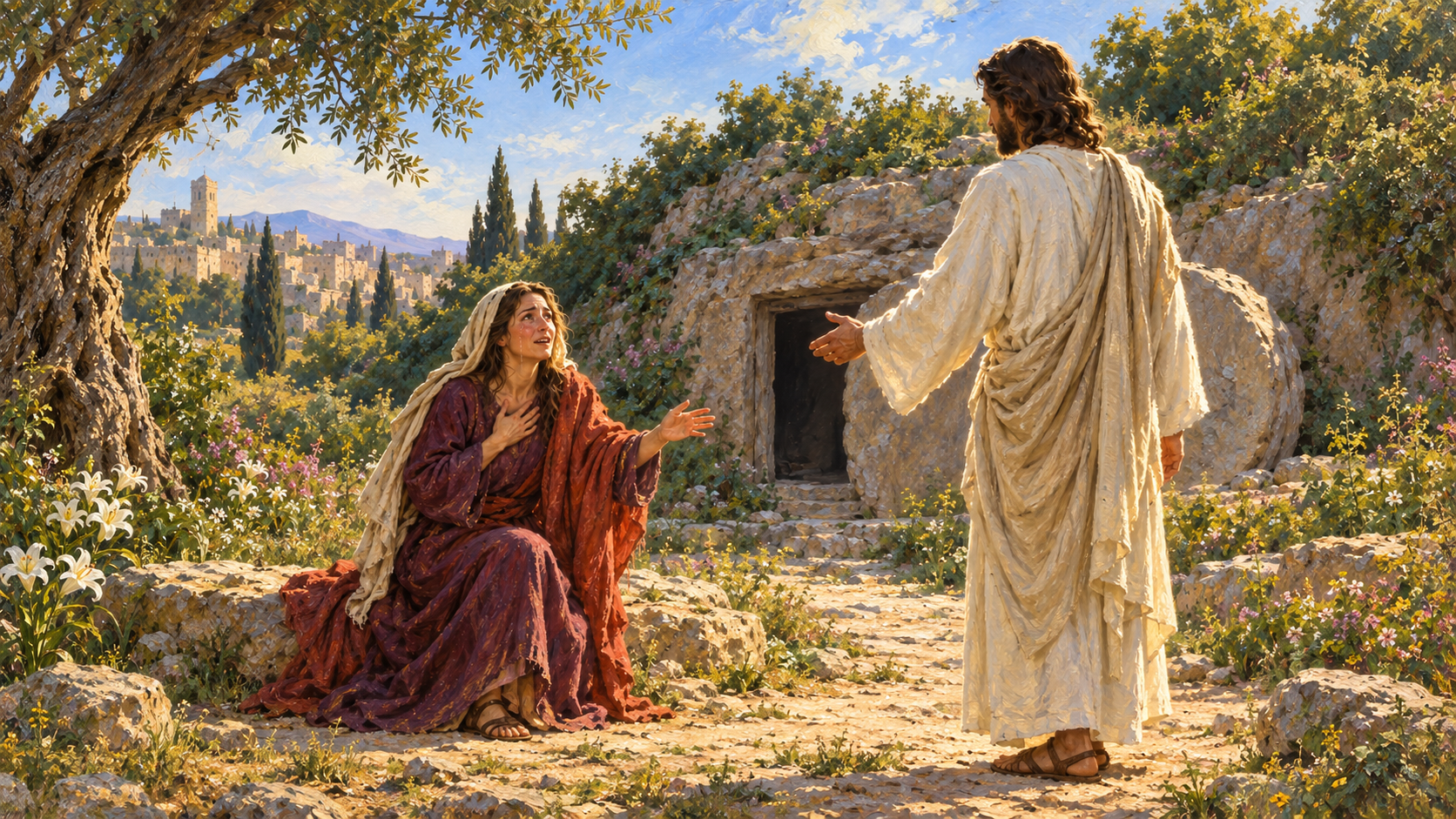
John 20 gives the fullest account of Mary’s personal meeting with Jesus after His resurrection. Peter and the other disciple had already inspected the tomb, but Mary remained outside weeping. She spoke with angels and then saw Jesus without recognizing Him. At first she supposed He was the gardener.
Mary recognized Jesus when He called her by name: “Mary.” She answered, “Rabboni,” which means Teacher. This was not a vision of a dead teacher who remained alive only in her memory. Mary saw and spoke with the risen Christ.
Jesus told her not to cling to Him and sent her to His brethren with this message: “I am ascending to My Father and your Father, and to My God and your God.” He distinguishes His relationship with the Father from theirs, and that helps me understand how He brings us to God. Jesus is the eternal Son with a unique relationship to the Father. As believers, we enter a gracious relationship with the Father through Him. He is not simply another adopted child among many, but the Son who brings His people to the Father.
Mary did what Jesus asked. John records that she went to the disciples and told them she had seen the Lord, reporting what He had said to her. Mark 16:9 says Jesus appeared first to Mary Magdalene. That is a singular honor, and Scripture gives it to her as a faithful witness sent to bring news of the risen Lord.
Mary’s message came from Christ, but she was not becoming a new source of doctrine alongside His apostles and Scripture. She reported what she had seen and heard from Jesus. He had risen and would ascend, and His disciples needed to know. Her report keeps our attention on Him, which is where she faithfully directed it.
How the Four Gospel Accounts Fit Together
Some readers see contradictions in the differences among the four resurrection accounts. I see four truthful reports whose writers give attention to different parts of what happened. Matthew describes the earthquake and the angel before the women’s worship. Mark follows the women’s visit and the message for the disciples, while Luke names the group who reported to the apostles. John spends more time on Mary’s early arrival. He then takes us with Peter and the other disciple into the tomb before describing Jesus’ appearance to her.
A reliable report need not mention every person or event. These accounts agree that Jesus died and that His tomb was found empty on the first day of the week. They tell of angels announcing His resurrection and women carrying the news to the disciples. The risen Jesus appeared to His followers, and every Gospel includes Mary Magdalene in this shared witness.
I don’t think we need to force every detail into an artificial harmony to trust these accounts. Ordinary differences in what the writers select give us no reason to dismiss the resurrection. Each testifies to Jesus, and together they help us see more of what happened. His followers’ grief gave way to astonishment as God’s action explained the empty tomb. They were sent to proclaim that Christ had risen bodily.
Claims About Mary That Scripture Does Not Make
The most persistent claim about Mary Magdalene is that she had been a prostitute, yet the Bible never says it. That tradition likely arose from confusing her with the unnamed sinful woman who anointed Jesus’ feet in Luke 7. But Luke starts a new scene in Luke 8 and introduces Mary by name as the woman from whom seven demons had gone out. I see no textual connection that would let us identify those women as the same person.
Nor does John 8 identify Mary with the woman caught in adultery. That woman is unnamed, and the passage makes no connection to Mary Magdalene. The claim that Mary was Jesus’ wife or romantic partner also lacks biblical support. In John 20, the risen Lord meets a devoted disciple and sends her with a message. It is a holy encounter, and adding romance to it changes what Scripture records without any warrant in the text.
Some later writers called Mary the “apostle to the apostles” because she brought the disciples news of the resurrection. They may have meant to honor her witness, but the phrase is not a biblical title or office. Scripture calls the Twelve apostles and locates the church’s authoritative foundation in the apostles and prophets Christ appointed. I don’t believe assigning Mary a position Scripture never gives her adds anything to the honor she already received.
We cannot infer sexual sin, moral notoriety, or a sensational past from the seven demons. Scripture sometimes connects suffering to a particular circumstance, but it also warns against simple judgments about someone else’s affliction. With Mary, it directs us to Jesus’ compassion and divine authority. He delivered her, and she followed Him faithfully.
Christ appeared first to a woman who had once been oppressed by demons and entrusted her with a message for His brethren. I see His grace in that choice. In a world that often measured people by status and public power, He honored Mary’s faithfulness without making her honor depend on human rank.
We should also let the rest of Scripture speak when we consider what Mary’s witness means. Someone can truthfully report God’s work without holding the governing office of apostle or the authoritative teaching office of elder. The New Testament honors women as disciples and witnesses who served alongside others in the Gospel. It also reserves authoritative teaching leadership in the local church for biblically qualified men. We can affirm the value of women’s ministry and still accept the order Scripture gives the church.
Mary’s faithfulness encourages me because it did not depend on publicity. She remained near the cross and watched where Jesus was buried. Still grieving, she returned to the tomb, and when He sent her to the disciples, she obeyed. Her attention stayed on the Lord through those events. That gives us a healthier example than making our personal experiences the center of faith.
Mary’s Story and the Good News of Christ
Mary’s life keeps bringing us back to the Gospel. Jesus delivered her from real darkness, but her greatest testimony went beyond improved circumstances: she saw the crucified and risen Christ. His resurrection declares that His sacrifice was accepted and death defeated. He shed His blood for the sins of the whole world, so the offer of forgiveness is genuinely open to all.
The Savior Mary saw calls us to trust Him, rather than a program of moral improvement. He bore our sins in His innocent body and shed His blood. After He died and was buried, He rose bodily. Everyone who personally receives Him by faith is forgiven and made new. The Holy Spirit seals the believer, and eternal life is given by grace. We do not earn that life by overcoming a dramatic past or performing religious service.
What happened in Mary’s life encourages believers who know Christ has delivered them from real darkness. It also points those who have not believed to the Savior who can forgive and save them. Our hope rests on His resurrection as an event that actually happened. The Lord who called Mary by name is alive, and His promise of life is true.
For more on the biblical evidence, see The Resurrection of Jesus Christ. The studies on Women in the Bible and Demons and Spiritual Warfare explore two other aspects of Mary’s life, while the study on Salvation follows the Bible’s teaching on forgiveness and eternal life through Christ.
My Final Thoughts
I believe we honor Mary Magdalene best by letting the Gospel accounts tell us who she was. Jesus delivered her, and she responded to His mercy with steady faithfulness. She witnessed His death and watched where He was buried before returning to find His tomb empty. When the risen Lord called her by name, she obeyed His instruction to carry the news to His disciples. Nothing in that witness needs the added claims that she was a prostitute, an adulteress, Jesus’ wife, or an apostle. Her life already shows us His grace and directs us to the living Christ, whose bodily resurrection is the foundation of our hope.