
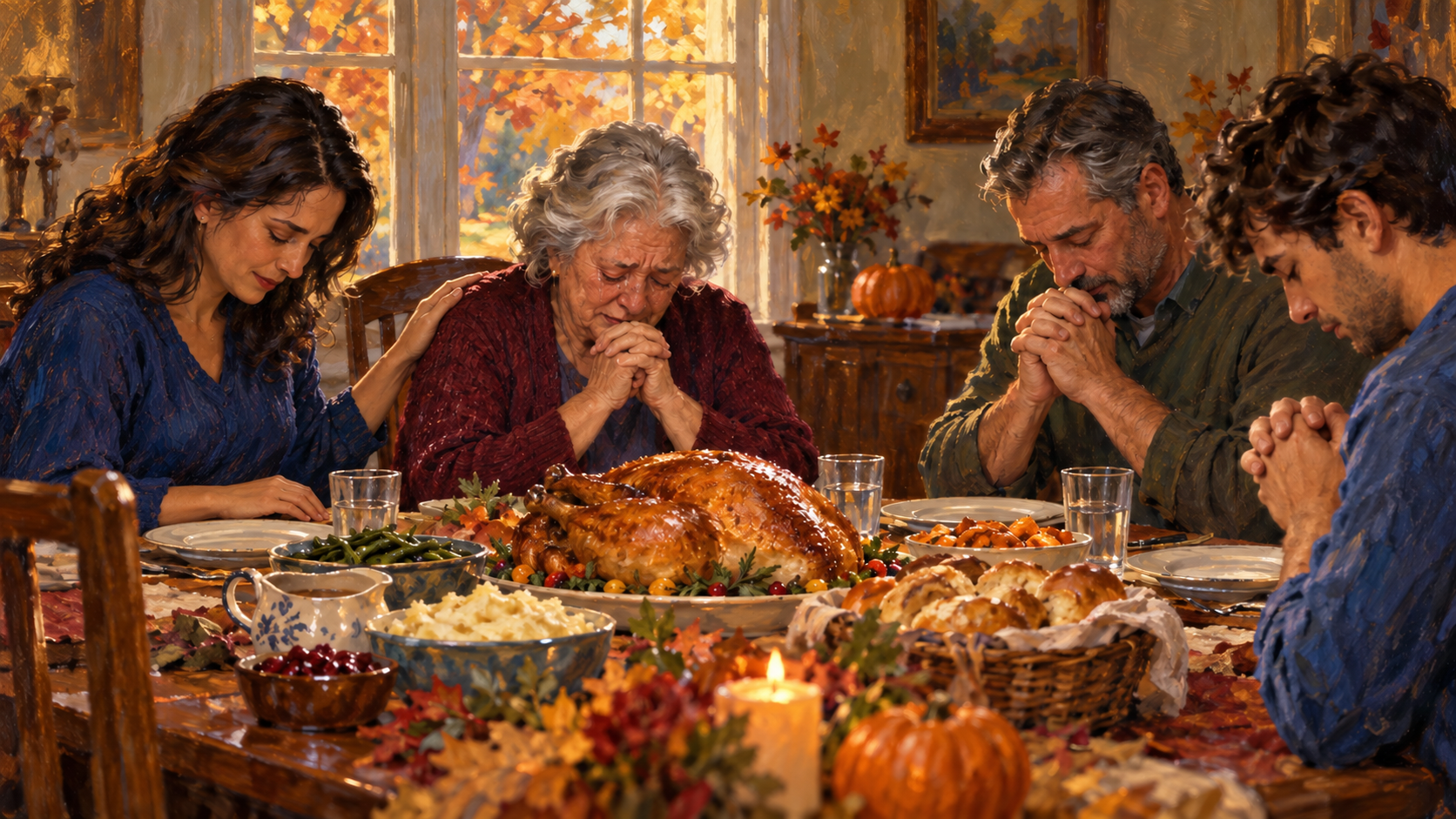
What are Christians actually doing when we give thanks? Scripture describes a response to God that reaches far beyond a holiday meal. The American holiday also has a history worth understanding, though it is more complicated than the familiar accounts suggest. We can appreciate that history without treating a national tradition as one of God’s covenant promises.
Thanksgiving Begins With the Living God
Thanksgiving begins with recognizing how much we have received from God. He is our Creator, so even our life and breath come from Him. We depend on Him for the food we eat and the strength to work and provide, and our friendships are gifts as well. Beyond those daily mercies, He has made a way for sinners to be forgiven and brought near through His Son. I cannot honestly thank Him while imagining that I have made myself what I am. Gratitude is the fitting response to the God who made us and has shown us redeeming mercy.
Psalm 100 calls the whole earth to serve the LORD with gladness and enter His gates with thanksgiving. It gives us reasons to do so: the LORD is God, and we belong to Him because He made us. His goodness does not fade with changing circumstances. His mercy is everlasting, and His truth endures to every generation (Psalm 100:1–5). So when we give thanks, we are doing more than trying to feel positive. We are thanking the God who has shown us what He is like, and we can rely on His character.
We can thank God without pretending that everything happening to us is pleasant. Scripture gives us words for lament and confession, as well as prayers spoken in grief or in need of rescue. Giving thanks in everything does not require me to call evil good or to be thankful for sin, cruelty, or loss in itself. I can bring my sorrow honestly before God and ask Him for help while still remembering that He is good and rules over my circumstances.
Thanksgiving also requires humility. If I believe I produced my prosperity entirely on my own, what would I be thanking God for? Moses warned Israel not to say, “My power and the might of my hand have gained me this wealth.” They were to remember the LORD, who gave them power to gain wealth (Deuteronomy 8:17–18). That warning reaches beyond Israel’s particular situation. We really do work hard, but God gives us the strength and health to do it. The opportunities we receive and every breath we take are gifts too.
Israel and the Psalms Teach Us to Remember
God built thanksgiving into Israel’s worship. Leviticus 7 describes a peace offering given for thanksgiving, with unleavened cakes and leavened bread brought along with the sacrifice. The worshiper then ate the offering in fellowship according to God’s command (Leviticus 7:11–15). He was not buying forgiveness by his own effort. He was responding to God within the covenant worship God had established, acknowledging His peace and goodness.
Israel’s feasts helped the people remember what God had done for them. At Passover they recalled their deliverance from Egypt, and at the Feast of Weeks they brought firstfruits before the LORD. During the Feast of Tabernacles, they remembered their dependence on Him in the wilderness and rejoiced before Him for the harvest. I notice how their food and their history belonged together in that worship. They were not to enjoy the crop and forget who had given them rain and land. The God who provided for them was also the God who had redeemed them and shown them covenant mercy.
Giving thanks did not make obedience optional. The prophets rebuked people who brought sacrifices while continuing in injustice and idolatry, because God would not accept a religious gathering as a covering for an unrepentant heart. Isaiah told Judah to stop doing evil and learn to do good by seeking justice and defending the vulnerable (Isaiah 1:11–17). I need to take that seriously when I pray. Thankful words do not excuse a refusal to tell the truth, show mercy, or repent.
Those acts of covenant worship belong to Israel’s own history. Christians learn from them and worship the same holy God, but the United States has not taken Israel’s place in His covenant promises. No other modern country has either. A national day of thanksgiving can provide an occasion for prayer and remembrance without being a feast God commanded. Observing it does not give a country a uniquely righteous standing before Him.
The Psalms repeatedly connect thanksgiving with the character and saving acts of the LORD. Psalm 107 begins, “Oh, give thanks to the LORD, for He is good! For His mercy endures forever” (Psalm 107:1). It tells of people who wandered and went hungry. Others sat in darkness, suffered because of sin, or feared for their lives in a storm. They cried to the LORD, He delivered them, and they responded with thanks.
The people in Psalm 107 began by admitting their need. Some were hungry or bound; others needed rescue from rebellion and sickness, or from danger that left them afraid. That helps me understand why thanksgiving can be so honest. God receives the prayers of people who know they cannot rescue themselves. Remembering the trouble from which He delivered us also helps us appreciate the mercy He showed in delivering us.
Psalm 103 tells the soul not to forget the LORD’s benefits. He forgives iniquities and redeems life from destruction. He heals according to His wisdom, crowns His people with lovingkindness and tender mercies, and satisfies them with good things (Psalm 103:1–5). I would not read those words as a promise that every believer will be healed immediately from every illness. They call us to remember His compassion and His everlasting mercy toward those who fear Him. Whether we sit down to a full table or a simple meal, turning our attention to that worthy God makes our thanks an act of worship.
Jesus Gives Thanks and Gives Himself
The Lord Jesus gave thanks in the Gospels. Before feeding the multitude, He took the loaves and thanked the Father (John 6:11). Before raising Lazarus, He thanked the Father for hearing Him (John 11:41–42). At the Last Supper, He took the bread and the cup, gave thanks, and spoke of His body and blood given for His disciples (Luke 22:19–20).
In each of these moments, Jesus gave thanks in perfect fellowship with the Father. He was not trying to discover what the Father would do or persuade Him to act. His thanks expressed faithful obedience and taught His disciples to receive God’s gifts with worship. The Last Supper also directs our thanksgiving toward the cross. The bread and cup remember and proclaim the sacrifice He would accomplish once for all; they do not repeat it.
Jesus physically bore the punishment for our sins in His innocent body. His blood was shed when He was tortured and killed. After He was buried, He rose bodily from the grave on the third day. His death is the greatest gift for which believers give thanks because sinners receive forgiveness through Him. In Christ we have peace with God and eternal life.
Paul says, “Thanks be to God for His indescribable gift!” (2 Corinthians 9:15). He was writing about generosity, and God’s grace is what makes every Christian gift possible. Food and safety are mercies we should thank God for, as are employment and family. But if my thanks stop there, I have left out the greatest gift. Christ Himself is the eternal Son who came to save the lost, and He deserves our deepest gratitude.
Romans 1 shows why ingratitude is more serious than poor manners. People knew God through what He had made, yet they refused to glorify Him or give Him thanks. As their thinking became empty and their hearts were darkened, they exchanged the Creator’s glory for images of created things (Romans 1:18–25). They accepted what He gave while refusing to worship Him as the Giver. That refusal leaves people treating themselves or some other part of creation as ultimate.
Religious words alone cannot repair that rebellion. Neither a public proclamation nor a family tradition can save anyone, and saying a prayer before dinner does not save us either. Salvation comes through repentance and faith in Jesus Christ, rather than civic gratitude or moral improvement. He died for the whole world, though people can genuinely resist His offer. Whoever truly trusts Him is born again and made a new creation. The Holy Spirit lives within that believer and seals him. His eternal security rests in God and does not depend on any holiday observance.
Because salvation is found only in Christ, I do not want admiration for our country to become an excuse for its sin. But I would not want to become so contemptuous that I dismissed every example of public gratitude either, as though God had left the world without witnesses. We can recognize what is good in a nation’s history while grieving what is sinful. Our confidence still belongs in Christ rather than in any human institution.
Remembering the Plymouth Gathering Honestly
Popular accounts of American Thanksgiving often begin at Plymouth in 1621, and the real event deserves careful remembrance. English colonists who arrived on the Mayflower in 1620 endured a devastating first winter. After their first harvest, the Plymouth community held a celebration that lasted several days. Wampanoag men were present, including Massasoit. Contemporary English accounts mention fowl and venison as part of the gathering.
Many Plymouth colonists had separated from the Church of England and wanted freedom to order their worship according to their Christian convictions. Their surviving writings regularly refer to God’s providence, so it is reasonable to recognize those convictions in what they said and did. Still, the 1621 gathering was not a federal holiday or the first occasion when people in North America thanked God. Earlier European and Indigenous histories, as well as other colonial days of prayer and thanksgiving, keep me from treating Plymouth as the beginning of thanksgiving in North America.
The Wampanoag people were participants in this history, and we should remember more about them than their presence at a harvest gathering. Their larger history included alliance and conflict, along with disease and the loss of land. Later war brought further suffering. I do not want a comforting national memory to obscure what happened to them. The God of truth does not need an embellished account, and gratitude for His providence gives us no reason to simplify other people’s lives or hide what they suffered.
We can still appreciate the good in that 1621 gathering. People who had known hunger and loss paused after a harvest to celebrate, and I can understand why Christians recognize in their response the biblical instinct to receive provision with thanks. We should appreciate that gratitude without claiming that God established an American covenant parallel to His covenants with Israel.
National Thanksgivings Are Not a New Covenant
Colonial and early American communities sometimes proclaimed days of prayer and thanksgiving following a harvest or a deliverance. They also called for such days after times of public need. During the Revolutionary War, the Continental Congress issued a Thanksgiving proclamation in 1777. These proclamations show leaders speaking publicly about God’s providence and their dependence on Him. They do not establish that He approved every political cause or national action.
After Congress made a request in 1789, George Washington recommended Thursday, November 26, as a day of public thanksgiving and prayer. His proclamation called people to acknowledge the providence of Almighty God and give thanks for civil and religious liberty. It also called them to seek pardon for national and other transgressions. I appreciate that he joined gratitude with repentance. Prosperity did not mean the nation had no sin to confess, so giving thanks did not prevent an honest admission of wrongdoing.
In 1863, while the Civil War continued, Abraham Lincoln proclaimed the last Thursday of November a day of Thanksgiving and Praise. He acknowledged the nation’s blessings while calling for humility and penitence. His proclamation also remembered those wounded by the war. The annual national observance grew from that period, though its exact date varied later.
President Franklin Roosevelt moved the observance earlier in November in 1939, which produced disagreement among the states. Congress settled the date in 1941 by establishing the fourth Thursday of November as Thanksgiving Day. That explains the date on our calendar, though it does not make the holiday a biblical ordinance. Christians are free to observe it and can use the occasion to serve others and thank God together. We should carry that gratitude into the rest of the year, since biblical thanksgiving belongs to every day.
Appreciating those examples of public thanks does not require treating America as though it holds Israel’s place. God made specific covenants with Abraham and his descendants, including His promise of land. He sent prophets to Israel and Judah and will fulfill every word He has spoken. I cannot transfer those promises to a modern country simply because it uses Christian language or sets aside a holiday.
National prosperity alone cannot tell me whether God approves of a nation. Scripture records corrupt nations prospering for a time while faithful believers sometimes suffered deeply. God rules over them all, but observing His providence does not give us authority to announce His final verdict on every event. We can thank Him for protection and provision as we pray for leaders and seek justice. The final judgment remains His to make.
Thanksgiving should not make us so sentimental that we become silent about sin. Every nation needs the gospel. A civil religion that borrows biblical words while denying the Christ of Scripture cannot meet that need. Churches honor God by proclaiming His whole Word, including salvation through the blood of Jesus and the call to repentance. We must also speak truthfully about the dignity of every person made in God’s image and the judgment still to come.
A Thankful Christian Life
Paul tells believers to rejoice always and pray without ceasing. They are to give thanks in everything because this is God’s will for them in Christ Jesus (1 Thessalonians 5:16–18). I do not understand that as a demand to force a cheerful expression onto every sorrow. Paul describes a life of prayer and gratitude rooted in Christ, and a believer can live that way while weeping. We can grieve a death and ask God for help while still thanking Him for the hope of resurrection.
Colossians places thanksgiving within the shared life of the church. The peace of Christ should rule in believers’ hearts, and His Word should live richly among them. They sing with grace and act in the name of the Lord Jesus, giving thanks to the Father through Him (Colossians 3:12–17). Gratitude should shape more than our songs. It changes how we speak to one another and moves us to serve and forgive each other. Knowing that God has supplied what we have also gives us reason to share it.
Philippians 4 speaks about thanksgiving when we are anxious. Paul tells Christians to bring every request to God through prayer and supplication with thanksgiving. His promise is not that every request will be answered exactly as we picture it, but that God’s peace will guard our hearts and minds in Christ Jesus (Philippians 4:6–7). Remembering how the Father has already been faithful helps me bring a new burden to Him. I can ask for what I need with gratitude, even while leaving the outcome in His hands.
A thankful church does not settle into complacency. When we know that every resource belongs to God, we have reason to share with people in need and support faithful ministry. Gratitude does not relieve us of speaking the truth or dealing carefully with sin. The grace we have received moves us toward generosity, because the gift we share was never something we created for ourselves.
A Thanksgiving meal can be a simple occasion to express that gratitude. Family and friends may read Scripture and thank God for particular mercies. If someone is absent or suffering, those gathered can pray for that person and consider how to help. We can give thanks around a modest table as well as a full one. I want us to remember whom we are thanking, so that the menu and the number of people in the room do not become more important than God Himself.
For some people, a holiday gathering comes with conflict or financial strain. Others feel lonely or grieve someone who is missing. They should be able to speak honestly about that without pressure to pretend everything is well. We can listen and offer practical care, entrusting the pain to the Lord instead of denying it. The church family should also notice those who have no easy holiday gathering and extend the hospitality Christ commands.
Above all, our gratitude should lead to the gospel. Everyone at the table needs reconciliation with God. Jesus Christ is the only Savior and Mediator. He invites sinners to come through repentance and faith in His shed blood and bodily resurrection, not through family tradition or national heritage. Readers who want to keep studying these themes can continue with the studies on prayer, the providence of God, salvation, and Christian hospitality.
My Final Thoughts
I do not see a conflict between giving thanks and being honest about our history. We can appreciate public calls to prayer while admitting national sin and acknowledging where the facts are more complicated than a familiar account suggests. The same honesty belongs at our own tables. We thank the living God for daily provision and for the people He has placed in our lives, knowing that every quiet mercy comes from Him. Most of all, our thanks return to Jesus Christ, who shed His blood for sinners and rose bodily from the grave. Whether the holiday brings joy or pain this year, we can bring our circumstances truthfully before Him and worship the God whose goodness does not change.