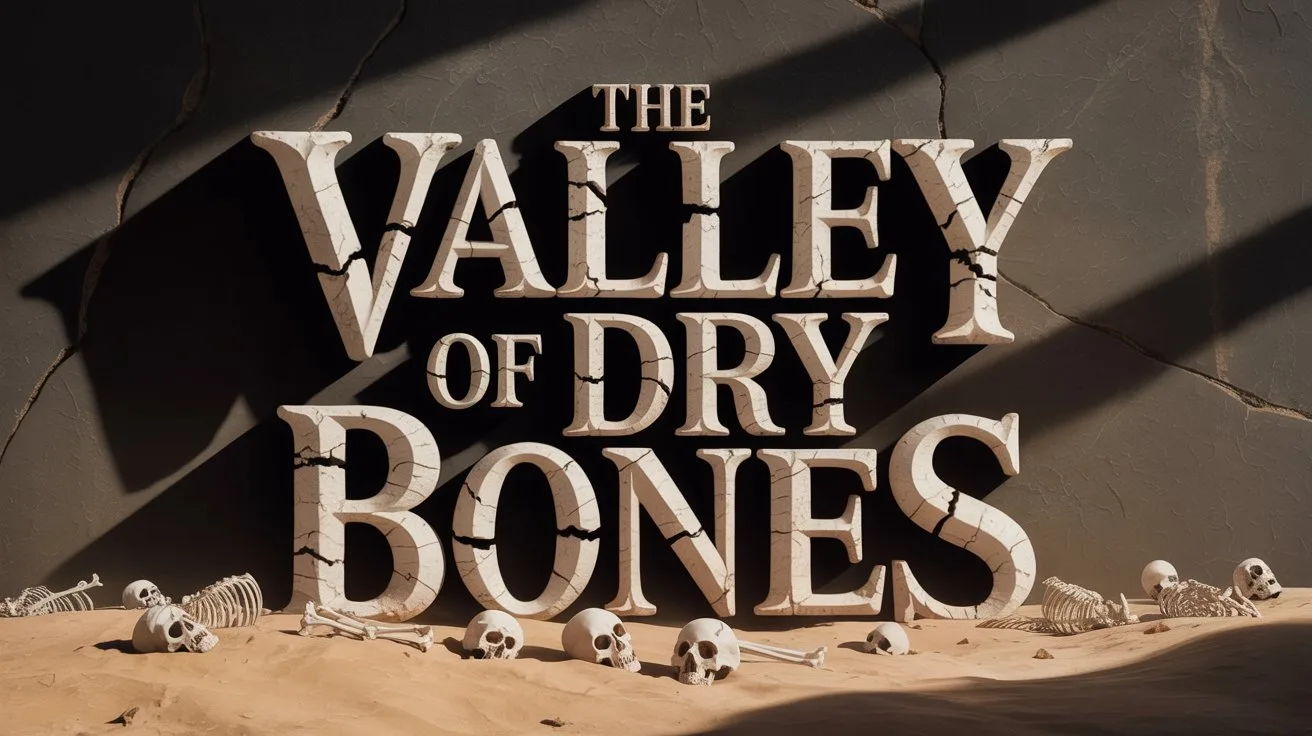

The Valley of Dry Bones in Ezekiel 37 is one of the most powerful and prophetic visions in all of Scripture. It is a vivid portrayal of God’s power to bring life where there is only death, to restore what is hopeless, and to fulfill His covenant promises even when everything appears lost. This vision was given to the prophet Ezekiel during the Babylonian exile, which was during a time of national despair, spiritual dryness, and utter brokenness.
Yet out of a valley full of dry bones comes the sound of rattling, the breath of life, and the forming of an exceedingly great army. This is more than a poetic image. It is a revelation of the character of God, the destiny of Israel, and the hope of resurrection through the power of the Word and the Spirit.
“So I prophesied as He commanded me, and breath came into them, and they lived, and stood upon their feet, an exceedingly great army.” (Ezekiel 37:10)
This study will explore the vision’s context, its meaning for Israel, its application to the Church, and how it ultimately points to the resurrection power of God in Christ Jesus.
The Historical Context
Ezekiel was a prophet to the exiles in Babylon, because Jerusalem had fallen and the temple was destroyed. The people were scattered, both Spiritually and nationally, and Israel was as good as dead. In their own words:
“Our bones are dry, our hope is lost, and we ourselves are cut off!” (Ezekiel 37:11)
It is in this context that God gives Ezekiel a vision, not of judgment, but of restoration. God’s people felt forgotten, but God had not abandoned His covenant. The vision of the valley was a divine declaration that even in the bleakest condition, God can restore, rebuild, and resurrect.
A Valley of Death
“The hand of the Lord came upon me and brought me out in the Spirit of the Lord, and set me down in the midst of the valley; and it was full of bones.” (Ezekiel 37:1)
Ezekiel is transported by the Spirit into a valley, not of warriors or worshipers, but bones… dry, lifeless, scattered bones. These bones were not simply dead. They had been dead a long time.
“And indeed they were very dry.” (Ezekiel 37:2)
This is a picture of total desolation. No sinews, no flesh, no breath… just dry, sun-bleached bones. It’s important to note that these bones represent the whole house of Israel (Ezekiel 37:11). The people were not physically dead, but spiritually and nationally they were as good as buried.
The Big Question
“And He said to me, ‘Son of man, can these bones live?’ So I answered, ‘O Lord God, You know.’” (Ezekiel 37:3)
God asks a question that invites faith. Ezekiel does not presume, nor does he doubt. He defers to the Lord’s wisdom and ability. This question should still be asked to every generation: Can something spiritually dead come to life? Can a ruined people be restored? Can revival come to a lifeless land?
God answers… not with explanations, but instructions.
The First Command
“Prophesy to these bones, and say to them, ‘O dry bones, hear the word of the Lord!’” (Ezekiel 37:4)
God tells Ezekiel to speak His Word to the bones. Not feelings, not ideas, not strategies… but the Word of the Lord. This shows the centrality of the Word in spiritual restoration.
“So I prophesied as I was commanded; and as I prophesied, there was a noise, and suddenly a rattling; and the bones came together, bone to bone.” (Ezekiel 37:7)
As Ezekiel speaks, the bones begin to rattle and connect. Tendons, flesh, and skin come upon them. But they are still lifeless.
“But there was no breath in them.” (Ezekiel 37:8)
The Word had brought structure and form, but not life. This is a sobering truth: people can look alive, sound alive, and be spiritually dead without the breath of God.
The Second Command
“Prophesy to the breath… and say, ‘Come from the four winds, O breath, and breathe on these slain, that they may live.’” (Ezekiel 37:9)
The Hebrew word for “breath” here is “ruach”, the same word for Spirit and wind. It is the Spirit of God who gives life.
“So I prophesied as He commanded me, and breath came into them, and they lived, and stood upon their feet, an exceedingly great army.” (Ezekiel 37:10)
This is true revival. Not emotional hype. Not religious form. But Spirit-filled, Word-formed life. The dry bones become an army that is restored, alive, and ready for battle.
Israel’s National Restoration
“Son of man, these bones are the whole house of Israel.” (Ezekiel 37:11)
This vision is first and foremost a promise to Israel. It is God’s declaration that He will regather His people from among the nations, restore them to their land, and renew their spiritual life.
“Behold, O My people, I will open your graves and cause you to come up from your graves, and bring you into the land of Israel.” (Ezekiel 37:12)
This was partially fulfilled in 538 BC when the Jews returned from Babylon. But the fullness points to a future regathering and spiritual awakening of Israel in the last days, as Paul also affirmed:
“And so all Israel will be saved, as it is written: ‘The Deliverer will come out of Zion.’” (Romans 11:26)
The Word and the Spirit
Ezekiel had to prophesy twice… once to the bones and once to the breath. This shows us that both the Word and the Spirit are necessary for revival.
“It is the Spirit who gives life; the flesh profits nothing. The words that I speak to you are spirit, and they are life.” (John 6:63)
Preaching alone cannot bring life. Emotional experience alone cannot transform. But when the Word and Spirit work together, dead things come alive.
Application to the Church
Though this prophecy is about Israel, the principle applies to the Church. Many congregations today resemble dry bones… no breath, no power, no life. There may be structure, programs, even crowds… but without the Holy Spirit, they are graves with steeples.
Paul wrote:
“Awake, you who sleep, arise from the dead, and Christ will give you light.” (Ephesians 5:14)
Jesus rebuked the church at Sardis:
“You have a name that you are alive, but you are dead.” (Revelation 3:1)
We have the same calling Ezekiel had… to speak the Word and pray for the wind.
Hope for the Hopeless
Many believers feel like those bones… dry, lifeless… forgotten. But God has not abandoned you.
“He heals the brokenhearted and binds up their wounds.” (Psalm 147:3)
Your valley is not your end. If God can raise an army from bones, He can restore your soul, heal your marriage, revive your calling, and breathe new life into what you thought was dead.
Jesus said:
“I am the resurrection and the life. He who believes in Me, though he may die, he shall live.” (John 11:25)
The same Spirit that raised Christ from the dead dwells in you (Romans 8:11). Dry bones can live again.
Prophetic Fulfillment in Christ
Ultimately, the valley of dry bones points to the resurrection of Christ and the new life He gives to those dead in sin. Paul declared:
“Even when we were dead in trespasses, made us alive together with Christ.” (Ephesians 2:5)
We were all dry bones once… hopeless, helpless, and dead. But God spoke, and the Spirit moved, and now we stand redeemed.
My Final Thoughts
The valley of dry bones is more than a vision, it is a promise. A promise that God restores what is broken, revives what is dead, and breathes life into that which has no hope. Whether you are praying for a prodigal child, pleading for revival in your church, or facing a spiritual drought in your own soul, remember: the Word still speaks. The Spirit still breathes. The bones can live again.
Prophesy to the bones. Proclaim the truth. Call on the Spirit. And watch as God does what only He can… bring life out of death and raise an army from the ashes.
“Then you shall know that I, the Lord, have spoken it and performed it,” says the Lord.’” (Ezekiel 37:14)
God is not finished. Not with Israel. Not with the Church. And not with you. Praise the Lord.

 Get the book that teaches you how to evangelize and disarm doctrines from every single major cult and religion.