
Did Jesus appear to people before He was born in Bethlehem? We know that the Son already existed, but I want to look at the passages that help us recognize Him in the Old Testament. Some give us much more to work with than others, so we need to consider the evidence before calling an angel or an unexplained figure a Christophany.
The Eternal Son Makes God Known
When we open the Old Testament, we aren’t opening a book from a time before Christ existed. The Son became truly man at Bethlehem without ceasing to be truly God, but His existence did not begin there. He is the eternal Creator who makes God known and saves sinners. That helps us understand why we should expect the Old Testament to speak of Him long before we reach Matthew.
An appearance of Christ is called a Christophany, while the broader term theophany means an appearance of God. Because Christ is fully God, an appearance of Christ is also an appearance of God. The broader term alone, however, doesn’t tell us which divine Person appeared. To understand that, we need the details of the passage and what the New Testament later reveals.
We should also distinguish an appearance from the incarnation, when the Son became man. Before Bethlehem, He could appear visibly without permanently taking human nature. When the Word became flesh, He truly became man and remains so. Those earlier appearances were real encounters, but they were not earlier incarnations or a series of births.
God speaking from heaven is different from someone seeing Him appear, so I want to pay attention to what each account actually describes. Sometimes a figure introduced as the Angel of the LORD speaks as the LORD Himself. Elsewhere, a Man accepts worship or makes the ground holy by His presence. These are claims to authority that belongs to God alone. When the Messenger is distinguished personally from the LORD and yet identified as the LORD, we have more to consider than an unusual visitor. Later Scripture may also identify the glory seen in that encounter as Christ’s.
The Old Testament also describes visits from ordinary created angels and human beings. Some visions use symbols, and some accounts leave the visitor’s identity unexplained. I can’t take that lack of information as proof that the visitor was Christ. At the same time, I don’t want to overlook the evidence God has given when a passage does identify Him.
My confidence in these appearances grows as I see how the passages agree. In Genesis, the LORD appears and the divine Messenger speaks in His own name. Exodus identifies the Messenger with the God of Israel, whose presence makes the ground holy, and Judges continues that identification. The prophets show His glory as He rescues His servants and removes iniquity. When the New Testament tells us that the eternal Son makes God known, it helps explain what we have been seeing in those earlier passages. We can follow those connections without supplying details from our imagination.
John gives us a clear place to begin. At the opening of his Gospel, the Word already exists with God and is Himself God. He is personally distinct from the Father, and all things were made through Him. John then tells us that this same Word became flesh and lived among us.
No one has seen God at any time. The only begotten Son, who is in the bosom of the Father, He has declared Him.
John 1:18, NKJV
How can John 1:18 say that no one has seen God when the Old Testament describes people encountering Him? John explains that the Son makes the unseen Father known. Jesus adds in John 5:37, “You have neither heard His voice at any time, nor seen His form.” I don’t understand those Old Testament encounters as appearances of the Father, because that would conflict with Jesus’ words. They fit the work of the eternal Son who reveals Him.
Colossians 1:15 calls Christ the image of the invisible God, and Hebrews 1:3 describes Him as the brightness of God’s glory and the express image of His person. We shouldn’t read those descriptions as though the Son were simply one of God’s created messengers. All things were made through Him, so He cannot belong to the creation He made. He is fully God while remaining personally distinct from the Father.
Jesus makes His existence before Abraham clear in John 8:58: “Before Abraham was, I AM.” His words agree with the eternal identity John has already described at the beginning of the Gospel. The One who became flesh did not begin to exist when He became man.
We need to keep both truths in view as we consider these appearances. The Son is neither a created angel nor a lesser divine being, but that doesn’t make Him the same Person as the Father. The Father sends the Son, and the Son reveals the Father. They share the same deity while remaining personally distinct.
Melchizedek, the Priest-King
After Abram rescued Lot, Genesis 14 introduces us to Melchizedek, the king of Salem and priest of God Most High. He brought out bread and wine and blessed Abram, who gave him a tenth. We are told very little about him here, yet later passages return to this encounter to explain Christ’s priesthood.
Then Melchizedek king of Salem brought out bread and wine; he was the priest of God Most High.
Genesis 14:18, NKJV
Psalm 110 says that the Messiah is a priest forever according to the order of Melchizedek. When Paul explains the Genesis account in Hebrews 7, he draws attention to the way Scripture describes this king of righteousness and king of peace. Melchizedek is presented without father or mother, with no recorded genealogy or beginning of days or end of life. Hebrews says he was made like the Son of God and remains a priest continually.
Some readers understand Melchizedek as an ordinary historical king whose missing genealogy makes him a picture of Christ. I understand him as a Christophany, and it isn’t only the missing family record that leads me there. Abraham recognized the greatness of this priest-king by receiving his blessing and giving him tithes. Psalm 110 connects his priestly order with the Messiah, while Hebrews describes him in terms that fit Christ’s eternal priesthood. Paul also uses Abraham’s encounter to show the superiority of Melchizedek’s order to Levi, whose priestly descendants were still in Abraham. Together, those details point me to more than a man whose life foreshadowed Christ.
Hebrews says Melchizedek was “made like the Son of God,” and we need to read that description with the whole argument. I wouldn’t try to settle Melchizedek’s identity from the phrase alone. His name fits a righteous king who is also a priest, and the absence of a genealogy in Genesis belongs alongside Hebrews’ description of his continuing priesthood. Psalm 110 then assigns a permanent priesthood to the Messiah. My understanding rests on those connections, not simply on information Genesis leaves out.
What draws me to this passage is what it helps us understand about Jesus. His priesthood will never pass to someone else because He lives forever. That means He is able to save completely those who come to God through Him. Studying Melchizedek should bring us to a greater appreciation of that Priest-King, rather than leave us absorbed in a mystery with no bearing on our confidence in Christ.
The Angel of the LORD Speaks as God
We see the clearest repeated evidence of Christophany in the Angel of the LORD passages. The word angel means messenger, which tells us about the work being done without necessarily telling us the messenger’s nature. Ordinary angels are created servants, but this distinctive Messenger speaks as God and bears His name. He also claims works that belong to the LORD. Those details are what we need to examine before deciding who He is.
In Genesis 16, Hagar had fled after Sarai dealt harshly with her. The Angel of the LORD found this vulnerable servant beside a spring and called her by name. He promised, “I will multiply your descendants exceedingly” (Genesis 16:10). Hagar then called the LORD who spoke to her “You-Are-the-God-Who-Sees.” Notice who was making the promise. The Messenger spoke with divine authority about what He Himself would do, and the account identifies Him as the LORD.
I don’t want to become so occupied with identifying the Messenger that I pass over His mercy toward Hagar. Others had used and afflicted her, yet the Lord saw her and spoke to her personally. His care for her belongs in our understanding of who He is.
In Genesis 22, the Angel of the LORD stopped Abraham before Isaac was harmed. He said, “By Myself I have sworn, says the LORD” (Genesis 22:16). Hebrews 6 explains why God swore by Himself: there was no one greater by whom He could swear. That helps us understand the authority of the One speaking to Abraham. This was a unique test in God’s covenant dealings with him, and God Himself stopped the knife.
At the burning bush, Exodus 3 first identifies the One who appeared to Moses in the flame as the Angel of the LORD. As the account continues, it says that the LORD saw Moses and God called to him from the bush. The Speaker identified Himself as the God of Abraham, Isaac, and Jacob, and Moses had to remove his sandals because God’s presence made the ground holy.
Then He said, “Do not draw near this place. Take your sandals off your feet, for the place where you stand is holy ground.”
Exodus 3:5, NKJV
Exodus 23 tells us that the Angel bears God’s name and must be obeyed. Then, in Judges 2, He speaks of bringing Israel out of Egypt and making covenant with them. I find it difficult to understand Him as an ordinary created angel when He claims the LORD’s own acts and covenant in this way.
We can compare these encounters with Revelation 22:8-9, where John fell before a created angel and was told, “Do not do that” and “Worship God.” That angel refused worship. In the Angel of the LORD accounts, however, the Messenger is identified with the LORD even while remaining personally distinct from Him. That may seem difficult to understand if we read the encounters by themselves, but it agrees with what Scripture later teaches about the unity and personal distinctions within the Trinity.
The title alone would not persuade me that this Messenger is the Son. His words and actions carry divine authority, and the way people receive Him agrees with that identity. We can also recognize the connection to the New Testament, where the eternal Son is sent to reveal the Father. In the Old Testament, the Angel of the LORD is sent while speaking and acting as the LORD Himself. Calling Him a Messenger doesn’t make Him a creature; it describes the divine Son at work before Bethlehem.
The LORD Appears to His Servants
Genesis 18 tells us that “the LORD appeared” to Abraham by the terebinth trees of Mamre. When Abraham looked up, he saw three men. Two later went toward Sodom, while the LORD spoke with Abraham about Sarah and the promised son. Their conversation then turned to the judgment of Sodom.
Genesis leaves some questions about the three visitors unanswered, but it gives us enough to recognize who was speaking with Abraham. The LORD appeared visibly and received Abraham’s hospitality. He spoke about things that only God could know and do. Abraham’s question, “Shall not the Judge of all the earth do right?” (Genesis 18:25), shows that he understood himself to be speaking with the LORD who judges perfectly.
In Genesis 32, Jacob wrestled through the night with a Man who touched his hip and changed his name to Israel. After receiving His blessing, Jacob named the place Peniel, explaining, “I have seen God face to face, and my life is preserved” (Genesis 32:30). Hosea 12:3-5 looks back on this same struggle and speaks of the Angel and the LORD God of hosts.
Jacob’s struggle doesn’t mean that he was stronger than God. The Lord met him in a form that allowed a real struggle, and through it broke his self-reliance. I notice that Jacob left with both a blessing and a limp. His new name did not come with a new reason to boast in his strength. He had to go forward in dependence on the Lord who had met him. These appearances changed the people involved and directed how they would live.
Before the battle at Jericho, Joshua saw a Man with a drawn sword who identified Himself as Commander of the army of the LORD. Joshua 5 records that Joshua fell on his face and worshiped. The Commander accepted that worship and told him to remove his sandal because the place was holy. The encounter closely resembles what happened to Moses at the burning bush.
Although the passage doesn’t call Him the Angel of the LORD, His acceptance of worship and the holiness of the ground point to a Christophany. He also placed Joshua under His command. I think we can easily miss that part if we only ask who the Man was. The Lord had not come to endorse whatever Israel planned to do. Joshua had to bow before the true Commander and receive his orders from Him.
Moses stood on holy ground before being sent to bring Israel out of Egypt. Now Joshua stood on holy ground before Israel entered Jericho. In both encounters, the Lord revealed His holiness and directed His servant toward the work ahead. We can see Him carrying His covenant promises forward through the people He called to serve Him.
In Judges, we see the Lord respond mercifully to people who feared Him. Gideon was hiding from Midian when he met the Angel of the LORD. After the visitor spoke, the account says that the LORD turned to Gideon and commissioned him. When the offering had been consumed and the Angel had departed, Gideon feared that he would die because he had seen the Angel of the LORD face to face. The LORD answered him with peace: “Do not fear, you shall not die” (Judges 6:23).
Manoah and his wife met the Angel of the LORD in Judges 13. He announced Samson’s birth and later ascended in the flame of the altar. Manoah cried, “We shall surely die, because we have seen God!” (Judges 13:22). I appreciate the way his wife answered that fear by considering what the LORD had actually done. If He intended to kill them, why had He accepted their offering and promised them a child? She reasoned from His mercy instead of letting fear lead her to a conclusion His actions did not support.
Zechariah 3 describes a courtroom scene in which Joshua the high priest stood in filthy garments while Satan accused him. The LORD rebuked Satan, and Joshua’s filthy garments were removed. He was told, “See, I have removed your iniquity from you, and I will clothe you with rich robes” (Zechariah 3:4). The Angel of the LORD was at the center of this encounter, where the accusation was answered and Joshua’s iniquity was taken away.
These encounters help me understand the Lord’s mercy as well as His identity. Gideon expected death but heard a promise of peace. Manoah’s offering was accepted, and Joshua’s accuser was silenced as Joshua’s guilt was removed. We see the fullness of that saving work in Jesus Christ, our Advocate and our righteousness. Our peace with God comes through Him because He alone can save us.
Daniel, Isaiah, and the Glory of Christ
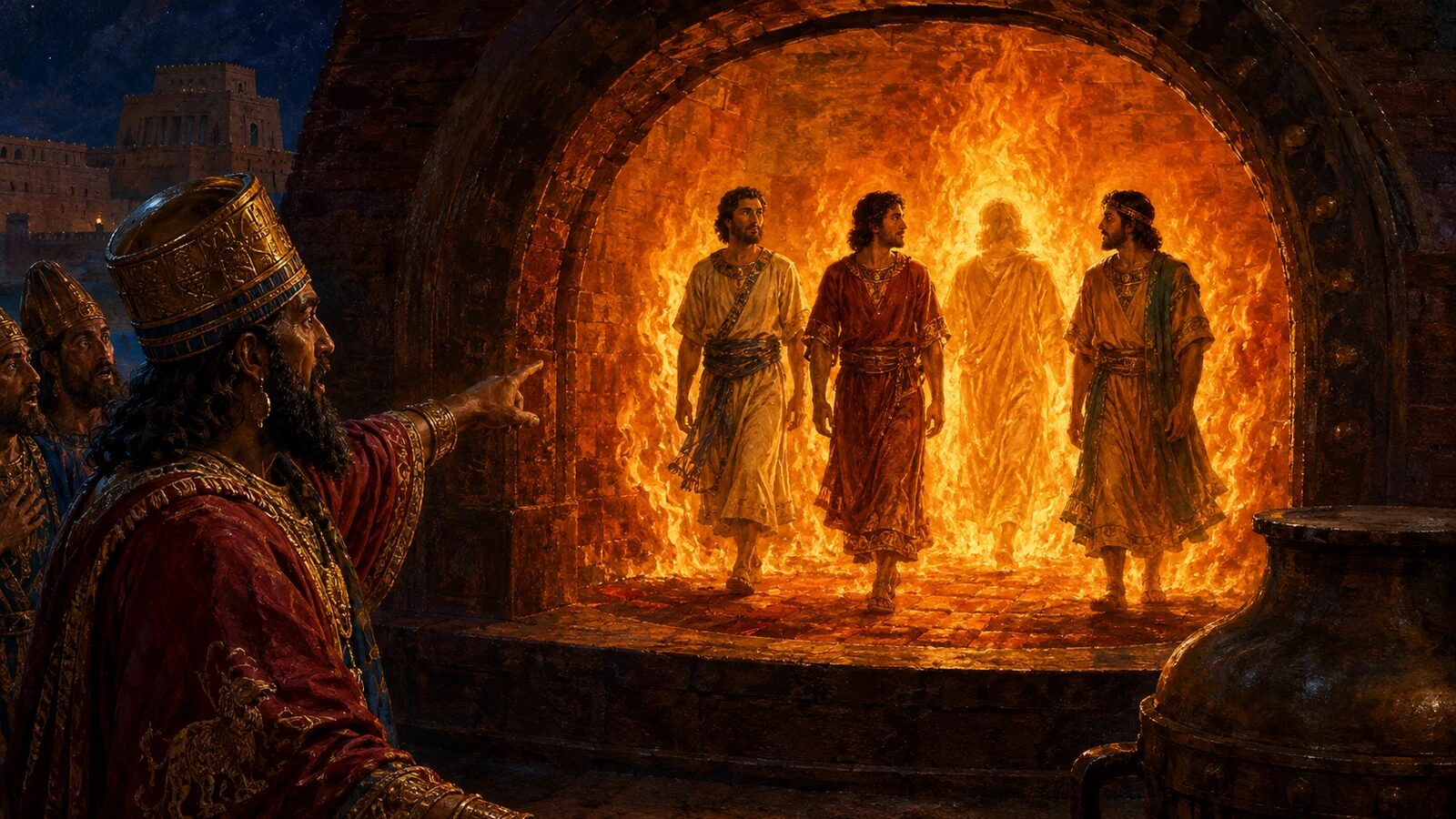
Daniel 3 gives us another appearance to consider, though the identifying evidence is less detailed than in some of the passages we have read. Shadrach, Meshach, and Abed-Nego were thrown into the furnace for refusing to worship Nebuchadnezzar’s golden image. The king expected three bound men to die, but instead saw four walking freely in the fire. He described the fourth as “like the Son of God” (Daniel 3:25) and later called Him a messenger sent by their God.
I understand the fourth Man as a Christophany, but I wouldn’t rest that conclusion on Nebuchadnezzar’s description alone. He wasn’t speaking from a mature understanding of biblical truth, and this account gives us fewer identifying details than Exodus 3 or Genesis 16. What leads me to recognize the Son here is the divine Deliverer’s presence with His servants. It agrees with the wider pattern of Him making God known and rescuing His people. These men were not alone in the fire, and the flames could not consume them.
With Isaiah 6, we have a direct explanation in the New Testament. Isaiah saw the Lord high and lifted up on His throne while the seraphim cried, “Holy, holy, holy is the LORD of hosts; The whole earth is full of His glory!” He knew he was undone because he had seen the King, the LORD of hosts. Later, while explaining the unbelief that followed Jesus’ signs, John applied Isaiah’s vision to Christ.
These things Isaiah said when he saw His glory and spoke of Him.
John 12:41, NKJV
John identifies the glory Isaiah saw as Christ’s glory. I don’t have to infer that connection from the appearance alone, because John makes it for us. This affirms the Son’s full deity and His part in Old Testament revelation without dividing God into competing gods. The Son who later came humbly and was rejected by men is the Lord Isaiah saw on the throne.
Once we recognize who appeared, we can see how these encounters belong to God’s work of making Himself known and redeeming His people. The Son was already speaking and blessing them before Bethlehem. He judged with perfect justice and rescued those who trusted the LORD. When He became man, He came to accomplish the redemption those earlier encounters anticipated.
Jesus willingly shed His physical blood for sinners and died before rising bodily from the grave. He bore the punishment for our sins in His innocent body. The Father and Son remained united in that saving work. The Father did not personally punish or curse Jesus, nor did He abandon Him or pour wrath upon Him. He did not strike or bruise His Son. Christ willingly gave Himself and is now the only Savior and Mediator between God and man.
He died for the whole world, and His offer of salvation is genuine even though people can resist and reject it. Everyone who repents and believes in Him is born again. The Holy Spirit indwells and seals that person, and a truly born-again believer is eternally secure. That security never turns sin into something harmless. The eternal Son who appeared in the Old Testament now gives new life to everyone who comes to Him in faith.
Reading These Appearances Without Guessing
As we draw these passages together, we need to be clear about what we mean when we call the Son a messenger. We are describing His mission, not placing Him among the created angels. Colossians 1 says that all things were created through Him and for Him. Hebrews 1 also distinguishes Him from the angels and commands them to worship Him.
We also need to keep the Father and Son personally distinct. The Father sends the Son, who reveals Him and prays to Him. The Holy Spirit is likewise a divine Person, not a force. The one God has eternally existed as three coequal and co-eternal Persons: Father, Son, and Holy Spirit. The Trinity helps us understand these appearances because the Son is fully God without being the Father, and the LORD remains one.
There will still be passages where we don’t have enough information to identify the person who appears. Some describe created angels, and others use symbolic visions. I’m willing to leave an identity unexplained when Scripture leaves it unexplained. Where it does give us evidence, we should consider that evidence along with what the New Testament tells us about the Son.
One objection is that the word Christophany never appears in the Bible. That is true of Trinity as well, so the question is whether the term accurately describes what Scripture teaches. I find such terms useful when they help us explain the passages. We go wrong when we let a label determine what a passage must mean.
Others understand these accounts as created angels speaking on God’s behalf. A created messenger can repeat God’s words, but that doesn’t account for everything we have read. The Angel bears God’s name and claims His covenant works as His own. His oath is sworn by Himself, and His presence makes the ground holy. He does not refuse worship, and Zechariah places Him at the removal of iniquity. Taken together, those details identify Him with the LORD while preserving His personal distinction.
The suggestion that the Father appeared visibly doesn’t fit John 1:18 or John 5:37. Those passages tell us that the Son makes the unseen Father known. As the image of the invisible God and the express image of His person, the Son is the One whose work fits these visible appearances.
I also want to resist the temptation to identify every mysterious figure as Christ simply because the possibility interests me. Confidence needs a reason in the passage itself. When a figure is clearly identified as divine and other Scripture supports the connection to the Son, we have a stronger basis for recognizing a Christophany.
We should also remember why the Son appeared in these encounters. He was carrying out God’s covenant purposes while meeting people’s actual needs. Hagar learned that He saw her, and Abraham received a promise that would shape his family. Moses was sent to serve, while Joshua had to recognize the divine Commander’s authority. Gideon received peace when he expected death. In Zechariah’s vision, the accuser was rebuked and the high priest received clean garments. The Lord’s presence called for faith and obedience in each person’s circumstances.
What persuades me is how these passages support one another. Melchizedek directs us to the eternal Priest-King, while the Angel of the LORD is identified as the LORD and yet personally distinguished from Him. Abraham received the LORD at Mamre, and Jacob spoke of seeing God face to face. Moses and Joshua stood on ground made holy by His presence, while Gideon and Manoah feared after encountering Him. Zechariah saw iniquity removed, and Daniel’s account shows the fourth Man with God’s faithful servants. Then John explicitly identifies the glory Isaiah saw as Christ’s. Each passage contributes to the conclusion, though they do not all identify Him with equal clarity.
For a closer look at the main parts of this study, see The Angel of the Lord, The Trinity, and Melchizedek. Each study develops one part of the same biblical witness.
My Final Thoughts
I believe these passages show us the eternal Son appearing before His incarnation. We don’t need to find Him in every unexplained encounter to appreciate how much Scripture does reveal about Him. He is the Creator and eternal Priest-King who made God known long before Bethlehem. The Lord who gave promises and commands to His people also came to their rescue, and He later took on flesh to save us. That gives me a deeper reverence for the Old Testament. I’m reading about the same Lord I worship today, so I want to recognize Him where Scripture reveals Him and be careful where it leaves questions unanswered.