
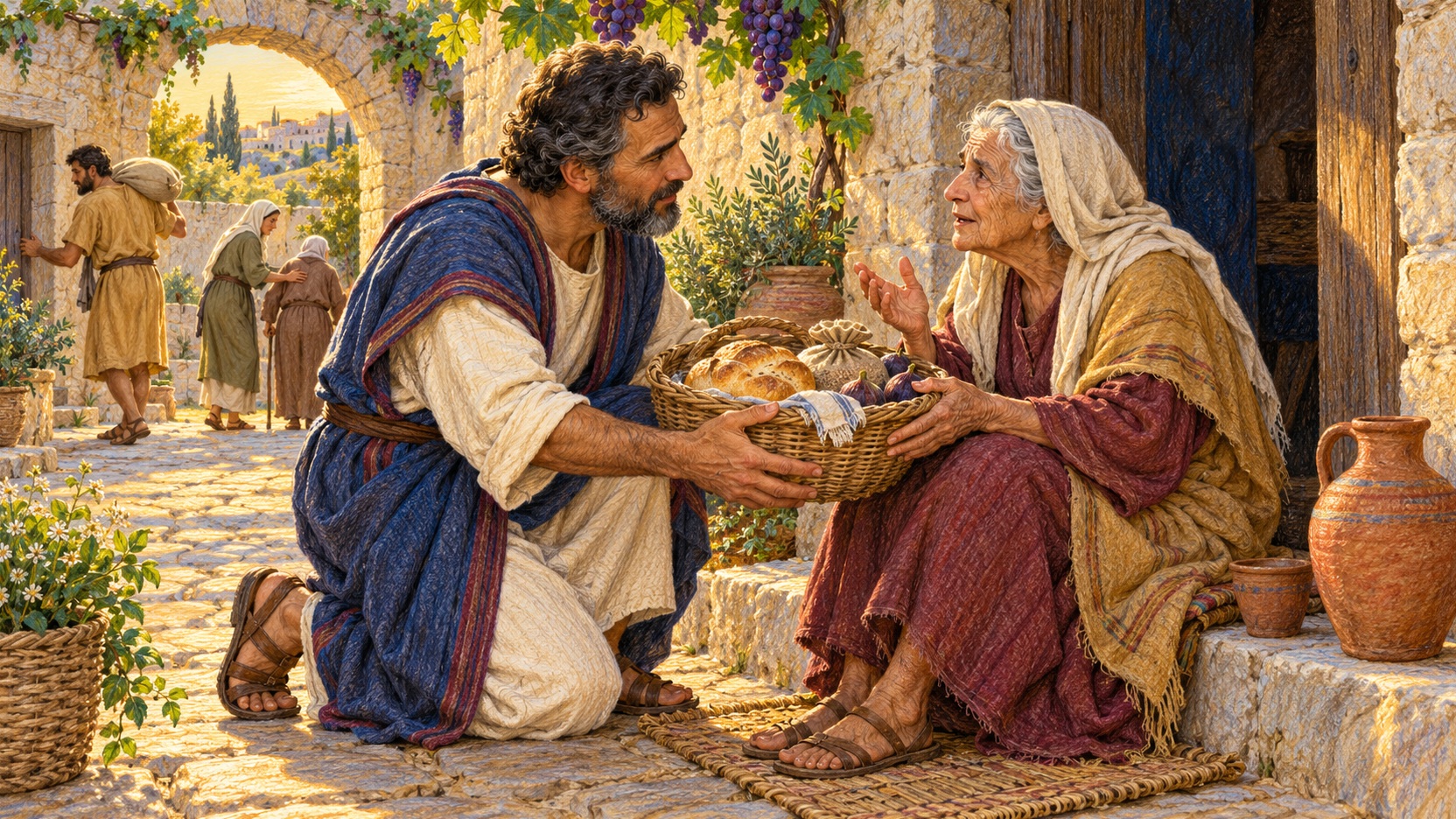
When a church entrusts someone with money to help a struggling family, that family needs more than a man who can keep good records. They need to know he will treat them honestly and handle their situation with care. That helps us understand why the New Testament spends so much time describing a deacon’s character before a church appoints him to serve.
Deacons are recognized servants in the local church. Their work helps meet practical needs, while elders bear the responsibility of pastoral oversight and teaching. I understand Scripture to reserve both offices for qualified men, and the qualifications tell us what kind of men a congregation should be able to trust. To see how those responsibilities fit together, let’s begin with what Jesus taught His disciples about serving.
Christ Defines Servant Leadership
In Mark 10:35–45, James and John, two of Jesus’ apostles, asked Him for the places on His right and left when He came in His glory. When the other ten heard about their request, they were greatly displeased. Jesus brought them together and explained that the rulers around them used their positions to exercise power over others. His disciples were to approach greatness differently. The man who wanted to be first would have to serve.
Jesus then pointed to His own purpose. He referred to Himself as the Son of Man and said:
For even the Son of Man did not come to be served, but to serve, and to give His life a ransom for many.
He was speaking about giving His life to secure our release from sin. A ransom is a price paid for release, and none of His disciples could accomplish what He was going to accomplish through His death. The eternal Son of God became truly human, lived without sin, and willingly gave Himself for us. Men put Him to death, but they did not take Him against His will. He offered Himself through the eternal Spirit, and His shed blood and death completed the atonement before He was buried. He rose bodily on the third day. The Father never punished, cursed, abandoned, struck, bruised, or poured wrath on the Son. Father, Son, and Holy Spirit were united in this work of redemption (John 1:1–14; Hebrews 9:11–15; 1 Corinthians 15:1–8).
Christ’s sacrifice was for the whole world, so the invitation to repent and believe in Him is a genuine invitation to every person. His grace can be resisted, but everyone who repents and believes receives the salvation He provides. We receive forgiveness and eternal life by God’s grace through faith, not by earning a place through church service (1 John 2:1–2; Ephesians 2:8–10). Once that is clear, we can also see why His example changes the way we serve. The One who saves us gave Himself for our good. A position among His people ought to make us willing to give our time and attention for their good.
I find that to be a useful place to begin because a man can be busy helping people and still want the influence that comes with being needed. A deacon may learn about a family’s financial hardship or become involved in a difficult disagreement. Those people have placed themselves in a vulnerable position by asking for help. He must not use what he knows to control them or make them feel indebted to him. Serving them may cost him convenience or recognition, but their need remains the reason for the work.
That does not mean a servant can never give direction or make a firm decision. Someone has to organize the work and be accountable for it. The question is whether he uses that responsibility to care for the people entrusted to him. The apostles faced exactly that kind of practical responsibility as the church in Jerusalem grew.
Acts 6 Gives a Pattern of Recognized Service
Acts 6 begins with a complaint about the daily distribution of assistance. Some of the believers were Hellenists, meaning Greek-speaking Jews, while the Hebrews were the Hebrew- or Aramaic-speaking Jews among them. The Hellenists said their widows were being neglected. These women had lost their husbands, and the assistance they received from the church mattered to their daily lives. The growing congregation had a problem that needed to be addressed.
Now in those days, when the number of the disciples was multiplying, there arose a complaint against the Hebrews by the Hellenists, because their widows were neglected in the daily distribution. Then the twelve summoned the multitude of the disciples and said, It is not desirable that we should leave the word of God and serve tables.
The twelve apostles did not tell the widows to stop complaining or suggest that their needs were beneath them. They called the believers together because the work needed responsible attention. If the apostles left their ministry of the Word to handle the entire distribution themselves, another responsibility would go unattended. They proposed a way for both needs to be met.
Therefore, brethren, seek out from among you seven men of good reputation, full of the Holy Spirit and wisdom, whom we may appoint over this business; but we will give ourselves continually to prayer and to the ministry of the word.
Pay attention to the kind of men they asked the church to choose. They needed seven men with a good reputation who were full of the Holy Spirit and wisdom. The task involved practical arrangements, but the people making those arrangements needed spiritual maturity. They would have to listen to complaints, treat people fairly, and make decisions about resources. A man who could count the supplies but favored his friends would not solve the problem that had brought the church together.
The congregation chose the seven, and the apostles prayed and laid their hands on them. The work now had recognized men responsible for it, while the apostles continued in prayer and the ministry of the Word. Luke, who wrote Acts, then tells us that the Word of God spread and the number of disciples increased greatly in Jerusalem (Acts 6:5–7).
I see a pattern here that helps us understand the later instructions about deacons. A practical need was entrusted to spiritually qualified men so that the church could care for its people without neglecting the teaching of God’s Word. Luke does not actually call these seven men deacons in this passage, so I would not make that title part of his account. The connection I am drawing is between their recognized service and the character required of men entrusted with similar responsibilities.
Nor did that assignment mean the seven could never proclaim the gospel. Stephen was one of them. After men brought false accusations against him, he testified before the Jewish council and was eventually stoned to death (Acts 6:8–15; 7:51–60). Philip was another of the seven. When persecution scattered believers from Jerusalem, he preached Christ in Samaria, and later he explained the gospel to an Ethiopian official who was reading Isaiah (Acts 8:1–8, 26–40). Caring for practical needs did not take away their responsibility or ability to tell people about Jesus.
Paul Requires Proven Character and Sound Faith
The apostle Paul gives the qualifications for deacons in 1 Timothy 3. He had left Timothy in Ephesus to address false teaching, and in this letter he explained how people were to conduct themselves in God’s household, the church (1 Timothy 1:3–7; 3:14–15). These instructions concern the spiritual health of a congregation, including the men appointed to serve it.
Likewise deacons must be reverent, not double-tongued, not given to much wine, not greedy for money, holding the mystery of the faith with a pure conscience.
Paul begins by saying that deacons must be reverent. I understand that to describe men who take God and their responsibilities seriously. It does not mean they must have a reserved personality or never enjoy a conversation. It means the needs of the church are not an opportunity for them to make a show of themselves. When someone brings a painful situation to them, they recognize that a real person is depending on their care.
That seriousness must also be present in their speech. A double-tongued man tells one person one thing and then tells someone else something different because he wants to please both of them. That can do a great deal of damage when he is handling a disagreement. People may think they have reached an understanding, only to discover he made incompatible promises. A deacon needs to tell the truth consistently, and he needs to protect information that was entrusted to him in confidence.
The warnings about wine and greed concern the same trust. His judgment must not be controlled by drink, and his decisions must not be driven by an opportunity to profit. A church may place donations, purchases, or assistance for needy families in his care. If he is greedy for money, financial ability can make him more effective at serving himself. The congregation needs confidence that the resources will reach the people and purposes for which they were given.
Paul also requires him to hold the mystery of the faith with a pure conscience. The mystery is the truth God has revealed concerning Christ, not secret knowledge available to a small circle of people. A deacon needs to understand and hold to the faith he professes. Because he serves in Christ’s church, it matters what he believes about Christ and whether his conduct agrees with that belief.
A pure conscience does not mean he has never sinned. It means he cannot knowingly carry on in dishonesty while presenting himself as a faithful servant. When he is wrong, he needs to acknowledge it and respond to correction. Paul therefore tells the church to examine a man before appointing him.
But let these also first be tested; then let them serve as deacons, being found blameless.
That testing takes time. An interview can tell us what a man says he believes, but his ordinary conduct helps us see whether he lives that way. How does he speak when someone disagrees with him? Does he handle money honestly when nobody is praising him for it? When a concern is brought to him, does he listen, or does he immediately become defensive? These are things a church should have some opportunity to observe before giving him greater responsibility.
Being found blameless does not mean nobody has ever criticized him. It means there should not be an established pattern of disqualifying conduct that the congregation chooses to overlook. Enthusiasm, business success, or an empty position on a church board cannot replace the qualifications Paul gives. Waiting until a man has been tested protects the people he would serve, and it also protects him from being placed in a responsibility he is not ready to carry.
Home Life Supports Public Credibility
Paul continues by bringing the household into the discussion. A man may be helpful and courteous for a few hours at church, while those who live with him experience a very different person. His home life gives the congregation something to consider beyond his public manner.
Likewise their wives must be reverent, not slanderers, temperate, faithful in all things.
I understand this verse to refer to the wives of deacons. The Greek wording in verse 11 uses a word that can mean women or wives, and the word “their” is supplied in the translation rather than expressed by a separate Greek possessive. My conclusion comes from reading the verse in its setting. Paul is discussing deacons, and in the next verse he speaks directly about their faithfulness as husbands and their care for their households.
A wife who is reverent, careful with her speech, temperate, and faithful supports the trust involved in her husband’s service. If she hears about someone’s difficulty, that person should not become the subject of slander. Temperance also matters because a steady, clear-minded response can help keep a difficult situation from becoming worse. Faithfulness is seen in the ordinary dependability of a life, including how someone treats people who have little to offer in return.
This does not give a deacon permission to share every confidential matter with his family. His wife does not automatically become entitled to information simply because he serves the church. He still has a responsibility to handle another person’s private circumstances carefully.
Let deacons be the husbands of one wife, ruling their children and their own houses well.
The requirement that a deacon be the husband of one wife calls for marital faithfulness and moral integrity. His service at church cannot compensate for unfaithfulness at home. In the same way, ruling his household well requires him to take responsibility for the people already in his care. A man who repeatedly neglects them should not be treated as a model servant because he is always available to help somebody else.
I do not understand good household leadership to mean harsh control. A father can make everyone afraid to speak without caring for them well. Nor does this qualification require a family that never experiences difficulty. We need to look at how the man responds to the responsibilities he actually has. Does he care for his wife and children, address problems honestly, and give his household the attention it needs? A difficult season may reveal that care more clearly than an appearance of perfection on Sunday morning.
For those who have served well as deacons obtain for themselves a good standing and great boldness in the faith which is in Christ Jesus.
Paul attaches encouragement to faithful service. A man who serves well gains a good standing, and his faith in Christ is expressed with greater boldness. The people he has helped have reason to trust him, and he has had opportunities to put what he believes into practice. This is not a promise that his work earns salvation or that he will automatically be promoted to another office. The service itself is honorable, and Paul wants the church to recognize that.
Self-Control and the Difference Between Elders and Deacons
The qualifications for deacons follow Paul’s instructions about an overseer, which the NKJV calls a bishop. We can see how the terms relate in Titus 1:5–7. Paul had left Titus on the island of Crete to appoint elders in its churches, and as he explains their qualifications he refers to a bishop. He is describing the responsibility of oversight held by those elders. Peter likewise tells elders to shepherd God’s people and serve as overseers (1 Peter 5:1–3).
With that responsibility in view, Paul writes:
A bishop then must be blameless, the husband of one wife, temperate, sober-minded, of good behavior, hospitable, able to teach; not given to wine, not violent, not greedy for money, but gentle, not quarrelsome, not covetous.
Much of the character described here is also required of deacons. Both kinds of service place people in a position of trust. An elder, however, must also be able to teach because he is responsible for instructing and shepherding the congregation. Paul does not include that same express requirement in the qualifications for deacons. I therefore distinguish the office of pastoral oversight from the recognized service of deacons, while remembering that Stephen and Philip show how a man entrusted with practical service may also proclaim God’s Word.
The distinction does not lower the moral standard for either group. Paul expects clear judgment and self-control. A quiet man is not necessarily sober-minded, and an outgoing man is not necessarily careless. What matters is whether he can assess a situation responsibly and govern his conduct. If anger repeatedly determines how he treats people, his knowledge of theology will not make those people safe in his care.
Likewise, the difference between Paul’s wording about wine for overseers and deacons should not become an excuse for drunkenness. Ephesians 5:18 forbids drunkenness for believers generally. A man cannot defend impaired judgment by saying that he still managed to finish the day’s work. The church is entrusting him with people and their needs, and his conduct affects whether they can approach him with confidence.
These qualifications become especially important when money is limited or a disagreement grows tense. Someone may need to make an unpopular decision, but he can explain it honestly and listen without becoming quarrelsome. He can refuse an improper request without humiliating the person who made it. That is where the congregation begins to see whether the character described in 1 Timothy 3 is present in the man carrying the responsibility.
Authority and Roles in the Gathered Church
The instructions about church offices also need to be read alongside what Paul says in the preceding chapter. In 1 Timothy 2, he addresses the conduct of men and women and then gives this instruction:
Let a woman learn in silence with all submission. And I do not permit a woman to teach or to have authority over a man, but to be in silence.
Notice that he begins with “Let a woman learn.” Women are to receive instruction in the faith. Paul is not excluding them from understanding Scripture or treating their spiritual growth as unimportant. He calls for quietness and submission in learning, and then he identifies the teaching and authority he does not permit a woman to exercise over a man.
I understand this to restrict authoritative teaching and governing authority over men in the gathered church. It cannot mean that a woman is forbidden to speak about Scripture in every circumstance. In 1 Corinthians 11:5, Paul discusses women praying and prophesying. In Acts 18:24–26, Apollos was teaching boldly, but his understanding was incomplete. Aquila and his wife Priscilla heard him, took him aside, and explained the way of God to him more accurately. Their help did not require Priscilla to become an elder over the congregation.
Paul also tells older women to teach what is good and to instruct younger women in faithful conduct (Titus 2:3–5). There is real work for women to do in helping others understand and live out God’s Word. I want to honor that work while also honoring the particular restriction Paul gives in 1 Timothy 2. Neither instruction needs to be set aside for the other to stand.
Paul explains the reason for his instruction by going back to the first man and woman:
For Adam was formed first, then Eve. And Adam was not deceived, but the woman being deceived, fell into transgression.
Adam was created before Eve, who became his wife. In Genesis 3, the serpent deceived Eve about God’s command, and she ate the forbidden fruit and gave it to Adam, who also ate. Paul’s reference to Eve’s deception does not excuse Adam’s disobedience. It directs us back to creation and the entrance of sin when we consider the order Paul gives for the church.
Because Paul gives that reason, I do not understand his instruction to be a temporary arrangement based only on the education of women in one city. He does not argue that women are less valuable or incapable of understanding Scripture. He appeals to what happened at the beginning, and then he proceeds in the next chapter to describe the man entrusted with oversight.
If a man desires the position of a bishop, he desires a good work. A bishop then must be blameless, the husband of one wife, temperate, sober-minded, of good behavior, hospitable, able to teach.
My conclusion is that the offices of elder and deacon are to be filled by qualified men, with the elder bearing the responsibility for pastoral oversight and teaching. Being a man alone does not qualify anyone for either office. Paul gives a demanding description of character, and a congregation must not allow wealth, popularity, or a forceful personality to take the place of that examination.
Phoebe’s service also deserves careful attention. In Romans 16:1-2, Paul commends her as a servant of the church in Cenchrea and asks the believers in Rome to help her. He says she had helped many people, including him. The Greek word used for servant, diakonos, can describe service generally, and it can also be used for the recognized office of deacon. The word by itself does not settle which responsibility a person held; we have to consider the passage in which it appears.
I read Paul’s commendation of Phoebe together with his qualifications in 1 Timothy 3. I understand him to commend her faithful service without appointing her to the male office described there. That does not diminish what she did. Paul wanted other believers to receive her and give her assistance because she had been a helper to many. A church that overlooks the service of women would be failing to follow his example.
Women who teach other women, offer hospitality, pray, witness, and care for people are doing work the church needs. Recognizing that service does not require us to remove the distinctions Paul gives. It requires us to make room for people to serve faithfully within the instruction he has given, while holding those appointed to office accountable to every qualification that accompanies it.
My Final Thoughts
The passages we have considered place proven character at the center of a deacon’s service. Acts 6 shows why practical needs require men with spiritual wisdom, and 1 Timothy 3 explains the conduct a church should look for before appointing them. Their speech, self-control, handling of money, and care for their families all affect whether people can trust them with the needs of the congregation.
If a man wants to serve as a deacon, I think he should welcome an honest examination of his life before he receives the title. The habits that matter in that office are developed in ordinary responsibilities long before an appointment is made. Those of us receiving their help also have a responsibility to speak honestly and address disagreements without creating further confusion. A church should give those men clear responsibilities and support their work, rather than assuming a few willing servants can carry every burden alone.
I want my own willingness to serve to come from remembering how Christ has cared for me. He gave Himself to save me, and the people He places in my care deserve more than an appearance of helpfulness. They need truthful words, patient attention, and help they can depend on. When a deacon serves that way, the church has good reason to honor him, because his work is bringing real care to people who need it.