
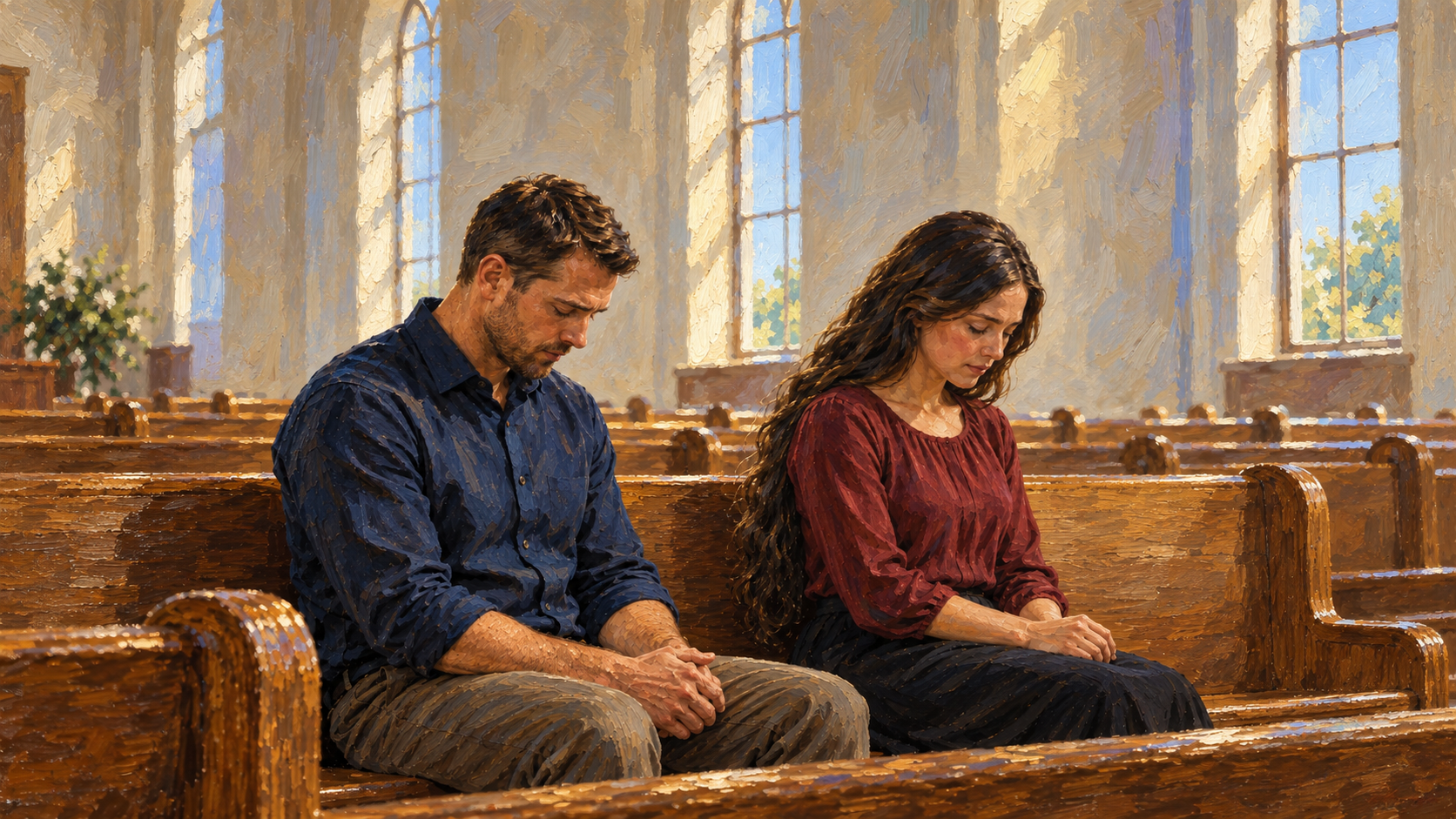
Hair may seem like a small subject until we come to 1 Corinthians 11:2-16 and see how seriously Paul treats it. What is he teaching about hair in worship and the difference God created between men and women? I want to hear the passage without turning it into an inch-by-inch law or dismissing it because the subject makes us uncomfortable.
“But I want you to know that the head of every man is Christ, the head of woman is man, and the head of Christ is God.” (1 Corinthians 11:3)
Some Christians have seen hair rules used to intimidate people or even take the place of the gospel. Others see the world deliberately erasing the distinction between men and women but conclude that the church should say nothing for fear of causing offense. Neither response fits what Paul teaches here. He places worship under Christ’s authority and connects the honor we show Him with the difference God made in creation. I cannot dismiss that connection simply because people have handled the subject badly.
At the same time, taking Paul seriously means respecting the limits of what he says. He never gives a universal number of inches for either a man’s or a woman’s hair. No husband or father has permission to use this text to intimidate or humiliate, and neither do pastors or churches. Our appearance cannot save us. Christ saves sinners through His blood, and every believer stands before Him by grace. That grace teaches a redeemed person to honor the Lord inwardly, with obedience that shapes worship and conduct. How we present ourselves visibly belongs within that life of obedience, even though it is never the ground of our salvation.
Paul’s Argument Begins With Worship and Headship
Paul wrote 1 Corinthians to a gifted but troubled church. The Corinthians had tolerated division and sexual sin, while some believers were taking one another to court. Confusion about Christian liberty was part of the trouble. Even their gatherings had become disorderly at the Lord’s Supper, and they were misusing spiritual gifts. With that setting in mind, I would not read 1 Corinthians 11 as an isolated lesson about grooming. Paul was teaching this congregation to worship in a way that reflected the Lord’s truth rather than their own self-will.
He begins, “Now I praise you, brethren, that you remember me in all things and keep the traditions just as I delivered them to you” (1 Corinthians 11:2). The word traditions here does not refer to human customs that may displace Scripture. Paul means the apostolic instruction delivered to the churches. He then applies that instruction to men and women who pray or prophesy. Later in the chapter, he corrects abuses at the Lord’s Supper. He eventually commands that worship be done “decently and in order” (1 Corinthians 14:40). The whole setting is public devotion under the authority of Christ.
We can see why Paul gives attention to visible signs when we think about baptism and the Lord’s Supper. Baptism visibly identifies a believer with Christ’s death and resurrection, while the Lord’s Supper proclaims His death until He comes. Worship involves the heart, but what we do outwardly also says something about whom we honor. When men and women gather as a church, their conduct should acknowledge Christ’s authority instead of communicating rebellion against the Creator’s order.
Clothing and hairstyles vary from one nation to another, and an outward sign can take on a different social meaning as customs change. I need to account for those differences without using them to set aside Paul’s appeal to creation. Christ’s authority and the difference between man and woman do not disappear when fashions change. The question is how to honor that lasting principle without presenting my own preferences as rules God has given everyone.
In verse 3, Paul says that Christ is the head of man, man is the head of woman, and God is the head of Christ. I would be misreading that order if I took it to mean that men have greater worth than women. Both were created in God’s image (Genesis 1:26-28), and both answer directly to Him. Believing husbands and wives are fellow heirs of the grace of life, as 1 Peter 3:1-7 teaches (1 Peter 3:7). Consider also what Paul says about Christ. The Son is fully God and equal in essence with the Father, yet He willingly obeyed the Father’s saving will during His earthly mission. Equality does not rule out order.
For a husband, headship brings a grave responsibility before God rather than permission to domineer. Ephesians 5 explains what that responsibility requires. In Ephesians 5:22-33, husbands are commanded to love their wives as Christ loved the church and gave Himself for her (Ephesians 5:25). His headship is holy and truthful, and His love seeks another’s good at cost to Himself. A man cannot claim to follow that example while manipulating or threatening a woman. Degrading or harming her disobeys the very Lord he claims to represent.
Paul also speaks of women praying and prophesying, so I cannot reduce a woman’s faithfulness to being silent or passive. His immediate concern is whether that activity honors God. A woman is herself a responsible disciple of Christ, not an accessory to a man. Paul goes on to say that neither woman nor man is independent of the other in the Lord. Woman came from man in creation, but every man since then has come through woman, and all things are from God (1 Corinthians 11:11-12). Remembering that dependence leaves neither sex a reason to boast over the other.
Receiving God’s order should humble us, not give us a reason to exalt ourselves. A man who speaks about headship must first bring his own life under Christ’s rule. A woman honors the Lord by walking in the calling He gives her instead of accepting the world’s contempt for womanhood. For both, worship means acknowledging that God deserves obedience rather than treating the freedom to do whatever we choose as our highest good.
Hair, Covering, and What Nature Teaches
In verses 4-6, Paul says a man who prays or prophesies with his head covered dishonors his head. A woman who does so with her head uncovered dishonors hers, and Paul compares her condition to being shorn or shaved. Then 1 Corinthians 11:15 says plainly, “if a woman has long hair, it is a glory to her; for her hair is given to her for a covering.” Whatever questions remain about the covering, Paul includes hair in his reasoning. We cannot remove it from the passage as though it were an incidental detail with no bearing on us.
The Greek word translated covering in verse 15, peribolaion, refers to something thrown or wrapped around a person. Understanding that word helps us follow Paul’s description of a woman’s hair as a covering given by God. He also calls it her glory. I hear an invitation to gratitude here: God made men and women distinct, and this feature of womanhood deserves honor. A culture may dismiss it or turn it into an occasion for vanity, but Paul gives no reason for either vanity or self-contempt.
Does Paul also expect a woman to wear a material head covering while praying or prophesying? Faithful interpreters differ on that question. Some understand hair itself to be the covering throughout the paragraph. Others point out that verses 5 and 6 distinguish being uncovered from being shorn, which leads them to understand an additional covering. To weigh those readings, we need to account for Paul’s contrast between the covered man and uncovered woman, including his comparison with shaving. His question in verse 13 about a woman praying uncovered also belongs in that consideration.
I don’t want to treat that disagreement lightly, because it concerns how a church understands obedience in worship. If a church believes a physical covering is required, it should practice that conviction reverently. If it understands the hair itself to fulfill the sign, it still needs to honor the distinction between the sexes and the glory Paul describes. Uncertainty about an additional covering gives neither church a reason to disregard what is clear about honoring God in worship.
Paul closes this part of the discussion by saying, “if anyone seems to be contentious, we have no such custom, nor do the churches of God” (1 Corinthians 11:16). Christians disagree about the precise force of this sentence, but it cannot be permission for endless quarrels. The churches were meant to receive apostolic teaching with humility. A sign of honor should never become an excuse for pride.
Paul also asks, “Does not even nature itself teach you that if a man has long hair, it is a dishonor to him? But if a woman has long hair, it is a glory to her?” (1 Corinthians 11:14-15). The Greek word translated nature, physis, can refer to what belongs to something because of its origin or how it is made. Paul’s appeal to creation in verses 8 and 9 helps us understand his use of the word here. He treats the contrast between the sexes as fitting the order God made, so I cannot read his words as no more than approval of a passing fashion.
Applying that principle still requires us to understand the person’s circumstances. A photograph alone may tell me very little about why someone wears a particular hairstyle. Hair texture and age affect the choices available, while health or work may create practical limits. Ethnicity and local custom also shape how a hairstyle is understood. Scripture gives us no chart for ranking every possible haircut. It does, however, call men away from a presentation that treats masculinity as shameful, and women should not reject the glory and distinction God has given womanhood.
God created human beings male and female, so our bodies already have a purpose that comes from Him. He made the body good, even though it now lives in a fallen world and waits for resurrection. My outward life should acknowledge His creation rather than treat my sex as something to overcome in an attempt to reinvent myself. Honoring the Creator includes honoring what He made.
That brings the question closer to home than finding a technical way around verse 14. As a Christian man, am I using my appearance to repudiate manhood? A Christian woman should consider whether her choices express rejection of womanhood. We also need to examine a desire for attention or an attempt to imitate worldly rebellion. The Lord knows our hearts, and the visible choices we make can express what we value inwardly.
Created Distinction and the Passage’s Hard Questions
Genesis begins with the Creator: “So God created man in His own image; in the image of God He created him; male and female He created them” (Genesis 1:27). Neither sex is an inferior version of the other, nor were they made to compete over their worth. Together they reveal God’s wisdom. Genesis 2 describes the woman as a helper corresponding to the man, someone fit for him who shared his humanity and dignity. When Adam said, “This is now bone of my bones and flesh of my flesh,” he joyfully recognized that relationship rather than asserting ownership over her (Genesis 2:23).
Sin distorts those good differences into opportunities for pride or exploitation. Sin can also produce resentment or confusion. The gospel restores people to their Creator instead of asking them to pretend that the differences have vanished. It calls men away from passivity and cruelty toward faithful service, while calling women away from the world’s contempt for womanhood toward godly strength and wisdom. Where God gives marriage, that relationship displays the covenant union of one man and one woman. Our worship as a church should honor His design, not express disdain for it.
Deuteronomy 22:5 belongs to Israel’s Law, so we should not turn it into an exhaustive modern dress code. Yet its moral direction is plain: God’s people were not to blur the distinction between male and female through dress. Ancient Israel’s garments were different from ours, but the Creator’s distinction did not expire with them. Christians should seek presentation that is modest and recognizably appropriate to their sex in the setting where they live.
Recognizing that distinction does not require us to assign everyone a fixed personality. A man can be gentle and patient without denying his manhood, just as he can have artistic ability or speak honestly about his emotions. A woman’s capability and strength do not make her less feminine; she can think deeply and act with courage. Scripture praises different kinds of faithful labor and wisdom. I should not expect every man to enjoy the same work or every woman to share one temperament when God has given no such rule. The distinction He did make between the sexes remains good.
The Nazirite vow raises another question, since Numbers 6 describes a special consecration involving uncut hair. Under the instructions in Numbers 6:1-21, a man or woman who took this voluntary, temporary vow was required to leave the hair of the head uncut for its duration. When the days ended, the person shaved the consecrated head at the tabernacle. I would not use that exceptional practice to overturn the ordinary male and female distinction Paul describes. It marked a particular season of separation to the Lord rather than establishing a new general rule for men.
Samson’s hair belonged to his Nazirite calling, but Judges 13-16 does not describe hair as magical. His strength depended on God’s consecration and enabling. Samson repeatedly treated sin lightly, and after he disclosed the secret of his vow, Delilah had his hair cut. The Lord then departed from him (Judges 16:19-20). What concerns me in this account is his careless treatment of a sacred calling. It warns us to take that calling seriously, rather than teaching us to look for spiritual power in a hairstyle.
Paul introduces another difficulty in verse 10: “For this reason the woman ought to have a symbol of authority on her head, because of the angels.” He does not explain the exact connection with angels. Some Christians understand them as reverent witnesses of worship, while others connect the phrase more directly with created order. Other explanations have been offered too. I cannot claim certainty about the connection when Scripture leaves it unexplained. But the surrounding argument does tell us how to approach gathered worship: with reverence and order, because we are offering it to God.
Some people take the whole teaching as something that applied only to Corinthian culture. We certainly need to understand the cultural setting, but Paul gives reasons that reach beyond local fashion. He begins with Christ’s headship and the order of creation, then considers the interdependence of man and woman. His appeals to nature and the practice of the churches carry the argument further. Calling all of this “cultural” does not answer those reasons. I also want to avoid filling gaps with folklore about Corinthian hairstyles or prostitution. Claims about slavery and particular forms of public shame need reliable evidence too. We have enough in Scripture’s own argument to take the passage seriously without inventing its background.
Obedience Without Measuring Every Haircut
Does that mean a woman sins whenever she trims her hair? Paul gives no numerical length that would establish a universal measuring line. Health or hair loss may make a haircut necessary, and practical care or work can affect the decision. Age and ordinary changes in life may play a part too. I have no basis for calling a woman rebellious simply because I would prefer her hair to be longer. We need to judge truthfully from what Scripture teaches instead of allowing suspicion to supply what we do not know.
Yet the absence of a measurement does not leave us with nothing to obey. Paul calls a woman’s long hair her glory, and a Christian woman should receive that description gratefully rather than deliberately erase feminine distinction. Likewise, a Christian man should honor Paul’s description of long hair as dishonorable for men and avoid deliberately presenting himself as female. I need to consider the intention behind a choice without stopping there. Modesty also matters, as does what that choice communicates in the community where the person lives.
A conscience shaped by Scripture grows with patient teaching and wise counsel. A young believer needs that patience, not public policing of appearance. Someone recovering from illness or living with changes to their hair during treatment deserves the same care. We should also allow someone from a confused background time to learn. Mature Christians can encourage obedience without taking authority over every private detail. Parents can teach their children with kindness and consistency, and husbands can speak truthfully with their wives without force or contempt. Pastors likewise need to shepherd people rather than bind their consciences with rules beyond God’s Word.
In 1 Peter 3:3-4, Peter directs our attention to the hidden person of the heart. He does not forbid all care for appearance, but identifies a gentle and quiet spirit as a woman’s deepest adornment, precious before God. Proverbs 31:30 says, “Charm is deceitful and beauty is passing, but a woman who fears the LORD, she shall be praised.” I need to keep that emphasis in view when discussing hair. It can be a God-given glory without being the source of a woman’s worth or salvation. She is precious because God made her and, in Christ, redeemed her.
A church that receives male and female as the Creator’s good gift bears witness to truth in a culture that denies the body’s God-given meaning. We are not called to imitate that rebellion, but neither should we look down on our neighbors. As Christians, we have been rescued by mercy ourselves. Remembering that should make our witness humble without making us silent about what God has made plain.
Churches need to teach the whole counsel of God. If hair length becomes our only message while we leave lust or dishonesty unchallenged, we have neglected that responsibility. Pride and greed must be addressed too, along with abuse, and believers need teaching about forgiveness. None of this gives us a reason to avoid 1 Corinthians 11 because it is difficult. We can uphold God’s order while protecting women from control and calling men to sacrificial responsibility. We also need to welcome people who are still learning obedience and give them patient discipleship.
A woman persuaded that she should wear an additional head covering in worship should do so reverently, as obedience to the Lord. A woman who understands her hair itself as the covering still needs to take the passage seriously. Both readings leave us responsible to honor God when the church gathers. I am not there to compete for attention or use worship to promote myself. Flirtation and deliberate defiance have no place in a gathering that belongs to Jesus Christ.
Biblical distinction should never be taken to mean that men must be harsh or women weak. Jesus perfectly reveals strength and holiness, and His church should reflect His character. That gives a godly man reason to use his strength to serve and protect rather than control. A godly woman fears the Lord and walks in wisdom instead of accepting the world’s contempt for womanhood. Both are called to lives of love and truth, with purity and courage evident in the good works God gives them.
Christ Cleanses and Changes His People
A hairstyle or veil cannot make anyone right with God, and neither can compliance with a dress code or any other moral performance. All have sinned and fall short of God’s glory. Our hope is Jesus Christ, the eternal Son of God who became fully man without ceasing to be God. He lived in complete holiness and willingly suffered, bearing the punishment for our sins in His innocent body on the cross. His blood was shed for the sins of the world. He died and was buried, then rose bodily from the grave.
Those who trust Christ receive forgiveness and are made new. The Holy Spirit lives within each believer and begins the lifelong work of sanctification, our growth in holiness. That is where the question of hair belongs: within a life of learning to follow the Savior. I do not obey Him to purchase forgiveness. I obey because He bought me and is my Lord, and because what He commands is good.
If this study brings pride or resentment to light, we should bring those things honestly to Christ and repent of rebellion against His design. Someone carrying fear or hurt from spiritual control also needs to come to Him, without mistaking another person’s harshness for God’s voice. Mature believers can help when shame or confusion has taken root. Jesus does not crush the bruised reed. He speaks truth with mercy and calls His people into the freedom of holy obedience.
Related studies examine What It Means to Be a Godly Man, Being a Biblical Wife and Mother, and What Marriage Is. The study on Biblical Modesty looks more closely at reverence for God without reducing modesty to a system for judging appearances.
My Final Thoughts
Paul’s teaching in 1 Corinthians 11 leaves me responsible to honor Christ’s authority in worship and to respect the distinction God created between men and women. He calls a woman’s long hair her glory and says it was given to her for a covering. Sincere believers differ about whether he also requires a material covering during worship, but we should neither dismiss the passage nor supply measurements God never gave. Headship must never become an excuse for control, and a woman’s worth does not depend on her appearance. I want Scripture to shape my conscience about outward presentation while keeping my confidence in Christ’s blood for forgiveness. His Spirit enables the holy obedience that should grow from that confidence.