
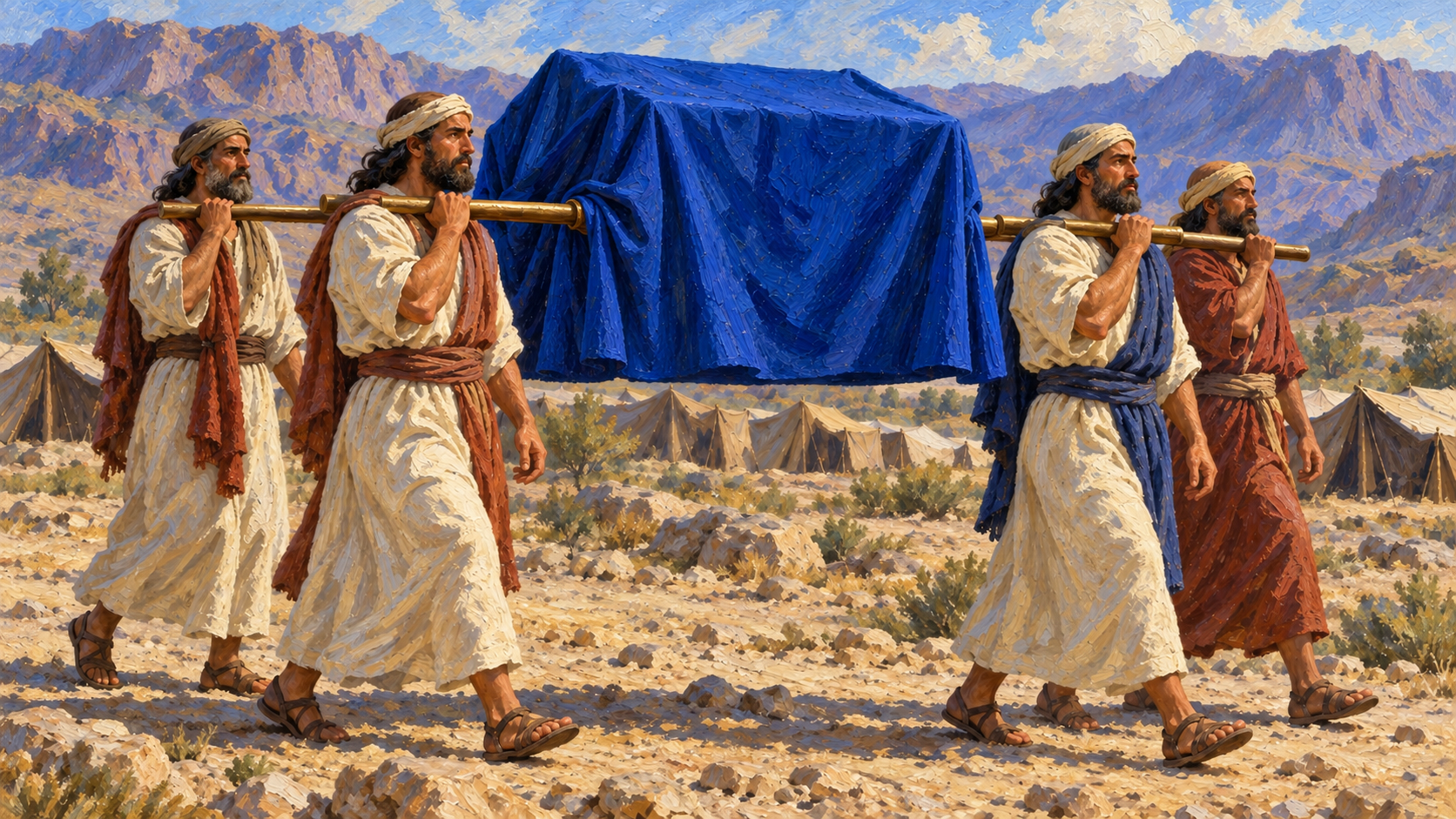
Who were the sons of Kohath, and why did God surround their work with such serious warnings? They carried the most holy furnishings of the tabernacle, but only after Aaron’s sons had covered them. Their service was a sacred privilege that demanded obedience, and their later family history shows how grace can restore a line marked by failure.
“This is the service of the sons of Kohath in the tabernacle of meeting, relating to the most holy things.”
God graciously dwelt among Israel, but He also determined how His people could approach Him. I notice that the Kohathites’ nearness to the holy things made obedience more urgent. Being entrusted with that work was a great honor, and they could never treat it casually.
The LORD was present with His people without becoming common, so the mercy of serving near Him carried a serious responsibility. His instructions taught the Kohathites that faith belonged with reverence. Working near the sanctuary did not give them the right to decide for themselves what holiness meant.
The Kohathite Line and Its Place Among the Levites
Aaron and his sons may be the first people we associate with the Levites. His sons offered sacrifices and burned incense as part of their priestly ministry before the LORD, and they entered the holy place. Yet Levi’s tribe included more than Aaron’s house. God gave different assignments to the families of Gershon, Kohath, and Merari.
“The sons of Levi were Gershon, Kohath, and Merari.”
Kohath was one of Levi’s three sons. His own sons were Amram, Izhar, Hebron, and Uzziel. Through Amram came Moses and Aaron, along with their sister Miriam. The lawgiver, Israel’s first high priest, and the prophetess who witnessed the Exodus all belonged to the Kohathite line.
“The sons of Kohath were Amram, Izhar, Hebron, and Uzziel. And the years of the life of Kohath were one hundred and thirty-three.”
“Now Amram took for himself Jochebed, his father’s sister, as wife; and she bore him Aaron and Moses.”
Aaron belonged to the Kohathite line, but that did not make every Kohathite a priest. The priestly office belonged to Aaron and his sons. The wider clan served near the holy things without having permission to take those priestly duties for themselves. I need to keep that distinction in mind when reading about their service, because being close to the tabernacle did not remove the boundaries God had set.
The meaning of the name Kohath is uncertain. Some have connected it with an assembly or congregation, though the evidence is debated. I would rather learn from the work God actually gave this family than build doctrine on a name whose meaning we cannot establish with confidence.
Numbers 3 places each Levitical clan around the tabernacle and gives it a particular responsibility. According to Numbers 3:25-26, the Gershonites cared for the curtains and coverings. The screens and hangings also belonged to their charge, along with the cords. Numbers 3:36-37 assigns the Merarites the structural parts: boards and bars, pillars and sockets, and pegs. Numbers 3:31 and 4:4 place the sanctuary furnishings under the care of the Kohathites.
“Their duty included the ark, the table, the lampstand, the altars, the utensils of the sanctuary with which they ministered, the screen, and all the work relating to them.”
Israel needed every clan’s work. The curtains and frames served a purpose, and even the sockets were needed just as truly as the furnishings. Yet the Kohathites faced a particular danger because their assignment involved the most holy things. They carried the furnishings at the heart of Israel’s sanctuary life, and they could approach them only after the priests had finished the required covering.
The LORD named the families and placed them around the sanctuary, giving each one its own burden. Moving the tabernacle was therefore not a matter of whoever happened to volunteer. God had arranged their responsibilities to work together so that Israel could continue worshiping as the camp traveled.
Carrying the Most Holy Things Under God’s Order
Numbers 4 counted Kohathite men from thirty to fifty years old for service at the tabernacle. Their work did not grow from family custom or personal preference. The LORD commanded it, and the repeated phrase “the most holy things” shows how carefully God limited their access.
Access to the tabernacle depended on the place God had given a person within Israel’s covenant order. No one could simply rush into His presence. Priests served in ways ordinary Levites could not, and even the high priest went behind the veil only on the Day of Atonement, entering with blood and incense. The Kohathites came very near to the holy furnishings, but that nearness did not remove the limits on their access.
“When the camp prepares to journey, Aaron and his sons shall come, and they shall take down the covering veil and cover the ark of the Testimony with it.”
Before the Kohathites could carry the furnishings, Aaron and his sons had to cover them. They covered the Ark with the veil, a covering of badger skins, and a blue cloth. The table and lampstand also had to be covered according to God’s command, as did the altars and sanctuary utensils. Only after the priests finished could the sons of Kohath come near.
A Kohathite’s Levitical birth did not give him permission to handle holy things however he wished. The command and the calling came from the same God. Being chosen for the work made obedience more necessary, rather than giving him freedom to disregard the boundary.
“And when Aaron and his sons have finished covering the sanctuary and all the furnishings of the sanctuary, when the camp is set to go, then the sons of Kohath shall come to carry them; but they shall not touch any holy thing, lest they die.”
“But they shall not go in to watch while the holy things are being covered, lest they die.”
Scripture does not soften these warnings. God’s holiness gives life to those who come by His appointed way, but those who treat Him as common face judgment. The furnishings were not magical objects. They belonged to the worship order the LORD had placed among Israel, so contempt for His instruction was contempt for Him.
I need to remember that the Kohathites were honored even though their duties were restricted. God had assigned holy work to them without giving them freedom to improvise or demand another place. In ministry too, faithfulness can mean accepting the burden God gives without trying to make the work more dramatic.
Numbers 7 tells us that the Gershonites and Merarites received carts and oxen for their loads, while the Kohathites received none. That difference becomes especially relevant when we come to the later account of the Ark’s transport.
“But to the sons of Kohath he gave none, because theirs was the service of the holy things, which they carried on their shoulders.”
God had provided rings and poles for the Ark so it could be carried as He commanded. The other clans’ use of carts shows that wheels were not the problem. God had specified a different way for these holy furnishings, which could not be treated as ordinary cargo. The Kohathites bore the physical weight with every step. Their burden reminded them that His presence among the people was a gift to be honored according to His holiness.
These furnishings followed the tabernacle pattern God gave Moses. Their connection to Christ is an example of typology, where an earlier part of God’s work points forward to its fulfillment. We need Scripture to guide those connections. The New Testament identifies this earthly ministry as a copy and shadow fulfilled in Christ.
“For Christ has not entered the holy places made with hands, which are copies of the true, but into heaven itself, now to appear in the presence of God for us.”
The Ark stood at the center of Israel’s sanctuary and was connected with the testimony and mercy seat, where the LORD met with Moses. It spoke of His throne and covenant, showing His holiness alongside His mercy and presence. The table held the bread of the Presence and spoke of fellowship and provision, while the lampstand gave light in the holy place. Prayer and intercession were connected with the golden altar. The bronze altar spoke of sacrifice and blood, bringing before the people the cost of sin.
I would not want to invent a meaning for every detail when Scripture already gives us the connections we need. Jesus called Himself the bread of life, and He is the true Light. Hebrews presents Him as the One who lives to intercede for those who come to God through Him. The sacrifices could never complete the work He accomplished through His own blood.
The Kohathites carried covered signs of truths they could not yet see in their fullness. We can look back on Christ’s death and burial, knowing that He rose bodily and entered heaven for us. His finished work is greater than every shadow they carried.
Korah, Uzzah, and the Danger of Presumption
Korah’s rebellion shows how serious it was to disregard those boundaries. He came from the family of Izhar, Kohath’s son. Numbers 16 records how he joined others in rising against Moses and Aaron, claiming that the whole congregation was holy. On that basis they challenged the priestly authority God had given Aaron’s house.
“Now Korah the son of Izhar, the son of Kohath, the son of Levi, with Dathan and Abiram the sons of Eliab, and On the son of Peleth, sons of Reuben, took men.”
Korah used language that sounded spiritual to seek an office the LORD had not given him. He was rebelling against God’s order. Moses answered by reminding him that the Levites already had the privilege of being brought near for service, yet Korah and his company wanted the priesthood too.
“Is it a small thing to you that the God of Israel has separated you from the congregation of Israel, to bring you near to Himself?”
Moses’ question makes me stop and consider what pride can do to our view of service. Korah had been given holy work, yet he treated it as too small because he wanted a different calling. A real privilege had become something he despised. Judgment followed his rebellion: the earth swallowed the rebels, and fire consumed the men who offered incense presumptuously.
Uzzah’s death also helps us understand why the Kohathites had to handle the holy things so carefully, although Scripture does not identify him as a Kohathite. David was transporting the Ark on a new cart when the oxen stumbled, and Uzzah reached out to it. What happened next shows the seriousness of the command.
“And when they came to Nachon’s threshing floor, Uzzah put out his hand to the ark of God and took hold of it, for the oxen stumbled. Then the anger of the LORD was aroused against Uzzah, and God struck him there for his error.”
David later acknowledged that they had ignored the appointed way of carrying the Ark. In 1 Chronicles 15, he gathered the Levites and told them to sanctify themselves. This time they would bring the Ark up as Moses had commanded.
“For because you did not do it the first time, the LORD our God broke out against us, because we did not consult Him about the proper order.”
Uzzah may have wanted to steady the Ark, but sincerity could not make the chosen method lawful. I cannot use good intentions as a substitute for obedience. God must be approached according to His Word, as David came to acknowledge.
Grace in the Kohathite Line
There is also grace in this family’s history. Through Amram came Moses, who served as covenant mediator, and Aaron, Israel’s high priest. Their sister Miriam was also Amram’s child and belonged to that Exodus generation. Later, 1 Chronicles 6 traces Samuel through the Kohathite and Korahite line, from which he arose as a faithful prophet and judge during a dark period in Israel’s history.
Korah’s rebellion did not end God’s purposes for his descendants. Heman the singer, connected with Samuel’s line, became a leading voice in temple worship. The sons of Korah became known through Psalms that express longing for God and confidence in His help, while celebrating the beauty of His dwelling place.
“As the deer pants for the water brooks, So pants my soul for You, O God.”
“God is our refuge and strength, A very present help in trouble.”
“How lovely is Your tabernacle, O LORD of hosts!”
What I find beautiful is that the name associated with Korah’s rebellion later stood over songs teaching God’s people to long for Him and seek refuge in Him. Grace did not treat Korah’s sin as harmless. It overcame sin and produced worship in a family whose record could have ended with judgment.
Kohathite service continued as Israel moved from the tabernacle into the temple era. David organized Levites for music and other ordered work. When he corrected the Ark’s transport, the Levites obeyed the command given through Moses.
As Israel moved into temple life, the Kohathites served in worship leadership and gatekeeping, along with other ordered work. They were no longer carrying a moving sanctuary through the wilderness, so the details of their duties changed. They still had to attend to God’s Word as they guarded and supported worship.
“And the children of the Levites bore the ark of God on their shoulders, by its poles, as Moses had commanded according to the word of the LORD.”
Kohathites also took part in reform. During Hezekiah’s reign, the house of the LORD had suffered neglect and defilement. When the Levites rose to cleanse it and restore proper worship, members of this family were named among them.
“Then these Levites arose: Mahath the son of Amasai and Joel the son of Azariah, of the sons of the Kohathites.”
We have followed this family from carrying the sanctuary in the wilderness through the rebellion that stained its history. Later generations took part in corrected worship and temple music, and Kohathites also helped with reform. I see both responsibility and hope in that record. Holy service must be guarded, yet God can preserve worship through people whose family history includes serious failure.
What the Kohathites Teach Us About Christ and Service
Christians should not claim the Kohathite office for themselves. The church is not Levi’s tribe, and believers have not been assigned to carry the Ark through the wilderness. That service belonged to Israel under the Mosaic covenant.
This history remains Scripture for our learning even though those duties were not given to the church. The Kohathites teach us reverence in handling the things of God. I should not use Scripture or worship to make myself important. Prayer belongs to the Lord, as do the ordinances of baptism and communion. Church leadership and gospel ministry must likewise never become tools for entertainment or self-promotion, because the Lord cares how His people worship Him.
That does not place Christians under the Levitical rules or make church furniture holy in the same way as the tabernacle furnishings. God’s Word still governs His people, and ministry is not ours to reshape around ambition. Worship cannot become a stage for making ourselves impressive. The privilege of serving should make us more careful to honor the Lord who called us.
The different assignments given to the Levitical clans help me understand contentment in service. Gershon and Merari each received a burden, and Kohath’s family had its own responsibility. Aaron’s sons held a priestly office that ordinary Levites could not take for themselves. Faithfulness begins with humbly receiving God’s Word and obeying Him where He places us, rather than choosing another person’s assignment.
Korah’s religious language concealed ambition, while Uzzah’s death shows that sincerity cannot make disobedience holy. Those warnings belong alongside the grace we see in Samuel and Heman, faithful servants from a line marked by failure. The sons of Korah also show that God can turn a name linked with judgment into a heading over songs of hope.
The Kohathites could carry the Ark and the other furnishings, but their own strength could not give sinners access to God. Those shadows belonged to a covenant order that pointed beyond itself to Jesus Christ, through whom true access comes.
Jesus is the eternal Son of God, fully God and fully man. He tabernacled among us as the true Light and bread of life. The sacrifices reach their fulfillment in Him, and He is the perfect Mediator who opens the living way into God’s presence. Wicked men physically tortured and killed Him, but He willingly bore real punishment for our sins in His innocent body. He suffered and shed His blood before dying, then was buried and rose bodily from the dead. The Father did not hate, abandon, or personally abuse the Son. Jesus offered Himself willingly so that sinners could be forgiven and brought near to God.
“But now in Christ Jesus you who once were far off have been brought near by the blood of Christ.”
The Kohathites carried covered furnishings from one place to another, but Jesus brings His people into reconciled fellowship with God. He is greater than every shadow they bore. Believers are indwelt by the Holy Spirit and entrusted with the gospel of the risen Lord. That privilege should move me to obey Him with reverence and joy.
These related studies continue the major themes: The Ark of the Covenant, The Altar of Incense, and The Role of the High Priest. The studies on The Death of Uzzah, The Sons of Korah, and The Gospel explain the warnings and fulfillment in greater depth.
My Final Thoughts
The sons of Kohath remind me that sacred responsibility is both a gift and a burden. God brought this family near without giving them permission to replace His order with their own ideas. Korah’s rebellion and Uzzah’s death show how dangerous that presumption was. Yet later generations also show His grace, as faithful service and worship came from a line marked by failure. I want to receive my own place of service humbly and handle God’s Word with reverence. Above all, we must come through Christ, because those furnishings were shadows and only His blood truly brings sinners near.