
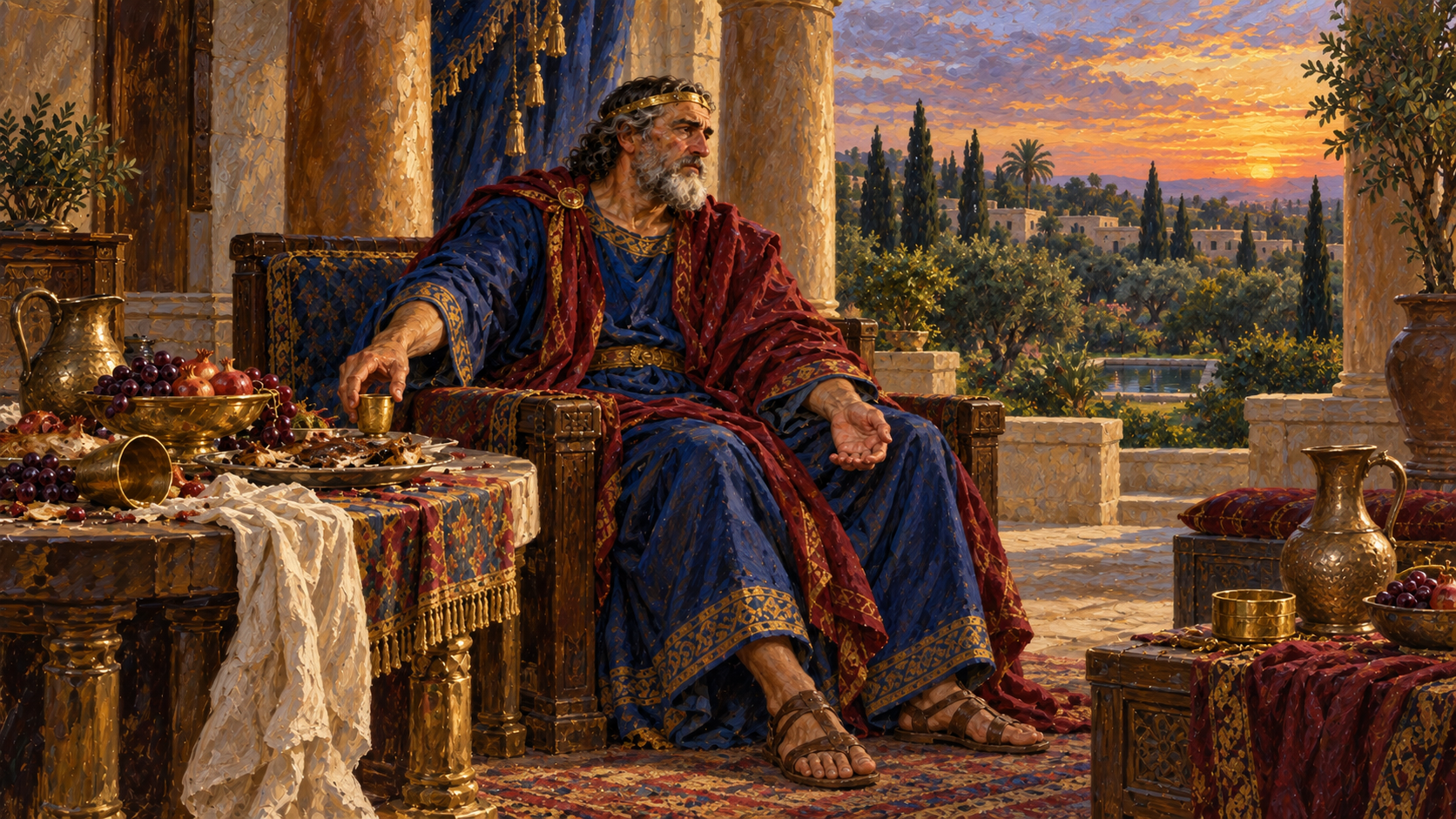
Why does Ecclesiastes keep calling life “vanity”? Is Solomon saying nothing has meaning, or is he exposing what happens when we ask created things to give us what only God can provide? We need to follow his whole search before we reach the book’s final call to fear God.
Solomon Speaks After Testing Life at the Top
Ecclesiastes introduces its speaker as a king in Jerusalem, which points us toward Solomon. He had the authority and resources to examine life from a position of extraordinary privilege. We’re hearing from someone who could test these pursuits for himself, rather than an abstract philosopher trying to sound clever.
The words of the Preacher, the son of David, king in Jerusalem.
I believe the strongest internal evidence points to Solomon. He was the son of David who reigned in Jerusalem, and Ecclesiastes 1:12 says the Preacher was king over Israel there. After Solomon, the Davidic kings ruled Judah rather than the united kingdom of Israel. The book also describes a ruler with extraordinary wisdom and wealth. He could test pleasure through great building projects and cultivated gardens. His command of servants and his access to music, silver, and gold fit the biblical record of Solomon’s life remarkably well.
Ecclesiastes does not celebrate Solomon’s compromises. He had pursued what most people can only imagine, but 1 Kings records that his heart was turned after other gods in his later years. Along with learning and public honor, he knew the bitter consequences of a heart divided from wholehearted obedience to the LORD. I don’t read this book as an excuse for that history. Solomon teaches us through what those pursuits cost him.
A late-life setting fits the book well because Solomon looks back over the pursuits of a long reign. Scripture does not give us an exact composition date, so I would not state that part more strongly than the evidence allows. Still, I find mature reflection more convincing than another proposed setting because of the royal voice and the experience behind it. The man speaking sounds wounded by what he has learned, yet wise enough to instruct others.
The title “Preacher” translates the Hebrew term often written as Qoheleth, which is connected with gathering or assembling. Solomon addresses the assembly as someone calling hearers together to receive hard-earned wisdom. These are more than private thoughts that never have to answer to anyone. He has searched and weighed these matters so that he can teach God’s people.
Vanity Under the Sun Is Not Meaninglessness
The great repeated word of Ecclesiastes is “vanity.” The Hebrew word is hebel, a term that can describe breath, vapor, mist, or something that cannot be held for long. This is not a declaration that God’s creation has no meaning. Solomon is showing that people cannot seize lasting meaning from created things when they treat those things as ultimate.
“Vanity of vanities,” says the Preacher; “Vanity of vanities, all is vanity.”
I can recognize the value of our work and still admit how quickly its results slip from our control. That’s part of what Solomon is showing us about life as it passes. Pleasure fades after we enjoy it, and wisdom cannot keep even the wise person from dying. Wealth may make life more comfortable without making it permanent. These good things become vapor when we ask them to give us lasting security for eternity.
The other controlling phrase is “under the sun.” Solomon uses it for life viewed within the visible order of this present world. One generation passes and another comes, while rivers keep running into a sea that is never full. Wisdom does not prevent death, so the wise die like the fool. Riches pass to someone else, and oppression continues. Solomon is not denying God with this phrase. He is showing how little we understand when we live as though the visible world is all we have.
We need to hold together two things Solomon teaches: God made the world and gives us things to enjoy, but the world cannot become God. A meal or a marriage cannot give the soul lasting security. Neither can music, learning, or the respect of others. Even wealth and health cannot last forever, however long a person lives. Solomon’s warnings are severe because these false hopes keep people from looking to the God who gives life.
The arrangement of Ecclesiastes helps us keep individual statements in their proper place. The opening verses introduce vanity and the repeating cycles of life. Ecclesiastes 1:12 through chapter 2 records Solomon’s tests of wisdom, pleasure, great works, riches, and labor before joy is traced back to God’s hand. Chapters 3 through 6 consider appointed seasons, eternity in the heart, judgment, oppression, wealth, worship, and dissatisfaction.
Ecclesiastes 7 through 11 gives wisdom for living humbly and diligently when outcomes are uncertain. The final movement, beginning in Ecclesiastes 11:7, calls the young to remember their Creator and brings every observation under the certainty of judgment. Solomon returns to subjects because life keeps returning us to the same questions. But he doesn’t leave us in frustration at the end of that search. He directs us to God.
This is why I do not believe Ecclesiastes should be read as nihilism, the idea that life has no real meaning. Solomon does not destroy true purpose. He exposes the false gods people use in its place. Created things cannot secure lasting meaning apart from the One who created them.
Wisdom, Pleasure, and Labor Cannot Save Us
Solomon first tested wisdom itself, giving his heart to seek and search out what is done under heaven. He wasn’t being lazy or pursuing a shallow curiosity. He was using the intellectual gifts God had given him, yet wisdom became grief when he asked it to master life apart from surrender to God. The more clearly Solomon saw the world’s crookedness, the more painfully he knew that intellect alone could not straighten it.
For in much wisdom is much grief, And he who increases knowledge increases sorrow.
Knowledge can show me more of what is wrong without giving me the power to fix it. I shouldn’t conclude that learning is evil, but I can’t ask education to save me either. The mind is a gift from God. It cannot cleanse my guilt or overcome death, and knowing more will never make the future submit to my plans.
Solomon then tested pleasure on a scale few people could match. He began with laughter and wine, then used his wealth to build houses and cultivate vineyards and gardens. His estate was full of servants and possessions, and he had access to silver and gold. He could enjoy music and every royal delight. Many people assume dissatisfaction comes from not having enough. If that were all there was to it, Solomon should have been satisfied. Yet his abundance shows that a person can possess all of this and still be empty when the soul is not satisfied in God.
He called the result vanity and grasping for the wind. The gardens were real, and the music had value as a created good, but neither could give him what only God can give. Pleasure may delight the senses for a moment without cleansing sin or answering death. It cannot secure our future or judge evil, nor can it bring a wandering heart home to God.
Solomon tested labor in much the same way. God gave Adam work before sin entered the world, so work itself is not evil, and Ecclesiastes does not commend laziness. The question is whether achievement can give a person his final meaning. Solomon built and organized more than almost anyone, yet death would force him to leave the results to another person who might even be a fool. For all he accomplished, he could not control what happened to his work after he was gone.
Ecclesiastes 2:17-23 grieves over labor when a person treats it as his ultimate gain. Jesus gives the same warning in Luke 12:16-21. The rich fool filled larger barns and planned years of ease, but he was not prepared to meet God. A full storehouse does not make a soul rich toward Him.
Still, chapter 2 does not end by despising ordinary life. Solomon says a person should eat, drink, and enjoy good in his labor, then explains that this too comes from the hand of God. The same meal becomes vanity when I treat it as an idol and a blessing when I receive it with gratitude. My labor can enslave me to myself, or I can faithfully receive God’s provision through it.
This also keeps us from turning Ecclesiastes into permission for worldly indulgence. Solomon’s calls to enjoy food, work, and life are not invitations to sin. Joy remains under God’s authority and coming judgment. Created gifts serve us well when we receive them from God, but they harm us when we worship them.
God Rules the Times and Calls Us to Reverence
Ecclesiastes 3 is one of the best-known passages in the book. It is often softened into sentimental poetry, but Solomon is asking us to recognize the limits of our control. Birth and death come within appointed times. So do planting and loss, healing and breaking, weeping and laughter. We live within seasons we did not create and cannot fully control.
To everything there is a season, A time for every purpose under heaven.
That leaves little room for my pride. I can make plans without being able to command the season in which they unfold. I can plant, but I cannot force the rain to fall. Even when I seek healing, I cannot banish death from the earth. Wisdom begins with admitting that I am a creature, not the sovereign Lord of these things.
The world is not random, however. God makes everything beautiful in its time, and He has placed eternity in the human heart.
He has made everything beautiful in its time. Also He has put eternity in their hearts, except that no one can find out the work that God does from beginning to end.
We are more than physical creatures living for temporary appetites. Our longing for permanence and justice, along with our response to beauty and meaning, cannot be explained by short-lived pleasures alone. Yet we cannot discover all that God is doing from beginning to end. I think that combination helps explain some of the ache we experience in life. We are finite creatures who still carry an awareness of eternity.
Solomon does not look away from injustice. Wickedness can occupy the very place where judgment should be given. Courts may be corrupt and rulers proud, while victims are ignored and evil is publicly rewarded. Ecclesiastes gives no easy answer to that pain, but it does give us a reason not to despair: God will judge both the righteous and the wicked. Even when we cannot see when justice will come, hidden things will not stay hidden forever.
The fear of God therefore shapes worship as well as our view of history. Ecclesiastes 5 tells a person to approach God’s house carefully and to come ready to hear.
Walk prudently when you go to the house of God; and draw near to hear rather than to give the sacrifice of fools, for they do not know that they do evil.
When Solomon says God is in heaven while we are on earth, I need to remember who I’m addressing. Our words should be few because religious noise without reverence does not impress Him. We must speak soberly before God and keep the vows we make. Solomon isn’t forbidding prayer or praise, and he isn’t telling us to stop teaching. He is warning against careless promises and a familiarity that forgets who God is.
The same section warns that a person who loves silver will never be satisfied with silver. If I am covetous, more money may give me more choices without satisfying that desire for more. It can fill my house while leaving my soul hungry. That doesn’t mean I have to be miserable to take God seriously. Eating and drinking can be gifts from Him, as can meaningful work and marriage. We can be glad in the portion He gives us while learning to hold these good things with open hands.
Wisdom in a Crooked World Begins With Fearing God
The middle of Ecclesiastes often sounds like Proverbs spoken beneath a darker sky. A good name is better than precious ointment, and the house of mourning can teach more than the house of feasting. Solomon would have us receive a wise rebuke rather than the song of fools, and choose patience over pride. He is not promising that every wise choice will produce an easy outcome. These sayings teach us how to live faithfully in a world that remains crooked.
When I read Ecclesiastes 7:16-17, I need to ask what kind of righteousness Solomon is warning against. He speaks of being “overly righteous” or “overly wise,” alongside a warning against reckless wickedness. He cannot be rebuking true holiness, because Scripture never warns anyone that obedience to God has gone too far. His concern is self-righteous extremism and proud displays of wisdom, but he also rejects the opposite error of foolish rebellion. The next verse helps us understand both warnings by saying that the one who fears God will escape them all.
Ecclesiastes 7:20 says there is not a just person on earth who does good and never sins. Romans 3:23 teaches the same truth: all have sinned and fall short of God’s glory. Ecclesiastes prepares the reader to stop trusting human righteousness as though anyone could justify himself. Even the wise person needs God.
Wisdom also means working faithfully when we do not control results. Solomon says the person who watches the wind will never sow, and the one who keeps looking at the clouds will never reap. I can be so concerned about timing and risk that I refuse to do the work God has placed before me. Ecclesiastes doesn’t promise me control over the harvest. It calls me to diligence in the very circumstances I cannot control.
That call to work comes from a book that faces injustice and death honestly. Solomon knows that fools can occupy high places and that neither our wisdom nor our efforts can make outcomes certain. Yet none of this excuses doing nothing. We can sow in the morning and keep working in the evening, fearing God as we do the work He has given us. What He has not revealed about His plans, we must trust Him with.
This is also why I cannot use an isolated “under the sun” observation as the whole doctrine of Scripture. Solomon tells the truth about what we can see in this world, but he leads us to the Creator and Judge in his conclusion. No isolated verse may erase resurrection or final judgment. Neither can it cancel our responsibility to obey God or deny the goodness of His commands.
Ecclesiastes gives us plenty to think about, yet Solomon is not a detached philosopher. His teaching belongs beside Proverbs and Song of Solomon as wisdom for God’s covenant people. It corrects the way we think while drawing our hearts away from hopes that cannot survive death.
Remember Your Creator Before Death Comes
The closing appeal speaks especially to the young. Solomon tells them to rejoice in life, not despise it, while Ecclesiastes 11:9 warns that God will bring their choices into judgment. Young people should not live as though accountability were far away. They need to remember their Creator now, before habits harden and strength fades with the coming of difficult days.
Remember now your Creator in the days of your youth, Before the difficult days come, And the years draw near when you say, “I have no pleasure in them”.
Ecclesiastes 12 uses vivid poetry to describe aging. The keepers of the house tremble and the strong men bow down, while the grinders cease because they are few. Those looking through the windows grow dim as the body steadily loses its strength and moves toward the grave. Then the images turn to the end of life itself: the silver cord is loosed, the golden bowl is broken, and the pitcher and wheel can no longer serve at the well.
I don’t hear mockery of old age in these images. Solomon tells the truth about the body’s decline so that we will not waste our youth worshiping strength. We need to remember our Creator now, rather than waiting until every other hope has failed.
Then the dust will return to the earth as it was, And the spirit will return to God who gave it.
The verse echoes Genesis, where God formed man from dust. Death brings the body back to the earth, and the spirit returns to the God who gave it. I wouldn’t expect this one sentence to explain everything about resurrection or the state between death and resurrection. The rest of Scripture gives fuller light on those matters and on final judgment. Solomon has said enough here to rule out the proud idea that I can ignore my Creator and then escape accountability by dying. Death brings man before God rather than removing God from the question.
Solomon ends by describing his work as a teacher. He pondered and sought out many proverbs, arranging them carefully. He sought acceptable words, and what was written was upright and true. That care helps me see why Ecclesiastes should not be treated as a heap of despairing fragments. Its wisdom is deliberately arranged to expose the false hopes that hurt us and help us recover from them.
Let us hear the conclusion of the whole matter: Fear God and keep His commandments, For this is man’s all. For God will bring every work into judgment, Including every secret thing, Whether good or evil.
This conclusion governs everything before it. When death arrives, wisdom cannot rescue the wise person, and pleasure cannot satisfy the soul that has lived apart from God. Labor cannot secure permanence for the worker, while wealth fails to purchase the peace it promises. Human justice may be corrupted, and the future remains beyond our command. Our bodies weaken and death comes, yet God remains the Creator who gives life and every good thing. He is also the Judge and Lord.
To fear God is to stand in reverent awe of Him and respond with humble submission and obedient trust. That includes hating evil, but it is more than terror that makes us run away from Him. If I fear God, I will receive His Word and honor His commands. I will believe His promises and stop treating myself as though I belong at the center of everything.
Ecclesiastes is merciful to restless people because it tells the truth about the pursuits that keep disappointing us. Learning more can increase our sorrow without relieving it, and entertainment cannot sustain the soul. Wealth leaves us unsatisfied, while the results of our work remain fragile. God has put eternity in our hearts, so death confronts us with how little earthly glory can offer. We will never be whole if we live as though this visible world were all there is.
You may also want to read A Complete Bible Study on the Book of Proverbs, A Complete Bible Study on The Wisdom of Solomon, A Complete Bible Study on Job, and A Complete Bible Study on the Fear of the Lord.
My Final Thoughts
The more I follow Solomon’s search, the more clearly I see that Ecclesiastes is not trying to make life empty. It shows why life becomes empty whenever a created gift is asked to take God’s place. We can receive ordinary joys with gratitude and do our work faithfully, but we must remember that every gift comes from the Creator and every life moves toward His judgment. Jesus Christ alone can answer the guilt and death that no earthly pursuit can overcome, because He gave His physical body and shed His blood for our sins before rising bodily from the grave. Solomon’s appeal still deserves our attention: remember your Creator now and fear Him. His Word teaches us how to live under the sun without treating the sun as the limit of our hope.