
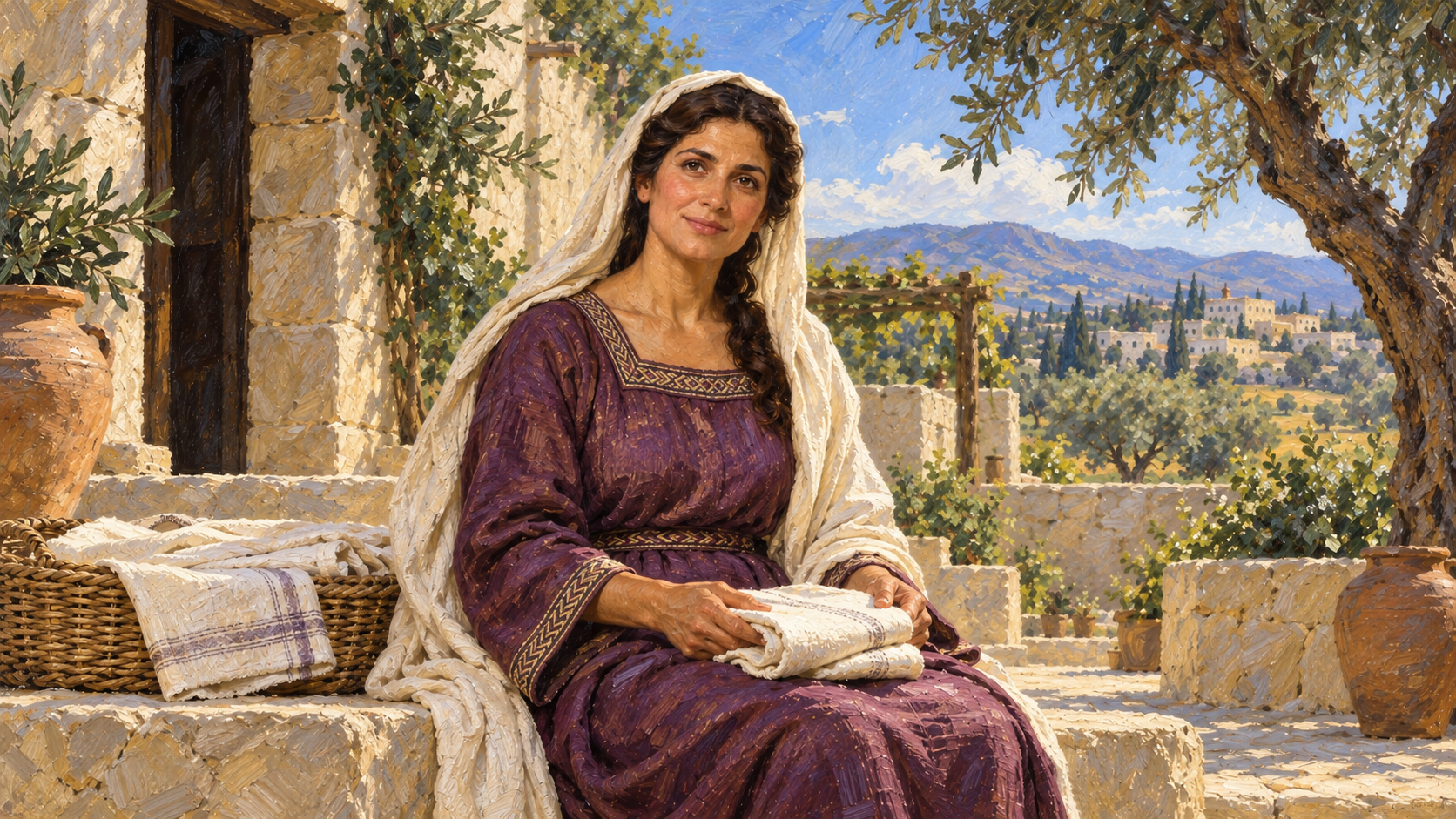
Proverbs 31 is often handed to women as a list of everything they should accomplish, but the chapter begins with a mother teaching her son how to be a righteous king. I think we miss its wisdom when we separate those two parts or squeeze the final poem into one impossible day. The chapter teaches men what strength to honor and shows women what strength under the fear of the LORD looks like over a lifetime.
A Mother Teaches a King to Govern His Strength
The opening words of Proverbs 31 are connected to King Lemuel and the instruction his mother gave him. In verses 1–9, she addresses a ruler’s appetites and his duty toward people with little power. Verses 10–31 then praise a wife of remarkable strength and faithfulness. Scripture does not explicitly name the author of that final poem, but I can see why the two parts belong together. A king who must refuse destructive desire and judge righteously also needs to recognize godly character in a woman.
Lemuel’s mother first told a powerful man what he must not surrender and whom he must defend. The poem then shows a woman’s strength serving her household and reaching beyond it to merchants and the poor. Her servants benefit from her care too. By placing male responsibility beside female strength, the chapter trains a ruler’s judgment and shows faithful character at work in a woman’s life.
Proverbs is wisdom literature, and its poetry trains our judgment through parallel thoughts and memorable images. The poem’s form allows it to offer complete praise without supplying a rigid schedule. I need to read that concentrated portrait with discernment, especially when applying it to a woman whose household or resources differ from those described here. We should not use this portrait of mature fruit to shame her. Her health and season of life may change what faithful work looks like.
At the close of Proverbs, we return to the book’s foundation: the fear of the LORD. Honoring God as holy and authoritative gives work and skill their proper place. That reverence shapes our handling of money and our understanding of marriage. It also directs how we speak to people and practice justice, right down to deciding what deserves our praise.
The words of King Lemuel, the utterance which his mother taught him: What, my son? And what, son of my womb? And what, son of my vows? Do not give your strength to women, Nor your ways to that which destroys kings.
Scripture calls Lemuel a king but does not identify his kingdom or connect him with another ruler. His name likely carries the sense “for God” or “belonging to God.” Jewish tradition sometimes identifies him with Solomon, but that is a proposal rather than a statement in the text. The NKJV calls the heading “the utterance.” The Hebrew word massa can mean an oracle or weighty pronouncement, though some interpreters have asked whether it names a place. The grammar is debated, but the options do not change the instruction.
I would rather stay with what the inspired heading tells us than try to fill in Lemuel’s biography. He was a king whose mother taught him, and her counsel was preserved in Proverbs. That gives us enough to understand her instruction without speculating about the rest of his life.
She addressed him as her son, the son of her womb, and the son of her vows. I hear urgency and affection in those repeated questions. Her counsel was part of preparing him for the serious work of kingship, because the way he learned to judge right and wrong would affect the justice he gave others.
Proverbs repeatedly tells a son to hear his father’s instruction without forsaking his mother’s law, so a mother’s wisdom has real weight. Her teaching can shape rulers and households, and its influence can extend into churches and later generations without placing her in the authoritative teaching office of elder or pastor.
Her counsel makes me question any attempt to separate a leader’s private appetites from his public responsibilities. His sexual conduct affects his judgment. Alcohol and uncontrolled anger can affect it too. The pursuit of money or attention can begin to rule him too. When a man spends his strength serving those desires, he has less clarity and resolve to remember the law or protect people with no power. Parents cannot guarantee that a grown child will obey, but they can love him enough to speak plainly about the danger and its consequences.
It is not for kings, O Lemuel, It is not for kings to drink wine, Nor for princes intoxicating drink; Lest they drink and forget the law, And pervert the justice of all the afflicted. Give strong drink to him who is perishing, And wine to those who are bitter of heart. Let him drink and forget his poverty, And remember his misery no more. Open your mouth for the speechless, In the cause of all who are appointed to die. Open your mouth, judge righteously, And plead the cause of the poor and needy.
The warning about giving strength to women cannot be contempt for women when the rest of the chapter honors a woman’s character so fully. It condemns the uncontrolled sexual behavior that has destroyed kings. Deuteronomy 17 warned Israel’s future rulers not to multiply wives, and Solomon’s later life proved the danger. He ignored God’s command, and his wives turned his heart toward other gods. His failure helps us see how a king can surrender to desire the strength he should use to protect his kingdom.
Wine raises the same question of self-government. An intoxicated ruler may forget the law and distort a case involving afflicted people. I read these verses as instruction about a ruler’s clarity and responsibility, not as a complete theology of alcohol. The reference to strong drink for someone perishing or bitter contrasts that person’s misery with the king’s duty. It does not give a general command to seek relief through drunkenness. The king must remain alert because other lives depend on his judgment.
Leadership brings responsibility for how our choices affect others. A husband or father cannot call an appetite private when impaired judgment puts his family at risk. Elders and employers also answer for their treatment of people under their care. For judges and civil officials, a decision can determine what happens to someone who has little power to resist it.
Lemuel had to speak for people who could not secure a hearing. “Speechless” does not necessarily mean physically unable to speak; it describes someone with no effective voice in court. A poor person might lack access or an influential advocate. Someone facing disability or displacement could be vulnerable too. A serious accusation or approaching death could make the need urgent, especially when that person could not withstand a powerful opponent.
Notice that Lemuel was still required to judge righteously. Compassion did not allow him to invent facts for a person he wanted to help. I should oppose partiality toward wealth without accepting a verdict that ignores the evidence, because truth belongs with compassion. That responsibility prepares us to recognize the generosity of the woman in the poem. She too uses her strength and resources to serve people in need.
The Poem Praises a Woman of Strength
The twenty-two verses of Proverbs 31:10–31 each begin with the next Hebrew letter, moving from aleph to tav. We cannot see those opening letters in an English translation, but a Hebrew reader would recognize the alphabet unfolding in order. This acrostic gives the praise a beautiful, memorable form and suggests completeness. It is still selective, though. The poem does not describe every virtue or every hardship and season of family life, so I would not turn its praise and instruction into an exhaustive domestic law.
Men plainly learn from this woman whom they should value, but the poem never limits its audience to young men. Women and families need its instruction too, as does the worshiping community. Its final command calls for public recognition: give her the fruit of her hands.
Then he said, “Blessed are you of the LORD, my daughter! For you have shown more kindness at the end than at the beginning, in that you did not go after young men, whether poor or rich. And now, my daughter, do not fear. I will do for you all that you request, for all the people of my town know that you are a virtuous woman.
The Hebrew expression translated “virtuous wife” is eshet chayil. The word chayil can describe strength or valor, and in other settings it can refer to capability or resources. Worth and excellence are also part of its range of meaning. Ruth receives the same description before Proverbs gives us this alphabetic portrait.
The strength described here leaves no room for equating biblical femininity with weakness or ornamental silence. This woman brings moral courage and energy to faithful work. She makes sound economic decisions without losing her generosity, and she speaks with wisdom. Yet her active strength is not independent of God. Covenant faithfulness and the fear of the LORD direct what she does with it.
Ruth helps me keep character distinct from financial circumstances. She was a poor and vulnerable widow when the town recognized her strength. The woman in Proverbs 31 shows mature fruit with much greater resources, but both women display recognizable strength under God. Money and an established household do not determine who deserves that description.
Who can find a virtuous wife? For her worth is far above rubies. The heart of her husband safely trusts her; So he will have no lack of gain. She does him good and not evil All the days of her life.
Before the poem describes her work, it tells us that her husband trusts her. In Proverbs, the heart can refer to a person’s inward thoughts and intentions as well as confidence. His heart rests securely in her character rather than fearing betrayal or waste. He can depend on her sexual faithfulness and trust her with private knowledge. She consistently seeks his good.
The promised “gain” means more than a modern paycheck. Her faithful stewardship brings benefit, or spoil, to the household. Her husband grows in confidence as her repeated choices show that his family and property are safe with her. He can trust her with his name and confidences as well.
Trust also leaves room for the wife to speak. A corresponding helper may know something her husband does not, and her counsel or warning can supply what he needs. Her labor and courage strengthen their shared work too. If a husband refuses to listen to her wisdom, he rejects part of the help God has given him.
The poem describes covenant partnership, not autonomous self-sufficiency. Her strength benefits their shared household, and his confidence allows her capability to flourish without suspicion or control.
Her Work Builds a Trustworthy Household
She seeks wool and flax, And willingly works with her hands. She is like the merchant ships, She brings her food from afar. She also rises while it is yet night, And provides food for her household, And a portion for her maidservants. She considers a field and buys it; From her profits she plants a vineyard.
Wool and flax were basic materials for making textiles, but there was considerable work between obtaining the fibers and producing clothing or linen to sell. The fibers had to be sourced and cleaned before they could be spun and woven. That work required patient skill. Her willingness to labor served a clear purpose, and she knew how to turn good intentions into useful goods.
Comparing her to merchant ships does not mean she personally sails abroad. Ships brought valuable cargo from a distance, and she is similarly resourceful about obtaining food instead of providing carelessly. She rises while it is still dark to supply a large household that included maidservants. Their “portion” could include an allotted share of food and might also refer to assigned work. Whichever sense is intended, I notice that her management includes the servants and their needs.
Her planning reaches beyond the next meal, even while she attends to work that must be done repeatedly. Proverbs treats that household labor as an expression of wisdom, not as lesser work. Rising in darkness shows diligence when provision requires it. We should not turn that detail into a command to go without needed sleep or a reason to regard exhaustion as greater holiness.
Before buying the field, she considers it carefully. She then uses the fruit of her hands to plant a vineyard, which requires capital and patient cultivation before a useful harvest comes. I see deliberate stewardship in that sequence. Her care for the household includes ownership and profit, with planning that looked beyond an immediate return.
To understand her work, we need to remember that an ancient household was more than a private residence set apart from economic life. It could produce food and textiles and serve as the center for managing land. Trade and hospitality belonged there, along with the work of servants. We cannot therefore define homemaking in a way that forbids productive work or confines every task within the house. The poem includes trade and investment, and later describes her selling linen garments and supplying merchants. Her economic work belongs with her care for the family.
I would also be careful about making her choose between career and home in terms the poem never uses. It does not praise income detached from covenant responsibility. Her enterprise serves the people entrusted to her, including the maidservants for whom she provides a portion.
Applying that principle requires attention to a woman’s health and abilities, as well as the children in her care and their ages. Her income and season of life affect the work available to her too. The consistent requirement is faithful stewardship of those responsibilities, not one schedule that every household must follow.
Her Strength Looks Ahead, Gives, and Speaks Wisely
She girds herself with strength, And strengthens her arms. She perceives that her merchandise is good, And her lamp does not go out by night. She stretches out her hands to the distaff, And her hand holds the spindle. She extends her hand to the poor, Yes, she reaches out her hands to the needy.
Girding herself meant gathering loose clothing so it would not hinder strenuous work. The image shows her preparing for a task and strengthening her arms through use. She also recognizes the quality of the goods she makes. The lamp that remains lit conveys sustained provision and productive oversight; it does not tell us that a godly woman never sleeps.
The distaff and spindle were tools for turning fiber into thread. We may pass over those names, but the poem’s first audience would have recognized practiced textile work. I notice that the same hands that make and sell goods also reach out to the poor. The prosperity gained through her work has not confined her concern to private comfort. She gives resources and time, with personal attention to people in need.
Strength without mercy can make a household efficient but hard, while generosity without wise stewardship can neglect existing duties. I appreciate how the poem holds both together instead of asking us to choose between them.
She is not afraid of snow for her household, For all her household is clothed with scarlet.
The Masoretic Text says the household is clothed with scarlet. Some translations follow a different understanding involving double garments. I would keep the NKJV received-text reading without making the color carry a hidden spiritual code. Scarlet clothing indicates valuable, prepared garments in the poem’s picture; the verse does not say that the color itself guarantees warmth or spiritual protection.
The snow helps us understand why she prepares clothing: cold weather is foreseeable. With suitable garments ready, her household is prepared for it. I can learn to plan for foreseeable needs without imagining that preparation controls the future. The verse does not promise faithful families a life without emergencies.
Verses 22-24 describe fine clothing and continued commerce alongside her husband’s public standing. Elders and officials handled legal and civic affairs at the city gate, so being known there meant recognized standing in the community, not casual popularity. Her work does not compete with his honor at the gates. Their household’s faithful life supports both of them.
Planning for those needs can express trust in God rather than a lack of faith. I still need to remember that neither my preparations nor my possessions can guarantee safety. My confidence must finally rest in the LORD.
Strength and honor are her clothing; She shall rejoice in time to come. She opens her mouth with wisdom, And on her tongue is the law of kindness. She watches over the ways of her household, And does not eat the bread of idleness.
The poet describes strength and honor as her clothing because those qualities are so consistently visible in her life. They explain her settled confidence about the future better than her possessions do. She cannot control every outcome through planning, but she can approach her present responsibilities with diligence and wisdom because she reveres God.
The Hebrew phrase torat chesed can be rendered the law or instruction of kindness. It brings truthful teaching together with faithful love. I hear a useful test for my own speech in that description. Flattery can sound gentle while failing to tell the truth, and a person can speak accurately while being cruel. She knows the truth and speaks it for the other person’s good.
She watches the household attentively, noticing its patterns and needs so that she can respond to danger and fulfill her responsibilities. That is different from trying to control everything anxiously. Nor does refusing idleness mean refusing rest. Biblical rest renews us for faithful service, while idleness avoids the duty itself.
Her children rise up and call her blessed; Her husband also, and he praises her: “Many daughters have done well, But you excel them all.” Charm is deceitful and beauty is passing, But a woman who fears the LORD, she shall be praised. Give her of the fruit of her hands, And let her own works praise her in the gates.
Her husband and children express their praise openly and specifically. They do not simply benefit from her familiar labor while assuming she knows they are grateful. Recognizing how someone’s work has strengthened my life should lead me to thank the person doing it.
“Give her” asks for more than a warm feeling. She should receive the fruit of her hands and the recognition her work deserves. The gates bring that honor into the community’s public life. Much of her work may have happened around the household, but its benefit reaches the place where public judgments are made. Calling it household work does not make it insignificant.
Honoring her does not amount to worshiping human achievement, because the poem praises fruit that grows from the fear of the LORD. My gratitude to God should make me more willing to honor His faithful servants.
Charm can create a false impression, and physical beauty changes with time. The poem does not call beauty evil or command a woman to neglect her appearance; it simply denies appearance the right to define her worth.
Fearing the LORD means submitting reverently and in faith to the holy God. That reverence makes a person teachable and turns her away from evil. It gives her courage to withstand human pressure too, because her other strengths are directed by her regard for God.
Modern beauty systems profit from comparison and insecurity. A woman can spend her life managing how she is seen while neglecting the hidden person God sees completely. Proverbs redirects praise toward durable character.
Men need to receive this correction as well. A husband who chooses or evaluates a wife by surface appeal alone accepts the deception of charm. He needs to value her love of truth and the wisdom of her speech. Her faithfulness and strength deserve far more honor than passing appearance, and above all he should recognize her reverence for the LORD.
This Portrait Is Direction, Not an Impossible Schedule
Many women read these lines as though everything described had to fit into one day. They imagine rising before dawn to feed everyone and then beginning a day of trade. Somehow they must also buy property and plant a vineyard before returning to sewing and generous giving. They must teach wisely through it all and never appear tired. Putting all those expectations together produces an impossible schedule because it mistakes how praise poetry works.
The poem gathers mature fruit across time. This woman has children old enough to praise her, and a husband who does so too. Maidservants assist her household, and she has enough capital to buy land. Her commerce is established and her household publicly recognized. I cannot fairly impose those circumstances on every woman reading the passage.
I read the poem as wise direction for a life. A woman who fears God grows in trustworthiness as she works willingly and thinks carefully about her responsibilities. She prepares for real needs and gives as she is able, learning to speak wisely to those around her. Her attention stays on what God has entrusted to her instead of yielding to idleness and neglect. That growth can be real even when every detail in the poem is not visible in her present season.
A woman living with disability or illness may be able to do much less outwardly, while poverty can limit the materials and money she has to work with. Caregiving or grief may consume much of her strength. An infant’s needs can reshape a whole season of family life. God calls her to obey with what He has actually entrusted to her, not to compete with an imagined household.
the older women likewise, that they be reverent in behavior, not slanderers, not given to much wine, teachers of good things– that they admonish the young women to love their husbands, to love their children, to be discreet, chaste, homemakers, good, obedient to their own husbands, that the word of God may not be blasphemed.
Paul left Titus in Crete to help set disordered churches in order. Titus 2 places women’s lives within that concern for sound doctrine. Older women must live the truth they teach as they train younger women to love their husbands and children. Their instruction should develop sound judgment and purity, along with goodness and faithful care of the household. Younger wives are also taught to submit to their own husbands under Christ.
Men and women share the dignity of bearing God’s image without receiving identical assignments. The husband leads under Christ and must love sacrificially. His wife is a strong corresponding helper who supports him without surrendering her conscience or obeying sin. After seeing the initiative and competence of the woman in Proverbs 31, I cannot honestly describe biblical submission as passivity or the loss of those abilities.
A husband’s responsibilities do not disappear because his wife submits to him, and her submission cannot excuse his laziness. She may speak the truth and make an appropriate appeal. Her strength belongs with biblical order when both husband and wife submit to Christ.
The church’s authoritative teaching office belongs to biblically qualified men, while women have indispensable ministry within the church. They pray and serve, and Scripture calls them to teach children and younger women. Through hospitality and spiritual gifts tested by the Word, they contribute deeply to the church’s life.
The poem specifically praises a wife and mother. Faithful interpretation should not erase that setting to make it generic. Marriage, motherhood, and household care are honorable callings.
Honoring marriage and motherhood does not make them measures of a woman’s worth. A single woman and a widow still bear God’s image. Infertility does not lessen a woman’s value, nor does being abandoned by a husband. Each of these women can fear the LORD and show genuine strength through diligent, generous work and words marked by wisdom and kindness.
Ruth was already recognized as a woman of strength while widowed and poor. We should remember her when considering different circumstances. Older women still have meaningful teaching work, and a woman without children can bear substantial spiritual fruit in her extended family and church. Hospitality and discipleship give her meaningful ways to minister, as do mercy and practical service.
Women should not rank one another by household income or the size of a house. A family’s number of children and its schooling choice are no measure of spiritual standing either. Physical capacity varies, so visible productivity cannot fairly serve as that measure. God’s direct commands bind every believer, but applying wisdom requires us to recognize these differences.
Character Bears Fruit but Cannot Save
Proverbs can train our judgment and expose folly, but the character it commends cannot erase sin. No woman gains salvation through diligence or through marriage and motherhood. Generosity and sexual purity cannot provide forgiveness either. I want to honor these good things without asking any human role or achievement to do what only the Savior can do.
Wicked men physically tortured and punished Jesus before killing Him, and He willingly bore that real punishment for our sins in His innocent body. He shed His blood and died, was buried, and rose bodily from the dead. The Father did not punish or curse His beloved Son, nor did He abandon Him. He did not strike or bruise Jesus or pour wrath upon Him.
Christ died for the whole world. People can resist or reject God’s genuine offer, while everyone who repents and believes receives forgiveness and everlasting life apart from works. Those who are truly born again are new creations. The Holy Spirit indwells and seals them, and they are eternally secure.
Grace then trains the believer to live differently. A woman does not have to protect a public image by hiding idleness or manipulation. She can confess sexual sin and contempt, and be honest about fear or harsh speech. If she has neglected a responsibility, grace allows her to admit the failure and repent. The Holy Spirit produces changed conduct under the authority of the Word.
Related studies: Being a Biblical Wife and Mother, A Complete Bible Study on Proverbs, A Complete Bible Study on the Fear of the Lord.
My Final Thoughts
Proverbs 31 teaches me to honor a woman whose strength is governed by the fear of the LORD. Men need to welcome her wisdom and recognize the good her work has done, rather than simply taking advantage of it. Women can receive the poem as direction for a lifetime without treating one difficult season as a verdict on their faithfulness. I want our families and churches to give faithful women honest thanks, with gratitude to God for every lasting virtue He produces in their lives.