
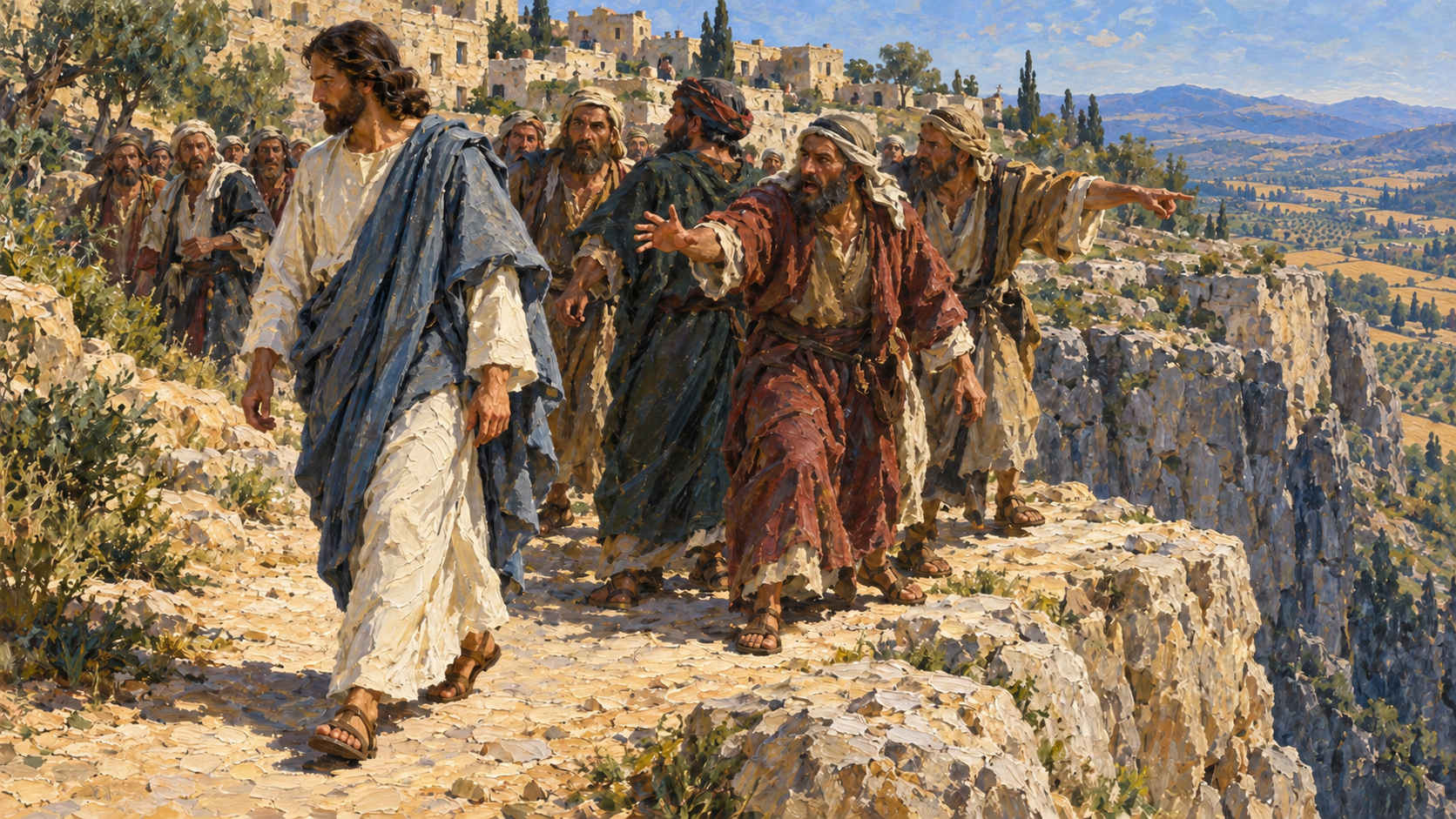
Several times before the crucifixion, people tried to seize or kill Jesus. They were not all the same group, and I want to follow the scenes carefully because loose language can hide what the passages actually say and can be twisted into hatred of Jewish people. As we read, we will also see that no one could take Jesus’ life before His appointed hour and that He finally gave Himself willingly.
We Must Name the People the Gospels Name
In Nazareth, the attackers were hearers from Jesus’ hometown synagogue. Later, Pharisees plotted with Herodians, men connected with the political order of Herod’s dynasty. Chief priests and members of the Jerusalem council opposed Him as well. At other moments, temple officers or hostile crowds tried to take Him. These people sometimes worked together, but the Gospels do not merge them into one faceless group.
John sometimes calls an opposing group “the Jews.” To a modern reader, that wording may sound as though he meant every Jewish person. He did not. John and the other apostles were themselves Jewish, and Jesus was Jewish according to the flesh. John’s Gospel also records many Jewish people believing in Jesus. In a hostile scene, the phrase may identify the Judean authorities or leaders at a festival. Elsewhere John may mean particular questioners or one crowd. The immediate setting tells us whom he means.
I will use the precise descriptions Scripture supplies as we move through each passage. Biblical truth gives no permission for antisemitism or inherited ethnic blame. It certainly cannot justify contempt for the people through whom the Messiah came.
We must also distinguish the earlier attacks from the final execution. Some opponents wanted to throw Jesus from a hill or stone Him. Crucifixion was a Roman sentence that Roman soldiers carried out under Pontius Pilate. Pilate authorized it after repeatedly saying that he found no fault in Jesus. The Gospel record assigns guilt to the people and institutions that acted; it never makes an ethnicity collectively guilty.
Opposition Began in Nazareth and Grew Around the Sabbath
The first attempt Luke records came from people who had known Jesus in Nazareth. Their response changed sharply as He explained the Scripture He had just read.
So He came to Nazareth, where He had been brought up. And as His custom was, He went into the synagogue on the Sabbath day, and stood up to read. And He was handed the book of the prophet Isaiah. And when He had opened the book, He found the place where it was written: “The Spirit of the LORD is upon Me, Because He has anointed Me To preach the gospel to the poor; He has sent Me to heal the brokenhearted, To proclaim liberty to the captives And recovery of sight to the blind, To set at liberty those who are oppressed; To proclaim the acceptable year of the LORD.” Then He closed the book, and gave it back to the attendant and sat down. And the eyes of all who were in the synagogue were fixed on Him. And He began to say to them, “Today this Scripture is fulfilled in your hearing.” So all bore witness to Him, and marveled at the gracious words which proceeded out of His mouth. And they said, “Is this not Joseph’s son?” He said to them, “You will surely say this proverb to Me, ‘Physician, heal yourself! Whatever we have heard done in Capernaum, do also here in Your country.'” Then He said, “Assuredly, I say to you, no prophet is accepted in his own country. But I tell you truly, many widows were in Israel in the days of Elijah, when the heaven was shut up three years and six months, and there was a great famine throughout all the land; but to none of them was Elijah sent except to Zarephath, in the region of Sidon, to a woman who was a widow. And many lepers were in Israel in the time of Elisha the prophet, and none of them was cleansed except Naaman the Syrian.” So all those in the synagogue, when they heard these things, were filled with wrath, and rose up and thrust Him out of the city; and they led Him to the brow of the hill on which their city was built, that they might throw Him down over the cliff. Then passing through the midst of them, He went His way.
Jesus read Isaiah in His hometown synagogue and announced that the Scripture was fulfilled in their hearing. The hearers first marveled at His gracious words. Their amazement turned to anger when He used Elijah and Elisha to expose their unbelief.
God had shown mercy to a Sidonian widow and a Syrian leper while many in Israel remained unbelieving. Those examples confronted hometown presumption. Familiarity with Jesus and physical descent from Israel did not guarantee that they would receive God’s grace.
The crowd drove Jesus to the brow of the hill intending to throw Him down, but Luke says He passed through their midst and went His way. Luke does not tell us whether the escape was openly miraculous. Perhaps the crowd recoiled before His authority. Confusion or another providential circumstance may have opened a path. I would not choose an explanation the text does not give. Their murderous intent failed, and Jesus continued His ministry.
And He entered the synagogue again, and a man was there who had a withered hand. So they watched Him closely, whether He would heal him on the Sabbath, so that they might accuse Him. And He said to the man who had the withered hand, “Step forward.” Then He said to them, “Is it lawful on the Sabbath to do good or to do evil, to save life or to kill?” But they kept silent. And when He had looked around at them with anger, being grieved by the hardness of their hearts, He said to the man, “Stretch out your hand.” And he stretched it out, and his hand was restored as whole as the other. Then the Pharisees went out and immediately plotted with the Herodians against Him, how they might destroy Him.
In another synagogue, opponents watched Jesus so they could accuse Him. He asked whether the Sabbath was for doing good or evil, for saving life or killing. Their silence exposed the contradiction. He then restored the man’s withered hand. They objected to an act of mercy, then left the synagogue to plan a death.
Mark specifically names Pharisees and Herodians. The Pharisees were known for strict religious observance, while the Herodians were associated with Herod’s political order. They did not need to agree about everything to unite against Jesus.
Jesus did not violate God’s Sabbath command. The day prohibited ordinary labor; it never made mercy sinful. He exposed traditions that treated human need as less important than a controlling interpretation. Their plot grew from hard hearts that preferred their own authority to the truth standing in front of them. Religious leaders in any generation face the same danger when precise rules become weapons against compassion and truth. Here the danger is even clearer because their interpretation rejected the Lord of the Sabbath Himself.
For this reason the Jews persecuted Jesus, and sought to kill Him, because He had done these things on the Sabbath. But Jesus answered them, “My Father has been working until now, and I have been working.” Therefore the Jews sought all the more to kill Him, because He not only broke the Sabbath, but also said that God was His Father, making Himself equal with God.
John 5 joins the Sabbath conflict to the larger question of Jesus’ identity. At Bethesda, Jesus told a man to take up his bed and walk, and the man was immediately healed. His opponents persecuted Him over the Sabbath, and their hostility increased when He called God His Father in a way that made Himself equal with God.
This was not a misunderstanding Jesus corrected by denying His deity. Instead, He continued by saying that the Son gives life and deserves the same honor as the Father. He also said that He will execute judgment. John records the charge that Jesus broke the Sabbath, but recording an accusation is not the same as approving it. The sinless Son did not violate God’s law. He exposed their wrong way of enforcing the Sabbath.
I think we need to keep both authority and identity in view here. If Jesus is the eternal Son, His word judges every human tradition. Rejecting His identity allowed these leaders to protect their system, but only by resisting God.
Jesus’ Divine Claims Brought Stones and Attempted Arrests
John next takes us into public confrontations at Jerusalem. The crowds were divided, the rulers were watching, and Jesus kept speaking about where He came from and who had sent Him.
Now some of them from Jerusalem said, “Is this not He whom they seek to kill? But look! He speaks boldly, and they say nothing to Him. Do the rulers know indeed that this is truly the Christ? However, we know where this Man is from; but when the Christ comes, no one knows where He is from.” Then Jesus cried out, as He taught in the temple, saying, “You both know Me, and you know where I am from; and I have not come of Myself, but He who sent Me is true, whom you do not know. But I know Him, for I am from Him, and He sent Me.” Therefore they sought to take Him; but no one laid a hand on Him, because His hour had not yet come. And many of the people believed in Him, and said, “When the Christ comes, will He do more signs than these which this Man has done?”
Jerusalem was divided. Some wondered why a Man whom the rulers wanted dead could teach openly, while many believed because of His signs. The scene itself keeps us from treating every Jewish person as though they shared one response.
They sought to take Jesus, but no one laid a hand on Him because His hour had not yet come. John uses “hour” for the appointed movement toward His death, resurrection, and glorification. This does not erase human choice. Officers could hesitate or refuse an order, crowds could respond in different ways, and leaders could fail to accomplish their plans. God’s knowledge and Christ’s authority ensured that the arrest would not happen too soon, but His opponents were not innocent puppets.
Jesus kept teaching openly without surrendering His mission to threats or provoking death merely to prove courage.
Jesus answered, “If I honor Myself, My honor is nothing. It is My Father who honors Me, of whom you say that He is your God. Yet you have not known Him, but I know Him. And if I say, ‘I do not know Him,’ I shall be a liar like you; but I do know Him and keep His word. Your father Abraham rejoiced to see My day, and he saw it and was glad.” Then the Jews said to Him, “You are not yet fifty years old, and have You seen Abraham?” Jesus said to them, “Most assuredly, I say to you, before Abraham was, I AM.” Then they took up stones to throw at Him; but Jesus hid Himself and went out of the temple, going through the midst of them, and so passed by.
Jesus distinguished His eternal existence from Abraham’s created beginning. He did not say, “Before Abraham was, I was.” He said, “I AM,” using language that reveals eternal divine identity. His hostile hearers took up stones because they heard more than a claim that He was older than Abraham. They understood that He was making a claim which would have been blasphemous if it were false.
Jesus hid Himself and left the temple. John does not explain how, so we should not insist that He became invisible or reduce the escape to an ordinary maneuver. The attempt failed, but His claim remains: Jesus is not a created prophet competing for honor. He is the eternal Son, fully God and fully man.
My sheep hear My voice, and I know them, and they follow Me. And I give them eternal life, and they shall never perish; neither shall anyone snatch them out of My hand. My Father, who has given them to Me, is greater than all; and no one is able to snatch them out of My Father’s hand. I and My Father are one.” Then the Jews took up stones again to stone Him. Jesus answered them, “Many good works I have shown you from My Father. For which of those works do you stone Me?” The Jews answered Him, saying, “For a good work we do not stone You, but for blasphemy, and because You, being a Man, make Yourself God.” Jesus answered them, “Is it not written in your law, ‘I said, “You are gods”‘? If He called them gods, to whom the word of God came (and the Scripture cannot be broken), do you say of Him whom the Father sanctified and sent into the world, ‘You are blaspheming,’ because I said, ‘I am the Son of God’? If I do not do the works of My Father, do not believe Me; but if I do, though you do not believe Me, believe the works, that you may know and believe that the Father is in Me, and I in Him.” Therefore they sought again to seize Him, but He escaped out of their hand.
Jesus promised His sheep eternal life. They are secure in His hand and in the Father’s hand, and they will never perish. Then He said, “I and My Father are one.” His hearers again reached for stones and openly accused Him of making Himself God.
Jesus answered from Psalm 82 and pointed to His works. He was not reducing Himself to one human ruler among others called gods. He exposed the inconsistency of charging the One whom the Father sanctified and sent when Scripture itself used elevated language for human judges. He then renewed the greater claim: the Father is in Him, and He is in the Father. They tried to seize Him, but He escaped from their hand.
The doctrine of the Trinity keeps distinction and unity together. The Father and Son are distinct Persons, yet the Son shares the one divine nature. That is the identity His opponents were resisting.
The Raising of Lazarus Turned Opposition Into a Council Plot
After Jesus raised Lazarus, opposition moved from repeated attempts into an organized council decision. What catches my attention is that the sign itself was not really in dispute; the leaders were deciding what to do about its political effect.
Then many of the Jews who had come to Mary, and had seen the things Jesus did, believed in Him. But some of them went away to the Pharisees and told them the things Jesus did. Then the chief priests and the Pharisees gathered a council and said, “What shall we do? For this Man works many signs. If we let Him alone like this, everyone will believe in Him, and the Romans will come and take away both our place and nation.” And one of them, Caiaphas, being high priest that year, said to them, “You know nothing at all, nor do you consider that it is expedient for us that one man should die for the people, and not that the whole nation should perish.” Now this he did not say on his own authority; but being high priest that year he prophesied that Jesus would die for the nation, and not for that nation only, but also that He would gather together in one the children of God who were scattered abroad. Then, from that day on, they plotted to put Him to death. Therefore Jesus no longer walked openly among the Jews, but went from there into the country near the wilderness, to a city called Ephraim, and there remained with His disciples.
Many Jewish mourners who saw Lazarus raised believed in Jesus. Others went to the Pharisees and reported what had happened. Once again, people in the same passage responded in very different ways.
When the chief priests and Pharisees gathered a council, they did not deny that Jesus worked signs. Instead, they worried that a large movement around Him might appear rebellious to Rome and bring destruction on their nation and place of authority. That fear helps us understand their political calculation, but it cannot justify murder.
Caiaphas argued that it was better for one man to die than for the nation to perish. John explains that his words carried a prophetic meaning beyond what Caiaphas intended. The high priest proposed an expedient killing; God announced that Jesus would willingly die for the nation and gather God’s scattered children.
This does not mean the Father punished Jesus in place of the nation. The council planned a judicial killing for political security. God used their wicked plan to accomplish saving good without approving their sin. Jesus then withdrew to Ephraim until the appointed Passover. His withdrawal was wise and purposeful, not fearful.
Jesus said to them, “Have you never read in the Scriptures: ‘The stone which the builders rejected Has become the chief cornerstone. This was the LORD’s doing, And it is marvelous in our eyes’? “Therefore I say to you, the kingdom of God will be taken from you and given to a nation bearing the fruits of it. And whoever falls on this stone will be broken; but on whomever it falls, it will grind him to powder.” Now when the chief priests and Pharisees heard His parables, they perceived that He was speaking of them. But when they sought to lay hands on Him, they feared the multitudes, because they took Him for a prophet.
The vineyard parable described tenants who beat the owner’s servants and killed his son. Israel’s history included the rejection of prophets, and these leaders were preparing to reject the Son. Matthew says the chief priests and Pharisees knew Jesus was speaking about them. They wanted to seize Him but feared the multitudes, who regarded Him as a prophet.
The parable condemns unfaithful leaders. It does not cancel God’s promises to Israel or transfer ethnic hatred to later generations. Judgment falls on unbelief and rebellion, while believing Jews and Gentiles receive one salvation in the Messiah. The stone the builders rejected became the chief cornerstone; human rejection could not overturn Jesus’ identity or kingdom.
Now it came to pass, when Jesus had finished all these sayings, that He said to His disciples, “You know that after two days is the Passover, and the Son of Man will be delivered up to be crucified.” Then the chief priests, the scribes, and the elders of the people assembled at the palace of the high priest, who was called Caiaphas, and plotted to take Jesus by trickery and kill Him. But they said, “Not during the feast, lest there be an uproar among the people.”
Jesus told His disciples that He would be delivered up and crucified. At the same time, chief priests, scribes, and elders met at Caiaphas’s residence to plan a deceptive arrest. They wanted to avoid the feast because they feared an uproar. Judas later gave them a chance to arrest Jesus at night, away from the teaching crowds.
Jesus’ prediction shows His knowledge and willing obedience. Their secrecy shows their moral guilt. Knowing a crime beforehand is not committing it, and using a wicked act for redemption never turns wickedness into righteousness. The Passover setting points to Jesus as the true Lamb whose blood brings deliverance. He was sinless; the conspirators were not carrying out divine justice.
Jesus Gave Himself When His Appointed Hour Came
All the failed attempts lead to Jesus’ own explanation of His death. He was not waiting for someone to overpower Him. He had already chosen to lay down His life and take it again.
I am the good shepherd; and I know My sheep, and am known by My own. As the Father knows Me, even so I know the Father; and I lay down My life for the sheep. And other sheep I have which are not of this fold; them also I must bring, and they will hear My voice; and there will be one flock and one shepherd. “Therefore My Father loves Me, because I lay down My life that I may take it again. No one takes it from Me, but I lay it down of Myself. I have power to lay it down, and I have power to take it again. This command I have received from My Father.”
Jesus said that He lays down His life for the sheep and has authority to take it again. He entered death willingly, knowing fully what He was doing, and His death was followed by bodily resurrection.
“No one takes it from Me” does not mean no human hands arrested or killed Him. The later chapters plainly name the people who seized Jesus and the soldiers who scourged and struck Him. Roman hands then carried out the crucifixion. Jesus meant that no one could take ultimate control or force the eternal Son into a death He had not freely chosen. He could have prevented the arrest, but He chose to finish the saving work for which He came.
His willing surrender does not excuse His abusers. If an innocent person accepts suffering to rescue another, that choice does not turn an attacker’s cruelty into obedience. Scripture speaks without contradiction: Jesus laid down His life, and lawless people killed Him. His authority also explains why every earlier attempt failed. He would die in the manner and hour He had accepted, not at Nazareth or beneath stones at a feast.
When Jesus had spoken these words, He went out with His disciples over the Brook Kidron, where there was a garden, which He and His disciples entered. And Judas, who betrayed Him, also knew the place; for Jesus often met there with His disciples. Then Judas, having received a detachment of troops, and officers from the chief priests and Pharisees, came there with lanterns, torches, and weapons. Jesus therefore, knowing all things that would come upon Him, went forward and said to them, “Whom are you seeking?” They answered Him, “Jesus of Nazareth.” Jesus said to them, “I am He.” And Judas, who betrayed Him, also stood with them. Now when He said to them, “I am He,” they drew back and fell to the ground. Then He asked them again, “Whom are you seeking?” And they said, “Jesus of Nazareth.” Jesus answered, “I have told you that I am He. Therefore, if you seek Me, let these go their way,” that the saying might be fulfilled which He spoke, “Of those whom You gave Me I have lost none.” Then Simon Peter, having a sword, drew it and struck the high priest’s servant, and cut off his right ear. The servant’s name was Malchus. So Jesus said to Peter, “Put your sword into the sheath. Shall I not drink the cup which My Father has given Me?”
Judas came to the garden with officers and a detachment of troops carrying weapons and lights. Jesus stepped forward and identified Himself. The armed party drew back and fell to the ground, then Jesus required them to let His disciples go. Even while yielding, the Good Shepherd directed the scene and protected His own.
Peter’s sword could not advance redemption, so Jesus ordered him to put it away. The cup was the suffering and rejection He had agreed to face. It included the torture and death wicked people would inflict on Him; it was not the Father’s wrath against the Son. John holds sovereignty and injustice together. Jesus freely gave Himself while Judas betrayed Him and the officers carried out an unjust arrest.
So then Pilate took Jesus and scourged Him. And the soldiers twisted a crown of thorns and put it on His head, and they put on Him a purple robe. Then they said, “Hail, King of the Jews!” And they struck Him with their hands. Pilate then went out again, and said to them, “Behold, I am bringing Him out to you, that you may know that I find no fault in Him.” Then Jesus came out, wearing the crown of thorns and the purple robe. And Pilate said to them, “Behold the Man!” Therefore, when the chief priests and officers saw Him, they cried out, saying, “Crucify Him, crucify Him!” Pilate said to them, “You take Him and crucify Him, for I find no fault in Him.” The Jews answered him, “We have a law, and according to our law He ought to die, because He made Himself the Son of God.” Therefore, when Pilate heard that saying, he was the more afraid, and went again into the Praetorium, and said to Jesus, “Where are You from?” But Jesus gave him no answer. Then Pilate said to Him, “Are You not speaking to me? Do You not know that I have power to crucify You, and power to release You?” Jesus answered, “You could have no power at all against Me unless it had been given you from above. Therefore the one who delivered Me to you has the greater sin.” From then on Pilate sought to release Him, but the Jews cried out, saying, “If you let this Man go, you are not Caesar’s friend. Whoever makes himself a king speaks against Caesar.” When Pilate therefore heard that saying, he brought Jesus out and sat down in the judgment seat in a place that is called The Pavement, but in Hebrew, Gabbatha. Now it was the Preparation Day of the Passover, and about the sixth hour. And he said to the Jews, “Behold your King!” But they cried out, “Away with Him, away with Him! Crucify Him!” Pilate said to them, “Shall I crucify your King?” The chief priests answered, “We have no king but Caesar!” Then he delivered Him to them to be crucified. Then they took Jesus and led Him away.
Pilate had Jesus scourged. Roman soldiers put a crown of thorns on Him, mocked Him, and struck Him. Pilate repeatedly said that he found no fault in Jesus, yet political pressure overcame his stated judgment and he sent an innocent Man to the cross.
Particular chief priests and officers demanded crucifixion and appealed to Jesus’ claim to be the Son of God. This was Roman punishment urged by specific Jerusalem leaders and a hostile crowd. It was not the act of every Jewish person, and Rome was not a neutral instrument with clean hands.
Jesus told Pilate that his power existed under God, but delegated authority did not make injustice lawful. By speaking of greater sin, Jesus could distinguish degrees of guilt without declaring any of the guilty parties innocent.
Scripture Assigns Responsibility Without Ethnic Blame
So when they heard that, they raised their voice to God with one accord and said: “Lord, You are God, who made heaven and earth and the sea, and all that is in them, who by the mouth of Your servant David have said: ‘Why did the nations rage, And the people plot vain things? The kings of the earth took their stand, And the rulers were gathered together Against the LORD and against His Christ.’ “For truly against Your holy Servant Jesus, whom You anointed, both Herod and Pontius Pilate, with the Gentiles and the people of Israel, were gathered together to do whatever Your hand and Your purpose determined before to be done. Now, Lord, look on their threats, and grant to Your servants that with all boldness they may speak Your word, by stretching out Your hand to heal, and that signs and wonders may be done through the name of Your holy Servant Jesus.” And when they had prayed, the place where they were assembled together was shaken; and they were all filled with the Holy Spirit, and they spoke the word of God with boldness.
The Jerusalem church interpreted the crucifixion through Psalm 2. Herod and Pontius Pilate stood among those gathered against God’s holy Servant Jesus, and the prayer names Gentiles together with people from Israel. Roman rulers supplied the political and military power, while local leaders pressed their case and soldiers carried out the physical punishment. Judas handed Jesus over, false witnesses lied about Him, and hostile crowds demanded His death. Yet the meaning of Christ’s death reaches far beyond those particular actors because He died for the whole sinful world.
This wording prevents ethnic scapegoating. The prayer says these human actors did what God’s hand and purpose had determined beforehand. God foretold their actions and sovereignly used them without planting malice in anyone’s heart. He did not approve false testimony or become the One who tortured Jesus.
The persecuted church asked for boldness to preach, not permission to retaliate against an ethnic community. Their answer to hostility was witness empowered by the Holy Spirit.
“Men of Israel, hear these words: Jesus of Nazareth, a Man attested by God to you by miracles, wonders, and signs which God did through Him in your midst, as you yourselves also know– Him, being delivered by the determined purpose and foreknowledge of God, you have taken by lawless hands, have crucified, and put to death; whom God raised up, having loosed the pains of death, because it was not possible that He should be held by it.
Peter placed divine foreknowledge beside human lawlessness. Jesus was delivered according to God’s determined purpose and foreknowledge, yet lawless hands crucified and killed Him. The Father knew the cross beforehand, Scripture foretold it, and the Son freely came to give Himself. None of that made Judas’s betrayal, Pilate’s cowardly sentence, or the physical torture righteous.
God’s sovereignty is powerful enough to bring salvation out of human evil without becoming evil. The resurrection is the decisive reversal: God raised Jesus because death could not hold Him. Peter preached this in Jerusalem to Jewish hearers and immediately offered repentance and forgiveness. His sermon was an invitation to grace, not a warrant for endless ethnic accusation.
Wicked men physically tortured and killed Jesus under an unjust sentence. He willingly bore that real punishment for our sins in His innocent body. His blood was shed, He died and was buried, and He rose bodily. The Father did not punish or curse Jesus, abandon Him, strike or bruise Him, or pour wrath on Him.
This distinction keeps the whole Gospel account together. Jesus truly suffered judicial and physical injustice, yet He was never helpless or defeated. The Father sent and raised the Son. Wicked people committed the cruelty Jesus chose to endure for us. Caiaphas wanted one death to preserve political order, but God accomplished something Caiaphas did not understand: the sinless Messiah gave Himself for Israel and the whole world, and His blood provides forgiveness to everyone who believes.
Matthew records a crowd saying, “His blood be on us and on our children.” A crowd cannot place moral guilt on unborn descendants who did not choose its act. Within weeks, the apostles preached forgiveness in Jerusalem and thousands of Jewish hearers believed. Paul longed for Israel’s salvation and taught that the gospel is for the Jew first and also for the Greek.
Antisemitism contradicts the gospel. Christians must not weaponize the crucifixion accounts against Jewish neighbors or repeat antisemitic slurs. Violence against Jewish people can never be excused, and modern people must not be treated as participants in an ancient trial. Yet fear of misuse must not make us hide what particular leaders and crowds did. Accuracy names the actors Scripture names and refuses both erasure and collective blame. Every nation contains sinners, and every nation needs Israel’s Messiah.
that if you confess with your mouth the Lord Jesus and believe in your heart that God has raised Him from the dead, you will be saved. For with the heart one believes unto righteousness, and with the mouth confession is made unto salvation. For the Scripture says, “Whoever believes on Him will not be put to shame.” For there is no distinction between Jew and Greek, for the same Lord over all is rich to all who call upon Him. For “whoever calls on the name of the LORD shall be saved.”
The same Lord is rich to everyone who calls on Him. No sinner is saved by transferring blame to another person or people. Salvation comes by confessing Jesus as Lord and believing that God raised Him bodily from the dead. The apostles answered hostility with truthful, Spirit-empowered witness and offered forgiveness through Christ to everyone.
My Final Thoughts
When I follow these scenes in context, I do not find one ethnic group carrying inherited guilt for Jesus’ death. I find particular people who acted wickedly, including Roman authorities who carried out an unjust sentence. Through it all, the eternal Son remained in control until He willingly laid down His life. God’s foreknowledge did not excuse their sin, and Christ’s willing sacrifice did not make their cruelty righteous. We should read the hard facts honestly, refuse ethnic blame, and make the same offer the apostles made: forgiveness through the crucified and risen Messiah for every person who believes.