
Korah’s name became a warning about rebellion, but his descendants later guarded the places where Israel worshiped and helped lead its songs. I find hope in following that family through Scripture. Their father’s sin had dreadful consequences without requiring every generation to repeat it.
Korah Despised an Honorable Calling and Rebelled Against God
And the sons of Korah were Assir, Elkanah, and Abiasaph. These are the families of the Korahites.
Korah was a Levite descended through Kohath and Izhar. Moses and Aaron belonged to the same extended family through Kohath’s son Amram, so Korah was challenging relatives who held responsibilities God had assigned. Exodus also names Korah’s sons, Assir, Elkanah, and Abiasaph. Their family line continues after their father’s death, and Scripture gives us more to learn about them than his rebellion alone (Exodus 6:16-24).
The Kohathites carried the sacred furnishings of the tabernacle, including the ark, table, lampstand, and altars. According to Numbers 4, Aaron and his sons first covered those objects; the Kohathites could then carry them without touching the holy objects or looking at them uncovered. Their responsibilities were restricted, but they were hardly insignificant. Korah’s complaint arose from a man whom God had already brought near to serve.
Then Moses said to Korah, “Hear now, you sons of Levi: Is it a small thing to you that the God of Israel has separated you from the congregation of Israel, to bring you near to Himself, to do the work of the tabernacle of the LORD, and to stand before the congregation to serve them; and that He has brought you near to Himself, you and all your brethren, the sons of Levi, with you? And are you seeking the priesthood also? Therefore you and all your company are gathered together against the LORD. And what is Aaron that you complain against him?”
Korah joined Dathan and Abiram of Reuben in a public challenge supported by 250 recognized leaders. They accused Moses and Aaron of exalting themselves over a holy congregation. God had indeed set Israel apart, but He had given the priesthood to Aaron’s family. Belonging to His people did not authorize every Israelite to perform every ministry. Korah appealed to a privilege they shared in order to claim a responsibility God had given to someone else (Numbers 16:1-11).
On the son of Peleth appears at the beginning of the rebellion, but Scripture gives no further account of him. Later traditions explain his absence in different ways; Numbers does not say whether he withdrew or what became of him. We should leave that question open instead of teaching a later explanation as something the passage records.
Moses fell on his face when Korah’s company confronted him. He then called for the men to bring censers, the vessels used to burn incense, before the LORD, who would identify the man He had chosen to approach Him. Moses also asked why Korah considered service at the tabernacle so small that he sought the priesthood as well. Korah treated an honorable calling as inadequate because it did not give him Aaron’s place.
Dathan and Abiram refused Moses’ summons and accused him of bringing the people out of a land flowing with milk and honey. They were describing Egypt, the country that had enslaved them, with language associated with God’s promised land. Their accusation made former bondage sound desirable and portrayed Moses, who had led them out, as the man who had ruined their lives. Moses denied exploiting them and brought their accusation before God.
And he spoke to the congregation, saying, “Depart now from the tents of these wicked men! Touch nothing of theirs, lest you be consumed in all their sins.” So they got away from around the tents of Korah, Dathan, and Abiram; and Dathan and Abiram came out and stood at the door of their tents, with their wives, their sons, and their little children. And Moses said: “By this you shall know that the LORD has sent me to do all these works, for I have not done them of my own will. If these men die naturally like all men, or if they are visited by the common fate of all men, then the LORD has not sent me. But if the LORD creates a new thing, and the earth opens its mouth and swallows them up with all that belongs to them, and they go down alive into the pit, then you will understand that these men have rejected the LORD.” Now it came to pass, as he finished speaking all these words, that the ground split apart under them, and the earth opened its mouth and swallowed them up, with their households and all the men with Korah, with all their goods. So they and all those with them went down alive into the pit; the earth closed over them, and they perished from among the assembly.
When God spoke of consuming the congregation, Moses and Aaron interceded for the people who had gathered against them. The LORD then commanded the people to move away from the rebels’ tents. Moses said that if the rebels died naturally, the LORD had not sent him. If the ground opened and swallowed the rebels, however, Israel would know that these men had rejected the LORD. As he finished speaking, the ground split and swallowed those described in the passage, along with their possessions. Fire also consumed the 250 men offering incense (Numbers 16:20-35).
Numbers 26 later names Korah with Dathan and Abiram among those swallowed by the earth. Numbers 16 describes both the men associated with Korah and the company consumed by fire, without tracing Korah’s movements between them. We do not need to reconstruct those movements to accept the later passage’s express statement that he died in the judgment. That passage also records an exception concerning his sons.
Israel’s recognized leaders could not make unauthorized worship acceptable by gathering a large following. The incense they brought became part of the warning left for the congregation.
Then the LORD spoke to Moses, saying: “Tell Eleazar, the son of Aaron the priest, to pick up the censers out of the blaze, for they are holy, and scatter the fire some distance away. The censers of these men who sinned against their own souls, let them be made into hammered plates as a covering for the altar. Because they presented them before the LORD, therefore they are holy; and they shall be a sign to the children of Israel.” So Eleazar the priest took the bronze censers, which those who were burned up had presented, and they were hammered out as a covering on the altar, to be a memorial to the children of Israel that no outsider, who is not a descendant of Aaron, should come near to offer incense before the LORD, that he might not become like Korah and his companions, just as the LORD had said to him through Moses.
Eleazar collected the bronze censers, which had been presented before the LORD and were therefore holy. Their metal was hammered into a covering for the altar. Anyone seeing it was to remember that no one outside Aaron’s line could take up the work of offering priestly incense. God used the very objects brought to challenge His appointment to warn later worshipers against repeating the offense. I see mercy in that enduring warning as well as the severity of the judgment behind it (Numbers 16:36-50).
Yet the next day the congregation accused Moses and Aaron of killing the LORD’s people. They blamed the men who had just interceded for them, despite having witnessed the sign God gave. When a plague began, Moses told Aaron to take fire from the altar in a censer, add incense, and go into the assembly to make atonement. Aaron ran among the people and stood between the dead and the living until the plague stopped. Another 14,700 people had died, apart from those lost in Korah’s rebellion.
The incense carried by Aaron came with a very different purpose from that brought by the rebels. They had presumed to take the priesthood for themselves; the appointed priest now obeyed Moses and interceded for people who had accused him. Aaron served as a mediator, someone acting on the people’s behalf before God. The atonement he made within Israel’s covenant life stopped the plague, but it did not provide the final cleansing of the conscience that comes through Christ. Israel needed the priest God had appointed, and the wider teaching of Scripture directs us beyond Aaron to the perfect Mediator.
God then gave another public sign to settle the complaints about His choice of priest.
Now it came to pass on the next day that Moses went into the tabernacle of witness, and behold, the rod of Aaron, of the house of Levi, had sprouted and put forth buds, had produced blossoms and yielded ripe almonds. Then Moses brought out all the rods from before the LORD to all the children of Israel; and they looked, and each man took his rod. And the LORD said to Moses, “Bring Aaron’s rod back before the Testimony, to be kept as a sign against the rebels, that you may put their complaints away from Me, lest they die.”
Each tribal leader supplied a rod, and Aaron’s name was written on the rod representing Levi. Moses placed them before the LORD. By the next morning Aaron’s rod had sprouted, blossomed, and borne ripe almonds. God identified His chosen priest by bringing life from the rod, answering the accusation that Aaron had exalted himself. He then commanded that it be kept as a sign against further rebellion (Numbers 17:1-13).
The people feared that anyone approaching the tabernacle would die. Numbers 18 answers that concern by explaining the duties and safeguards given to priests and Levites. God was providing a way for Israel to worship Him while respecting His holiness. They needed to honor the responsibilities He had established, rather than conclude that He had closed the way to everyone.
Korah’s Sons Survived and Answered to God for Themselves
The sons of Eliab were Nemuel, Dathan, and Abiram. These are the Dathan and Abiram, representatives of the congregation, who contended against Moses and Aaron in the company of Korah, when they contended against the LORD; and the earth opened its mouth and swallowed them up together with Korah when that company died, when the fire devoured two hundred and fifty men; and they became a sign. Nevertheless the children of Korah did not die.
“Nevertheless the children of Korah did not die.” Those few words prevent us from assuming that every member of his family perished. Numbers does not describe a conversation in which the sons rejected their father’s plan, tell us where they stood during the judgment, or record their feelings. We know they survived. Their line continued, and later genealogies connect faithful servants with it.
Their survival alone does not tell us everything about their spiritual condition. It does establish that their father’s rebellion neither ended the family nor made later faithfulness impossible. In Ezekiel 18, God directly addresses whether children inherit a parent’s guilt.
“Yet you say, ‘Why should the son not bear the guilt of the father?’ Because the son has done what is lawful and right, and has kept all My statutes and observed them, he shall surely live. The soul who sins shall die. The son shall not bear the guilt of the father, nor the father bear the guilt of the son. The righteousness of the righteous shall be upon himself, and the wickedness of the wicked shall be upon himself.”
Ezekiel addressed people who blamed their fathers’ sins for their predicament while avoiding responsibility for their own conduct. God rejected the claim that a righteous son must bear his father’s guilt. Deuteronomy 24:16 likewise forbids Israel’s courts to execute children for their parents’ crimes. A parent’s wrongdoing can still harm his children, but suffering its consequences does not make them guilty of committing it. Each person answers to God for his own actions (Ezekiel 18:19-23).
Numbers 16 includes little children among Dathan and Abiram’s households, so we cannot turn personal responsibility into a promise that children always escape the consequences of a parent’s rebellion. Nor are we told that everyone who died had knowingly helped organize it. The account of this public judgment does not explain each individual’s guilt or eternal condition. Scripture identifies the rebels’ sin and records the survival of Korah’s sons, and I need to be equally careful about what it leaves unstated.
If you grew up in a destructive home, you may still face the damage caused by someone else’s choices. Trust can be shattered, a family name can carry public shame, and sinful habits can become terribly familiar. You are not guilty merely because that person is your parent. You do answer to God for your own response, and His mercy gives you reason to seek a different course rather than accept family wickedness as something you must repeat.
Later Korahites Guarded Worship and Led Israel’s Song
The later records take us through many generations and changing places of worship. David organized service around the ark before Solomon built the temple. In 1 Chronicles 9, the account of Jerusalem’s inhabitants after the exile also recalls duties from earlier times. Keeping those settings distinct helps us follow the family without picturing Korah’s immediate sons serving for centuries in the same building.
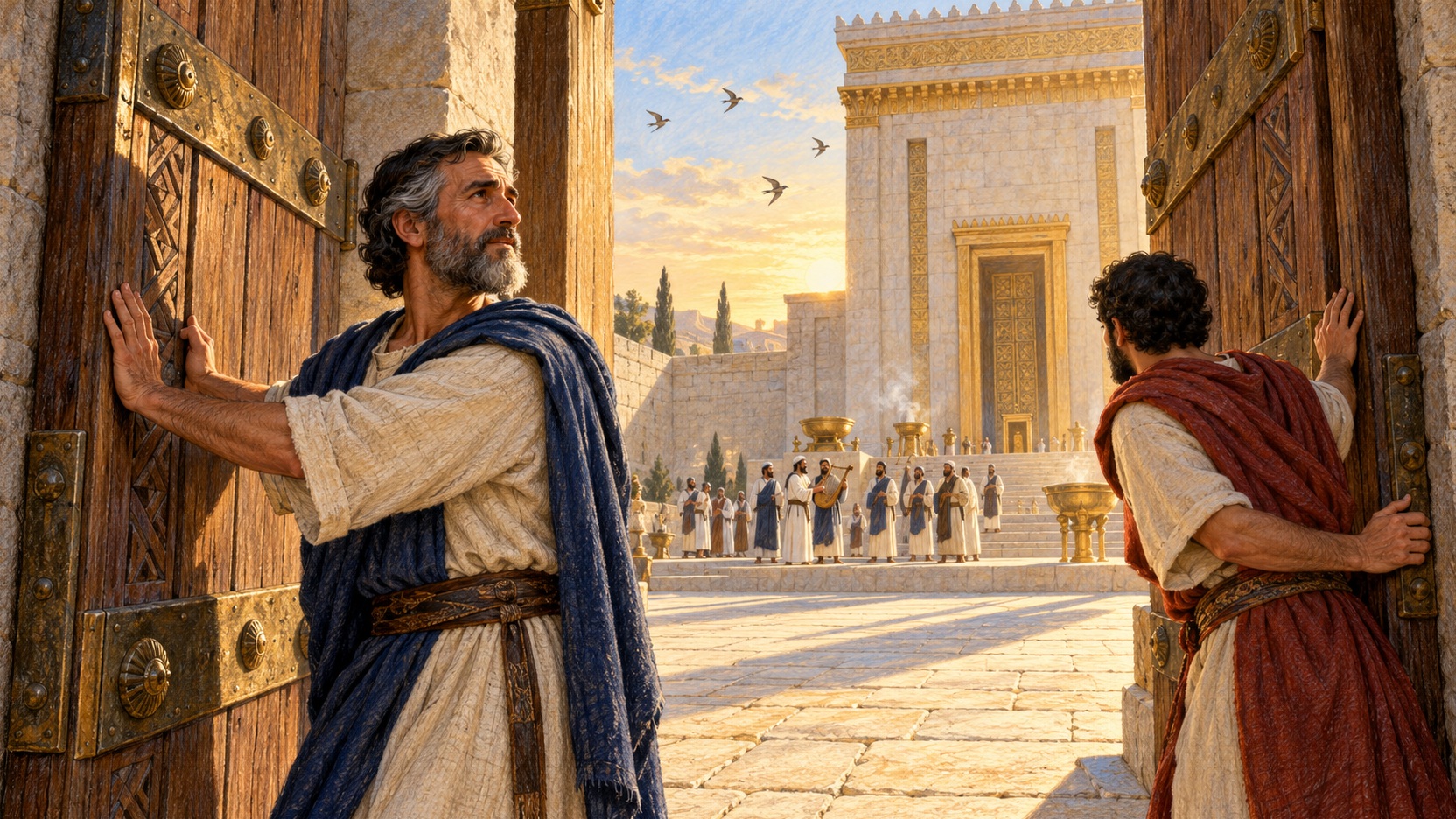
Shallum the son of Kore, the son of Ebiasaph, the son of Korah, and his brethren, from his father’s house, the Korahites, were in charge of the work of the service, gatekeepers of the tabernacle. Their fathers had been keepers of the entrance to the camp of the LORD.
Shallum’s genealogy connects him through Kore and Ebiasaph to Korah. He and his relatives served as gatekeepers, continuing work associated with the entrance to the LORD’s camp. Chronicles recalls the trusted office established by David and Samuel and describes duties at the gates, chambers, and treasuries. The chief gatekeepers lodged around the house of God and opened it each morning. Their relatives came from their villages for periods of service, sharing responsibility for work that had to continue day after day (1 Chronicles 9:17-27).
Entrances had to be watched and the house opened on time, while chambers and valuable property needed protection. Those duties required dependable people. Korah had tried to approach God on his own terms, yet later descendants were entrusted with helping preserve the order of worship. His sin did not permanently disqualify everyone who bore his name. In 1 Chronicles 26, we return to the divisions of gatekeepers arranged under David.
Among these were the divisions of the gatekeepers, among the chief men, having duties just like their brethren, to serve in the house of the LORD. And they cast lots for each gate, the small as well as the great, according to their father’s house. The lot for the East Gate fell to Shelemiah. Then they cast lots for his son Zechariah, a wise counselor, and his lot came out for the North Gate; to Obed-Edom the South Gate, and to his sons the storehouse. To Shuppim and Hosah the lot came out for the West Gate, with the Shallecheth Gate on the ascending highway–watchman opposite watchman.
1 Chronicles 26 names the Korahite and Merarite households who supplied the gatekeepers and records the capable men within them. It specifies how many were needed at particular gates and storehouses, with assignments made by lot for small and great alike. The ministry relied on those arrangements to keep each entrance properly staffed (1 Chronicles 26:1-19).
The men needed ability as well as willingness. Some are described as strong and capable, and Zechariah is called a wise counselor. I should not set devotion against competence, as though sincere intentions made careless work acceptable. A man entrusted with a gate or treasury needed to do his work properly because negligence could harm other people and disrupt their worship. Receiving less attention than a king or singer did not make his responsibility expendable.
Korahite service also included music, as the genealogy of Heman shows.
Now these are the men whom David appointed over the service of song in the house of the LORD, after the ark came to rest. They were ministering with music before the dwelling place of the tabernacle of meeting, until Solomon had built the house of the LORD in Jerusalem, and they served in their office according to their order. And these are the ones who ministered with their sons: Of the sons of the Kohathites were Heman the singer, the son of Joel, the son of Samuel, the son of Elkanah, the son of Jeroham, the son of Eliel, the son of Toah, the son of Zuph, the son of Elkanah, the son of Mahath, the son of Amasai, the son of Elkanah, the son of Joel, the son of Azariah, the son of Zephaniah, the son of Tahath, the son of Assir, the son of Ebiasaph, the son of Korah, the son of Izhar, the son of Kohath, the son of Levi, the son of Israel.
David appointed Heman to the service of song, and the genealogy traces his ancestry through Joel, Samuel, and Elkanah back to Korah and Levi. Heman ministered alongside Asaph of Gershon’s line and Ethan of Merari’s line. They began this work before Solomon built the temple, serving with their sons in the order David had established (1 Chronicles 6:31-48).
The genealogy also places Samuel in the Korahite line. First Samuel 1:1 describes Elkanah’s family in connection with Ephraim, while Chronicles supplies his Levitical descent. I understand the Ephraimite designation as identifying where the family lived, without denying that ancestry. The family remembered for resisting Moses thus included Samuel, the prophet who spoke God’s Word and helped establish the later arrangements for service. His grandson Heman continued that service through song.
These records do not tell us that every Korahite was faithful or that a hereditary assignment proved new birth. They show that God entrusted later members of the family with meaningful work. Gatekeepers, singers, and other Levites could serve in their appointed places without measuring their worth by someone else’s responsibility.
The Psalms of the Sons of Korah Teach Longing, Refuge, and Honest Lament
Eleven psalms name the sons of Korah in their headings: Psalm 42; Psalms 44-49; Psalms 84-85; and Psalms 87-88. Psalm 43 has no superscription, though its shared refrain and themes lead many readers to connect it with Psalm 42. That is a reasonable literary connection, but it does not give Psalm 43 an explicit Korahite heading.
The name refers to the continuing family and its body of singers, so we should not assume Korah’s immediate sons wrote every psalm. A heading can connect a psalm with the group without identifying the person who composed its words. Psalm 88, for example, also names Heman the Ezrahite. Each heading deserves attention before we draw conclusions about authorship or assign the whole collection to one generation.
These songs express longing for God’s presence and confidence amid national upheaval. They address wealth and death, celebrate God’s King, and ask for restoration. They also give words to profound grief. Psalm 42 begins with a worshiper who remembers the joy of going to God’s house and now longs to return (Psalm 42:1-11).
As the deer pants for the water brooks, So pants my soul for You, O God. My soul thirsts for God, for the living God. When shall I come and appear before God? My tears have been my food day and night, While they continually say to me, “Where is your God?” When I remember these things, I pour out my soul within me. For I used to go with the multitude; I went with them to the house of God, With the voice of joy and praise, With a multitude that kept a pilgrim feast. Why are you cast down, O my soul? And why are you disquieted within me? Hope in God, for I shall yet praise Him For the help of His countenance.
The writer of Psalm 42 remembers joining the multitude on the way to God’s house. Now he is separated from that worship, grieving and enduring the taunt that his God is absent. His thirst is for the living God Himself, not merely for familiar surroundings or a place in the procession.
He speaks to his own soul, acknowledging that he is cast down while directing himself to hope in God. The repeated refrain does not mean he has already stopped hurting. He returns to hope because the pain continues. I can tell God how deeply I am troubled and still trust Him for help I have not yet seen. In Psalm 46, that dependence finds expression in the confidence that God remains present when the world around His people gives way.
Come, behold the works of the LORD, Who has made desolations in the earth. He makes wars cease to the end of the earth; He breaks the bow and cuts the spear in two; He burns the chariot in the fire. Be still, and know that I am God; I will be exalted among the nations, I will be exalted in the earth! The LORD of hosts is with us; The God of Jacob is our refuge. Selah
Psalm 46 describes frightening upheaval: the earth gives way, mountains fall into the sea, and nations rage. The singers trust the LORD’s presence when their surroundings offer no stability. His command to be still comes amid warfare brought to an end and His name exalted among the nations. It reaches beyond advice to relax when we feel afraid. Those resisting God must cease their striving and recognize the One whose voice brings kingdoms down (Psalm 46:1-11).
Korah challenged God’s appointed order, while the family associated with his name sings that the God of Jacob is their refuge. I would not assume they composed Psalm 46 to reflect specifically on their ancestor. Even so, their confession places their security in the God he opposed. Psalm 49 then examines a false source of security, the wealth and position that cannot save anyone from death.
Those who trust in their wealth And boast in the multitude of their riches, None of them can by any means redeem his brother, Nor give to God a ransom for him– For the redemption of their souls is costly, And it shall cease forever– That he should continue to live eternally, And not see the Pit.
Psalm 49 addresses rich and poor together because neither wealth nor social position can keep a person from death (Psalm 49:1-15). A man may name his property after himself and expect his household to endure, but he cannot pay a ransom that would let his brother live forever. The psalmist trusts God to redeem him from the grave. A respected family name can provide that rescue no more than a fortune can. Psalm 84 directs our desire toward God Himself, whose presence is worth more than anything the wicked can offer.
For a day in Your courts is better than a thousand. I would rather be a doorkeeper in the house of my God Than dwell in the tents of wickedness. For the LORD God is a sun and shield; The LORD will give grace and glory; No good thing will He withhold From those who walk uprightly. O LORD of hosts, Blessed is the man who trusts in You!
The worshiper’s heart and body cry out for the living God, while pilgrims receive strength as they make their way to Zion. Even the birds near His altars contribute to the picture of a place the worshiper longs to be. His preference for a place in God’s house becomes explicit in verse 10 (Psalm 84:1-12).
The NKJV says, “I would rather be a doorkeeper in the house of my God than dwell in the tents of wickedness.” The Hebrew expression conveys standing at or guarding the threshold. That image fits the Korahite association with gatekeeping, although it need not describe the writer’s actual work assignment. He would choose even a modest place at God’s house over a home among the wicked, because he wants God Himself more than the status a position might bring.
We can share that allegiance without making our church buildings equivalent to Israel’s temple. The psalm calls us to value fellowship with God above the comfort available through wickedness. It does not teach contempt for ordinary work or family life.
The other psalms give us more of the range of this family’s worship. Psalm 85 asks for revival and brings mercy, truth, righteousness, and peace together. Psalm 87 celebrates Zion and includes people from the nations among those registered as born there. Psalm 88 ends without visible relief: its writer cries to the God of his salvation while describing isolation, affliction, and nearness to the grave.
Scripture does not add a cheerful conclusion to make his distress easier for us to hear. He continues addressing the LORD from within it. I think we do suffering believers a disservice when we require improved feelings before regarding their prayers as faithful. A congregation needs the confidence of Psalm 46 and the lament of Psalm 88. We can confess that God is our refuge while giving a fellow believer room to tell us how dark life presently seems.
Korah’s Rebellion Warns Leaders and Servants
Korah opposed appointments the LORD had made, not a leader’s personal preference. Some leaders appeal to his rebellion to intimidate people who ask for biblical accountability. We should compare that appeal with Moses’ conduct. He denied exploiting the people, interceded for them, and submitted his claim to a public test God confirmed. He did not insist that his unsupported word should settle the dispute. A pastor who conceals wrongdoing and labels every question rebellion cannot fairly claim Moses as his example.
Scripture gives qualifications for church leaders, commands believers to test teaching, and records leaders being corrected. Those standards should guide us when considering a complaint. Anyone calling for accountability must also tell the truth and examine his own conduct. Korah’s accusation sounded like concern for the congregation while he sought a position God had not given him. Religious language cannot make personal ambition righteous. Peter’s description of believers as a priesthood gives us another reason to be careful when applying this account to church leadership.
But you are a chosen generation, a royal priesthood, a holy nation, His own special people, that you may proclaim the praises of Him who called you out of darkness into His marvelous light; who once were not a people but are now the people of God, who had not obtained mercy but now have obtained mercy.
Peter describes believers together as a holy and royal priesthood whose spiritual sacrifices are acceptable through Jesus Christ. That prevents us from transferring Aaron’s hereditary priesthood to modern clergy. Every believer comes to God through Christ, our perfect High Priest and Mediator. A pastor does not stand between a believer and Jesus as though he personally controls access to the Savior (1 Peter 2:4-10).
The priesthood shared by believers does not abolish the order God gives His church. The New Testament entrusts authoritative teaching and oversight in the local church to biblically qualified male elders and gives qualifications for male deacons as well. Their leadership is a responsibility to serve Christ’s people under His Word, grounded in God’s created order rather than superiority or domination. Leaders must guard sound doctrine and care for the congregation. Those they serve should recognize faithful leadership while remembering that every leader also answers to Scripture.
A Family Can Receive a Different Legacy Through Mercy and Faithful Obedience
We cannot repair everything someone in our family has done, and a damaged reputation may outlast the person who caused it. But Korah’s descendants show why we should not assume that the family’s future is already settled. Later generations guarded entrances, cared for treasuries, taught God’s Word, and led His people in song. Ancestry neither earned them God’s favor nor prevented them from obeying Him.
If you recognize destructive patterns in your own family, begin with the choices before you. Refuse the dishonesty you learned to excuse, seek forgiveness for your own wrongdoing, and accept help where those patterns have taken hold. A different legacy generally develops through repeated faithfulness over time. You do not have to erase the past before you can answer God honestly in the present, nor can you guarantee how every relative will respond.
Korah’s desire for the priesthood also challenges the way we value service. If I neglect useful work because it brings too little recognition, I may be despising an opportunity God has already given me. The gatekeepers’ care and the singers’ music both contributed to the worship of the congregation. The value of their work came from serving God and His people, so I should not judge it by the attention it received.
Yet useful work is not all that these psalms teach us to desire. Psalm 42 makes me examine whether I am seeking the Lord Himself or becoming satisfied with working around the things associated with Him. Carrying out a ministry task cannot replace knowing and worshiping the God we claim to serve.
Neither should we confuse survival with salvation. Korah’s sons were spared in that judgment, but they still needed mercy for their own sins. Neither a good family name nor faithful work could ransom their souls. Psalm 49 directs our hope to God for redemption. It does not describe Christ’s death in detail, but the New Testament identifies His precious blood as the price of our redemption (1 Peter 1:18-19).
The One who supplies that redemption is Jesus, the eternal Son, fully God, who became fully man without ceasing to be God. He was born of a virgin and lived without sin. His sinless perfection made Him the perfect sacrifice for our sins, and He willingly gave Himself to be slain. Wicked men tortured and crucified Him, and He shed His blood and died. His sacrifice through His blood and death was complete before His burial and bodily resurrection. The Father did not punish, curse, abandon, strike, bruise, or pour wrath on Jesus. Father and Son remained united in the work of redemption.
Christ’s sacrifice was for the sins of the whole world, so His offer of salvation is genuine for everyone, although people can resist His grace and reject Him. Whoever repents and truly believes in Jesus receives forgiveness and everlasting life by grace apart from works. God justifies that believer, declaring him righteous, and gives him new birth through the Holy Spirit. The Spirit indwells and seals everyone truly born again, and Christ keeps that believer eternally secure. Neither an ancestor’s reputation nor the believer’s ministry supplies the ransom Christ has provided.
Eternal security does not excuse lawlessness or make a Christian label proof of new birth. Someone whom God has made new should show evidence of that life in his conduct. We serve because God has accepted us through Christ; our obedience neither earns salvation nor keeps us saved. Teaching and singing remain useful work, as do protecting people, welcoming newcomers, and helping a congregation meet. We can attend to those responsibilities with gratitude instead of trying to prove we deserve salvation or competing for someone else’s place.
My Final Thoughts
I am grateful that Scripture records more about Korah’s family than his rebellion. God preserved his sons, and later descendants served Him in ways that still help us worship. Their example calls me to examine the ambition I might disguise as spiritual concern and the useful work I might dismiss as beneath me. It also gives hope to someone carrying a painful family name. We answer God for ourselves, and His mercy can give our lives a different direction. Our deepest need remains the redemption no family or ministry can provide, which God freely gives through Jesus Christ.