
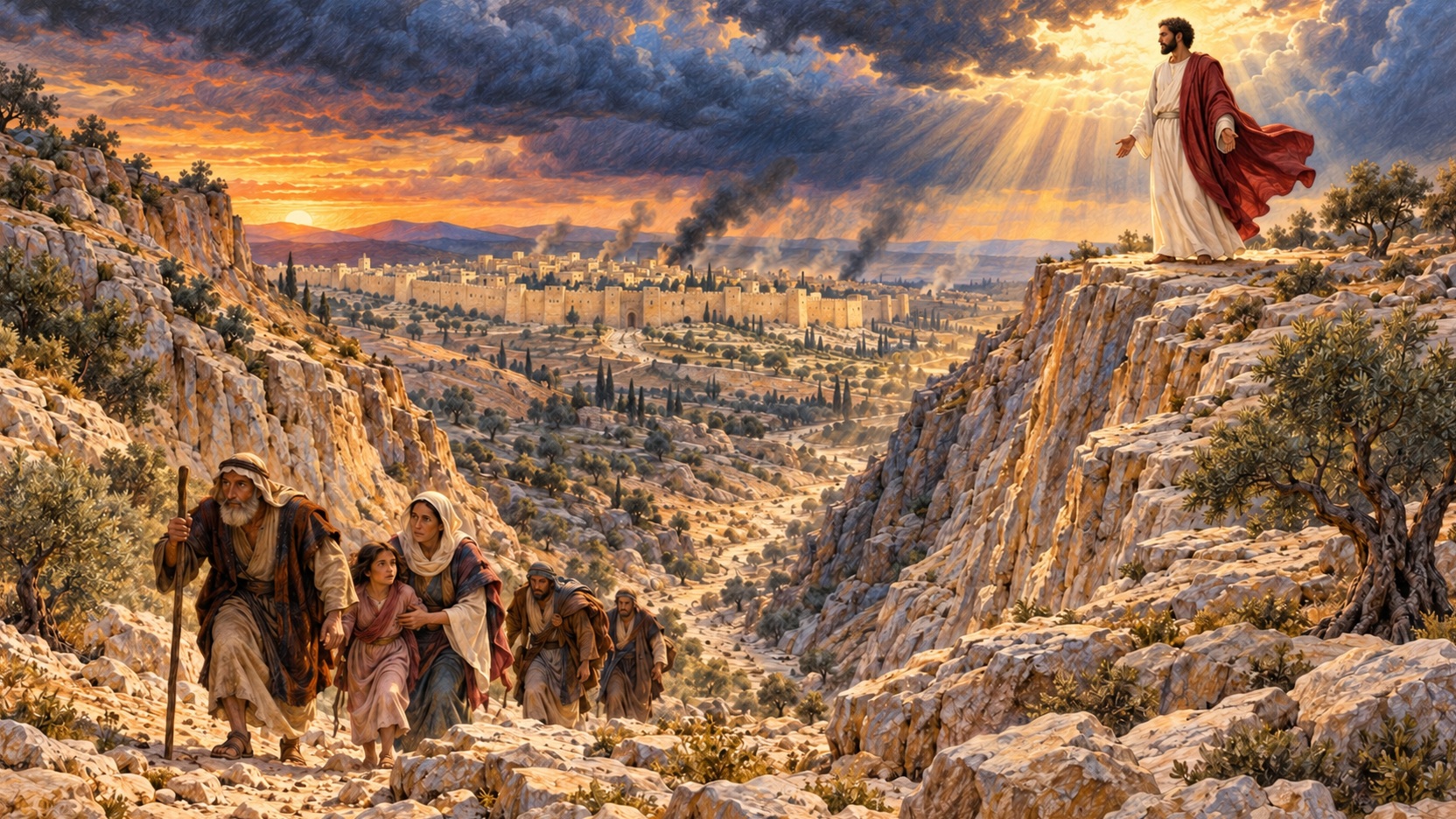
The Lord described people in Jerusalem who had become so complacent that they assumed He would do nothing about the way they lived. Through His prophet Zephaniah, He warned them that a day of judgment was approaching, and their wealth would not protect them when it came. They had mistaken His patience for indifference, but He had not forgotten what they were doing (Zephaniah 1:12–18).
The Day of the Lord Is God’s Appointed Time
When Scripture speaks of the Day of the Lord, it directs our attention to a time when God acts openly to judge evil and carry out His purpose. The Hebrew expression yom YHWH and the Greek expression hemera kyriou identify the day as belonging to Him. Neither expression, by itself, tells us how long the events being described will take.
That means I need to read what happens in the passage before deciding that the word day must mean twenty-four hours. Some prophets announce judgment upon a particular nation. Other passages describe events reaching as far as the passing away of the present heavens and earth. I understand the future Day of the Lord as a broader period in which He judges rebellion, establishes Christ’s promised rule, and brings the present order to its end.
The Great White Throne, where Revelation describes the final judgment of the unbelieving dead, belongs within that purpose. It does not account for everything Scripture says about the Day. To show you what I mean, let’s begin with the people the prophets addressed and then compare their warnings with the events described in the New Testament.
Zephaniah was speaking to Judah, the southern kingdom whose capital was Jerusalem, during King Josiah’s reign. These people belonged to the nation with which God had made His covenant, giving them His promises and His commands. Yet some worshiped other gods, some mixed worship of the Lord with allegiance to those gods, and others had stopped seeking Him at all (Zephaniah 1:1–6).
Their conduct toward one another reflected that departure. The Lord named violence and deceit, and He exposed the complacency of people who thought He would neither do good nor bring calamity upon them. They could accumulate property and money while assuming that no divine intervention would disturb their lives. Zephaniah answered that assumption with a warning about the Lord’s coming wrath.
“I will bring distress upon men, And they shall walk like blind men, Because they have sinned against the LORD; Their blood shall be poured out like dust, And their flesh like refuse.” Neither their silver nor their gold Shall be able to deliver them In the day of the LORD’s wrath; But the whole land shall be devoured By the fire of His jealousy, For He will make speedy riddance Of all those who dwell in the land.
The reason for the distress is stated in the passage: they had sinned against the Lord. Their gold could not undo that guilt, and their silver could not buy their way out of His judgment. The warning concerned real people and the land where they lived. Reading it only as a prediction for some distant generation would miss the confrontation Zephaniah was bringing to Judah.
But his book also carries the reader beyond that judgment. In Zephaniah 3:8–20, the Lord speaks of gathering nations for judgment, removing pride from His people, and leaving a humble remnant who trust Him. A remnant is the people He preserves from among those facing judgment. He promises to gather the scattered and dwell in their midst as Israel’s King, rejoicing over the people He has restored.
Judgment and restoration therefore belong together in the prophecy. God will deal with the rebellion that has corrupted His people, and He will keep His promises concerning their future. I do not think we should remove either part in order to make the book fit a simpler picture.
The nations outside Israel were also accountable to Him. Isaiah 10 describes Assyria’s king boasting as though his own strength had conquered the nations, and the Lord announces judgment upon that arrogance. Ezekiel 30 calls the coming judgment on Egypt a day of the Lord and names Nebuchadnezzar, Babylon’s king, as the one who would bring destruction there. Obadiah confronts Edom for its violence against Judah and its treatment of people trying to escape Jerusalem’s calamity. These warnings concern the conduct of named nations, not an undefined evil that has no place in history.
Babylon itself would also face the Judge who held those nations accountable. Isaiah 13 begins by identifying Babylon as the subject of the prophecy. It describes fear, destruction, and the Lord bringing down a proud power. Within that warning, God speaks about the reach of His judgment.
“I will punish the world for its evil, And the wicked for their iniquity; I will halt the arrogance of the proud, And will lay low the haughtiness of the terrible. I will make a mortal more rare than fine gold, A man more than the golden wedge of Ophir. Therefore I will shake the heavens, And the earth will move out of her place, In the wrath of the LORD of hosts And in the day of His fierce anger.
The people of Babylon could not preserve their power merely by possessing wealth or commanding armies. Later in the chapter, Isaiah names the Medes as a people God would stir up against them. The prophecy announces the downfall of the very kingdom whose glory and pride had seemed so impressive (Isaiah 13:17–19).
At the same time, the passage speaks of the world being punished for evil, of the heavens shaking, and of the earth moving from its place. I understand that wider language to reach beyond the defeat of one city. Babylon’s judgment points toward the Lord’s final confrontation with the proud world order that opposes Him. Its historical setting gives the warning substance, while its wider language prevents me from treating that one city’s fall as the end of everything Isaiah announces.
Prophecy can place nearer and more distant events beside one another without giving the length of every interval between them. That does not make the earlier warning unreal or the later promise less certain. It means we need the further revelation Scripture gives before trying to put all of those events in order.
Joel gives us another example. His opening chapter describes devastated crops, ruined vineyards, and animals without pasture. Locusts had consumed what the land produced, and grain and drink offerings had been cut off from the Lord’s house because the harvest had failed. The crisis affected food, livelihood, and the worship carried out by the priests (Joel 1).
Joel called the priests, elders, and people to gather and cry out to God. In chapter 2, the Lord called them to return with their whole hearts. Tearing a garment could express grief, but the Lord required a genuine turning within, rather than an outward display that left their relationship with Him unchanged. The promise that followed reached beyond the restoration of their fields to the outpouring of His Spirit.
“And it shall come to pass afterward That I will pour out My Spirit on all flesh; Your sons and your daughters shall prophesy, Your old men shall dream dreams, Your young men shall see visions. And also on My menservants and on My maidservants I will pour out My Spirit in those days. “And I will show wonders in the heavens and in the earth: Blood and fire and pillars of smoke. The sun shall be turned into darkness, And the moon into blood, Before the coming of the great and awesome day of the LORD. And it shall come to pass That whoever calls on the name of the LORD Shall be saved. For in Mount Zion and in Jerusalem there shall be deliverance, As the LORD has said, Among the remnant whom the LORD calls.
Peter quoted this passage at Pentecost, the Jewish feast when Jesus’ followers were filled with the Holy Spirit after His ascension. People in Jerusalem heard them declaring God’s works in languages the listeners recognized, and they asked what was happening. Peter stood with the other apostles and identified what they were witnessing with Joel’s promise (Acts 2:1–21).
That identification did not require every event Joel described to be completed on the same morning. Acts does not report the sun becoming dark and the moon becoming blood at Pentecost. The outpouring had begun, while the prophecy also looked toward wonders associated with the great and awesome Day of the Lord. I understand the fulfillment to unfold in stages, just as the passage brings those promises together without supplying the interval between them.
Joel also names people who might otherwise be overlooked. Sons and daughters would receive the Spirit, as would old people, young people, and servants. The promise was not reserved for rulers or the socially prominent. Alongside the warning of judgment stands the invitation to call on the Lord and be saved.
I want to retain both the invitation and the warning when teaching this passage. If I discuss the sun and moon while failing to tell a person that the Lord offers salvation, I have passed over something Joel plainly says. The people of every nation who need to hear about the coming judgment also need to hear how they may receive His mercy.
Zechariah describes another part of the future Day: the Lord intervening at Jerusalem and becoming King over the earth. He begins with the city’s suffering under an attack by the nations. The deliverance that follows is connected to what happens at that named place.
Behold, the day of the LORD is coming, And your spoil will be divided in your midst. For I will gather all the nations to battle against Jerusalem; The city shall be taken, The houses rifled, And the women ravished. Half of the city shall go into captivity, But the remnant of the people shall not be cut off from the city. Then the LORD will go forth And fight against those nations, As He fights in the day of battle. And in that day His feet will stand on the Mount of Olives, Which faces Jerusalem on the east. And the Mount of Olives shall be split in two, From east to west, Making a very large valley; Half of the mountain shall move toward the north And half of it toward the south. Then you shall flee through My mountain valley, For the mountain valley shall reach to Azal. Yes, you shall flee As you fled from the earthquake In the days of Uzziah king of Judah. Thus the LORD my God will come, And all the saints with You.
The account does not hide the suffering that precedes the Lord’s intervention. Houses are plundered, women are violated, and half the city goes into captivity. A remnant remains, and then the Lord goes out to fight the nations gathered against Jerusalem. His coming is the answer to their attack.
His feet stand on the Mount of Olives, the mountain east of Jerusalem, and it divides to form a valley through which people flee. Zechariah then describes living waters flowing from Jerusalem and the Lord being King over all the earth (Zechariah 14:8–9). I receive those promises as events involving the city and the land, rather than a picture of religion gradually gaining influence over society.
I understand this intervention as Christ’s bodily, visible return. Acts 1:9–12 records His disciples watching Him ascend into Heaven and then returning from the Mount of Olives. The messengers who spoke to them promised that the same Jesus would come again in the manner they had seen Him go. That connection helps me understand whose feet Zechariah describes standing upon the mountain.
The prophecy gives no date for us to calculate. It does give us the Lord’s promised action: He will deliver His people, defeat the gathered enemies, and establish His rule. We can take that promise seriously while allowing the other passages to explain what precedes and follows His arrival.
Christ Gathers His Church Before the Tribulation
I understand the future sequence to begin with Christ gathering His church before the Tribulation, a literal seven-year period of judgment upon the rebellious world. During that period, the ruler commonly called Antichrist will be exposed, and persecution will intensify. Jesus will then return visibly, overthrow that ruler, and establish His thousand-year reign.
Revelation carries the account beyond that reign to a final rebellion, its defeat, and the judgment of the unbelieving dead. God then brings His people into the new creation. Those events belong within His revealed purpose, but they do different things. Gathering believers to Christ is not the same occasion as raising unbelievers to face final judgment.
The kingdom and the Lake of Fire also need to remain distinct. The kingdom is Christ’s promised rule; the Lake of Fire is the place of final punishment. A broad understanding of the Day helps me see how the events belong together, but it does not give me permission to exchange one event for another. The apostle Paul’s description of the church’s gathering begins with a concern very different from the judgment of unbelievers: he is comforting a grieving church.
The believers at Thessalonica needed to understand what would happen to those among them who had died. Would death keep them from sharing in Christ’s coming? Paul answered by explaining what the Lord would do for the dead and for the believers still alive.
But I do not want you to be ignorant, brethren, concerning those who have fallen asleep, lest you sorrow as others who have no hope. For if we believe that Jesus died and rose again, even so God will bring with Him those who sleep in Jesus. For this we say to you by the word of the Lord, that we who are alive and remain until the coming of the Lord will by no means precede those who are asleep. For the Lord Himself will descend from heaven with a shout, with the voice of an archangel, and with the trumpet of God. And the dead in Christ will rise first. Then we who are alive and remain shall be caught up together with them in the clouds to meet the Lord in the air. And thus we shall always be with the Lord. Therefore comfort one another with these words.
Paul does not tell them that they must feel no sorrow. He gives them a reason why their sorrow does not have to be without hope. Jesus died and rose again, and He will raise those who belong to Him. Their death has not placed them beyond His promise.
Notice who acts and in what order. The Lord Himself descends from Heaven, and the dead in Christ rise first. Then the living believers are caught up together with them to meet Him in the air. They will always be with Him. The comfort rests on His ability to raise His people and bring them together, not on an inward feeling or the church’s ability to improve the world.
Paul calls the believers who have died those who sleep in Jesus. I understand that description in relation to their bodies awaiting resurrection. He does not teach that they have ceased to be conscious. In 2 Corinthians 5:6–8, he explains his confidence that being absent from the body means being present with the Lord. The future raising of the body completes a hope that already includes being with Christ after death.
The Greek verb translated as being caught up is harpazo, which describes seizing or taking away, as Thayer’s lexical entry explains. The English name Rapture comes through the Latin wording for that action. We can see rapiemur in the Latin text of 1 Thessalonians 4:17. Whatever English label we use, Paul describes an event in which the Lord gathers His people to Himself.
I believe this happens before the appointed worldwide Tribulation. That does not mean a Christian cannot suffer or be persecuted before that period begins. Jesus told His disciples that they would have tribulation in the world, and believers have suffered while remaining faithful to Him (John 16:33). The ordinary use of that word for affliction must be distinguished from the particular future period we are discussing.
I would not tell an afflicted Christian that a stronger faith would have kept every hardship away. That would turn the promise of future deliverance into an accusation against someone who may be suffering because of obedience. The hope of being gathered to Christ gives me a reason to comfort that person and help with the burden he or she is carrying.
Paul continues directly into the Day of the Lord in the next chapter. He describes its arrival as a thief in the night, and then contrasts the unprepared world with believers who belong to the light (1 Thessalonians 5:1–2).
For when they say, “Peace and safety!” then sudden destruction comes upon them, as labor pains upon a pregnant woman. And they shall not escape. But you, brethren, are not in darkness, so that this Day should overtake you as a thief. You are all sons of light and sons of the day. We are not of the night nor of darkness. Therefore let us not sleep, as others do, but let us watch and be sober. For those who sleep, sleep at night, and those who get drunk are drunk at night. But let us who are of the day be sober, putting on the breastplate of faith and love, and as a helmet the hope of salvation. For God did not appoint us to wrath, but to obtain salvation through our Lord Jesus Christ, who died for us, that whether we wake or sleep, we should live together with Him.
People will be speaking of peace and safety when destruction overtakes them. Their confidence will not stop what God has appointed. The thief image describes an arrival for which they are unprepared; it is not a hidden code through which a clever reader can calculate the date.
Paul tells believers that they are not in darkness and that God has not appointed them to wrath, but to salvation through Jesus Christ. I understand that assurance, following the promise of their gathering, to support the church’s removal before the Tribulation. Jesus’ promise to the faithful church in Philadelphia that He would keep it from the hour of trial coming upon the whole world also belongs with that understanding (Revelation 3:7–13).
Paul does not use the assurance to encourage carelessness. He calls them to watch and be sober, and he pictures faith and love as a breastplate and the hope of salvation as a helmet. Just as armor protects a soldier, those realities should govern how believers face the world. Knowing that we belong to Christ should keep us attentive to what He asks, rather than indifferent to how we live.
We can see that same relationship between assurance and obedience in Paul’s prayer for the church at Philippi. These believers had shared in the work of the gospel with him, including during his imprisonment. He thanked God for them and prayed that the work already begun in them would continue to bear fruit.
being confident of this very thing, that He who has begun a good work in you will complete it until the day of Jesus Christ; just as it is right for me to think this of you all, because I have you in my heart, inasmuch as both in my chains and in the defense and confirmation of the gospel, you all are partakers with me of grace. For God is my witness, how greatly I long for you all with the affection of Jesus Christ. And this I pray, that your love may abound still more and more in knowledge and all discernment, that you may approve the things that are excellent, that you may be sincere and without offense till the day of Christ, being filled with the fruits of righteousness which are by Jesus Christ, to the glory and praise of God.
His confidence that God would complete His work went together with a prayer for their love to grow in knowledge and discernment. They needed to recognize what was excellent and live in a way that honored Christ. Paul could be certain of God’s faithfulness while still caring deeply about the choices His people made.
Paul uses the expressions day of Jesus Christ, day of Christ, and day of our Lord Jesus Christ when speaking about believers’ completion, blamelessness, and hope. Here in Philippians, the emphasis is on God’s work in His people. In 1 Corinthians 1:4–9, Paul likewise thanks God for the grace given to believers and assures them of His faithfulness as they wait for Jesus.
I recognize the difference in emphasis between those passages and warnings of wrath upon the world. I would not, however, make the wording of a title alone into an inflexible rule for a prophetic calendar. We still need to read the surrounding passage. The same Christ completes His work in believers and judges rebellion, and each passage tells us which part of His work is being discussed.
His people will also answer to Him for their service. In 2 Corinthians 5, Paul explains that his confidence about being with the Lord gives him a reason to aim at pleasing Him now. He then names the judgment believers will face.
We are confident, yes, well pleased rather to be absent from the body and to be present with the Lord. Therefore we make it our aim, whether present or absent, to be well pleasing to Him. For we must all appear before the judgment seat of Christ, that each one may receive the things done in the body, according to what he has done, whether good or bad.
The Judgment Seat of Christ concerns His evaluation of the believer’s life and service. I distinguish that from the Great White Throne, where the unbelieving dead face final judgment. Christ’s evaluation does not put the gift of eternal life back on trial to determine whether we have done enough to keep it.
In 1 Corinthians 3:5–15, Paul compares the work he and Apollos, another teacher, have done among believers to planting, watering, and building. Christ is the foundation, and those who build must take care how they build upon it. Paul describes a person’s work being tested, with enduring work receiving reward and worthless work being lost. He even distinguishes the loss of work from the salvation of the person whose work is burned.
That explanation helps me understand why eternal security does not make service inconsequential. Someone who has received new life from God is a new creation, indwelt and sealed by the Holy Spirit. The believer is secure in Christ, but the Lord still evaluates what that person does with the life He has given (2 Corinthians 5:17; Ephesians 1:13–14).
Paul also says the Lord will bring hidden things to light and reveal the counsels of hearts (1 Corinthians 4:1–5). He knows the motive behind work that looks impressive to other people. I want to handle truth faithfully and treat people well because I will answer to Him, without imagining that either my usefulness or my reputation can purchase eternal life.
The Tribulation Ends With Christ’s Visible Return
The seven-year period comes from Daniel 9, where the prophet Daniel was praying about Israel’s sin and Jerusalem’s desolation. He had been reading Jeremiah’s prophecy concerning seventy years, and he appealed to God’s mercy on behalf of his people. While he prayed, the angel Gabriel came with a message concerning seventy weeks appointed for Daniel’s people and their holy city (Daniel 9:1–24).
The Hebrew word translated as week can identify a group of seven days or seven years. The Brown-Driver-Briggs entry identifies the use in Daniel 9 as periods of seven years. The prophecy first gives seven weeks and then sixty-two weeks leading to Messiah, God’s promised Anointed One. After those sixty-nine weeks, the Messiah is cut off, which I understand as a reference to Jesus’ death.
Daniel then describes a final week in which a coming ruler confirms a covenant with many and stops sacrifice and offering halfway through the period. I understand that ruler to be Antichrist and the final week to be still future. Its seven years are divided by that midpoint, when he violates the arrangement and brings desolation.
The title Antichrist identifies the ruler who opposes Christ while claiming an authority that belongs to God. Paul calls him the man of sin in 2 Thessalonians 2:3–4 and describes him exalting himself and presenting himself as God in the temple. His apparent power will not place him beyond Christ’s authority. Paul says the Lord will destroy him at His coming.
Revelation calls this ruler the beast. In John’s vision, the beast receives authority from Satan and makes war against the saints, the people who belong to God. Another figure, later called the false prophet, uses deceptive signs to direct worship toward the beast and its image. The mark on the hand or forehead is tied to that allegiance and to control over buying and selling (Revelation 13).
Those details explain why I would not identify the mark merely by pointing to a new invention or an unfamiliar payment system. The passage describes worship, deception, and a ruler’s demand for allegiance. Technology by itself does not establish that those events have occurred.
Although I place the church’s gathering before this period, Scripture still describes people turning to Christ during it. Revelation 7 names servants from the tribes of Israel and then shows a multitude from every nation before the throne. They are identified as people who have come out of the great tribulation and have been cleansed by the blood of the Lamb, Jesus Christ. Salvation remains through Him, not through surviving a crisis or resisting a ruler by human strength.
Faith will be costly for many of them. Revelation 6:9–11 describes people killed for God’s word and their testimony, asking how long it will be before He judges those who killed them. Revelation 13 describes the beast making war upon the saints, and chapter 20 later identifies believers killed for refusing his worship and mark. Their deaths do not mean their faith failed to obtain God’s salvation.
The judgments themselves are presented in an order. In Revelation 5, John sees a scroll closed with seven seals, and the Lamb is the One worthy to open it. In chapter 6, He begins opening those seals, and judgments follow. After the seventh seal is opened, seven angels are given trumpets in chapter 8. Chapters 15 and 16 then describe seven bowls of God’s wrath being poured out. I read these as ordered judgments that intensify, rather than repeated descriptions of ordinary events throughout history.
John’s visions use images, but the images describe God’s action against real rebellion. The sequence also includes His witnesses and people who remain faithful under opposition. In Revelation 11, two witnesses prophesy until their testimony is finished, and even their killing is followed by God raising them. In Revelation 16, people repeatedly refuse to repent despite what they suffer. The judgments expose a refusal of God’s authority, not a lack of opportunity to recognize it.
The end of Antichrist’s rule comes when Christ Himself appears. Revelation 19 first shows Heaven opened and a rider called Faithful and True. His name is the Word of God, and He bears the title King of kings and Lord of lords. The armies of Heaven follow Him, while earthly rulers gather to resist Him.
And I saw the beast, the kings of the earth, and their armies, gathered together to make war against Him who sat on the horse and against His army. Then the beast was captured, and with him the false prophet who worked signs in his presence, by which he deceived those who received the mark of the beast and those who worshiped his image. These two were cast alive into the lake of fire burning with brimstone. And the rest were killed with the sword which proceeded from the mouth of Him who sat on the horse. And all the birds were filled with their flesh.
The beast and the false prophet are captured and cast alive into the Lake of Fire. Their armies are killed. The rulers’ ability to gather forces against Christ does not give them the ability to prevent His reign, because the authority with which He comes is greater than theirs.
This is a different scene from the gathering Paul described in 1 Thessalonians 4. There, Christ raises His people and brings them together to meet Him in the air. Here, He comes with the armies of Heaven and overthrows those opposing His rule. I understand these as distinct events in the promised order, carried out by the same bodily risen Lord.
The Thousand-Year Kingdom Leads to Final Judgment
After the defeat of those rulers, Revelation 20 describes Satan being bound and confined so that he cannot deceive the nations for a thousand years. He is not yet cast into the Lake of Fire. John then describes the people who reign with Christ and what happens when that thousand-year period ends.
And I saw thrones, and they sat on them, and judgment was committed to them. Then I saw the souls of those who had been beheaded for their witness to Jesus and for the word of God, who had not worshiped the beast or his image, and had not received his mark on their foreheads or on their hands. And they lived and reigned with Christ for a thousand years. But the rest of the dead did not live again until the thousand years were finished. This is the first resurrection. Blessed and holy is he who has part in the first resurrection. Over such the second death has no power, but they shall be priests of God and of Christ, and shall reign with Him a thousand years. Now when the thousand years have expired, Satan will be released from his prison and will go out to deceive the nations which are in the four corners of the earth, Gog and Magog, to gather them together to battle, whose number is as the sand of the sea. They went up on the breadth of the earth and surrounded the camp of the saints and the beloved city. And fire came down from God out of heaven and devoured them. The devil, who deceived them, was cast into the lake of fire and brimstone where the beast and the false prophet are. And they will be tormented day and night forever and ever.
The duration is repeated, and the account gives us events on both sides of it. Satan is bound before the reign and released when the thousand years expire. Those who belong to the first resurrection live and reign with Christ, while the rest of the dead do not live again until afterward. Those stated boundaries give me reason to receive the thousand years literally.
Millennium is the name commonly used for that thousand-year reign. I understand it as Christ’s public rule on earth, following His return. It is not brought into existence when a church gains enough influence over a government. The King Himself establishes it after overthrowing the powers that oppose Him.
The passage particularly identifies people killed for their testimony and for refusing the beast. They live and reign with Christ, and the second death has no power over them. I understand the first resurrection as the resurrection to life shared by Christ’s people, with its participants raised in the order God has appointed. The church’s earlier gathering and the raising of these believers belong to that resurrection to life, while the resurrection of the unbelieving dead remains distinct.
That distinction is consistent with Paul’s explanation in 1 Corinthians 15:20–24 that resurrection has an order, with Christ first and those who belong to Him afterward at His coming. I do not make the word first in Revelation 20 mean that no believer could have been raised before the people John is describing here. The passage distinguishes their blessed resurrection from the later judgment and second death faced by the rest of the dead.
Christ’s government will be righteous and will fulfill His promises concerning Israel. Isaiah 11:1–10 describes the promised ruler from the family of Jesse, King David’s father. He judges the poor righteously, deals with wickedness, and brings peace even to the animal world. The earth is filled with the knowledge of the Lord. I understand those promises to describe the blessing of Christ’s rule over the world He made.
The reign also includes people living ordinary human lives. Zechariah 14:16 describes survivors from the nations going up year by year to worship the King. Isaiah 65:20–23 speaks of long life, houses, vineyards, and children, while still referring to death. I understand those conditions as belonging to the kingdom before the final state in which Revelation 21 says death will be gone altogether.
People born during that reign will therefore still need to trust Christ personally. Being born into a world governed righteously cannot give someone the new life that comes from God. This helps explain the seriousness of what happens when Satan is released. Nations become willing to follow him even after generations under the King’s just rule.
John calls the gathered nations Gog and Magog and describes their number as like the sand of the sea. They surround the camp of the saints and the beloved city, but their numbers do not bring victory. Fire comes down from God and devours them. The last rebellion ends because God ends it.
Satan is then cast into the Lake of Fire, where the beast and the false prophet already are. Revelation 20:10 explicitly says that these three will be tormented day and night forever. I receive that statement as it stands. I also keep its subjects clear, because the description that follows concerns a different group brought before God’s throne.
John now sees the unbelieving dead standing for judgment. The account includes Hades, the realm of the dead before final judgment, delivering up those who are in it. Hades is therefore not identical to the final Lake of Fire into which it is subsequently cast.
Then I saw a great white throne and Him who sat on it, from whose face the earth and the heaven fled away. And there was found no place for them. And I saw the dead, small and great, standing before God, and books were opened. And another book was opened, which is the Book of Life. And the dead were judged according to their works, by the things which were written in the books. The sea gave up the dead who were in it, and Death and Hades delivered up the dead who were in them. And they were judged, each one according to his works. Then Death and Hades were cast into the lake of fire. This is the second death. And anyone not found written in the Book of Life was cast into the lake of fire.
The Great White Throne follows the thousand-year reign and the final rebellion. The dead stand before God, whether they were important in the eyes of the world or scarcely noticed by anyone. Neither public reputation nor an obscure life can hide a person from the Judge.
The sea gives up its dead, and Death and Hades give up theirs. No circumstance of death prevents the resurrection God commands. The person whose remains could never be recovered is no less within His power to raise than the person whose burial place is carefully preserved.
I understand this as the judgment of unbelievers, distinct from Christ’s evaluation of the service of those who already belong to Him. Jesus said that the person who hears His word and believes has everlasting life and has passed from death into life. He also distinguished the resurrection of life from the resurrection of condemnation (John 5:24–29). The Great White Throne does not give the lost a new opportunity to earn salvation after death.
John distinguishes the books that record works from the Book of Life. The dead are judged according to their deeds, which brings the actual conduct of each person before God’s perfect knowledge. The judgment will be just. It does not offer an alternative gospel in which enough good deeds can replace faith in Christ.
The Book of Life concerns whether a person belongs among those who receive life. I understand every person to begin written in that book, and I read the warnings about being blotted out in that light. Those who finally reject the Messiah are blotted out, while believers remain because His blood has cleansed their sins. This is my understanding of how the passages fit together; Revelation 20 itself does not state when each name was first entered.
The language of blotting out appears earlier in Scripture. After Israel made and worshiped a golden calf, Moses asked God to forgive the people and even offered to be blotted out of God’s book himself. The Lord answered that He would blot out the one who sinned against Him (Exodus 32:30–35). In Psalm 69:19–28, the sufferer’s plea against persecutors includes their being removed from the book of the living and not written with the righteous.
Revelation 3:5 gives Christ’s promise that He will not blot out the name of the one who overcomes. In 1 John 5:1–5, John connects overcoming the world with being born of God and believing that Jesus is the Son of God. The victory comes through faith in Him. I therefore receive Christ’s promise as assurance for those who truly belong to Him, not a threat that His gift of new life may be revoked. The warnings about rejection and the promises to believers need to be read together. None makes the cleansing of sin unnecessary.
At the throne, John states the decisive outcome without leaving it open: anyone not found in the Book of Life is cast into the Lake of Fire. The person who has refused the Son’s cleansing stands accountable for sins that have not been forgiven. God’s knowledge of those sins is complete, and His verdict is final.
The Second Death Gives Way to a New Creation
Revelation calls this final outcome the second death. The first death does not prevent a person from being raised for judgment. The second death is the irreversible end that follows that judgment, and Scripture gives no further resurrection that undoes it.
Jesus spoke about the reach of God’s judgment when He prepared His disciples to face opposition. People could kill the body, but their authority did not extend as far as God’s. Jesus told His followers to fear the One who can destroy both soul and body in hell, using the term Gehenna for the place of final punishment (Matthew 10:24–28).
I understand that destruction to be real. Human beings do not possess an indestructible life independent of God. Paul identifies God as the One who alone has immortality, and he describes eternal life as God’s gift in Christ rather than as something every person naturally possesses (1 Timothy 6:15–16; Romans 6:23).
For that reason, I understand the lost to perish in the final judgment, with both body and soul destroyed. I do not understand their end as endless conscious torment. The punishment is everlasting because its result is permanent, not because the person receives everlasting life in order to suffer without end.
That conclusion does not mean people are unconscious between their first death and their resurrection. In Luke 16:19–31, Jesus describes a rich man who dies, is buried, and remains conscious in Hades while his brothers are still alive on earth. The man speaks of his suffering and asks that his brothers be warned. Whatever the length of that interval, it is different from the final judgment after the dead are raised.
Nor does final destruction mean that everyone will eventually be saved. Universal salvation would require the judgment to be reversed and the lost restored, whereas Revelation calls the outcome a second death. I keep that description alongside the specific statement of endless torment for Satan, the beast, and the false prophet, rather than changing one passage to make its subjects identical to those of the other.
The Day of the Lord also reaches beyond the judgment of people to the passing away of the present creation. Peter explains this while answering scoffers who ask why Christ has not returned. They assume that because things have continued for so long, the promise will not be fulfilled.
Peter answers by reminding them that the world has already experienced God’s intervention. The heavens and earth existed by His word, and the world was judged by the Flood in Noah’s time. The present heavens and earth are preserved by that same word until the appointed judgment. Their continued existence is therefore no proof that God cannot or will not act (2 Peter 3:1–7).
But, beloved, do not forget this one thing, that with the Lord one day is as a thousand years, and a thousand years as one day. The Lord is not slack concerning His promise, as some count slackness, but is longsuffering toward us, not willing that any should perish but that all should come to repentance. But the day of the Lord will come as a thief in the night, in which the heavens will pass away with a great noise, and the elements will melt with fervent heat; both the earth and the works that are in it will be burned up. Therefore, since all these things will be dissolved, what manner of persons ought you to be in holy conduct and godliness, looking for and hastening the coming of the day of God, because of which the heavens will be dissolved, being on fire, and the elements will melt with fervent heat? Nevertheless we, according to His promise, look for new heavens and a new earth in which righteousness dwells.
Peter’s comparison of one day and a thousand years explains why human expectations cannot measure God’s patience. It is not a formula for turning years into days so that someone can calculate Christ’s return. The Lord is not failing to keep His promise. His patience gives people an opportunity to repent.
The invitation is genuine. Peter says God is not willing that any should perish but that all should come to repentance. I do not treat that patience as permission to continue rejecting Him. The same passage that explains His patience also says that the Day will come and the present heavens and earth will pass away.
This is one of the clearest reasons I understand the Day as more than a single instant at the beginning of the Tribulation. Peter places the passing of the heavens and earth within it. Revelation 20:11 describes the earth and heaven fleeing away after the thousand-year reign, and chapter 21 then introduces the new heaven and new earth. Reading those accounts together, I understand the Day to encompass the completion of God’s judgment on the present order.
Peter’s response to that future is practical. Because these things will be dissolved, he asks what sort of people we ought to be now. His answer is holy conduct and godliness, while looking for the new heavens and new earth in which righteousness dwells. I should not become so interested in the destruction that I overlook the kind of life he says belongs with that hope.
John describes the promised future after seeing the old creation pass away. The holy city, New Jerusalem, comes down from God out of Heaven. He then hears what life with God will mean for His people.
And I heard a loud voice from heaven saying, “Behold, the tabernacle of God is with men, and He will dwell with them, and they shall be His people. God Himself will be with them and be their God. And God will wipe away every tear from their eyes; there shall be no more death, nor sorrow, nor crying. There shall be no more pain, for the former things have passed away.” Then He who sat on the throne said, “Behold, I make all things new.” And He said to me, “Write, for these words are true and faithful.” And He said to me, “It is done! I am the Alpha and the Omega, the Beginning and the End. I will give of the fountain of the water of life freely to him who thirsts. He who overcomes shall inherit all things, and I will be his God and he shall be My son. But the cowardly, unbelieving, abominable, murderers, sexually immoral, sorcerers, idolaters, and all liars shall have their part in the lake which burns with fire and brimstone, which is the second death.”
The announcement that God’s tabernacle is with humanity means that He will dwell with His people. The image is of His dwelling among them, and the passage goes on to describe the difference His completed work makes. Death, sorrow, crying, and pain will have passed away. The One on the throne makes all things new.
Those promises address the things that wound people now. A believer may die while waiting for justice, and a family may spend years grieving a loss, but neither death nor grief will govern the life God gives in His new creation. The promise rests on His faithfulness to bring about what He has announced.
His titles Alpha and Omega, the first and last letters of the Greek alphabet, are immediately explained as the Beginning and the End. He offers the water of life freely to the thirsty, and He promises an inheritance and a relationship with Him to the one who overcomes. The future belongs to the God who completes what He begins.
The invitation stands beside the warning about the second death. Grace is freely offered, but the passage does not say that the unbelieving enter the new creation while remaining in rebellion. We should receive the promise and the warning together, because God Himself gives both.
Watchfulness Means Faithful Living
When we put these passages together, the Day of the Lord includes more than the Great White Throne judgment. That judgment brings the unbelieving dead before God after the thousand-year reign, but the prophets also describe His intervention against rebellious nations, His deliverance of His people, and His rule as King. Peter carries the expectation through to the passing away of the present heavens and earth. The final court belongs within that larger work of judgment and restoration.
The earlier judgments help us understand that God acts in history, and the later prophecies tell us what He will yet complete. I understand the coming sequence to include Christ gathering His Church before the seven-year Tribulation, His visible return at its end, His thousand-year reign, the final rebellion and judgment, and the new creation. Each event has its own place and purpose. Keeping them distinct helps us understand the people and promises in each passage.
Even so, knowing where an event belongs on a chart is not the same as responding to what God has said. Paul’s teaching about the coming Day leads him to speak about faith, love, and the hope of salvation. Peter’s teaching about the passing of the present creation leads him to ask how we ought to live. The passages themselves show us what watchfulness should produce.
For a believer, that means continuing in the ordinary responsibilities Christ has given us. We pray, gather with other believers, show mercy to people who need help, and tell people the gospel. When someone makes a spiritual claim, we examine it by Scripture. When obedience costs us something, we remember that the Lord who will judge rightly has not lost sight of our circumstances.
I do not think every alarming event gives us permission to announce that a particular prophecy has just been fulfilled. A war, an election, an eclipse, a disease outbreak, or a new technology may raise questions that deserve careful examination. The event still has to fit what the passage actually says. Fear and excitement cannot supply the details that Scripture requires, and speculation should never take the place of the work Christ has already told us to do.
There is also comfort here for the person who has suffered injustice. God’s patience does not mean that He approves of what happened, any more than it meant that He approved of the corruption in Zephaniah’s Jerusalem. He will judge rightly. He will keep His promises to Israel, gather His Church, raise the dead, bring Satan’s rebellion to an end, and make all things new.
That does not promise that every wrong will be put right during our present lifetime. Some of the believers John sees were killed because they remained faithful to Christ. Their hope rests on the Lord who raises the dead and gives them a place in His kingdom. When we speak to someone who is suffering, we should give them that hope without promising an immediate change that God has not promised.
The same coming judgment makes the gospel an urgent matter. Jesus Christ is the eternal, uncreated Son of God. He took on humanity through the virgin birth, and He lived without sin. He then gave Himself willingly as the perfect sacrifice for our sins. His suffering was real bodily suffering, His blood was truly shed, and His death was real.
I do not understand that sacrifice as the Father turning against His Son. The Father did not punish, curse, abandon, strike, or bruise Jesus, and He did not pour His wrath upon Him. The Father and the Son remained united in the work of redemption. Jesus willingly gave His life for us, and His sacrificial work was complete before His body was placed in the tomb. He then rose bodily from the dead, which is why the hope of resurrection in this study rests on a living Savior.
His provision is for the whole world, and the invitation to receive Him is genuine. God’s grace can be resisted, but no one is excluded from coming to Christ because the offer was never meant for them. The response He calls for is repentance and faith: turning to Him from sin and trusting Jesus Christ to save us. Forgiveness and everlasting life are His gift, received by faith rather than earned through our works.
When a person truly comes to Christ, God gives that person new life. That is what I mean by regeneration, or the new birth. The believer becomes a new creation in Christ, and the Holy Spirit indwells and seals that person. The security of that life rests on God’s saving work and His promise, rather than on our ability to earn it or keep it by our performance (John 1:12–13; 2 Corinthians 5:17; Ephesians 1:13–14; 2:8–10).
That assurance is not permission to treat sin as harmless. The Lord who gives us life also calls us to obey Him. Our obedience grows out of that new relationship; it does not purchase the relationship or keep it in force. A profession of faith that leaves someone content to reject Christ’s authority should not be confused with the new life He gives.
A person can know a great deal about prophecy, attend church, and compare favorably with other people while still needing to come to Christ. None of those things cleanses us from sin. He does. We are not asked to become flawless before we may trust Him, but we are called to stop relying on ourselves and receive the Savior who gave His life for us.
If you have not received Him, His patience gives you an opportunity to respond now. If you belong to Him, the promise of His coming gives you a reason to continue in faith, comfort other believers, and live in the light He has given you. In both cases, the right response begins with taking Him at His word.
My Final Thoughts
The Day of the Lord shows us that God will not leave His creation under sin and rebellion forever. The judgments in Israel’s history demonstrated that His warnings were real, and the promises still awaiting fulfillment assure us that He will complete His purpose. Christ will gather His people, return to reign, judge the wicked, and bring His people into a creation where death and sorrow have passed away.
That is why I understand the Day as more than the final judgment before the Great White Throne. The passages have shown us God’s judgment and also His deliverance, His kingdom, and the new heavens and new earth. The distinction matters because the believer waiting to be gathered to Christ has been given a different promise from the person who continues to refuse Him.
I want that promise to shape the way I live now. His patience should move me to share the gospel, His coming judgment should keep me honest about sin, and His faithfulness should help me care for people who are still waiting for relief. I do not need to know the date of His return to do those things. I can trust the Lord who has told us how this ends and remain faithful to the work He has given us today.