
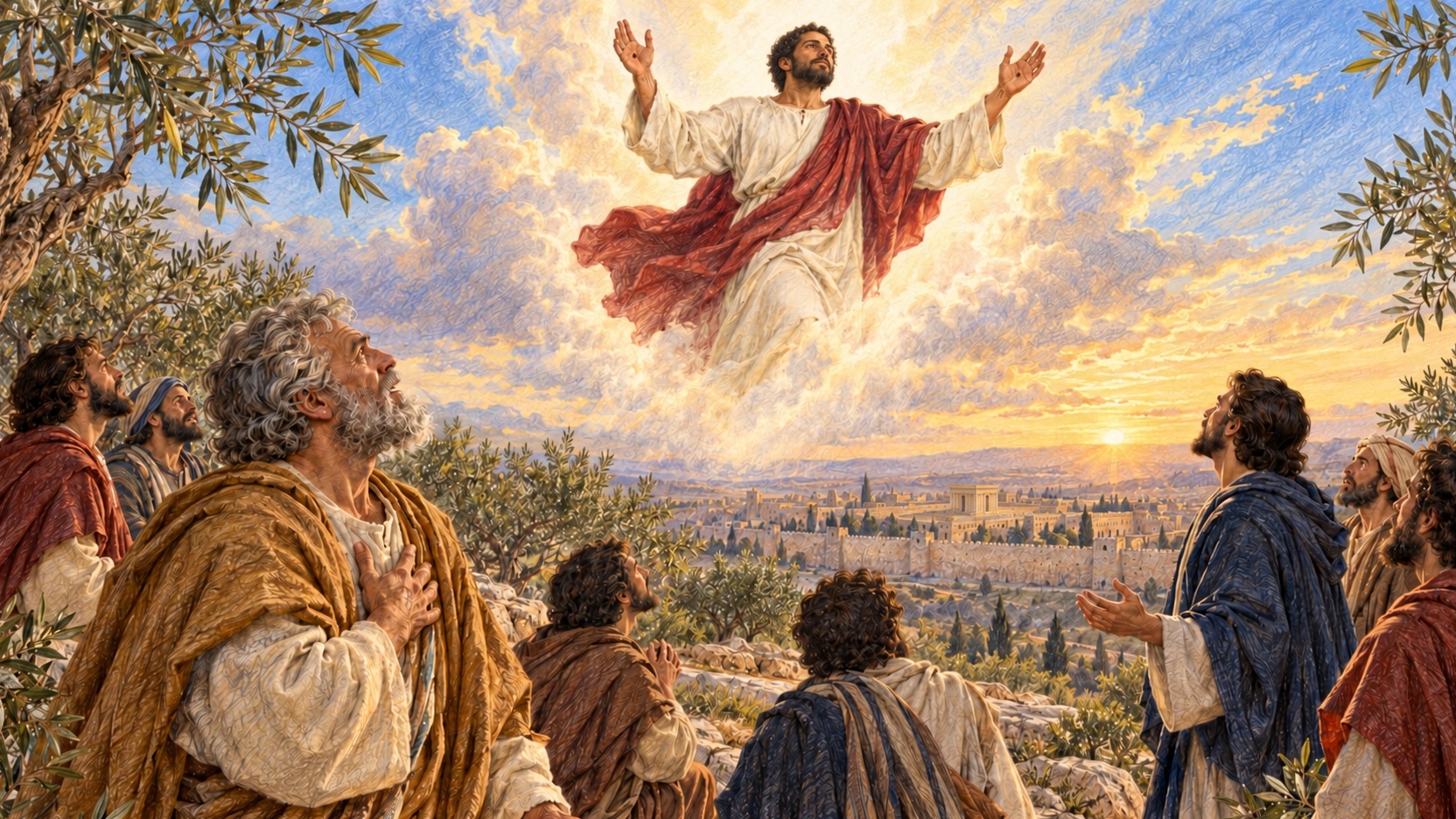
Jesus spent forty days with His disciples between His resurrection and ascension, giving them evidence they would later proclaim to the world. These were men who had struggled to believe the first reports that He was alive. As He met with them, He explained Scripture and prepared them to bear witness, including Peter, who had denied knowing Him.
Jesus Gave Forty Days of Bodily Proof
Therefore, when they had come together, they asked Him, saying, “Lord, will You at this time restore the kingdom to Israel?” And He said to them, “It is not for you to know times or seasons which the Father has put in His own authority. But you shall receive power when the Holy Spirit has come upon you; and you shall be witnesses to Me in Jerusalem, and in all Judea and Samaria, and to the end of the earth.” Now when He had spoken these things, while they watched, He was taken up, and a cloud received Him out of their sight. And while they looked steadfastly toward heaven as He went up, behold, two men stood by them in white apparel, who also said, “Men of Galilee, why do you stand gazing up into heaven? This same Jesus, who was taken up from you into heaven, will so come in like manner as you saw Him go into heaven.”
Luke tells Theophilus that Jesus presented Himself alive through many infallible proofs. The term translated as proofs describes convincing evidence, as Thayer’s entry for tekmerion explains. Luke then identifies the period as forty days, during which Jesus spoke about the kingdom of God. The apostles’ later testimony rested on repeated encounters with the risen Lord (Acts 1:1-11).
The Gospels and 1 Corinthians record selected appearances rather than a daily itinerary. We can follow the broad sequence without pretending to know the precise date or location of every meeting. Together, the accounts establish that the One who had been crucified was alive and preparing His disciples to testify about Him.
The body laid in the tomb had been raised. Jesus showed the disciples His wounds, invited them to handle Him, and ate in their presence. They were meeting their living Lord, not merely preserving His memory or interpreting a shared impression as a resurrection.
His risen body was physical and glorified, no longer subject to death. John says Jesus stood among the disciples while the doors were shut, but does not explain how He entered. The passage does not require us to conclude that His body passed through wood. Nor does their initial failure to recognize Him mean that His body was immaterial; His wounds and His invitation to touch Him establish otherwise.
Our hope also includes the resurrection and transformation of the body. Christ is the firstfruits, the beginning of the resurrection harvest. God’s promise for His people reaches beyond continued life after death to the raising of their bodies, patterned after the risen humanity of Jesus.
The Risen Jesus Met Doubt With Witness and Scripture
So they went out quickly from the tomb with fear and great joy, and ran to bring His disciples word. And as they went to tell His disciples, behold, Jesus met them, saying, “Rejoice!” So they came and held Him by the feet and worshiped Him. Then Jesus said to them, “Do not be afraid. Go and tell My brethren to go to Galilee, and there they will see Me.”
The women left the tomb with fear and great joy after hearing that Jesus had risen as He promised. They were hurrying to tell the disciples when He met them, and they held His feet and worshiped Him. The Lord they had come to seek among the dead was alive before them, accepting their worship and telling them not to be afraid. Matthew gives us a bodily encounter, with the women’s joy grounded in whom they had actually seen (Matthew 28:1-10).
Mark 16:9, in the received text, identifies Mary Magdalene as the first person to whom Jesus appeared. John describes her meeting in detail, while Matthew describes an encounter involving a group of women. Neither writer gives every movement of every person that morning. We need not force both descriptions into the same instant in order to receive them together.
Now when she had said this, she turned around and saw Jesus standing there, and did not know that it was Jesus. Jesus said to her, “Woman, why are you weeping? Whom are you seeking?” She, supposing Him to be the gardener, said to Him, “Sir, if You have carried Him away, tell me where You have laid Him, and I will take Him away.” Jesus said to her, “Mary!” She turned and said to Him, “Rabboni!” (which is to say, Teacher). Jesus said to her, “Do not cling to Me, for I have not yet ascended to My Father; but go to My brethren and say to them, ‘I am ascending to My Father and your Father, and to My God and your God.'” Mary Magdalene came and told the disciples that she had seen the Lord, and that He had spoken these things to her.
Mary initially assumed that someone had removed Jesus’ body. After Peter and the other disciple investigated the tomb and went home, she stood outside weeping because she did not know where He had been taken. Even when Jesus spoke to her, she supposed He was the gardener. Then He called her by name, and she recognized Him and answered, “Rabboni,” which John explains means Teacher. Her search for a missing body had brought her face to face with the living Lord (John 20:1-18).
His words, “Do not cling to Me,” cannot mean that every touch before the ascension was forbidden, because the women in Matthew held His feet and He later invited Thomas to examine His wounds. Jesus gave Mary a message to carry: He was going to the Father. I understand Him to be directing her onward rather than allowing her to hold on as though their former circumstances could simply resume. She was now to tell the disciples that she had seen Him, and John records that she did.
The women were entrusted with resurrection testimony, and Scripture honors their indispensable part in bringing it to the disciples. I would distinguish that witness from the church’s authoritative teaching office of elder, which Scripture assigns to qualified men. Recognizing that distinction should never diminish the testimony Jesus actually gave these women to bear.
Later that day, two other disciples were walking away from Jerusalem with questions the reports from the tomb had not resolved (Luke 24:13-35).
Then He said to them, “O foolish ones, and slow of heart to believe in all that the prophets have spoken! Ought not the Christ to have suffered these things and to enter into His glory?” And beginning at Moses and all the Prophets, He expounded to them in all the Scriptures the things concerning Himself. Then they drew near to the village where they were going, and He indicated that He would have gone farther. But they constrained Him, saying, “Abide with us, for it is toward evening, and the day is far spent.” And He went in to stay with them. Now it came to pass, as He sat at the table with them, that He took bread, blessed and broke it, and gave it to them. Then their eyes were opened and they knew Him; and He vanished from their sight. And they said to one another, “Did not our heart burn within us while He talked with us on the road, and while He opened the Scriptures to us?”
Cleopas and his companion explained why they were troubled: Jesus had been crucified, while they had hoped He would redeem Israel. They knew the women had reported an empty tomb and angels announcing that He was alive, but they had not understood how His suffering belonged to God’s promised deliverance. Their eyes were restrained from recognizing the One now walking beside them.
Jesus began with Moses and the Prophets, explaining the Scriptures concerning Himself. He showed these disciples that the Messiah’s suffering belonged to God’s purpose and would be followed by glory. They had to understand His death in light of all that God had said, including the suffering they had not expected. Their hope that He would redeem Israel needed that fuller understanding of Scripture.
They recognized Jesus when He broke the bread, after which He vanished from their sight. Luke does not identify this meal as the Lord’s Supper or say that the bread gave them saving grace, so I would not build a sacramental teaching on their recognition of Him at the table. They returned to Jerusalem that same hour, remembering how their hearts had burned while He opened the Scriptures. When they arrived, they heard that the Lord had also appeared to Simon and added their own testimony.
Luke’s closing passage begins with Jesus appearing to the gathered disciples that evening and carries the account forward to His ascension. Acts supplies the forty-day interval, so the whole passage should not be read as one uninterrupted evening (Luke 24:36-53).
And He said to them, “Why are you troubled? And why do doubts arise in your hearts? Behold My hands and My feet, that it is I Myself. Handle Me and see, for a spirit does not have flesh and bones as you see I have.” When He had said this, He showed them His hands and His feet. But while they still did not believe for joy, and marveled, He said to them, “Have you any food here?” So they gave Him a piece of a broiled fish and some honeycomb. And He took it and ate in their presence.
At that evening meeting in Jerusalem, the disciples were terrified because they thought they saw a spirit. Jesus showed them His hands and feet and invited them to handle Him, explaining that a spirit does not have flesh and bones as they could see He had. Luke then describes their joy and astonishment as they still struggled to believe what was before them. Jesus asked for food and ate in their presence, giving these frightened disciples further evidence that He was bodily alive.
He also opened their understanding of the Law of Moses, the Prophets, and the Psalms. They needed more than evidence that He was alive; they needed to understand His suffering and resurrection in the light of Scripture. Repentance and remission of sins, meaning forgiveness, were to be preached in His name to all nations, beginning at Jerusalem.
John gives further details of that first evening and a second meeting eight days later. Thomas had been absent when Jesus met the gathered disciples the first time, and he would not accept their testimony without examining Jesus’ wounds for himself (John 20:19-31).
Then He said to Thomas, “Reach your finger here, and look at My hands; and reach your hand here, and put it into My side. Do not be unbelieving, but believing.” And Thomas answered and said to Him, “My Lord and my God!” Jesus said to him, “Thomas, because you have seen Me, you have believed. Blessed are those who have not seen and yet have believed.” And truly Jesus did many other signs in the presence of His disciples, which are not written in this book; but these are written that you may believe that Jesus is the Christ, the Son of God, and that believing you may have life in His name.
Jesus met Thomas’s demand directly. John does not say that Thomas actually touched Him or fell to his knees. Thomas answered His call to believe with the confession, “My Lord and my God!” Jesus accepted that acknowledgment of His deity.
Jesus’ blessing on those who have not seen Him bodily does not commend believing without evidence or without knowing whom we trust. Later believers receive the apostles’ testimony, and John explains why he recorded these signs: readers can believe that Jesus is the Christ, the Son of God, and have life in His name. I do not need Thomas’s physical encounter in order to receive the witness God preserved through him and the other apostles.
Jesus Restored Peter and Appeared to Many Witnesses
So when they had eaten breakfast, Jesus said to Simon Peter, “Simon, son of Jonah, do you love Me more than these?” He said to Him, “Yes, Lord; You know that I love You.” He said to him, “Feed My lambs.” He said to him again a second time, “Simon, son of Jonah, do you love Me?” He said to Him, “Yes, Lord; You know that I love You.” He said to him, “Tend My sheep.” He said to him the third time, “Simon, son of Jonah, do you love Me?” Peter was grieved because He said to him the third time, “Do you love Me?” And he said to Him, “Lord, You know all things; You know that I love You.” Jesus said to him, “Feed My sheep. Most assuredly, I say to you, when you were younger, you girded yourself and walked where you wished; but when you are old, you will stretch out your hands, and another will gird you and carry you where you do not wish.” This He spoke, signifying by what death he would glorify God. And when He had spoken this, He said to him, “Follow Me.”
Seven disciples fished through the night at the Sea of Tiberias without catching anything. When they cast the net at Jesus’ direction, they caught 153 large fish, yet the net did not break. I take the number as a detail of the actual catch, consistent with the eyewitness character of John’s account. The passage gives no interpretation that would make it a hidden numerical code (John 21:1-19).
When the disciples reached the shore, Jesus had bread and fish waiting and invited them to breakfast. He provided a meal for the men who had fished all night before He spoke to Peter about his love and responsibility. His care for them extended to that ordinary need as well as to the remarkable catch.
Peter had denied knowing Jesus three times, and now Jesus asked three times about his love and repeatedly entrusted His sheep to Peter’s care. Peter grieved at the third question, yet Jesus was entrusting His people to him as He called him back to faithful service. I understand this as restoration before his companions, rather than a ritual in which three answers mechanically erased three denials.
That service would be costly. Jesus spoke of Peter being taken where he did not want to go, and John explains that He was indicating the death by which Peter would glorify God. Restoration did not come with a promise of safety or comfort. Knowing what lay ahead, Jesus still said to him, “Follow Me.”
Paul also preserves a summary of resurrection appearances while reminding the Corinthians of the gospel they had received.
Moreover, brethren, I declare to you the gospel which I preached to you, which also you received and in which you stand, by which also you are saved, if you hold fast that word which I preached to you–unless you believed in vain. For I delivered to you first of all that which I also received: that Christ died for our sins according to the Scriptures, and that He was buried, and that He rose again the third day according to the Scriptures, and that He was seen by Cephas, then by the twelve. After that He was seen by over five hundred brethren at once, of whom the greater part remain to the present, but some have fallen asleep. After that He was seen by James, then by all the apostles. Then last of all He was seen by me also, as by one born out of due time.
Christ died for our sins according to the Scriptures, was buried, and rose on the third day according to the Scriptures. Paul then names witnesses: Cephas, another name for Peter, followed by the Twelve as an established apostolic group. The designation does not require Judas to have been present.
More than five hundred believers saw Jesus at once, and Paul notes that most were still alive when he wrote. His claim concerned an event with living witnesses who could be consulted. Jesus also appeared to James, His brother, who had not believed during His earthly ministry but later became a leader in Jerusalem. Paul then names an appearance to all the apostles. Scripture does not give us enough information to place every one of these meetings on a precise day.
Some Corinthians were denying bodily resurrection, which would empty their professed faith of the very event the gospel announces. Paul’s warning about believing in vain calls them back to the message they had received and in which they stand. I do not read it as a threat that a genuinely born-again person can lose the new life Christ has given. A denial of the resurrection attacks the substance of the gospel, and Paul refuses to treat it as an inconsequential difference of opinion.
Paul’s own encounter with the risen Christ occurred later, after the ascension. He includes it here as the basis of his distinct apostolic witness. It does not belong within the forty days or make him Judas’s replacement among the Twelve.
The Risen Lord Taught the Kingdom and Commissioned His Church
During the forty days before His ascension, Jesus prepared His disciples to understand the kingdom and proclaim its King. Their question in Acts 1 was whether He would now restore the kingdom to Israel. Jesus told them that the times and seasons remained under the Father’s authority; He did not deny Israel’s future restoration. I understand His answer to withhold the timing while leaving God’s literal promises to Israel intact.
They would receive the Spirit’s power and bear witness from Jerusalem to the ends of the earth. The church neither replaces Israel nor establishes Christ’s promised kingdom through political conquest. Its responsibility is to announce Him and make disciples while awaiting the public reign He will establish. Earlier, at an appointed meeting in Galilee, Jesus had given them the commission Matthew records.
Then the eleven disciples went away into Galilee, to the mountain which Jesus had appointed for them. When they saw Him, they worshiped Him; but some doubted. And Jesus came and spoke to them, saying, “All authority has been given to Me in heaven and on earth. Go therefore and make disciples of all the nations, baptizing them in the name of the Father and of the Son and of the Holy Spirit, teaching them to observe all things that I have commanded you; and lo, I am with you always, even to the end of the age.” Amen.
On the appointed mountain in Galilee, the disciples worshiped Jesus, though Matthew also says some doubted. The verb distazo means to doubt or waver, as Thayer’s entry explains. Matthew neither identifies each doubter nor explains the precise cause of the hesitation. I would not turn his brief statement into a claim that some apostles had become settled opponents of the resurrection.
Jesus came near and declared His authority over heaven and earth. Their mission rested on that authority. They were to make disciples of all nations, baptizing believers in the name of the Father, Son, and Holy Spirit and teaching them to obey all He had commanded.
Making disciples requires us to care about what happens after someone professes faith. Those who believe are to be baptized and taught to obey Christ within the life of His church. Counting decisions while neglecting sound doctrine and continuing instruction leaves that work unfinished. Jesus’ promise to remain with His people through the end of the age gives us reason to persevere in it. Although He ascended bodily into heaven, He continues to work among us through His Spirit and Word.
I receive Mark 16:9-20 as part of the Textus Receptus, or received Greek text, and the Byzantine manuscript tradition. In this passage, Jesus rebukes unbelief, sends His disciples to preach throughout the world, and then is received into heaven. As with Luke’s closing account, Mark brings the commission and ascension together without giving a daily chronology.
Later He appeared to the eleven as they sat at the table; and He rebuked their unbelief and hardness of heart, because they did not believe those who had seen Him after He had risen. And He said to them, “Go into all the world and preach the gospel to every creature. He who believes and is baptized will be saved; but he who does not believe will be condemned. And these signs will follow those who believe: In My name they will cast out demons; they will speak with new tongues; they will take up serpents; and if they drink anything deadly, it will by no means hurt them; they will lay hands on the sick, and they will recover.” So then, after the Lord had spoken to them, He was received up into heaven, and sat down at the right hand of God. And they went out and preached everywhere, the Lord working with them and confirming the word through the accompanying signs. Amen.
Belief and baptism belong together as faith and its expected public expression. Mark 16:16 names unbelief as the ground of condemnation. It does not teach that water produces salvation. The thief saved beside Jesus had no opportunity for baptism, and Scripture teaches justification through faith apart from works. We should obey the command to baptize believers without making baptism the means by which they are born again.
The accompanying signs confirmed the word as the apostles carried it outward. These descriptions do not command believers to handle snakes or drink poison as a test of faith. I believe the gifts of the Spirit continue, but that does not mean every believer must perform a miracle to prove that he belongs to Christ. The tongues were actual spoken languages, and they are not required of every Christian. We must test claims about spiritual gifts by Scripture rather than accept an impressive claim as proof of the Spirit’s work.
Before beginning the witness Jesus had assigned them, the apostles were to remain in Jerusalem for the Father’s promise. John had baptized with water, but they would shortly be baptized with the Holy Spirit. Pentecost fulfilled that promise in the public beginning of the church. Their responsibility was to obey and wait for what God had promised; no private technique could produce the Spirit’s coming.
Every true believer is indwelt and sealed by the Holy Spirit at salvation. He is a divine Person who gives new life and empowers obedience, and we should seek His filling as we submit to His written Word. We do not need a second experience to become saved or establish that we belong to Christ. A strong feeling, however memorable, cannot take the place of understanding and believing the gospel.
The Bodily Ascension Established Christ’s Present Ministry
Before Pentecost, the disciples watched Jesus depart from the Mount of Olives. Luke places His departure as far as Bethany, while Acts says they returned from the Mount of Olives. Bethany lies on the eastern side of that mount, so the descriptions fit naturally together. Neither book identifies a modern shrine or gives the exact spot from which He ascended.
Jesus lifted His hands and blessed the disciples. While they watched, He was taken up and a cloud received Him from their sight. The same Lord who had shown His wounds and eaten with them was ascending bodily into heaven. This was an event they witnessed, not a metaphor for His influence continuing after death.
The cloud recalls the scriptural pattern of God’s presence at Sinai, the tabernacle, the temple, and the Transfiguration. Daniel 7 also portrays the Son of Man coming with clouds to receive dominion. Those connections are fitting to Christ’s glory, but they do not explain the cloud as a vehicle or map the geography of heaven. The messengers directed the disciples toward Jesus’ promised return and the responsibilities He had given them.
The disciples worshiped Jesus and returned to Jerusalem with great joy, continuing together in prayer as they awaited the Father’s promise. Their response fits what had happened: Jesus had not been taken from them by death again. He had risen, blessed them, and gone to the Father as He said He would.
The eternal Son did not become divine at the ascension or leave His humanity behind. In the incarnation He took human nature, becoming fully man while remaining fully God. He rose and ascended as the God-man, and His humanity was not a temporary condition that ended when He returned to the Father. He remains our one Mediator, the One through whom we approach the Father.
His sacrifice for sin was complete, but His ministry to His people continues. From heaven He reigns, sends the promised Spirit, intercedes for believers, and supplies what they need as He builds His church. Peter explained the connection between Christ’s exaltation and the Spirit’s coming at Pentecost.
This Jesus God has raised up, of which we are all witnesses. Therefore being exalted to the right hand of God, and having received from the Father the promise of the Holy Spirit, He poured out this which you now see and hear. “For David did not ascend into the heavens, but he says himself: ‘The LORD said to my Lord, “Sit at My right hand, Till I make Your enemies Your footstool.”‘ “Therefore let all the house of Israel know assuredly that God has made this Jesus, whom you crucified, both Lord and Christ.”
Peter announced that the crucified Jesus had been raised and exalted to God’s right hand. He used Psalm 110 to identify Him as the Lord whose enemies would become His footstool. The right hand expresses supreme honor and authority; it does not make the Son a lesser deity. Father and Son remain distinct Persons, co-equal within the one God.
When Peter says God “made” Jesus Lord and Christ, he is speaking of the incarnate Son’s exaltation to His promised messianic rule. The Father did not create the Son or make Him divine at Pentecost, for the Son is eternally God. Peter is announcing that the Jesus whom his hearers had crucified now holds the place of honor and authority promised in the Psalm. God has publicly declared and installed the crucified and risen Jesus as the Lord and Messiah Peter proclaims.
Christ’s present session means His position of rule at the Father’s right hand. He is Lord and Christ now, even while we await His public reign on earth. The church therefore serves under His authority, whatever strength an earthly ruler may possess. Rulers can oppose His people, but neither they, death, nor demonic powers can remove Him from that position. His endless life also means that His priestly ministry can never be cut short by death, as Hebrews explains.
Also there were many priests, because they were prevented by death from continuing. But He, because He continues forever, has an unchangeable priesthood. Therefore He is also able to save to the uttermost those who come to God through Him, since He always lives to make intercession for them. For such a High Priest was fitting for us, who is holy, harmless, undefiled, separate from sinners, and has become higher than the heavens; who does not need daily, as those high priests, to offer up sacrifices, first for His own sins and then for the people’s, for this He did once for all when He offered up Himself. For the law appoints as high priests men who have weakness, but the word of the oath, which came after the law, appoints the Son who has been perfected forever.
Paul, the author of Hebrews, contrasts priests whose service ended at death with Jesus, who lives forever. His priesthood is permanent and does not pass to a successor. The wording is explained in Thayer’s entry for aparabatos. Because He always lives to intercede for those who come to God through Him, He saves them completely.
Intercession is Christ’s continuing ministry on behalf of those who come to God through Him. It does not mean that the cross was insufficient or that He must offer another sacrifice in heaven. Our holy High Priest offered Himself once for all, and we depend on that completed sacrifice and His endless life. Other believers can pray for us, but no saint, earthly priest, or religious institution can share or replace His unique work as our Mediator.
The Ascended Jesus Will Gather His Church and Return to Rule
But I do not want you to be ignorant, brethren, concerning those who have fallen asleep, lest you sorrow as others who have no hope. For if we believe that Jesus died and rose again, even so God will bring with Him those who sleep in Jesus. For this we say to you by the word of the Lord, that we who are alive and remain until the coming of the Lord will by no means precede those who are asleep. For the Lord Himself will descend from heaven with a shout, with the voice of an archangel, and with the trumpet of God. And the dead in Christ will rise first. Then we who are alive and remain shall be caught up together with them in the clouds to meet the Lord in the air. And thus we shall always be with the Lord. Therefore comfort one another with these words.
Paul addresses believers who are grieving for those who have died, and his comfort is that death will not exclude their loved ones in Christ from His coming. The Lord Himself will descend from heaven, the dead in Christ will rise first, and living believers will be caught up together with them to meet Him in the air. Their hope rests on what Jesus will do: raise His people, bring them together, and keep them with Him forever. Paul does not forbid their sorrow; he gives them a reason to grieve with hope.
The phrase “sleep in Jesus” refers to believers whose bodies have died. It does not teach that the person has ceased to exist consciously between death and resurrection. The believer is with Christ while awaiting the resurrection and transformation of the body.
I understand Scripture to place this gathering before the literal seven-year Tribulation. At this gathering, believers meet the Lord in the air; His later visible return brings Him to earth to rule. I distinguish these events within the prophetic order, while recognizing that the same bodily Lord is central to both. Revelation describes the public return with the clouds in terms that reach beyond the gathering of His church.
Behold, He is coming with clouds, and every eye will see Him, even they who pierced Him. And all the tribes of the earth will mourn because of Him. Even so, Amen.
After the Tribulation, Christ will return bodily and visibly with clouds. Every eye will see Him, and the nations will face the pierced King as He overthrows rebellious power. He will establish His literal thousand-year reign on earth. That promised rule cannot be reduced to the church’s present influence, an inward spiritual experience, or a program of social improvement.
The messengers in Acts promised the return of the same Jesus in the manner the disciples saw Him go. That bodily Lord will come from heaven. He will neither be reincarnated nor be replaced by an institution, and His promised return cannot be reduced to a symbol for His continuing influence.
The question, “Why do you stand gazing?” sent the witnesses back to His instructions. They were to return to Jerusalem, wait for the Spirit, and then testify. It did not forbid hope in His return or careful study of prophecy. They needed to obey what He had told them rather than remain on the hillside staring.
That obedience continues in the church as we worship and pray together, grow in holiness, show mercy, and carry the gospel to others. When people believe, we baptize them and teach what Christ commanded. Patient teaching and care for others are part of how we wait for Him. Setting dates or pursuing sensational claims about clouds draws our attention away from what He has told us to do.
The message we carry rests on the work of the eternal Son, fully God and fully man, born of a virgin and without sin. He willingly gave Himself to be slain as the perfect sacrifice for our sins; His atonement rests on His perfection and that sacrifice. Wicked men inflicted real bodily suffering as they tortured and crucified Him, and He shed His innocent blood and died. His saving sacrifice through His blood and death was complete before His burial, and He then rose bodily from the dead. The Father did not punish, curse, abandon, strike, bruise, or pour wrath on Jesus; Father and Son remained united in redemption. His resurrection vindicates His identity and shows that death did not defeat Him.
The risen Lord sent His witnesses to the nations because His saving provision is for the whole world. God’s offer is genuine, though people can resist His grace and reject Him. Everyone who repents and believes is forgiven and justified, meaning declared righteous before God. Through regeneration, or genuine new birth, that person is made new, indwelt by the Holy Spirit, and sealed as eternally secure. Obedience follows as evidence of that new life; it neither earns salvation nor keeps us saved. Security gives no permission for lawlessness, and an empty profession of faith does not establish that someone has been born again. Baptism follows salvation as a public identification with Christ’s death and resurrection, which is why the church baptizes those who believe the message it proclaims.
My Final Thoughts
The witnesses who first struggled to believe that Jesus had risen were given repeated encounters with Him and an understanding of the Scriptures they would proclaim. Peter was restored to service, but he was also told that following Jesus would cost him his life. I need to receive their testimony with that seriousness. The Lord they saw is bodily alive in heaven, interceding for His people and directing His church. I can wait confidently for Him to gather us and return to rule, while giving my attention to the people who need His gospel now. His ascension leaves us with work to do under His authority and with His promised presence.