
What does it mean to have faith when our feelings are weak or our circumstances do not improve? Scripture does not describe faith as a force that creates whatever we want, nor does it make our works the price of salvation. I want to understand how we can come to Christ with nothing to offer and then learn to obey Him, with our confidence resting in the Savior rather than in ourselves.
What Faith Means and Who It Trusts
The Greek noun pistis can describe faith or trust, though a particular sentence may use it for belief or faithfulness. It can also name the body of truth Christians believe, the faith. Its related verb, pisteuo, means to believe or trust. Understanding these words helps us read the passages accurately, but I still need to follow the sentence and its larger argument to know which meaning fits.
Faith always involves trusting someone or something. A person can sincerely believe a false report and still be wrong, so the intensity of our confidence does not give it spiritual power. Biblical faith receives what the truthful God has revealed. When we speak of saving faith, we mean trust specifically in Jesus Christ and His gospel.
Nor does pistis require an emotion that never trembles. Trust can begin weak and grow as it is tested. I do not have to produce a flawless feeling for Christ to save me, because faith’s saving value lies in Him.
In the Old Testament, the Hebrew noun emunah often means firmness or faithfulness. Habakkuk 2:4 contrasts the proud person with the just person who lives by faith. The just person’s confidence would not make Babylon disappear or move the vision ahead of its appointed time. He had to trust the faithful God and continue faithfully while he waited.
Paul later cites Habakkuk while explaining justification by faith. Hebrews uses the same passage to call believers to endure. I do not see those uses competing with one another. Both grow from a setting in which God’s reliable word sustains a person who must wait.
We also need to distinguish believing from what we believe. Jude speaks of the faith once delivered to the saints, whereas the Gospels call individuals to believe in Christ. My response to Him is personal, but I am not free to invent the Person I trust. He is the living Savior publicly revealed in the gospel of His death and bodily resurrection.
Hebrews 11 develops this trust by calling faith the substance of things hoped for and the evidence of things not seen.
Now faith is the substance of things hoped for, the evidence of things not seen. For by it the elders obtained a good testimony. By faith we understand that the worlds were framed by the word of God, so that the things which are seen were not made of things which are visible. By faith Abel offered to God a more excellent sacrifice than Cain, through which he obtained witness that he was righteous, God testifying of his gifts; and through it he being dead still speaks. By faith Enoch was taken away so that he did not see death, “and was not found, because God had taken him”; for before he was taken he had this testimony, that he pleased God. But without faith it is impossible to please Him, for he who comes to God must believe that He is, and that He is a rewarder of those who diligently seek Him.
I understand Paul to be the author of Hebrews. Here he describes trusting God now for what He has promised in the future. The nouns translated substance and evidence can convey assurance, conviction, or proof. The unseen God has spoken and acted, so faith has something to respond to. It does not bring a promise into existence by imagining it.
Abel and Enoch responded to God’s word, as did Noah, Abraham, and Sarah. What they did depended on what God had told them. Noah prepared an ark after receiving a warning, while Abraham left when God called him. Sarah judged the One who promised to be faithful. As I follow those examples, I cannot make by faith a technique for getting whatever a person chooses.
Verse 6 calls us to believe that God exists and to trust His character as the rewarder of those who diligently seek Him. Acknowledging some deity is not the full response described here. Hope in this chapter is more than a wish because it looks toward what God has promised but has not yet brought into sight. That helps me understand why these people could obey at great cost without seeing the whole promise fulfilled during their lives.
Who we trust is therefore essential to saving faith. Jesus is the eternal Son, fully God and fully man. Born of a virgin, He remained completely sinless. Wicked men crucified Him, but He rose bodily. He alone is the Savior and Mediator we receive by faith.
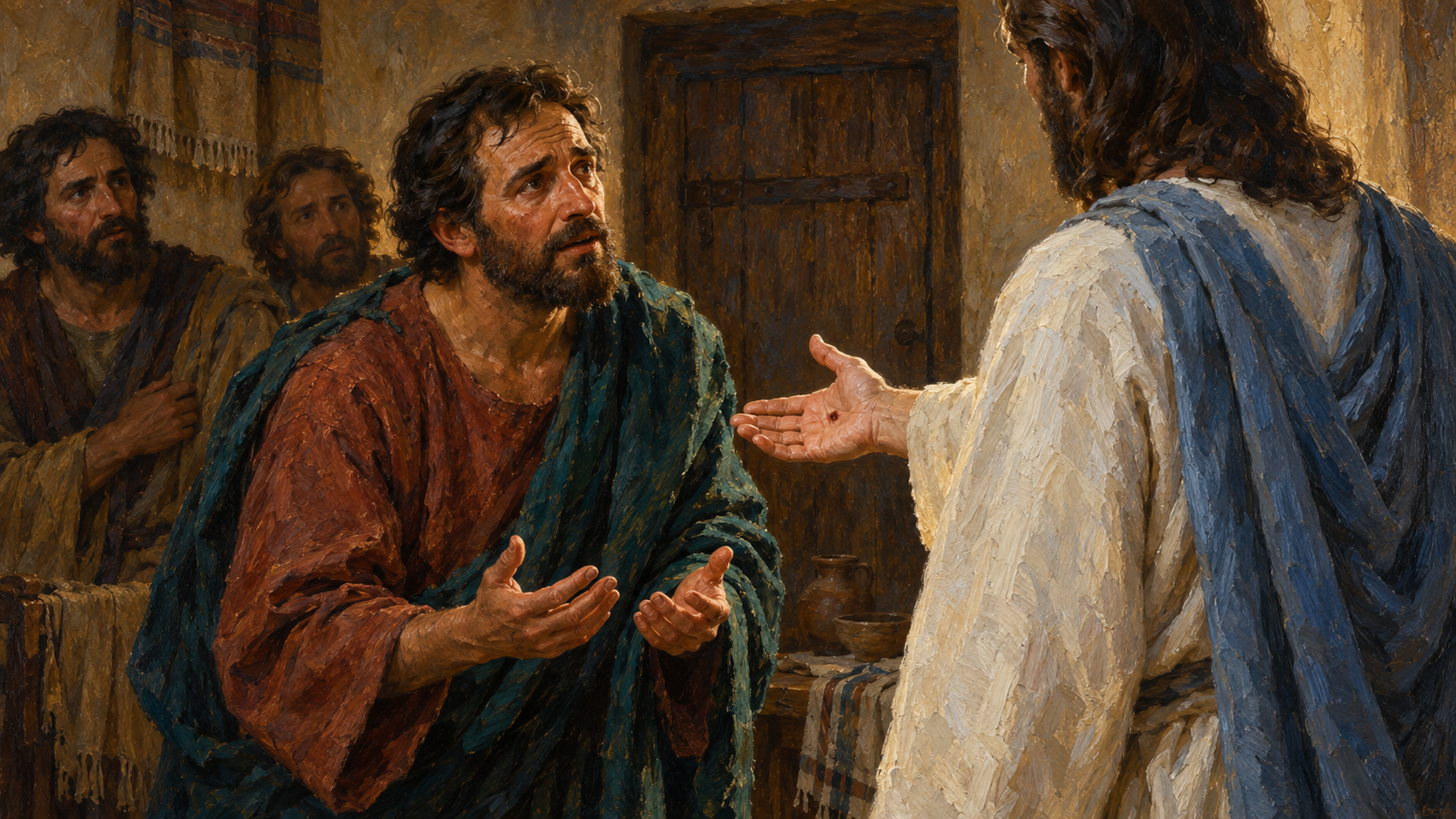
Thomas struggled with the report of the resurrection. When Jesus appeared to him, Thomas confessed Christ as both Lord and God. John then explained why he recorded the signs in his Gospel.
Now Thomas, called the Twin, one of the twelve, was not with them when Jesus came. The other disciples therefore said to him, “We have seen the Lord.” So he said to them, “Unless I see in His hands the print of the nails, and put my finger into the print of the nails, and put my hand into His side, I will not believe.” And after eight days His disciples were again inside, and Thomas with them. Jesus came, the doors being shut, and stood in the midst, and said, “Peace to you!” Then He said to Thomas, “Reach your finger here, and look at My hands; and reach your hand here, and put it into My side. Do not be unbelieving, but believing.” And Thomas answered and said to Him, “My Lord and my God!” Jesus said to him, “Thomas, because you have seen Me, you have believed. Blessed are those who have not seen and yet have believed.” And truly Jesus did many other signs in the presence of His disciples, which are not written in this book; but these are written that you may believe that Jesus is the Christ, the Son of God, and that believing you may have life in His name.
We cannot inspect the empty tomb with our own eyes as those first witnesses could, but we can receive their testimony preserved in Scripture. John selected these signs so his readers could believe that Jesus is the Christ and the Son of God. I do not understand that as a call to believe without evidence. Historical facts cannot force the new birth through an intellectual argument, yet we have no reason to treat them as irrelevant. Eyewitness testimony and fulfilled Scripture are part of the witness God gave us.
The apostolic witness also gives us a way to recognize counterfeit christs. Sincerity will not save someone through a message that denies Jesus’ deity or sinlessness. The same is true of a message that rejects His bodily resurrection or His exclusive authority to save. We must trust the Son proclaimed by the apostles rather than redesign Him around what we would prefer to hear.
Justified by Faith Apart From Works
Romans 3 begins with a problem none of us can solve by improving our record. Everyone has sinned, so none of us can present a moral record that obligates God to declare us righteous.
But now the righteousness of God apart from the law is revealed, being witnessed by the Law and the Prophets, even the righteousness of God, through faith in Jesus Christ, to all and on all who believe. For there is no difference; for all have sinned and fall short of the glory of God, being justified freely by His grace through the redemption that is in Christ Jesus, whom God set forth as a propitiation by His blood, through faith, to demonstrate His righteousness, because in His forbearance God had passed over the sins that were previously committed, to demonstrate at the present time His righteousness, that He might be just and the justifier of the one who has faith in Jesus. Where is boasting then? It is excluded. By what law? Of works? No, but by the law of faith. Therefore we conclude that a man is justified by faith apart from the deeds of the law.
God’s righteousness comes through faith in Jesus Christ, and He freely gives justification through the redemption found in Him. To be justified is to be declared righteous by God, and that declaration comes by grace. I have nothing to boast about when I receive a gift. Faith does not become a disguised work simply because I must receive what Christ gives.
Works of the Law and attempts at moral improvement cannot add merit to Christ’s saving work. Neither Baptism nor Communion can save, and church membership or generous giving cannot contribute to redemption. Even intense religious emotion adds no merit to what Christ has done. The Law exposes sin, but it cannot supply the righteousness it requires.
Paul places Jews and Gentiles together as guilty people who need grace. When God freely justifies the believer, neither ethnic privilege nor ceremonial achievement gives anyone a claim on Him. Comparing myself with another sinner will not make me righteous either. I must come empty-handed because Christ alone supplies redemption.
Wicked men physically tortured and punished Jesus before killing Him, and He willingly bore that real punishment for our sins in His innocent body. He shed His blood and died, was buried, and rose bodily. The Father did not punish or curse His Son. He did not abandon Jesus or strike or bruise Him, and He did not pour wrath upon Him.
Jesus’ call to repent and believe belongs inside this gracious offer.
Now after John was put in prison, Jesus came to Galilee, preaching the gospel of the kingdom of God, and saying, “The time is fulfilled, and the kingdom of God is at hand. Repent, and believe in the gospel.”
When a sinner turns to Christ, repentance and faith belong together even though we can distinguish them. In repentance, we turn from rebellion and agree with God’s verdict; in faith, we trust the good news and the Savior it announces. This does not mean cleaning ourselves up enough for Christ to accept us. Repentance requires neither penance nor self-punishment, and it is not a promise never to stumble again. We come as guilty sinners to receive the forgiveness His blood purchased.
Christ died for the whole world, and His offer is genuine even though people can resist and reject it. That is why I reject Calvinist limited atonement and irresistible grace as false. Receiving salvation still gives us nothing to boast about, because the gift is entirely God’s.
Romans 10 brings heart belief and spoken confession together around the risen Lord.
But what does it say? “The word is near you, in your mouth and in your heart” (that is, the word of faith which we preach): that if you confess with your mouth the Lord Jesus and believe in your heart that God has raised Him from the dead, you will be saved. For with the heart one believes unto righteousness, and with the mouth confession is made unto salvation. For the Scripture says, “Whoever believes on Him will not be put to shame.” For there is no distinction between Jew and Greek, for the same Lord over all is rich to all who call upon Him. For “whoever calls on the name of the LORD shall be saved.”
Confessing Jesus as Lord means openly agreeing with His identity and authority. Paul is not making confession a second act that earns salvation, as though the right syllables could save someone who does not trust Christ. Genuine faith is willing to identify with Him, though a frightened new believer may need time to grow in courage.
Everyone who calls on the Lord is included in this promise. Ethnicity does not restrict access, and the offer is not reserved for a secret class. Paul goes on to say that faith comes by hearing God’s word, which tells me what evangelism needs to provide: an understandable account of who Jesus is and what He has done. Emotional pressure and music cannot supply that message. Neither can repeated phrases or an invitation formula take the place of gospel truth.
That brings me to the person who believes yet struggles with doubt. If genuine faith could never waver, how would we understand Jesus calling His disciples people of little faith? Thomas doubted before confessing Christ, and a desperate father cried, “Lord, I believe; help my unbelief!” These examples show faith that needed help rather than confidence that never faltered.
We should bring doubt into the light and seek answers from Scripture rather than cultivate it as a virtue. But an honest question or fearful feeling does not by itself prove that someone is unsaved. The Savior can hold the person whose faith is weak. On the other hand, being certain about a personal wish does not obligate God to fulfill it. I can trust what He has promised while submitting my requests to Him when He has not told me the outcome.
Saved for Good Works and the Paul-James Question
Ephesians 2 helps us see where works belong by putting God’s saving action first.
And you He made alive, who were dead in trespasses and sins, in which you once walked according to the course of this world, according to the prince of the power of the air, the spirit who now works in the sons of disobedience, among whom also we all once conducted ourselves in the lusts of our flesh, fulfilling the desires of the flesh and of the mind, and were by nature children of wrath, just as the others. But God, who is rich in mercy, because of His great love with which He loved us, even when we were dead in trespasses, made us alive together with Christ (by grace you have been saved), and raised us up together, and made us sit together in the heavenly places in Christ Jesus, that in the ages to come He might show the exceeding riches of His grace in His kindness toward us in Christ Jesus. For by grace you have been saved through faith, and that not of yourselves; it is the gift of God, not of works, lest anyone should boast. For we are His workmanship, created in Christ Jesus for good works, which God prepared beforehand that we should walk in them.
Paul begins with our spiritual death and God’s rich mercy, so I need to keep that order in mind when I reach verse 10. Salvation comes by grace through faith, not from ourselves or our works. Good works then belong to the life God has given us. As His workmanship, believers are created in Christ for the obedience He prepared for them.
Grace gives us no basis for either legalism or lawlessness. Our works cannot bring about the new birth, but being born again changes the person who does those works. The Holy Spirit lives within believers and produces fruit as they grow in holiness. That real growth is what we mean by sanctification.
Growth can be uneven, and a believer may resist correction or grieve the Spirit. Serious sin can bring the Father’s discipline, calling for correction and restoration. I cannot use uneven growth to make obedience optional, but neither can I make my performance the ground of salvation when that remains Christ alone.
Romans 4 shows that Abraham was counted righteous before circumcision and before the offering of Isaac.
What then shall we say that Abraham our father has found according to the flesh? For if Abraham was justified by works, he has something to boast about, but not before God. For what does the Scripture say? “Abraham believed God, and it was accounted to him for righteousness.” Now to him who works, the wages are not counted as grace but as debt. But to him who does not work but believes on Him who justifies the ungodly, his faith is accounted for righteousness, just as David also describes the blessedness of the man to whom God imputes righteousness apart from works: “Blessed are those whose lawless deeds are forgiven, And whose sins are covered; Blessed is the man to whom the LORD shall not impute sin.”
Abraham believed God, and righteousness was credited to him. Paul explains the difference between a gift and a debt: a worker is owed wages, whereas God justifies the ungodly person who believes. Notice when this happened. Genesis 15 precedes Abraham’s circumcision and comes long before Genesis 22. I cannot make his later obedience the reason God first accepted him when Scripture has already described him as righteous.
David likewise describes the blessing of forgiven lawlessness and sin the Lord does not count. Faith directs the guilty person toward mercy rather than a self-made righteousness.
James asks a different question. He confronts someone who says he has faith but refuses mercy to a brother or sister in need.
What does it profit, my brethren, if someone says he has faith but does not have works? Can faith save him? If a brother or sister is naked and destitute of daily food, and one of you says to them, “Depart in peace, be warmed and filled,” but you do not give them the things which are needed for the body, what does it profit? Thus also faith by itself, if it does not have works, is dead. But someone will say, “You have faith, and I have works.” Show me your faith without your works, and I will show you my faith by my works. You believe that there is one God. You do well. Even the demons believe–and tremble! But do you want to know, O foolish man, that faith without works is dead? Was not Abraham our father justified by works when he offered Isaac his son on the altar? Do you see that faith was working together with his works, and by works faith was made perfect? And the Scripture was fulfilled which says, “Abraham believed God, and it was accounted to him for righteousness.” And he was called the friend of God. You see then that a man is justified by works, and not by faith only. Likewise, was not Rahab the harlot also justified by works when she received the messengers and sent them out another way? For as the body without the spirit is dead, so faith without works is dead also.
James describes someone sending a hungry person away with kind words while withholding the food that person needs. I need to notice the claim he is examining: someone says he has faith, but nothing in his response shows it. Can that barren profession save? Even demons know that God is one and tremble before Him. Knowing that truth about one God, or monotheism, is not the same as trusting Christ’s gospel.
Paul asks how an ungodly sinner can be declared righteous before God and answers that it is by grace through faith apart from works. James is examining whether a person’s claim to faith is alive. I do not see him overturning Paul’s answer, because the obedience and mercy he describes make living faith visible. They show what the person claims to possess.
By the time Abraham offered Isaac, years had passed since Genesis 15 declared him righteous through faith. His costly obedience in Genesis 22 displayed that trust and brought it to maturity. The later act could not purchase a righteousness God had already credited to him.
Rahab had heard what the LORD had done, and she protected the messengers because she now stood with Israel’s God. By taking that dangerous action, she showed that her confession involved a change of allegiance rather than safe religious talk. James then compares a claim of faith without works to a body without its spirit, because both are dead. Works give evidence that faith is alive; they never become a second savior.
Galatians gives the same relationship another expression.
Stand fast therefore in the liberty by which Christ has made us free, and do not be entangled again with a yoke of bondage. Indeed I, Paul, say to you that if you become circumcised, Christ will profit you nothing. And I testify again to every man who becomes circumcised that he is a debtor to keep the whole law. You have become estranged from Christ, you who attempt to be justified by law; you have fallen from grace. For we through the Spirit eagerly wait for the hope of righteousness by faith. For in Christ Jesus neither circumcision nor uncircumcision avails anything, but faith working through love.
Paul rejects circumcision as a condition for being justified. Anyone who adds that rite as necessary takes on the obligation to keep the whole Law and abandons reliance on grace. Yet in the same passage Paul describes faith working through love. Love expresses the life of faith as the Spirit produces it in believers who walk in freedom. It does not become an extra payment toward Christ’s work.
Jesus’ commands about love and obedience belong to discipleship. Rebellion should never be excused, but one failure does not prove that Christ’s blood and the Spirit’s seal have stopped holding a true believer.
Weak, Tested, and Enduring Faith
Faith is often tested in circumstances where a believer cannot see the outcome. Peter writes to suffering Christians whose living hope rests on the bodily resurrection of Jesus.
Blessed be the God and Father of our Lord Jesus Christ, who according to His abundant mercy has begotten us again to a living hope through the resurrection of Jesus Christ from the dead, to an inheritance incorruptible and undefiled and that does not fade away, reserved in heaven for you, who are kept by the power of God through faith for salvation ready to be revealed in the last time. In this you greatly rejoice, though now for a little while, if need be, you have been grieved by various trials, that the genuineness of your faith, being much more precious than gold that perishes, though it is tested by fire, may be found to praise, honor, and glory at the revelation of Jesus Christ, whom having not seen you love. Though now you do not see Him, yet believing, you rejoice with joy inexpressible and full of glory, receiving the end of your faith–the salvation of your souls.
Peter says that God keeps our inheritance and also keeps us by His power through faith for the salvation ready to be revealed. That gives me a reason to trust Him while trials test faith as fire tests gold. Pain alone does not refine a person, since someone can become bitter or deceptive while suffering. God works through tested trust as believers continue looking to the unseen Christ.
These Christians could grieve over their trials and still rejoice in Christ. Peter did not ask them to deny their wounds or put on a cheerful face to prove their faith. I can take their joy seriously without pretending their grief was absent.
Hebrews 11 makes the same point by placing dramatic deliverance beside suffering that continues to death.
And what more shall I say? For the time would fail me to tell of Gideon and Barak and Samson and Jephthah, also of David and Samuel and the prophets: who through faith subdued kingdoms, worked righteousness, obtained promises, stopped the mouths of lions, quenched the violence of fire, escaped the edge of the sword, out of weakness were made strong, became valiant in battle, turned to flight the armies of the aliens. Women received their dead raised to life again. Others were tortured, not accepting deliverance, that they might obtain a better resurrection. Still others had trial of mockings and scourgings, yes, and of chains and imprisonment. They were stoned, they were sawn in two, were tempted, were slain with the sword. They wandered about in sheepskins and goatskins, being destitute, afflicted, tormented– of whom the world was not worthy. They wandered in deserts and mountains, in dens and caves of the earth. And all these, having obtained a good testimony through faith, did not receive the promise, God having provided something better for us, that they should not be made perfect apart from us.
Some of the people named here subdued kingdoms or escaped danger through faith. Others received their dead alive again. Yet many faithful people accepted torture without earthly rescue. They faced mockery and prison or lived without a settled home, and some were killed.
Hebrews never accuses those who suffered of having less faith. Instead, it says the world was not worthy of them. I cannot measure their faithfulness by whether their circumstances improved when the passage honors both groups. Preaching that makes health or wealth the universal proof of belief reverses what Hebrews teaches. Earthly safety is no better a measure. All these saints looked toward God’s better and completed promise.
Prayer, Assurance, and Christ’s Keeping
In prayer, we trust God’s power together with His wisdom and character. We can ask specifically and keep asking without claiming He has guaranteed the answer we want. He has not promised every requested healing, desired relationship, or job. I may seek rescue while leaving Him to decide what form His answer will take.
Positive speech cannot create reality, and visualization cannot guarantee the outcome we want. Praying boldly is also compatible with using ordinary means and receiving wise counsel, including medical help when needed. We can use that help while submitting the result we cannot know to God.
An unanswered request by itself gives us no basis to accuse someone of hidden sin or inadequate confidence. Scripture sometimes reveals a reason, but where God has remained silent, I have no right to invent one for the person seeking counsel.
Assurance rests on firmer ground than continuous emotional strength. Jesus promises to receive everyone who comes to Him and to raise His people at the last day.
And Jesus said to them, “I am the bread of life. He who comes to Me shall never hunger, and he who believes in Me shall never thirst. But I said to you that you have seen Me and yet do not believe. All that the Father gives Me will come to Me, and the one who comes to Me I will by no means cast out. For I have come down from heaven, not to do My own will, but the will of Him who sent Me. This is the will of the Father who sent Me, that of all He has given Me I should lose nothing, but should raise it up at the last day. And this is the will of Him who sent Me, that everyone who sees the Son and believes in Him may have everlasting life; and I will raise him up at the last day.”
Eternal security rests on Christ’s saving purpose and completed work. The Holy Spirit lives within and seals the believer. A truly born-again person is a new creation and cannot lose salvation, which is why I reject Arminian loss-of-salvation teaching. Security does not make lawlessness safe, because the Father disciplines His children and the Spirit produces holiness.
A profession of faith can be superficial. Self-examination may show that someone is relying on a past prayer instead of trusting Christ now, or leaning on family background or a church role. Still, I need to distinguish that honest examination from endlessly measuring feelings and fruit. A believer will not gain assurance by using those measurements to replace Jesus’ promise.
Christ receives the one who comes to Him, gives everlasting life, and will raise everyone who belongs to Him. His promise and saving work give us assurance that does not rise and fall with our feelings. A changed appetite for truth can confirm that His life is present, as can repentance and growing love expressed in obedience. Those signs do not replace His promise. When growth is slow or feelings are dark, we return to the faithful Savior rather than try to build an impressive spiritual record to feel secure.
What Biblical Faith Does and Does Not Claim
Taken together, these passages give us no reason to treat faith as a way of getting whatever we want. Confident words cannot command reality or guarantee wealth, and God cannot be forced to perform a miracle. Using medicine does not contradict trust in Him. Nor can we reduce faith to simply agreeing that one God exists.
We do not need perfect theological vocabulary or sinless behavior to come to Christ. Uninterrupted certainty and a naturally confident personality are not what make faith genuine either. Baptism cannot cause salvation, and our works cannot help pay for justification. Yet grace does not leave a born-again person unchanged, and it gives no permission to cherish rebellion.
We come to Christ Himself, God the Son, the risen Savior and only Mediator. I have no wages to offer Him. Everyone who admits sin, repents, and believes in the Lord Jesus is forgiven and justified. God gives that believer new birth and makes the person new. The Holy Spirit comes to dwell within and seals the believer as eternally secure. Jesus purchased salvation with His blood, so we receive it by grace through faith apart from works.
We can bring our questions and fear to God through Scripture and prayer, because trembling does not keep us from receiving a strong Savior. Living faith then works through love as we care for people in need and obey Christ’s teaching. We confess known sin and turn from it, serving with the ability God supplies. That obedience shows the life He has given us without taking His place as its source.
Faith also endures without measuring itself by visible outcomes. God may deliver in this life or sustain a believer through loss. Christ’s resurrection and promised return remain certain in either case. Everyone truly born again is sealed and eternally secure, and everyone Christ saves will be raised at the last day.
My Final Thoughts
My assurance rests in Christ rather than in how confident I feel. Saving faith receives the true Christ and His finished work without bringing wages of its own. The life He gives becomes visible in love and obedience, even when growth is uneven and feelings tremble. Hebrews 11 will not let me measure faith by comfort, since it honors both those who were delivered and those who remained faithful through suffering. When doubt or hardship comes, I want to return to the Savior who receives everyone who comes to Him and promises to raise His people at the last day.