
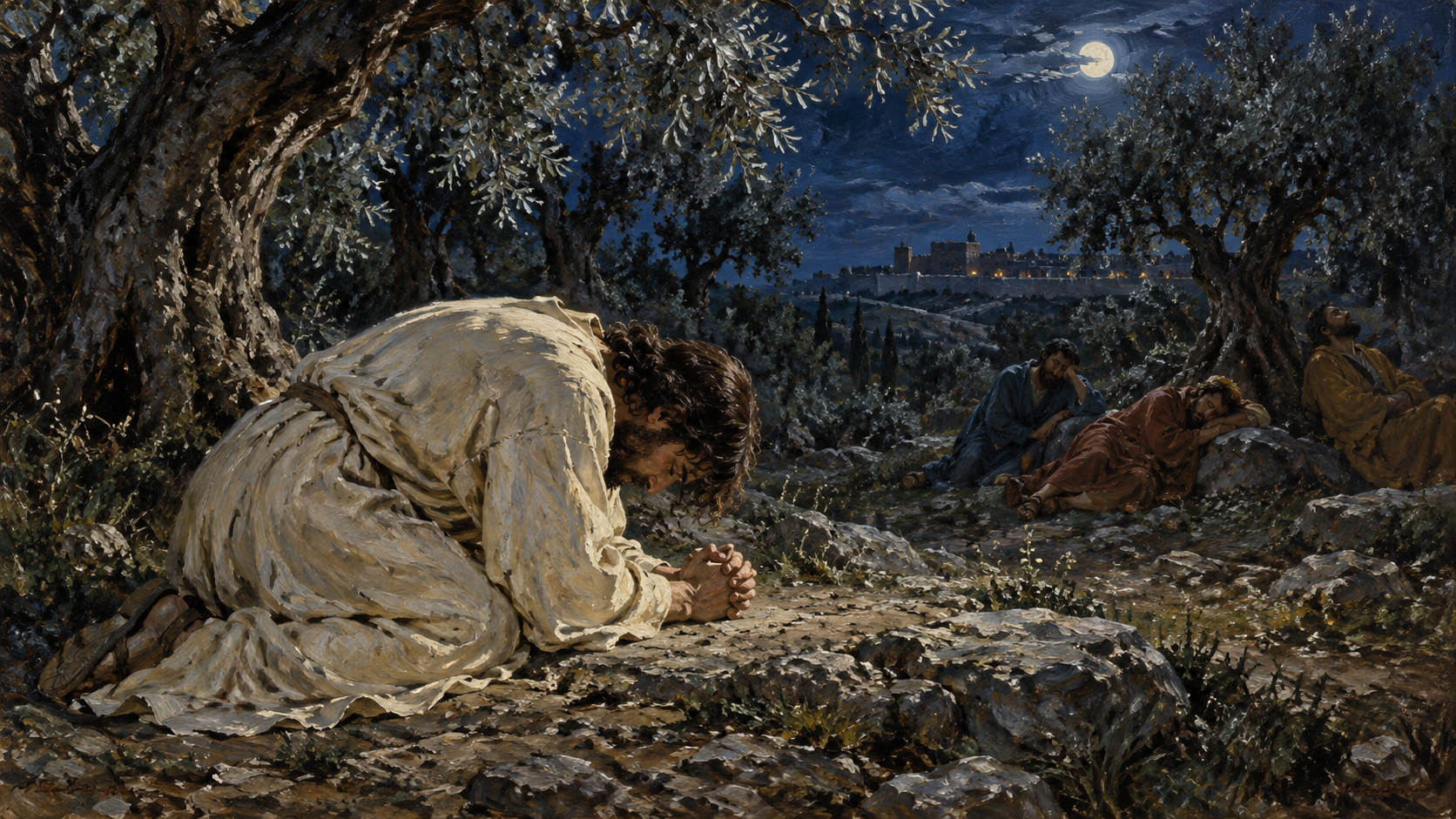
Gethsemane is one of those passages where I want to slow down, because Jesus’ sorrow is real and so is His willing obedience. What did He mean when He asked for the cup to pass, and why did He still step forward to meet Judas and the armed crowd? The four Gospels, Hebrews, and 1 Peter help us follow the answer from the garden to the cross and the empty tomb.
Gethsemane, the Sorrow, and the Cup
Matthew and Mark call the place Gethsemane, while Luke describes Jesus going to the Mount of Olives. John adds that He crossed the Brook Kidron before entering a garden. Together, the accounts show the same journey from the city to a familiar place, even though each writer includes different geographical details.
Gethsemane likely comes from a Semitic expression meaning “oil press.” An olive grove with a working press would fit the Mount of Olives, but the Gospels do not identify the owner or give the garden’s exact boundaries. They do not describe a press installation or name a tree that survives today. Later traditions may help a visitor picture the setting, though I would not give them the certainty of the inspired account.
The likely meaning helps us picture an olive-growing area, but I would not draw doctrine from the place-name. The Gospels never say the garden spiritually “pressed” Jesus, nor do they teach that His sweat accomplished atonement. The blood that saves us was shed when He willingly gave His body to suffering and death. Its meaning comes from that sacrifice, not from a hidden message in the name of the garden.
John tells us that Judas knew the place because Jesus often met His disciples there. That helps me understand His decision to enter the garden. He was going somewhere His betrayer could find, not looking for an unknown hiding place. His prayer prepared Him to meet what lay ahead willingly; the arrest was not the failure of an attempt to escape.
After singing a hymn, Jesus went with the disciples to the Mount of Olives and told them they would all stumble that night. He also warned Peter that he would deny Him. Yet He spoke beyond their coming failure to His own resurrection, promising to go before them to Galilee once He had risen. Before anyone came to arrest Him, Jesus was already speaking of what would follow His victory over death.
And when they had sung a hymn, they went out to the Mount of Olives. Then Jesus said to them, “All of you will be made to stumble because of Me this night, for it is written: ‘I will strike the Shepherd, And the sheep of the flock will be scattered.’ But after I have been raised, I will go before you to Galilee.” Peter answered and said to Him, “Even if all are made to stumble because of You, I will never be made to stumble.” Jesus said to him, “Assuredly, I say to you that this night, before the rooster crows, you will deny Me three times.” Peter said to Him, “Even if I have to die with You, I will not deny You!” And so said all the disciples. Then Jesus came with them to a place called Gethsemane, and said to the disciples, “Sit here while I go and pray over there.” And He took with Him Peter and the two sons of Zebedee, and He began to be sorrowful and deeply distressed. Then He said to them, “My soul is exceedingly sorrowful, even to death. Stay here and watch with Me.” He went a little farther and fell on His face, and prayed, saying, “O My Father, if it is possible, let this cup pass from Me; nevertheless, not as I will, but as You will.” Then He came to the disciples and found them sleeping, and said to Peter, “What! Could you not watch with Me one hour? Watch and pray, lest you enter into temptation. The spirit indeed is willing, but the flesh is weak.” Again, a second time, He went away and prayed, saying, “O My Father, if this cup cannot pass away from Me unless I drink it, Your will be done.” And He came and found them asleep again, for their eyes were heavy. So He left them, went away again, and prayed the third time, saying the same words. Then He came to His disciples and said to them, “Are you still sleeping and resting? Behold, the hour is at hand, and the Son of Man is being betrayed into the hands of sinners. Rise, let us be going. See, My betrayer is at hand.”
Jesus left most of the disciples behind and took Peter, James, and John farther into the garden. He asked them to watch with Him before moving a short distance away to pray. His closest disciples were allowed to see His sorrow, while He brought the decisive prayer to His Father.
Jesus knew Judas was coming and understood the Scriptures that would be fulfilled through the suffering ahead. I don’t read His calm during the arrest as an absence of feeling. We have just seen His sorrow and repeated prayer, and from that prayer He rose ready to obey.
Matthew describes Him as sorrowful and deeply distressed, while Mark adds that He was troubled and records His sorrow even to death. We are seeing genuine human anguish in the eternal Son. He remained fully God and fully man, and completely without sin through all that anguish.
Then they came to a place which was named Gethsemane; and He said to His disciples, “Sit here while I pray.” And He took Peter, James, and John with Him, and He began to be troubled and deeply distressed. Then He said to them, “My soul is exceedingly sorrowful, even to death. Stay here and watch.” He went a little farther, and fell on the ground, and prayed that if it were possible, the hour might pass from Him. And He said, “Abba, Father, all things are possible for You. Take this cup away from Me; nevertheless, not what I will, but what You will.” Then He came and found them sleeping, and said to Peter, “Simon, are you sleeping? Could you not watch one hour? Watch and pray, lest you enter into temptation. The spirit indeed is willing, but the flesh is weak.” Again He went away and prayed, and spoke the same words. And when He returned, He found them asleep again, for their eyes were heavy; and they did not know what to answer Him. Then He came the third time and said to them, “Are you still sleeping and resting? It is enough! The hour has come; behold, the Son of Man is being betrayed into the hands of sinners. Rise, let us be going. See, My betrayer is at hand.”
Jesus’ sinlessness did not mean He felt no dread at the suffering before Him. Betrayal was terrible, and His friends would soon abandon Him. Beyond that lay public shame and physical torture, ending in the bloodshed and death of crucifixion. He did not pretend any of it was harmless. His sorrow and His perfect obedience were both real.
I don’t want to explain His anguish by putting thoughts into His mind that the Gospel writers never record. They tell us that His soul was overwhelmed with sorrow and that He knew the hour ahead as He prayed about the cup. They do not say the Father was angry with Him or that He feared divine punishment. Nothing here describes a break in fellowship within the Trinity.
A cup can represent an experience allotted to someone. Scripture may use the image for blessing in one passage and suffering in another, and it can also speak of judgment or wrath. That range of meaning makes context essential. Before applying an Old Testament judgment passage to Gethsemane, we need to listen to how Jesus Himself used the image.
In Matthew 20, Jesus asks James and John whether they are able to drink His cup. He then says that both disciples will indeed drink it. They never bore divine wrath as substitutes for sin, but they did share in suffering because they followed Christ. When I compare this passage with Gethsemane, I do not believe the image of the cup can automatically mean wrath transferred from God to Jesus.
John 18:11 describes the cup as something the Father gave Jesus. The Father appointed the saving mission, and the Son accepted it willingly in complete unity with Him. That does not make the Father the one who inflicted the violence. Wicked men would arrest Jesus and inflict physical torture and punishment on the innocent Son before killing Him. The Father’s purpose to redeem through that voluntary offering does not mean He beat or cursed Jesus. The Father did not crucify His Son.
The cup included betrayal and suffering at human hands, followed by Christ’s sacrificial death and the resurrection victory beyond it. He willingly bore real punishment for our sins in His innocent body. The Father did not punish or curse His Son, and He did not abandon Him. Neither did He bruise Jesus or pour wrath upon Him.
Prayer, Sweat, and the Sleeping Disciples
Matthew and Mark describe three prayers, with Jesus returning to the same words as His anguish continued. I see earnest dependence in that repetition, rather than an empty religious performance. He told the Father that He desired the cup to pass, and each time He submitted without reservation to the Father’s will.
“Not as I will, but as You will” expresses the sorrow of a real man facing the horror of death. It does not reveal sinful resistance or a quarrel within the Godhead. The Son spoke honestly about suffering while obeying perfectly, and He never turned from His mission.
We use the word incarnate to say that the eternal Son truly took human nature without ceasing to be God. Both natures belong to one sinless Person. His human desire not to endure terrible suffering was therefore not rebellion, and His obedience was freely given. In Gethsemane we can see His real humanity without losing sight of His unwavering holiness.
In Matthew, Jesus’ second prayer moves from “if it is possible” to “if this cup cannot pass away from Me unless I drink it, Your will be done.” He was not bargaining for a compromise. He prayed through the path appointed to Him and then rose to meet the betrayer.
His honest submission gives us something to learn, though His saving mission belongs to Him alone. I need to distinguish what God has actually revealed from what someone merely claims is His will. Scripture is the test for those claims, and faithful submission begins with what God has said.
Luke records an angel strengthening Jesus as His agony deepened and He prayed more earnestly. His sweat fell to the ground like great drops of blood. These verses belong in the Textus Receptus and the received Byzantine tradition; Alexandrian critical-text assumptions are not a reason to remove them.
Coming out, He went to the Mount of Olives, as He was accustomed, and His disciples also followed Him. When He came to the place, He said to them, “Pray that you may not enter into temptation.” And He was withdrawn from them about a stone’s throw, and He knelt down and prayed, saying, “Father, if it is Your will, take this cup away from Me; nevertheless not My will, but Yours, be done.” Then an angel appeared to Him from heaven, strengthening Him. And being in agony, He prayed more earnestly. Then His sweat became like great drops of blood falling down to the ground. When He rose up from prayer, and had come to His disciples, He found them sleeping from sorrow. Then He said to them, “Why do you sleep? Rise and pray, lest you enter into temptation.”
Luke uses a simile, a comparison: the sweat became like great drops of blood. He does not say that blood came through Jesus’ pores or diagnose hematidrosis. That medical condition is often mentioned in sermons, but Luke’s profession does not turn a possible diagnosis into something the verse states. We should keep his vivid comparison as he gives it.
The description is already enough to show the reality of His agony. His sweat fell heavily to the ground, and He prayed more earnestly while an angel strengthened Him from heaven. We can recognize that profound physical anguish without identifying the sweat as the blood of atonement. Salvation comes through the blood He shed in His willing sacrificial death.
The angel’s help does not suggest that Jesus was morally weak or less than God. He had truly taken a complete human nature, so He could be hungry and thirsty, grow tired in body, and grieve in His soul. He could suffer and die while remaining fully God and completely sinless.
In Matthew and Mark, Jesus returned three times to find the disciples asleep. He spoke particularly to Peter, who had been so confident that he would never stumble. His question, “Could you not watch with Me one hour?” makes me consider how different a confident promise can be from faithfulness when that promise is tested.
He told them to watch and pray so they would not enter temptation. Their spirits were willing, but the flesh was weak, and good intentions could not replace dependence on God. Peter loved Jesus sincerely. That sincerity, however, would not keep him from drawing his sword or from fleeing and later denying Him that night.
Luke tells us they were sleeping from sorrow. I want to remember that detail when I read Jesus’ correction, because overwhelming grief can exhaust the body. He woke them and called them to pray without treating their sorrow as unreal. We can recognize such grief with compassion while still calling one another to faithful attention.
To watch and pray is to remain alert while depending on God before temptation comes. They are not ways to remove every painful feeling. The disciples’ failure warns me against putting off prayer until the moment my courage is already giving way.
Betrayal, Peter’s Sword, and Willing Surrender
Judas arrived with an armed crowd sent by the chief priests and elders. He had arranged to identify Jesus with a kiss, so they would know whom to seize. What would ordinarily have been a greeting became the means of betrayal.
And while He was still speaking, behold, Judas, one of the twelve, with a great multitude with swords and clubs, came from the chief priests and elders of the people. Now His betrayer had given them a sign, saying, “Whomever I kiss, He is the One; seize Him.” Immediately he went up to Jesus and said, “Greetings, Rabbi!” and kissed Him. But Jesus said to him, “Friend, why have you come?” Then they came and laid hands on Jesus and took Him. And suddenly, one of those who were with Jesus stretched out his hand and drew his sword, struck the servant of the high priest, and cut off his ear. But Jesus said to him, “Put your sword in its place, for all who take the sword will perish by the sword. Or do you think that I cannot now pray to My Father, and He will provide Me with more than twelve legions of angels? How then could the Scriptures be fulfilled, that it must happen thus?” In that hour Jesus said to the multitudes, “Have you come out, as against a robber, with swords and clubs to take Me? I sat daily with you, teaching in the temple, and you did not seize Me. But all this was done that the Scriptures of the prophets might be fulfilled.” Then all the disciples forsook Him and fled.
Jesus called Judas “Friend” and asked why he had come. The Greek form is a direct address that can mean companion or friend, but Jesus knew exactly what that kiss meant. I would not turn His choice of address into approval of Judas or a suggestion that his betrayal was harmless.
Luke records the way Jesus exposed the contradiction: “Judas, are you betraying the Son of Man with a kiss?” Nothing was hidden from Him in the darkness. Judas was choosing evil, even though Scripture had foretold the betrayal and God would accomplish redemption through the deeds of wicked people.
And while He was still speaking, behold, a multitude; and he who was called Judas, one of the twelve, went before them and drew near to Jesus to kiss Him. But Jesus said to him, “Judas, are you betraying the Son of Man with a kiss?” When those around Him saw what was going to happen, they said to Him, “Lord, shall we strike with the sword?” And one of them struck the servant of the high priest and cut off his right ear. But Jesus answered and said, “Permit even this.” And He touched his ear and healed him. Then Jesus said to the chief priests, captains of the temple, and the elders who had come to Him, “Have you come out, as against a robber, with swords and clubs? When I was with you daily in the temple, you did not try to seize Me. But this is your hour, and the power of darkness.”
John names Peter as the man who drew the sword and Malchus as the wounded servant. Luke tells us that Jesus touched the ear and healed it. Even as He was being seized, He repaired the harm caused by a disciple who was trying to defend Him in the wrong way.
Jesus ordered Peter to put the sword away. More than twelve legions of angels were available if He asked the Father, but accepting that rescue would have meant leaving His saving mission unfinished. The Scriptures concerning that mission had to be fulfilled. His surrender was willing obedience, not helplessness.
A Roman legion held thousands of soldiers, so Jesus was speaking of overwhelming heavenly power. Peter’s single sword was not what stood between Him and capture. The armed crowd could proceed because He willingly submitted to the Scriptures and His saving mission, not because their strength exceeded His ability to answer it.
I understand His warning about those who take the sword perishing by it in light of what Peter was trying to do. Peter could not advance Christ’s redemptive mission by attacking the people He came to die for. The passage does not give a complete treatment of civil government or settle every question about lawful defense and military service. It does clearly forbid using violence to carry out this saving work.
John describes Jesus stepping forward to meet those who came to arrest Him and asking whom they wanted. When He identified Himself, they drew back and fell to the ground. He then required them to let His disciples go, protecting His followers even as He accepted His own arrest.
When Jesus had spoken these words, He went out with His disciples over the Brook Kidron, where there was a garden, which He and His disciples entered. And Judas, who betrayed Him, also knew the place; for Jesus often met there with His disciples. Then Judas, having received a detachment of troops, and officers from the chief priests and Pharisees, came there with lanterns, torches, and weapons. Jesus therefore, knowing all things that would come upon Him, went forward and said to them, “Whom are you seeking?” They answered Him, “Jesus of Nazareth.” Jesus said to them, “I am He.” And Judas, who betrayed Him, also stood with them. Now when He said to them, “I am He,” they drew back and fell to the ground. Then He asked them again, “Whom are you seeking?” And they said, “Jesus of Nazareth.” Jesus answered, “I have told you that I am He. Therefore, if you seek Me, let these go their way,” that the saying might be fulfilled which He spoke, “Of those whom You gave Me I have lost none.” Then Simon Peter, having a sword, drew it and struck the high priest’s servant, and cut off his right ear. The servant’s name was Malchus. So Jesus said to Peter, “Put your sword into the sheath. Shall I not drink the cup which My Father has given Me?”
Jesus knew everything that was coming and remained fully able to summon heavenly help. Judas had not surprised Him or overturned His plan. He freely accepted the cup while directing the arresting party to release His followers.
“Therefore My Father loves Me, because I lay down My life that I may take it again. No one takes it from Me, but I lay it down of Myself. I have power to lay it down, and I have power to take it again. This command I have received from My Father.”
His willingness did not make those who harmed Him innocent. Judas chose betrayal, and the religious leaders carried out their scheme. After the crowd seized Jesus, false witnesses lied about Him. Soldiers scourged the innocent Son before rulers condemned Him to death. Wicked men physically punished and killed Him, while He willingly bore that real punishment for our sins in His innocent body. He shed His blood and died, then rose bodily from the dead.
The Father loves the Son who laid down His life and took it up again. We are not shown hatred or a divine curse from the Father, and Jesus was never abandoned. No rupture occurred within the Trinity. The Father remained perfectly united with the Son and the Holy Spirit in their saving purpose.
Our High Priest and the Road to the Cross
Paul points suffering believers to Jesus as the great High Priest who passed through the heavens. He was tempted in every respect as we are and remained without sin. After seeing His anguish in Gethsemane, I can understand why His sympathy is more than an observer’s concern. He has truly experienced suffering.
Seeing then that we have a great High Priest who has passed through the heavens, Jesus the Son of God, let us hold fast our confession. For we do not have a High Priest who cannot sympathize with our weaknesses, but was in all points tempted as we are, yet without sin. Let us therefore come boldly to the throne of grace, that we may obtain mercy and find grace to help in time of need.
Jesus understands sorrow without sharing our sinful responses, and He knows bodily weakness without ever experiencing moral failure. He was betrayed and left by His disciples. As death approached, He also endured false accusations and physical pain, though the Father never abandoned Him. We can therefore approach the throne of grace for mercy and timely help instead of hiding our anguish behind religious performance.
who, in the days of His flesh, when He had offered up prayers and supplications, with vehement cries and tears to Him who was able to save Him from death, and was heard because of His godly fear, though He was a Son, yet He learned obedience by the things which He suffered. And having been perfected, He became the author of eternal salvation to all who obey Him,
Paul says Jesus was heard because of His godly fear, even though He was not spared death. The answer came through His bodily resurrection. Nor does “He learned obedience” mean that He had once been disobedient. As the incarnate Son, He experienced what perfect obedience required through suffering and completed it all without sin.
Gethsemane prepared for the atonement, but its prayers, tears, and sweat did not take the place of Christ’s sacrifice. He rose and gave Himself into the hands of men who bound Him and brought false accusations against Him. Soldiers scourged Him and pressed thorns onto His head before nailing Him to the cross. Wicked men killed the innocent Son as He shed His blood and died, and on the third day He rose bodily from the grave.
In 1 Peter, we see both the physical suffering Jesus endured and His sinlessness through it. He did not sin or answer reviling with sinful retaliation, yet He bore our sins in His own body on the tree. Bearing them did not make Him personally guilty or inwardly corrupt. He remained the righteous Shepherd suffering for His wandering sheep.
For to this you were called, because Christ also suffered for us, leaving us an example, that you should follow His steps: “Who committed no sin, Nor was deceit found in His mouth”; who, when He was reviled, did not revile in return; when He suffered, He did not threaten, but committed Himself to Him who judges righteously; who Himself bore our sins in His own body on the tree, that we, having died to sins, might live for righteousness–by whose stripes you were healed. For you were like sheep going astray, but have now returned to the Shepherd and Overseer of your souls.
“By whose stripes you were healed” first concerns the saving restoration described here: those who had wandered have returned to the Shepherd and Overseer of their souls. I don’t read it as a promise that every believer will be physically healed immediately in this age. We are assured of future bodily resurrection because Christ rose, but faithful Christians still face illness and death as they wait for it.
Saying that Jesus bore our sins does not mean the Father treated Him as sinful. Wicked men imposed real punishment on His innocent body, and He willingly carried it for us through bloodshed and death. That voluntary sacrifice truly deals with sin and reconciles believers to God. The Father accepts and honors His Son’s offering without becoming His persecutor.
The empty tomb belongs in our understanding of the garden. Jesus entered the arrest as the only Savior, accomplishing redemption through His blood and defeating death by rising bodily. He gives us much more than an example of composure under pressure. We follow the living Lord who completed His saving work willingly, not a tragic teacher whose enemies proved too strong for Him.
What Gethsemane Calls Us to Do
His prayer teaches me to bring sorrow to God honestly. Jesus did not call anguish unbelief or cover it with calm religious language. We can name what is terrible in faithful prayer and still submit to what God has actually revealed.
The sleeping disciples warn me not to wait until temptation becomes a crisis before I pray. Peter had confidence in his own faithfulness, but he needed greater dependence on God. We learn that vigilance by listening to Scripture and admitting our weakness, and we can receive help from other believers. Luke also gives us reason for compassion: grief can leave a person physically exhausted.
Peter tried to defend Jesus with a sword, while Judas used a kiss to betray Him. Neither action served the truth. We cannot advance Christ’s work through violence or manipulation, even when a dishonest method appears to offer a quicker result. Our calling is to obey Scripture and bear truthful witness.
These passages also keep our understanding of the atonement clear. Wicked men physically tortured, punished, and killed Jesus, and He willingly bore that real punishment for our sins in His innocent body. He shed His blood and died, was buried, and rose bodily. The Father did not punish or curse Jesus, and He did not abandon Him. He did not strike or bruise Him or pour wrath upon Him. Salvation is in Christ’s blood, and the Father remained united with the Son throughout His saving work.
The prayer in Gethsemane was heard, and His arrest did not end in defeat. Jesus accepted the cup and completed His sacrifice, then took up His life again in resurrection. He died for the whole world, though people can resist and reject God’s genuine offer of salvation. Whoever repents and believes is forgiven and justified, declared righteous before God. That person is born again and made new, with the Holy Spirit dwelling within and sealing the believer for eternity. Such security never permits lawlessness, and a superficial profession does not prove genuine new birth. The Savior who prayed in agony lives now to help His people.
My Final Thoughts
When I follow Jesus through Gethsemane, I do not see a helpless victim or a Son abandoned by His Father. I see the sinless Christ speaking honestly about terrible suffering and then rising from prayer to give Himself willingly. His sorrow shows that faithful obedience does not require us to pretend pain is harmless. His surrender also shows that no one took His life against His will. Because He completed the sacrifice and rose bodily, we can bring our own weakness to a living High Priest who understands and gives grace in the time of need.