
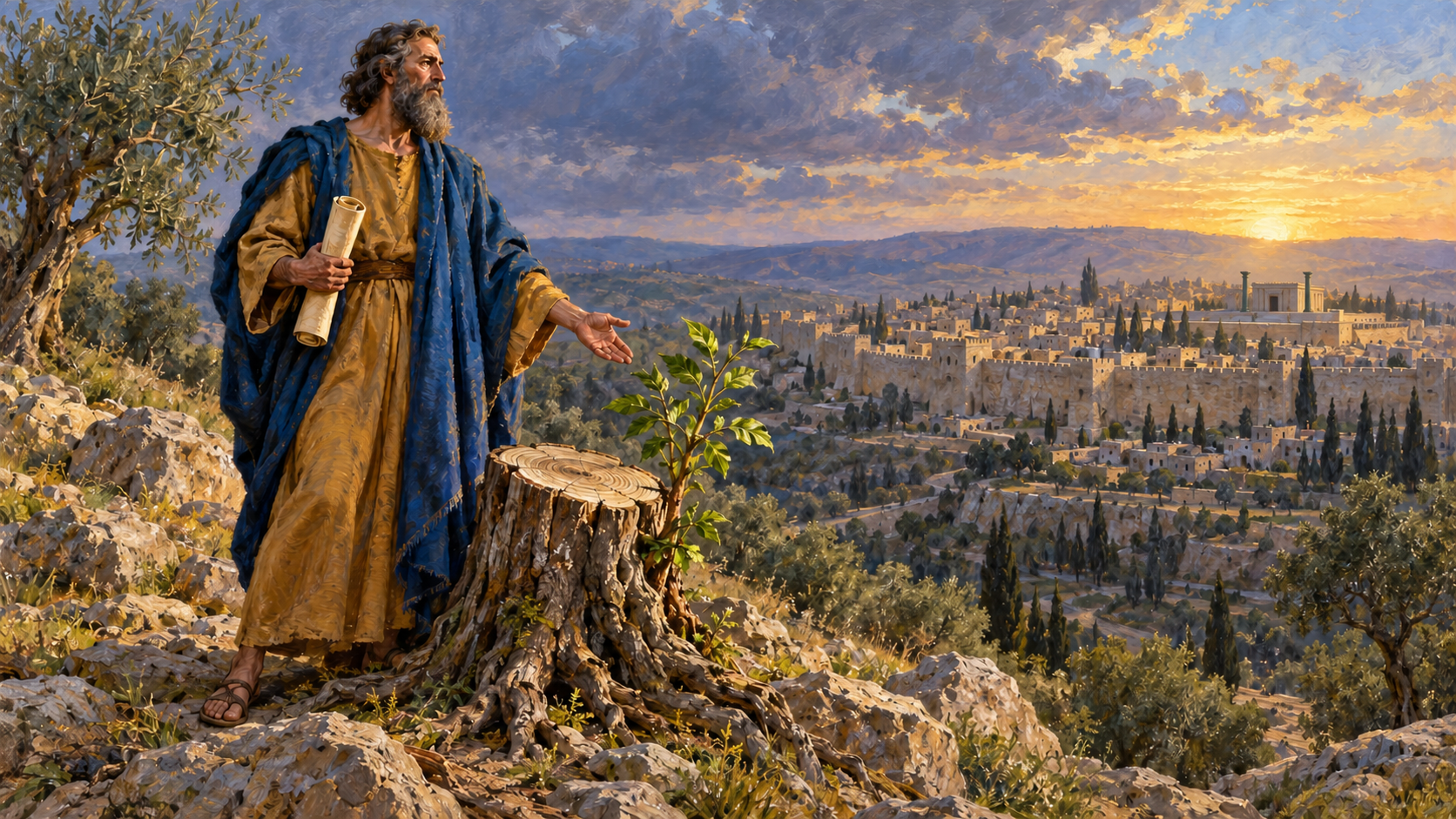
Isaiah can be difficult to follow when a message about Judah’s crisis leads into a promise about Christ and His kingdom. I want to understand how those passages belong together without losing sight of the people Isaiah first addressed. Getting to know the prophet and his setting will help us follow the judgment and hope that run through his book.
Isaiah and His One Prophetic Book
Isaiah’s name is commonly understood to mean “the LORD saves,” a fitting name for a prophet whose book so often brings judgment and salvation together. Scripture identifies his father as Amoz. We should not confuse Amoz with the prophet Amos, since their Hebrew names are different and the Bible gives us no family connection between them.
By Isaiah’s time, the nation descended from Israel had long been divided into two kingdoms. The northern kingdom was commonly called Israel. Judah was the southern kingdom, which included Jerusalem. Isaiah ministered primarily to Judah, though he also prophesied about the northern kingdom and the foreign powers threatening both.
Isaiah ministered during the reigns of Uzziah, Jotham, Ahaz, and Hezekiah. He received his call vision in the year Uzziah died, commonly dated around 740 BC. He was still active decades later during Sennacherib’s invasion in 701 BC and Hezekiah’s meeting with Babylonian envoys. His death is harder to place because Scripture never dates it. Tradition may identify Isaiah with the person sawn in two in Hebrews 11:37, but that passage doesn’t name him. I would not present the identification as part of his recorded biography.
The vision of Isaiah the son of Amoz, which he saw concerning Judah and Jerusalem in the days of Uzziah, Jotham, Ahaz, and Hezekiah, kings of Judah.
Isaiah spoke to people throughout Judah, including kings and religious leaders. He lived and prophesied around Jerusalem, and he had access to the royal court. That access doesn’t tell me he belonged to the royal family or held an official position there. His authority came from the Lord’s commission, not a social title. We also know that his wife is called the prophetess and that God used their sons’ names as signs within his message.
Judah and Jerusalem were his central historical audience, but Isaiah also addressed the northern kingdom and surrounding nations. His first hearers faced Assyria’s threat while idolatry persisted beneath their corrupt worship. They needed to confront public injustice and their misplaced confidence in political power. Yet the prophecy reaches much further than those immediate troubles. It looks across the rise of world empires to a faithful remnant and Gentiles seeking the Messiah, then toward His promised kingdom and the renewed creation beyond it.
It helps me to follow the order of those events. Isaiah first warned Judah when Assyria was the leading military threat. Jerusalem was delivered in Hezekiah’s reign, but Isaiah announced that Babylon would later take Judah into exile. Chapters 40–48 offer comfort beyond that exile and name Cyrus, the Persian ruler who would permit return and rebuilding. Returning to the land was not the whole promise, though. The Servant passages lead us to salvation through Christ, and the closing chapters look toward His kingdom and the final new creation.
We call Isaiah a major prophet because of the length of his book, not because he was more inspired than the shorter prophets. Its sixty-six chapters were divided that way long after Isaiah’s time. That is why I would not let the popular comparison of thirty-nine chapters with the Old Testament and twenty-seven with the New Testament govern how we interpret it.
There is a broad progression we can follow in the book itself. Chapters 1–39 repeatedly confront Judah’s rebellion and announce judgment on the nations. Assyria’s threat and Hezekiah’s crisis bring that historical portion to its climax. Chapters 40–66 look beyond exile with sustained comfort, bringing the Servant more clearly into view. Zion’s future under the Messiah then leads toward the new creation. Still, judgment and hope appear in both portions. The movement comes from the history and theology of the book, not a secret numbering code.
Modern theories often assign Isaiah to several authors because the later chapters offer comfort after exile and name Cyrus before he rose to power. That conclusion treats detailed prediction as historically impossible. But Isaiah appeals to the LORD’s ability to declare events before they happen as evidence that He is different from idols. I don’t want to rule out beforehand the very thing the book calls us to recognize about God.
The New Testament also treats the book as Isaiah’s work. John 12 quotes Isaiah 53:1 and then Isaiah 6:10, attributing both to Isaiah. Romans 10 likewise cites Isaiah 53 and Isaiah 65 under the same prophet’s name. The apostles cross the divisions proposed by those theories without suggesting that they are quoting different writers.
A prophet speaking across decades can address different audiences and periods of history, changing his tone and vocabulary to suit the purpose. Those differences don’t overturn the book’s attribution or the testimony of Christ’s apostles. I receive Isaiah as one inspired and inerrant prophetic book. Naming Cyrus before his rise shows the LORD’s rule over history rather than giving me a reason to deny the prophecy.
Judah Before the Holy King
Isaiah opens with the Lord bringing charges against Judah, much as in a covenant lawsuit. These people had entered a binding relationship with Him and then violated His commands. They continued to gather for worship and offer sacrifices, and they still prayed. Yet their hands were full of blood while their leaders neglected vulnerable people. God would not accept their religious activity as a cover for ongoing evil.
In the vineyard song of Isaiah 5, God describes a vineyard for which He had made every reasonable provision and expected good fruit. It produced wild grapes instead. Isaiah explains what that picture means: God looked for justice and righteousness among His people, but found oppression and heard cries of distress. The failure concerned the way they lived, not a lack of provision from Him.
So repentance had to change what Judah was doing. Feeling more religious would not address the wrongs Isaiah named. They needed to turn from evil and learn to do good, which included protecting the oppressed. Seeking justice also meant caring faithfully for children without fathers and defending widows who had no one to speak for them.
“Wash yourselves, make yourselves clean; Put away the evil of your doings from before My eyes. Cease to do evil, Learn to do good; Seek justice, Rebuke the oppressor; Defend the fatherless, Plead for the widow. “Come now, and let us reason together,” Says the LORD, “Though your sins are like scarlet, They shall be as white as snow; Though they are red like crimson, They shall be as wool. If you are willing and obedient, You shall eat the good of the land; But if you refuse and rebel, You shall be devoured by the sword”; For the mouth of the LORD has spoken.
I don’t want to separate the promise of scarlet sins becoming white from the invitation and warning around it. God graciously called Judah to come to Him, but He also warned them about refusing. Ceremonies could not buy cleansing while the people protected their rebellion. For us as Christian readers, the passage helps us understand the need Christ fulfills. God truly cleanses sinners, and His grace changes the direction of a life instead of giving permission to continue in injustice.
In Isaiah 6, the prophet saw the true King in the year Judah lost Uzziah. Judah’s throne was changing hands, but heaven’s throne was not empty. I notice that Isaiah saw the LORD still reigning when Judah’s earthly king had died. The seraphim covered themselves and proclaimed His holiness. The title “Holy One of Israel,” repeated throughout Isaiah, brings His absolute moral purity together with His covenant relationship to His people.
In the year that King Uzziah died, I saw the Lord sitting on a throne, high and lifted up, and the train of His robe filled the temple. Above it stood seraphim; each one had six wings: with two he covered his face, with two he covered his feet, and with two he flew. And one cried to another and said: “Holy, holy, holy is the LORD of hosts; The whole earth is full of His glory!” And the posts of the door were shaken by the voice of him who cried out, and the house was filled with smoke. So I said: “Woe is me, for I am undone! Because I am a man of unclean lips, And I dwell in the midst of a people of unclean lips; For my eyes have seen the King, The LORD of hosts.” Then one of the seraphim flew to me, having in his hand a live coal which he had taken with the tongs from the altar. And he touched my mouth with it, and said: “Behold, this has touched your lips; Your iniquity is taken away, And your sin purged.” Also I heard the voice of the Lord, saying: “Whom shall I send, And who will go for Us?” Then I said, “Here am I! Send me.”
Isaiah’s first response was to confess his unclean lips and acknowledge that he lived among people with unclean lips. He didn’t volunteer out of confidence in his natural fitness. God cleansed him before commissioning him. I need to keep that order in view without turning the coal into a ritual for believers to repeat. It was the sign God appointed in that vision.
The commission included a difficult message about what lay ahead. Isaiah would preach to people whose continued refusal would bring hardening and desolation. Yet the chapter ends with a holy seed remaining in the stump. That makes me cautious about measuring his faithfulness by the response he received. He had to speak God’s word while judgment fell, even as hope remained with the remnant.
Isaiah’s courage showed in his willingness to tell kings and Judah’s leaders what they did not want to hear. He spoke to priests and ordinary people too, without softening God’s message. After God cleansed him, he willingly answered the call and kept serving through changing kings and repeated national crises.
We have enough in Isaiah’s confession and commission to see his character, along with the signs and messages God gave him. We don’t need to fill the gaps in his biography. Scripture tells us nothing about his childhood or education, and it does not define his social rank or private prayer routine. Nor does it give a complete account of his death. I can’t infer royal ancestry from access to kings or invent an emotional profile from the beauty of his poetry.
Immanuel, the Divine Child, and the Nations
Isaiah 7 opens during the Syro-Ephraimite crisis. “Syro” refers to Syria, and “Ephraim” is a prophetic name for the northern kingdom of Israel. Those two kingdoms wanted Judah to join them in resisting Assyria. When King Ahaz refused, they planned to invade Judah and replace him with a ruler who would cooperate. Ahaz and his people shook with fear at the threat.
The Lord sent Isaiah and his son Shear-Jashub to call Ahaz to quiet trust in God. The boy’s name means “a remnant shall return.” God offered Ahaz a sign, but the king refused while trying to sound pious. What concerns me is where he turned instead: he sought rescue from Assyria, the very empire that would soon overwhelm the region. He would not trust the Lord to preserve David’s royal line. Isaiah’s answer therefore addressed more than this unbelieving king; it reached the whole house of David.
Moreover the LORD spoke again to Ahaz, saying, “Ask a sign for yourself from the LORD your God; ask it either in the depth or in the height above.” But Ahaz said, “I will not ask, nor will I test the LORD!” Then he said, “Hear now, O house of David! Is it a small thing for you to weary men, but will you weary my God also? Therefore the Lord Himself will give you a sign: Behold, the virgin shall conceive and bear a Son, and shall call His name Immanuel. Curds and honey He shall eat, that He may know to refuse the evil and choose the good. For before the Child shall know to refuse the evil and choose the good, the land that you dread will be forsaken by both her kings.
In the Masoretic Hebrew, almah describes a young woman of marriageable age, and her description in this sign supports virginity. I read this promise from that Hebrew base text, which the Septuagint does not overrule. Matthew 1:22–23, in the received New Testament, authoritatively identifies its fulfillment in Jesus’ virgin conception and birth. He truly is Immanuel, God with us.
At the same time, we should not lose the immediate crisis. Isaiah 7 gives a timetable for the fall of the two kings threatening Judah, and Isaiah 8 calls Isaiah’s children signs. Maher-Shalal-Hash-Baz announced swift Assyrian plunder. I can recognize those nearby signs without reducing Immanuel to an ordinary child or treating the promise as exhausted. Its full identity became clear in Christ, fulfilling the prophecy given to the house of David.
Here am I and the children whom the LORD has given me! We are for signs and wonders in Israel From the LORD of hosts, Who dwells in Mount Zion.
Isaiah 9 moves from Galilee’s darkness into great light before introducing the Son who will govern. The Child is genuinely born in history, and the Son is given. When I read His titles, I cannot take them as ordinary praise for a human ruler.
For unto us a Child is born, Unto us a Son is given; And the government will be upon His shoulder. And His name will be called Wonderful, Counselor, Mighty God, Everlasting Father, Prince of Peace.
Calling the Son “Mighty God” affirms His deity. But “Everlasting Father” does not identify Him as the Person of God the Father. It describes His eternal, fatherly care for the people He rules. The next verse places the Messiah on David’s throne, establishing an endless government through righteous judgment.
Isaiah 11 pictures David’s royal line as a cut stump from which a living Branch grows. The Spirit rests upon Him, and His judgment is righteous rather than superficial. Jesus is both the descendant of Jesse and the Root whom Gentiles seek.
There shall come forth a Rod from the stem of Jesse, And a Branch shall grow out of his roots. The Spirit of the LORD shall rest upon Him, The Spirit of wisdom and understanding, The Spirit of counsel and might, The Spirit of knowledge and of the fear of the LORD.
Isaiah goes on to picture a wolf living with a lamb and a leopard resting with a young goat. Even the lion eats straw like an ox. I understand these as concrete descriptions of creation transformed under the Messiah’s reign, not symbols of an inward feeling that replace His kingdom. The same passage speaks of Israel being regathered while Gentiles seek the Root of Jesse.
Isaiah also announced judgment on the surrounding nations. Chapters 13–23 contain pronouncements often called burdens, addressing Babylon and Egypt as well as Moab, Damascus, Tyre, and other powers. Their power did not exempt them from answering to Israel’s God. Even an empire He used as His instrument remained accountable for its pride and cruelty.
Judah’s leaders repeatedly looked for safety in foreign alliances and tribute. They put their confidence in military plans and Egypt’s horses. Isaiah’s objection was not to prudent action itself, and I don’t want to confuse the two. He condemned policies that rejected the Lord’s Word and treated human power as a savior. Assyria’s threat brought that misplaced trust to its sharpest test.
In Isaiah 36–37, Sennacherib sent the Rabshakeh to Jerusalem. That was an office title, not necessarily the man’s name. He spoke loudly enough for the people on the wall to hear his mockery of their trust in the Lord, trying to frighten them into surrender. Hezekiah took the threatening letter into the temple and spread it before the LORD. Isaiah then gave him a definite word: Sennacherib would not capture the city.
“Therefore thus says the LORD concerning the king of Assyria: ‘He shall not come into this city, Nor shoot an arrow there, Nor come before it with shield, Nor build a siege mound against it. By the way that he came, By the same shall he return; And he shall not come into this city,’ Says the LORD. ‘For I will defend this city, to save it For My own sake and for My servant David’s sake.'”
The Angel of the LORD struck the Assyrian camp, and Sennacherib returned to Nineveh. In these distinctive Old Testament appearances, I understand the Angel of the LORD to be the pre-incarnate Christ, acting before His human birth. He is more than a created messenger. This deliverance confirmed the prophetic word and God’s promise to David.
Hezekiah later failed despite that deliverance. Isaiah 39 records how he proudly displayed his possessions to Babylonian envoys. Isaiah then announced that Judah’s treasures and descendants would one day be carried to Babylon.
Comfort, Cyrus, and the Faithful Servant
Isaiah 40 begins its sustained comfort with the assurance that Babylonian exile would not end God’s covenant purpose. Judah would be conquered and many of its people carried away, but the Lord would still lead His people like a shepherd. I find the comparison with idols helpful here. The Creator calls the stars by name, and every nation is small before Him. An idol is only something human hands have made, unable to speak or save. Judgment would not have the last word because His purpose would endure.
The voice in the wilderness prepares the way of the LORD, and all four Gospels apply that ministry to John the Baptist preparing for Jesus. I don’t want to hurry past the identity of the One whose way John prepared. Isaiah speaks of the LORD, and Jesus was the One who came to His people. He is God the Son.
The voice of one crying in the wilderness: “Prepare the way of the LORD; Make straight in the desert A highway for our God.
In Isaiah 44–45, the Lord names Cyrus as the ruler who would authorize Jerusalem and the temple to be rebuilt. Naming a future king is part of the prophecy’s testimony about God. Israel’s Redeemer rules the very events that idols cannot predict.
Who says of Cyrus, ‘He is My shepherd, And he shall perform all My pleasure, Saying to Jerusalem, “You shall be built,” And to the temple, “Your foundation shall be laid.”‘
Cyrus was a pagan imperial ruler, not the Messiah. Long after Isaiah’s ministry during the Assyrian threat, Cyrus ruled Persia and allowed exiled peoples, including the Jews, to return and rebuild. The LORD called and used him for that limited historical purpose, and his decree brought real restoration after Babylonian exile. But political return was not the full extent of the prophecy’s hope. It pointed beyond Cyrus to the Servant who would bring salvation to the ends of the earth.
We need to notice whom Isaiah means when he uses servant language. He calls Israel the Lord’s servant, yet rebukes the nation for spiritual blindness. Then another Servant appears who obeys perfectly. He restores Jacob, another name for Israel, and establishes justice. God also makes Him a light to the Gentiles, the nations outside Israel. That contrast helps me distinguish Israel’s failed calling from the work of the Messiah, the faithful Servant who will finish God’s work.
“Behold! My Servant whom I uphold, My Elect One in whom My soul delights! I have put My Spirit upon Him; He will bring forth justice to the Gentiles. He will not cry out, nor raise His voice, Nor cause His voice to be heard in the street. A bruised reed He will not break, And smoking flax He will not quench; He will bring forth justice for truth. He will not fail nor be discouraged, Till He has established justice in the earth; And the coastlands shall wait for His law.”
Matthew 12 applies these words to Jesus. He does not crush the bruised reed, but His gentleness should not lead us to think He is weak or has abandoned justice. He will finish His work and establish justice in the earth.
In Isaiah 49, restoring Israel belongs to a mission that reaches the whole world. The Servant’s task is too great to end with the tribes of Jacob, so He is also given as light to the Gentiles and as God’s salvation to the ends of the earth. Acts 13 applies that outward movement to the apostles’ gospel mission under Christ.
Indeed He says, ‘It is too small a thing that You should be My Servant To raise up the tribes of Jacob, And to restore the preserved ones of Israel; I will also give You as a light to the Gentiles, That You should be My salvation to the ends of the earth.'”
I want to keep both promises in view. Isaiah joins Jacob’s restoration with light for the Gentiles, so the worldwide mission does not erase Israel. Christ died for the whole world, and that makes the gospel invitation genuine for every person. People can still resist His offer and reject Him.
The Suffering Servant and the Coming Kingdom
Isaiah 52:13 begins by announcing the Servant’s wisdom and final exaltation. Only then does it describe suffering that would mar His appearance. Isaiah 53 follows Him through rejection and grief before explaining His wounds. He remains silent before His oppressors and willingly goes to death. After describing His burial with the rich, the chapter declares that He bore the sins of others and closes with intercession and triumph. Acts 8 identifies this Servant as Jesus.
The speakers acknowledge that they had wrongly regarded Him as “stricken, smitten by God.” Isaiah records their mistaken estimate rather than teaching that it was correct. The next lines explain that He was wounded for our transgressions and bore the punishment that brings peace.
Surely He has borne our griefs And carried our sorrows; Yet we esteemed Him stricken, Smitten by God, and afflicted. But He was wounded for our transgressions, He was bruised for our iniquities; The chastisement for our peace was upon Him, And by His stripes we are healed. All we like sheep have gone astray; We have turned, every one, to his own way; And the LORD has laid on Him the iniquity of us all.
Wicked men physically tortured Jesus and put Him to death, and He willingly bore that real punishment for our sins in His innocent body. He shed His blood and was buried, then rose bodily. The Father did not punish or curse His Son, nor did He abandon Jesus. He did not strike or bruise Him or pour wrath on Him. I understand “The chastisement for our peace” to describe what Christ endured to reconcile us to God. The phrase does not identify the Father as His punisher.
The LORD laid our iniquity upon Him without making Him sinful. The righteous Servant took responsibility for sins that belonged to us while remaining without violence or deceit. His stripes bring alienated sinners back to God. We should distinguish that reconciliation from a promise that every believer will be physically healed now. Matthew 8 applies the griefs and sorrows language to Jesus’ earthly healing ministry, but Isaiah 53 and 1 Peter 2 do not make that universal promise of present healing.
Yet it pleased the LORD to bruise Him; He has put Him to grief. When You make His soul an offering for sin, He shall see His seed, He shall prolong His days, And the pleasure of the LORD shall prosper in His hand.
The Lord’s pleasure in this offering was not delight in suffering. Nor does the verse portray the Father personally assaulting His Son. God willed and accepted the Servant’s voluntary offering through violence He foreknew and wicked men carried out. I notice that the passage continues beyond death: after pouring out His life, the Servant sees His seed and prolongs His days. His life after death vindicates Him. He justifies many and receives victory. God’s saving purpose prospers through that outcome.
Jesus fulfilled these details in history without sinning. He faced false judgment without retaliatory violence and was numbered with transgressors. He truly died, and Joseph of Arimathea placed His body in a rich man’s tomb. Yet He rose bodily from the dead. Isaiah’s Servant is therefore neither a defeated victim nor an abstract symbol, but the risen Savior who intercedes for His people.
In Isaiah 61, we hear the One whom the Lord has anointed speaking of His work. He brings good news to the poor and healing to broken hearts, and He proclaims liberty. Jesus read this passage in Nazareth and told the synagogue that it was fulfilled in their hearing.
“The Spirit of the Lord GOD is upon Me, Because the LORD has anointed Me To preach good tidings to the poor; He has sent Me to heal the brokenhearted, To proclaim liberty to the captives, And the opening of the prison to those who are bound; To proclaim the acceptable year of the LORD, And the day of vengeance of our God; To comfort all who mourn,
Luke records Jesus stopping after “the acceptable year of the LORD.” He closed the scroll and announced that the passage was being fulfilled. But Isaiah’s sentence continues into the day of vengeance and Zion’s restoration. That pause helps me distinguish the grace proclaimed at His first coming from the future judgment and completion of the kingdom at His return. Jesus did not cancel the words He had not yet read.
Isaiah can place future events beside one another even when a long time separates their fulfillment. Jesus’ first coming brought the good news and saving invitation, while His bodily return will complete the remaining judgment and kingdom promises. I want to receive what the New Testament identifies as fulfilled without quietly treating the rest as though it has already happened.
Isaiah looks forward to Israel being regathered and Jerusalem restored to future honor. The Son of David will rule righteously over a transformed creation. Human life will be extended and ordinary work will become fruitful, while knowledge of the Lord fills the world. Persistent rebels will still face judgment. Beyond that kingdom is the final promise of new heavens and a new earth. I cannot reduce these promises to poetic descriptions of the church’s present experience without losing what Isaiah actually describes.
In Isaiah 65, the language of new heavens and a new earth appears beside conditions that still belong to earthly life. Children are born and people build homes. Lifespans become remarkably long, yet the passage still speaks of a sinner dying. Those features fit the Messiah’s millennial reign. Revelation 21 later describes the eternal order, where death no longer exists. That difference helps me see why we should recognize both horizons in Isaiah instead of collapsing them into one setting.
“No more shall an infant from there live but a few days, Nor an old man who has not fulfilled his days; For the child shall die one hundred years old, But the sinner being one hundred years old shall be accursed. They shall build houses and inhabit them; They shall plant vineyards and eat their fruit. They shall not build and another inhabit; They shall not plant and another eat; For as the days of a tree, so shall be the days of My people, And My elect shall long enjoy the work of their hands.
Isaiah 66 closes with the nations worshiping and with a warning of irreversible judgment. Human souls are not inherently immortal. Those who finally reject the Messiah will be raised and judged, and the second death destroys body and soul. I hear an urgent call to repent in that severe ending. It gives us no basis for universalism or for saying that human beings will suffer eternal conscious torment.
Jesus Himself stands at the center of this hope. He will return bodily as the promised Son of David, take His throne, and fulfill everything He pledged. He will defeat every enemy before bringing His people into the creation where righteousness dwells.
Isaiah leaves us before the LORD who is holy and incomparable. He rules the nations and keeps His Word, judging rebellion while remaining rich in saving mercy. That makes worship which ignores injustice impossible to defend. Political power cannot take His place as the One we trust, and idols cannot save us. Pride falls before the true King.
The hope running through this book leads to Jesus. He is Immanuel, the divine Child who is also the Branch from Jesse. As the gentle Servant, He brings light to the Gentiles and bears our sins as Savior. He is the anointed preacher of good news and the King who is coming. Recognizing Him calls for repentance toward God and faith in the Lord Jesus Christ.
Because Christ died for the whole world, His invitation is genuine even though people can resist and reject it. Everyone who truly believes is forgiven and justified, which means God declares that person righteous. God also gives the believer new birth. The Holy Spirit then indwells and seals that person, who is eternally secure in Christ. This security produces obedience and hope, not permission for lawlessness. A shallow profession still cannot prove that someone has genuinely been born again.
Reading prophecy should shape the way we live, not feed date-setting. Isaiah’s call to protect the vulnerable and reject idols belongs in our daily response to God. When empires boast, we are to trust His Word instead of their power. We also have Christ to proclaim to the nations while we wait for His bodily return and the government that will never end.
My Final Thoughts
Isaiah helps me hold together the LORD’s holiness and the certainty of His promises. His judgment does not erase hope, and His comfort never excuses rebellion. Those promises lead us to Jesus, the virgin-born Immanuel who suffered for our sins and rose again. He is also the King who will return bodily to reign. Knowing that should affect how I live now. I want to turn from sin and trust Christ, treating people justly while I wait for His promised kingdom.