
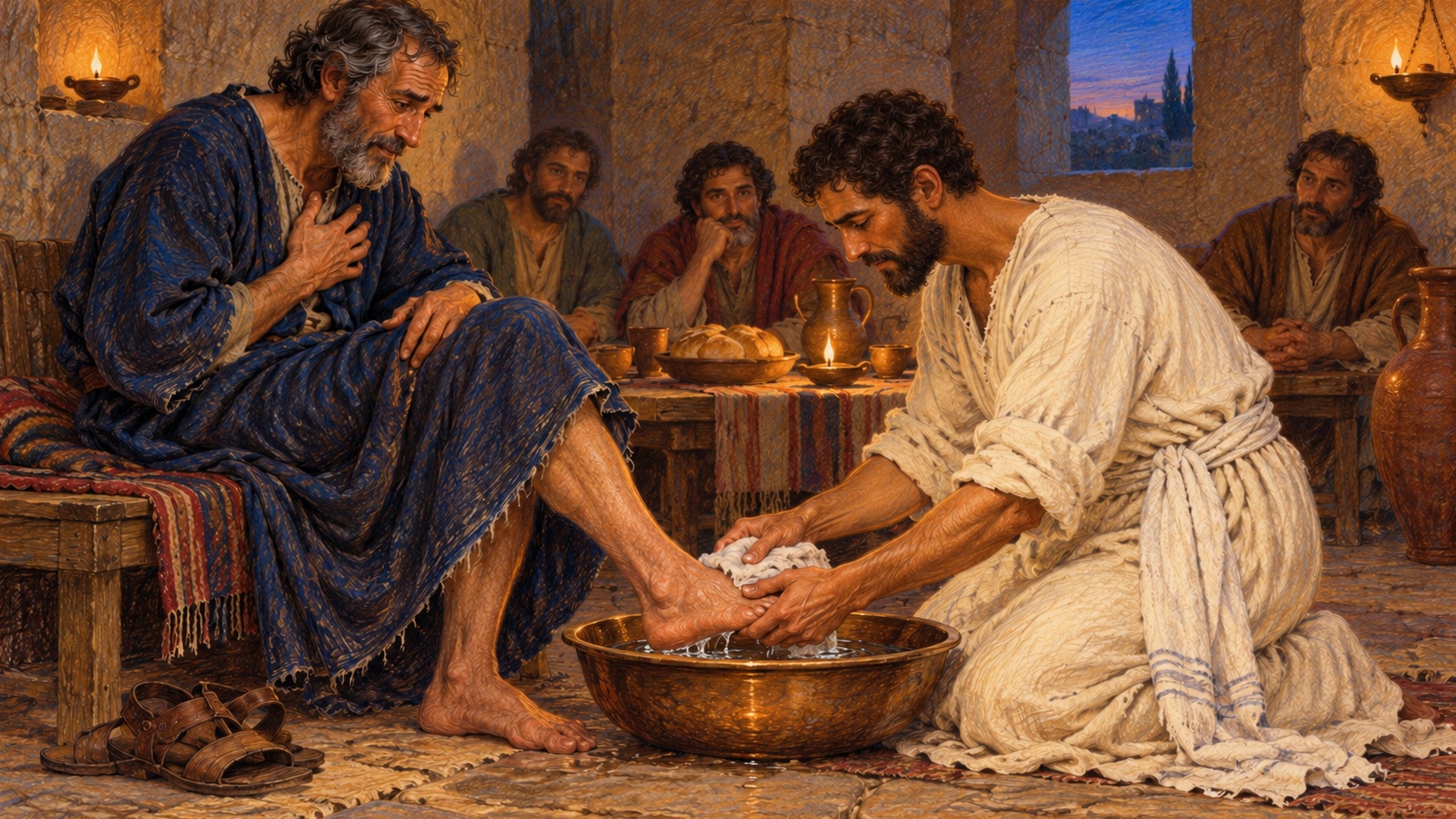
Jesus washed His disciples’ feet, and afterward He reminded them that they were right to call Him Teacher and Lord (John 13:12-14). He knew who He was while He served them. I think that helps us understand humility, because Scripture calls us to serve other people without asking us to deny the truth about what God has given us.
Humility Begins With the Truth
If God has given me an ability, pretending that I do not have it is not an honest response to Him. Neither is insisting that I have no value. God created human beings in His image, and acknowledging that does not mean I have made myself the center of His creation. It means I am receiving what He says about the people He made (Genesis 1:26-27).
That same truth also tells me why I have no reason to boast. God is my Creator and rightful Lord, and I depend on Him even for the life that allows me to do anything. When Paul, one of Jesus’ apostles, spoke to the people of Athens about the God they did not know, he explained that God gives everyone life and breath. He then called them to repent because God would judge the world (Acts 17:24-31). We are dependent creatures, and we are also sinners who cannot rescue ourselves from that judgment.
I need to acknowledge both of those things honestly. My sin gives me reason to confess my guilt and seek God’s mercy. It does not give me reason to call His creation worthless. And whatever ability I possess gives me a responsibility to use it faithfully, because I received it rather than creating myself. Paul makes that point when he asks the Corinthians why they boast as though what they have was not received (1 Corinthians 4:7).
A person can remain preoccupied with himself even while speaking contemptuously about himself. He might deny every ability and dismiss every encouragement, yet still spend his time worrying about how other people see him. I do not think that constantly drawing attention to my inadequacy is the same as humbling myself before God. Sometimes the honest response is to accept encouragement, acknowledge the help He has given, and get on with the work someone needs me to do.
That work brings other people into the question. Their lives do not exist to advance my ambitions, and their needs deserve attention even when helping them brings me no recognition. If I say that my time, abilities, and authority are gifts from God, then how I use them should reflect His concern for those people. Humility begins to become visible when someone else’s good has a real claim on my decisions.
One Greek word used for humility is tapeinophrosynē (ταπεινοφροσύνη), which describes lowliness of mind. Paul uses it in Philippians 2:3 when teaching believers how to regard one another, and he also uses it in Colossians 3:12 among the qualities they are to put into practice. Yet the same word appears in his warning about false humility in Colossians 2. Thayer’s entry notes those different uses. The word alone does not tell us that an outwardly lowly person is acting rightly; we have to look at what he is doing and what his humility serves.
The Mind of Christ and the Example of Moses
Paul’s letter to the Philippians helps us see what genuine lowliness looks like among believers. This church had supported his ministry and sent help for his needs, but its members still needed to learn how to put aside rivalry. Later in the letter, Paul addresses two women, Euodia and Syntyche, who had worked with him in the gospel. He urges them to be of the same mind in the Lord and asks that they be helped (Philippians 4:2-3, 15-18). Serving Christ together did not make them immune to disagreement.
In chapter 2, Paul appeals to what they already share through Christ’s love and the fellowship of the Holy Spirit. Because they belong to the same Lord, they are to care about one another instead of allowing selfish ambition to determine their conduct. He then points them to Christ Himself.
Let nothing be done through selfish ambition or conceit, but in lowliness of mind let each esteem others better than himself. Let each of you look out not only for his own interests, but also for the interests of others. Let this mind be in you which was also in Christ Jesus, who, being in the form of God, did not consider it robbery to be equal with God, but made Himself of no reputation, taking the form of a bondservant, and coming in the likeness of men. And being found in appearance as a man, He humbled Himself and became obedient to the point of death, even the death of the cross.
When Paul tells us to esteem others better than ourselves, I do not understand him to mean that I must pretend every person is wiser or more capable than I am in every respect. The next sentence explains the direction of his command: I am to look out for their interests as well as my own. Their needs should not be dismissed simply because I would rather have my way.
For example, if I expect everyone around me to rearrange what they are doing whenever my preference changes, I am treating my wishes as more important than their concerns. Calling myself unworthy while I do that will not repair the problem. I need to consider what my decision requires of them and whether I am willing to inconvenience myself for their good. Paul’s instruction reaches into the choices we make together, not merely the words we use about ourselves.
Jesus shows us how far that willingness to serve can go. Paul begins by identifying Him as being in the form of God. His equality with God was rightfully His, and He did not cease to be God when He took the form of a bondservant. The words translated as making Himself of no reputation are explained by what follows: He took a servant’s condition and came in the likeness of men.
I understand this to mean that the eternal Son became truly man while remaining fully God. He added a genuine human nature; He did not surrender His divine nature or empty Himself of His divine attributes. His humility was therefore voluntary service by One who knew His rightful position. He did not use that position to avoid serving people beneath Him, and His obedience continued all the way to death on a Roman cross.
Paul continues by saying that God highly exalted Him and that every knee will bow and every tongue will confess that Jesus Christ is Lord (Philippians 2:9-11). The Father vindicated the Son whom people had rejected. Jesus did not become divine for the first time when He was exalted, nor did He acquire a worth He had previously lacked. The One who willingly humbled Himself is the Lord whom all will acknowledge.
We can see that same relationship between His authority and His service in the foot washing mentioned at the beginning of this study. John tells us that Jesus knew the Father had given all things into His hands and that He had come from God and was returning to God. Then He rose from supper, took a towel, poured water into a basin, and began washing His disciples’ feet. Afterward He explained that, because their Lord and Teacher had served them in that way, they ought to serve one another (John 13:3-15).
Knowing His authority did not keep Him from serving, and serving did not require Him to deny His authority. Nor did His humility prevent truthful correction. When His disciples tried to keep children away, He corrected them and welcomed the children (Mark 10:13-16). He also exposed the hypocrisy of religious leaders who wanted honor while burdening others, and He drove sellers and money changers out of the temple (Matthew 23:1-15; 21:12-13). I cannot appeal to His humility as an excuse to avoid a difficult responsibility or remain silent when someone needs correction.
Moses gives us another example of humility in a person entrusted with authority. He was the man God used to lead Israel out of Egypt, and in Numbers 12 his sister Miriam and his brother Aaron spoke against him. They began with criticism concerning the Ethiopian woman he had married, and then they questioned whether the Lord had spoken only through Moses. They pointed out that He had also spoken through them (Numbers 12:1-2).
It is in that setting that Scripture describes Moses as very humble. The Hebrew word is anav (עָנָו), meaning humble or meek in this passage, as the entry in Brown–Driver–Briggs explains. The Lord heard their criticism and called all three of them to the tabernacle, the place of meeting with Him. He came down in a pillar of cloud and stood at the entrance, and then He called Aaron and Miriam forward to address them about the responsibility He had given Moses.
Then He said, “Hear now My words: If there is a prophet among you, I, the LORD, make Myself known to him in a vision; I speak to him in a dream. Not so with My servant Moses; He is faithful in all My house. I speak with him face to face, Even plainly, and not in dark sayings; And he sees the form of the LORD. Why then were you not afraid To speak against My servant Moses?”
God explained that His communication with Moses differed from the dreams and visions He gave other prophets. He spoke to Moses plainly, and He described him as faithful in His house. Moses had not invented this distinction as a way to elevate himself over his brother and sister. God had established it, and God now defended the servant to whom He had entrusted that work. Humility did not require Moses to pretend their responsibilities were identical.
What Moses did next also shows us how he regarded the people who had opposed him. When the cloud departed, Miriam was afflicted with leprosy. Aaron acknowledged their sin and pleaded with Moses, and Moses cried out to God to heal her. The Lord required Miriam to remain outside the camp for seven days, and the people waited until she was brought back before continuing their journey (Numbers 12:9-16).
Moses had been defended by God, but he did not use Miriam’s affliction as an opportunity to humiliate her further. He asked for her healing. I find that to be a helpful example because accepting the responsibility God has given me does not require hostility toward someone who questions it. Moses could accept God’s defense of his role while still seeking mercy for his sister.
The statement about Moses’ humility sometimes raises a question about his recording it himself. I do not think an inspired writer becomes proud simply by reporting something God reveals about him. Paul could truthfully identify himself as an apostle while acknowledging that he had persecuted the church and that his present service was due to God’s grace (1 Corinthians 15:9-10). The question is whether the statement serves God’s message or whether I am using it to impress the people listening. Telling the truth about a calling is different from claiming that I deserve everyone’s admiration.
Humbling Ourselves Before God
The concern for other people that we have seen in Christ and Moses also exposes what is wrong with selfish ambition. James addresses that problem among his readers by tracing their quarrels to the desires they were determined to satisfy. They coveted what they did not have, fought with one another, and brought their selfish aims into prayer. Some did not ask God at all; others asked so that they could spend what they received on their pleasures (James 4:1-3).
James calls them away from this friendship with the world, which puts them in opposition to God. He does not leave them to repair themselves without help. He tells them that God gives more grace, and then he explains the response His grace calls for.
But He gives more grace. Therefore He says: “God resists the proud, But gives grace to the humble.” Therefore submit to God. Resist the devil and he will flee from you. Draw near to God and He will draw near to you. Cleanse your hands, you sinners; and purify your hearts, you double-minded. Lament and mourn and weep! Let your laughter be turned to mourning and your joy to gloom. Humble yourselves in the sight of the Lord, and He will lift you up.
The command to humble themselves in James 4:10 uses tapeinōthēte, a form of the Greek verb tapeinoō (ταπεινόω). The verb can mean to bring low or humble, and Thayer’s discussion includes its use here before the Lord. The surrounding commands tell us what James means. These people are to submit to God, resist the devil, and draw near to the One whose will they have been resisting.
Clean hands and purified hearts describe more than an outward religious gesture. Their actions need to change, and so do the divided loyalties behind those actions. James calls them double-minded because they cannot keep pursuing the world’s desires while claiming undivided devotion to God. Their grief should be an honest response to the wrong they have done and the harm their conduct has caused.
I do not understand James to be prescribing permanent gloom or a display of sorrow intended to impress someone. He is speaking to people who have treated sin too lightly. When they acknowledge what they have done, their response should fit its seriousness. Laughing it off or explaining why everyone else is responsible would leave them defending the very conduct he is calling them to forsake.
James then shows how that repentance affects ordinary life. He forbids speaking evil of a brother and taking the position of a judge over God’s law. He also addresses people who confidently announce their plans to travel, trade, and make a profit, even though they do not know what tomorrow will bring. Their plans need to acknowledge the Lord’s will and their dependence on Him (James 4:11-17). I cannot claim to be humble before God while reserving the right to malign other people or to live as though my future belonged entirely to me.
His rebuke gives the repentant person somewhere to turn because God gives more grace. We do not have to make Him willing to be merciful by producing a sufficiently impressive apology. He is already calling sinners to draw near. Humility receives that correction, admits the wrong, and depends on the mercy He gives instead of continuing to defend a position against Him.
The promise that He will lift us up does not turn humility into a way to obtain wealth, promotion, or a larger audience. James gives no deadline by which other people must recognize our importance. I understand the promise in terms of God’s gracious restoration of the repentant and His final exaltation of His people. If I adopt a lowly manner because I expect it to make me important later, I am still pursuing the selfish ambition James has exposed.
Peter applies humility to believers who are facing suffering, and he begins his instruction with the elders who care for the church. He describes the people as God’s flock and tells their leaders to serve willingly, without exploiting them for gain or dominating them. Younger people are to submit to their elders, but the leaders themselves are not exempt from humility. Peter extends the instruction to everyone (1 Peter 5:1-5).
Likewise you younger people, submit yourselves to your elders. Yes, all of you be submissive to one another, and be clothed with humility, for “God resists the proud, But gives grace to the humble.” Therefore humble yourselves under the mighty hand of God, that He may exalt you in due time, casting all your care upon Him, for He cares for you. Be sober, be vigilant; because your adversary the devil walks about like a roaring lion, seeking whom he may devour. Resist him, steadfast in the faith, knowing that the same sufferings are experienced by your brotherhood in the world. But may the God of all grace, who called us to His eternal glory by Christ Jesus, after you have suffered a while, perfect, establish, strengthen, and settle you.
A pastor’s responsibility is to shepherd people who belong to Christ. Peter calls Jesus the Chief Shepherd, which means the man leading a congregation is himself answerable to the Lord. He is to teach sound doctrine and give people an example of obedience. He has no right to require sin or conceal wrongdoing because the truth would damage his reputation. Asking people to protect a leader from truthful accountability contradicts the care Peter requires of that leader.
Peter also connects humbling ourselves under God’s mighty hand with casting our care upon Him. I find that connection to be helpful because admitting that I cannot carry everything alone is part of recognizing my dependence on God. His care gives me reason to entrust my fears to Him and ask for help. I do not have to pretend that the trouble is small before I can bring it to Him.
At the same time, Peter immediately tells his readers to be watchful because the devil seeks to devour them. He calls them to resist him, remaining steadfast in the faith. Depending on God therefore includes paying attention to the dangers He has warned us about. Casting my care on Him is not a reason to ignore what is happening or refuse a wise action that is available to me.
The promised exaltation comes in God’s due time. Peter acknowledges that these believers suffer, and he reminds them that other Christians throughout the world are suffering too. He directs them to the God of all grace, who will establish and strengthen His people. I should not accuse a suffering believer of pride or weak faith simply because relief has not come. God’s care is present during the affliction, and the person does not have to minimize that affliction to prove that he trusts Him.
A promise about humbling ourselves also appears in 2 Chronicles 7, but there God is speaking to a particular king about a particular nation. Solomon, David’s son and the king of Israel, had built and dedicated the temple. In his prayer, he had asked God to hear His people when their sin brought judgment upon them and they turned back to Him. He specifically mentioned such troubles as drought, defeat, and disease (2 Chronicles 6:24-31).
When the Lord appeared to Solomon afterward, He said that He had heard that prayer. The Hebrew root used for humbling themselves is kana (כָּנַע), which can describe humbling oneself or being subdued. Brown–Driver–Briggs includes this passage among its uses. Here God joins His people’s humility with prayer, seeking Him, and turning from their wicked conduct.
When I shut up heaven and there is no rain, or command the locusts to devour the land, or send pestilence among My people, if My people who are called by My name will humble themselves, and pray and seek My face, and turn from their wicked ways, then I will hear from heaven, and will forgive their sin and heal their land.
The land in this promise was the land God had given Israel. The surrounding verses also name the temple and the throne promised to David’s house. God promised to hear repentant Israel and heal their land after the judgments He described, but He also warned that abandoning Him to worship other gods would bring removal from the land and disgrace upon the temple (2 Chronicles 7:12-22). The promise of restoration and the warning of judgment belong to His covenant dealings with that nation.
I can learn from Israel’s call to confess sin and seek the Lord without changing the people to whom He made that promise. Christians should pray for our country, its rulers, and our neighbors, and we should ask God to correct sin among His people. But this verse does not guarantee a particular election result, policy, prosperity, or rainfall in our country. The church does not replace Israel. I believe God will keep His promises to that nation, including its future under the Messiah, as Paul also explains when he speaks of Israel’s coming deliverance in Romans 11:25-29.
When Humility Becomes a Religious Performance
Submitting to God also means testing teaching that claims to speak for Him. In Colossians 2, Paul warns believers about people who judged them over food and drink and over the observance of festivals, new moons, and sabbaths. These teachers also promoted the worship of angels and occupied themselves with claims about things they had not seen. Their religious practices could appear demanding and impressive, but Paul identifies pride beneath the appearance of humility.
Let no one cheat you of your reward, taking delight in false humility and worship of angels, intruding into those things which he has not seen, vainly puffed up by his fleshly mind, and not holding fast to the Head, from whom all the body, nourished and knit together by joints and ligaments, grows with the increase that is from God. Therefore, if you died with Christ from the basic principles of the world, why, as though living in the world, do you subject yourselves to regulations– “Do not touch, do not taste, do not handle,” which all concern things which perish with the using–according to the commandments and doctrines of men? These things indeed have an appearance of wisdom in self-imposed religion, false humility, and neglect of the body, but are of no value against the indulgence of the flesh.
The wording about things the person has not seen follows the received Greek text reflected in the NKJV. Paul is exposing an unfounded claim, not approving the teacher’s claimed spiritual access. He also identifies a deeper problem: the person is not holding fast to the Head. Christ is the Head of the body, the church, and the body receives its nourishment and growth from Him. Angels, claimed visions, and rules invented by men cannot take His place.
This is the same noun for humility that we encountered in Philippians, but here Paul describes people who are puffed up in their own minds. They impose restrictions and neglect the body in ways that give an appearance of wisdom. Yet those practices do not overcome the sinful desires Paul describes as the indulgence of the flesh. A person may be very harsh toward his body while remaining proud of how much more disciplined he is than everyone else.
I do not take Paul’s warning as a condemnation of fasting or wise personal discipline. Jesus fasted in the wilderness, and Paul describes disciplining his body in his service of the gospel (Matthew 4:1-2; 1 Corinthians 9:24-27). A believer may set aside something lawful in order to pray or remove a distraction. The problem comes when I turn my practice into a command from God that Scripture has not given, and then judge other believers by whether they adopt it.
Jesus addresses another way that right practices can be used to serve pride. In Matthew 6, He speaks about giving to those in need, praying, and fasting. He expects His followers to do these things, but He warns them about doing them for the purpose of being seen and honored by other people.
“Take heed that you do not do your charitable deeds before men, to be seen by them. Otherwise you have no reward from your Father in heaven. Therefore, when you do a charitable deed, do not sound a trumpet before you as the hypocrites do in the synagogues and in the streets, that they may have glory from men. Assuredly, I say to you, they have their reward. But when you do a charitable deed, do not let your left hand know what your right hand is doing, that your charitable deed may be in secret; and your Father who sees in secret will Himself reward you openly.”
The charitable deed may help someone, but the person doing it can still be seeking an audience’s admiration. Jesus tells His followers to give so quietly that they do not turn their own generosity into an advertisement. The Father sees what happens in secret, and His knowledge is enough even when no one else gives the giver credit.
That does not mean every visible gift or public prayer is wrong. We have already considered Solomon’s prayer at the dedication of the temple, offered before the assembled people. Acts also records believers praying together and church leaders fasting together (Acts 4:23-31; 13:1-3). Jesus identifies the purpose He condemns: performing devotion in order to be seen. Someone noticing what I do is different from my arranging it so that being noticed becomes the reward I seek.
His teaching continues into the ordinary decisions involved in prayer and fasting. I can pray when no one else is listening because the Father already knows what I need. I can help someone without publicizing that I helped, and I can fast without making sure everyone notices my discomfort. If I think an act of devotion has accomplished little because it brought me no reputation, I need to examine whose approval I was seeking.
Religious performance can also appear in the very words a person speaks to God. Luke tells us that Jesus addressed a parable to people who trusted in their own righteousness and despised others. In the parable, two men go to the temple to pray. One is a Pharisee, a member of a religious group associated with careful observance of the law. The other is a tax collector, and the Pharisee treats him as an example of the kind of sinner he believes himself to be above (Luke 18:9-10).
“The Pharisee stood and prayed thus with himself, ‘God, I thank You that I am not like other men–extortioners, unjust, adulterers, or even as this tax collector. I fast twice a week; I give tithes of all that I possess.’ And the tax collector, standing afar off, would not so much as raise his eyes to heaven, but beat his breast, saying, ‘God, be merciful to me a sinner!’ I tell you, this man went down to his house justified rather than the other; for everyone who exalts himself will be humbled, and he who humbles himself will be exalted.”
The Pharisee addresses God with thanks, but he uses the prayer to recite his achievements and establish a favorable comparison. He fasts twice a week and gives tithes, meaning a tenth, of what he possesses. The tax collector supplies no corresponding record of accomplishments. He will not even lift his eyes toward Heaven, and he appeals to God for mercy as a sinner.
Jesus says that the tax collector went home justified rather than the Pharisee. To be justified is to be declared righteous before God. The tax collector admitted his guilt and depended on God’s mercy instead of claiming that his religious record entitled him to acceptance. His confession did not purchase justification. If I turn my admission of unworthiness into another accomplishment that makes me better than other people, I have reproduced the attitude Jesus was confronting.
I can do that even while discussing humility. Thanking God that I am less proud than the people around me still leaves me looking at them with contempt. I have changed the virtue I am congratulating myself about, but I have not abandoned the comparison. We must discern whether teaching and conduct agree with Scripture, yet another person’s failure does not establish my superiority. Nor does it give me knowledge of every private motive behind his actions.
The mercy that the tax collector sought is the mercy God provides through Jesus Christ. We have already seen that the eternal Son became truly man without ceasing to be God. He was born of a virgin and lived without sin, so He did not need forgiveness for wrongs of His own (Luke 1:26-35; Hebrews 4:15). He willingly gave Himself to be slain as the perfect sacrifice for our sins while wicked men tortured and crucified Him.
I believe His saving work through His shed blood and death was complete before His burial and bodily resurrection. He truly died for our sins, was buried, and rose again, as Paul sets out in 1 Corinthians 15:3-4. I also believe the Father did not punish, curse, abandon, strike, bruise, or pour wrath upon Jesus. Father, Son, and Holy Spirit remained united, with no broken fellowship in the Godhead. The Son’s humility and obedience do not mean that the Father became His torturer.
Christ died for the whole world, and God genuinely offers eternal life to every person (1 John 2:2; John 3:16-18). A person can resist His grace and reject the Savior, but everyone who repents and believes in Christ is forgiven and justified. Repentance turns from our sinful rejection of God to Him, and faith receives what Christ has provided. Neither is a religious achievement that puts God in our debt.
God also gives the true believer new birth, making him a new creation. The Holy Spirit, who is a divine Person, comes to live within him and seals him for the promised inheritance (John 1:12-13; Ephesians 1:13-14). Everyone truly born again is eternally secure in Christ. A shallow profession of faith does not establish that new birth has occurred, and assurance of salvation gives no permission for lawlessness. The Spirit teaches us to turn from conceit and serve others, even though we still need correction and have not become sinlessly perfect.
Sober Service, Safe Boundaries, and a Humble Walk
Because salvation is God’s gift, serving Him is a response to mercy we have received. It is not how we earn or keep our place in His family. Paul follows that order in Romans 12, beginning with God’s mercies and then calling believers to present themselves to Him. He goes on to explain how this response affects their work together in the church, where people with different gifts need one another.
For I say, through the grace given to me, to everyone who is among you, not to think of himself more highly than he ought to think, but to think soberly, as God has dealt to each one a measure of faith. For as we have many members in one body, but all the members do not have the same function, so we, being many, are one body in Christ, and individually members of one another. Having then gifts differing according to the grace that is given to us, let us use them: if prophecy, let us prophesy in proportion to our faith; or ministry, let us use it in our ministering; he who teaches, in teaching; he who exhorts, in exhortation; he who gives, with liberality; he who leads, with diligence; he who shows mercy, with cheerfulness.
Paul tells us to think soberly, which means making an honest judgment about ourselves. His next instruction is to use the gifts God has given. A teacher should teach, a leader should lead diligently, and someone entrusted with resources should give generously. Denying that I have a responsibility or ability would not fulfill the command. I am to use what I have received while remembering who gave it and how it can help other people.
Paul’s comparison with the human body also keeps me from treating one gift as a reason for superiority. Different members do different work, but they belong to the same body and depend on one another. The measure of faith God has given is not permission to divide believers into classes of greater and lesser worth. Paul directs each person toward faithful service in the place God has given him.
If I use a gift to demonstrate how important I am, I have taken something intended to benefit others and made it an occasion to congratulate myself. But I can also fail those people by refusing to serve because I do not want anyone to think I regard myself as capable. Humility allows me to accept the responsibility and do the work, while remaining willing to receive help from someone whose gifts differ from mine.
That honesty affects the way I receive encouragement too. If someone offers a sincere compliment, denying every word of it can leave him arguing against my self-criticism instead of encouraging me. Often I can simply thank him, acknowledge the Lord’s help and the contributions of other people, and return to the work. I do not need to fish for praise or turn refusing praise into another performance.
The same willingness to tell the truth lets me acknowledge a limitation. I can say that I do not know an answer, ask someone to help me, or admit that I was wrong. Pretending I can handle something beyond my present ability may hurt the people depending on me. Asking for help gives someone else an opportunity to serve and protects those people from my determination to appear competent at everything.
Honesty is just as necessary when authority is being abused. Nothing we have read requires a victim or a witness to conceal wrongdoing. Truthful testimony may be needed to protect someone else, and answering a false accusation does not automatically mean I am proud. Quietly allowing a lie to stand is not always the more humble response.
Every human authority remains under God’s authority. A husband, parent, pastor, employer, or government official cannot make an evil action righteous by ordering someone to do it. We can see that principle when the religious council ordered Jesus’ apostles to stop teaching in His name. Peter and the other apostles answered that they must obey God rather than men (Acts 5:27-29). Their refusal was obedience to the higher authority, not a claim that they were answerable to no one.
A believer may therefore need to refuse an evil demand, seek appropriate protection, or report wrongdoing. That can be done truthfully and with restraint, without using the situation to settle personal grievances. Preserving the appearance of peace cannot justify asking someone to surrender the truth. The care for other people required by humility may be the very reason a person needs to speak.
Micah makes that connection between walking humbly with God and treating people rightly. In chapter 6, the prophet presents the Lord’s complaint against Israel, calling the mountains and the foundations of the earth to hear His case. This is sometimes called a covenant lawsuit because God is confronting the people with their failure to live according to their relationship with Him. He reminds them that He brought them out of slavery in Egypt and protected them as He brought them into the land (Micah 6:1-5).
The questions that follow propose increasingly extravagant offerings. They move from ordinary sacrifices to thousands of rams and immense quantities of oil, and finally to the proposal of giving a firstborn child. The question is whether some costly gift can make things right while the giver has failed to live as God requires.
With what shall I come before the LORD, And bow myself before the High God? Shall I come before Him with burnt offerings, With calves a year old? Will the LORD be pleased with thousands of rams, Ten thousand rivers of oil? Shall I give my firstborn for my transgression, The fruit of my body for the sin of my soul? He has shown you, O man, what is good; And what does the LORD require of you But to do justly, To love mercy, And to walk humbly with your God?
The Lord had already shown His people what was good. Doing justly meant that their dealings with others needed to be right, and loving mercy meant that they should care about showing kindness instead of looking for reasons to withhold it. Walking humbly with God meant living under His direction. An impressive offering could not take the place of that obedience.
The proposal about a firstborn child is part of the escalating question, not God’s approval of human sacrifice. Nor is Micah teaching that people can buy forgiveness by accumulating good deeds instead of sacrifices. He is exposing an attempt to use an offering in place of the response God had already required. The rest of the chapter names dishonest measures, deceitful weights, violence, and lies among the people’s sins (Micah 6:10-12). Someone cheating a neighbor could not repair that wrong simply by appearing devout at worship.
I need to apply that to ordinary relationships. A quiet manner tells us very little about whether I walk humbly with God if I ignore someone being oppressed. Listening before I answer gives another person a fair hearing. Confessing sin without excuses means acknowledging what I actually did, rather than apologizing only for the other person’s reaction. When correction exposes a real failure, pointing to someone else’s faults will not deal with my own.
There are also ordinary opportunities to give credit where it belongs, keep a promise, and do useful work that few people notice. I can ask the Holy Spirit to show me through Scripture where defensiveness or a desire for recognition is shaping those decisions. If He exposes a wrong, the response needs to become specific. I may need to apologize plainly, ask for help, or serve a person whose need I have been overlooking. False self-condemnation needs correction too, because denying what God has given does not help me obey Him.
When anxiety accompanies that obedience, Peter’s instruction gives us a response: entrust the care to the Lord because He cares for us. We can do that while taking the wise action available to us. Depending on Him is something we practice in the decision before us, whether anyone else notices that decision or not.
My Final Thoughts
Christ served His disciples while knowing that He was their Lord, and Moses sought mercy for his sister after God defended his responsibility. Those accounts show why humility does not require denying the truth about ourselves. The warnings in James and Colossians also show why a lowly appearance is not enough. Humility submits to God in the way we respond to correction, use what He has given, and treat the people around us.
I have received salvation through Christ’s mercy, so I do not need to make a religious performance the basis of His acceptance. I want to serve from that gratitude, tell the truth when doing so is costly, and admit my sin without trying to make someone else look worse. God knows the work that goes unnoticed and the needs I cannot carry alone. I can leave recognition and exaltation in His hands while doing what He has placed before me.