
Canaan runs through the Bible from Abraham’s call to Israel’s future restoration. Why did God give this particular land, and what happened when Israel failed within it? As I work through those questions, I think we have to face the conquest honestly without letting the greater rest found in Christ erase the literal covenant promise.
God’s Covenant Promise of the Land
We need to avoid two opposite errors. Possession of the land never excused Israel’s unbelief or made every national action righteous. At the same time, Canaan cannot be reduced to a spiritual metaphor whose promises are transferred to the church. Scripture permits neither conclusion because the land ultimately belongs to the Lord. Israel received it through covenant promise while remaining accountable to the God who gave it.
Canaan also contributes to the Bible’s teaching about rest and inheritance. Hebrews looks back to the wilderness generation and Joshua, then announces that a rest still remains for the people of God. That larger rest is received through faith and will reach its fullness in God’s completed kingdom. Yet the later spiritual application does not erase the earlier promise in its ordinary historical sense. God can give believers from every nation an inheritance in Christ while still keeping His word to Abraham’s physical descendants.
The land promise enters Abraham’s story before he owns any substantial part of Canaan. God calls him away from his country and his father’s household without first giving him a map of the entire journey. Abraham responds by going where the Lord leads, so his first relationship to Canaan is one of faith. I do not want to overlook his genuine obedience, but Abraham’s faithfulness is not what guarantees the covenant. The promise rests finally on the faithfulness of the God who spoke it.
Now the LORD had said to Abram: “Get out of your country, From your family And from your father’s house, To a land that I will show you. I will make you a great nation; I will bless you And make your name great; And you shall be a blessing. I will bless those who bless you, And I will curse him who curses you; And in you all the families of the earth shall be blessed.” So Abram departed as the LORD had spoken to him, and Lot went with him. And Abram was seventy-five years old when he departed from Haran. Then Abram took Sarai his wife and Lot his brother’s son, and all their possessions that they had gathered, and the people whom they had acquired in Haran, and they departed to go to the land of Canaan. So they came to the land of Canaan. Abram passed through the land to the place of Shechem, as far as the terebinth tree of Moreh. And the Canaanites were then in the land. Then the LORD appeared to Abram and said, “To your descendants I will give this land.” And there he built an altar to the LORD, who had appeared to him.
The promise has several parts that must remain together. Abraham will become a great nation, his descendants will receive the land, and God will make him a blessing to all the families of the earth. That worldwide blessing eventually centers upon Jesus Christ, the promised Seed, without making either the nation or the land unreal. God later repeats the land promise through Isaac in Genesis 26 and Jacob in Genesis 28. Ishmael receives real promises from God, but the covenant line is specified through Isaac and Jacob.
Genesis 15 deepens the promise by revealing that Abraham’s descendants will first live as afflicted strangers in another land. God will judge the nation that oppresses them. Afterward, He will bring His people out and return them to Canaan. The Exodus and conquest are therefore not emergency plans devised after Israel falls into slavery. They fulfill a word God spoke centuries earlier.
Then He said to Abram: “Know certainly that your descendants will be strangers in a land that is not theirs, and will serve them, and they will afflict them four hundred years. And also the nation whom they serve I will judge; afterward they shall come out with great possessions. Now as for you, you shall go to your fathers in peace; you shall be buried at a good old age. But in the fourth generation they shall return here, for the iniquity of the Amorites is not yet complete.” And it came to pass, when the sun went down and it was dark, that behold, there appeared a smoking oven and a burning torch that passed between those pieces. On the same day the LORD made a covenant with Abram, saying: “To your descendants I have given this land, from the river of Egypt to the great river, the River Euphrates– the Kenites, the Kenezzites, the Kadmonites, the Hittites, the Perizzites, the Rephaim, the Amorites, the Canaanites, the Girgashites, and the Jebusites.”
The covenant ceremony is striking. Jeremiah 34 later explains that people cut a covenant by passing between the parts of a calf, an act that placed them under its solemn obligation. In Genesis 15, however, Abraham does not walk between the divided animals because God places him in a deep sleep. Instead, the smoking oven and burning torch that signify God’s presence pass between the pieces. The scene visibly places the covenant guarantee upon God’s own word, and Genesis 17 later calls this an everlasting covenant and the land an everlasting possession.
The broad boundary formula runs from the river of Egypt to the Euphrates. Interpreters debate the precise identity of the river of Egypt, and other passages describe boundaries for particular stages of settlement and administration. We do not need to force every boundary text into the same function. What I think we can say with confidence is that God named actual territory, not an undefined religious feeling. Israel experienced substantial fulfillment under Joshua and the monarchy, while the prophets still looked ahead to a settled restoration that had not yet reached its final form.
When God calls Moses, He identifies Himself as the God of the patriarchs. Israel’s deliverance from Egypt is therefore tied directly to His covenant and the promised land. The Lord has seen the oppression of His people and heard their cry. He knows their sorrow and acts to bring them out.
Moreover He said, “I am the God of your father–the God of Abraham, the God of Isaac, and the God of Jacob.” And Moses hid his face, for he was afraid to look upon God. And the LORD said: “I have surely seen the oppression of My people who are in Egypt, and have heard their cry because of their taskmasters, for I know their sorrows. So I have come down to deliver them out of the hand of the Egyptians, and to bring them up from that land to a good and large land, to a land flowing with milk and honey, to the place of the Canaanites and the Hittites and the Amorites and the Perizzites and the Hivites and the Jebusites.
“Flowing with milk and honey” is a Hebrew expression for fertility and abundance. Milk points naturally to productive herds and flocks. The Hebrew word translated honey can describe honey and is also used where concentrated fruit sweetness may be in view. The expression should not be pressed into a secret symbolic code. God was promising a good land capable of sustaining His people.
The land’s abundance did not promise effortless luxury. Israel would have to cultivate fields and tend livestock. The people would build homes and defend their communities while also observing the Sabbath years God commanded. Deuteronomy warns that prosperity can produce forgetfulness because full houses and successful harvests may tempt a person to credit his own power. The land remained an inheritance received from God. Leviticus 25:23 states the deeper ownership plainly: “the land is Mine.” Israel possessed Canaan under covenant but could never exclude the Lord who owned it.
Faith and Failure on the Way to Canaan
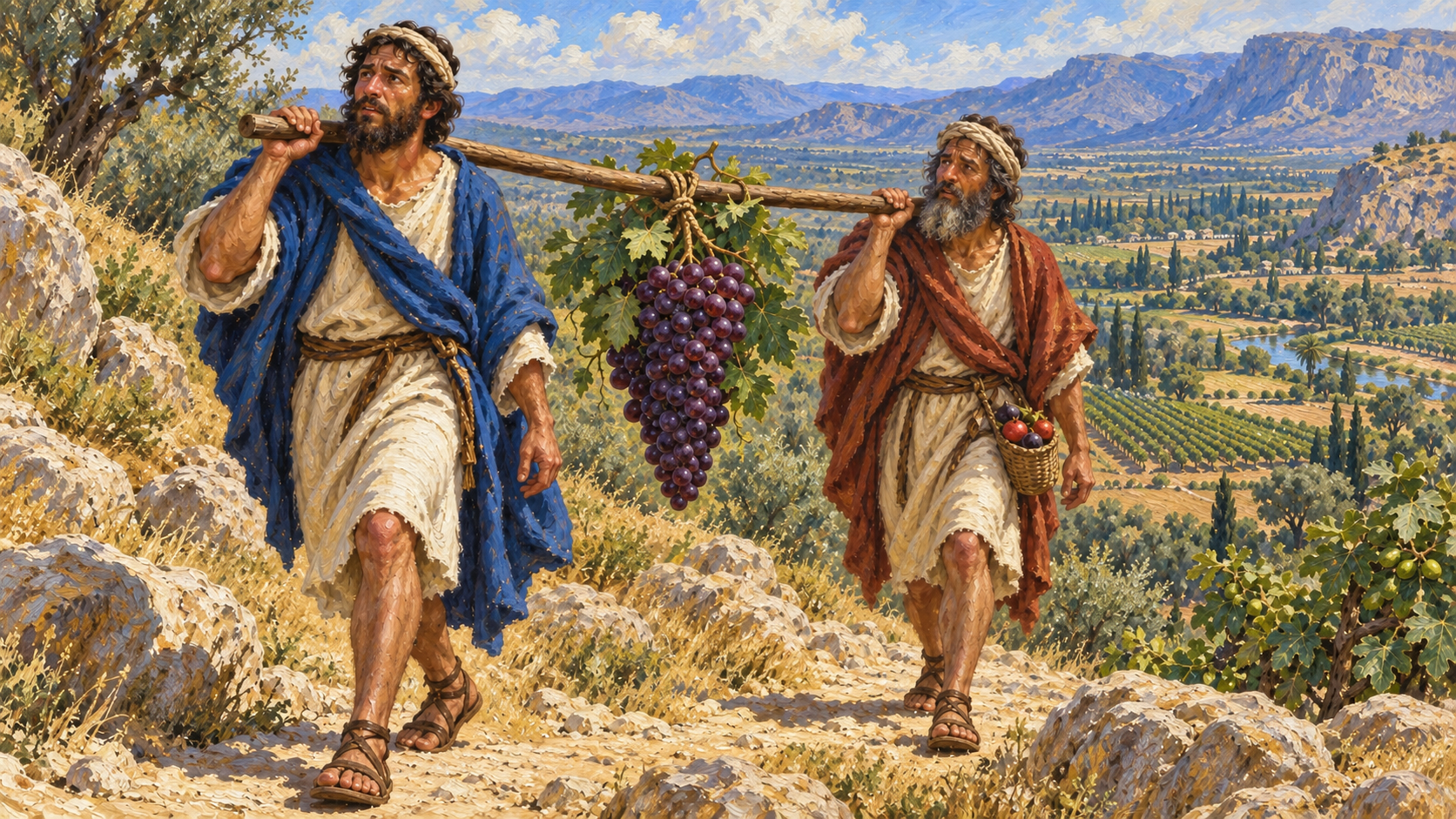
The twelve spies found both abundance and danger in Canaan. The fruit they carried back confirmed the land’s fertility. They also reported fortified cities and formidable inhabitants, including descendants of Anak who were known for unusual height. Numbers records their claim about the Nephilim, translated “giants” in the NKJV. The passage does not invite speculation about them to become the center of the account. Israel’s refusal to trust God is the true theological crisis.
Then they came to the Valley of Eshcol, and there cut down a branch with one cluster of grapes; they carried it between two of them on a pole. They also brought some of the pomegranates and figs. The place was called the Valley of Eshcol, because of the cluster which the men of Israel cut down there. And they returned from spying out the land after forty days.
Now they departed and came back to Moses and Aaron and all the congregation of the children of Israel in the Wilderness of Paran, at Kadesh; they brought back word to them and to all the congregation, and showed them the fruit of the land. Then they told him, and said: “We went to the land where you sent us. It truly flows with milk and honey, and this is its fruit. Nevertheless the people who dwell in the land are strong; the cities are fortified and very large; moreover we saw the descendants of Anak there. The Amalekites dwell in the land of the South; the Hittites, the Jebusites, and the Amorites dwell in the mountains; and the Canaanites dwell by the sea and along the banks of the Jordan.”
Then Caleb quieted the people before Moses, and said, “Let us go up at once and take possession, for we are well able to overcome it.” But the men who had gone up with him said, “We are not able to go up against the people, for they are stronger than we.”
And they gave the children of Israel a bad report of the land which they had spied out, saying, “The land through which we have gone as spies is a land that devours its inhabitants, and all the people whom we saw in it are men of great stature.
There we saw the giants (the descendants of Anak came from the giants);
and we were like grasshoppers in our own sight, and so we were in their sight.”
Caleb did not deny the size of the cities or the strength of their inhabitants. Faith never requires a person to pretend that an obstacle is small. Caleb measured Canaan’s defenses against the Lord who had defeated Egypt and sustained Israel in the wilderness. Because God had also promised the land, Caleb knew obedience was possible. The other spies reversed that comparison and measured God’s promise against the obstacle.
The grasshopper comparison came from their own fearful imagination: “we were like grasshoppers in our own sight.” Fear had already decided how the enemy saw them, and the report spread through the congregation until the people wanted a new leader and a return to Egypt. Their unbelief did not remain a private feeling; it grew into rebellion against God’s clear word.
Then the LORD said: “I have pardoned, according to your word; but truly, as I live, all the earth shall be filled with the glory of the LORD– because all these men who have seen My glory and the signs which I did in Egypt and in the wilderness, and have put Me to the test now these ten times, and have not heeded My voice, they certainly shall not see the land of which I swore to their fathers, nor shall any of those who rejected Me see it. But My servant Caleb, because he has a different spirit in him and has followed Me fully, I will bring into the land where he went, and his descendants shall inherit it.
Moses’ intercession was heard, yet pardon did not remove every temporal consequence. The unbelieving generation died in the wilderness, while Caleb and Joshua entered. Their history warns that exposure to God’s works is not the same as trusting His word.
Moses faithfully served through decades of opposition, but Scripture does not conceal his failure at Meribah. When the congregation lacked water, God told Moses and Aaron to gather the people and speak to the rock. Moses instead addressed the people in anger and struck the rock twice.
Then the LORD spoke to Moses, saying, “Take the rod; you and your brother Aaron gather the congregation together. Speak to the rock before their eyes, and it will yield its water; thus you shall bring water for them out of the rock, and give drink to the congregation and their animals.” So Moses took the rod from before the LORD as He commanded him.
And Moses and Aaron gathered the assembly together before the rock; and he said to them, “Hear now, you rebels! Must we bring water for you out of this rock?” Then Moses lifted his hand and struck the rock twice with his rod; and water came out abundantly, and the congregation and their animals drank.
Then the LORD spoke to Moses and Aaron, “Because you did not believe Me, to hallow Me in the eyes of the children of Israel, therefore you shall not bring this assembly into the land which I have given them.” This was the water of Meribah, because the children of Israel contended with the LORD, and He was hallowed among them.
God’s explanation is more precise than the common summary that Moses merely lost his temper. The LORD says Moses and Aaron did not believe Him and did not hallow Him before Israel. Moses’ words, “Must we bring water for you out of this rock?” and his repeated striking did not represent God’s instruction faithfully. Saying that he took credit may describe part of the danger, but Scripture emphasizes his unbelief and failure to sanctify God in the people’s sight.
Leadership does not make disobedience less serious. A teacher who speaks for God carries a special duty to represent His character and word accurately, especially when frustrated with God’s people. Moses later viewed the land from Mount Nebo, but Joshua led the nation across the Jordan. Grace did not erase the earthly consequence, and the consequence did not mean that Moses had ceased to belong to God.
Conquest, Judgment, and Mercy
Joshua’s Hebrew name stands behind the Greek form rendered Jesus, and both names declare that the Lord saves. I think that shared meaning is worth noticing, but it must never confuse Joshua son of Nun with Jesus Christ. Joshua was the appointed human leader who brought Israel into Canaan, while Jesus is the eternal Son of God and the only Savior.
God brought Israel across the Jordan before the nation kept Passover in the land and approached Jericho. The city’s walls fell only after the people followed an unusual command that left no room to boast in military brilliance. Rahab believed the Lord and welcomed the Israelite spies. When she sought mercy, God spared her household. Her rescue shows that the conquest was not based upon racial hatred. A Canaanite who turned to the Lord in faith found refuge among His people.
Joshua records a genuine stage of fulfillment after Israel’s campaigns and setbacks. The nation experienced covenant discipline along the way before the tribes received their allotted territory. We must believe Joshua’s declaration within its own setting. It neither denies Israel’s later failures nor cancels promises that the prophets still place in the future.
So the LORD gave to Israel all the land of which He had sworn to give to their fathers, and they took possession of it and dwelt in it. The LORD gave them rest all around, according to all that He had sworn to their fathers. And not a man of all their enemies stood against them; the LORD delivered all their enemies into their hand. Not a word failed of any good thing which the LORD had spoken to the house of Israel. All came to pass.
God kept every word required for Israel to possess and settle the land in Joshua’s generation. The same book also identifies territory that remained to be occupied. Judges later records Israel’s failure to drive out all the remaining inhabitants, while the prophets promise a restoration extending beyond the return from Babylon. These passages describe successive stages in one unfolding covenant history rather than contradicting one another.
The conquest includes commands and judgments that rightly trouble careful readers. Some passages explicitly name adults and children among those who died. Faithful teaching must not hide these words or soften them into something the text never says. It must also speak about human suffering with appropriate gravity. At the same time, we cannot judge God as though He were a fallible human ruler acting with limited knowledge.
Genesis 15:16 establishes divine patience before Israel existed as a nation: Abraham’s descendants would wait because “the iniquity of the Amorites is not yet complete.” The conquest came after centuries of forbearance. Leviticus then identifies the judgment as moral rather than ethnic.
‘Do not defile yourselves with any of these things; for by all these the nations are defiled, which I am casting out before you. For the land is defiled; therefore I visit the punishment of its iniquity upon it, and the land vomits out its inhabitants. You shall therefore keep My statutes and My judgments, and shall not commit any of these abominations, either any of your own nation or any stranger who dwells among you
(for all these abominations the men of the land have done, who were before you, and thus the land is defiled), lest the land vomit you out also when you defile it, as it vomited out the nations that were before you. For whoever commits any of these abominations, the persons who commit them shall be cut off from among their people.
‘Therefore you shall keep My ordinance, so that you do not commit any of these abominable customs which were committed before you, and that you do not defile yourselves by them: I am the LORD your God.'”
The warning is deliberately impartial because Israel could be expelled for committing the same abominations. Descent from Abraham could never make idolatry holy. Neither could it excuse sexual corruption or the sacrifice of children. After persistent covenant rebellion, the northern kingdom fell to Assyria and Judah fell to Babylon. The Judge who removed the Canaanites also disciplined Israel.
Deuteronomy removes another false defense by declaring that Israel did not receive the land because of moral superiority. God judged the entrenched wickedness of the nations. At the same time, He kept the oath He had made to the patriarchs.
“Hear, O Israel: You are to cross over the Jordan today, and go in to dispossess nations greater and mightier than yourself, cities great and fortified up to heaven, a people great and tall, the descendants of the Anakim, whom you know, and of whom you heard it said, ‘Who can stand before the descendants of Anak?’ Therefore understand today that the LORD your God is He who goes over before you as a consuming fire.
He will destroy them and bring them down before you; so you shall drive them out and destroy them quickly, as the LORD has said to you. “Do not think in your heart, after the LORD your God has cast them out before you, saying, ‘Because of my righteousness the LORD has brought me in to possess this land’; but it is because of the wickedness of these nations that the LORD is driving them out from before you.
It is not because of your righteousness or the uprightness of your heart that you go in to possess their land, but because of the wickedness of these nations that the LORD your God drives them out from before you, and that He may fulfill the word which the LORD swore to your fathers, to Abraham, Isaac, and Jacob. Therefore understand that the LORD your God is not giving you this good land to possess because of your righteousness, for you are a stiff-necked people.
God is the Creator and rightful Judge of every human life. He knows each heart and every possible consequence with perfect accuracy, but no human being possesses that authority. The conquest was a unique command from the time when God ruled Israel as a nation through the covenant. It supplies no standing permission for a church or modern government to wage religious war. No army or individual may claim private revelation as authority to seize land. The passage can never excuse ethnic hatred or killing in God’s name.
Mercy also appears inside the judgment. Rahab believed and was spared. The Gibeonites sought a covenant and survived, even though they acted deceptively. These accounts do not answer every emotional question, but they prevent the false claim that Canaanite ancestry itself made mercy impossible. Judgment fell on entrenched wickedness under God’s express command, and Israel was never authorized to generalize that command into ordinary policy.
Compromise, Exile, and Return
Judges begins where a triumphal summary could be misunderstood. Several tribes failed to remove the inhabitants from the territory assigned to them. Arrangements involving forced labor may have appeared practical because they promised an economic benefit. Yet this covenant compromise opened the door to worshiping the gods of the land. At Bochim, the Angel of the Lord declared that the remaining peoples and their gods would become snares to Israel.
The distinctive Angel of the Lord in this passage speaks with divine authority and identifies Himself as the One who brought Israel out of Egypt. I therefore understand Him as a Christophany, an appearance of the eternal Son before His incarnation, rather than an ordinary created angel. His warning frames every cycle that follows. Israel forsakes the Lord and falls under enemy oppression. When the people cry out, God raises a judge to deliver them.
Israel’s conflicts with its neighbors cannot be reduced to one cause. Some attacks arose because surrounding rulers desired greater control. At other times, Israel’s idolatry brought covenant discipline. The division of the kingdom after Solomon weakened both Israel and Judah, but political weakness was never the deepest problem. Corrupt kings led the people in false worship. Priests and ordinary Israelites also participated in injustice while rejecting the prophets God sent.
Assyria conquered the northern kingdom. Babylon later destroyed Jerusalem and the temple before carrying Judah into exile. These events fulfilled warnings given long before in Leviticus and Deuteronomy. I think we need to separate the promise itself from Israel’s enjoyment of it. God’s grant to Abraham was unconditional, but Israel’s peace and continued life in the land under the Mosaic covenant were tied to obedience. Exile was severe covenant discipline, not proof that God had become unfaithful or transferred the land to another people.
God did not leave Judah in Babylon forever. He stirred Cyrus to authorize the people’s return and the rebuilding of the temple. Zerubbabel led one of the early groups back to the land. Ezra later taught the Law, and Nehemiah oversaw the rebuilding of Jerusalem’s wall. Their accounts reveal God’s providence as His people face opposition and confess their sin. They also show renewed courage and attention to covenant faithfulness.
The return was real, but it was not the complete restoration described by all the prophets. Many Israelites remained dispersed. The restored community still lived under Gentile imperial power. Sin and death continued, and the nation remained vulnerable. The books written after the exile themselves look ahead to the coming Messiah and a greater work of cleansing and rule.
As I read these passages together, I want to avoid two mistakes. We should not minimize the return from Babylon as though it fulfilled nothing, but neither should we force every future restoration text into that return when its details extend beyond it. Biblical prophecy often moves through an initial fulfillment toward a final completion, and the context shows which features remain ahead.
Canaan’s Rest and Israel’s Future
Paul, the author of Hebrews, reads Psalm 95 alongside the wilderness history in Hebrews 3-4. The generation that left Egypt heard God’s promise but hardened their hearts in unbelief. Psalm 95 was written long after Joshua led Israel into the land, yet it still called its hearers to respond to God “Today.” That later invitation proves that the historical entrance under Joshua did not exhaust God’s rest.
For if Joshua had given them rest, then He would not afterward have spoken of another day.
There remains therefore a rest for the people of God.
For he who has entered His rest has himself also ceased from his works as God did from His.
Let us therefore be diligent to enter that rest, lest anyone fall according to the same example of disobedience.
Hebrews 4:8 uses the Greek name Iesous, which can refer to Joshua or Jesus. The context clearly identifies Joshua son of Nun because David later spoke of another day of rest. If Joshua had supplied the final rest, that later promise would have been unnecessary. Canaan gave Israel genuine relief from wandering and surrounding enemies, but it was not heaven. The people still experienced war and suffering there. They also continued to sin and die.
Canaan therefore supplies a pattern of received inheritance and rest without becoming a one-for-one picture of the believer’s final home. The deeper rest is received through faith rather than earned by human works. Hebrews’ warnings call professing believers to persevere rather than harden their hearts. They do not teach that a person who is truly born again can become unborn. God makes every true believer new. The Holy Spirit indwells and seals him, and his salvation is eternally secure. That security never permits rebellion, and a superficial profession is not proof that someone has truly believed.
All the families of the earth receive Abrahamic blessing through Jesus Christ. He is the eternal Son who is fully God and fully man. He was born of a virgin and remained completely sinless. Wicked men physically tortured and punished Jesus before killing Him. He willingly bore that real punishment for our sins in His innocent body. He shed His blood and died. After His burial, He rose bodily. The Father did not punish or curse Jesus. He did not abandon His Son, strike or bruise Him, or pour wrath upon Him.
Christ died for the whole world, and God’s genuine offer can be resisted, so every person must repent and believe in Him. The one who truly believes is forgiven and justified as God gives him new birth and makes him new. The Holy Spirit indwells and seals him, and his salvation is eternally secure. Neither ethnicity and land possession nor law keeping, baptism, church membership, or political loyalty can provide that salvation.
Gentile believers become children of Abraham by faith and share the blessing promised through the Seed. This inclusion does not convert the church into ethnic Israel or authorize Gentiles to boast against the natural branches. Spiritual blessing in Christ and a literal future for Israel belong together in the same faithful plan.
Romans 11 directly addresses Gentile pride. Israel has experienced blindness in part and for a limited period, “until the fullness of the Gentiles has come in.” Paul does not say that every Jewish person in every generation is automatically saved. Salvation has always required personal faith in the Messiah. The words “all Israel will be saved” point to the future believing nation that turns to its Deliverer, not to unbelieving Israelites being saved apart from Christ. God’s national purpose has not ended, and Paul grounds that confidence in God’s covenant and irrevocable calling.
For I do not desire, brethren, that you should be ignorant of this mystery, lest you should be wise in your own opinion, that blindness in part has happened to Israel until the fullness of the Gentiles has come in.
And so all Israel will be saved, as it is written: “The Deliverer will come out of Zion, And He will turn away ungodliness from Jacob; For this is My covenant with them, When I take away their sins.”
Concerning the gospel they are enemies for your sake, but concerning the election they are beloved for the sake of the fathers. For the gifts and the calling of God are irrevocable.
Ezekiel 36-37 joins Israel’s return to the land with spiritual cleansing and the gift of a new heart. The vision of national resurrection leads into the reunion of the nation under David’s greater Son. Zechariah 12-14 likewise places Israel’s recognition of the pierced Messiah within a connected future. National mourning gives way to cleansing before the Lord defeats His enemies and reigns. Amos describes the same hope in concrete terms as Israelites rebuild cities and cultivate the land God gave them.
“On that day I will raise up The tabernacle of David, which has fallen down, And repair its damages; I will raise up its ruins, And rebuild it as in the days of old; That they may possess the remnant of Edom, And all the Gentiles who are called by My name,” Says the LORD who does this thing.
“Behold, the days are coming,” says the LORD, “When the plowman shall overtake the reaper, And the treader of grapes him who sows seed; The mountains shall drip with sweet wine, And all the hills shall flow with it. I will bring back the captives of My people Israel;
They shall build the waste cities and inhabit them; They shall plant vineyards and drink wine from them; They shall also make gardens and eat fruit from them. I will plant them in their land, And no longer shall they be pulled up From the land I have given them,” Says the LORD your God.
I understand these promises as part of the literal future Scripture describes. Jesus will gather His church before the seven-year Tribulation. The phrase “Jacob’s trouble” comes from Jeremiah 30 and describes the severe period of distress from which Israel will finally be delivered. During that future Tribulation, Israel will be brought to recognize and trust the Messiah. Christ will then return bodily and reign for a literal thousand years. The land covenant belongs within that kingdom and cannot be dissolved into a metaphor.
This conviction does not declare every policy of a modern government righteous. A biblical covenant promise is not the same question as the moral evaluation of a present political decision. Every modern ruler remains accountable to God regardless of ancestry. Christians can reject replacement theology and oppose antisemitism while affirming Israel’s future. They must still test each human action by Scripture.
Living in Light of God’s Faithfulness
Canaan teaches us to receive God’s words in their ordinary context. When He names the patriarchs and their descendants, faith does not improve the promise by changing its recipients. It also does not turn a specified land into a different subject. When the New Testament announces blessing through Christ and a rest still open to believers, faith receives that teaching as well. God can keep both promises without contradiction.
The wilderness generation’s refusal to enter the land raises a question for us. Have we allowed visible obstacles to become arguments against obedience? Caleb and Joshua saw the same walls and warriors as the other spies. Their different report grew from a different confidence in the LORD. Biblical faith does not deny facts; it refuses to treat any creature as greater than the God who has spoken.
Moses at Meribah gives a warning to everyone who speaks about God. Teachers and parents should feel its weight with particular care. Anger can distort a true message until our frustration appears to reflect God’s own character. Long service never gives anyone permission to alter His instructions. When we fail, we should confess without delay and return to speaking with care so that those watching us see the Lord as holy.
The conquest and exile together destroy ethnic pride. God judged the Canaanites after showing long patience, yet Rahab found mercy through faith. Israel received the land by promise rather than moral superiority. When the nation later practiced the same evils, God expelled it. No person can stand before Him upon the strength of ancestry or culture. Political identity and moral comparison cannot save us either. We need the mercy offered through the blood of Jesus Christ.
The land also directs our hope toward God’s faithfulness. Human sin can bring severe discipline, delay the enjoyment of a promise, and expose false confidence, but it can never make God untrue. The Lord will keep His Word to Israel and complete His church, and He will judge evil before restoring creation under the righteous reign of Christ. We should therefore trust Jesus with humility. As that trust shapes our obedience to Scripture, it should also lead us to pray for Israel’s salvation in full confidence that not one good word of the Lord will fail.
My Final Thoughts
After tracing Canaan through Scripture, I do not believe we can turn it into only a symbol or use it to excuse whatever a nation does. God gave real land to Abraham’s line through Isaac and Jacob, and He remained faithful even when Israel’s sin brought exile. The conquest also reminds me that His judgments are holy and cannot be claimed as a model for modern religious war. Hebrews reveals a greater rest in Christ, but that blessing does not cancel Israel’s future restoration under the Messiah. Our first need is not a territorial claim; it is reconciliation with God through the crucified and risen Jesus. When we trust Him, we can receive each promise according to the words God used and rest in the certainty that not one good word of the Lord will fail.