
When Scripture speaks of the right hand of God, I want to slow down and ask what the image is actually telling us. The Bible uses bodily language to reveal God’s action, yet it also says plainly that God is Spirit. Psalm 110 then brings the question into sharp focus, because the risen Jesus is seated at the Father’s right hand.
How Scripture Uses the Right Hand
The Bible sometimes speaks about God’s face or describes Him as seeing and hearing. Other passages use the image of His arm or hand, and some even speak of His wings. These expressions communicate truth in language human beings can understand. They do not teach that the Father possesses a mortal body assembled from physical parts.
But the hour is coming, and now is, when the true worshipers will worship the Father in spirit and truth; for the Father is seeking such to worship Him. God is Spirit, and those who worship Him must worship in spirit and truth."
Jesus states plainly that God is Spirit. When Scripture says that God’s hand saved Israel, it is describing His personal action. The image emphasizes the strength He exercised and His complete control over the event. It is neither fiction nor an anatomical diagram.
This kind of language is often called anthropomorphism. The term simply means that God describes His action by comparison with human form so that we can understand it. The description is true, but I think we should pay close attention to the particular detail the context emphasizes. We should receive the picture God gave without turning it into a claim that the Father has flesh.
The Hebrew word commonly translated “right hand” is yamin. In Greek, Scripture uses dexios or the related noun dexia. These words can identify the physical right side. The biblical writers also use them as an image of strength or support, while a royal setting may make honor the main point. The sentence around the word must decide which meaning is in view.
"Your right hand, O LORD, has become glorious in power; Your right hand, O LORD, has dashed the enemy in pieces. And in the greatness of Your excellence You have overthrown those who rose against You; You sent forth Your wrath; It consumed them like stubble. And with the blast of Your nostrils The waters were gathered together; The floods stood upright like a heap; The depths congealed in the heart of the sea. The enemy said, ‘I will pursue, I will overtake, I will divide the spoil; My desire shall be satisfied on them. I will draw my sword, My hand shall destroy them.’ You blew with Your wind, The sea covered them; They sank like lead in the mighty waters. "Who is like You, O LORD, among the gods? Who is like You, glorious in holiness, Fearful in praises, doing wonders? You stretched out Your right hand; The earth swallowed them.
Moses sings after the sea has opened for Israel and closed over Pharaoh’s pursuing force. God’s right hand is the power that accomplished a historical rescue. The surrounding images of breath and hand describe the LORD’s direct action in creation; they do not require literal nostrils or fingers.
Pharaoh boasts that his own hand will destroy. The song answers that human military confidence cannot withstand the Creator. The right hand of the LORD therefore directs attention away from the instrument and toward the divine Deliverer.
"But you, Israel, are My servant, Jacob whom I have chosen, The descendants of Abraham My friend. You whom I have taken from the ends of the earth, And called from its farthest regions, And said to you, ‘You are My servant, I have chosen you and have not cast you away: Fear not, for I am with you; Be not dismayed, for I am your God. I will strengthen you, Yes, I will help you, I will uphold you with My righteous right hand.’"
Here the image moves from defeating an enemy to holding a servant steady. Israel is secure because God chose this people and remains present with them. His strength is joined to perfect faithfulness. The image of His righteous right hand never separates divine power from moral perfection.
The promise belonged to Israel in its historical and covenant setting. Christians should not erase that identity. We may still learn the character of the unchanging God: His servants need not treat fear as their master because His ability is joined to His faithfulness.
In the ancient world, the right side could represent the honored place beside a ruler. This symbolism appears when Scripture describes a blessing. It also belongs to the setting of a royal court and may distinguish the favored side in a scene of judgment. The context establishes the meaning. There is no mystical force residing in one direction.
Jacob crossed his hands when blessing Joseph’s sons and deliberately placed his right hand on Ephraim, the younger. Joseph tried to correct him, but Jacob explained that the choice was intentional. The hand expressed precedence in that blessing; it did not make every firstborn or every left side evil.
Solomon’s wisdom saying pictures length of days in wisdom’s right hand and riches and honor in her left. Both hands carry gifts. The verse itself prevents a rigid formula in which right always means good and left always means wickedness.
Judges identifies Ehud as a left-handed man whom God used to deliver Israel from Moab. 1 Chronicles records skilled Benjamites who could use both right and left hands in battle. Song of Solomon speaks warmly of the beloved’s left hand under the head.
Jonah 4:11 describes people in Nineveh who could not discern their right hand from their left. The idiom portrays their moral ignorance or helplessness; it does not declare their left hands sinful.
Scripture sometimes places the condemned on a judge’s left and the honored on his right, but the judge’s verdict gives those positions their meaning. Nothing in these passages makes a right-handed person holier than a left-handed person. A seat, entrance, gesture, or physical direction has no spiritual power of its own. This is why I believe we have to read each symbol within its sentence and book.
"When the Son of Man comes in His glory, and all the holy angels with Him, then He will sit on the throne of His glory. All the nations will be gathered before Him, and He will separate them one from another, as a shepherd divides his sheep from the goats. And He will set the sheep on His right hand, but the goats on the left. Then the King will say to those on His right hand, "Come, you blessed of My Father, inherit the kingdom prepared for you from the foundation of the world:
The right and left positions publicly display the King’s verdict. Deeds of mercy reveal the reality of allegiance; they do not purchase salvation. Christ identifies with His people so closely that treatment of His least brethren exposes the heart’s response to Him.
Those on the left enter everlasting punishment, while the righteous enter eternal life. The final punishment of unbelieving human beings is the second death: irreversible destruction of body and soul in Gehenna. Its effect is everlasting, not a process by which inherently immortal human souls must consciously suffer forever.
David sets the LORD continually before him and says that God is at his right hand. In this sentence, the right hand expresses the LORD’s protective nearness. David is not picturing himself on God’s throne.
The psalm moves from present stability to resurrection hope. God will not leave His Holy One in Sheol or allow Him to see corruption. Peter and Paul both explain that David could not be the final fulfillment because his body decayed. The promise reaches beyond him and is fulfilled in the bodily resurrection of Jesus.
The closing words place everlasting pleasures at God’s right hand, where nearness to Him brings fullness of joy. In this psalm, His power gives security and protection. The honored place in His presence also holds life and lasting delight. Those ideas belong together here, though that does not make them the meaning of every right-hand passage.
Psalm 110 and the Identity of the Messiah
The LORD said to my Lord, "Sit at My right hand, Till I make Your enemies Your footstool." The LORD shall send the rod of Your strength out of Zion. Rule in the midst of Your enemies! Your people shall be volunteers In the day of Your power; In the beauties of holiness, from the womb of the morning, You have the dew of Your youth. The LORD has sworn And will not relent, "You are a priest forever According to the order of Melchizedek."
Psalm 110 is the central Old Testament passage behind the New Testament language of Christ at God’s right hand. David hears the LORD address David’s Lord. The promised King receives the position of highest royal honor and waits for the public subjection of every enemy.
The psalm brings kingship and priesthood together in one Person. This ruler extends His scepter from Zion, yet He is also a priest forever according to Melchizedek’s order. Genesis 14 first introduces Melchizedek as king of Salem and priest of God Most High. I understand that meeting as a Christophany, a true appearance of the eternal Son before His incarnation. Psalm 110 therefore does not place Jesus beneath an unrelated human priest. It reveals the Messiah openly exercising the eternal royal priesthood already seen in Melchizedek. No ordinary king in David’s line can fulfill that union. Jesus does.
While the Pharisees were gathered together, Jesus asked them, saying, "What do you think about the Christ? Whose Son is He?" They said to Him, "The Son of David." He said to them, "How then does David in the Spirit call Him ‘Lord,’ saying: ‘The LORD said to my Lord, "Sit at My right hand, Till I make Your enemies Your footstool"’? If David then calls Him ‘Lord,’ how is He his Son?" And no one was able to answer Him a word, nor from that day on did anyone dare question Him anymore.
Jesus accepts the Messiah’s descent from David and exposes the incompleteness of stopping there. By the Holy Spirit, David calls his descendant Lord. The Messiah is truly human in David’s line and greater than David.
The eternal Son became fully man through the virgin birth without ceasing to be fully God. His two natures explain how He can be David’s descendant in history and David’s sovereign Lord.
The LORD speaks to David’s Lord. One Person addresses another, so Psalm 110 cannot collapse the Father and Son into one Person wearing different roles. Jesus prays to the Father and is sent by Him. He later returns to the Father and sits at His right hand.
This personal distinction does not create two gods. Scripture reveals one God who eternally exists in three Persons. The Father is God. The Son and Holy Spirit are also fully God, equal in divine nature and without beginning. Yet the three remain personally distinct.
Right-hand language therefore preserves both relationship and authority without teaching that the Father occupies a human-shaped chair. The risen Son possesses a real glorified human body, while the Father is Spirit. The Son’s bodily location in heaven is real, and the royal expression declares His honor beside the Father.
Christ’s Resurrection, Ascension, and Reign
This Jesus God has raised up, of which we are all witnesses. Therefore being exalted to the right hand of God, and having received from the Father the promise of the Holy Spirit, He poured out this which you now see and hear. "For David did not ascend into the heavens, but he says himself: ‘The LORD said to my Lord, "Sit at My right hand, Till I make Your enemies Your footstool."’ "Therefore let all the house of Israel know assuredly that God has made this Jesus, whom you crucified, both Lord and Christ."
Peter’s Pentecost sermon follows a clear sequence. Wicked men crucified Jesus, but God raised Him from the dead. The risen Christ was then exalted and poured out the promised Holy Spirit. The visible and audible signs of Pentecost testified that the enthroned Messiah was acting.
“Made both Lord and Christ” does not mean Jesus began to be divine. The eternal Son already shared God’s glory. In resurrection and exaltation, the crucified Jesus is publicly installed and declared as the promised Messianic ruler.
His ascension was not a disappearance into an idea. After rising, Jesus ate and spoke with His disciples. They saw His wounds and touched Him. This same Jesus entered heaven in His glorified body, and He will return in that body.
The theological term session refers to Christ sitting at God’s right hand. The word comes from the Latin idea of sitting, but I do not want us to miss how much more the Bible is describing than posture. The King has taken His appointed place and now actively exercises His reign.
Sitting upon the throne shows that Christ is neither wandering nor suffering defeat. He is not waiting for permission to become King. Jesus has received supreme authority, although His kingdom still awaits its open earthly manifestation. At the appointed time, every enemy will be placed beneath His feet.
Christ’s reign is already real, but the world has not yet seen its complete public result. He rules at the Father’s right hand even while nations resist Him and death continues to strike. When He returns, the victory that is certain now will become visible to all.
The Enthroned Christ’s Finished Work and Present Ministry
And every priest stands ministering daily and offering repeatedly the same sacrifices, which can never take away sins. But this Man, after He had offered one sacrifice for sins forever, sat down at the right hand of God, from that time waiting till His enemies are made His footstool. For by one offering He has perfected forever those who are being sanctified.
Paul contrasts Christ’s finished work with the Levitical priests in Hebrews. Those priests stood because their repeated sacrifices could not remove sin. Jesus offered Himself once and sat down. His sacrifice never needs to be repeated. Nothing can be added to it, and no human ceremony can reenact His saving work.
Jesus is the eternal Son, fully God and fully man, and He lived completely without sin. Wicked men physically tortured Him, shed His blood, and killed Him. He willingly bore that real punishment for our sins in His innocent body and then rose bodily from the grave. The Father did not punish, curse, abandon, strike, bruise, or pour wrath on Jesus.
Christ died for the sins of the whole world, so God’s saving offer is genuine for every person. People may still resist and reject it. The sinner who repents and trusts in Jesus is forgiven and born again. The Holy Spirit comes to dwell within that believer and seals him, making him eternally secure in Christ. This security never turns lawlessness into freedom, and a shallow profession without new life does not prove genuine faith. Communion remembers and proclaims Christ’s body and blood; it never repeats His sacrifice.
What then shall we say to these things? If God is for us, who can be against us? He who did not spare His own Son, but delivered Him up for us all, how shall He not with Him also freely give us all things? Who shall bring a charge against God’s elect? It is God who justifies. Who is he who condemns? It is Christ who died, and furthermore is also risen, who is even at the right hand of God, who also makes intercession for us. Who shall separate us from the love of Christ? Shall tribulation, or distress, or persecution, or famine, or nakedness, or peril, or sword?
The enthroned Christ is active for His people. His intercession rests on His finished death and bodily resurrection. It does not imply that the Father is reluctant to save or must be persuaded to love those whom the Son loves.
The Father acted in love when He sent His Son and delivered Him into the hands of wicked men. The Son willingly gave Himself, and the Holy Spirit now seals those who believe. The triune God acts in perfect agreement. No accusation can reverse God’s justification. No created power can sever a born-again believer from His love.
Christ’s intercession gives assurance without making sin harmless. The Savior who represents us is also the Lord who calls us to holiness. Because eternal security rests in His saving work, a believer can confess sin honestly instead of hiding it. Gratitude for that grace then leads into obedience.
In Psalm 110, the footstool depicts decisive royal conquest. Ancient victors used the image of enemies beneath their feet to show complete subjection. God promises that rebellion will not continue forever.
Jesus presently rules while His enemies remain active. Satan still deceives, and nations continue to resist the Lord. Persecutors harm the saints while sin wounds human lives. Death still takes bodies to the grave. None of this disproves Christ’s throne, because the psalm itself says He waits until the appointed subjection occurs.
At His bodily return, Christ will judge and reign. He will raise the dead and bring every creature to account before ultimately destroying death itself. Revelation 20:10 uniquely assigns endless torment to the devil along with the beast and the false prophet. Unbelieving human beings will also be resurrected and judged. Their final punishment is the irreversible second death.
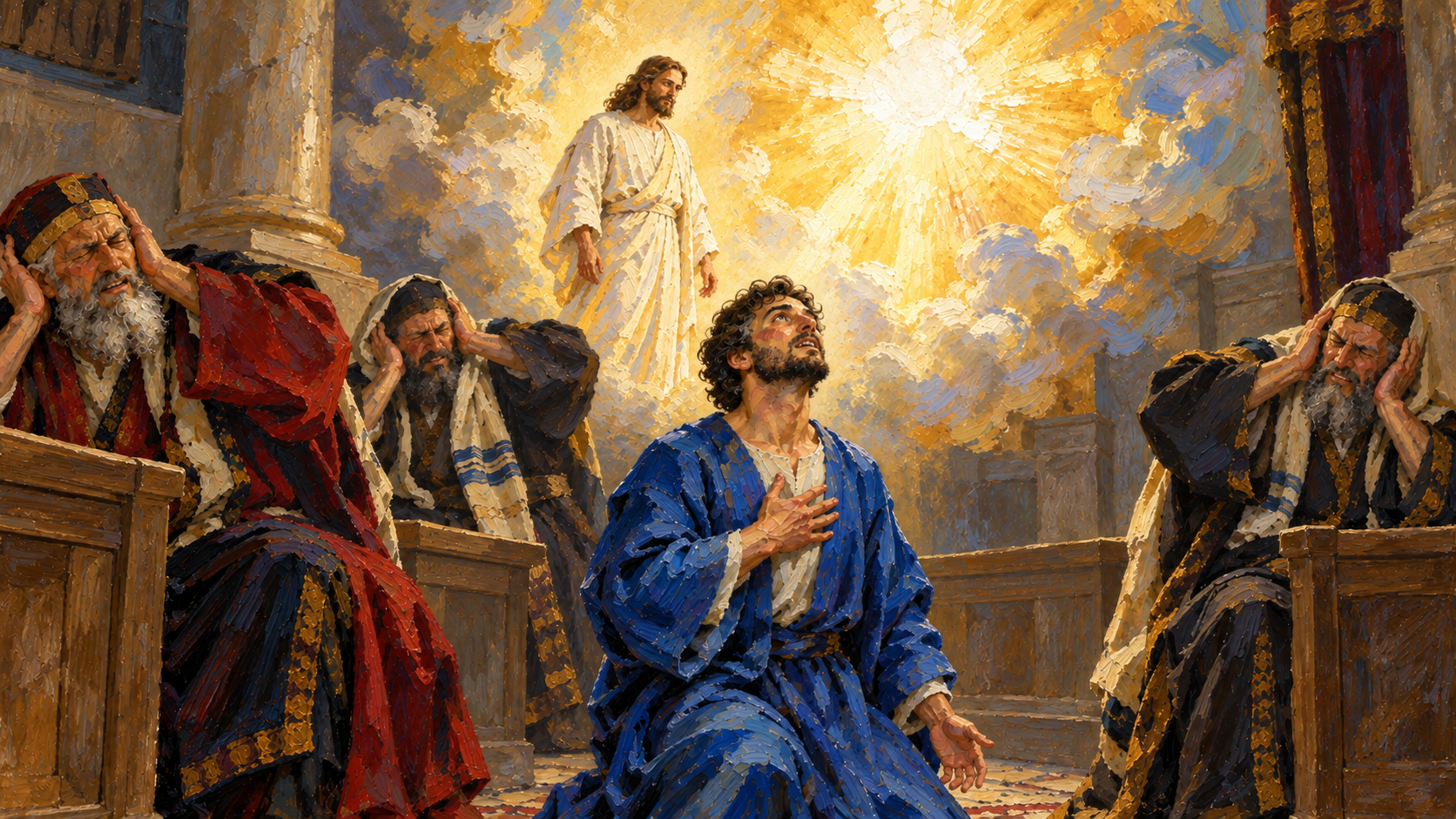
But he, being full of the Holy Spirit, gazed into heaven and saw the glory of God, and Jesus standing at the right hand of God, and said, "Look! I see the heavens opened and the Son of Man standing at the right hand of God!" Then they cried out with a loud voice, stopped their ears, and ran at him with one accord; and they cast him out of the city and stoned him. And the witnesses laid down their clothes at the feet of a young man named Saul.
Stephen’s vision does not contradict the passages saying Christ sits. Sitting communicates His enthroned status; it does not create a rule that the Lord can never rise. The King who occupies the throne is certainly able to stand.
Some interpreters believe Jesus stands to receive and honor His faithful witness. Others see Him acting as Stephen’s advocate or rising in judgment against the persecutors. I would not force the passage to choose among explanations it never states. What it clearly shows is that the living Son of Man sees Stephen and receives him.
As stones strike him, Stephen entrusts himself to Jesus and asks mercy for his killers. His prayer echoes Christ without confusing Stephen’s death with Christ’s saving sacrifice. Jesus alone died for sins; Stephen bears faithful witness to Him.
Living Under the Authority of the Risen King
Ephesians 1 connects the power that raised Christ with His seat in the heavenly places. Every principality and power is beneath Him, so no other might or dominion can rival His throne. His authority surpasses every name in this age and the age to come. As I read this passage, I see that God has placed all things beneath Christ’s feet and given Him to the church as Head over everything.
Spiritual powers are real, but they are creatures beneath Christ. No occult practice or astrological claim can rise to His level. Territorial spirits and political rulers remain under the same authority. We therefore have no need for superstitious formulas. Christians answer evil by holding to the truth and depending on God in prayer. Their holy lives then make the gospel they confess visible.
Christ’s headship sets the limit for every church leader. A pastor or council cannot overrule the written Word of the enthroned Lord, and a denomination remains under that same authority. Scripture must also test anyone who claims to be a prophet. Even the state has no right to set aside what Christ has spoken.
Then James and John, the sons of Zebedee, came to Him, saying, "Teacher, we want You to do for us whatever we ask." And He said to them, "What do you want Me to do for you?" They said to Him, "Grant us that we may sit, one on Your right hand and the other on Your left, in Your glory." But Jesus said to them, "You do not know what you ask. Are you able to drink the cup that I drink, and be baptized with the baptism that I am baptized with?"
James and John understand that positions beside a king carry honor. Their request exposes ambition and a shallow understanding of the road to glory. Jesus redirects them from rank to suffering and service.
He does not declare the left seat evil. Both requested places are positions of honor, and both are assigned according to God’s preparation. The disciples’ problem is their desire to secure superiority over one another.
Gentile rulers use authority to dominate. Christ’s followers must pursue a different greatness. The greatest becomes a servant, and the first becomes slave of all. Jesus embodies the standard by giving His life as a ransom for many.
The same hunger for rank can attach itself to a church title or a place on a public platform. When someone craves recognition, even a seating arrangement can begin to feel like a measure of status. Visibility and access to influential people can then look like proof of worth. Christ’s throne calls us away from that competition and into humble faithfulness under His authority.
Believers do not face suffering with vague optimism. The Jesus who shed His blood for them is alive and enthroned. He actively intercedes for His people. His authority exceeds both the hostile power they can see and the spiritual power hidden from their sight.
That confidence leaves room for grief and honest prayer. Stephen still died beneath the stones, and the apostles still entered prison. Faithful churches have also endured painful losses. The right hand of God does not promise immediate comfort, political dominance, wealth, or exemption from persecution.
When I bring these passages together, the right hand of God assures me that His strength cannot fail and that Christ’s sacrifice is complete. Nothing can separate His people from His love. His enemies will not evade the judgment He has appointed, and because the resurrection is certain, even death cannot finally keep the believer.
Prayer offered in Christ’s name therefore approaches the Father with reverence and assurance. We ask according to His will, then submit our preferred timing to Him. Because He has already spoken clearly in Scripture, faith also obeys what He has revealed. It trusts the enthroned Lord instead of attempting to control Him through formulas.
My Final Thoughts
After working through these passages, I do not see the right hand of God as a secret code about physical direction. Sometimes the image speaks of God’s strength or His help. In a royal setting, it points to honor and authority, so the immediate context must guide us. Psalm 110 brings those ideas to their highest point in the risen Son, whose sacrifice is complete and whose reign will end with every enemy beneath His feet. Our hope therefore rests in the living Christ, not in superstition or human rank, and we do not need to pretend that we can control the future.