
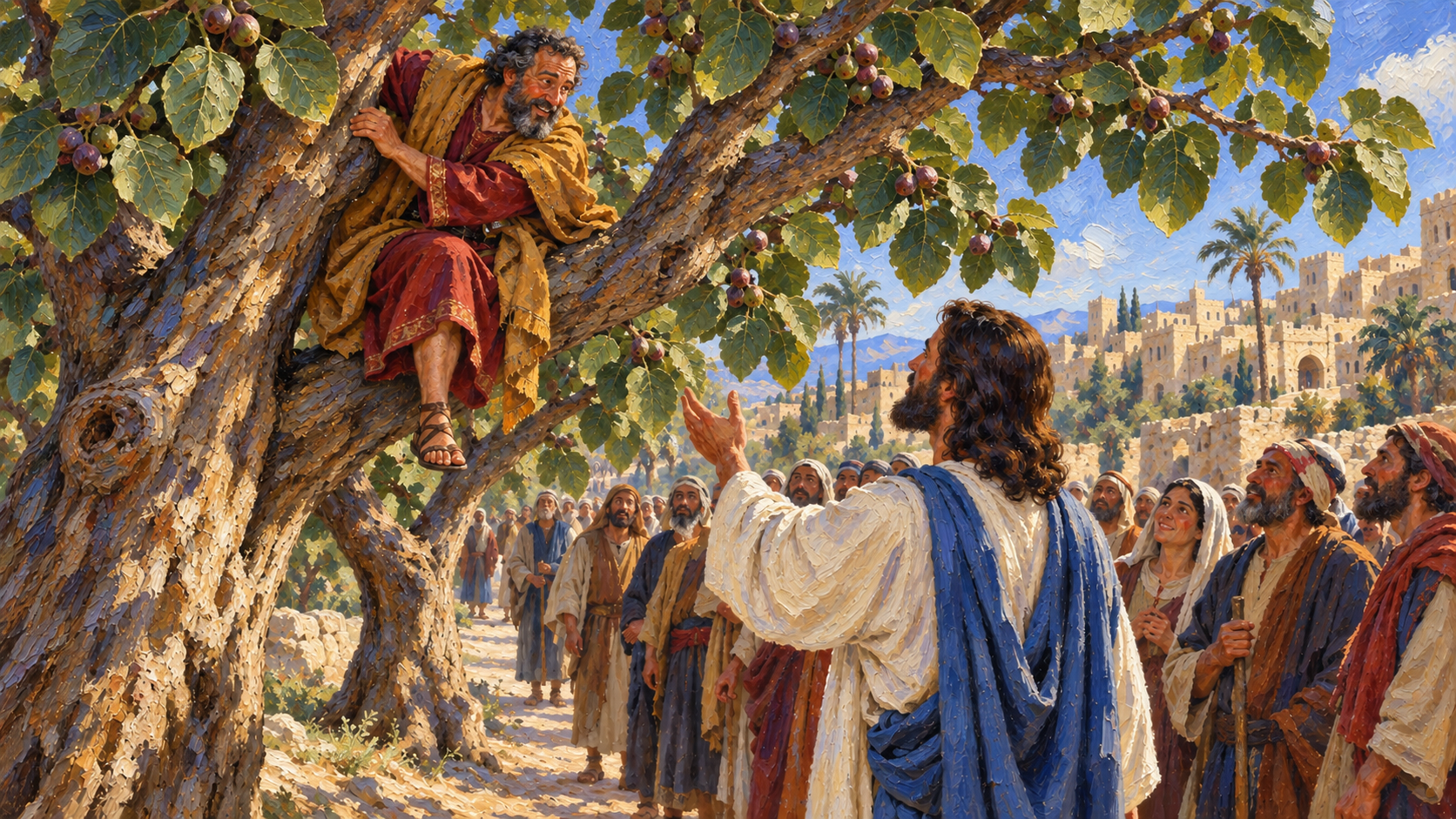
Zacchaeus climbed a tree because he wanted to see Jesus. Jesus stopped beneath it, called him down, and announced that He must stay at his house. By the end of the encounter, the wealthy tax collector was speaking about generosity and repayment, while Jesus declared that salvation had come. I want to follow how Luke connects that welcome, Zacchaeus’s repentance, and the financial commitments that made his change visible.
Zacchaeus Meets Jesus on the Road to Jerusalem
Luke has prepared us for this encounter through several events in chapter 18. In Jesus’ parable, a tax collector pleaded for mercy and went home justified, while a Pharisee trusted his own righteousness. A despised occupation had not placed the repentant man beyond forgiveness, and a respected religious position could not justify the proud man. Then a rich ruler asked about eternal life but refused to release the possessions that controlled him. When the hearers wondered who could be saved, Jesus answered that God could do what human effort could not.
Near Jericho, a blind beggar called Jesus the Son of David, despite attempts to silence him. Jesus stopped and restored his sight. The next man Luke introduces also wanted to see Jesus, though for a different reason: Zacchaeus was short, and the crowd obstructed his view. Jesus gave both men His attention. The crowd’s hostility is explicit in the beggar’s case and in its later complaint about Zacchaeus, but Luke does not say anyone deliberately blocked the tax collector’s sight.
Jesus was on His way to Jerusalem, where He had said He would suffer, die, and rise again. His purpose in Jericho belonged to that mission. Here was a rich man who would receive what the rich ruler had refused, as the Savior approached the death through which He would provide salvation.
Then Jesus entered and passed through Jericho. Now behold, there was a man named Zacchaeus who was a chief tax collector, and he was rich.
Jericho stood on important routes of commerce and travel. Tolls and customs could be collected there, and men such as Zacchaeus worked within a revenue system connected with Roman rule. Luke gives neither his contract nor an account of his income. He identifies his office and wealth, which are enough to establish that this was a man with considerable influence.
The ordinary Greek term for a tax collector is telones, but Zacchaeus is called an architelones, a chief tax collector. The term occurs only here in the New Testament and indicates a leading or supervisory position. He was more than a minor employee at a collection booth. That position also helps explain the resentment surrounding him: collectors served an unpopular system and had opportunities to demand more than people owed.
His name, the Greek Zakchaios, probably reflects the Hebrew or Aramaic Zakkai, associated with purity or innocence. A name did not establish his character any more than the crowd’s opinion could determine whether mercy was available to him. Luke’s description and Zacchaeus’s own response must guide how we judge his conduct.
John the Baptist had told tax collectors to take no more than the amount appointed. The occupation could therefore be practiced without extortion. I should not accuse every collector of every possible abuse, or assume every coin Zacchaeus owned was stolen. His later words about repayment raise the question of wrongful gain directly, but Luke has not given us a complete financial history.
And he sought to see who Jesus was, but could not because of the crowd, for he was of short stature. So he ran ahead and climbed up into a sycamore tree to see Him, for He was going to pass that way.
Luke tells us that Zacchaeus sought to see who Jesus was. He may initially have been curious, or conviction and hope may already have been involved. We are not told. What Luke records is his persistence: when he could not see through the crowd, he ran ahead and found another vantage point. His wealth could not remedy his height, but climbing gave him a view of the road.
The tree is a sykomorea, usually called a sycamore or sycamore-fig. It differs from the tree many English speakers now call a sycamore, and its spreading branches could provide a place to watch. Luke gives a practical explanation for Zacchaeus’s position. His height does not symbolize greater sinfulness, and the branches do not represent works through which he earned salvation.
Running and climbing may have risked embarrassment for a prominent man, but Luke establishes no cultural rule that Zacchaeus violated by doing either. He found a way to see. His effort could put him beside the route Jesus was taking; it could not oblige Jesus to save him.
Grace Comes to Zacchaeus’s House
And when Jesus came to the place, He looked up and saw him, and said to him, "Zacchaeus, make haste and come down, for today I must stay at your house."
Jesus looked up and called Zacchaeus by name. Luke does not explain how He knew the name. He records the Lord deliberately stopping for the man the crowd despised and choosing to enter his home. Zacchaeus could no longer remain merely an observer in the tree.
Jesus’ word must translates dei, expressing necessity. Elsewhere Luke uses this language for Jesus’ obligation to preach and for the suffering and resurrection Scripture foretold. I understand this visit as belonging to the same saving purpose, rather than a casual choice of lodging. The verb kataluo describes staying as a guest. Jesus really would enter Zacchaeus’s household, though we are told neither the menu nor the length of His stay.
So he made haste and came down, and received Him joyfully. But when they saw it, they all complained, saying, "He has gone to be a guest with a man who is a sinner."
Zacchaeus hurried down and received Jesus joyfully. The watching crowd responded by grumbling, a complaint Luke presents as shared among them. Their objection was that Jesus had become the guest of a sinner. The accusation of wrongdoing was not necessarily false. What was wrong was treating that guilt as a reason the Savior should remain distant.
We have heard the complaint before. In Luke 15, Pharisees and scribes objected when Jesus received sinners and ate with them. He answered with the lost sheep, the lost coin, and the two sons, including the elder brother who resented his father’s welcome. Heaven rejoices over a sinner who repents, while self-righteous people can be offended by the same mercy. In Jericho, that disagreement surrounded an actual man whom Christ was receiving.
Jesus had not asked the crowd to nominate a worthy host, and He did not demand a completed account of repayments before entering the house. He drew near to a guilty man with the purpose of saving him. That welcome did not approve fraud or make repentance unnecessary. Because Christ was sinless, He could approach sinners without sharing their guilt, bringing the mercy that would call them out of it.
Repentance and Restitution
Then Zacchaeus stood and said to the Lord, "Look, Lord, I give half of my goods to the poor; and if I have taken anything from anyone by false accusation, I restore fourfold."
Zacchaeus addressed Jesus as Lord and made two distinct commitments. Giving half his goods to the poor would change how he used his possessions. Repaying fourfold would address the people he had wronged. Generosity toward one group was not a substitute for returning what belonged to another. His response included both compassion and justice.
The expression “taken by false accusation” translates sykophanteo, a verb that can describe extortion or fraud. Intimidation or a false charge could be used to obtain money. John the Baptist used the same verb when warning soldiers against exploiting people for gain. Zacchaeus did not defend such conduct by blaming the system, his colleagues, or the hostility directed at him. He committed himself to repay wrongful taking, and the people concerned could test whether he kept his word.
Repentance begins as an inward change of mind and direction toward God, then becomes visible in conduct. It does not produce immediate sinless perfection, but it means we stop defending the wrong. Money was connected with Zacchaeus’s influence and reputation. His response in that area offered a concrete demonstration that his relationship to his possessions was changing.
Moses’ law had already required substantial restitution. Exodus 22:1 prescribes multiplied repayment for stolen livestock killed or sold. Leviticus 6:1-5 addresses dishonest gain, including fraud and robbery, with the return of what was taken plus one fifth and an acknowledgment of guilt before the Lord. Zacchaeus offered fourfold repayment, but Luke does not identify the particular statute he was applying. We should not force every wrongful collection into a livestock law to explain his generosity.
The verb apodidomi means giving back or repaying. The payment belonged to the injured person; it could address a measurable loss without erasing the past or purchasing God’s forgiveness. A sinner’s repentance toward God should affect his response to a neighbor who has suffered because of him.
There is a grammatical question worth acknowledging. The NKJV accurately gives the present-tense words “I give” and “I restore.” Some interpreters understand Zacchaeus to be describing an established practice and defending himself against the crowd. In that reading, Jesus vindicates a man whose conduct has been misjudged. A Greek present can describe customary action, but direct speech can also express a commitment being made now. The tense alone does not settle which is intended.
I understand his words as a new or renewed declaration of repentance. He welcomed Jesus joyfully, spoke directly about wealth and fraud, and heard Jesus announce that salvation had come today. Luke has also just described the rich ruler’s refusal to yield his possessions. Zacchaeus’s response moves in the opposite direction. We do not need to pretend his verbs are future tense to recognize the financial commitment as fruit of a saving encounter.
What Jesus Says About Salvation
And Jesus said to him, "Today salvation has come to this house, because he also is a son of Abraham;
The Greek soteria means salvation or deliverance. Jesus was announcing the rescue He had brought to this man. He did not wait for Zacchaeus to locate every victim and complete every repayment before declaring it. The promises of restitution were evidence of grace received, not the price at which forgiveness became available.
Ephesians 2:8-10 explains that order: salvation is by grace through faith rather than works, and those saved are created in Christ Jesus for good works. Fourfold repayment could address particular injuries, but no amount could settle Zacchaeus’s guilt before God. He received salvation through repentant faith in the Lord he welcomed. The changed use of money followed that reception.
Jesus also called him a son of Abraham. Zacchaeus was evidently Jewish, despite his involvement with Roman revenue interests. The words “he also” challenged the crowd’s treatment of him as though their contempt could erase his place among Abraham’s descendants. Yet ancestry by itself did not explain his salvation. John the Baptist had warned people who claimed Abraham as their father while refusing the fruit of repentance.
Galatians 3 says those who believe are blessed with believing Abraham. Zacchaeus’s faith belonged with that saving promise. I keep his actual ancestry and his faith together here: he was an Israelite, and he received the blessing of salvation through faith. We need not turn Israel into a symbol to recognize that blessing, or turn descent from Abraham into an alternative to believing God.
Salvation coming to his house does not mean every family member and servant was automatically born again. Luke gives no account of their responses and records no baptism. This passage cannot establish infant baptism, inherited faith, or automatic household salvation. Each person must respond to Christ.
The change in Zacchaeus would nevertheless affect the people living and working around him. Giving away half his goods and repaying fourfold would alter the household’s finances. Honest conduct would also change his dealings with neighbors. Conversion is personal, but its consequences reach relationships: a dishonest provider should handle money differently, and a harsh parent should acknowledge the harm he has caused. One person’s faith cannot save the others, but it can bring truth and changed conduct into their daily lives.
Wealth itself is not sinful. Abraham possessed substantial resources, and believers used theirs to support Jesus and help others. The danger is trusting money, obtaining it dishonestly, or hoarding it while disregarding genuine need. The rich ruler refused to release what controlled him; Zacchaeus welcomed Jesus and committed his wealth to generosity and repayment. In this rich man’s salvation, God accomplished what Jesus had said was humanly impossible.
Neither half his goods nor fourfold repayment becomes a compulsory formula for every convert. The appropriate response depends on the wrong and the responsibilities involved. What must not disappear is the concern for generosity, honesty, and justice. I would not reassure someone who defends ongoing fraud merely because he professes faith. Growth can be uneven, but the new life God gives should become visible in conduct.
The Son of Man Seeks and Saves the Lost
for the Son of Man has come to seek and to save that which was lost."
Jesus’ closing explanation tells us why He stopped at the tree and entered the house. Zacchaeus had sought a view of Jesus; Jesus came to seek and rescue the lost. Luke uses the same Greek word family, zeteo, for seeking in both places, while the purposes differ. Getting near enough to watch did not accomplish the salvation Christ came to provide.
Lost does not mean Zacchaeus was innocent and merely misunderstood. Jesus’ teaching in Luke 15 connects recovery of the lost with a sinner’s repentance and heaven’s joy. He was guilty and needed rescue. His guilt did not place him beyond the reach of Christ’s mission.
The title Son of Man reaches especially into Daniel 7. Jesus’ teaching joins His divine authority and future reign with His first coming to suffer, die, and rise bodily. The One who will return in glory humbled Himself to save people who could not save themselves. His invitation is genuine, but people can resist it, as the rich ruler and many religious leaders did. Zacchaeus received Him instead.
Luke supplies no later biography of Zacchaeus. Traditions identifying him as a bishop or a companion of Peter should not be preached as Scripture. Neither should we invent the meal, private conversation, later repayments, or outcome of his employment. We are not told whether he had heard Jesus before that day. The details Luke does give are sufficient: Christ sought a lost man, that man welcomed Him, repentance became visible, and the Lord declared salvation.
The crowd’s complaint also deserves examination. We must not romanticize exploitation or silence the people harmed by it in the name of grace. Zacchaeus’s response required honesty about the wrong. Yet concern for justice can also conceal resentment at the prospect of mercy for the guilty. A church should be able to receive a repentant offender while protecting vulnerable people and taking restitution seriously.
I need to consider whose conversion I would struggle to welcome. Christ died for the corrupt official, political collaborator, and dishonest business owner as well as the people whose conduct seems more respectable. A ruined reputation based on real wrongdoing does not put a person beyond grace. We should use discernment, look for genuine repentance, and rejoice when the Lord brings a sinner to faith.
The Gospel and Our Response
Zacchaeus needed more than a better reputation or a more generous financial policy. He needed salvation, and so do we. Neither charitable giving nor restitution can remove guilt or produce new birth. A respected name and a disgraced name leave their owners equally dependent on the Savior.
Jesus is the eternal Son who became fully man without ceasing to be fully God. Born of a virgin, He lived without sin. Wicked men physically tortured and punished Him, then killed Him, but He willingly bore that real punishment for our sins in His innocent body. He shed His blood and died, completing His saving work through that death before His bodily resurrection. The Father did not punish, curse, abandon, strike, bruise, or pour wrath on Jesus.
Christ died for the whole world, and God genuinely calls every sinner to repent and believe. His grace can be resisted and rejected, but whoever truly believes receives forgiveness and justification, righteous standing before God. That person is born again, made new, indwelt and sealed by the Holy Spirit, and eternally secure in Christ. That salvation is never permission for lawlessness, and a Christian label alone cannot prove new birth.
If you have not trusted Christ, do not wait until your record seems clean enough to approach Him. Come honestly as a sinner and believe the gospel. The Savior who receives you also calls you to obey where sin has shaped your conduct. Begin by confessing the wrong, putting a stop to it, and returning what belongs to another person wherever you can. Those actions express repentance; they cannot buy the mercy you need.
Some losses can be repaid, while others cannot be undone. A false accusation may have spread beyond everyone we can reach. Years lost to abuse or deception cannot be returned, and a payment cannot restore someone who has died. Those limits call for honest acknowledgment and whatever repair remains possible. They do not justify continuing the wrong or refusing appropriate consequences.
Repair also needs to consider the injured person’s welfare. A public confession made to ease my discomfort could expose someone else’s private life. Complex financial or legal questions may require qualified professional guidance, while pastoral help can assist with the biblical responsibilities involved. The aim is truthful obedience that cares for the person harmed, not a performance intended to restore the offender’s reputation.
For those of us who know Christ, the crowd gives reason for sober reflection. We can tell the truth about evil while praying and working for the salvation of someone we would struggle to receive. We do not need to deny the injury or prevent proper consequences. We need to recognize the mercy we ourselves depend on and welcome genuine repentance with joy.
My Final Thoughts
Zacchaeus did not earn a place near Jesus through his determination or purchase salvation through repayment. Jesus sought him and brought salvation to his house. His financial commitments showed a repentant response to that grace, with concern for the poor and for the people he had wronged. I want to keep that order clear while taking the change seriously. Christ receives sinners who come to Him in faith, and His grace gives us reason to face our wrong honestly and begin obeying Him.