
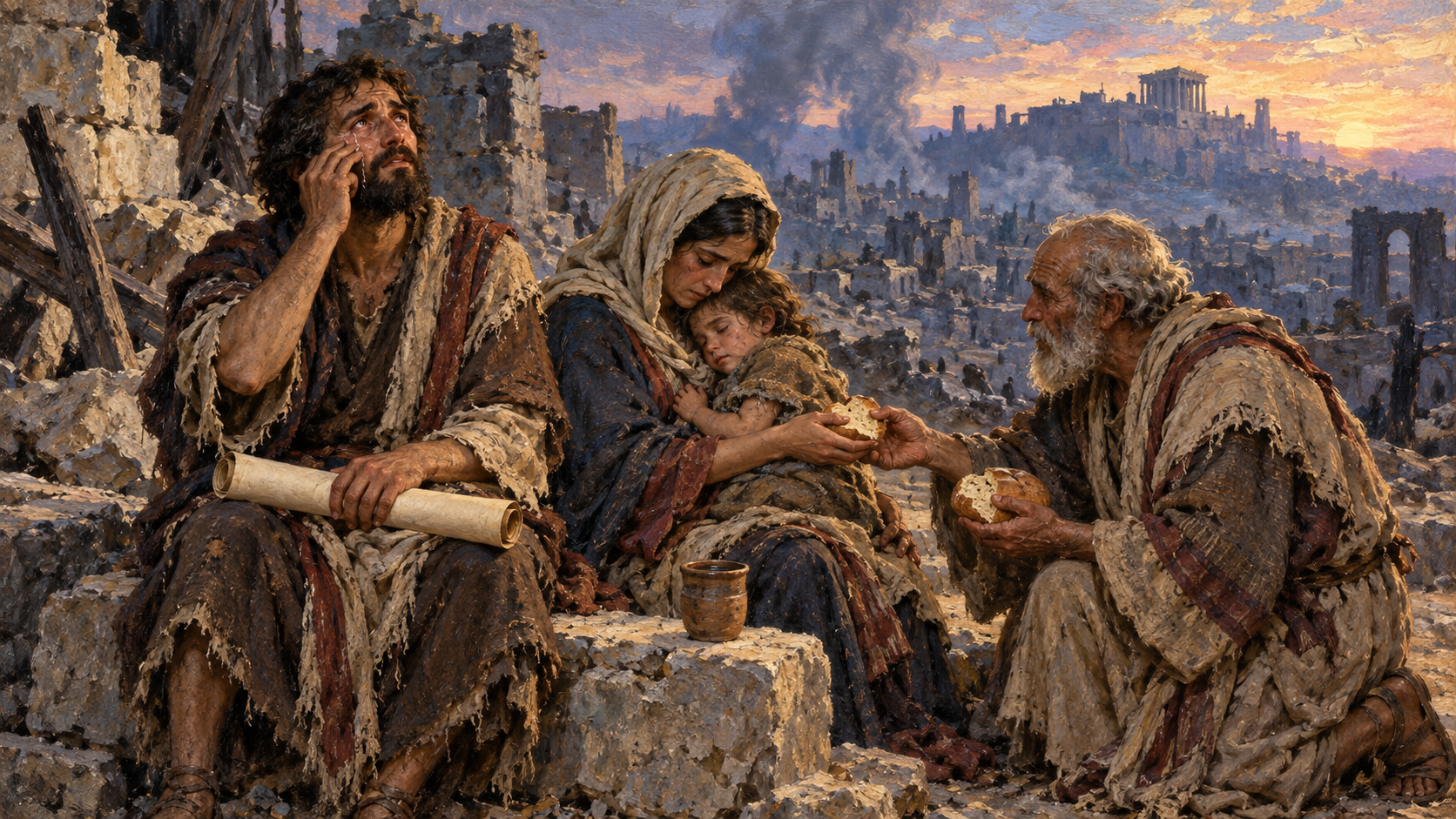
Lamentations gives us words for grief when there is no way to make what happened sound less terrible. Jerusalem had fallen, and the five poems let us hear confession and a cry for justice while the ruins were still in view. What draws me back to this book is that its hope appears in the middle of the pain, before every question has an answer.
Jerusalem Fell After Years of Warning
By the time Lamentations begins, years of prophetic warning had become visible in shattered stone and ash. Jerusalem was hungry, its temple burned and its streets empty. Graves testified to the destruction. The king had been taken into exile along with soldiers and craftsmen, and many ordinary families had been carried away too. For those who remained, the devastation showed that the warnings of Moses and the prophets had been far more than religious words.
The poems look back on Babylon’s destruction of Jerusalem and Solomon’s temple, commonly dated to 586 BC. That was the final stage of a longer collapse, since Babylon had already taken captives in earlier campaigns. King Jehoiachin and many skilled people were deported in 597 BC. After King Zedekiah rebelled, Babylon returned and surrounded Jerusalem. The city weakened through the long siege until its defenses broke. In 2 Kings 24-25, the Babylonians entered and burned the temple and royal buildings, then tore down the walls. They executed leaders and carried off the temple treasures, sending still more people into exile. 2 Chronicles 36 confirms this devastation.
None of this caught the LORD unprepared. Deuteronomy 28 had warned Israel that persistent covenant rebellion would bring siege and famine. Defeat and exile would follow rebellion too, leaving the land desolate. Jeremiah preached through Judah’s final decades. In Jeremiah 25, he plainly announced that Babylon would come because the people refused God’s words. Yet many leaders preferred assurances of peace and treated the temple’s continued presence as proof that judgment could never reach them.
Lamentations shows what happened when that confidence failed. The LORD kept His warning, so Babylon’s victory did not mean He was weak or that an idol had defeated Him. He remained sovereign over history. Babylon was nevertheless a guilty aggressor, and God would hold it accountable for its pride and violence.
The Hebrew book does not name its human author, although ancient Jewish and Christian tradition strongly associates these laments with Jeremiah. He ministered during Judah’s final years and shared deeply in the nation’s grief, so the connection fits. 2 Chronicles 35:25 also reports that Jeremiah composed laments for King Josiah. That verse does not identify those particular compositions with the canonical book of Lamentations, and the inspired Hebrew text never attaches Jeremiah’s name to these five poems. I believe Jeremiah is the likely author, but our certainty should not go beyond the wording God preserved.
I need to remember what God had revealed before applying this judgment to someone else’s suffering. Judah had received clear covenant warnings over many years. Lamentations explains that particular judgment; it does not tell us that every illness comes from hidden personal sin. Nor can we assign that cause to bereavement, harm done by others, financial loss, or disaster unless God has revealed it. We do not have Jerusalem’s specific explanation for every hardship people face today.
Five Ordered Poems Give Grief a Voice
The Hebrew title, Eikhah, means How and opens chapters 1, 2, and 4. The poet is not asking for a simple piece of information. He is trying to give voice to a devastating reversal: how has the crowded city become solitary, and how has the Lord covered Zion with a cloud? How has the gold become dim? Those questions let us hear the shock of what has happened.
Yet these five poems give that grief a deliberate order. Chapters 1, 2, and 4 each have 22 verses, corresponding to the Hebrew alphabet’s 22 letters. Chapter 3 gives three successive lines to each letter and so expands to 66 verses. Chapter 5 has 22 verses too, but does not preserve the alphabetic acrostic. There is also a difference in letter order: chapters 2, 3, and 4 place the Pe stanza before the Ayin stanza, unlike chapter 1. We can observe that feature without treating it as evidence of a hidden code.
The alphabetic form lets the poet put grief into words from beginning to end, almost as though he were lamenting from A to Z. I do not see him waiting until the pain becomes orderly before he prays. He sets it down line by line under the discipline of inspired speech. The chaos remains, but it no longer has the only voice.
That order does not give us a fixed timetable for recovering from grief. Lamentations promises neither identical emotional stages for every sufferer nor visible resolution by a certain verse. After chapter 3’s confession of hope, the poem returns to tears and enemies, remembering terror and pleading for help. Chapter 5 still ends with an unanswered question.
The poems also let us hear different voices. An observer may describe the ruined city, then Zion speaks as though the city were a person. Chapter 3 brings us close to a man who has seen affliction, while chapter 5 gathers the survivors in shared prayer. We hear both individual suffering and public catastrophe, along with the community’s confession. Those experiences belong together without becoming the same point of view.
Each poem helps us understand the others. Chapter 1 lets the lonely city speak, and chapter 2 faces judgment and the damage caused by false comfort. The afflicted speaker in chapter 3 remembers God’s mercy. The final two poems measure what the collapse has cost and bring the survivors’ shared grief before God in prayer. If I take only a familiar promise from the middle, I miss the setting that gives it meaning.
Chapter 1 pictures Jerusalem as a bereaved, humiliated woman. Once she welcomed great crowds as an honored center of worship, and her rulers held international standing. Now she sits alone like a widow, betrayed by former allies. Her people search for bread while her children are taken captive. Even the roads to Zion seem to mourn because pilgrims no longer come for the appointed feasts.
How lonely sits the city That was full of people! How like a widow is she, Who was great among the nations! The princess among the provinces Has become a slave! She weeps bitterly in the night, Her tears are on her cheeks; Among all her lovers She has none to comfort her. All her friends have dealt treacherously with her; They have become her enemies.
Giving Zion a voice does not make the suffering men, women, and children disappear. The city speaks for their many losses and for its covenant identity. Its widowhood and tears allow the community to hear its own grief expressed together. The image also lets the poet move between an observer describing Zion and Zion answering from within her pain.
Zion’s repeated cry that she has no comforter tells us something about where Judah had placed its trust. Covenant unfaithfulness had led the people toward political and spiritual lovers who could not save them. Those alliances failed when Babylon came. The bereaved city now feels how empty that trust had been.
The poem lets us hear the suffering instead of discussing people from a distance. Hunger and shame belong to the lament, as do abandonment and the loss of children. God does not ask wounded people to make their loss sound small before they pray. Yet Zion also speaks honestly about her guilt: the LORD is righteous, and she rebelled against His commandment.
“The LORD is righteous, For I rebelled against His commandment. Hear now, all peoples, And behold my sorrow; My virgins and my young men Have gone into captivity.
Zion’s confession does not excuse Babylon’s cruelty. The same poem asks God to consider the enemies’ evil, recognizing that Judah and Babylon are both guilty without making their guilt identical. I should be able to agree that God is righteous and still speak honestly about pain. Naming that pain need not accuse Him of wrongdoing. I can confess my own sin while telling the truth about an enemy’s conduct and leaving judgment in God’s hands.
Chapter 2 describes the LORD’s anger with frightening clarity. Strongholds have fallen, and the LORD has rejected the altar and handed the sanctuary to enemies. Zion’s appointed feasts have been forgotten. These are the consequences of covenant judgment after generations of warning, not evidence that God suddenly lost control or became unstable.
People had turned the temple into a hiding place for rebellion. Jeremiah 7 records them crying, “The temple of the LORD,” while oppressing others and shedding innocent blood. They followed idols and refused correction while trusting the building as though God’s presence were a charm. Holy architecture could not protect that unholy confidence.
The false prophets made that confidence more dangerous. For years Jeremiah had called Judah to repent, warning that resistance to Babylon could not rescue a rebellious nation. Other prophets contradicted him with promises of peace. Their comforting message left the sin untouched and influenced the people’s decisions. It also left them spiritually unprepared for the siege they had been told would never come.
Your prophets have seen for you False and deceptive visions; They have not uncovered your iniquity, To bring back your captives, But have envisioned for you false prophecies and delusions.
A pleasant message can be cruel if it helps people continue toward destruction. That makes me consider what faithful preaching must offer. It needs to expose sin according to Scripture and call for repentance, while also announcing mercy through Christ. Harshness alone does not make a preacher faithful. Neither does reassurance that leaves people thinking repentance is unnecessary.
The poet does not let that judgment make him indifferent to suffering. Chapter 2 describes children fainting from hunger and his own eyes failing with tears. He urges Zion to rise in the night and pour out her heart before the Lord for her children’s lives. His theology gives him no reason to withhold compassion.
“Arise, cry out in the night, At the beginning of the watches; Pour out your heart like water before the face of the Lord. Lift your hands toward Him For the life of your young children, Who faint from hunger at the head of every street.”
Pouring out the heart means bringing that anguish to the Lord and asking Him to see. It does not require a polished performance, and it is not faithless venting. The anguish is brought to the Lord in prayer. A sufferer need not make every sentence emotionally tidy before coming to God.
I cannot read only the promise that God’s compassions never fail and pass over the mother’s anguish or the city’s unanswered cry. All of those lines belong to the same inspired Word. If I rush to offer comfort without hearing what happened, even true words can be cruel in that moment. Lamentations asks us to listen long enough to acknowledge the loss. Hope does not grow stronger by denying the facts. It grows stronger when we rest on God’s character while admitting the full weight of what has happened.
Mercy Stands in the Middle of Affliction
Chapter 3 turns from the city speaking as a person to “the man who has seen affliction.” His pain belongs to the community’s disaster, but now we hear how personally he feels it. He describes being led into darkness and enclosed behind stone. Bitterness fills him as peace disappears, and his life seems covered with ashes.
He describes judgment as it feels from within: prayer seems blocked and the path crooked. Even strength and hope appear to have perished. The inspired record leaves those perceptions in place rather than making his pain sound easier to bear.
Some Christians read every line here as referring directly to Jesus. There are real echoes of His suffering: He was mocked and afflicted, struck and rejected. He entered suffering more deeply than any sinner can. But the speaker in Lamentations 3 also belongs to a guilty community and later joins its confession. I do not want to lose that original voice while recognizing that all righteous suffering and saving hope reach their center in Christ.
The turning point comes through what the speaker remembers, without a change in his circumstances. He recalls affliction and restless wandering, with wormwood and gall, until his soul sinks. Then he deliberately brings another truth to mind. The painful memory remains, but he remembers the LORD’s character alongside it.
Remember my affliction and roaming, The wormwood and the gall. My soul still remembers And sinks within me. This I recall to my mind, Therefore I have hope.
That deliberate remembering is not artificial hope. Pain can occupy our attention until it seems to be the only fact left, and the speaker brings back to mind what suffering has not changed. He is neither denying what happened nor trying to hypnotize himself into feeling better. He is letting the truth God revealed govern what he remembers.
What impresses me about the familiar promise that follows is where the speaker says it. Jerusalem is still ruined, the dead remain dead, and the exiles remain far away. He does not claim life has become good. He recognizes that the surviving community has not been completely consumed because the LORD’s mercy and compassion have not failed.
Chapter 3 gives three lines to each Hebrew letter, slowing us down through its expanded acrostic. Before recalling God’s mercy, the speaker has described darkness and mockery line after line. His bitterness and remembered affliction are still with him when he turns to God’s character. The poem makes room for all that sorrow, so we cannot treat its confession of mercy as a slogan that covers the pain.
Through the LORD’s mercies we are not consumed, Because His compassions fail not. They are new every morning; Great is Your faithfulness. “The LORD is my portion,” says my soul, “Therefore I hope in Him!”
The Hebrew words help us understand what the speaker is trusting. The plural chasadim belongs to the family often translated mercy, lovingkindness, or steadfast covenant love. Judah did not deserve to have a remnant preserved; the LORD’s faithful mercy explains why one remained. Alongside that mercy, rachamim expresses deep compassion and tender pity. The text says His compassions do not end.
Emunah means faithfulness or reliability, directing our hope toward God’s steady character instead of our emotional strength. The speaker then calls the LORD his cheleq, or portion, the word for a person’s share or inheritance. Even with the visible inheritance stripped away, he can confess that God Himself remains his sure possession.
The words new every morning do not promise that each new day will feel fresh. Morning in this passage comes over a burned city. Mercy may mean breath for another day or strength to pray. It may come through food shared in scarcity, or through correction that prevents deeper ruin. Remembering truth in confusion can be mercy too. Above all, God’s covenant purpose continues while visible relief has yet to arrive.
God’s faithfulness includes keeping His warnings as well as His promises. When the poet says Great is Your faithfulness, he has already seen God do what He warned about persistent rebellion. Yet judgment neither changed His character nor canceled every covenant purpose. His compassion preserved life, and His throne remained. His Word still taught the people how to seek Him.
Calling the LORD his portion acknowledged an inheritance Babylon could not take. Judah had lost land and homes, along with wealth and social standing. Public worship and the ordinary stability of life had collapsed too. None of those losses was imaginary. Yet God Himself remained the believer’s deepest inheritance, and hope could rest on Him when every lesser support had failed.
I also need to hear what Lamentations says about God’s rule alongside what it says about His holiness. History has not escaped His command, yet He does not approve the crushing of prisoners or denial of justice. Knowing that He rules history does not make oppression any less evil.
Babylon acted from pride and a desire to conquer, and its greed and cruelty belonged to it. God used the empire to bring judgment without sharing its evil motives, then later judged Babylon itself. Joseph’s words in Genesis 50 help me understand how those truths belong together. His brothers meant evil, while God meant the same history for good. God’s holy purpose did not excuse what they did.
Lamentations 3:31-33 tells us more about His character. The Lord will not cast off forever. Though He causes grief, He shows compassion according to the abundance of His mercies. The Hebrew expression behind willingly is connected with the heart, helping us understand that He does not afflict out of cruel delight. Pain is not something He enjoys for its own sake.
For the Lord will not cast off forever. Though He causes grief, Yet He will show compassion According to the multitude of His mercies. For He does not afflict willingly, Nor grieve the children of men.
That does not mean judgment fell outside God’s purpose or that He was forced to act against His will. This same chapter insists that events remain under His command. It shows us a holy God whose discipline upholds truth and justice, calls sinners to repentance, and prepares for restoration. He is not sadistic. Human cruelty serves the person inflicting it and will itself come under His judgment.
The chapter speaks about prisoners being crushed and justice being denied. It asks who can speak and make something happen unless the Lord commands it, then immediately rejects the idea that the Most High approves the subversion of a lawful cause. I need both truths to understand what has happened. If I speak of sovereignty without holiness, I may excuse the oppressor. If I treat human evil as proof that history has escaped God’s rule, I leave the sufferer in a universe controlled by evil. Lamentations allows neither conclusion: the LORD rules and sees every case, while the evildoer remains responsible.
The book applies that accountability to people with authority too. It exposes oppression and sexual violence, and it condemns leaders who corrupt their office. Prophets who speak falsely and judges who subvert justice do not escape scrutiny because of their position. Recognizing God’s discipline never puts an official or any other aggressor beyond examination. Humility before Him does not give an evildoer immunity.
When God has revealed His discipline, the community is called to examine its ways and turn back to Him. It should neither defend its sin nor sink into hopeless self-punishment. The people lift their hearts and hands to heaven and confess their rebellion honestly.
Let us search out and examine our ways, And turn back to the LORD; Let us lift our hearts and hands To God in heaven. We have transgressed and rebelled; You have not pardoned.
Examining our ways means asking what God has said and where our conduct has departed from His Word. It is more specific than a vague sense of shame. We name the sin honestly and turn away from it. Where harm can be repaired, repentance may require restitution. It should also produce truthfulness and a new pattern of conduct that protects those who have been vulnerable.
That examination must stay under Scripture. Lamentations distinguishes the community’s sin from the enemies’ evil, so it gives us no reason to invent guilt that God has not assigned. I need to be honest about what I have done without making excuses or accepting false accusations.
Judah’s return involved more than admitting a broken rule. The people had rebelled against the LORD who redeemed them and made covenant with them. He warned them but kept calling them back to Himself. Repentance therefore seeks Him, rather than merely a way out of the consequences.
Even after confessing God’s mercy, the speaker in chapter 3 returns to tears and appeal. He remembers calling on the LORD from the lowest pit, and he remembers God drawing near with the words “Do not fear.” Past rescue gives him something to remember in hope while he still asks for present justice.
I called on Your name, O LORD, From the lowest pit. You have heard my voice: “Do not hide Your ear From my sighing, from my cry for help.” You drew near on the day I called on You, And said, “Do not fear!” O Lord, You have pleaded the case for my soul; You have redeemed my life.
The Final Poems Count the Cost Without Forcing Closure
Chapter 4 opens again with “How.” Dimmed gold and scattered sacred stones show how much has changed. People once considered precious are treated like broken pottery, and those raised in scarlet embrace ash heaps. The poem sets former honor beside present degradation so we can see how completely the siege reversed ordinary life.
The famine has become so severe that ordinary human bonds have broken down. I want to read those lines soberly, without using their horror to make preaching sensational. They show the terrible end toward which covenant rebellion carried Jerusalem. Years of political deception had helped bring the city to that ruin.
The chapter again identifies prophets and priests who shed righteous blood and became polluted. Their spiritual office could not shelter them from judgment or make their falsehood true. Neither could a title make violence holy or exploitation safe.
Judah had looked to a nation that could not save it, allowing political alliance to take the place of repentance. Egypt and the people’s other human hopes could not support the trust placed in them. Wise action and lawful defense still have their place, but no strategy can make rebellion secure before God.
The chapter ends by addressing Edom, which gloated over Jerusalem’s fall. Edom too would face the cup of judgment. Judah’s guilt gave hostile nations no right to celebrate cruelty, and confession did not release those nations from accountability. God judges His people and those who exploit their fall.
Chapter 5 keeps 22 verses but leaves behind the alphabetic acrostic. Now the community pleads together, “Remember, O LORD, what has come upon us.” The people mourn their lost inheritance and fatherless children. Even water and wood have become costly. Forced labor and hunger fill the lament alongside sexual violence and the dishonoring of elders. Music has vanished, and Zion lies desolate.
Those details tell us far more than a general statement that times are hard. We hear who has been harmed and what was taken, and we see how violence disrupted family and public life. Yet verse 16 also confesses, “Woe to us, for we have sinned!” The people acknowledge their guilt without erasing crimes against women and children, elders and laborers, or the poor. They can confess as a community and still seek justice.
With Judah’s throne in ruins, the final prayer turns to the LORD whose throne endures forever. That is why the people still have someone to ask about their pain. They want to know why He seems to have forgotten them for so long, and they plead with Him to turn and renew them.
You, O LORD, remain forever; Your throne from generation to generation. Why do You forget us forever, And forsake us for so long a time? Turn us back to You, O LORD, and we will be restored; Renew our days as of old, Unless You have utterly rejected us, And are very angry with us!
The book leaves that tension unresolved. It does not tell us Jerusalem has been rebuilt or that every prayer has received a visible answer. The people continue speaking to the LORD with a question still before them.
That ending helps me understand why chapter 3 is not a simple climb from despair to happiness. The confession of mercy stands at the center, yet lament remains on both sides of it. Hope directs the speaker’s prayer without telling him his loss is over. In chapter 5, the community trusts God’s eternal throne while asking why He seems distant. I do not see failed faith in that question. I see people who know whom to ask while the answer remains out of sight.
In the prayer “Turn us back to You”, the Hebrew word family shuv can describe turning, returning, and restoration. Those meanings help us hear what the people are asking for. They want the LORD to turn them toward Himself so they can truly return and be restored, not merely recover their former comforts. They depend on His mercy for the very return they must make. Divine mercy and human repentance are working together here.
A suffering reader does not have to supply a tidy ending that these poems themselves do not give. Scripture allows a believer to confess that God reigns and still ask a painful question. He can keep pleading for renewal while he waits, because his prayer is directed to the LORD rather than to emptiness.
Reading Lamentations Carefully in Our Own Suffering
We know why Jerusalem fell because God revealed the cause through covenant warnings and prophets. We do not have that explanation for every hardship today. Jesus rejected the assumption that people killed in a tragedy were worse sinners than others. He also rejected the claim that a man’s blindness from birth had to result from a particular sin of his or his parents.
Judah lived under the Mosaic covenant, which publicly attached specific national blessings and curses to obedience and rebellion in the land. Lamentations looks back at curses Moses had named and prophets repeatedly applied to that generation. The church does not stand in Judah’s place under that covenant arrangement. A pastor therefore has no authority to invent God’s reason for a Christian’s illness or bereavement, poverty or disaster.
Suffering has many causes in a fallen world. Our own choices may bring it, or someone else’s sin may harm us. A believer can also suffer persecution precisely because he is faithful to Christ. Bodily weakness and disease are real, as are disasters that strike a community and economic disorder that costs a family its security. Bereavement and spiritual opposition also bring suffering, and the Father does discipline His children. Scripture often does not disclose the immediate cause of a particular hardship.
Our responsibility is to tell the truth instead of guessing. If Scripture exposes our sin, we should confess and repent. If another person has done wrong, we can name that harm and seek justice without taking his guilt upon ourselves. When God has not revealed the cause of suffering, we can lament honestly without accepting an accusation He has not made.
Quiet waiting belongs alongside the book’s appeals to God about cruelty and subverted justice. It does not require silence about wrongdoing. Likewise, Lamentations 3 speaks of new mercy over a burned city whose losses remain; it does not promise that each morning will feel good. God used Babylon without making its violence righteous, and Judah could confess without taking responsibility for its enemy’s guilt. I need to keep those truths together instead of letting one cancel another.
These inspired poems give us no reason to treat grief itself as unbelief. They bring remembered pain to God with tears and difficult questions, asking Him to judge rightly. Lament differs from godless bitterness because it still addresses the LORD and submits its claims to truth. It confesses actual sin while leaving vengeance with the Judge.
The speaker can confess “Great is Your faithfulness,” and still weep. We should be able to trust God without becoming numb to loss. Jesus Himself wept at Lazarus’s tomb even though He knew resurrection was moments away. His tears let us see that sorrow and trust can belong together, because love feels the wrongness of death.
Hebrews 12 teaches that God disciplines His children as evidence of their sonship and for their holiness. That correction may hurt, but a Christian should neither despise it nor collapse beneath it. When Scripture exposes sin, we need to receive the correction and return to obedient fellowship.
A born-again believer does not stand under condemnation, and fatherly discipline does not change that. Jesus willingly bore the punishment for our sins once for all as wicked men tortured His innocent body, shed His blood, and killed Him on the cross. Romans 8 therefore begins by declaring no condemnation for those in Christ Jesus. The Father trains a child who is already secure; He does not demand a second payment after the Son has completed His saving work.
Eternal security gives us no permission to cherish sin, but failure does not mean we have lost salvation either. Scripture rejects both lawlessness and despair. A truly born-again person is a new creation whom the Holy Spirit indwells and seals, and he remains eternally secure. The grace that keeps him also teaches him to confess sin and receive correction so he can walk in the light again.
Condemnation is the judicial sentence the guilty deserve, and Christ’s finished work has saved the believer from that sentence. Fatherly discipline comes within a different relationship: God has already received us as His children. His correction may expose serious sin and bring painful consequences, but He aims at holiness and restored fellowship. I cannot call that a second atonement without treating Christ’s blood as insufficient. Nor can I dismiss it as unimportant without dismissing the Father’s loving correction.
Forgiveness does not always bring consequences to an immediate end. Jerusalem’s survivors could confess without seeing the walls rise that day. A damaged relationship may take time to repair, especially when trust must be rebuilt or restitution is costly. Physical or legal effects may remain too. Those lasting consequences do not prove that Christ’s forgiveness is incomplete.
If I cannot identify a particular sin, I should not invent one to explain my pain. I can ask God to search me and remain willing to hear Scripture and wise counsel, while still resting in Christ. Peace with God comes through the cross, not through a perfect explanation of my circumstances.
Christ Enters Our Lament and Secures the Greater Hope
Although Lamentations does not name Jesus, its great themes lead us toward Him. The eternal Son took true humanity and entered a world of graves and oppression. He knew hunger and betrayal, and He shed real tears among people whose worship sin had ruined. He came near to guilty people instead of watching their suffering from a distance.
That connection to Christ does not erase Jerusalem from the poems. The speaker of Lamentations 3 belongs to the city’s communal disaster and joins its confession, so we cannot treat every sentence as a direct first-person prediction spoken by Jesus. Christ fulfills the wider biblical hope by entering our sorrow without personal sin. He willingly bore punishment in His innocent body at wicked men’s hands, then rose from death and secured the final city that cannot be destroyed.
Luke 19 records that Jesus wept over Jerusalem because the city did not know the things that made for peace. He warned that enemies would surround and destroy it. He also wept at Lazarus’s tomb. His tears show neither weakness nor unbelief. The sinless Lord grieves what sin and death have done.
Jesus suffered outside the city as the sinless, virgin-born Savior who is fully God and fully man. He willingly bore the punishment for our sins in His innocent body through real torture. He shed His blood and died, then was buried and rose bodily.
But God demonstrates His own love toward us, in that while we were still sinners, Christ died for us. Much more then, having now been justified by His blood, we shall be saved from wrath through Him.
In the gospel, justice and mercy meet more fully than any human explanation could bring them together. God does not forgive by pretending sin is harmless. The Son willingly bore real punishment in His innocent body and shed real blood, completing what sinners could never accomplish. We receive salvation by grace rather than earn it through efforts to restore ourselves.
Jesus died for the whole world, so God’s invitation is genuine even though people may resist and reject it. Everyone who repents and believes in Christ receives forgiveness and justification. God gives new birth and eternal life, and the Holy Spirit indwells and seals the believer. Tears and religious rituals cannot take the place of faith in the crucified and risen Savior. Neither penance nor moral reform can save us, and religious ancestry gives us no power to save ourselves either.
The resurrection assures us that death cannot have the final word or a ruined city defeat God’s purpose. Exile cannot defeat it either. Our hope concerns what will happen to our bodies and in history: Jesus will return bodily and raise the dead. He will judge with perfect justice and defeat evil, and He will reign. We are waiting for the new creation where God dwells with His people, not merely learning how to cope with loss.
And I heard a loud voice from heaven saying, “Behold, the tabernacle of God is with men, and He will dwell with them, and they shall be His people. God Himself will be with them and be their God. And God will wipe away every tear from their eyes; there shall be no more death, nor sorrow, nor crying. There shall be no more pain, for the former things have passed away.”
Lamentations asks God to remember and restore; Revelation shows the greater answer. He will dwell with His people and wipe away their tears. Death will be gone, and sorrow will no longer bring crying or pain. I do not have to pretend present grief is imaginary to trust that promise. It tells us grief will end under Christ’s reign.
Until then, Lamentations helps us tell God the truth about what we have lost and where it hurts most. We should neither exaggerate the damage nor minimize it to make other people comfortable. The poems name empty roads and missing children. They tell us water has become costly and music has fallen silent, while elders are dishonored and worship lies in ruins. Their honesty gives us room to speak specifically about sorrow.
Lamentations also shows us whom to address. We can bring God our tears and honest questions, admitting fear or confusion and asking Him to see what happened. That is different from making accusation our identity, because we place the whole matter under His character and His written Word.
When sin is ours, confession belongs in the lament. Regretting the consequences is not the same as repenting, so I must not shift blame or soften what God’s Word exposes. I must not claim responsibility for someone else’s violence. Truth requires us to place responsibility where it belongs.
We can deliberately remember God’s character as the speaker did in chapter 3. Scripture tells us He is holy and merciful, with compassion that has not failed and faithfulness that has not weakened. He remains just and present even when we cannot understand what He is doing. Remembering those truths alongside the pain does not erase grief. It keeps pain from deciding what we believe about God.
We can appeal for justice without taking personal vengeance. In prayer, we ask God to expose lies and restrain evil, defending those who have been harmed. We also ask Him to bring repentance or judgment according to the truth. Leaving judgment with Him does not mean calling wrongdoing harmless.
Quiet waiting in Lamentations means continuing to seek the LORD instead of answering pain with rebellion. While the outcome remains hidden, we can pray and do the next faithful thing Scripture makes plain. We can also receive ordinary mercies without denying the seriousness of our loss. Food and restorative sleep may be gifts from God, as may an honest friend or support from the church. A remembered psalm can help us trust Him, and strength for another responsibility is mercy too. Even another morning gives us reason to acknowledge His care.
Some losses have no neat resolution in this life. A funeral remains a funeral, and an offender may never repent. A weakened body may not recover, and some opportunities will remain lost. Yet we can keep speaking to the eternal King as we wait for resurrection and final judgment. Our assurance rests in Christ’s blood and bodily resurrection, His continuing intercession and His unchanged promise. He does not require a perfect emotional recovery for us to remain held by Him. The Shepherd keeps His own and will finish what grace began.
That gives me reason to be patient with someone whose grief does not follow a schedule. Lamentations never makes visible calm the measure of faith. Someone may remember God’s faithfulness and still weep another night or pray again for justice. The church may need to sit with him and help with ordinary needs, repeating truths he already believes but finds hard to hold through the pain. We are helping him bring sorrow to the God whose compassion has not failed, not trying to make his grief look respectable.
For a closer look at the prophet traditionally connected with this book, see A Complete Bible Study on the Life of Jeremiah. The studies A Complete Bible Study on Repentance and A Bible Study on Grief develop two of Lamentations’ main concerns in greater detail.
My Final Thoughts
Reading these poems together, I cannot separate Jerusalem’s grief from its confession or its hope. The city had sinned, but Babylon was still guilty of the suffering it caused. God remained righteous through that real pain, and His unchanged character and throne gave the people reason to trust His mercy while relief remained out of sight. We too can keep speaking to Him when suffering has no neat ending. Our rest is in Jesus Christ’s finished work, and our hope is in the risen King who will judge perfectly and wipe away every tear.