
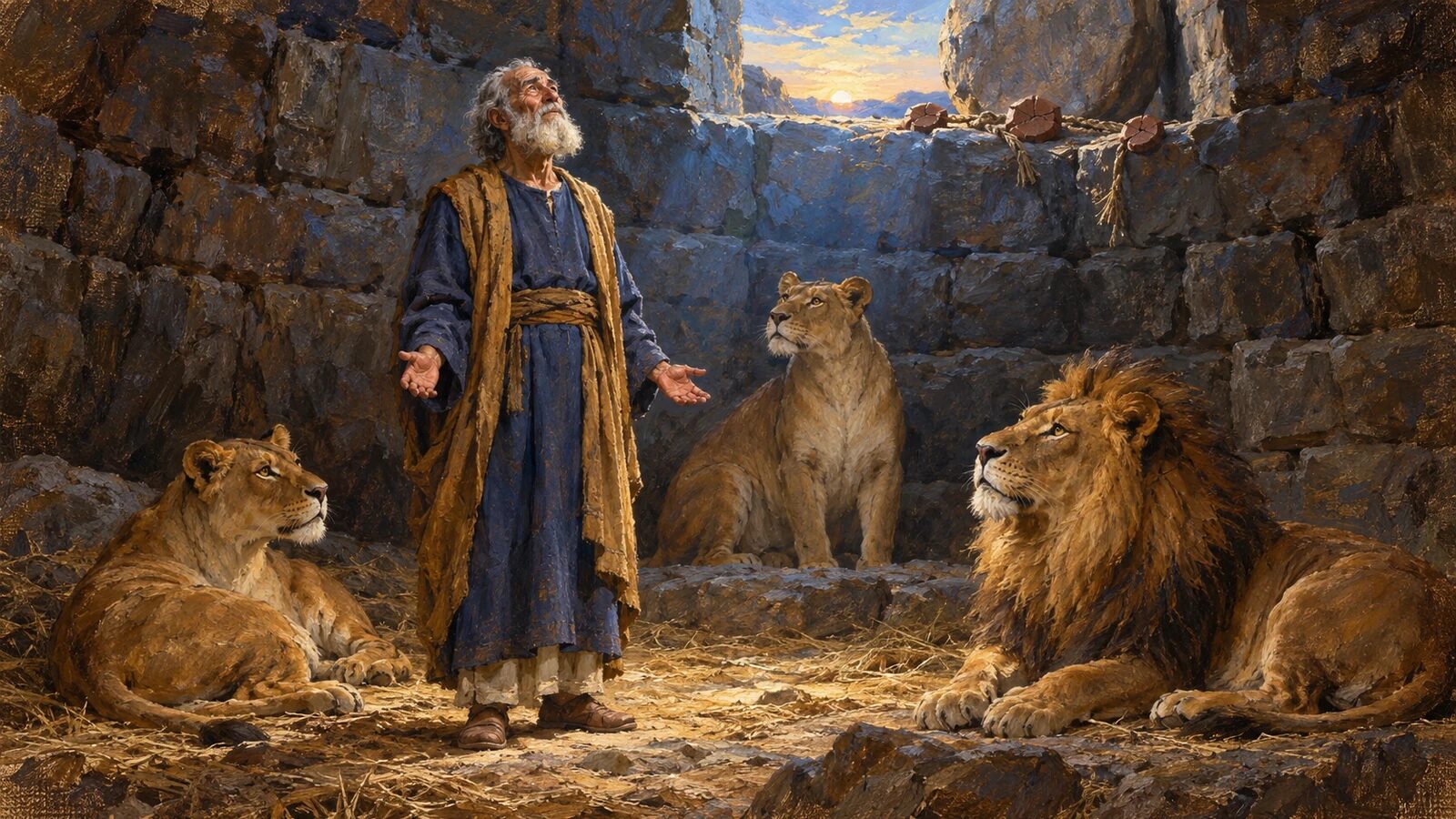
By the time I reach Daniel 6, I am blown away by how long Daniel had been faithful to God before he ever faced the lions. We tend to remember him in the den, but he had already spent decades in exile, serving under rulers who didn’t worship his God. Now another king was in power, and Daniel was still doing his work and praying as he had for years. That prayer would give his enemies the opportunity they had been looking for.
Daniel’s Faith Survived Political Change
Daniel 5 ends with Belshazzar being killed on the night Babylon fell and Darius the Mede receiving the kingdom at about sixty-two years of age. The age given belongs to Darius, not Daniel. Daniel 6 describes Daniel’s service under Darius and closes by mentioning Cyrus the Persian as well.
There is disagreement about the identity of Darius the Mede and how his rule relates to Cyrus. Some scholars understand Darius as a throne name; others suggest he governed under Cyrus or propose another arrangement. I don’t think we have to settle that question to understand what happens here. Daniel tells us that Darius received the kingdom and appointed officials to administer it.
Daniel had been taken from Judah as a young man near the beginning of Babylonian domination. By the fall of Babylon, he had spent roughly six decades in exile and government service, so he was probably an elderly man by this point. Scripture doesn’t give us his birth date, but this was a man who had lived through the rise and fall of rulers and was now serving under another government.
Some rulers had valued Daniel’s wisdom, while others had needed to be reminded of him. God had given him knowledge and prophetic revelation, but that didn’t mean every king would appreciate him or that his position would always be secure. As a young man, he had refused to defile himself in Babylon. Years later, he was still serving God while carrying out his responsibilities under a foreign government.
It pleased Darius to set over the kingdom one hundred and twenty satraps, to be over the whole kingdom; and over these, three governors, of whom Daniel was one, that the satraps might give account to them, so that the king would suffer no loss.
A satrap was a regional official, and these men had to give an account of their work to the three governors above them. Daniel’s position required him to exercise oversight on the king’s behalf. His faithfulness to God included taking that responsibility seriously, even though he was serving a pagan ruler.
If my employer doesn’t share my faith, I still owe him an honest day’s work, even when we disagree about what we believe. Calling myself a Christian doesn’t excuse me from doing what I agreed to do.
Then this Daniel distinguished himself above the governors and satraps, because an excellent spirit was in him; and the king gave thought to setting him over the whole realm.
The king was considering putting Daniel over the whole realm. That would have given him authority above the other governors, and they began looking for a way to bring a charge against him. I think jealousy is a reasonable explanation for their hostility, although Daniel doesn’t explicitly tell us their motive.
This part of Daniel was written in Aramaic. The phrase translated “excellent spirit,” ruach yattirah, describes a surpassing or exceptional spirit. We can see why the description fits when we look at how Daniel handled his responsibilities. Darius trusted him enough to consider giving him greater authority, and even the men trying to discredit him couldn’t find corruption or negligence in his work.
Daniel 1:17 tells us that God gave Daniel and his friends knowledge and skill. Daniel certainly had to apply himself, but I don’t want to treat his ability as though he had accomplished everything on his own. God had equipped him for the work, and he was responsible for how he used what God had given him.
So the governors and satraps sought to find some charge against Daniel concerning the kingdom; but they could find no charge or fault, because he was faithful; nor was there any error or fault found in him. Then these men said, “We shall not find any charge against this Daniel unless we find it against him concerning the law of his God.”
The officials had examined Daniel’s service to the kingdom and come up empty. Even men intent on removing him could not substantiate a charge of wrongdoing, so they decided to use his obedience to God against him.
If I do shoddy work for my employer and get reprimanded for it, that isn’t persecution. That is the repercussion of my own actions. So before we decide someone is attacking us because of our faith, we need to make sure that truly is the reason. Daniel’s accusers couldn’t point to misconduct in his job, which is why they devised a law that would make his prayers punishable.
A Legal Trap Made Prayer the Target
The other officials devised a plan to make a rule that sounded very favorable and reasonable to the king, but they secretly knew it would harm Daniel. They proposed thirty days in which no one could make a petition to any god or man except Darius. Anyone who disobeyed would be thrown into the lions’ den.
They told Darius that all the governors had agreed, but Daniel was one of those governors and the proposal was devised to harm him. I think we can reasonably conclude that they didn’t have his agreement, even though they presented the plan as the recommendation of all the king’s officials.
Now, O king, establish the decree and sign the writing, so that it cannot be changed, according to the law of the Medes and Persians, which does not alter.” Therefore King Darius signed the written decree.
I think the officials were appealing to Darius’s vanity. They were offering him thirty days in which petitions could be made only to him, while concealing their plan against Daniel. The king had signed a binding decree, and the officials would later insist that he could not withdraw it simply because he wanted to spare Daniel. They could now accuse Daniel of breaking the law simply for praying to God.
Daniel had served the government faithfully for years, so his refusal wasn’t out of contempt for authority. He had no problem honoring the authority of government, but when that government tried to usurp the authority of God, Daniel knew who the true King was. Darius’s decree demanded that Daniel stop bringing his petitions to God for thirty days. Obeying it would require him to disobey God, which is why I believe Acts 5:29 applies here: “We ought to obey God rather than men.”
Now when Daniel knew that the writing was signed, he went home. And in his upper room, with his windows open toward Jerusalem, he knelt down on his knees three times that day, and prayed and gave thanks before his God, as was his custom since early days.
Daniel usually prayed three times a day, so after the decree was signed, he had a decision to make: honor the Lord in his personal life as he had always done and risk being killed, or follow the king’s orders and try to protect his position. Even without the lions’ den, refusing the decree could have damaged his career and reputation. His enemies could portray him as disloyal to the king and turn others against him, putting the success and comfort of his life in government at risk. Daniel’s choice shows that prayer was not just something he did; it was daily worship of his God, and no man had the right to forbid it.
Daniel prayed with his windows open toward Jerusalem even though he was still in exile. In 1 Kings 8, Solomon had prayed about Israelites who might one day be taken captive and carried away from their homeland. He asked God to hear them if they returned to Him with all their heart and soul and prayed toward the land He had given them, His chosen city, and the temple.
and when they return to You with all their heart and with all their soul in the land of their enemies who led them away captive, and pray to You toward their land which You gave to their fathers, the city which You have chosen and the temple which I have built for Your name: then hear in heaven Your dwelling place their prayer and their supplication, and maintain their cause.
Although Daniel 6 doesn’t give us his reason for facing Jerusalem, I think the connection with Solomon’s prayer makes sense of the practice. Daniel was an exile praying toward the city God had chosen, and he had not given up on God’s covenant promises to Israel.
The point isn’t that Christians are required to face Jerusalem or follow Daniel’s three-times-a-day schedule, because through Christ we can come directly to the Father wherever we are.
I shouldn’t neglect prayer while life is comfortable and then assume I will be faithful when praying could bring trouble. Prayer doesn’t make us immune to fear, but it is how we bring our concerns to God and depend on Him. The fuller study on prayer considers that dependence and our communion with God.
Daniel also gave thanks while the decree was still in force and his enemies intended to use it against him. I want to be able to thank God while I’m waiting for help, rather than only after I’ve received it. We can acknowledge the evil being done to us and still thank God for His goodness. The study on thanksgiving in the Bible looks further at thanking God in ordinary life and in suffering.
God Shut the Lions’ Mouths
When the officials reported Daniel, Darius was distressed with himself. He spent the rest of the day trying to find a way to deliver him, but the officials kept insisting that the decree could not be changed. By sunset, the king who wanted to save Daniel gave the order to have him thrown into the den.
So the king gave the command, and they brought Daniel and cast him into the den of lions. But the king spoke, saying to Daniel, “Your God, whom you serve continually, He will deliver you.”
Since the king’s decrees were binding and could not be undone simply because the king liked Daniel, Darius’s hands were tied. Daniel couldn’t rely on the king or himself to save him. He needed to rely fully on God.
The Aramaic word gob, translated “den,” refers to a pit or enclosure. A stone was placed over the entrance, and Darius and his lords sealed it so that no one could change Daniel’s situation. Darius could spend the night regretting his decision, but Daniel was still shut inside with the lions.
Darius spent the night fasting and couldn’t sleep. I can understand his anguish, even though his own decision had put Daniel there. He had signed the decree without recognizing what the officials intended to do with it. By the time he understood, his efforts to undo the harm had failed.
At dawn, Darius hurried to the den and called to Daniel in a lamenting voice. He asked whether the God Daniel served continually had been able to deliver him from the lions. Daniel was alive, and he answered the king.
My God sent His angel and shut the lions’ mouths, so that they have not hurt me, because I was found innocent before Him; and also, O king, I have done no wrong before you.” Now the king was exceedingly glad for him, and commanded that they should take Daniel up out of the den. So Daniel was taken up out of the den, and no injury whatever was found on him, because he believed in his God.
Daniel could tell Darius that he had done him no wrong. He had served the king faithfully, and refusing to stop praying hadn’t made him a disloyal servant. When Daniel said he was found innocent before God, he was answering the charge against him. He wasn’t claiming that he had never sinned. The decree had made his prayers a crime under the king’s law, but praying to God was no offense against God.
Daniel says that God sent His angel, but the passage doesn’t identify this messenger as the Angel of the LORD. I understand the Angel of the LORD to be the preincarnate Christ, meaning Christ appearing before He came in the flesh. Such an appearance is called a Christophany. Here, though, I don’t think the passage gives us enough information to know who the messenger was. God sent him to deliver Daniel, and Daniel gives God the credit for his rescue.
who through faith subdued kingdoms, worked righteousness, obtained promises, stopped the mouths of lions.
Paul includes the stopping of lions’ mouths among the examples of faith in Hebrews 11, but he goes on to describe believers who were tortured and killed. God delivered Daniel from death in the den, while those other believers were not spared and were still commended for their faith.
I think it is grossly inaccurate and reckless to tell someone they are suffering hardship because they have a lack of faith. Scripture repeatedly tells us of people who were tortured and killed, yet they had extraordinary faith. When a fellow believer is going through a tough season, let’s not assume it is their own fault or blame it on a lack of faith.
We can ask God to rescue us, and we should believe that He is able to do it. What we can’t do is promise someone that obedience will always keep him from suffering. The companion study on Shadrach, Meshach, and Abednego considers the same issue when those men faced the furnace. They knew God could deliver them, and they were determined to obey Him even if He didn’t.
Rescue Became a Public Witness
After Daniel was brought out unharmed, Darius ordered his accusers to be thrown into the den. Daniel 6:24 records that their wives and children were thrown in with them. That is a terrible consequence for the families, and I don’t think we should pass over it simply because we are relieved that Daniel survived.
The account records what Darius did. It doesn’t give us permission to punish someone’s family for his wrongdoing or to approve every action a ruler takes. These men had plotted against Daniel, but that doesn’t make their children guilty of devising the plot. We can recognize that Daniel was vindicated without treating everything Darius did afterward as an example to follow.
When someone has been harmed, seeking justice may require reporting what happened and giving truthful evidence so that others can be protected. That is different from trying to make people suffer because we are angry. We are accountable for how we treat even those who have wronged us, and final judgment belongs to God.
Darius then sent a decree throughout his kingdom, telling the people to fear Daniel’s God. Only a short time earlier, he had signed a law restricting petitions to himself. Now he was publicly acknowledging the living God and a kingdom that would never be destroyed.
I make a decree that in every dominion of my kingdom men must tremble and fear before the God of Daniel. For He is the living God, And steadfast forever; His kingdom is the one which shall not be destroyed, And His dominion shall endure to the end. He delivers and rescues, And He works signs and wonders In heaven and on earth, Who has delivered Daniel from the power of the lions.
I don’t think this statement gives us enough to determine whether Darius personally came to saving faith. What he said about God was true, and he ordered that testimony to be circulated among the peoples of his kingdom. Daniel’s enemies had tried to use his worship to destroy him. After his deliverance, people across a Gentile empire were being told that Daniel’s God was the living God and that His rule would endure long after Darius’s own reign.
Christ Gives the Greater Deliverance
Daniel 6:23 says that no injury was found on him because he believed in his God. Daniel had trusted God when the king couldn’t help him, and God had sent His angel to preserve his life. I want to admire Daniel without overlooking the God who delivered him.
As remarkable as this rescue was, Daniel still needed the salvation that God provides through Christ. He was a faithful man, but he was also a sinner who needed mercy. Being spared the lions didn’t remove that need, any more than being delivered from danger removes our need to be forgiven.
Jesus Christ, the eternal Son, is fully God and fully man. He was falsely accused and condemned even though He was completely innocent. His enemies handed Him over to death, but He willingly gave Himself to be slain as the sinless, perfect sacrifice for our sins. He shed His blood and died, was buried, and then rose bodily from the dead.
Daniel wasn’t bearing anyone’s sins in the den. Christ completed His saving work through His shed blood and death before His burial and bodily resurrection. When I speak of His atonement, I am talking about that saving work through which He deals with our sin and brings us back to God. We need more than the courage to endure hardship; we need the forgiveness that only Christ can provide.
The Father did not punish, curse, abandon, strike, bruise, or pour wrath on Jesus; Father and Son acted in unity. Wicked people tortured and killed Him, and He willingly endured that suffering for our sins. He died for the sins of the whole world, so God’s offer of salvation is genuine for every person. People can resist His grace and reject the Savior, but everyone who repents and believes in Jesus is forgiven and born again.
When I use the word regeneration, I mean that someone has genuinely been born again, not merely called himself a Christian. His actions should give evidence that he is a new creation, although that does not mean he has become sinless. His obedience is the result of new life; it does not earn salvation or keep him saved.
The Holy Spirit lives in the person who is genuinely saved and seals him, and God keeps him eternally secure in Christ. That assurance gives us no excuse to carry on in lawlessness. If I claim to belong to Christ, that should affect how I treat the people I work for and whether I make time to pray. It should also affect what I do when obedience to God threatens the comfortable life I would like to keep.
My Final Thoughts
I can understand wanting to protect a job or a good reputation. I don’t think Daniel’s decision was trivial just because we already know how the account ends. He kept praying before he knew that he would come out of the den alive. I want to be faithful to God in the life I have now, and I need His help when obedience could cost me something. I can ask Him for deliverance without demanding a particular outcome. Whatever happens, the forgiveness and eternal life I have in Christ give me reason to keep trusting Him.